About the Report
Base Year 2024United States Natural Gas Market Overview
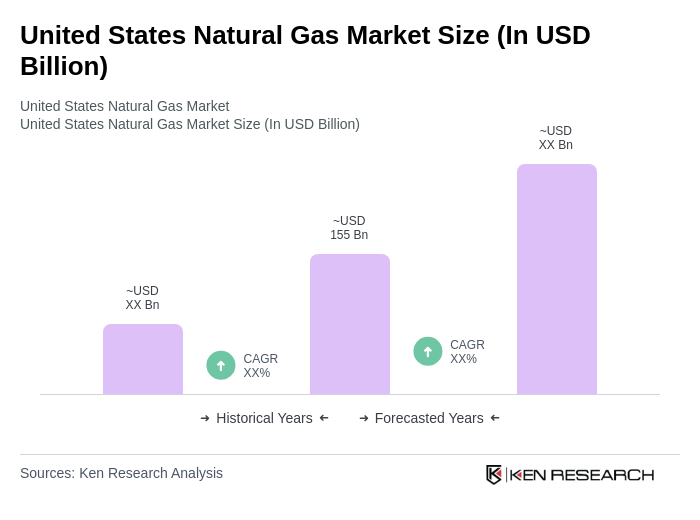
- The United States Natural Gas Market is valued at USD 155 billion, based on a five-year historical analysis. This value reflects the robust expansion of natural gas production and consumption, with the market supported by strong domestic demand, increased LNG export capacity, and the ongoing transition to lower-emission energy sources . Growth is primarily driven by the increasing demand for cleaner energy sources, advancements in extraction technologies such as hydraulic fracturing and horizontal drilling, and the expansion of natural gas infrastructure across the country. The market has seen a significant rise in production and consumption, particularly in the industrial and power generation sectors .
- Key producing regions include Texas, Pennsylvania, and Louisiana, which dominate due to their rich natural gas reserves and established extraction and distribution networks. Texas benefits from its extensive shale formations, notably the Permian Basin, while Pennsylvania's Marcellus Shale has become a significant contributor to the national supply. Louisiana remains a critical hub for LNG exports and pipeline infrastructure, making these regions central to overall market dynamics .
- In 2023, the U.S. government implemented the Inflation Reduction Act, which includes provisions to promote the use of natural gas as a transitional fuel towards renewable energy. While the act primarily targets renewable energy, it also incentivizes investments in natural gas infrastructure and technology to ensure grid reliability and support the energy transition, thereby supporting market growth and ensuring a stable energy supply during the shift to greener alternatives .
United States Natural Gas Market Segmentation
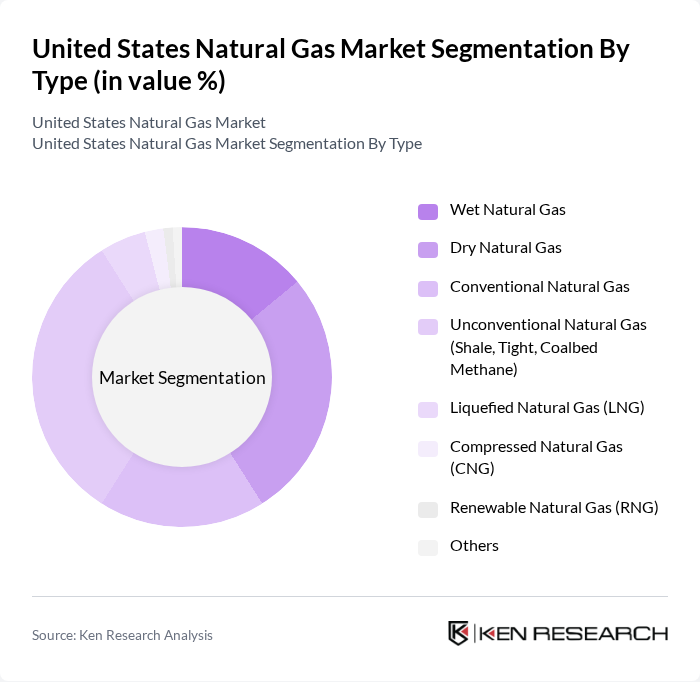
By Type:The market is segmented into Wet Natural Gas, Dry Natural Gas, Conventional Natural Gas, Unconventional Natural Gas (Shale, Tight, Coalbed Methane), Liquefied Natural Gas (LNG), Compressed Natural Gas (CNG), Renewable Natural Gas (RNG), and Others. Wet and dry natural gas refer to the presence or absence of natural gas liquids, while conventional and unconventional sources reflect the extraction method and geological formation. Unconventional sources, particularly shale gas, have driven recent production growth. LNG and CNG are primarily used for storage, transport, and export, while RNG represents a small but growing segment focused on sustainability .
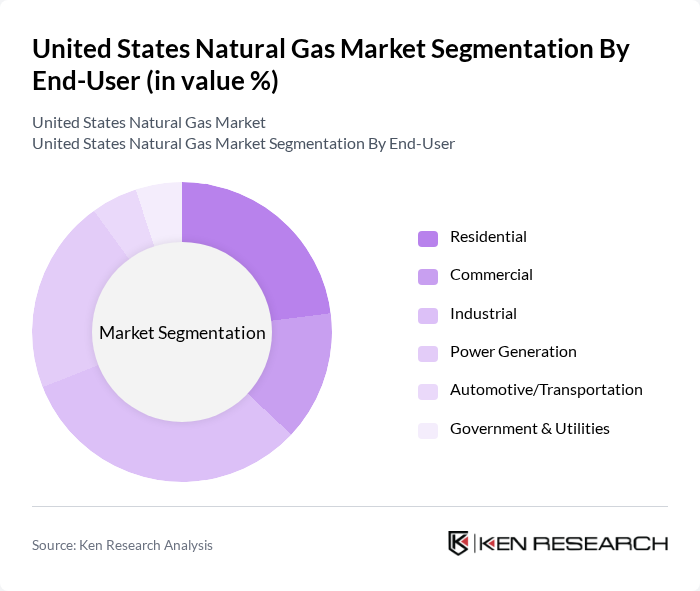
By End-User:The market is segmented by end-users, including Residential, Commercial, Industrial, Power Generation, Automotive/Transportation, and Government & Utilities. The industrial and power generation sectors account for the largest share of consumption, driven by the need for reliable, lower-carbon energy. Residential and commercial segments primarily use natural gas for heating and cooking, while the transportation sector utilizes CNG and LNG for fleet and heavy-duty vehicles. Utilities and government entities focus on grid stability and public infrastructure .
United States Natural Gas Market Competitive Landscape
The United States Natural Gas Market is characterized by a dynamic mix of regional and international players. Leading participants such as ExxonMobil Corporation, Chevron Corporation, ConocoPhillips, Kinder Morgan, Inc., Dominion Energy, Inc., Williams Companies, Inc., EnLink Midstream, LLC, EQT Corporation, Antero Resources Corporation, Coterra Energy Inc., Range Resources Corporation, Chesapeake Energy Corporation, Southwestern Energy Company, ONEOK, Inc., NiSource Inc. contribute to innovation, geographic expansion, and service delivery in this space.
United States Natural Gas Market Industry Analysis
Growth Drivers
- Increasing Demand for Clean Energy:The U.S. natural gas consumption reached approximately33 trillion cubic feet (Tcf)in future, driven by a shift towards cleaner energy sources. The Energy Information Administration (EIA) indicates that natural gas accounts for about41%of the electricity generation mix, reflecting a growing preference for lower carbon emissions compared to coal. This trend is supported by the U.S. government's goal to reduce greenhouse gas emissions by 50% in future, further boosting natural gas demand.
- Technological Advancements in Extraction:Innovations in hydraulic fracturing and horizontal drilling have significantly increased U.S. natural gas production, which reachedapproximately 103 billion cubic feet per day (Bcf/d)in future. The U.S. Geological Survey estimates that the Marcellus Shale holds about97 trillion cubic feet (Tcf)of recoverable natural gas. These advancements not only enhance extraction efficiency but also reduce operational costs, making natural gas a more attractive energy source for utilities and industries alike, thereby driving market growth.
- Infrastructure Development and Expansion:The U.S. has invested overUSD 100 billionin natural gas infrastructure over the past decade, including pipelines and storage facilities. The Federal Energy Regulatory Commission (FERC) reported that approximately1,000 milesof new pipelines were constructed in future. This expansion facilitates better distribution and access to natural gas, supporting increased consumption across various sectors, including residential heating and industrial applications, thus propelling market growth.
Market Challenges
- Environmental Regulations:The natural gas industry faces stringent environmental regulations, particularly concerning methane emissions. The Environmental Protection Agency (EPA) has proposed regulations that could impose costs exceedingUSD 1 billion annuallyon the industry in future. Compliance with these regulations may lead to increased operational costs and could hinder production capabilities, posing a significant challenge to market growth and profitability.
- Price Volatility:Natural gas prices have experienced significant fluctuations, with the Henry Hub spot price averagingUSD 2.54 per million British thermal units (MMBtu)in future. Factors such as weather patterns, geopolitical tensions, and supply-demand imbalances contribute to this volatility. Such unpredictability can deter investment and complicate long-term planning for companies in the natural gas sector, presenting a challenge to market stability.
United States Natural Gas Market Future Outlook
The U.S. natural gas market is poised for continued evolution, driven by the increasing integration of renewable energy sources and advancements in extraction technologies. As the demand for cleaner energy rises, natural gas is expected to play a pivotal role in the transition towards a more sustainable energy landscape. Additionally, ongoing investments in infrastructure and regulatory frameworks will likely shape the market dynamics, fostering innovation and enhancing operational efficiencies in the coming years.
Market Opportunities
- Export Potential to Global Markets:The U.S. is positioned to become a leading exporter of liquefied natural gas (LNG), with export capacity projected to reachapproximately 14 billion cubic feet per day (Bcf/d)in future. This growth is driven by increasing global demand for cleaner energy sources, particularly in Asia and Europe, where countries are seeking alternatives to coal and oil, presenting significant market opportunities for U.S. producers.
- Innovations in LNG Technology:Advances in LNG technology, such as floating LNG facilities, are expected to enhance the efficiency and cost-effectiveness of natural gas liquefaction. The U.S. Department of Energy has allocatedUSD 50 millionfor research and development in this area, which could lead to breakthroughs that lower production costs and expand market access, creating new opportunities for growth in the natural gas sector.
Scope of the Report
| Segment | Sub-Segments |
|---|---|
| By Type | Wet Natural Gas Dry Natural Gas Conventional Natural Gas Unconventional Natural Gas (Shale, Tight, Coalbed Methane) Liquefied Natural Gas (LNG) Compressed Natural Gas (CNG) Renewable Natural Gas (RNG) Others |
| By End-User | Residential Commercial Industrial Power Generation Automotive/Transportation Government & Utilities |
| By Application | Power Generation Heating Transportation Feedstock for Chemicals |
| By Distribution Mode | Pipelines Trucking Rail Marine |
| By Pricing Strategy | Fixed Pricing Variable Pricing Contractual Pricing |
| By Investment Source | Domestic Investment Foreign Direct Investment (FDI) Public-Private Partnerships (PPP) |
| By Policy Support | Subsidies Tax Exemptions Renewable Energy Credits (RECs) |
Key Target Audience
Investors and Venture Capitalist Firms
Government and Regulatory Bodies (e.g., Federal Energy Regulatory Commission, Department of Energy)
Natural Gas Producers and Exploration Companies
Pipeline Operators and Infrastructure Developers
Energy Trading Firms
Environmental Advocacy Groups
Utility Companies
Energy Policy Makers
Players Mentioned in the Report:
ExxonMobil Corporation
Chevron Corporation
ConocoPhillips
Kinder Morgan, Inc.
Dominion Energy, Inc.
Williams Companies, Inc.
EnLink Midstream, LLC
EQT Corporation
Antero Resources Corporation
Coterra Energy Inc.
Range Resources Corporation
Chesapeake Energy Corporation
Southwestern Energy Company
ONEOK, Inc.
NiSource Inc.
Table of Contents
Market Assessment Phase
1. Executive Summary and Approach
2. United States Natural Gas Market Overview
2.1 Key Insights and Strategic Recommendations
2.2 United States Natural Gas Market Overview
2.3 Definition and Scope
2.4 Evolution of Market Ecosystem
2.5 Timeline of Key Regulatory Milestones
2.6 Value Chain & Stakeholder Mapping
2.7 Business Cycle Analysis
2.8 Policy & Incentive Landscape
3. United States Natural Gas Market Analysis
3.1 Growth Drivers
3.1.1 Increasing Demand for Clean Energy
3.1.2 Technological Advancements in Extraction
3.1.3 Infrastructure Development and Expansion
3.1.4 Government Support and Incentives
3.2 Market Challenges
3.2.1 Environmental Regulations
3.2.2 Price Volatility
3.2.3 Competition from Renewable Energy Sources
3.2.4 Aging Infrastructure
3.3 Market Opportunities
3.3.1 Export Potential to Global Markets
3.3.2 Innovations in LNG Technology
3.3.3 Strategic Partnerships and Collaborations
3.3.4 Increased Investment in Infrastructure
3.4 Market Trends
3.4.1 Shift Towards Renewable Natural Gas
3.4.2 Digital Transformation in Operations
3.4.3 Focus on Sustainability and Carbon Neutrality
3.4.4 Rising Consumer Awareness and Demand
3.5 Government Regulation
3.5.1 Clean Air Act Compliance
3.5.2 FERC Regulations
3.5.3 State-Level Renewable Portfolio Standards
3.5.4 Pipeline Safety Regulations
4. SWOT Analysis
5. Stakeholder Analysis
6. Porter's Five Forces Analysis
7. United States Natural Gas Market Market Size, 2019-2024
7.1 By Value
7.2 By Volume
7.3 By Average Selling Price
8. United States Natural Gas Market Segmentation
8.1 By Type
8.1.1 Wet Natural Gas
8.1.2 Dry Natural Gas
8.1.3 Conventional Natural Gas
8.1.4 Unconventional Natural Gas (Shale, Tight, Coalbed Methane)
8.1.5 Liquefied Natural Gas (LNG)
8.1.6 Compressed Natural Gas (CNG)
8.1.7 Renewable Natural Gas (RNG)
8.1.8 Others
8.2 By End-User
8.2.1 Residential
8.2.2 Commercial
8.2.3 Industrial
8.2.4 Power Generation
8.2.5 Automotive/Transportation
8.2.6 Government & Utilities
8.3 By Application
8.3.1 Power Generation
8.3.2 Heating
8.3.3 Transportation
8.3.4 Feedstock for Chemicals
8.4 By Distribution Mode
8.4.1 Pipelines
8.4.2 Trucking
8.4.3 Rail
8.4.4 Marine
8.5 By Pricing Strategy
8.5.1 Fixed Pricing
8.5.2 Variable Pricing
8.5.3 Contractual Pricing
8.6 By Investment Source
8.6.1 Domestic Investment
8.6.2 Foreign Direct Investment (FDI)
8.6.3 Public-Private Partnerships (PPP)
8.7 By Policy Support
8.7.1 Subsidies
8.7.2 Tax Exemptions
8.7.3 Renewable Energy Credits (RECs)
9. United States Natural Gas Market Competitive Analysis
9.1 Market Share of Key Players
9.2 KPIs for Cross Comparison of Key Players
9.2.1 Company Name
9.2.2 Group Size (Large, Medium, or Small as per industry convention)
9.2.3 Revenue Growth Rate
9.2.4 Market Share (%)
9.2.5 Production Volume (Bcf/d)
9.2.6 Reserve Replacement Ratio
9.2.7 EBITDA Margin (%)
9.2.8 Net Income Margin (%)
9.2.9 Capital Expenditure (CapEx)
9.2.10 Return on Investment (ROI)
9.2.11 Debt-to-Equity Ratio
9.2.12 Pipeline Mileage/Infrastructure Assets
9.2.13 LNG Export Capacity
9.2.14 Safety & Environmental Compliance Record
9.2.15 Customer Retention Rate
9.3 SWOT Analysis of Top Players
9.4 Pricing Analysis
9.5 List of Major Companies
9.5.1 ExxonMobil Corporation
9.5.2 Chevron Corporation
9.5.3 ConocoPhillips
9.5.4 Kinder Morgan, Inc.
9.5.5 Dominion Energy, Inc.
9.5.6 Williams Companies, Inc.
9.5.7 EnLink Midstream, LLC
9.5.8 EQT Corporation
9.5.9 Antero Resources Corporation
9.5.10 Coterra Energy Inc.
9.5.11 Range Resources Corporation
9.5.12 Chesapeake Energy Corporation
9.5.13 Southwestern Energy Company
9.5.14 ONEOK, Inc.
9.5.15 NiSource Inc.
10. United States Natural Gas Market End-User Analysis
10.1 Procurement Behavior of Key Ministries
10.1.1 Federal Energy Management Program
10.1.2 Department of Energy Procurement Strategies
10.1.3 State Energy Office Initiatives
10.2 Corporate Spend on Infrastructure & Energy
10.2.1 Investment in Natural Gas Infrastructure
10.2.2 Corporate Sustainability Initiatives
10.2.3 Energy Efficiency Programs
10.3 Pain Point Analysis by End-User Category
10.3.1 Cost Management for Residential Users
10.3.2 Supply Reliability for Industrial Users
10.3.3 Regulatory Compliance for Utilities
10.4 User Readiness for Adoption
10.4.1 Awareness of Natural Gas Benefits
10.4.2 Infrastructure Availability
10.4.3 Financial Incentives
10.5 Post-Deployment ROI and Use Case Expansion
10.5.1 Measurement of Energy Savings
10.5.2 Expansion into New Applications
10.5.3 Long-term Contracts and Pricing Stability
11. United States Natural Gas Market Future Size, 2025-2030
11.1 By Value
11.2 By Volume
11.3 By Average Selling Price
Go-To-Market Strategy Phase
1. Whitespace Analysis + Business Model Canvas
1.1 Market Gaps Identification
1.2 Business Model Framework
2. Marketing and Positioning Recommendations
2.1 Branding Strategies
2.2 Product USPs
3. Distribution Plan
3.1 Urban Retail Strategies
3.2 Rural NGO Tie-ups
4. Channel & Pricing Gaps
4.1 Underserved Routes
4.2 Pricing Bands Analysis
5. Unmet Demand & Latent Needs
5.1 Category Gaps
5.2 Consumer Segments
6. Customer Relationship
6.1 Loyalty Programs
6.2 After-sales Service
7. Value Proposition
7.1 Sustainability Initiatives
7.2 Integrated Supply Chains
8. Key Activities
8.1 Regulatory Compliance
8.2 Branding Efforts
8.3 Distribution Setup
9. Entry Strategy Evaluation
9.1 Domestic Market Entry Strategy
9.1.1 Product Mix Considerations
9.1.2 Pricing Band Strategy
9.1.3 Packaging Options
9.2 Export Entry Strategy
9.2.1 Target Countries
9.2.2 Compliance Roadmap
10. Entry Mode Assessment
10.1 Joint Ventures
10.2 Greenfield Investments
10.3 Mergers & Acquisitions
10.4 Distributor Model
11. Capital and Timeline Estimation
11.1 Capital Requirements
11.2 Timelines for Implementation
12. Control vs Risk Trade-Off
12.1 Ownership Considerations
12.2 Partnerships Evaluation
13. Profitability Outlook
13.1 Breakeven Analysis
13.2 Long-term Sustainability
14. Potential Partner List
14.1 Distributors
14.2 Joint Ventures
14.3 Acquisition Targets
15. Execution Roadmap
15.1 Phased Plan for Market Entry
15.1.1 Market Setup
15.1.2 Market Entry
15.1.3 Growth Acceleration
15.1.4 Scale & Stabilize
15.2 Key Activities and Milestones
15.2.1 Milestone Planning
15.2.2 Activity Tracking
Research Methodology
Phase 1: Approach1
Desk Research
- Analysis of historical natural gas consumption data from the U.S. Energy Information Administration (EIA)
- Review of market reports and publications from the American Gas Association (AGA) and other industry bodies
- Examination of regulatory frameworks and policy documents from the Federal Energy Regulatory Commission (FERC)
Primary Research
- Interviews with executives from major natural gas producers and distributors
- Surveys targeting energy analysts and market researchers specializing in the natural gas sector
- Field interviews with utility company representatives and energy policy experts
Validation & Triangulation
- Cross-validation of findings through comparison with international natural gas market trends
- Triangulation of data from government reports, industry publications, and expert interviews
- Sanity checks conducted through expert panel reviews and feedback sessions
Phase 2: Market Size Estimation1
Top-down Assessment
- Estimation of total natural gas demand based on macroeconomic indicators and energy consumption patterns
- Segmentation of the market by end-use applications, including residential, commercial, industrial, and power generation
- Incorporation of state-level regulations and incentives affecting natural gas usage
Bottom-up Modeling
- Collection of production and consumption data from leading natural gas companies
- Operational cost analysis based on transportation, storage, and distribution expenses
- Volume x price modeling to estimate revenue generation across different market segments
Forecasting & Scenario Analysis
- Multi-variable regression analysis incorporating factors such as economic growth, energy prices, and technological advancements
- Scenario modeling based on potential regulatory changes and shifts in consumer preferences towards renewable energy
- Development of baseline, optimistic, and pessimistic forecasts through 2030
Phase 3: CATI Sample Composition1
| Scope Item/Segment | Sample Size | Target Respondent Profiles |
|---|---|---|
| Residential Natural Gas Usage | 100 | Homeowners, Property Managers |
| Commercial Natural Gas Consumption | 60 | Facility Managers, Energy Procurement Managers |
| Industrial Natural Gas Applications | 50 | Plant Managers, Operations Managers |
| Natural Gas Power Generation | 40 | Energy Analysts, Utility Managers |
| Natural Gas Policy and Regulation Insights | 40 | Regulatory Affairs Specialists, Policy Advisors |
Frequently Asked Questions
What is the current value of the United States Natural Gas Market?
The United States Natural Gas Market is valued at approximately USD 155 billion, reflecting significant growth in production and consumption driven by strong domestic demand and advancements in extraction technologies.
Which regions are the key producers of natural gas in the U.S.?
How has the Inflation Reduction Act impacted the natural gas market?
What are the main types of natural gas in the U.S. market?
Other Regional/Country Reports
Why Buy From Us?

What makes us stand out is that our consultants follow Robust, Refine and Result (RRR) methodology. Robust for clear definitions, approaches and sanity checking, Refine for differentiating respondents' facts and opinions, and Result for presenting data with story.

We have set a benchmark in the industry by offering our clients with syndicated and customized market research reports featuring coverage of entire market as well as meticulous research and analyst insights.

While we don't replace traditional research, we flip the method upside down. Our dual approach of Top Bottom & Bottom Top ensures quality deliverable by not just verifying company fundamentals but also looking at the sector and macroeconomic factors.

With one step in the future, our research team constantly tries to show you the bigger picture. We help with some of the tough questions you may encounter along the way: How is the industry positioned? Best marketing channel? KPI's of competitors? By aligning every element, we help maximize success.

Our report gives you instant access to the answers and sources that other companies might choose to hide. We elaborate each steps of research methodology we have used and showcase you the sample size to earn your trust.

If you need any support, we are here! We pride ourselves on universe strength, data quality, and quick, friendly, and professional service.