About the Report
Base Year 2024Germany Circular Economy & Recycling Tech Market Overview
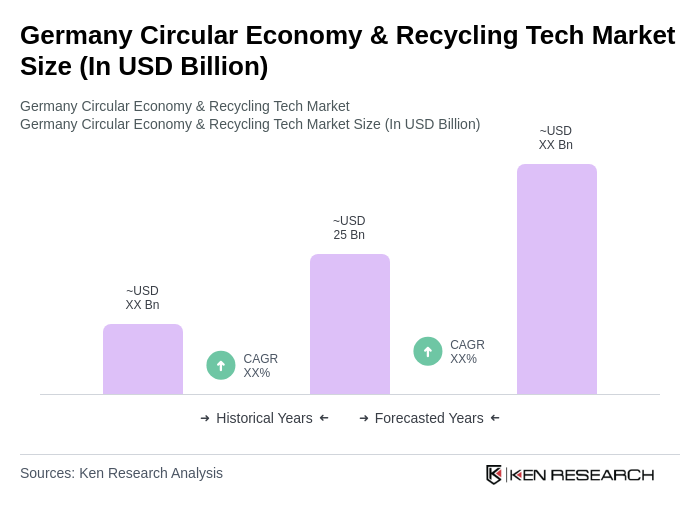
- The Germany Circular Economy & Recycling Tech Market is valued at USD 25 billion, based on a five-year historical analysis. This growth is primarily driven by tightening regulatory frameworks, heightened consumer and corporate focus on sustainability, and rapid advancements in recycling and resource recovery technologies. The market is further supported by robust investments in waste management infrastructure, digitalization of waste tracking, and the expansion of innovative recycling solutions, which are critical for achieving national and EU circular economy targets .
- Key players in this market are concentrated in major urban centers such as Berlin, Hamburg, and Munich. These cities dominate due to their advanced industrial clusters, high population densities, and progressive environmental policies. The presence of leading recycling firms, technology providers, and research institutions in these areas further strengthens their role as hubs for innovation and best practices in circular economy implementation .
- The National Circular Economy Strategy (NCES), adopted by the German Federal Cabinet in December 2024, establishes a binding framework for the transition to a comprehensive circular economy. The NCES mandates increased use of secondary raw materials, sets targets for waste reduction, and requires companies to adapt product design and production processes to facilitate reuse and recycling. The NCES is administered by the Federal Ministry for the Environment, Nature Conservation, Nuclear Safety and Consumer Protection (BMUV), and includes compliance monitoring, public funding, and sector-specific roadmaps .
Germany Circular Economy & Recycling Tech Market Segmentation
By Type:The market is segmented into various types, including Waste-to-Energy, Material Recovery Facilities, Composting Solutions, Recycling Equipment, Circular Supply Chain Solutions, and Others. Each of these segments plays a crucial role in the overall recycling ecosystem, addressing different aspects of waste management and resource recovery .
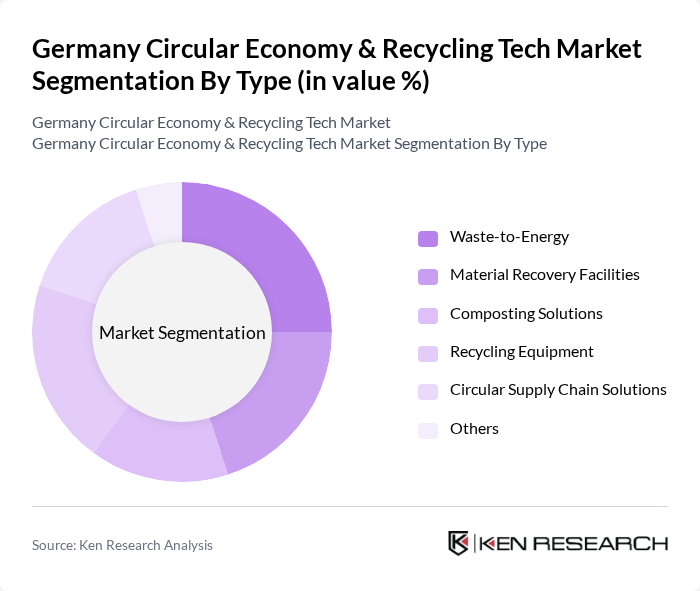
The Waste-to-Energy segment is currently leading the market due to its dual role in waste management and renewable energy generation. This segment is gaining momentum as municipalities and industry seek sustainable solutions to manage rising waste volumes, comply with landfill reduction targets, and contribute to energy transition goals. The integration of digital monitoring and emissions reduction technologies further drives adoption of Waste-to-Energy solutions .
By End-User:The market is segmented by end-users, including Residential, Commercial, Industrial, and Government & Utilities. Each segment has unique requirements and contributes differently to the overall recycling ecosystem .
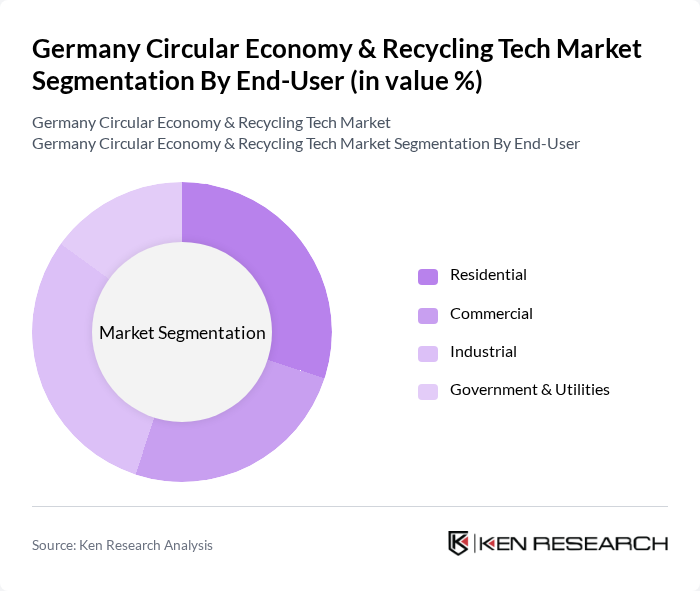
The Residential segment is the largest contributor to the market, driven by widespread adoption of recycling practices, mandatory municipal waste separation, and strong public engagement in sustainability initiatives. Local government programs, digital recycling platforms, and increased accessibility of collection services have further accelerated household participation in recycling and composting .
Germany Circular Economy & Recycling Tech Market Competitive Landscape
The Germany Circular Economy & Recycling Tech Market is characterized by a dynamic mix of regional and international players. Leading participants such as Veolia Umweltservice GmbH, ALBA Group plc & Co. KG, Remondis SE & Co. KG, SUEZ Recycling and Recovery Deutschland GmbH, BSR (Berliner Stadtreinigungsbetriebe), Interseroh Dienstleistungs GmbH, RWE AG, TOMRA Systems ASA, DSD – Duales System Deutschland GmbH, Ecoloop GmbH, GreenCycle GmbH, Recup GmbH, TerraCycle Germany GmbH, KIKKM International, and Bartenbach Werbemittel GmbH & Co. KG contribute to innovation, geographic expansion, and service delivery in this space.
Germany Circular Economy & Recycling Tech Market Industry Analysis
Growth Drivers
- Increasing Environmental Awareness:The German population's environmental consciousness has surged, with 80% of citizens prioritizing sustainability in their purchasing decisions. This shift is reflected in the report from the Federal Environment Agency, which indicates that 70% of consumers are willing to pay more for eco-friendly products. This growing demand drives companies to adopt circular economy practices, enhancing recycling technologies and sustainable product offerings, ultimately fostering market growth.
- Government Regulations and Policies:Germany's stringent environmental regulations, including the Packaging Act, mandate that companies reduce packaging waste by 20% in future. The government allocated €1.5 billion in future to support recycling initiatives and infrastructure development. These policies not only encourage businesses to innovate in recycling technologies but also create a favorable environment for investments in sustainable practices, propelling the circular economy forward.
- Technological Advancements in Recycling:The recycling sector in Germany is experiencing rapid technological advancements, with investments in AI and automation projected to reach €500 million in future. These innovations enhance sorting efficiency and material recovery rates, with some facilities achieving up to 95% recovery of recyclable materials. As technology improves, the cost-effectiveness of recycling operations increases, driving further adoption of circular economy principles across industries.
Market Challenges
- High Initial Investment Costs:The transition to circular economy practices often requires significant upfront investments, with estimates suggesting that companies may need to invest between €1 million to €5 million in new recycling technologies and infrastructure. This financial burden can deter smaller businesses from adopting sustainable practices, limiting overall market growth and innovation in the recycling sector, particularly in the None region.
- Fragmented Market Structure:The German recycling market is characterized by a fragmented structure, with over 1,000 small to medium-sized enterprises operating in various niches. This fragmentation complicates collaboration and standardization efforts, leading to inefficiencies. According to the German Waste Management Association, this lack of cohesion results in an estimated 30% loss in potential recycling efficiency, hindering the overall effectiveness of the circular economy initiatives.
Germany Circular Economy & Recycling Tech Market Future Outlook
The future of the Germany Circular Economy and Recycling Tech market appears promising, driven by increasing consumer demand for sustainable products and robust government support. As technological advancements continue to evolve, the integration of smart recycling solutions and AI will enhance operational efficiencies. Furthermore, the growing emphasis on zero waste initiatives will likely lead to innovative business models, fostering collaboration among stakeholders and creating a more cohesive market environment that supports sustainability goals.
Market Opportunities
- Expansion of Circular Business Models:Companies are increasingly adopting circular business models, which can reduce costs by up to 30% through resource efficiency. This shift presents opportunities for businesses to innovate in product design and lifecycle management, ultimately enhancing their competitive edge in the market while contributing to sustainability goals.
- Collaboration with Technology Providers:Partnerships with technology providers can facilitate the development of advanced recycling solutions. By leveraging expertise in AI and automation, companies can improve material recovery rates and operational efficiencies, potentially increasing profitability by 15% in the long term, thus driving growth in the circular economy sector.
Scope of the Report
| Segment | Sub-Segments |
|---|---|
| By Type | Waste-to-Energy Material Recovery Facilities Composting Solutions Recycling Equipment Circular Supply Chain Solutions Others |
| By End-User | Residential Commercial Industrial Government & Utilities |
| By Application | Construction Waste Management Electronic Waste Recycling Plastic Waste Management Organic Waste Recycling Others |
| By Investment Source | Domestic Investment Foreign Direct Investment (FDI) Public-Private Partnerships (PPP) Government Schemes |
| By Policy Support | Subsidies Tax Exemptions Recycling Credits (RECs) Others |
| By Distribution Channel | Direct Sales Online Platforms Distributors Retail Outlets |
| By Technology | Mechanical Recycling Chemical Recycling Biological Recycling Others |
Key Target Audience
Investors and Venture Capitalist Firms
Government and Regulatory Bodies (e.g., Federal Ministry for the Environment, Nature Conservation and Nuclear Safety)
Manufacturers and Producers
Waste Management Companies
Recycling Technology Developers
Environmental NGOs and Advocacy Groups
Industry Associations (e.g., German Association for Waste Management and Resource Recovery)
Financial Institutions and Banks
Players Mentioned in the Report:
Veolia Umweltservice GmbH
ALBA Group plc & Co. KG
Remondis SE & Co. KG
SUEZ Recycling and Recovery Deutschland GmbH
BSR (Berliner Stadtreinigungsbetriebe)
Interseroh Dienstleistungs GmbH
RWE AG
TOMRA Systems ASA
DSD Duales System Deutschland GmbH
Ecoloop GmbH
GreenCycle GmbH
Recup GmbH
TerraCycle Germany GmbH
ARA (Altstoff Recycling Austria AG) Note: Austrian, not German; consider replacing with a German player such as KIKKM International or BOOMEX GmbH for textile recycling, or Bartenbach Werbemittel GmbH & Co. KG for broader circular economy solutions
KREIS GmbH
Table of Contents
Market Assessment Phase
1. Executive Summary and Approach
2. Germany Circular Economy & Recycling Tech Market Overview
2.1 Key Insights and Strategic Recommendations
2.2 Germany Circular Economy & Recycling Tech Market Overview
2.3 Definition and Scope
2.4 Evolution of Market Ecosystem
2.5 Timeline of Key Regulatory Milestones
2.6 Value Chain & Stakeholder Mapping
2.7 Business Cycle Analysis
2.8 Policy & Incentive Landscape
3. Germany Circular Economy & Recycling Tech Market Analysis
3.1 Growth Drivers
3.1.1 Increasing Environmental Awareness
3.1.2 Government Regulations and Policies
3.1.3 Technological Advancements in Recycling
3.1.4 Rising Demand for Sustainable Products
3.2 Market Challenges
3.2.1 High Initial Investment Costs
3.2.2 Fragmented Market Structure
3.2.3 Limited Consumer Awareness
3.2.4 Regulatory Compliance Complexity
3.3 Market Opportunities
3.3.1 Expansion of Circular Business Models
3.3.2 Collaboration with Technology Providers
3.3.3 Growth in E-Waste Recycling
3.3.4 Investment in R&D for Innovative Solutions
3.4 Market Trends
3.4.1 Shift Towards Zero Waste Initiatives
3.4.2 Adoption of Smart Recycling Technologies
3.4.3 Increased Focus on Upcycling
3.4.4 Integration of AI in Waste Management
3.5 Government Regulation
3.5.1 Packaging Act Compliance
3.5.2 Waste Management Act Regulations
3.5.3 Extended Producer Responsibility (EPR)
3.5.4 Circular Economy Strategy Implementation
4. SWOT Analysis
5. Stakeholder Analysis
6. Porter's Five Forces Analysis
7. Germany Circular Economy & Recycling Tech Market Market Size, 2019-2024
7.1 By Value
7.2 By Volume
7.3 By Average Selling Price
8. Germany Circular Economy & Recycling Tech Market Segmentation
8.1 By Type
8.1.1 Waste-to-Energy
8.1.2 Material Recovery Facilities
8.1.3 Composting Solutions
8.1.4 Recycling Equipment
8.1.5 Circular Supply Chain Solutions
8.1.6 Others
8.2 By End-User
8.2.1 Residential
8.2.2 Commercial
8.2.3 Industrial
8.2.4 Government & Utilities
8.3 By Application
8.3.1 Construction Waste Management
8.3.2 Electronic Waste Recycling
8.3.3 Plastic Waste Management
8.3.4 Organic Waste Recycling
8.3.5 Others
8.4 By Investment Source
8.4.1 Domestic Investment
8.4.2 Foreign Direct Investment (FDI)
8.4.3 Public-Private Partnerships (PPP)
8.4.4 Government Schemes
8.5 By Policy Support
8.5.1 Subsidies
8.5.2 Tax Exemptions
8.5.3 Recycling Credits (RECs)
8.5.4 Others
8.6 By Distribution Channel
8.6.1 Direct Sales
8.6.2 Online Platforms
8.6.3 Distributors
8.6.4 Retail Outlets
8.7 By Technology
8.7.1 Mechanical Recycling
8.7.2 Chemical Recycling
8.7.3 Biological Recycling
8.7.4 Others
9. Germany Circular Economy & Recycling Tech Market Competitive Analysis
9.1 Market Share of Key Players
9.2 Cross Comparison of Key Players
9.2.1 Company Name
9.2.2 Group Size (Large, Medium, or Small as per industry convention)
9.2.3 Revenue Growth Rate (YoY, %)
9.2.4 Market Penetration Rate (by region or segment, %)
9.2.5 Customer Retention Rate (annual, %)
9.2.6 Operational Efficiency Ratio (e.g., tons processed per employee, % recycled material recovery)
9.2.7 Pricing Strategy (premium, economy, value-based)
9.2.8 Innovation Rate (patents filed, R&D spend as % of revenue)
9.2.9 Sustainability Index (ESG score, % recycled content in products)
9.2.10 Brand Equity Score (brand recognition, customer trust index)
9.3 SWOT Analysis of Top Players
9.4 Pricing Analysis
9.5 Detailed Profile of Major Companies
9.5.1 Veolia Umweltservice GmbH
9.5.2 ALBA Group plc & Co. KG
9.5.3 Remondis SE & Co. KG
9.5.4 SUEZ Recycling and Recovery Deutschland GmbH
9.5.5 BSR (Berliner Stadtreinigungsbetriebe)
9.5.6 Interseroh Dienstleistungs GmbH
9.5.7 RWE AG
9.5.8 TOMRA Systems ASA
9.5.9 DSD – Duales System Deutschland GmbH
9.5.10 Ecoloop GmbH
9.5.11 GreenCycle GmbH
9.5.12 Recup GmbH
9.5.13 TerraCycle Germany GmbH
9.5.14 ARA (Altstoff Recycling Austria AG) – Note: Austrian, not German; consider replacing with a German player such as KIKKM International or BOOMEX GmbH for textile recycling, or Bartenbach Werbemittel GmbH & Co. KG for broader circular economy solutions[1].
9.5.15 KREIS GmbH
10. Germany Circular Economy & Recycling Tech Market End-User Analysis
10.1 Procurement Behavior of Key Ministries
10.1.1 Sustainability Goals Alignment
10.1.2 Budget Allocation for Recycling Initiatives
10.1.3 Supplier Selection Criteria
10.2 Corporate Spend on Infrastructure & Energy
10.2.1 Investment in Recycling Facilities
10.2.2 Expenditure on Waste Management Technologies
10.2.3 Budget for Sustainability Projects
10.3 Pain Point Analysis by End-User Category
10.3.1 Cost of Recycling Services
10.3.2 Availability of Recycling Options
10.3.3 Compliance with Regulations
10.4 User Readiness for Adoption
10.4.1 Awareness of Circular Economy Benefits
10.4.2 Willingness to Invest in Sustainable Solutions
10.4.3 Training and Support Needs
10.5 Post-Deployment ROI and Use Case Expansion
10.5.1 Measurement of Cost Savings
10.5.2 Assessment of Environmental Impact
10.5.3 Opportunities for Scaling Solutions
11. Germany Circular Economy & Recycling Tech Market Future Size, 2025-2030
11.1 By Value
11.2 By Volume
11.3 By Average Selling Price
Go-To-Market Strategy Phase
1. Whitespace Analysis + Business Model Canvas
1.1 Market Gaps Identification
1.2 Value Proposition Development
1.3 Revenue Streams Analysis
1.4 Key Partnerships Exploration
1.5 Customer Segmentation
1.6 Cost Structure Evaluation
1.7 Competitive Advantage Assessment
2. Marketing and Positioning Recommendations
2.1 Branding Strategies
2.2 Product USPs
2.3 Target Market Positioning
2.4 Communication Strategy
2.5 Digital Marketing Tactics
3. Distribution Plan
3.1 Urban Retail Strategies
3.2 Rural NGO Tie-Ups
3.3 E-commerce Integration
3.4 Logistics and Supply Chain Management
4. Channel & Pricing Gaps
4.1 Underserved Routes
4.2 Pricing Bands Analysis
4.3 Competitor Pricing Comparison
5. Unmet Demand & Latent Needs
5.1 Category Gaps Identification
5.2 Consumer Segments Analysis
5.3 Emerging Trends Exploration
6. Customer Relationship
6.1 Loyalty Programs Development
6.2 After-sales Service Strategies
6.3 Customer Feedback Mechanisms
7. Value Proposition
7.1 Sustainability Initiatives
7.2 Integrated Supply Chains
7.3 Customer-Centric Solutions
8. Key Activities
8.1 Regulatory Compliance
8.2 Branding Initiatives
8.3 Distribution Setup
9. Entry Strategy Evaluation
9.1 Domestic Market Entry Strategy
9.1.1 Product Mix Considerations
9.1.2 Pricing Band Strategy
9.1.3 Packaging Solutions
9.2 Export Entry Strategy
9.2.1 Target Countries Identification
9.2.2 Compliance Roadmap Development
10. Entry Mode Assessment
10.1 Joint Ventures
10.2 Greenfield Investments
10.3 Mergers & Acquisitions
10.4 Distributor Model Evaluation
11. Capital and Timeline Estimation
11.1 Capital Requirements Analysis
11.2 Timelines for Implementation
12. Control vs Risk Trade-Off
12.1 Ownership vs Partnerships
12.2 Risk Management Strategies
13. Profitability Outlook
13.1 Breakeven Analysis
13.2 Long-term Sustainability Assessment
14. Potential Partner List
14.1 Distributors Identification
14.2 Joint Ventures Opportunities
14.3 Acquisition Targets
15. Execution Roadmap
15.1 Phased Plan for Market Entry
15.1.1 Market Setup
15.1.2 Market Entry
15.1.3 Growth Acceleration
15.1.4 Scale & Stabilize
15.2 Key Activities and Milestones
15.2.1 Milestone Planning
15.2.2 Activity Tracking
Research Methodology
Phase 1: Approach1
Desk Research
- Analysis of government reports on circular economy policies and recycling regulations in Germany
- Review of industry publications and market reports focusing on recycling technologies and circular economy practices
- Examination of academic journals and white papers discussing innovations in recycling and waste management
Primary Research
- Interviews with key stakeholders in the recycling technology sector, including CEOs and R&D heads
- Surveys targeting municipal waste management officials to understand local recycling initiatives
- Focus groups with sustainability consultants to gather insights on market trends and challenges
Validation & Triangulation
- Cross-validation of findings through comparison with existing market data and forecasts
- Triangulation of insights from primary interviews with secondary data sources to ensure consistency
- Sanity checks conducted through expert panels comprising industry veterans and academic researchers
Phase 2: Market Size Estimation1
Top-down Assessment
- Estimation of the total addressable market for recycling technologies based on national waste generation statistics
- Segmentation of the market by technology type, including mechanical recycling, chemical recycling, and energy recovery
- Incorporation of government funding and incentives for circular economy projects into market size calculations
Bottom-up Modeling
- Collection of data on operational capacities and throughput from leading recycling facilities
- Cost analysis of recycling processes, including labor, technology, and logistics expenses
- Estimation of revenue potential based on material recovery rates and market prices for recycled materials
Forecasting & Scenario Analysis
- Development of predictive models using historical growth rates and emerging trends in sustainability
- Scenario planning based on potential regulatory changes and shifts in consumer behavior towards recycling
- Creation of multiple forecasts (baseline, optimistic, and pessimistic) to assess market dynamics through 2030
Phase 3: CATI Sample Composition1
| Scope Item/Segment | Sample Size | Target Respondent Profiles |
|---|---|---|
| Municipal Waste Management | 100 | City Waste Managers, Environmental Policy Makers |
| Recycling Technology Providers | 60 | CEOs, Product Development Managers |
| Corporate Sustainability Initiatives | 50 | Sustainability Officers, Corporate Social Responsibility Managers |
| Consumer Recycling Behavior | 120 | General Public, Eco-conscious Consumers |
| Industry Associations and NGOs | 40 | Association Leaders, Environmental Advocates |
Frequently Asked Questions
What is the current value of the Germany Circular Economy & Recycling Tech Market?
The Germany Circular Economy & Recycling Tech Market is valued at approximately USD 25 billion, driven by regulatory frameworks, consumer focus on sustainability, and advancements in recycling technologies. This valuation reflects a five-year historical analysis of market growth.
What are the key drivers of growth in the Germany Circular Economy & Recycling Tech Market?
Which cities are the main hubs for the Circular Economy & Recycling Tech Market in Germany?
What is the National Circular Economy Strategy (NCES) in Germany?
Other Regional/Country Reports
Indonesia Circular Economy & Recycling Tech Market
Malaysia Circular Economy & Recycling Tech Market
KSA Circular Economy & Recycling Tech Market
APAC Circular Economy & Recycling Tech Market
SEA Circular Economy & Recycling Tech Market
Vietnam Circular Economy & Recycling Tech Market
Other Adjacent Reports
Oman Resource Recovery Market
Indonesia E-Waste Recycling Market
India Plastic Recycling Market Size, Share & Forecast, By Polymer Type, Waste Source & Recycling Technology, 2026-2032Germany Bio-based Materials Market
Singapore Supply Chain Sustainability Market
Why Buy From Us?

What makes us stand out is that our consultants follow Robust, Refine and Result (RRR) methodology. Robust for clear definitions, approaches and sanity checking, Refine for differentiating respondents' facts and opinions, and Result for presenting data with story.

We have set a benchmark in the industry by offering our clients with syndicated and customized market research reports featuring coverage of entire market as well as meticulous research and analyst insights.

While we don't replace traditional research, we flip the method upside down. Our dual approach of Top Bottom & Bottom Top ensures quality deliverable by not just verifying company fundamentals but also looking at the sector and macroeconomic factors.

With one step in the future, our research team constantly tries to show you the bigger picture. We help with some of the tough questions you may encounter along the way: How is the industry positioned? Best marketing channel? KPI's of competitors? By aligning every element, we help maximize success.

Our report gives you instant access to the answers and sources that other companies might choose to hide. We elaborate each steps of research methodology we have used and showcase you the sample size to earn your trust.

If you need any support, we are here! We pride ourselves on universe strength, data quality, and quick, friendly, and professional service.