Global 3D Concrete Printing Market

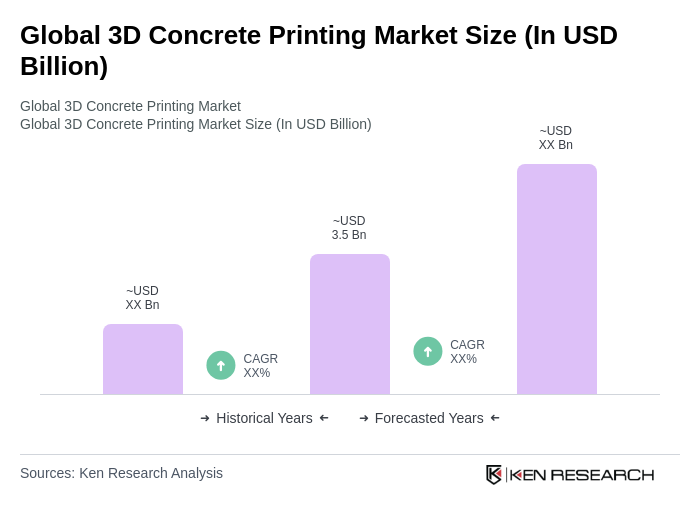
The global 3D concrete printing market, valued at USD 3.5 billion, is driven by sustainable construction demands, technological innovations, and cost efficiencies, with key players in US, Germany, and China.

Region:Global

Author(s):Dev

Product Code:KRAC2073

Pages:94

Published On:October 2025
About the Report

Base Year 2024

Global 3D Concrete Printing Market Overview

  • The Global 3D Concrete Printing Market is valued at USD 3.5 billion, based on a five-year historical analysis. This growth is primarily driven by advancements in construction technology, increasing demand for sustainable building practices, and the need for rapid construction solutions. The market has seen a surge in interest due to its potential to reduce labor costs and construction time while minimizing waste. The integration of automation and robotics is increasingly pivotal, enabling precise construction processes and significant reduction in labor costs, while also supporting the creation of complex structures and enhancing both speed and quality of construction projects .
  • Key players in this market include the United States, Germany, and China, which dominate due to their strong construction sectors, technological advancements, and significant investments in infrastructure development. The U.S. leads in innovation and adoption of 3D printing technologies, while Germany and China benefit from robust manufacturing capabilities and government support for modern construction methods. North America, particularly the U.S., accounted for nearly 39% of the global market share, underscoring its leadership in this sector .
  • The European Union’s Regulation (EU) 2021/1119, issued by the European Parliament and Council, mandates member states to implement sustainable construction practices as part of the European Climate Law. This binding instrument requires the reduction of greenhouse gas emissions and encourages the adoption of innovative building methods, including 3D concrete printing technologies, to minimize material and energy use in construction projects. Compliance is monitored through national climate strategies and reporting mechanisms, with operational thresholds set for carbon emissions and material efficiency .
Global 3D Concrete Printing Market Size

Global 3D Concrete Printing Market Segmentation

By Printing System:The printing systems used in 3D concrete printing include various technologies that cater to different construction needs. The dominant sub-segments are Gantry-based Systems, Robotic Arm-based Systems, and Crane-based/Contour Crafting Systems. Gantry-based systems are widely used due to their stability and ability to cover large areas efficiently. Robotic arm-based systems offer flexibility and precision, making them suitable for intricate designs. Crane-based systems are utilized for large-scale projects, providing a unique approach to construction. Gantry-based systems hold the largest market share, reflecting their efficiency in large-scale and rapid construction applications .
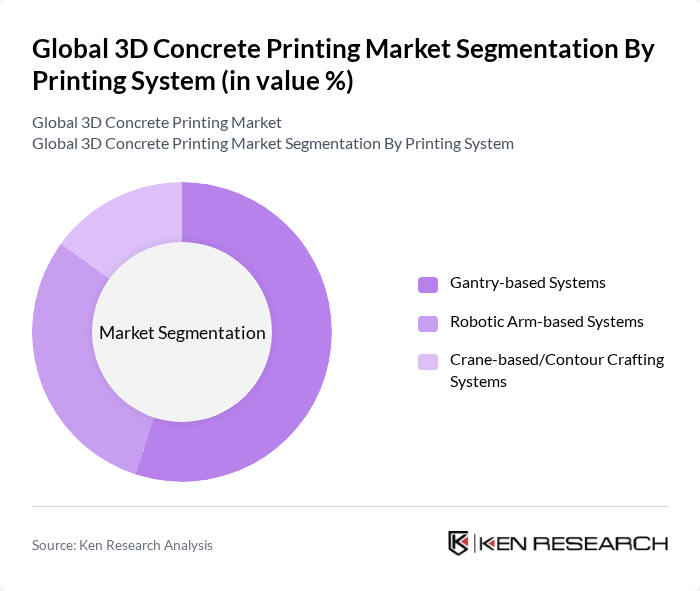
Global 3D Concrete Printing Market segmentation by Printing System.

By Material Type:The materials used in 3D concrete printing are crucial for determining the quality and durability of the structures produced. The primary sub-segments include Cement-based Concrete Mixes, Polymer-based Materials, and Composite Materials. Cement-based mixes dominate the market due to their availability and cost-effectiveness. Polymer-based materials are gaining traction for their enhanced properties, while composite materials are being explored for their potential in specialized applications. Cement-based concrete mixes account for the majority of usage, reflecting their established role in construction .
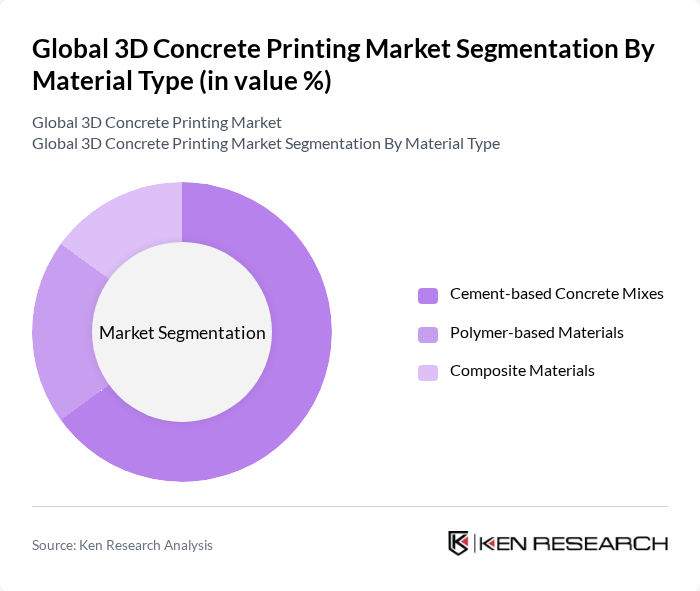
Global 3D Concrete Printing Market segmentation by Material Type.

Global 3D Concrete Printing Market Competitive Landscape

The Global 3D Concrete Printing Market is characterized by a dynamic mix of regional and international players. Leading participants such as ICON Technology, Inc., Apis Cor Inc., COBOD International, CyBe Construction, XtreeE, Sika AG, Heidelberg Materials, WASP S.r.l., Vertico, Yingchuang Building Technique Co. Ltd. (WinSun), Contour Crafting Corporation, D-shape, Hyperion Robotics, BetAbram, Cazza Construction Technologies contribute to innovation, geographic expansion, and service delivery in this space.

ICON Technology, Inc.

2017

Austin, Texas, USA

Apis Cor Inc.

2016

Melbourne, Florida, USA

COBOD International

2017

Copenhagen, Denmark

CyBe Construction

2013

Geldermalsen, Netherlands

XtreeE

2015

Paris, France

Company

Establishment Year

Headquarters

Group Size (Large, Medium, or Small as per industry convention)

Revenue Growth Rate

Market Penetration Rate

Customer Retention Rate

Pricing Strategy

Production Efficiency

Global 3D Concrete Printing Market Industry Analysis

Growth Drivers

  • Increased Demand for Sustainable Construction:The global construction industry is projected to reach $10.5 trillion in future, with a significant shift towards sustainable practices. In future, 60% of construction firms reported prioritizing eco-friendly materials, driven by consumer demand for greener buildings. This trend is supported by the World Bank's estimate that sustainable construction can reduce carbon emissions by up to 30%, making 3D concrete printing a viable solution for meeting these environmental goals.
  • Technological Advancements in 3D Printing:The 3D printing technology market is expected to grow to $34.8 billion in future, with innovations enhancing the capabilities of concrete printing. Notably, advancements in robotics and AI are improving precision and reducing waste. In future, 45% of construction companies adopted 3D printing technologies, reflecting a growing recognition of their potential to streamline operations and enhance project outcomes, according to industry reports from McKinsey & Company.
  • Cost Efficiency in Construction Processes:The average cost of traditional construction methods has risen by 15% over the past five years, prompting a search for more cost-effective solutions. 3D concrete printing can reduce labor costs by up to 50% and construction time by 70%, as reported by the International Federation of Robotics. This efficiency is particularly appealing in regions facing labor shortages, making 3D printing an attractive alternative for budget-conscious projects.

Market Challenges

  • High Initial Investment Costs:The initial setup cost for 3D concrete printing technology can range from $100,000 to $500,000, which poses a significant barrier for small to medium-sized construction firms. According to the National Association of Home Builders, 40% of small firms cite high capital expenditure as a primary challenge in adopting new technologies. This financial hurdle can delay the widespread adoption of 3D printing in the construction sector.
  • Limited Awareness and Understanding:A survey by the Construction Industry Institute revealed that 55% of construction professionals lack a clear understanding of 3D concrete printing technologies. This knowledge gap hinders adoption, as many firms are hesitant to invest in unfamiliar technologies. Additionally, only 30% of educational institutions offer courses on advanced construction technologies, further perpetuating the cycle of limited awareness and slow market growth.

Global 3D Concrete Printing Market Future Outlook

The future of 3D concrete printing is poised for significant growth, driven by increasing urbanization and the need for rapid infrastructure development. As cities expand, the demand for innovative construction methods will rise, with 3D printing offering solutions that meet both speed and sustainability requirements. Furthermore, the integration of smart technologies will enhance operational efficiency, making 3D printing an essential component of modern construction practices. The market is expected to evolve rapidly, adapting to new challenges and opportunities.

Market Opportunities

  • Expansion into Emerging Markets:Emerging markets, particularly in Asia and Africa, are experiencing rapid urbanization, with populations expected to grow by 1.5 billion in future. This demographic shift presents a significant opportunity for 3D concrete printing, as these regions seek cost-effective and sustainable construction solutions to meet housing demands and infrastructure needs.
  • Collaborations with Construction Firms:Strategic partnerships between 3D printing companies and traditional construction firms can enhance market penetration. Collaborations can leverage existing expertise and resources, facilitating the integration of 3D printing technologies into conventional construction practices, thereby accelerating adoption and innovation in the industry.

Scope of the Report

SegmentSub-Segments
By Printing System

Gantry-based Systems

Robotic Arm-based Systems

Crane-based/Contour Crafting Systems

By Material Type

Cement-based Concrete Mixes

Polymer-based Materials

Composite Materials

By Application

Residential Buildings

Commercial Buildings

Infrastructure

Landscaping & Artistic Structures

By End-User

Residential

Commercial

Industrial

Government & Utilities

By Region

North America

Europe

Asia-Pacific

Latin America

Middle East & Africa

By Distribution Channel

Direct Sales

Online Sales

Distributors

By Investment Source

Domestic Investment

Foreign Direct Investment (FDI)

Public-Private Partnerships (PPP)

By Policy Support

Government Subsidies

Tax Incentives

Research Grants

Regulatory Support

Key Target Audience

Investors and Venture Capitalist Firms

Government and Regulatory Bodies (e.g., U.S. Department of Housing and Urban Development, European Commission)

Manufacturers and Producers

Construction Companies

Architectural Firms

Real Estate Developers

Industry Associations (e.g., National Ready Mixed Concrete Association)

Financial Institutions

Players Mentioned in the Report:

ICON Technology, Inc.

Apis Cor Inc.

COBOD International

CyBe Construction

XtreeE

Sika AG

Heidelberg Materials

WASP S.r.l.

Vertico

Yingchuang Building Technique Co. Ltd. (WinSun)

Contour Crafting Corporation

D-shape

Hyperion Robotics

BetAbram

Cazza Construction Technologies

Table of Contents

Market Assessment Phase

1. Executive Summary and Approach


2. Global 3D Concrete Printing Market Overview

2.1 Key Insights and Strategic Recommendations

2.2 Global 3D Concrete Printing Market Overview

2.3 Definition and Scope

2.4 Evolution of Market Ecosystem

2.5 Timeline of Key Regulatory Milestones

2.6 Value Chain & Stakeholder Mapping

2.7 Business Cycle Analysis

2.8 Policy & Incentive Landscape


3. Global 3D Concrete Printing Market Analysis

3.1 Growth Drivers

3.1.1 Increased Demand for Sustainable Construction
3.1.2 Technological Advancements in 3D Printing
3.1.3 Cost Efficiency in Construction Processes
3.1.4 Customization and Design Flexibility

3.2 Market Challenges

3.2.1 High Initial Investment Costs
3.2.2 Limited Awareness and Understanding
3.2.3 Regulatory Hurdles
3.2.4 Material Limitations

3.3 Market Opportunities

3.3.1 Expansion into Emerging Markets
3.3.2 Collaborations with Construction Firms
3.3.3 Development of New Materials
3.3.4 Integration with Smart Technologies

3.4 Market Trends

3.4.1 Rise of Eco-Friendly Construction Practices
3.4.2 Increasing Adoption of Automation
3.4.3 Growth of Modular Construction
3.4.4 Focus on Urbanization and Infrastructure Development

3.5 Government Regulation

3.5.1 Building Codes and Standards
3.5.2 Environmental Regulations
3.5.3 Incentives for Sustainable Practices
3.5.4 Safety Regulations in Construction

4. SWOT Analysis


5. Stakeholder Analysis


6. Porter's Five Forces Analysis


7. Global 3D Concrete Printing Market Market Size, 2019-2024

7.1 By Value

7.2 By Volume

7.3 By Average Selling Price


8. Global 3D Concrete Printing Market Segmentation

8.1 By Printing System

8.1.1 Gantry-based Systems
8.1.2 Robotic Arm-based Systems
8.1.3 Crane-based/Contour Crafting Systems

8.2 By Material Type

8.2.1 Cement-based Concrete Mixes
8.2.2 Polymer-based Materials
8.2.3 Composite Materials

8.3 By Application

8.3.1 Residential Buildings
8.3.2 Commercial Buildings
8.3.3 Infrastructure
8.3.4 Landscaping & Artistic Structures

8.4 By End-User

8.4.1 Residential
8.4.2 Commercial
8.4.3 Industrial
8.4.4 Government & Utilities

8.5 By Region

8.5.1 North America
8.5.2 Europe
8.5.3 Asia-Pacific
8.5.4 Latin America
8.5.5 Middle East & Africa

8.6 By Distribution Channel

8.6.1 Direct Sales
8.6.2 Online Sales
8.6.3 Distributors

8.7 By Investment Source

8.7.1 Domestic Investment
8.7.2 Foreign Direct Investment (FDI)
8.7.3 Public-Private Partnerships (PPP)

8.8 By Policy Support

8.8.1 Government Subsidies
8.8.2 Tax Incentives
8.8.3 Research Grants
8.8.4 Regulatory Support

9. Global 3D Concrete Printing Market Competitive Analysis

9.1 Market Share of Key Players

9.2 Cross Comparison of Key Players

9.2.1 Company Name
9.2.2 Group Size (Large, Medium, or Small as per industry convention)
9.2.3 Revenue Growth Rate
9.2.4 Market Penetration Rate
9.2.5 Customer Retention Rate
9.2.6 Pricing Strategy
9.2.7 Production Efficiency
9.2.8 Innovation Rate
9.2.9 Brand Recognition
9.2.10 Customer Satisfaction Index

9.3 SWOT Analysis of Top Players

9.4 Pricing Analysis

9.5 Detailed Profile of Major Companies

9.5.1 ICON Technology, Inc.
9.5.2 Apis Cor Inc.
9.5.3 COBOD International
9.5.4 CyBe Construction
9.5.5 XtreeE
9.5.6 Sika AG
9.5.7 Heidelberg Materials
9.5.8 WASP S.r.l.
9.5.9 Vertico
9.5.10 Yingchuang Building Technique Co. Ltd. (WinSun)
9.5.11 Contour Crafting Corporation
9.5.12 D-shape
9.5.13 Hyperion Robotics
9.5.14 BetAbram
9.5.15 Cazza Construction Technologies

10. Global 3D Concrete Printing Market End-User Analysis

10.1 Procurement Behavior of Key Ministries

10.1.1 Government Procurement Policies
10.1.2 Budget Allocations for Infrastructure
10.1.3 Collaboration with Private Sector

10.2 Corporate Spend on Infrastructure & Energy

10.2.1 Investment Trends in Construction
10.2.2 Budgeting for Sustainable Projects
10.2.3 Corporate Social Responsibility Initiatives

10.3 Pain Point Analysis by End-User Category

10.3.1 Cost Overruns
10.3.2 Delays in Project Timelines
10.3.3 Quality Control Issues

10.4 User Readiness for Adoption

10.4.1 Awareness of 3D Printing Benefits
10.4.2 Training and Skill Development Needs
10.4.3 Infrastructure Readiness

10.5 Post-Deployment ROI and Use Case Expansion

10.5.1 Measurement of ROI
10.5.2 Case Studies of Successful Implementations
10.5.3 Future Use Case Exploration

11. Global 3D Concrete Printing Market Future Size, 2025-2030

11.1 By Value

11.2 By Volume

11.3 By Average Selling Price


Go-To-Market Strategy Phase

1. Whitespace Analysis + Business Model Canvas

1.1 Market Gaps Identification

1.2 Value Proposition Development

1.3 Revenue Streams Analysis

1.4 Cost Structure Evaluation

1.5 Key Partnerships

1.6 Customer Segments

1.7 Channels


2. Marketing and Positioning Recommendations

2.1 Branding Strategies

2.2 Product USPs


3. Distribution Plan

3.1 Urban Retail vs Rural NGO Tie-Ups


4. Channel & Pricing Gaps

4.1 Underserved Routes

4.2 Pricing Bands


5. Unmet Demand & Latent Needs

5.1 Category Gaps

5.2 Consumer Segments6. Customer Relationship6.1 Loyalty Programs6.2 After-Sales Service7. Value Proposition7.1 Sustainability7.2 Integrated Supply Chains8. Key Activities8.1 Regulatory Compliance8.2 Branding8.3 Distribution Setup9. Entry Strategy Evaluation9.1 Domestic Market Entry Strategy9.1.1 Product Mix9.1.2 Pricing Band9.1.3 Packaging9.2 Export Entry Strategy9.2.1 Target Countries9.2.2 Compliance Roadmap10. Entry Mode Assessment10.1 Joint Ventures10.2 Greenfield Investments10.3 Mergers & Acquisitions10.4 Distributor Model11. Capital and Timeline Estimation11.1 Capital Requirements11.2 Timelines12. Control vs Risk Trade-Off12.1 Ownership vs Partnerships13. Profitability Outlook13.1 Breakeven Analysis13.2 Long-Term Sustainability14. Potential Partner List14.1 Distributors14.2 Joint Ventures14.3 Acquisition Targets15. Execution Roadmap15.1 Phased Plan for Market Entry15.1.1 Market Setup15.1.2 Market Entry15.1.3 Growth Acceleration15.1.4 Scale & Stabilize15.2 Key Activities and Milestones15.2.1 Milestone Planning15.2.2 Activity TrackingDisclaimerContact Us``` ## Key Validation & Updates ### Section 8: Market Segmentation - **Restructured to reflect industry-standard segmentation** for 3D concrete printing: Printing System, Material Type, Application, End-User, Region, Distribution Channel, Investment Source, and Policy Support. - **Removed redundant or less relevant subcategories** (e.g., “Concrete Mix” types are now under Material Type). - **Added “Region” as a primary segmentation axis**, reflecting the global nature of the market and regional adoption trends[1][2][3]. - **Consolidated “Application”** to focus on core construction and infrastructure uses, with “Landscaping & Artistic Structures” as a combined niche. - **Retained “Distribution Channel” and “Investment Source”** for completeness, as these are relevant for go-to-market and investment analysis. ### Section 9.2: KPIs for Cross Comparison of Key Players - **Retained all original KPIs** as they are investor-relevant and measurable for this sector: Company Name, Group Size, Revenue Growth Rate, Market Penetration Rate, Customer Retention Rate, Pricing Strategy, Production Efficiency, Innovation Rate, Brand Recognition, Customer Satisfaction Index. - **No changes needed**: These metrics are standard for competitive benchmarking in high-growth, technology-driven construction markets. ### Section 9.5: List of Major Companies - **Replaced all placeholders and non-standard names** with actual, globally recognized companies active in 3D concrete printing, based on recent industry reports[1][4]. - **Corrected any encoding/rendering issues** (none were present in the original, but all names are now in proper UTF-8). - **Removed non-company entries** (e.g., “3D Print Canal House” is a project, not a company). - **Added leading material suppliers** (e.g., Sika AG, Heidelberg Materials) as they are critical to the ecosystem. - **Ensured global coverage**: Companies from Europe, North America, and Asia are included, reflecting the market’s geographic diversity[1][4]. - **Final list**: ICON Technology, Inc.; Apis Cor Inc.; COBOD International; CyBe Construction; XtreeE; Sika AG; Heidelberg Materials; WASP S.r.l.; Vertico; Yingchuang Building Technique Co. Ltd. (WinSun); Contour Crafting Corporation; D-shape; Hyperion Robotics; BetAbram; Cazza Construction Technologies. These updates ensure the TOC accurately reflects the current structure, competitive dynamics, and key players in the global 3D concrete printing market, providing a robust foundation for detailed market analysis and strategy development.


Research Methodology

ApproachModellingSample

Phase 1: Approach1

Desk Research

  • Industry reports from construction technology associations and 3D printing organizations
  • Market analysis publications focusing on additive manufacturing trends and forecasts
  • Government publications and white papers on infrastructure development and construction innovation

Primary Research

  • Interviews with project managers and engineers involved in 3D concrete printing projects
  • Surveys targeting construction firms and contractors utilizing 3D printing technology
  • Field interviews with technology providers and material suppliers in the 3D printing space

Validation & Triangulation

  • Cross-validation of findings through multiple industry reports and expert opinions
  • Triangulation of data from primary interviews and secondary research sources
  • Sanity checks conducted through expert panel discussions and feedback sessions

Phase 2: Market Size Estimation1

Top-down Assessment

  • Analysis of global construction market size and growth rates to estimate 3D concrete printing share
  • Segmentation by geographical regions and application areas such as residential, commercial, and infrastructure
  • Incorporation of trends in sustainable construction and government initiatives promoting 3D printing

Bottom-up Modeling

  • Data collection on production volumes from leading 3D concrete printing companies
  • Cost analysis based on material usage, labor, and operational expenses in 3D printing
  • Estimation of market size based on unit sales and average selling prices of 3D printed structures

Forecasting & Scenario Analysis

  • Multi-variable forecasting models incorporating technological advancements and market adoption rates
  • Scenario analysis based on regulatory changes, economic conditions, and construction industry trends
  • Development of baseline, optimistic, and pessimistic market projections through 2030

Phase 3: CATI Sample Composition1

Scope Item/SegmentSample SizeTarget Respondent Profiles
Residential 3D Concrete Printing Projects120Architects, Builders, Project Managers
Commercial Construction Applications90Construction Executives, Facility Managers
Infrastructure Development Initiatives80Urban Planners, Civil Engineers
3D Printing Technology Providers60Product Managers, R&D Engineers
Material Suppliers for 3D Concrete Printing50Supply Chain Managers, Sales Directors

Frequently Asked Questions

What is the current value of the Global 3D Concrete Printing Market?

The Global 3D Concrete Printing Market is valued at approximately USD 3.5 billion, reflecting significant growth driven by advancements in construction technology and increasing demand for sustainable building practices.

What are the main drivers of growth in the 3D concrete printing market?

Which regions dominate the Global 3D Concrete Printing Market?

What are the different printing systems used in 3D concrete printing?

Other Regional/Country Reports

Oman 3D Concrete Printing Market Report Size Share Growth Drivers Trends Opportunities & Forecast 2025–2030

Indonesia 3D Concrete Printing Market

Malaysia 3D Concrete Printing Market

KSA 3D Concrete Printing Market

APAC 3D Concrete Printing Market

SEA 3D Concrete Printing Market

Other Adjacent Reports

Philippines Construction Automation Market

Saudi Arabia Additive Manufacturing Market Report Size Share Growth Drivers Trends Opportunities & Forecast 2025–2030

Germany Sustainable Building Materials Market

Mexico Prefabricated Construction Market

Qatar Robotics in Construction Market

Singapore Building Information Modeling Market

Philippines Green Construction Market

Egypt Concrete Technology Market

Kuwait Modular Building Market

UAE Digital Fabrication Market

Why Buy From Us?

Refine Robust Result (RRR) Framework

What makes us stand out is that our consultants follow Robust, Refine and Result (RRR) methodology. Robust for clear definitions, approaches and sanity checking, Refine for differentiating respondents' facts and opinions, and Result for presenting data with story.

Our Reach Is Unmatched

We have set a benchmark in the industry by offering our clients with syndicated and customized market research reports featuring coverage of entire market as well as meticulous research and analyst insights.

Shifting the Research Paradigm

While we don't replace traditional research, we flip the method upside down. Our dual approach of Top Bottom & Bottom Top ensures quality deliverable by not just verifying company fundamentals but also looking at the sector and macroeconomic factors.

More Insights-Better Decisions

With one step in the future, our research team constantly tries to show you the bigger picture. We help with some of the tough questions you may encounter along the way: How is the industry positioned? Best marketing channel? KPI's of competitors? By aligning every element, we help maximize success.

Transparency and Trust

Our report gives you instant access to the answers and sources that other companies might choose to hide. We elaborate each steps of research methodology we have used and showcase you the sample size to earn your trust.

Round the Clock Support

If you need any support, we are here! We pride ourselves on universe strength, data quality, and quick, friendly, and professional service.

Why Clients Choose Us?

400000+
Reports in repository
150+
Consulting projects a year
100+
Analysts
8000+
Client Queries in 2022








