Ken Research Logo

Global Abaca Pulp Market Report Size, Share, Growth Drivers, Trends, Opportunities & Forecast 2025–2030

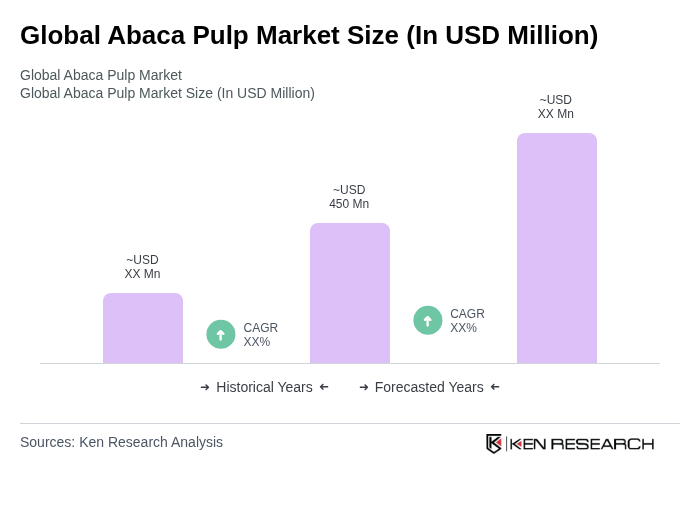
Global Abaca Pulp Market, valued at USD 450 million, grows due to eco-friendly trends in food, beverage, and healthcare sectors, led by Philippines' production dominance.

Region:Global

Author(s):Rebecca

Product Code:KRAD4985

Pages:98

Published On:December 2025
About the Report

Base Year 2024

Global Abaca Pulp Market Overview

  • The Global Abaca Pulp Market is valued at USD 450 million, based on a five-year historical analysis. This growth is primarily driven by the increasing demand for sustainable and biodegradable materials in various industries, particularly in food packaging, tea and coffee filtration, and medical barrier applications. The unique properties of abaca pulp, such as its high tensile strength, porosity, and biodegradability, have made it a preferred choice for manufacturers looking to reduce their environmental footprint and comply with stricter sustainability standards.
  • The Philippines is the dominant player in the Global Abaca Pulp Market, accounting for the majority of global abaca fiber output and supplying a substantial share of abaca pulp used worldwide. The country's favorable tropical climate and rich biodiversity provide ideal growing conditions for abaca plants, while regions such as Bicol, Eastern Visayas, and Davao are key producing areas supported by established farming and processing networks. Additionally, a strong export market for abaca-based specialty papers and pulp, particularly in Europe for tea bags and filter papers and in North America for specialty paper and technical applications, further solidifies the Philippines' position as a leader in this sector.
  • In 2023, the Philippine government continued to advance regulations and programs aimed at promoting sustainable agricultural practices in the abaca industry, including measures under the Philippine Fiber Industry Development Authority’s mandate and the Philippine Abaca Industry Development Program established through Department of Agriculture administrative issuances. These include initiatives to support local farmers through training on disease management and good agricultural practices, access to credit and planting materials, and incentives for rehabilitating and expanding abaca plantations, ensuring that abaca production is environmentally responsible and economically viable. These regulatory and support measures are designed to enhance the quality and traceability of abaca pulp and increase its competitiveness in the global market, especially in high-value applications such as medical, filtration, and security papers.
Global Abaca Pulp Market Size

Global Abaca Pulp Market Segmentation

By Product Type:The product type segmentation includes various categories such as Food Preparation & Filter Papers, Medical & Specialty Papers, Currency & Security Papers, Industrial & Technical Papers, and Others. Each of these subsegments serves distinct applications across different industries, with food and beverage filtration and specialty technical papers recognized as the largest consumption areas for abaca-based pulp.
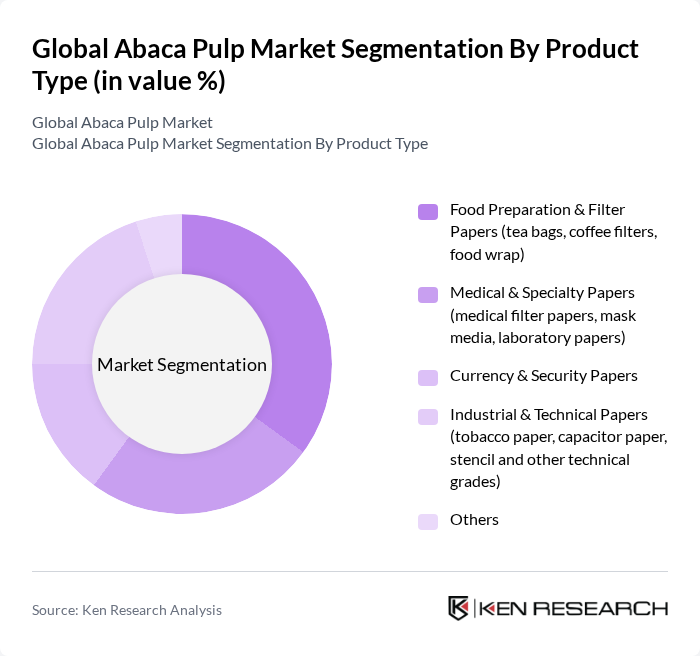
Global Abaca Pulp Market segmentation by Product Type.

By End-Use Industry:The end-use industry segmentation encompasses various sectors including Food & Beverage, Healthcare & Medical Devices, Banking & Government, Tobacco Industry, Industrial & Technical Applications, and Others. Each sector utilizes abaca pulp for its unique properties and benefits, with the paper and pulp value chain for tea bags, coffee filters, and medical filtration media identified as the most intensive end-use for abaca fibers and pulp.
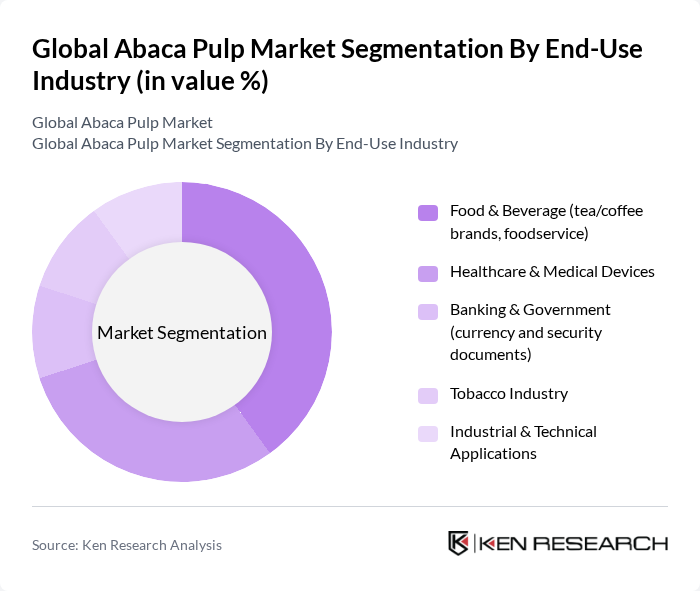
Global Abaca Pulp Market segmentation by End-Use Industry.

Global Abaca Pulp Market Competitive Landscape

The Global Abaca Pulp Market is characterized by a dynamic mix of regional and international players. Leading participants such as Specialty Pulp Manufacturing, Inc., ALINDECO (Albay Agro-Industrial Development Corporation), Pulp Specialties Philippines, Inc., Newtech Pulp, Inc., Abacell, Royale Fibers, CELESA (Celulosa de Levante S.A.), Ahlstrom, Terranova Papers, Glatfelter Corporation, Wigglesworth & Co. Ltd., University Products, Inc., Preservation Equipment Ltd, Other Regional Abaca Pulp Producers, Emerging Local Producers in the Philippines and Ecuador contribute to innovation, geographic expansion, and service delivery in this space.

Specialty Pulp Manufacturing, Inc.

1994

Philippines

ALINDECO (Albay Agro-Industrial Development Corporation)

1977

Philippines

Pulp Specialties Philippines, Inc.

1998

Philippines

Newtech Pulp, Inc.

2007

Philippines

Abacell

2004

Philippines

Company

Establishment Year

Headquarters

Group Size (Large, Medium, or Small as per industry convention)

Abaca Pulp Revenue (USD million)

Abaca Pulp Revenue CAGR (3–5 year)

Share of Abaca Pulp in Total Company Revenue (%)

Production Capacity (tons/year)

Capacity Utilization Rate (%)

Global Abaca Pulp Market Industry Analysis

Growth Drivers

  • Increasing Demand for Eco-Friendly Products:The global market for eco-friendly products is projected to reach $150 billion in future, driven by consumer preferences for sustainable options. This trend is particularly evident in the abaca pulp sector, where the demand for biodegradable materials is surging. The World Bank reports that 70% of consumers are willing to pay a premium for sustainable products, indicating a robust market for abaca pulp as an eco-friendly alternative in various applications.
  • Rising Applications in the Paper Industry:The paper industry is expected to consume approximately 1.5 million tons of abaca pulp in future, as manufacturers increasingly seek natural fibers for paper production. The global paper market is valued at $500 billion, with a significant shift towards sustainable sourcing. This trend is supported by the International Paper Association, which highlights that 60% of paper producers are integrating natural fibers to meet environmental standards, boosting abaca pulp demand.
  • Expanding Use in Textiles and Composites:The textile industry is projected to utilize over 200,000 tons of abaca fibers in future, driven by the growing trend towards natural and sustainable materials. The global textile market is valued at $1 trillion, with a significant portion focusing on eco-friendly alternatives. According to the Textile Exchange, 30% of brands are shifting towards natural fibers, enhancing the market potential for abaca pulp in textiles and composite materials.

Market Challenges

  • Fluctuating Raw Material Prices:The price of abaca fibers has seen fluctuations, with costs ranging from $1,200 to $1,500 per ton in recent years. This volatility poses a challenge for manufacturers who rely on stable pricing for production planning. The Food and Agriculture Organization (FAO) indicates that price instability can lead to supply chain disruptions, affecting the overall market dynamics and profitability for abaca pulp producers.
  • Limited Awareness Among End-Users:Despite the benefits of abaca pulp, awareness among end-users remains low, particularly in emerging markets. A survey by the Sustainable Fiber Alliance found that only 25% of manufacturers are familiar with abaca's advantages. This lack of knowledge hinders market penetration and growth, as potential users may opt for more familiar synthetic alternatives, limiting the expansion of abaca pulp applications.

Global Abaca Pulp Market Future Outlook

The future of the abaca pulp market appears promising, driven by increasing consumer awareness of sustainability and the growing demand for eco-friendly products. Innovations in processing technologies are expected to enhance the quality and efficiency of abaca fiber extraction, making it more competitive against synthetic alternatives. Additionally, as global regulations tighten around environmental practices, the shift towards natural fibers will likely accelerate, positioning abaca pulp as a key player in sustainable manufacturing across various industries.

Market Opportunities

  • Growth in Sustainable Packaging Solutions:The sustainable packaging market is projected to reach $500 billion in future, creating significant opportunities for abaca pulp. As companies seek biodegradable alternatives, abaca's natural properties make it an ideal candidate for eco-friendly packaging solutions, aligning with consumer preferences for sustainability.
  • Innovations in Abaca Fiber Processing:Advances in fiber processing technology are expected to enhance the yield and quality of abaca pulp. With investments in research and development projected to exceed $100 million in future, these innovations will improve production efficiency and reduce costs, making abaca pulp more accessible to a broader range of industries.

Scope of the Report

SegmentSub-Segments
By Product Type

Food Preparation & Filter Papers (tea bags, coffee filters, food wrap)

Medical & Specialty Papers (medical filter papers, mask media, laboratory papers)

Currency & Security Papers

Industrial & Technical Papers (tobacco paper, capacitor paper, stencil and other technical grades)

Others

By End-Use Industry

Food & Beverage (tea/coffee brands, foodservice)

Healthcare & Medical Devices

Banking & Government (currency and security documents)

Tobacco Industry

Industrial & Technical Applications

Others

By Application

Tea Bags

Coffee Filters

Medical & Laboratory Filter Media

Mask & Air Filtration Media

Currency & Security Paper Base

Specialty & Technical Paper

Others

By Processing / Pulping Method

Chemical Pulping (e.g., sulphate/kraft)

Mechanical / Chemi-mechanical Pulping

Bleached Abaca Pulp

Unbleached Abaca Pulp

Others

By Geographic Distribution

Asia-Pacific

Europe

North America

Central & South America

Middle East & Africa

By Product Form

Bales

Wet-Lap Pulp

Dry Pulp Sheets

Others

By Supply Chain Structure

Direct Supply to Paper Mills & Converters

Through Trading Houses / Aggregators

Through Distributors & Agents

Others

Key Target Audience

Investors and Venture Capitalist Firms

Government and Regulatory Bodies (e.g., Food and Drug Administration, Environmental Protection Agency)

Manufacturers and Producers of Abaca Pulp

Distributors and Retailers of Pulp Products

Packaging Industry Stakeholders

Textile and Fiber Industry Players

Biodegradable Product Manufacturers

Financial Institutions and Banks

Players Mentioned in the Report:

Specialty Pulp Manufacturing, Inc.

ALINDECO (Albay Agro-Industrial Development Corporation)

Pulp Specialties Philippines, Inc.

Newtech Pulp, Inc.

Abacell

Royale Fibers

CELESA (Celulosa de Levante S.A.)

Ahlstrom

Terranova Papers

Glatfelter Corporation

Wigglesworth & Co. Ltd.

University Products, Inc.

Preservation Equipment Ltd

Other Regional Abaca Pulp Producers

Emerging Local Producers in the Philippines and Ecuador

Table of Contents

Market Assessment Phase

1. Executive Summary and Approach


2. Global Abaca Pulp Market Overview

2.1 Key Insights and Strategic Recommendations

2.2 Global Abaca Pulp Market Overview

2.3 Definition and Scope

2.4 Evolution of Market Ecosystem

2.5 Timeline of Key Regulatory Milestones

2.6 Value Chain & Stakeholder Mapping

2.7 Business Cycle Analysis

2.8 Policy & Incentive Landscape


3. Global Abaca Pulp Market Analysis

3.1 Growth Drivers

3.1.1 Increasing Demand for Eco-Friendly Products
3.1.2 Rising Applications in the Paper Industry
3.1.3 Expanding Use in Textiles and Composites
3.1.4 Government Support for Sustainable Agriculture

3.2 Market Challenges

3.2.1 Fluctuating Raw Material Prices
3.2.2 Limited Awareness Among End-Users
3.2.3 Competition from Synthetic Fibers
3.2.4 Environmental Concerns Related to Cultivation

3.3 Market Opportunities

3.3.1 Growth in Sustainable Packaging Solutions
3.3.2 Innovations in Abaca Fiber Processing
3.3.3 Expansion into Emerging Markets
3.3.4 Collaborations with Eco-Conscious Brands

3.4 Market Trends

3.4.1 Increasing Popularity of Biodegradable Products
3.4.2 Technological Advancements in Fiber Extraction
3.4.3 Shift Towards Circular Economy Practices
3.4.4 Growing Consumer Preference for Natural Fibers

3.5 Government Regulation

3.5.1 Policies Promoting Sustainable Agriculture
3.5.2 Regulations on Fiber Quality Standards
3.5.3 Incentives for Eco-Friendly Manufacturing
3.5.4 Import/Export Tariffs on Abaca Products

4. SWOT Analysis


5. Stakeholder Analysis


6. Porter's Five Forces Analysis


7. Global Abaca Pulp Market Market Size, 2019-2024

7.1 By Value

7.2 By Volume

7.3 By Average Selling Price


8. Global Abaca Pulp Market Segmentation

8.1 By Product Type

8.1.1 Food Preparation & Filter Papers (tea bags, coffee filters, food wrap)
8.1.2 Medical & Specialty Papers (medical filter papers, mask media, laboratory papers)
8.1.3 Currency & Security Papers
8.1.4 Industrial & Technical Papers (tobacco paper, capacitor paper, stencil and other technical grades)
8.1.5 Others

8.2 By End-Use Industry

8.2.1 Food & Beverage (tea/coffee brands, foodservice)
8.2.2 Healthcare & Medical Devices
8.2.3 Banking & Government (currency and security documents)
8.2.4 Tobacco Industry
8.2.5 Industrial & Technical Applications
8.2.6 Others

8.3 By Application

8.3.1 Tea Bags
8.3.2 Coffee Filters
8.3.3 Medical & Laboratory Filter Media
8.3.4 Mask & Air Filtration Media
8.3.5 Currency & Security Paper Base
8.3.6 Specialty & Technical Paper
8.3.7 Others

8.4 By Processing / Pulping Method

8.4.1 Chemical Pulping (e.g., sulphate/kraft)
8.4.2 Mechanical / Chemi-mechanical Pulping
8.4.3 Bleached Abaca Pulp
8.4.4 Unbleached Abaca Pulp
8.4.5 Others

8.5 By Geographic Distribution

8.5.1 Asia-Pacific
8.5.2 Europe
8.5.3 North America
8.5.4 Central & South America
8.5.5 Middle East & Africa

8.6 By Product Form

8.6.1 Bales
8.6.2 Wet-Lap Pulp
8.6.3 Dry Pulp Sheets
8.6.4 Others

8.7 By Supply Chain Structure

8.7.1 Direct Supply to Paper Mills & Converters
8.7.2 Through Trading Houses / Aggregators
8.7.3 Through Distributors & Agents
8.7.4 Others

9. Global Abaca Pulp Market Competitive Analysis

9.1 Market Share of Key Players

9.2 Cross Comparison of Key Players

9.2.1 Company Name
9.2.2 Group Size (Large, Medium, or Small as per industry convention)
9.2.3 Abaca Pulp Revenue (USD million)
9.2.4 Abaca Pulp Revenue CAGR (3–5 year)
9.2.5 Share of Abaca Pulp in Total Company Revenue (%)
9.2.6 Production Capacity (tons/year)
9.2.7 Capacity Utilization Rate (%)
9.2.8 Geographic Footprint (number of production sites / countries served)
9.2.9 Key Application Exposure (share to food prep papers, medical, currency, tobacco, etc.)
9.2.10 Average Realized Price per Ton (USD/ton)
9.2.11 R&D / Innovation Intensity (% of revenue, patents, new grades launched)
9.2.12 Long-Term Supply & Offtake Agreements (number and scale)
9.2.13 Sustainability & Certification Score (FSC, PEFC, ISO, environmental performance)
9.2.14 Vertical Integration Level (own plantations vs. third-party sourcing)
9.2.15 Financial Health Indicators (EBITDA margin, leverage level)

9.3 SWOT Analysis of Top Players

9.4 Pricing Analysis

9.5 Detailed Profile of Major Companies

9.5.1 Specialty Pulp Manufacturing, Inc.
9.5.2 ALINDECO (Albay Agro-Industrial Development Corporation)
9.5.3 Pulp Specialties Philippines, Inc.
9.5.4 Newtech Pulp, Inc.
9.5.5 Abacell
9.5.6 Royale Fibers
9.5.7 CELESA (Celulosa de Levante S.A.)
9.5.8 Ahlstrom
9.5.9 Terranova Papers
9.5.10 Glatfelter Corporation
9.5.11 Wigglesworth & Co. Ltd.
9.5.12 University Products, Inc.
9.5.13 Preservation Equipment Ltd
9.5.14 Other Regional Abaca Pulp Producers
9.5.15 Emerging Local Producers in the Philippines and Ecuador

10. Global Abaca Pulp Market End-User Analysis

10.1 Procurement Behavior of Key Ministries

10.1.1 Government Procurement Policies
10.1.2 Budget Allocations for Sustainable Materials
10.1.3 Supplier Selection Criteria
10.1.4 Contracting Processes

10.2 Corporate Spend on Infrastructure & Energy

10.2.1 Investment Trends in Sustainable Materials
10.2.2 Budgeting for Eco-Friendly Projects
10.2.3 Corporate Social Responsibility Initiatives
10.2.4 Partnerships with Sustainable Suppliers

10.3 Pain Point Analysis by End-User Category

10.3.1 Quality Concerns
10.3.2 Supply Chain Disruptions
10.3.3 Cost Management
10.3.4 Regulatory Compliance Issues

10.4 User Readiness for Adoption

10.4.1 Awareness of Abaca Benefits
10.4.2 Training and Support Needs
10.4.3 Adoption Barriers
10.4.4 Feedback Mechanisms

10.5 Post-Deployment ROI and Use Case Expansion

10.5.1 Measurement of ROI
10.5.2 Case Studies of Successful Implementations
10.5.3 Opportunities for Scaling
10.5.4 Long-term Sustainability Goals

11. Global Abaca Pulp Market Future Size, 2025-2030

11.1 By Value

11.2 By Volume

11.3 By Average Selling Price


Go-To-Market Strategy Phase

1. Whitespace Analysis + Business Model Canvas

1.1 Market Gaps Identification

1.2 Value Proposition Development

1.3 Revenue Streams Analysis

1.4 Cost Structure Evaluation

1.5 Key Partnerships Exploration

1.6 Customer Segmentation

1.7 Channels of Distribution


2. Marketing and Positioning Recommendations

2.1 Branding Strategies

2.2 Product USPs


3. Distribution Plan

3.1 Urban Retail vs Rural NGO Tie-ups


4. Channel & Pricing Gaps

4.1 Underserved Routes

4.2 Pricing Bands


5. Unmet Demand & Latent Needs

5.1 Category Gaps

5.2 Consumer Segments


6. Customer Relationship

6.1 Loyalty Programs

6.2 After-Sales Service


7. Value Proposition

7.1 Sustainability

7.2 Integrated Supply Chains


8. Key Activities

8.1 Regulatory Compliance

8.2 Branding

8.3 Distribution Setup


9. Entry Strategy Evaluation

9.1 Domestic Market Entry Strategy

9.1.1 Product Mix
9.1.2 Pricing Band
9.1.3 Packaging

9.2 Export Entry Strategy

9.2.1 Target Countries
9.2.2 Compliance Roadmap

10. Entry Mode Assessment

10.1 JV

10.2 Greenfield

10.3 M&A

10.4 Distributor Model


11. Capital and Timeline Estimation

11.1 Capital Requirements

11.2 Timelines


12. Control vs Risk Trade-Off

12.1 Ownership vs Partnerships


13. Profitability Outlook

13.1 Breakeven Analysis

13.2 Long-term Sustainability


14. Potential Partner List

14.1 Distributors

14.2 JVs

14.3 Acquisition Targets


15. Execution Roadmap

15.1 Phased Plan for Market Entry

15.1.1 Market Setup
15.1.2 Market Entry
15.1.3 Growth Acceleration
15.1.4 Scale & Stabilize

15.2 Key Activities and Milestones

15.2.1 Milestone Planning
15.2.2 Activity Tracking

Research Methodology

ApproachModellingSample

Phase 1: Approach1

Desk Research

  • Analysis of global abaca pulp production statistics from FAO and industry reports
  • Review of market trends and forecasts from trade associations and pulp industry publications
  • Examination of regulatory frameworks affecting abaca cultivation and pulp processing

Primary Research

  • Interviews with key stakeholders in abaca farming, including farmers and cooperatives
  • Surveys with manufacturers of abaca pulp and end-users in the paper and textile industries
  • Field visits to processing facilities to gather insights on production practices and challenges

Validation & Triangulation

  • Cross-validation of data from multiple sources, including trade statistics and expert opinions
  • Triangulation of findings from primary interviews with secondary research insights
  • Sanity checks through expert panel discussions to ensure data reliability

Phase 2: Market Size Estimation1

Top-down Assessment

  • Estimation of global demand for abaca pulp based on consumption patterns in key markets
  • Segmentation of market size by application areas such as paper, textiles, and specialty products
  • Incorporation of macroeconomic indicators and growth rates in relevant industries

Bottom-up Modeling

  • Collection of production capacity data from major abaca pulp manufacturers
  • Estimation of average selling prices based on market surveys and historical pricing trends
  • Calculation of total market size by aggregating production volumes and pricing data

Forecasting & Scenario Analysis

  • Development of forecasting models using historical data and market growth drivers
  • Scenario analysis based on potential changes in consumer preferences and environmental regulations
  • Creation of baseline, optimistic, and pessimistic forecasts through 2030

Phase 3: CATI Sample Composition1

Scope Item/SegmentSample SizeTarget Respondent Profiles
Abaca Pulp Manufacturers100Production Managers, Operations Directors
Textile Industry Users80Procurement Managers, Product Development Heads
Paper Industry Stakeholders90Supply Chain Managers, Quality Control Officers
Research Institutions50Research Analysts, Environmental Scientists
Government Regulatory Bodies60Policy Makers, Agricultural Officers

Frequently Asked Questions

What is the current value of the Global Abaca Pulp Market?

The Global Abaca Pulp Market is valued at approximately USD 450 million, driven by the increasing demand for sustainable and biodegradable materials across various industries, including food packaging and medical applications.

Which country is the largest producer of abaca pulp?

What are the main applications of abaca pulp?

What are the growth drivers for the abaca pulp market?

Other Regional/Country Reports

Indonesia Abaca Pulp Market

Malaysia Abaca Pulp Market

KSA Abaca Pulp Market

APAC Abaca Pulp Market

SEA Abaca Pulp Market

Vietnam Abaca Pulp Market

Other Adjacent Reports

Oman Natural Fiber Market

Qatar Specialty Paper Market

Thailand Filter Media Market

KSA sustainable packaging market report Size, Share, Growth Drivers, Trends, Opportunities & Forecast 2025–2030

Malaysia Biodegradable Materials Market

Middle East Textile Fiber Market Report Size, Share, Growth Drivers, Trends, Opportunities & Forecast 2025–2030

Malaysia Composite Materials Market

Qatar Security Paper Market

KSA Medical Filtration Market

Kuwait Eco-Friendly Pulp Market

Why Buy From Us?

Refine Robust Result (RRR) Framework

What makes us stand out is that our consultants follow Robust, Refine and Result (RRR) methodology. Robust for clear definitions, approaches and sanity checking, Refine for differentiating respondents' facts and opinions, and Result for presenting data with story.

Our Reach Is Unmatched

We have set a benchmark in the industry by offering our clients with syndicated and customized market research reports featuring coverage of entire market as well as meticulous research and analyst insights.

Shifting the Research Paradigm

While we don't replace traditional research, we flip the method upside down. Our dual approach of Top Bottom & Bottom Top ensures quality deliverable by not just verifying company fundamentals but also looking at the sector and macroeconomic factors.

More Insights-Better Decisions

With one step in the future, our research team constantly tries to show you the bigger picture. We help with some of the tough questions you may encounter along the way: How is the industry positioned? Best marketing channel? KPI's of competitors? By aligning every element, we help maximize success.

Transparency and Trust

Our report gives you instant access to the answers and sources that other companies might choose to hide. We elaborate each steps of research methodology we have used and showcase you the sample size to earn your trust.

Round the Clock Support

If you need any support, we are here! We pride ourselves on universe strength, data quality, and quick, friendly, and professional service.

Why Clients Choose Us?

400000+
Reports in repository
150+
Consulting projects a year
100+
Analysts
8000+
Client Queries in 2022








