About the Report
Base Year 2024Global Advanced Drug Delivery Systems Market Overview
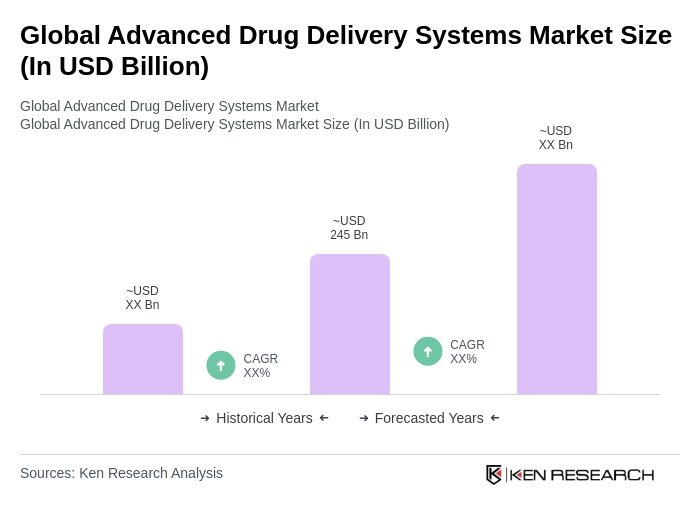
- The Global Advanced Drug Delivery Systems Market is valued at USD 277 billion, based on a five-year historical analysis. This growth is primarily driven by the increasing prevalence of chronic diseases, advancements in drug formulation technologies, and the rising demand for targeted and personalized therapies. The market is also influenced by the growing geriatric population, expansion of biologics pipelines, and the need for efficient drug delivery methods that enhance therapeutic efficacy and patient compliance. Notable technology trends include the adoption of nanocarriers, micro-reservoir implants, and 3D-printed dosage forms, which improve drug bioavailability and targeting precision .
- Key players in this market include the United States, Germany, and Japan, which dominate due to their strong pharmaceutical industries, significant investments in research and development, and robust healthcare infrastructure. North America, led by the United States, holds the largest market share, driven by rapid technology adoption, high healthcare spending, and a favorable regulatory environment. The presence of leading pharmaceutical companies and a high rate of innovation in drug delivery technologies further contribute to their market leadership .
- In 2023, the U.S. Food and Drug Administration (FDA) implemented the “Advanced Drug Delivery Systems Guidance for Industry” (FDA, 2023), which streamlines the approval process for innovative drug delivery technologies. This regulation mandates enhanced documentation of safety and efficacy for novel carriers, sets standards for nanotechnology-based and implantable systems, and encourages expedited review for therapies targeting unmet medical needs. The guidance has accelerated market access for advanced drug delivery products and fostered increased competition among pharmaceutical companies .
Global Advanced Drug Delivery Systems Market Segmentation
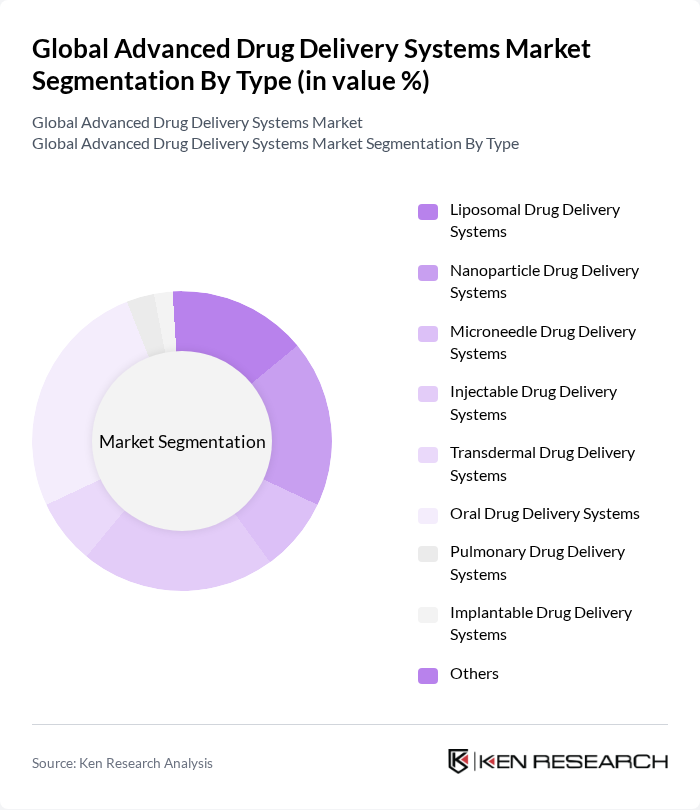
By Type:The advanced drug delivery systems market can be segmented into various types, including oral drug delivery systems, pulmonary drug delivery systems, transdermal drug delivery systems, parenteral (injectable) drug delivery systems, nanoparticle-based drug delivery systems, implantable drug delivery systems, microneedle drug delivery systems, liposomes and micelles, polymeric drug delivery systems, and others. Among these, oral drug delivery systems are the most widely used due to their convenience and patient compliance. The increasing demand for non-invasive delivery methods and the development of novel formulations, such as controlled-release tablets and microencapsulated drugs, are driving the growth of this segment. Nanoparticle-based and implantable systems are gaining traction for their ability to deliver biologics and gene therapies with high precision .
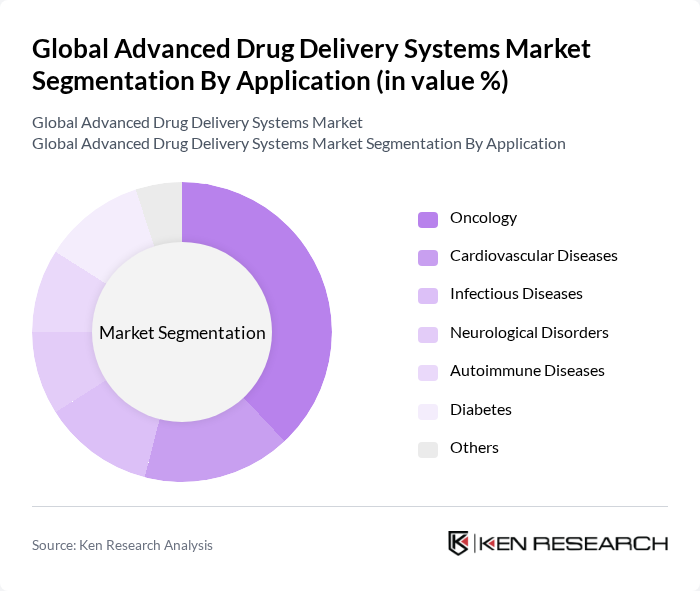
By Application:The applications of advanced drug delivery systems encompass various therapeutic areas, including oncology, cardiovascular diseases, infectious diseases, neurological disorders, diabetes management, autoimmune diseases, and others. The oncology segment is particularly dominant due to the increasing incidence of cancer and the need for targeted therapies that minimize side effects while maximizing treatment efficacy. The growing focus on personalized medicine, biologics, and the development of innovative drug formulations such as antibody-drug conjugates and nanoparticle-based chemotherapies are further propelling this segment's growth. Infectious diseases and diabetes management are also key areas, with advanced delivery systems improving adherence and outcomes .
Global Advanced Drug Delivery Systems Market Competitive Landscape
The Global Advanced Drug Delivery Systems Market is characterized by a dynamic mix of regional and international players. Leading participants such as Pfizer Inc., Johnson & Johnson, Roche Holding AG, Merck & Co., Inc., Amgen Inc., Novartis AG, Sanofi S.A., Gilead Sciences, Inc., AbbVie Inc., AstraZeneca PLC, Bayer AG, GlaxoSmithKline PLC, Eli Lilly and Company, Biogen Inc., Teva Pharmaceutical Industries Ltd., West Pharmaceutical Services, Inc., 3M Company, Becton, Dickinson and Company (BD), NeXstar Pharmaceuticals, Sequus Pharmaceuticals, Inc. contribute to innovation, geographic expansion, and service delivery in this space.
Global Advanced Drug Delivery Systems Market Industry Analysis
Growth Drivers
- Increasing Prevalence of Chronic Diseases:The rise in chronic diseases such as diabetes and cancer is a significant driver for advanced drug delivery systems. According to the World Health Organization, chronic diseases accounted for 71% of all deaths globally in future. This growing patient population necessitates innovative drug delivery solutions to enhance treatment efficacy and patient compliance.
- Advancements in Nanotechnology:The integration of nanotechnology in drug delivery systems is revolutionizing the pharmaceutical landscape. In future, the global nanotechnology market is expected to reach $125 billion, with significant investments directed towards developing nanoscale drug delivery systems. These advancements enable targeted therapy, reducing side effects and improving drug bioavailability, thus driving demand for sophisticated delivery mechanisms in the pharmaceutical industry.
- Growth in Biopharmaceuticals:The biopharmaceutical sector is experiencing rapid growth, with the global market projected to reach $500 billion by future. This surge is driven by the increasing number of biologics and biosimilars entering the market, which require advanced drug delivery systems for effective administration. The need for specialized delivery methods to enhance the stability and efficacy of these complex molecules is propelling the demand for innovative drug delivery technologies.
Market Challenges
- High Development Costs:The development of advanced drug delivery systems involves substantial financial investment, often exceeding $1 billion per new drug. This high cost is primarily due to extensive research and development phases, clinical trials, and regulatory compliance. As a result, many companies face financial constraints that limit their ability to innovate and bring new products to market, hindering overall industry growth.
- Stringent Regulatory Requirements:Regulatory bodies such as the FDA and EMA impose rigorous standards for drug delivery systems, which can delay product approvals. In future, the average time for drug approval is expected to remain around 10-15 years, significantly impacting the speed at which new technologies can be commercialized. These stringent regulations can deter investment and innovation in the advanced drug delivery sector, posing a challenge to market expansion.
Global Advanced Drug Delivery Systems Market Future Outlook
The future of advanced drug delivery systems is poised for transformative growth, driven by the increasing demand for personalized medicine and the integration of digital health technologies. As healthcare shifts towards more individualized treatment approaches, the need for tailored drug delivery solutions will intensify. Additionally, the rise of telehealth and remote monitoring will facilitate self-administration of drugs, enhancing patient engagement and adherence. These trends indicate a dynamic landscape where innovation and technology will play crucial roles in shaping the future of drug delivery systems.
Market Opportunities
- Expansion in Emerging Markets:Emerging markets present significant opportunities for advanced drug delivery systems, with healthcare spending projected to grow by 10% annually. Countries like India and Brazil are investing heavily in healthcare infrastructure, creating demand for innovative drug delivery solutions that cater to their unique healthcare challenges, thus opening new avenues for market players.
- Collaborations and Partnerships:Strategic collaborations between pharmaceutical companies and technology firms are becoming increasingly common. In future, partnerships aimed at developing novel drug delivery technologies are expected to rise, fostering innovation and accelerating product development. These collaborations can enhance resource sharing and expertise, driving advancements in drug delivery systems and expanding market reach.
Scope of the Report
| Segment | Sub-Segments |
|---|---|
| By Type | Oral drug delivery systems Pulmonary drug delivery systems Transdermal drug delivery systems Parenteral (injectable) drug delivery systems Nanoparticle-based drug delivery systems Implantable drug delivery systems Microneedle drug delivery systems Liposomes and micelles Polymeric drug delivery systems Others |
| By Application | Oncology Cardiovascular diseases Infectious diseases Neurological disorders Diabetes management Autoimmune diseases Others |
| By End-User | Hospitals Specialized clinics Home care settings Research & development centers Others |
| By Distribution Channel | Direct sales Distributors Online sales Retail pharmacies Others |
| By Region | North America (United States, Canada, Mexico) Europe (United Kingdom, Germany, France, Italy, Spain, Russia, Benelux, Nordics, Rest of Europe) Asia-Pacific (China, India, Japan, South Korea, ASEAN, Oceania, Rest of Asia Pacific) Latin America (Brazil, Argentina, Rest of Latin America) Middle East & Africa (Turkey, Israel, GCC, North Africa, South Africa, Rest of Middle East & Africa) |
| By Product Formulation | Injectable formulations Oral formulations Topical formulations Inhalable formulations Implantable formulations Others |
| By Payload Type | Small molecules Biologics Gene therapies RNA therapeutics Others |
Key Target Audience
Investors and Venture Capitalist Firms
Government and Regulatory Bodies (e.g., U.S. Food and Drug Administration, European Medicines Agency)
Pharmaceutical Manufacturers
Biotechnology Companies
Contract Research Organizations (CROs)
Healthcare Providers and Hospitals
Pharmaceutical Supply Chain Stakeholders
Insurance Companies and Payers
Players Mentioned in the Report:
Pfizer Inc.
Johnson & Johnson
Roche Holding AG
Merck & Co., Inc.
Amgen Inc.
Novartis AG
Sanofi S.A.
Gilead Sciences, Inc.
AbbVie Inc.
AstraZeneca PLC
Bayer AG
GlaxoSmithKline PLC
Eli Lilly and Company
Biogen Inc.
Teva Pharmaceutical Industries Ltd.
West Pharmaceutical Services, Inc.
3M Company
Becton, Dickinson and Company (BD)
NeXstar Pharmaceuticals
Sequus Pharmaceuticals, Inc.
Table of Contents
Market Assessment Phase
1. Executive Summary and Approach
2. Global Advanced Drug Delivery Systems Market Overview
2.1 Key Insights and Strategic Recommendations
2.2 Global Advanced Drug Delivery Systems Market Overview
2.3 Definition and Scope
2.4 Evolution of Market Ecosystem
2.5 Timeline of Key Regulatory Milestones
2.6 Value Chain & Stakeholder Mapping
2.7 Business Cycle Analysis
2.8 Policy & Incentive Landscape
3. Global Advanced Drug Delivery Systems Market Analysis
3.1 Growth Drivers
3.1.1 Increasing prevalence of chronic diseases
3.1.2 Advancements in nanotechnology
3.1.3 Rising demand for targeted drug delivery
3.1.4 Growth in biopharmaceuticals
3.2 Market Challenges
3.2.1 High development costs
3.2.2 Stringent regulatory requirements
3.2.3 Complex manufacturing processes
3.2.4 Market competition and pricing pressures
3.3 Market Opportunities
3.3.1 Expansion in emerging markets
3.3.2 Collaborations and partnerships
3.3.3 Innovations in drug formulation
3.3.4 Increasing investment in R&D
3.4 Market Trends
3.4.1 Growth of personalized medicine
3.4.2 Integration of digital health technologies
3.4.3 Shift towards self-administration of drugs
3.4.4 Focus on sustainability in drug delivery
3.5 Government Regulation
3.5.1 FDA guidelines on drug delivery systems
3.5.2 EMA regulations for biopharmaceuticals
3.5.3 Health Canada compliance requirements
3.5.4 WHO standards for drug delivery technologies
4. SWOT Analysis
5. Stakeholder Analysis
6. Porter's Five Forces Analysis
7. Global Advanced Drug Delivery Systems Market Market Size, 2019-2024
7.1 By Value
7.2 By Volume
7.3 By Average Selling Price
8. Global Advanced Drug Delivery Systems Market Segmentation
8.1 By Type
8.1.1 Oral drug delivery systems
8.1.2 Pulmonary drug delivery systems
8.1.3 Transdermal drug delivery systems
8.1.4 Parenteral (injectable) drug delivery systems
8.1.5 Nanoparticle-based drug delivery systems
8.1.6 Implantable drug delivery systems
8.1.7 Microneedle drug delivery systems
8.1.8 Liposomes and micelles
8.1.9 Polymeric drug delivery systems
8.1.10 Others
8.2 By Application
8.2.1 Oncology
8.2.2 Cardiovascular diseases
8.2.3 Infectious diseases
8.2.4 Neurological disorders
8.2.5 Diabetes management
8.2.6 Autoimmune diseases
8.2.7 Others
8.3 By End-User
8.3.1 Hospitals
8.3.2 Specialized clinics
8.3.3 Home care settings
8.3.4 Research & development centers
8.3.5 Others
8.4 By Distribution Channel
8.4.1 Direct sales
8.4.2 Distributors
8.4.3 Online sales
8.4.4 Retail pharmacies
8.4.5 Others
8.5 By Region
8.5.1 North America (United States, Canada, Mexico)
8.5.2 Europe (United Kingdom, Germany, France, Italy, Spain, Russia, Benelux, Nordics, Rest of Europe)
8.5.3 Asia-Pacific (China, India, Japan, South Korea, ASEAN, Oceania, Rest of Asia Pacific)
8.5.4 Latin America (Brazil, Argentina, Rest of Latin America)
8.5.5 Middle East & Africa (Turkey, Israel, GCC, North Africa, South Africa, Rest of Middle East & Africa)
8.6 By Product Formulation
8.6.1 Injectable formulations
8.6.2 Oral formulations
8.6.3 Topical formulations
8.6.4 Inhalable formulations
8.6.5 Implantable formulations
8.6.6 Others
8.7 By Payload Type
8.7.1 Small molecules
8.7.2 Biologics
8.7.3 Gene therapies
8.7.4 RNA therapeutics
8.7.5 Others
9. Global Advanced Drug Delivery Systems Market Competitive Analysis
9.1 Market Share of Key Players
9.2 Cross Comparison of Key Players
9.2.1 Company Name
9.2.2 Group Size (Large, Medium, or Small as per industry convention)
9.2.3 Revenue Growth Rate
9.2.4 Market Penetration Rate
9.2.5 R&D Intensity (R&D spend as % of revenue)
9.2.6 Product Portfolio Breadth (number of advanced drug delivery platforms)
9.2.7 Regulatory Approval Success Rate
9.2.8 Geographic Reach (number of countries/regions served)
9.2.9 Strategic Partnerships & Collaborations
9.2.10 Intellectual Property Strength (number of patents granted/pending)
9.2.11 Manufacturing Capacity Utilization
9.2.12 Innovation Index
9.2.13 Customer Retention Rate
9.2.14 Pricing Strategy
9.2.15 Distribution Efficiency
9.3 SWOT Analysis of Top Players
9.4 Pricing Analysis
9.5 Detailed Profile of Major Companies
9.5.1 Pfizer Inc.
9.5.2 Johnson & Johnson
9.5.3 Roche Holding AG
9.5.4 Merck & Co., Inc.
9.5.5 Amgen Inc.
9.5.6 Novartis AG
9.5.7 Sanofi S.A.
9.5.8 Gilead Sciences, Inc.
9.5.9 AbbVie Inc.
9.5.10 AstraZeneca PLC
9.5.11 Bayer AG
9.5.12 GlaxoSmithKline PLC
9.5.13 Eli Lilly and Company
9.5.14 Biogen Inc.
9.5.15 Teva Pharmaceutical Industries Ltd.
9.5.16 West Pharmaceutical Services, Inc.
9.5.17 3M Company
9.5.18 Becton, Dickinson and Company (BD)
9.5.19 NeXstar Pharmaceuticals
9.5.20 Sequus Pharmaceuticals, Inc.
10. Global Advanced Drug Delivery Systems Market End-User Analysis
10.1 Procurement Behavior of Key Ministries
10.1.1 Government healthcare procurement policies
10.1.2 Budget allocation for drug delivery systems
10.1.3 Evaluation criteria for suppliers
10.1.4 Contracting processes and timelines
10.2 Corporate Spend on Infrastructure & Energy
10.2.1 Investment in healthcare infrastructure
10.2.2 Funding for advanced drug delivery technologies
10.2.3 Partnerships with technology providers
10.3 Pain Point Analysis by End-User Category
10.3.1 Challenges in drug administration
10.3.2 Issues with patient compliance
10.3.3 Need for cost-effective solutions
10.4 User Readiness for Adoption
10.4.1 Awareness of advanced drug delivery systems
10.4.2 Training requirements for healthcare professionals
10.4.3 Infrastructure readiness for implementation
10.5 Post-Deployment ROI and Use Case Expansion
10.5.1 Measurement of treatment outcomes
10.5.2 Cost savings analysis
10.5.3 Opportunities for scaling solutions
11. Global Advanced Drug Delivery Systems Market Future Size, 2025-2030
11.1 By Value
11.2 By Volume
11.3 By Average Selling Price
Go-To-Market Strategy Phase
1. Whitespace Analysis + Business Model Canvas
1.1 Market gaps and opportunities
1.2 Value proposition development
1.3 Revenue model identification
1.4 Key partnerships and resources
1.5 Customer segments and relationships
2. Marketing and Positioning Recommendations
2.1 Branding strategies
2.2 Product USPs
2.3 Target audience identification
2.4 Communication strategies
3. Distribution Plan
3.1 Urban retail strategies
3.2 Rural NGO tie-ups
3.3 Online distribution channels
3.4 Partnerships with healthcare providers
4. Channel & Pricing Gaps
4.1 Underserved routes
4.2 Pricing bands analysis
4.3 Competitor pricing strategies
5. Unmet Demand & Latent Needs
5.1 Category gaps
5.2 Consumer segments analysis
5.3 Emerging trends and needs
6. Customer Relationship
6.1 Loyalty programs
6.2 After-sales service
6.3 Customer feedback mechanisms
7. Value Proposition
7.1 Sustainability initiatives
7.2 Integrated supply chains
7.3 Competitive advantages
8. Key Activities
8.1 Regulatory compliance
8.2 Branding efforts
8.3 Distribution setup
9. Entry Strategy Evaluation
9.1 Domestic Market Entry Strategy
9.1.1 Product mix considerations
9.1.2 Pricing band strategies
9.1.3 Packaging innovations
9.2 Export Entry Strategy
9.2.1 Target countries analysis
9.2.2 Compliance roadmap development
10. Entry Mode Assessment
10.1 Joint Ventures
10.2 Greenfield investments
10.3 Mergers & Acquisitions
10.4 Distributor Model
11. Capital and Timeline Estimation
11.1 Capital requirements
11.2 Timelines for market entry
12. Control vs Risk Trade-Off
12.1 Ownership considerations
12.2 Partnerships evaluation
13. Profitability Outlook
13.1 Breakeven analysis
13.2 Long-term sustainability strategies
14. Potential Partner List
14.1 Distributors
14.2 Joint Ventures
14.3 Acquisition targets
15. Execution Roadmap
15.1 Phased Plan for Market Entry
15.1.1 Market Setup
15.1.2 Market Entry
15.1.3 Growth Acceleration
15.1.4 Scale & Stabilize
15.2 Key Activities and Milestones
15.2.1 Milestone tracking
15.2.2 Activity scheduling
Research Methodology
Phase 1: Approach1
Desk Research
- Analysis of industry reports from pharmaceutical associations and market research firms
- Review of scientific literature and publications on advanced drug delivery technologies
- Examination of regulatory guidelines and frameworks from health authorities like FDA and EMA
Primary Research
- Interviews with R&D heads at pharmaceutical companies focusing on drug delivery systems
- Surveys with healthcare professionals and pharmacists regarding drug delivery preferences
- Field interviews with technology developers and innovators in drug delivery systems
Validation & Triangulation
- Cross-validation of findings through multiple data sources including market reports and expert opinions
- Triangulation of quantitative data with qualitative insights from industry experts
- Sanity checks through peer reviews and expert panel discussions
Phase 2: Market Size Estimation1
Top-down Assessment
- Estimation of market size based on global pharmaceutical spending and drug delivery system adoption rates
- Segmentation by therapeutic area and delivery method (e.g., oral, injectable, transdermal)
- Incorporation of trends in personalized medicine and biologics impacting market growth
Bottom-up Modeling
- Collection of sales data from leading manufacturers of drug delivery systems
- Estimation of market share based on product types and geographical distribution
- Volume and pricing analysis to derive revenue projections for each segment
Forecasting & Scenario Analysis
- Multi-variable forecasting using historical growth rates and emerging market trends
- Scenario analysis based on potential regulatory changes and technological advancements
- Development of baseline, optimistic, and pessimistic market forecasts through 2030
Phase 3: CATI Sample Composition1
| Scope Item/Segment | Sample Size | Target Respondent Profiles |
|---|---|---|
| Pharmaceutical Manufacturers | 100 | R&D Directors, Product Managers |
| Healthcare Providers | 80 | Pharmacists, Physicians |
| Regulatory Bodies | 40 | Regulatory Affairs Specialists, Compliance Officers |
| Technology Developers | 60 | Innovation Managers, Technical Leads |
| Market Analysts | 50 | Market Research Analysts, Industry Consultants |
Frequently Asked Questions
What is the current value of the Global Advanced Drug Delivery Systems Market?
The Global Advanced Drug Delivery Systems Market is valued at approximately USD 277 billion, driven by factors such as the increasing prevalence of chronic diseases, advancements in drug formulation technologies, and the rising demand for targeted and personalized therapies.
What are the key drivers of growth in the Advanced Drug Delivery Systems Market?
Which regions dominate the Advanced Drug Delivery Systems Market?
What types of drug delivery systems are included in the market segmentation?
Other Regional/Country Reports
Indonesia Advanced Drug Delivery Systems Market
Malaysia Advanced Drug Delivery Systems Market
APAC Advanced Drug Delivery Systems Market
SEA Advanced Drug Delivery Systems Market
Other Adjacent Reports
Singapore Nanotechnology in Healthcare Market
US personalized medicine market Size, Share, Growth Drivers, Trends, Opportunities & Forecast 2025–2030Egypt Oncology Therapeutics Market
UAE Cardiovascular Drug Delivery Market
South Korea Injectable Devices Market
KSA Implantable Drug Systems Market
Kuwait Gene Therapy Market Report Size Share Growth Drivers Trends Opportunities & Forecast 2025–2030Kuwait biosimilars market Size, Share, Growth Drivers, Trends, Opportunities & Forecast 2025–2030Middle East pharmaceutical packaging market size, share, growth drivers, trends, opportunities & forecast 2025–2030Why Buy From Us?

What makes us stand out is that our consultants follow Robust, Refine and Result (RRR) methodology. Robust for clear definitions, approaches and sanity checking, Refine for differentiating respondents' facts and opinions, and Result for presenting data with story.

We have set a benchmark in the industry by offering our clients with syndicated and customized market research reports featuring coverage of entire market as well as meticulous research and analyst insights.

While we don't replace traditional research, we flip the method upside down. Our dual approach of Top Bottom & Bottom Top ensures quality deliverable by not just verifying company fundamentals but also looking at the sector and macroeconomic factors.

With one step in the future, our research team constantly tries to show you the bigger picture. We help with some of the tough questions you may encounter along the way: How is the industry positioned? Best marketing channel? KPI's of competitors? By aligning every element, we help maximize success.

Our report gives you instant access to the answers and sources that other companies might choose to hide. We elaborate each steps of research methodology we have used and showcase you the sample size to earn your trust.

If you need any support, we are here! We pride ourselves on universe strength, data quality, and quick, friendly, and professional service.