About the Report
Base Year 2024Global Algorithmic Trading Market Overview
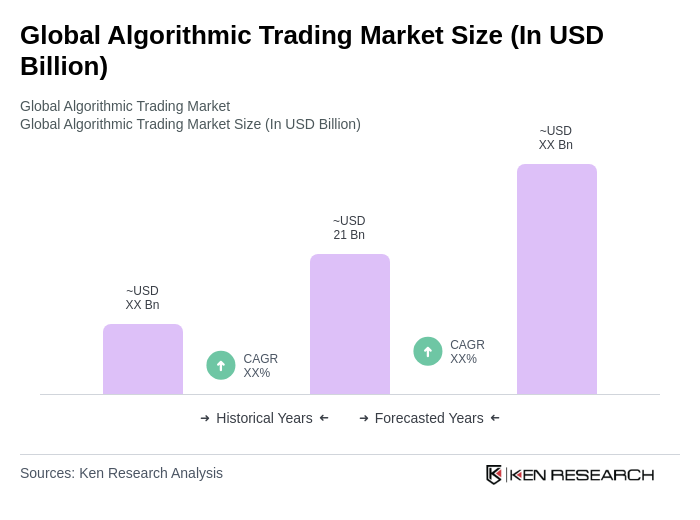
- The Global Algorithmic Trading Market is valued at USD 21 billion, based on a five-year historical analysis. This level aligns with independent industry estimates that place the market in the low-twenties billion range and reflects the expansion driven by institutional adoption and broader electronic trading penetration. AI/ML integration into execution and strategy design, low-latency infrastructure, and advanced data analytics are core drivers enhancing strategy performance and execution efficiency.
- Key players in this market include major financial hubs such as New York, London, and Hong Kong. These hubs dominate due to deep capital markets, dense trading venue connectivity, prime brokerage and clearing ecosystems, and concentration of quantitative talent and vendors that support algorithmic and high?frequency trading.
- In 2023, the U.S. Securities and Exchange Commission advanced multiple transparency and market-structure rulemakings affecting electronic and algorithmic trading, including enhanced order competition via an auction mechanism proposal, updates to Regulation NMS (tick sizes, access fees, and odd-lot transparency), and strengthened best?execution requirements; however, there is no SEC rule that requires firms to disclose their algorithms’ performance metrics. The SEC’s actions focused on market quality, competition, and disclosures around order handling rather than mandating publication of algorithm performance.
Global Algorithmic Trading Market Segmentation
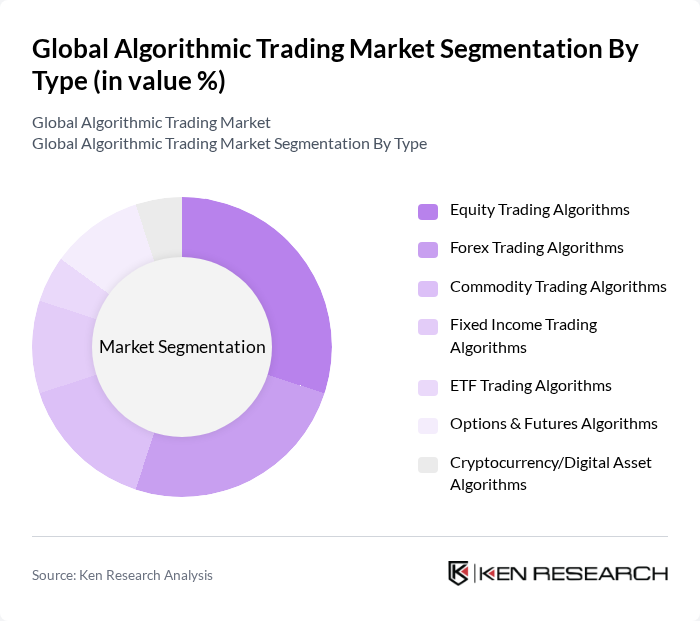
By Type:The algorithmic trading market is segmented into various types, including Equity Trading Algorithms, Forex Trading Algorithms, Commodity Trading Algorithms, Fixed Income Trading Algorithms, ETF Trading Algorithms, Options & Futures Algorithms, and Cryptocurrency/Digital Asset Algorithms. Each of these sub-segments caters to different trading needs and strategies, with varying levels of complexity and market focus.
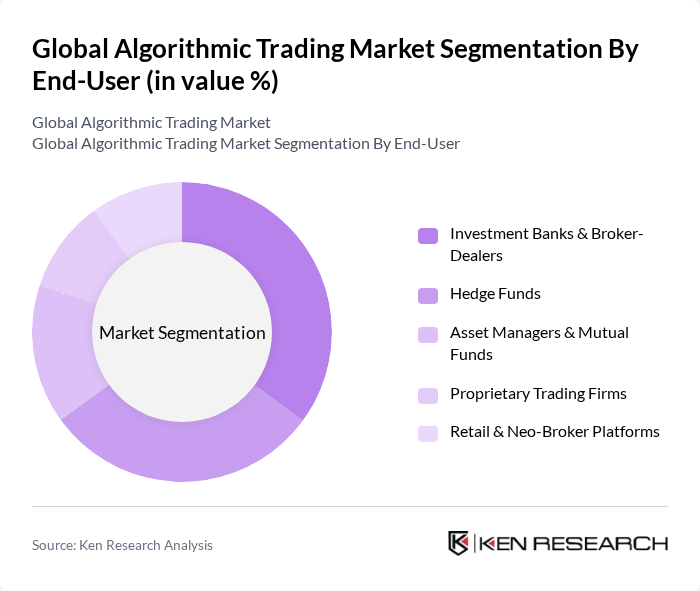
By End-User:The end-user segmentation of the algorithmic trading market includes Investment Banks & Broker-Dealers, Hedge Funds, Asset Managers & Mutual Funds, Proprietary Trading Firms, and Retail & Neo-Broker Platforms. Each of these segments utilizes algorithmic trading to optimize their trading strategies and improve operational efficiency.
Global Algorithmic Trading Market Competitive Landscape
The Global Algorithmic Trading Market is characterized by a dynamic mix of regional and international players. Leading participants such as Bloomberg L.P., Citadel Securities, Jane Street, Two Sigma Securities, Renaissance Technologies, DRW, Optiver, Hudson River Trading, IMC, Jump Trading, Tower Research Capital, Flow Traders, XTX Markets, Millennium Management, Virtu Financial, Citigroup (Citi) – Execution Services, Goldman Sachs – Electronic Trading, JPMorgan – Execution Services, UBS – Algorithmic Execution, Morgan Stanley – Electronic Trading, Deutsche Bank – Autobahn/Execution, Barclays – Electronic Trading, Credit Suisse (AES legacy, now UBS integration), Instinet (Nomura), ITG (Virtu) – POSIT, Cboe Global Markets – Cboe Silexx, Nasdaq – Trade Execution & Analytics, LSEG/Refinitiv – EMS/Algo tools, FlexTrade Systems, Trading Technologies (TT) contribute to innovation, geographic expansion, and service delivery in this space.
Global Algorithmic Trading Market Industry Analysis
Growth Drivers
- Increased Market Volatility:The global financial markets have experienced significant volatility, with the VIX index averaging 20.5 in future, compared to 18.2 in future. This volatility drives demand for algorithmic trading as investors seek to capitalize on rapid price movements. According to the World Bank, the global stock market capitalization reached $109 trillion in future, indicating a robust environment for algorithmic trading strategies that can exploit short-term fluctuations effectively.
- Advancements in Technology:The rapid evolution of technology, particularly in computing power and data analytics, has transformed algorithmic trading. In future, the global AI market is projected to reach $1.4 trillion, with significant investments in machine learning algorithms that enhance trading strategies. Additionally, the availability of high-speed internet and cloud computing solutions has enabled traders to execute complex algorithms in real-time, improving efficiency and accuracy in trading operations.
- Demand for High-Frequency Trading:High-frequency trading (HFT) has surged, with estimates indicating that HFT accounts for approximately 50% of all equity trading volume in the U.S. markets in future. This demand is driven by the need for speed and efficiency in executing trades, as firms leverage sophisticated algorithms to gain competitive advantages. The increasing complexity of financial instruments further fuels the need for advanced algorithmic trading solutions that can process vast amounts of data quickly.
Market Challenges
- High Initial Investment Costs:The entry barriers for algorithmic trading are significant, with initial setup costs often exceeding $1 million for firms looking to implement advanced trading systems. This includes expenses for technology infrastructure, data acquisition, and compliance measures. Smaller firms may struggle to justify these costs, limiting their ability to compete in a market increasingly dominated by larger players with more resources.
- Regulatory Compliance Issues:Navigating the complex regulatory landscape poses a significant challenge for algorithmic trading firms. In future, compliance costs are estimated to reach $5 billion for the industry globally, driven by stringent regulations such as MiFID II in Europe and SEC guidelines in the U.S. Firms must invest heavily in compliance technology and legal expertise to avoid penalties, which can divert resources from innovation and growth.
Global Algorithmic Trading Market Future Outlook
The future of algorithmic trading is poised for transformative growth, driven by technological advancements and evolving market dynamics. As firms increasingly adopt AI and machine learning, the sophistication of trading algorithms will enhance decision-making processes. Additionally, the integration of blockchain technology is expected to streamline operations and improve transparency. The rise of retail investors engaging in algorithmic trading will further diversify the market, creating new opportunities for innovation and competition among trading platforms.
Market Opportunities
- Expansion into Emerging Markets:Emerging markets present significant growth opportunities for algorithmic trading, with countries like India and Brazil experiencing rapid financial market development. In future, the Indian stock market capitalization is projected to reach $3 trillion, indicating a growing appetite for sophisticated trading solutions that can cater to local investors and institutions.
- Development of AI-Driven Algorithms:The increasing reliance on AI-driven algorithms offers a substantial opportunity for firms to enhance trading strategies. With the global AI software market expected to grow to $126 billion in future, firms that invest in developing proprietary algorithms can gain a competitive edge, optimizing trading performance and improving risk management capabilities.
Scope of the Report
| Segment | Sub-Segments |
|---|---|
| By Type | Equity Trading Algorithms Forex Trading Algorithms Commodity Trading Algorithms Fixed Income Trading Algorithms ETF Trading Algorithms Options & Futures Algorithms Cryptocurrency/Digital Asset Algorithms |
| By End-User | Investment Banks & Broker-Dealers Hedge Funds Asset Managers & Mutual Funds Proprietary Trading Firms Retail & Neo-Broker Platforms |
| By Trading Strategy | Trend Following Mean Reversion Statistical Arbitrage Market Making & Liquidity Provision Momentum & Execution (VWAP/TWAP/POV) News/Sentiment and Event-Driven |
| By Deployment Mode | On-Premises/Colocation Cloud/SaaS |
| By Region | North America Europe Asia-Pacific Latin America Middle East & Africa |
| By Asset Class | Equities Fixed Income Derivatives Foreign Exchange Exchange-Traded Funds (ETFs) Digital Assets/Crypto |
| By Regulatory Compliance | MiFID II (EU) SEC/CFTC (US) FCA (UK) ASIC (Australia) MAS (Singapore) Others |
Key Target Audience
Investors and Venture Capitalist Firms
Government and Regulatory Bodies (e.g., Securities and Exchange Commission, Commodity Futures Trading Commission)
Hedge Funds and Asset Management Firms
Brokerage Firms and Trading Platforms
Financial Technology (FinTech) Companies
Market Makers and Proprietary Trading Firms
Investment Banks
Data Providers and Analytics Firms
Players Mentioned in the Report:
Bloomberg L.P.
Citadel Securities
Jane Street
Two Sigma Securities
Renaissance Technologies
DRW
Optiver
Hudson River Trading
IMC
Jump Trading
Tower Research Capital
Flow Traders
XTX Markets
Millennium Management
Virtu Financial
Citigroup (Citi) Execution Services
Goldman Sachs Electronic Trading
JPMorgan Execution Services
UBS Algorithmic Execution
Morgan Stanley Electronic Trading
Deutsche Bank Autobahn/Execution
Barclays Electronic Trading
Credit Suisse (AES legacy, now UBS integration)
Instinet (Nomura)
ITG (Virtu) POSIT
Cboe Global Markets Cboe Silexx
Nasdaq Trade Execution & Analytics
LSEG/Refinitiv EMS/Algo tools
FlexTrade Systems
Trading Technologies (TT)
Table of Contents
Market Assessment Phase
1. Executive Summary and Approach
2. Global Algorithmic Trading Market Overview
2.1 Key Insights and Strategic Recommendations
2.2 Global Algorithmic Trading Market Overview
2.3 Definition and Scope
2.4 Evolution of Market Ecosystem
2.5 Timeline of Key Regulatory Milestones
2.6 Value Chain & Stakeholder Mapping
2.7 Business Cycle Analysis
2.8 Policy & Incentive Landscape
3. Global Algorithmic Trading Market Analysis
3.1 Growth Drivers
3.1.1 Increased Market Volatility
3.1.2 Advancements in Technology
3.1.3 Demand for High-Frequency Trading
3.1.4 Regulatory Changes Favoring Algorithmic Trading
3.2 Market Challenges
3.2.1 High Initial Investment Costs
3.2.2 Regulatory Compliance Issues
3.2.3 Cybersecurity Threats
3.2.4 Market Manipulation Concerns
3.3 Market Opportunities
3.3.1 Expansion into Emerging Markets
3.3.2 Development of AI-Driven Algorithms
3.3.3 Partnerships with Financial Institutions
3.3.4 Integration of Blockchain Technology
3.4 Market Trends
3.4.1 Rise of Retail Algorithmic Trading
3.4.2 Increased Use of Machine Learning
3.4.3 Growth of Cloud-Based Trading Solutions
3.4.4 Focus on ESG Factors in Trading Algorithms
3.5 Government Regulation
3.5.1 MiFID II Compliance in Europe
3.5.2 SEC Regulations in the United States
3.5.3 ASIC Guidelines in Australia
3.5.4 FCA Regulations in the UK
4. SWOT Analysis
5. Stakeholder Analysis
6. Porter's Five Forces Analysis
7. Global Algorithmic Trading Market Market Size, 2019-2024
7.1 By Value
7.2 By Volume
7.3 By Average Selling Price
8. Global Algorithmic Trading Market Segmentation
8.1 By Type
8.1.1 Equity Trading Algorithms
8.1.2 Forex Trading Algorithms
8.1.3 Commodity Trading Algorithms
8.1.4 Fixed Income Trading Algorithms
8.1.5 ETF Trading Algorithms
8.1.6 Options & Futures Algorithms
8.1.7 Cryptocurrency/Digital Asset Algorithms
8.2 By End-User
8.2.1 Investment Banks & Broker-Dealers
8.2.2 Hedge Funds
8.2.3 Asset Managers & Mutual Funds
8.2.4 Proprietary Trading Firms
8.2.5 Retail & Neo-Broker Platforms
8.3 By Trading Strategy
8.3.1 Trend Following
8.3.2 Mean Reversion
8.3.3 Statistical Arbitrage
8.3.4 Market Making & Liquidity Provision
8.3.5 Momentum & Execution (VWAP/TWAP/POV)
8.3.6 News/Sentiment and Event-Driven
8.4 By Deployment Mode
8.4.1 On-Premises/Colocation
8.4.2 Cloud/SaaS
8.5 By Region
8.5.1 North America
8.5.2 Europe
8.5.3 Asia-Pacific
8.5.4 Latin America
8.5.5 Middle East & Africa
8.6 By Asset Class
8.6.1 Equities
8.6.2 Fixed Income
8.6.3 Derivatives
8.6.4 Foreign Exchange
8.6.5 Exchange-Traded Funds (ETFs)
8.6.6 Digital Assets/Crypto
8.7 By Regulatory Compliance
8.7.1 MiFID II (EU)
8.7.2 SEC/CFTC (US)
8.7.3 FCA (UK)
8.7.4 ASIC (Australia)
8.7.5 MAS (Singapore)
8.7.6 Others
9. Global Algorithmic Trading Market Competitive Analysis
9.1 Market Share of Key Players
9.2 Cross Comparison of Key Players
9.2.1 Company Name
9.2.2 Business Model (Broker/ECN, Market Maker, Prop Trading, Asset Manager, Tech Vendor)
9.2.3 Estimated Trading Volume/ADV (by asset class)
9.2.4 Market Coverage (regions, venues, instruments)
9.2.5 Latency/Execution Metrics (ms, fill rate, slippage)
9.2.6 Client Segments (buy-side, sell-side, retail)
9.2.7 Pricing Model (commission, spread, subscription/SaaS)
9.2.8 Revenue and YoY Growth
9.2.9 Algorithm Performance KPIs (alpha, Sharpe, hit ratio, capacity)
9.2.10 Compliance & Risk KPIs (regulatory audits passed, kill-switch/controls, uptime %)
9.2.11 Technology Stack (colocation, cloud, FPGA, AI/ML capabilities)
9.2.12 R&D Intensity (% of revenue)
9.3 SWOT Analysis of Top Players
9.4 Pricing Analysis
9.5 Detailed Profile of Major Companies
9.5.1 Bloomberg L.P.
9.5.2 Citadel Securities
9.5.3 Jane Street
9.5.4 Two Sigma Securities
9.5.5 Renaissance Technologies
9.5.6 DRW
9.5.7 Optiver
9.5.8 Hudson River Trading
9.5.9 IMC
9.5.10 Jump Trading
9.5.11 Tower Research Capital
9.5.12 Flow Traders
9.5.13 XTX Markets
9.5.14 Millennium Management
9.5.15 Virtu Financial
9.5.16 Citigroup (Citi) – Execution Services
9.5.17 Goldman Sachs – Electronic Trading
9.5.18 JPMorgan – Execution Services
9.5.19 UBS – Algorithmic Execution
9.5.20 Morgan Stanley – Electronic Trading
9.5.21 Deutsche Bank – Autobahn/Execution
9.5.22 Barclays – Electronic Trading
9.5.23 Credit Suisse (AES legacy, now UBS integration)
9.5.24 Instinet (Nomura)
9.5.25 ITG (Virtu) – POSIT
9.5.26 Cboe Global Markets – Cboe Silexx
9.5.27 Nasdaq – Trade Execution & Analytics
9.5.28 LSEG/Refinitiv – EMS/Algo tools
9.5.29 FlexTrade Systems
9.5.30 Trading Technologies (TT)
10. Global Algorithmic Trading Market End-User Analysis
10.1 Procurement Behavior of Key Ministries
10.1.1 Budget Allocation Trends
10.1.2 Decision-Making Processes
10.1.3 Vendor Selection Criteria
10.2 Corporate Spend on Infrastructure & Energy
10.2.1 Investment in Trading Infrastructure
10.2.2 Spending on Technology Upgrades
10.2.3 Budget for Compliance and Risk Management
10.3 Pain Point Analysis by End-User Category
10.3.1 Data Management Challenges
10.3.2 Algorithm Performance Issues
10.3.3 Regulatory Compliance Difficulties
10.4 User Readiness for Adoption
10.4.1 Training and Skill Development Needs
10.4.2 Technology Adoption Barriers
10.4.3 Support and Maintenance Requirements
10.5 Post-Deployment ROI and Use Case Expansion
10.5.1 Measurement of Trading Performance
10.5.2 Scalability of Algorithms
10.5.3 Long-Term Value Realization
11. Global Algorithmic Trading Market Future Size, 2025-2030
11.1 By Value
11.2 By Volume
11.3 By Average Selling Price
Go-To-Market Strategy Phase
1. Whitespace Analysis + Business Model Canvas
1.1 Market Gaps Identification
1.2 Value Proposition Development
1.3 Revenue Streams Analysis
1.4 Cost Structure Evaluation
1.5 Key Partnerships Exploration
1.6 Customer Segmentation
1.7 Channels of Distribution
2. Marketing and Positioning Recommendations
2.1 Branding Strategies
2.2 Product USPs
2.3 Target Market Identification
2.4 Communication Strategies
2.5 Digital Marketing Approaches
3. Distribution Plan
3.1 Urban Retail Strategies
3.2 Rural NGO Tie-Ups
3.3 Online Distribution Channels
3.4 Direct Sales Approaches
4. Channel & Pricing Gaps
4.1 Underserved Routes
4.2 Pricing Bands Analysis
4.3 Competitor Pricing Strategies
5. Unmet Demand & Latent Needs
5.1 Category Gaps
5.2 Consumer Segments Analysis
5.3 Emerging Trends Identification
6. Customer Relationship
6.1 Loyalty Programs
6.2 After-Sales Service
6.3 Customer Feedback Mechanisms
7. Value Proposition
7.1 Sustainability Initiatives
7.2 Integrated Supply Chains
7.3 Competitive Advantages
8. Key Activities
8.1 Regulatory Compliance
8.2 Branding Efforts
8.3 Distribution Setup
9. Entry Strategy Evaluation
9.1 Domestic Market Entry Strategy
9.1.1 Product Mix Considerations
9.1.2 Pricing Band Strategies
9.1.3 Packaging Options
9.2 Export Entry Strategy
9.2.1 Target Countries
9.2.2 Compliance Roadmap
10. Entry Mode Assessment
10.1 Joint Ventures
10.2 Greenfield Investments
10.3 Mergers & Acquisitions
10.4 Distributor Model
11. Capital and Timeline Estimation
11.1 Capital Requirements
11.2 Timelines for Implementation
12. Control vs Risk Trade-Off
12.1 Ownership vs Partnerships
13. Profitability Outlook
13.1 Breakeven Analysis
13.2 Long-Term Sustainability
14. Potential Partner List
14.1 Distributors
14.2 Joint Ventures
14.3 Acquisition Targets
15. Execution Roadmap
15.1 Phased Plan for Market Entry
15.1.1 Market Setup
15.1.2 Market Entry
15.1.3 Growth Acceleration
15.1.4 Scale & Stabilize
15.2 Key Activities and Milestones
15.2.1 Milestone Planning
15.2.2 Activity Tracking
Research Methodology
Phase 1: Approach1
Desk Research
- Analysis of market reports from financial institutions and trading platforms
- Review of academic journals and white papers on algorithmic trading strategies
- Examination of regulatory frameworks and compliance guidelines from financial authorities
Primary Research
- Interviews with quantitative analysts and algorithm developers in hedge funds
- Surveys with institutional investors and asset managers utilizing algorithmic trading
- Field interviews with technology providers specializing in trading algorithms
Validation & Triangulation
- Cross-validation of findings through multiple data sources including market trends and expert opinions
- Triangulation of quantitative data with qualitative insights from industry experts
- Sanity checks through peer reviews and expert panel discussions
Phase 2: Market Size Estimation1
Top-down Assessment
- Estimation of total trading volume across major exchanges globally
- Segmentation of algorithmic trading by asset class and geographical region
- Incorporation of growth rates from historical data and market forecasts
Bottom-up Modeling
- Analysis of transaction costs and fees associated with algorithmic trading
- Volume estimates based on trading activity from leading financial institutions
- Cost modeling based on technology investments and operational expenditures
Forecasting & Scenario Analysis
- Multi-variable regression analysis incorporating market volatility and technological advancements
- Scenario planning based on regulatory changes and market adoption rates
- Development of baseline, optimistic, and pessimistic forecasts through 2030
Phase 3: CATI Sample Composition1
| Scope Item/Segment | Sample Size | Target Respondent Profiles |
|---|---|---|
| Institutional Algorithmic Trading | 120 | Portfolio Managers, Quantitative Analysts |
| Retail Algorithmic Trading Platforms | 90 | Retail Traders, Financial Advisors |
| High-Frequency Trading Firms | 80 | Trading Strategists, Risk Managers |
| Algorithmic Trading Technology Providers | 70 | Product Managers, Software Engineers |
| Regulatory Compliance in Algorithmic Trading | 60 | Compliance Officers, Legal Advisors |
Frequently Asked Questions
What is the current value of the Global Algorithmic Trading Market?
The Global Algorithmic Trading Market is valued at approximately USD 21 billion, reflecting significant growth driven by institutional adoption and advancements in technology, particularly in AI and machine learning integration for trading strategies.
What are the main drivers of growth in the algorithmic trading market?
Which regions dominate the Global Algorithmic Trading Market?
What types of algorithms are used in algorithmic trading?
Other Regional/Country Reports
Indonesia Algorithmic Trading Market
Malaysia Algorithmic Trading Market
APAC Algorithmic Trading Market
Why Buy From Us?

What makes us stand out is that our consultants follow Robust, Refine and Result (RRR) methodology. Robust for clear definitions, approaches and sanity checking, Refine for differentiating respondents' facts and opinions, and Result for presenting data with story.

We have set a benchmark in the industry by offering our clients with syndicated and customized market research reports featuring coverage of entire market as well as meticulous research and analyst insights.

While we don't replace traditional research, we flip the method upside down. Our dual approach of Top Bottom & Bottom Top ensures quality deliverable by not just verifying company fundamentals but also looking at the sector and macroeconomic factors.

With one step in the future, our research team constantly tries to show you the bigger picture. We help with some of the tough questions you may encounter along the way: How is the industry positioned? Best marketing channel? KPI's of competitors? By aligning every element, we help maximize success.

Our report gives you instant access to the answers and sources that other companies might choose to hide. We elaborate each steps of research methodology we have used and showcase you the sample size to earn your trust.

If you need any support, we are here! We pride ourselves on universe strength, data quality, and quick, friendly, and professional service.