About the Report
Base Year 2024Listen to the audio summary
Global Antacids Market Overview
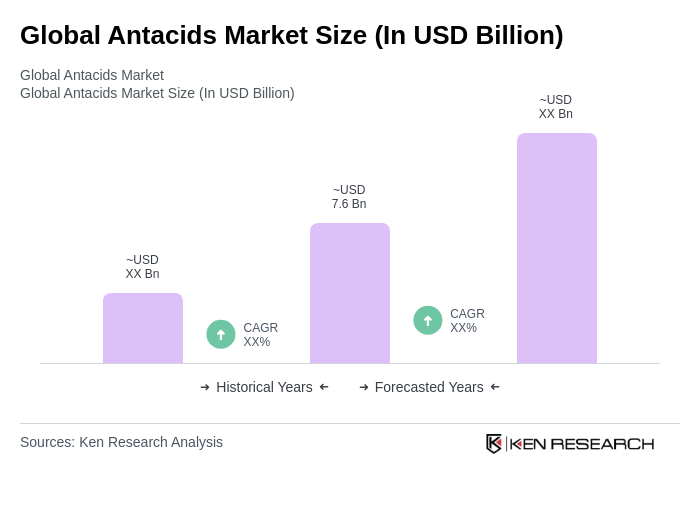
- The Global Antacids Market is valued at USD 7.6 billion, based on a five-year historical analysis. This growth is primarily driven by the increasing prevalence of gastrointestinal disorders such as gastroesophageal reflux disease (GERD), a rising geriatric population, and heightened consumer awareness regarding digestive health and wellness. The market has seen a notable uptick in sales due to the convenience and accessibility of antacid products, which are widely used to alleviate symptoms of heartburn and acid reflux. E-commerce channels have further accelerated growth, with double-digit increases in online antacid purchases reported by major brands.
- Key players in this market include the United States, Germany, and China, which dominate due to their large populations, high healthcare expenditure, and well-established pharmaceutical industries. North America holds the largest revenue share, accounting for approximately 46% of global antacid sales, driven by high prevalence of gastrointestinal disorders and robust OTC sales. Asia Pacific is experiencing the fastest expansion, attributed to rapid urbanization, changing dietary habits, and increased healthcare awareness.
- In 2023, the U.S. Food and Drug Administration (FDA) implemented updated regulations requiring clearer labeling on over-the-counter antacid products. These regulations are designed to enhance consumer safety by ensuring that all active ingredients and potential side effects are prominently displayed, promoting informed usage and reducing the risk of adverse reactions.
Global Antacids Market Segmentation
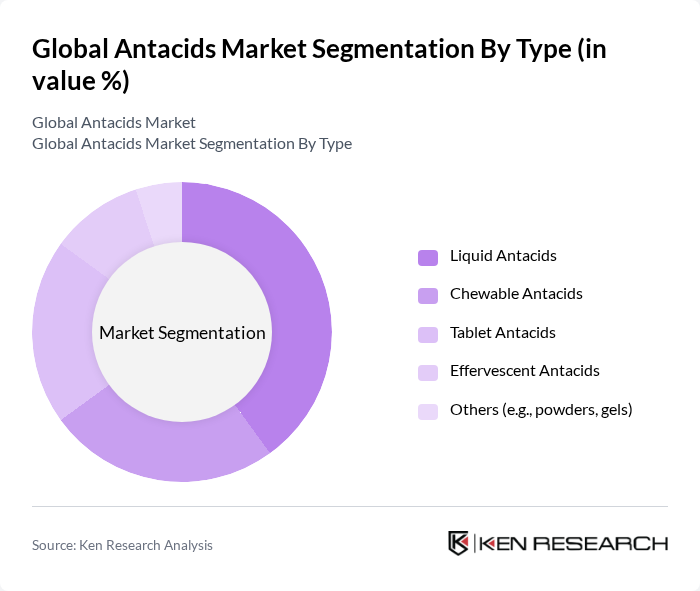
By Type:The antacids market can be segmented into various types, including Liquid Antacids, Chewable Antacids, Tablet Antacids, Effervescent Antacids, and Others (e.g., powders, gels). Among these, Liquid Antacids are currently leading the market due to their rapid onset of action and ease of consumption, especially among individuals seeking immediate relief from heartburn. Chewable Antacids hold a significant share, appealing to consumers who prefer a more palatable and convenient option. Effervescent forms are gaining traction, driven by their effectiveness and ease of use, particularly among younger demographics and those seeking fast relief.
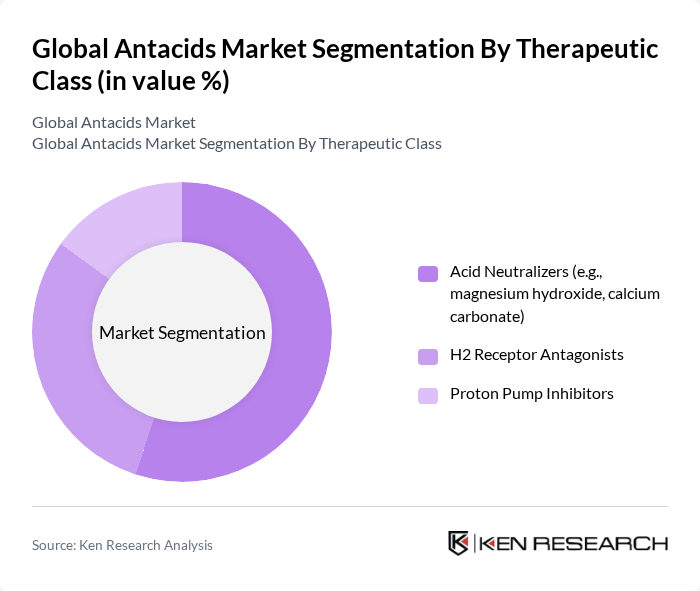
By Therapeutic Class:The therapeutic class segmentation includes Acid Neutralizers (e.g., magnesium hydroxide, calcium carbonate), H2 Receptor Antagonists, and Proton Pump Inhibitors. Acid Neutralizers continue to dominate the market due to their widespread use and rapid effectiveness in neutralizing stomach acid. H2 Receptor Antagonists are popular for providing longer-lasting relief, while Proton Pump Inhibitors are generally reserved for more severe or chronic conditions, resulting in a smaller market share.
Global Antacids Market Competitive Landscape
The Global Antacids Market is characterized by a dynamic mix of regional and international players. Leading participants such as Johnson & Johnson, GlaxoSmithKline plc, Bayer AG, Procter & Gamble Co., Pfizer Inc., Sanofi S.A., Reckitt Benckiser Group plc, Takeda Pharmaceutical Company Limited, Merck & Co., Inc., Abbott Laboratories, AstraZeneca plc, Boehringer Ingelheim International GmbH, Dr. Reddy’s Laboratories Ltd., Sun Pharmaceutical Industries Ltd., and HRA Pharma contribute to innovation, geographic expansion, and service delivery in this space.
Global Antacids Market Industry Analysis
Growth Drivers
- Increasing Prevalence of Gastrointestinal Disorders:The rise in gastrointestinal disorders, affecting approximately 60 million individuals in the None region, is a significant growth driver for the antacids market. Conditions such as acid reflux and gastritis are becoming more common, leading to a higher demand for antacid products. The World Health Organization reported that gastrointestinal diseases account for nearly 10% of global health expenditures, emphasizing the need for effective over-the-counter solutions to manage these conditions.
- Rising Consumer Awareness about Health and Wellness:In None, consumer awareness regarding health and wellness has surged, with 78% of the population actively seeking preventive healthcare solutions. This trend is reflected in the increasing sales of antacids, as consumers prioritize digestive health. The global health and wellness market is projected to reach $4.8 trillion in future, indicating a robust shift towards self-medication and preventive measures, further driving the demand for antacid products.
- Growth in the Geriatric Population:The geriatric population in None is expected to reach 22 million in future, significantly impacting the antacids market. Older adults are more susceptible to gastrointestinal issues, leading to increased consumption of antacids. According to the United Nations, the aging population is projected to grow by 3.2% annually, creating a sustained demand for digestive health products. This demographic shift presents a lucrative opportunity for antacid manufacturers to cater to the needs of older consumers.
Market Challenges
- Intense Competition Among Key Players:The antacids market in None is characterized by intense competition, with over 55 brands vying for market share. This saturation leads to price wars and reduced profit margins, making it challenging for new entrants to establish themselves. Major players like Johnson & Johnson and GlaxoSmithKline dominate the market, controlling approximately 42% of the total share, which further complicates the competitive landscape for smaller companies.
- Regulatory Hurdles and Compliance Issues:Navigating regulatory frameworks poses a significant challenge for antacid manufacturers in None. Compliance with stringent FDA regulations, which require extensive clinical testing and safety evaluations, can delay product launches. In future, the FDA is expected to increase scrutiny on over-the-counter medications, necessitating additional investments in compliance and quality assurance, which can strain resources for smaller firms in the industry.
Global Antacids Market Future Outlook
The future of the antacids market in None appears promising, driven by evolving consumer preferences and technological advancements. The shift towards over-the-counter medications is expected to continue, with a growing emphasis on convenience and accessibility. Additionally, the rise of online pharmacies is likely to enhance distribution channels, making antacids more readily available. As consumers increasingly seek personalized medicine, manufacturers will need to innovate and adapt their product offerings to meet these changing demands effectively.
Market Opportunities
- Development of Innovative Formulations:There is a significant opportunity for manufacturers to develop innovative antacid formulations that cater to specific consumer needs. For instance, creating products that combine antacids with probiotics could appeal to health-conscious consumers. The global probiotics market is projected to reach $80 billion in future, indicating a growing interest in products that promote digestive health.
- Expansion into Emerging Markets:Emerging markets in None present a lucrative opportunity for antacid manufacturers. With increasing disposable incomes and a rising middle class, the demand for healthcare products is expected to grow. The World Bank estimates that the middle-class population in None will increase by 18 million in future, creating a larger consumer base for antacid products and enhancing market potential.
Scope of the Report
| Segment | Sub-Segments |
|---|---|
| By Type | Liquid Antacids Chewable Antacids Tablet Antacids Effervescent Antacids Others (e.g., powders, gels) |
| By Therapeutic Class | Acid Neutralizers (e.g., magnesium hydroxide, calcium carbonate) H2 Receptor Antagonists Proton Pump Inhibitors |
| By End-User | Hospitals Retail Pharmacies Online Pharmacies Supermarkets/Hypermarkets |
| By Distribution Channel | Direct Sales Wholesalers Distributors E-commerce |
| By Formulation | Antacid Combinations Single-Ingredient Antacids |
| By Packaging Type | Bottles Blister Packs Sachets |
| By Price Range | Economy Mid-Range Premium |
| By Region | North America Europe Asia-Pacific Latin America Middle East & Africa |
Key Target Audience
Investors and Venture Capitalist Firms
Government and Regulatory Bodies (e.g., Food and Drug Administration, European Medicines Agency)
Manufacturers and Producers
Distributors and Retailers
Pharmaceutical Wholesalers
Health Insurance Companies
Pharmacy Chains
Market Access and Pricing Strategy Firms
Players Mentioned in the Report:
Johnson & Johnson
GlaxoSmithKline plc
Bayer AG
Procter & Gamble Co.
Pfizer Inc.
Sanofi S.A.
Reckitt Benckiser Group plc
Takeda Pharmaceutical Company Limited
Merck & Co., Inc.
Abbott Laboratories
AstraZeneca plc
Boehringer Ingelheim International GmbH
Dr. Reddys Laboratories Ltd.
Sun Pharmaceutical Industries Ltd.
HRA Pharma
Table of Contents
Market Assessment Phase
1. Executive Summary and Approach
2. Global Antacids Market Overview
2.1 Key Insights and Strategic Recommendations
2.2 Global Antacids Market Overview
2.3 Definition and Scope
2.4 Evolution of Market Ecosystem
2.5 Timeline of Key Regulatory Milestones
2.6 Value Chain & Stakeholder Mapping
2.7 Business Cycle Analysis
2.8 Policy & Incentive Landscape
3. Global Antacids Market Analysis
3.1 Growth Drivers
3.1.1 Increasing prevalence of gastrointestinal disorders
3.1.2 Rising consumer awareness about health and wellness
3.1.3 Growth in the geriatric population
3.1.4 Expansion of retail and e-commerce channels
3.2 Market Challenges
3.2.1 Intense competition among key players
3.2.2 Regulatory hurdles and compliance issues
3.2.3 Price sensitivity among consumers
3.2.4 Limited product differentiation
3.3 Market Opportunities
3.3.1 Development of innovative formulations
3.3.2 Expansion into emerging markets
3.3.3 Increasing demand for natural and organic products
3.3.4 Strategic partnerships and collaborations
3.4 Market Trends
3.4.1 Shift towards over-the-counter (OTC) medications
3.4.2 Growing popularity of online pharmacies
3.4.3 Rising demand for personalized medicine
3.4.4 Increased focus on preventive healthcare
3.5 Government Regulation
3.5.1 Compliance with FDA regulations
3.5.2 Labeling and advertising standards
3.5.3 Safety and efficacy requirements
3.5.4 Import/export regulations
4. SWOT Analysis
5. Stakeholder Analysis
6. Porter's Five Forces Analysis
7. Global Antacids Market Market Size, 2019-2024
7.1 By Value
7.2 By Volume
7.3 By Average Selling Price
8. Global Antacids Market Segmentation
8.1 By Type
8.1.1 Liquid Antacids
8.1.2 Chewable Antacids
8.1.3 Tablet Antacids
8.1.4 Effervescent Antacids
8.1.5 Others (e.g., powders, gels)
8.2 By Therapeutic Class
8.2.1 Acid Neutralizers (e.g., magnesium hydroxide, calcium carbonate)
8.2.2 H2 Receptor Antagonists
8.2.3 Proton Pump Inhibitors
8.3 By End-User
8.3.1 Hospitals
8.3.2 Retail Pharmacies
8.3.3 Online Pharmacies
8.3.4 Supermarkets/Hypermarkets
8.4 By Distribution Channel
8.4.1 Direct Sales
8.4.2 Wholesalers
8.4.3 Distributors
8.4.4 E-commerce
8.5 By Formulation
8.5.1 Antacid Combinations
8.5.2 Single-Ingredient Antacids
8.6 By Packaging Type
8.6.1 Bottles
8.6.2 Blister Packs
8.6.3 Sachets
8.7 By Price Range
8.7.1 Economy
8.7.2 Mid-Range
8.7.3 Premium
8.8 By Region
8.8.1 North America
8.8.2 Europe
8.8.3 Asia-Pacific
8.8.4 Latin America
8.8.5 Middle East & Africa
9. Global Antacids Market Competitive Analysis
9.1 Market Share of Key Players
9.2 Cross Comparison of Key Players
9.2.1 Company Name
9.2.2 Group Size (Large, Medium, or Small as per industry convention)
9.2.3 Global Antacids Revenue (USD Million)
9.2.4 Revenue Growth Rate (CAGR %)
9.2.5 Market Share (%)
9.2.6 Geographic Presence (Number of countries/regions)
9.2.7 Product Portfolio Breadth (Number of SKUs/brands in antacids)
9.2.8 R&D Investment (% of revenue)
9.2.9 Distribution Network Strength (Number of retail/e-commerce partners)
9.2.10 OTC vs. Prescription Sales Ratio
9.2.11 Brand Recognition Index
9.2.12 Innovation Rate (new launches in last 3 years)
9.3 SWOT Analysis of Top Players
9.4 Pricing Analysis
9.5 Detailed Profile of Major Companies
9.5.1 Johnson & Johnson
9.5.2 GlaxoSmithKline plc
9.5.3 Bayer AG
9.5.4 Procter & Gamble Co.
9.5.5 Pfizer Inc.
9.5.6 Sanofi S.A.
9.5.7 Reckitt Benckiser Group plc
9.5.8 Takeda Pharmaceutical Company Limited
9.5.9 Merck & Co., Inc.
9.5.10 Abbott Laboratories
9.5.11 AstraZeneca plc
9.5.12 Boehringer Ingelheim International GmbH
9.5.13 Dr. Reddy’s Laboratories Ltd.
9.5.14 Sun Pharmaceutical Industries Ltd.
9.5.15 HRA Pharma
10. Global Antacids Market End-User Analysis
10.1 Procurement Behavior of Key Ministries
10.1.1 Government health programs
10.1.2 Budget allocation for healthcare
10.1.3 Procurement policies for pharmaceuticals
10.1.4 Collaboration with healthcare providers
10.2 Corporate Spend on Infrastructure & Energy
10.2.1 Investment in healthcare infrastructure
10.2.2 Spending on health technology
10.2.3 Budget for employee health programs
10.3 Pain Point Analysis by End-User Category
10.3.1 Accessibility of antacid products
10.3.2 Affordability of treatments
10.3.3 Awareness of available options
10.4 User Readiness for Adoption
10.4.1 Familiarity with antacid products
10.4.2 Willingness to switch brands
10.4.3 Trust in product efficacy
10.5 Post-Deployment ROI and Use Case Expansion
10.5.1 Evaluation of treatment outcomes
10.5.2 Cost savings from preventive care
10.5.3 Expansion of product usage in different demographics
11. Global Antacids Market Future Size, 2025-2030
11.1 By Value
11.2 By Volume
11.3 By Average Selling Price
Go-To-Market Strategy Phase
1. Whitespace Analysis + Business Model Canvas
1.1 Market gaps identification
1.2 Value proposition development
1.3 Revenue model exploration
1.4 Customer segmentation analysis
1.5 Competitive landscape overview
2. Marketing and Positioning Recommendations
2.1 Branding strategies
2.2 Product USPs
3. Distribution Plan
3.1 Urban retail strategies
3.2 Rural NGO tie-ups
4. Channel & Pricing Gaps
4.1 Underserved routes
4.2 Pricing bands
5. Unmet Demand & Latent Needs
5.1 Category gaps
5.2 Consumer segments
6. Customer Relationship
6.1 Loyalty programs
6.2 After-sales service
7. Value Proposition
7.1 Sustainability
7.2 Integrated supply chains
8. Key Activities
8.1 Regulatory compliance
8.2 Branding
8.3 Distribution setup
9. Entry Strategy Evaluation
9.1 Domestic Market Entry Strategy
9.1.1 Product mix
9.1.2 Pricing band
9.1.3 Packaging
9.2 Export Entry Strategy
9.2.1 Target countries
9.2.2 Compliance roadmap
10. Entry Mode Assessment
10.1 Joint Ventures
10.2 Greenfield Investments
10.3 Mergers & Acquisitions
10.4 Distributor Model
11. Capital and Timeline Estimation
11.1 Capital requirements
11.2 Timelines
12. Control vs Risk Trade-Off
12.1 Ownership vs Partnerships
13. Profitability Outlook
13.1 Breakeven analysis
13.2 Long-term sustainability
14. Potential Partner List
14.1 Distributors
14.2 Joint Ventures
14.3 Acquisition targets
15. Execution Roadmap
15.1 Phased Plan for Market Entry
15.1.1 Market Setup
15.1.2 Market Entry
15.1.3 Growth Acceleration
15.1.4 Scale & Stabilize
15.2 Key Activities and Milestones
15.2.1 Activity timelines
15.2.2 Milestone tracking
Research Methodology
Phase 1: Approach1
Desk Research
- Analysis of market reports from industry associations such as the International Pharmaceutical Federation
- Review of published articles and white papers on antacid formulations and market trends
- Examination of regulatory documents from health authorities regarding antacid approvals and guidelines
Primary Research
- Interviews with gastroenterologists and pharmacists to understand prescription trends and consumer preferences
- Surveys with retail pharmacy managers to gather insights on sales volumes and customer demographics
- Field interviews with manufacturers to discuss production capacities and innovation in antacid products
Validation & Triangulation
- Cross-validation of data from multiple sources including sales data, market surveys, and expert opinions
- Triangulation of findings from primary interviews and secondary data to ensure consistency
- Sanity checks through expert panel reviews to validate market assumptions and projections
Phase 2: Market Size Estimation1
Top-down Assessment
- Estimation of total market size based on national healthcare expenditure and consumer spending on OTC medications
- Segmentation of the market by product type (e.g., liquid, tablet) and distribution channel (e.g., retail, online)
- Incorporation of demographic trends and health statistics to project future demand
Bottom-up Modeling
- Collection of sales data from leading antacid manufacturers to establish baseline volumes
- Analysis of pricing strategies across different product categories to determine revenue potential
- Volume x price calculations to derive market size estimates for each segment
Forecasting & Scenario Analysis
- Utilization of time-series analysis to project market growth based on historical data
- Scenario modeling based on potential changes in consumer behavior and regulatory impacts
- Development of baseline, optimistic, and pessimistic forecasts through 2030
Phase 3: CATI Sample Composition1
| Scope Item/Segment | Sample Size | Target Respondent Profiles |
|---|---|---|
| Retail Pharmacy Sales | 120 | Pharmacy Managers, Retail Pharmacists |
| Healthcare Professional Insights | 80 | Gastroenterologists, General Practitioners |
| Consumer Preferences Survey | 100 | End-users, Patients with Acid Reflux |
| Manufacturing Insights | 60 | Production Managers, R&D Heads |
| Market Distribution Channels | 60 | Supply Chain Managers, Distribution Executives |
Frequently Asked Questions
What is the current value of the Global Antacids Market?
The Global Antacids Market is valued at approximately USD 7.6 billion, reflecting a significant growth trend driven by increasing gastrointestinal disorders, an aging population, and rising consumer awareness regarding digestive health.
What factors are driving the growth of the antacids market?
Which regions dominate the Global Antacids Market?
What types of antacids are available in the market?
Other Regional/Country Reports
Malaysia Antacids Market
APAC Antacids Market
SEA Antacids Market
Why Buy From Us?

What makes us stand out is that our consultants follow Robust, Refine and Result (RRR) methodology. Robust for clear definitions, approaches and sanity checking, Refine for differentiating respondents' facts and opinions, and Result for presenting data with story.

We have set a benchmark in the industry by offering our clients with syndicated and customized market research reports featuring coverage of entire market as well as meticulous research and analyst insights.

While we don't replace traditional research, we flip the method upside down. Our dual approach of Top Bottom & Bottom Top ensures quality deliverable by not just verifying company fundamentals but also looking at the sector and macroeconomic factors.

With one step in the future, our research team constantly tries to show you the bigger picture. We help with some of the tough questions you may encounter along the way: How is the industry positioned? Best marketing channel? KPI's of competitors? By aligning every element, we help maximize success.

Our report gives you instant access to the answers and sources that other companies might choose to hide. We elaborate each steps of research methodology we have used and showcase you the sample size to earn your trust.

If you need any support, we are here! We pride ourselves on universe strength, data quality, and quick, friendly, and professional service.