About the Report
Base Year 2024Listen to the audio summary
Indonesia Antacids Market Overview
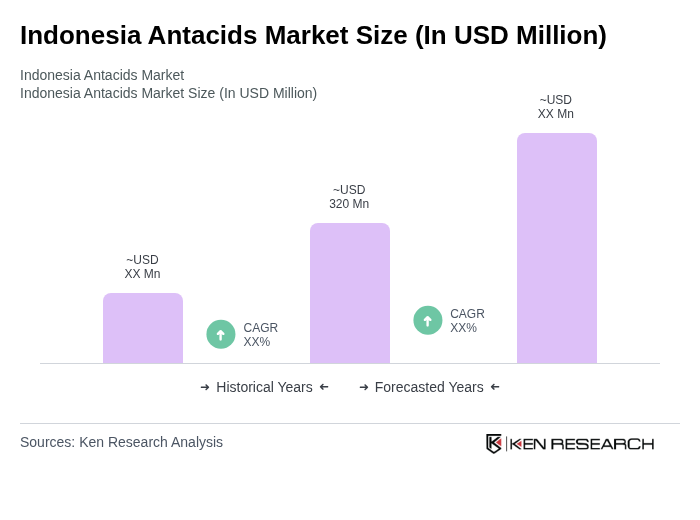
- The Indonesia Antacids Market is valued at USD 320 million, based on a five-year historical analysis and regional share of the Asia-Pacific market. This growth is primarily driven by the increasing prevalence of gastrointestinal disorders, rising healthcare expenditure, and growing consumer awareness regarding digestive health. The market has seen a steady rise in demand for over-the-counter antacids as more individuals seek immediate relief from heartburn and acid reflux. Urbanization, dietary westernization, and the expansion of retail pharmacy networks are further accelerating demand for antacid products in Indonesia.
- Key cities such as Jakarta, Surabaya, and Bandung dominate the market due to their high population density and urbanization. These cities have a well-established healthcare infrastructure and a growing middle class that is increasingly investing in health and wellness products, including antacids. The concentration of pharmacies, modern retail outlets, and healthcare facilities in these urban areas further supports market growth.
- The Indonesian government regulates the quality and safety of over-the-counter medications, including antacids, under the Regulation of the National Agency of Drug and Food Control (BPOM) Number 30 of 2017 concerning Supervision of Over-the-Counter and Limited Over-the-Counter Drugs. This regulation mandates strict quality control, labeling requirements, and post-market surveillance to ensure consumer safety and accurate product information. The regulation aims to improve public health outcomes and strengthen consumer trust in pharmaceutical products.
Indonesia Antacids Market Segmentation
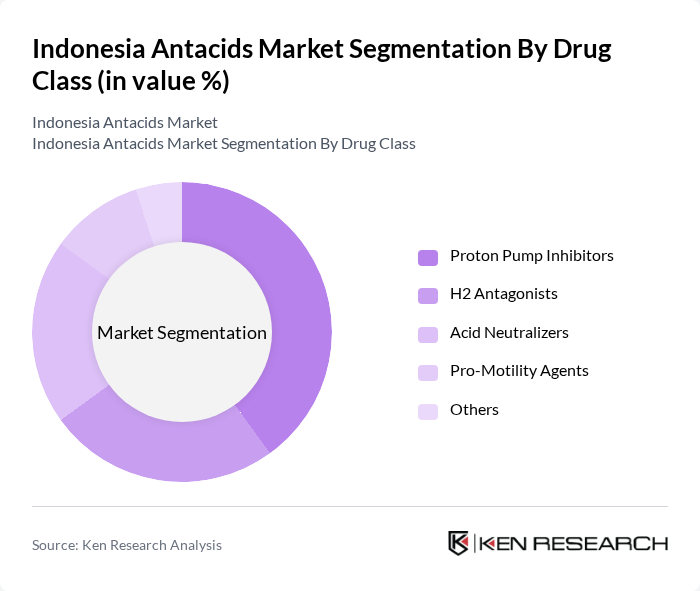
By Drug Class:The antacids market can be segmented into various drug classes, including Proton Pump Inhibitors, H2 Antagonists, Acid Neutralizers, Pro-Motility Agents, and Others. Among these, Proton Pump Inhibitors are gaining significant traction due to their effectiveness in treating severe acid-related disorders. The increasing awareness of gastrointestinal health, combined with a growing preference for prescription medications for chronic symptoms and OTC options for acute relief, is driving this trend.
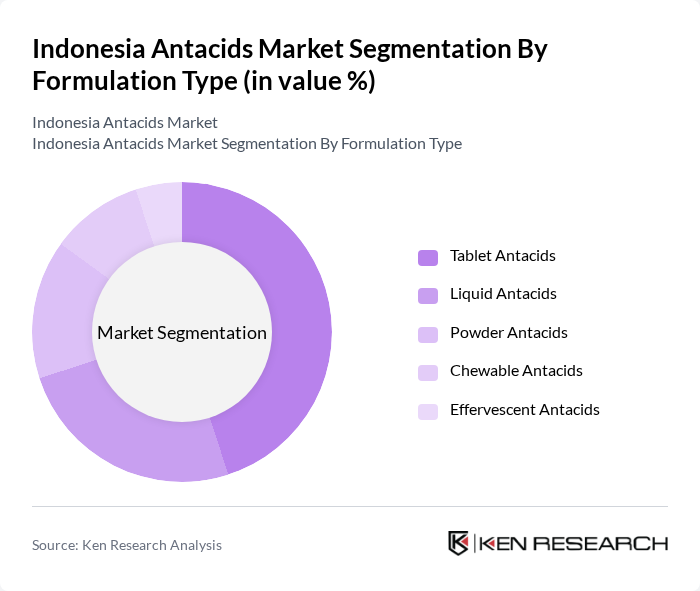
By Formulation Type:The market is also segmented by formulation type, which includes Tablet Antacids, Liquid Antacids, Powder Antacids, Chewable Antacids, Effervescent Antacids, and Others. Tablet Antacids are the most popular choice among consumers due to their convenience and ease of use. The growing trend of self-medication, preference for portable solutions, and the expansion of modern retail and e-commerce channels are contributing to the dominance of this segment.
Indonesia Antacids Market Competitive Landscape
The Indonesia Antacids Market is characterized by a dynamic mix of regional and international players. Leading participants such as Kalbe Farma, Kimia Farma, Sanofi Indonesia, Pfizer Indonesia, Johnson & Johnson Indonesia, Novartis Indonesia, Merck Sharp & Dohme Indonesia, Darya-Varia Laboratoria, Sido Muncul, Unilever Indonesia, Reckitt Benckiser Indonesia, Abbott Indonesia, Takeda Indonesia, Bayer Indonesia, Soho Global Health contribute to innovation, geographic expansion, and service delivery in this space.
Indonesia Antacids Market Industry Analysis
Growth Drivers
- Increasing Prevalence of Gastrointestinal Disorders:The rise in gastrointestinal disorders in Indonesia is significant, with approximately 20 million people affected annually. This increase is attributed to dietary changes and lifestyle factors. The World Health Organization reported that 30% of the population experiences acid-related issues, driving demand for antacids. As healthcare access improves, more individuals seek treatment, further boosting the antacid market. This trend is expected to continue, with a growing focus on digestive health in the coming years.
- Rising Disposable Income and Healthcare Spending:Indonesia's GDP per capita is approximately USD 4,580 in current terms, reflecting a 5% increase from the previous year. This economic growth correlates with rising disposable incomes, leading to increased healthcare spending. The Ministry of Health reported that healthcare expenditure is estimated at around USD 46 billion in current terms, enhancing access to over-the-counter medications like antacids. As consumers prioritize health, the demand for effective gastrointestinal relief products is anticipated to grow significantly.
- Growing Awareness of Preventive Healthcare:The Indonesian government has initiated various health campaigns, resulting in a reported increase in public awareness regarding preventive healthcare measures. This shift encourages consumers to seek preventive solutions, including antacids, to manage gastrointestinal discomfort. The rise in health literacy, particularly among urban populations, is driving the demand for over-the-counter medications. As more individuals recognize the importance of proactive health management, the antacid market is poised for substantial growth.
Market Challenges
- Intense Competition Among Local and International Brands:The Indonesian antacid market is characterized by fierce competition, with over 50 brands vying for market share. Local brands account for 60% of the market, while international players like GSK and Bayer hold significant portions. This saturation leads to price wars and aggressive marketing strategies, making it challenging for new entrants to establish a foothold. Companies must innovate and differentiate their products to remain competitive in this crowded landscape.
- Regulatory Hurdles and Compliance Issues:Navigating Indonesia's regulatory landscape poses significant challenges for antacid manufacturers. The National Agency of Drug and Food Control (BPOM) enforces stringent regulations, requiring extensive testing and documentation for product approval. Compliance can take up to 18 months, delaying market entry for new products. Additionally, companies face penalties for non-compliance, which can impact profitability. This regulatory environment necessitates careful planning and investment in compliance strategies.
Indonesia Antacids Market Future Outlook
The Indonesia antacids market is expected to evolve significantly, driven by increasing health awareness and a shift towards preventive healthcare. As disposable incomes rise, consumers are likely to invest more in health-related products, including antacids. The trend towards online purchasing will also reshape distribution channels, making products more accessible. Furthermore, the growing demand for natural and organic antacids will encourage innovation, leading to the development of new formulations that cater to health-conscious consumers.
Market Opportunities
- Introduction of Innovative Product Formulations:There is a significant opportunity for companies to develop innovative antacid formulations that cater to specific consumer needs. For instance, products targeting specific demographics, such as pregnant women or athletes, can capture niche markets. The increasing consumer preference for tailored health solutions presents a lucrative avenue for growth in the antacid sector.
- Expansion into Untapped Rural Markets:With approximately 43% of Indonesia's population residing in rural areas, there is a substantial opportunity for antacid manufacturers to expand their reach. Currently, access to healthcare products in these regions is limited. By establishing distribution networks and partnerships with local pharmacies, companies can tap into this underserved market, driving sales and brand loyalty.
Scope of the Report
| Segment | Sub-Segments |
|---|---|
| By Drug Class | Proton Pump Inhibitors H2 Antagonists Acid Neutralizers Pro-Motility Agents Others |
| By Formulation Type | Tablet Antacids Liquid Antacids Powder Antacids Chewable Antacids Effervescent Antacids Others |
| By Distribution Channel | Hospital Pharmacies Retail Pharmacies Online Pharmacies Other Distribution Channels |
| By End-User | Hospitals Clinics Retail Pharmacies Online Retailers Others |
| By Packaging Type | Bottles Blister Packs Sachets Tubes Others |
| By Consumer Demographics | Age Group (Children, Adults, Seniors) Gender (Male, Female) Income Level (Low, Middle, High) Others |
| By Region | Java Sumatra Bali Kalimantan Others |
| By Product Formulation | Antacid Combinations Single-Ingredient Antacids Others |
Key Target Audience
Investors and Venture Capitalist Firms
Government and Regulatory Bodies (e.g., Badan Pengawas Obat dan Makanan - BPOM)
Manufacturers and Producers
Distributors and Retailers
Pharmaceutical Wholesalers
Healthcare Providers and Hospitals
Industry Associations (e.g., Indonesian Pharmaceutical Association)
Financial Institutions
Players Mentioned in the Report:
Kalbe Farma
Kimia Farma
Sanofi Indonesia
Pfizer Indonesia
Johnson & Johnson Indonesia
Novartis Indonesia
Merck Sharp & Dohme Indonesia
Darya-Varia Laboratoria
Sido Muncul
Unilever Indonesia
Reckitt Benckiser Indonesia
Abbott Indonesia
Takeda Indonesia
Bayer Indonesia
Soho Global Health
Table of Contents
Market Assessment Phase
1. Executive Summary and Approach
2. Indonesia Antacids Market Overview
2.1 Key Insights and Strategic Recommendations
2.2 Indonesia Antacids Market Overview
2.3 Definition and Scope
2.4 Evolution of Market Ecosystem
2.5 Timeline of Key Regulatory Milestones
2.6 Value Chain & Stakeholder Mapping
2.7 Business Cycle Analysis
2.8 Policy & Incentive Landscape
3. Indonesia Antacids Market Analysis
3.1 Growth Drivers
3.1.1 Increasing prevalence of gastrointestinal disorders
3.1.2 Rising disposable income and healthcare spending
3.1.3 Growing awareness of preventive healthcare
3.1.4 Expansion of retail pharmacy networks
3.2 Market Challenges
3.2.1 Intense competition among local and international brands
3.2.2 Regulatory hurdles and compliance issues
3.2.3 Price sensitivity among consumers
3.2.4 Limited access to healthcare in rural areas
3.3 Market Opportunities
3.3.1 Introduction of innovative product formulations
3.3.2 Expansion into untapped rural markets
3.3.3 Collaborations with healthcare providers
3.3.4 Increasing demand for natural and organic antacids
3.4 Market Trends
3.4.1 Shift towards online purchasing and e-commerce
3.4.2 Growing preference for over-the-counter medications
3.4.3 Rising focus on health and wellness
3.4.4 Development of personalized medicine approaches
3.5 Government Regulation
3.5.1 Stricter quality control measures
3.5.2 Mandatory labeling requirements
3.5.3 Guidelines for advertising and promotion
3.5.4 Regulations on import and export of pharmaceutical products
4. SWOT Analysis
5. Stakeholder Analysis
6. Porter's Five Forces Analysis
7. Indonesia Antacids Market Market Size, 2019-2024
7.1 By Value
7.2 By Volume
7.3 By Average Selling Price
8. Indonesia Antacids Market Segmentation
8.1 By Drug Class
8.1.1 Proton Pump Inhibitors
8.1.2 H2 Antagonists
8.1.3 Acid Neutralizers
8.1.4 Pro-Motility Agents
8.1.5 Others
8.2 By Formulation Type
8.2.1 Tablet Antacids
8.2.2 Liquid Antacids
8.2.3 Powder Antacids
8.2.4 Chewable Antacids
8.2.5 Effervescent Antacids
8.2.6 Others
8.3 By Distribution Channel
8.3.1 Hospital Pharmacies
8.3.2 Retail Pharmacies
8.3.3 Online Pharmacies
8.3.4 Other Distribution Channels
8.4 By End-User
8.4.1 Hospitals
8.4.2 Clinics
8.4.3 Retail Pharmacies
8.4.4 Online Retailers
8.4.5 Others
8.5 By Packaging Type
8.5.1 Bottles
8.5.2 Blister Packs
8.5.3 Sachets
8.5.4 Tubes
8.5.5 Others
8.6 By Consumer Demographics
8.6.1 Age Group (Children, Adults, Seniors)
8.6.2 Gender (Male, Female)
8.6.3 Income Level (Low, Middle, High)
8.6.4 Others
8.7 By Region
8.7.1 Java
8.7.2 Sumatra
8.7.3 Bali
8.7.4 Kalimantan
8.7.5 Others
8.8 By Product Formulation
8.8.1 Antacid Combinations
8.8.2 Single-Ingredient Antacids
8.8.3 Others
9. Indonesia Antacids Market Competitive Analysis
9.1 Market Share of Key Players
9.2 KPIs for Cross Comparison of Key Players
9.2.1 Company Name
9.2.2 Group Size (Large, Medium, or Small as per industry convention)
9.2.3 Revenue Growth Rate (Indonesia Antacids Segment)
9.2.4 Market Share in Indonesia Antacids Market
9.2.5 Distribution Channel Coverage (Hospital, Retail, Online)
9.2.6 Product Portfolio Breadth (Number of Antacid SKUs)
9.2.7 Regulatory Compliance Record
9.2.8 Average Price per Unit (IDR)
9.2.9 Brand Awareness Index (Indonesia)
9.2.10 Customer Satisfaction Score (Indonesia)
9.3 SWOT Analysis of Top Players
9.4 Pricing Analysis
9.5 List of Major Companies
9.5.1 Kalbe Farma
9.5.2 Kimia Farma
9.5.3 Sanofi Indonesia
9.5.4 Pfizer Indonesia
9.5.5 Johnson & Johnson Indonesia
9.5.6 Novartis Indonesia
9.5.7 Merck Sharp & Dohme Indonesia
9.5.8 Darya-Varia Laboratoria
9.5.9 Sido Muncul
9.5.10 Unilever Indonesia
9.5.11 Reckitt Benckiser Indonesia
9.5.12 Abbott Indonesia
9.5.13 Takeda Indonesia
9.5.14 Bayer Indonesia
9.5.15 Soho Global Health
10. Indonesia Antacids Market End-User Analysis
10.1 Procurement Behavior of Key Ministries
10.1.1 Ministry of Health
10.1.2 Ministry of Trade
10.1.3 Ministry of Industry
10.1.4 Others
10.2 Corporate Spend on Infrastructure & Energy
10.2.1 Healthcare Infrastructure
10.2.2 Pharmaceutical Supply Chains
10.2.3 Research and Development
10.2.4 Others
10.3 Pain Point Analysis by End-User Category
10.3.1 Hospitals
10.3.2 Pharmacies
10.3.3 Consumers
10.3.4 Others
10.4 User Readiness for Adoption
10.4.1 Awareness Levels
10.4.2 Accessibility of Products
10.4.3 Affordability
10.4.4 Others
10.5 Post-Deployment ROI and Use Case Expansion
10.5.1 Effectiveness of Antacids
10.5.2 Customer Feedback
10.5.3 Market Expansion Opportunities
10.5.4 Others
11. Indonesia Antacids Market Future Size, 2025-2030
11.1 By Value
11.2 By Volume
11.3 By Average Selling Price
Go-To-Market Strategy Phase
1. Whitespace Analysis + Business Model Canvas
1.1 Market Gaps Identification
1.2 Business Model Development
2. Marketing and Positioning Recommendations
2.1 Branding Strategies
2.2 Product USPs
3. Distribution Plan
3.1 Urban Retail Strategies
3.2 Rural NGO Tie-ups
4. Channel & Pricing Gaps
4.1 Underserved Routes
4.2 Pricing Bands
5. Unmet Demand & Latent Needs
5.1 Category Gaps
5.2 Consumer Segments
6. Customer Relationship
6.1 Loyalty Programs
6.2 After-sales Service
7. Value Proposition
7.1 Sustainability
7.2 Integrated Supply Chains
8. Key Activities
8.1 Regulatory Compliance
8.2 Branding
8.3 Distribution Setup
9. Entry Strategy Evaluation
9.1 Domestic Market Entry Strategy
9.1.1 Product Mix
9.1.2 Pricing Band
9.1.3 Packaging
9.2 Export Entry Strategy
9.2.1 Target Countries
9.2.2 Compliance Roadmap
10. Entry Mode Assessment
10.1 JV
10.2 Greenfield
10.3 M&A
10.4 Distributor Model
11. Capital and Timeline Estimation
11.1 Capital Requirements
11.2 Timelines
12. Control vs Risk Trade-Off
12.1 Ownership vs Partnerships
13. Profitability Outlook
13.1 Breakeven Analysis
13.2 Long-term Sustainability
14. Potential Partner List
14.1 Distributors
14.2 JVs
14.3 Acquisition Targets
15. Execution Roadmap
15.1 Phased Plan for Market Entry
15.1.1 Market Setup
15.1.2 Market Entry
15.1.3 Growth Acceleration
15.1.4 Scale & Stabilize
15.2 Key Activities and Milestones
15.2.1 Milestone Planning
15.2.2 Activity Tracking
Research Methodology
Phase 1: Approach1
Desk Research
- Analysis of market reports from health organizations and pharmaceutical associations in Indonesia
- Review of published articles and journals focusing on gastrointestinal health and antacid consumption trends
- Examination of government health statistics and demographic data relevant to antacid usage
Primary Research
- Interviews with healthcare professionals, including gastroenterologists and pharmacists
- Surveys conducted with consumers to understand purchasing behavior and preferences for antacid products
- Focus group discussions with patients experiencing gastrointestinal issues to gather qualitative insights
Validation & Triangulation
- Cross-validation of findings through multiple data sources, including sales data and consumer feedback
- Triangulation of insights from healthcare professionals, consumers, and market reports
- Sanity checks through expert panel reviews to ensure data accuracy and relevance
Phase 2: Market Size Estimation1
Top-down Assessment
- Estimation of the overall pharmaceutical market size in Indonesia and its allocation to antacids
- Analysis of demographic trends and their impact on antacid consumption rates
- Incorporation of health awareness campaigns and their influence on market growth
Bottom-up Modeling
- Collection of sales data from major antacid manufacturers and distributors in Indonesia
- Estimation of average consumption rates based on survey data from healthcare professionals
- Volume x price analysis to determine revenue generation across different antacid segments
Forecasting & Scenario Analysis
- Multi-factor regression analysis considering factors such as population growth, health trends, and economic conditions
- Scenario modeling based on potential regulatory changes and shifts in consumer preferences
- Development of baseline, optimistic, and pessimistic forecasts through 2030
Phase 3: CATI Sample Composition1
| Scope Item/Segment | Sample Size | Target Respondent Profiles |
|---|---|---|
| Consumer Antacid Usage | 100 | General Consumers, Patients with Gastrointestinal Issues |
| Healthcare Professional Insights | 60 | Gastroenterologists, Pharmacists, General Practitioners |
| Retail Market Feedback | 50 | Pharmacy Owners, Retail Managers |
| Market Trends and Preferences | 40 | Health and Wellness Influencers, Nutritionists |
| Regulatory Impact Assessment | 40 | Regulatory Affairs Specialists, Health Policy Analysts |
Frequently Asked Questions
What is the current value of the Indonesia Antacids Market?
The Indonesia Antacids Market is valued at approximately USD 320 million, reflecting a steady growth driven by increasing gastrointestinal disorders, rising healthcare expenditure, and heightened consumer awareness regarding digestive health.
What factors are driving the growth of the antacids market in Indonesia?
Which cities are the primary markets for antacids in Indonesia?
What are the main drug classes in the Indonesia Antacids Market?
Other Regional/Country Reports
Malaysia Antacids Market
APAC Antacids Market
SEA Antacids Market
Other Adjacent Reports
Brazil Gastrointestinal Therapeutics Market
Singapore Over-the-Counter Medication Market
Thailand Digestive Supplements Market
Brazil Probiotics Market
Indonesia Herbal Remedies Market
Oman Pharmaceutical Distribution Market
Malaysia Retail Pharmacy Market
Malaysia E-Commerce Pharmacy Market
UAE Nutraceuticals Market
Qatar Health and Wellness Products Market
Why Buy From Us?

What makes us stand out is that our consultants follow Robust, Refine and Result (RRR) methodology. Robust for clear definitions, approaches and sanity checking, Refine for differentiating respondents' facts and opinions, and Result for presenting data with story.

We have set a benchmark in the industry by offering our clients with syndicated and customized market research reports featuring coverage of entire market as well as meticulous research and analyst insights.

While we don't replace traditional research, we flip the method upside down. Our dual approach of Top Bottom & Bottom Top ensures quality deliverable by not just verifying company fundamentals but also looking at the sector and macroeconomic factors.

With one step in the future, our research team constantly tries to show you the bigger picture. We help with some of the tough questions you may encounter along the way: How is the industry positioned? Best marketing channel? KPI's of competitors? By aligning every element, we help maximize success.

Our report gives you instant access to the answers and sources that other companies might choose to hide. We elaborate each steps of research methodology we have used and showcase you the sample size to earn your trust.

If you need any support, we are here! We pride ourselves on universe strength, data quality, and quick, friendly, and professional service.