About the Report
Base Year 2024Global Baby Apparel Market Overview
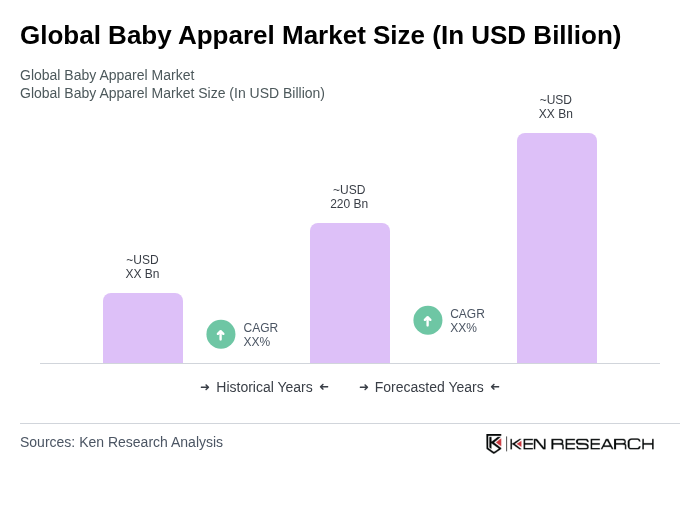
- The Global Baby Apparel Market is valued at USD 220 billion, based on a five-year historical analysis and consolidation of recent industry estimates. This growth is primarily driven by increasing birth rates and large infant populations in emerging economies, rising disposable incomes, rapid urbanization, and a growing trend towards premium, organic, and eco-friendly baby clothing. Parents are increasingly willing to spend on high-quality, stylish, and sustainable apparel for their children, with strong momentum for organic cotton, hypoallergenic fabrics, and ethically produced garments, which has significantly contributed to the market's expansion.
- Key countries driving this market include the United States, China, and large Western European economies such as Germany, France, and the United Kingdom. The United States holds a significant share due to high consumer spending power, strong retail and e-commerce infrastructure, and premiumization in baby products. China is one of the fastest-growing markets, supported by its large child population, rising middle class, and increasing urbanization, while Germany benefits from a robust economy and a strong focus on quality, safety, and sustainability standards in baby and children’s textiles.
- In 2023, the European Union strengthened the regulatory framework aimed at enhancing the safety and sustainability of baby apparel through instruments such as Regulation (EU) 2019/1021 on persistent organic pollutants and Regulation (EC) No 1907/2006 concerning the Registration, Evaluation, Authorisation and Restriction of Chemicals (REACH), together with the General Product Safety Regulation (EU) 2023/988. These regulations require manufacturers and importers of baby apparel to comply with strict limits on hazardous substances (such as certain dyes, phthalates, heavy metals, and flame retardants), ensure traceability and product safety documentation, and increasingly align with eco-design and sustainable textile objectives, which encourages wider use of organic and low-impact materials in baby clothing.
Global Baby Apparel Market Segmentation
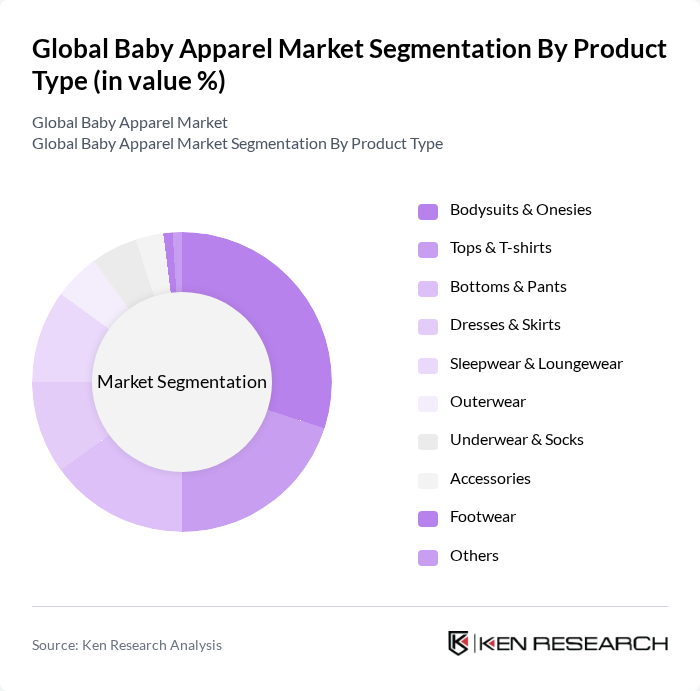
By Product Type:The product type segmentation of the baby apparel market includes various categories such as bodysuits & onesies, tops & t-shirts, bottoms & pants, dresses & skirts, sleepwear & loungewear, outerwear, underwear & socks, accessories, footwear, and others. This structure aligns with common industry classifications, where core garments (bodysuits, tops, bottoms, sleepwear, outerwear) are complemented by socks, underwear, accessories, and footwear. Among these, bodysuits & onesies remain one of the most widely used product categories due to their practicality, ease of changing, and comfort for infants, particularly in the first year of life. Parents prefer these items for their ease of use and the convenience they offer in dressing and changing babies, while demand is increasingly influenced by the availability of organic cotton, breathable fabrics, and sustainable materials across all key product types.
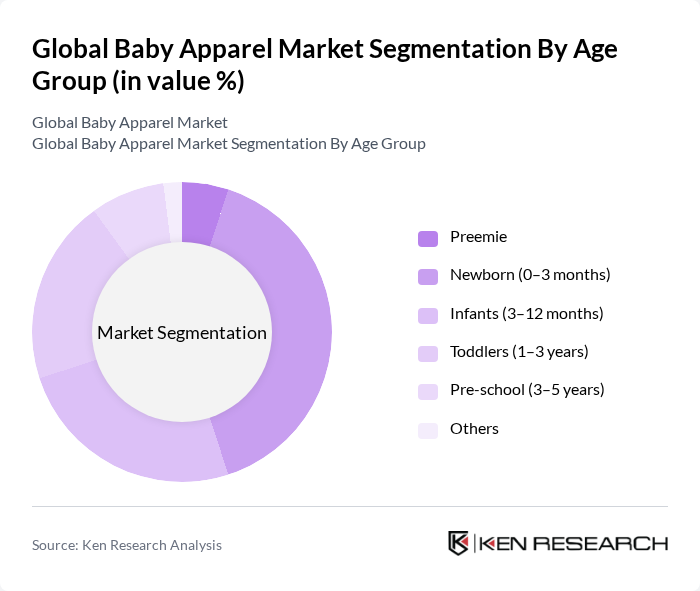
By Age Group:The age group segmentation includes preemie, newborn (0–3 months), infants (3–12 months), toddlers (1–3 years), pre-school (3–5 years), and others. This breakdown is consistent with market practice, where manufacturers and retailers typically distinguish between newborns, infants, and toddlers as core demand groups. The newborn and infant segments together account for a substantial share of demand, as parents prioritize purchasing clothing for younger babies who require frequent size changes and multiple daily outfit changes, driving higher garment turnover and purchase frequency. These segments are characterized by a high demand for soft, breathable, and easy-to-wear clothing with features such as flat seams, nickel-free snaps, and tagless labels, which drives ongoing innovation, design variety, and premium fabric adoption in product offerings.
Global Baby Apparel Market Competitive Landscape
The Global Baby Apparel Market is characterized by a dynamic mix of regional and international players. Leading participants such as Carter's, Inc., Gerber Childrenswear LLC, The Children's Place, Inc., H&M Hennes & Mauritz AB, Gap Inc. (including BabyGap), Nike, Inc., Adidas AG, Inditex (Zara Kids), Mothercare plc, Cotton On Group (Cotton On Kids), Ralph Lauren Corporation, Uniqlo Co., Ltd., Gymboree Group, Inc., Petit Bateau, Jacadi Paris, Bonpoint contribute to innovation, geographic expansion, and service delivery in this space.
Global Baby Apparel Market Industry Analysis
Growth Drivers
- Increasing Birth Rates:The global birth rate is projected to reach approximately 17–18 births per 1,000 people in future, translating to around 130 million to 135 million births annually. This increase in birth rates directly correlates with heightened demand for baby apparel, as new parents seek to purchase clothing for their infants. Countries like India and Nigeria are expected to contribute significantly to this growth, with India alone accounting for over 20 million births in future, driving the baby apparel market forward.
- Rising Disposable Income:In future, global disposable income is anticipated to rise by 4.5%, reaching an average of $12,500 per capita. This increase allows families to allocate more funds towards baby apparel, enhancing their purchasing power. Regions such as North America and Western Europe are expected to see the most significant increases, with families spending an average of $1,200 annually on baby clothing, reflecting a growing trend towards premium and branded products.
- Expansion of E-commerce Platforms:The e-commerce sector for baby apparel is projected to grow by $30 billion in future, driven by increased internet penetration and mobile shopping. With over 60% of parents preferring online shopping for convenience, platforms like Amazon and specialized baby retailers are expanding their offerings. This shift not only enhances accessibility but also allows for a wider variety of products, catering to diverse consumer preferences and driving overall market growth.
Market Challenges
- Intense Competition:The baby apparel market is characterized by fierce competition, with over 1,500 brands vying for market share. This saturation leads to price wars, which can erode profit margins. Major players like Carter's and Gerber face challenges from emerging brands that offer unique designs and sustainable options, making it difficult for established companies to maintain their market position without significant investment in innovation and marketing.
- Fluctuating Raw Material Prices:The volatility in raw material prices, particularly cotton and synthetic fibers, poses a significant challenge for manufacturers. In future, cotton prices are expected to fluctuate between $1.00 and $1.30 per pound, impacting production costs. This unpredictability can lead to increased retail prices for consumers, potentially reducing demand for baby apparel as families become more price-sensitive in their purchasing decisions.
Global Baby Apparel Market Future Outlook
The future of the baby apparel market appears promising, driven by evolving consumer preferences and technological advancements. As sustainability becomes a priority, brands are increasingly adopting eco-friendly practices, which will likely resonate with environmentally conscious consumers. Additionally, the rise of digital marketing and social media will facilitate direct engagement with target audiences, enhancing brand loyalty and driving sales. Companies that adapt to these trends will be well-positioned to capture market share in the coming years.
Market Opportunities
- Sustainable and Eco-friendly Products:The demand for sustainable baby apparel is on the rise, with consumers increasingly seeking organic materials. In future, the market for eco-friendly baby clothing is expected to grow by $5 billion, as parents prioritize health and environmental impact. Brands that focus on sustainable practices can tap into this lucrative segment, appealing to a growing demographic of eco-conscious consumers.
- Customization and Personalization Trends:The trend towards personalized baby apparel is gaining traction, with parents willing to spend an additional 20% on customized products. In future, the market for personalized baby clothing is projected to reach $2 billion. Companies that offer customization options, such as monogramming or unique designs, can differentiate themselves and attract a loyal customer base, enhancing overall market competitiveness.
Scope of the Report
| Segment | Sub-Segments |
|---|---|
| By Product Type | Bodysuits & Onesies Tops & T-shirts Bottoms & Pants Dresses & Skirts Sleepwear & Loungewear Outerwear Underwear & Socks Accessories Footwear Others |
| By Age Group | Preemie Newborn (0–3 months) Infants (3–12 months) Toddlers (1–3 years) Pre-school (3–5 years) Others |
| By Material | Cotton Organic Cotton Polyester Wool Blends Bamboo & Other Sustainable Fibers |
| By Distribution Channel | Specialty Stores Department Stores Supermarkets/Hypermarkets Mass Market/Retail Chains Boutique/Independent Retail Online Retail/E-commerce Others |
| By Region | North America Europe Asia-Pacific Latin America Middle East & Africa |
| By Price Range | Mass/Budget Mid-range Premium Luxury Others |
| By Brand Type | National & International Brands Private Labels/Store Brands Designer & Boutique Brands Others |
Key Target Audience
Investors and Venture Capitalist Firms
Government and Regulatory Bodies (e.g., Consumer Product Safety Commission, Federal Trade Commission)
Manufacturers and Producers
Distributors and Retailers
Importers and Exporters
Industry Associations (e.g., American Apparel & Footwear Association)
Financial Institutions
Logistics and Supply Chain Companies
Players Mentioned in the Report:
Carter's, Inc.
Gerber Childrenswear LLC
The Children's Place, Inc.
H&M Hennes & Mauritz AB
Gap Inc. (including BabyGap)
Nike, Inc.
Adidas AG
Inditex (Zara Kids)
Mothercare plc
Cotton On Group (Cotton On Kids)
Ralph Lauren Corporation
Uniqlo Co., Ltd.
Gymboree Group, Inc.
Petit Bateau
Jacadi Paris
Bonpoint
Table of Contents
Market Assessment Phase
1. Executive Summary and Approach
2. Global Baby Apparel Market Overview
2.1 Key Insights and Strategic Recommendations
2.2 Global Baby Apparel Market Overview
2.3 Definition and Scope
2.4 Evolution of Market Ecosystem
2.5 Timeline of Key Regulatory Milestones
2.6 Value Chain & Stakeholder Mapping
2.7 Business Cycle Analysis
2.8 Policy & Incentive Landscape
3. Global Baby Apparel Market Analysis
3.1 Growth Drivers
3.1.1 Increasing Birth Rates
3.1.2 Rising Disposable Income
3.1.3 Growing Awareness of Baby Health and Safety
3.1.4 Expansion of E-commerce Platforms
3.2 Market Challenges
3.2.1 Intense Competition
3.2.2 Fluctuating Raw Material Prices
3.2.3 Regulatory Compliance Issues
3.2.4 Changing Consumer Preferences
3.3 Market Opportunities
3.3.1 Sustainable and Eco-friendly Products
3.3.2 Customization and Personalization Trends
3.3.3 Expansion into Emerging Markets
3.3.4 Collaborations with Influencers and Celebrities
3.4 Market Trends
3.4.1 Growth of Online Retailing
3.4.2 Increasing Demand for Organic Baby Apparel
3.4.3 Technological Innovations in Fabric
3.4.4 Rise of Subscription Services for Baby Apparel
3.5 Government Regulation
3.5.1 Safety Standards for Baby Clothing
3.5.2 Environmental Regulations on Textile Production
3.5.3 Import Tariffs and Trade Policies
3.5.4 Labeling Requirements for Baby Products
4. SWOT Analysis
5. Stakeholder Analysis
6. Porter's Five Forces Analysis
7. Global Baby Apparel Market Market Size, 2019-2024
7.1 By Value
7.2 By Volume
7.3 By Average Selling Price
8. Global Baby Apparel Market Segmentation
8.1 By Product Type
8.1.1 Bodysuits & Onesies
8.1.2 Tops & T-shirts
8.1.3 Bottoms & Pants
8.1.4 Dresses & Skirts
8.1.5 Sleepwear & Loungewear
8.1.6 Outerwear
8.1.7 Underwear & Socks
8.1.8 Accessories
8.1.9 Footwear
8.1.10 Others
8.2 By Age Group
8.2.1 Preemie
8.2.2 Newborn (0–3 months)
8.2.3 Infants (3–12 months)
8.2.4 Toddlers (1–3 years)
8.2.5 Pre-school (3–5 years)
8.2.6 Others
8.3 By Material
8.3.1 Cotton
8.3.2 Organic Cotton
8.3.3 Polyester
8.3.4 Wool
8.3.5 Blends
8.3.6 Bamboo & Other Sustainable Fibers
8.4 By Distribution Channel
8.4.1 Specialty Stores
8.4.2 Department Stores
8.4.3 Supermarkets/Hypermarkets
8.4.4 Mass Market/Retail Chains
8.4.5 Boutique/Independent Retail
8.4.6 Online Retail/E-commerce
8.4.7 Others
8.5 By Region
8.5.1 North America
8.5.2 Europe
8.5.3 Asia-Pacific
8.5.4 Latin America
8.5.5 Middle East & Africa
8.6 By Price Range
8.6.1 Mass/Budget
8.6.2 Mid-range
8.6.3 Premium
8.6.4 Luxury
8.6.5 Others
8.7 By Brand Type
8.7.1 National & International Brands
8.7.2 Private Labels/Store Brands
8.7.3 Designer & Boutique Brands
8.7.4 Others
9. Global Baby Apparel Market Competitive Analysis
9.1 Market Share of Key Players
9.2 Cross Comparison of Key Players
9.2.1 Company Name
9.2.2 Revenue (Global and Baby Apparel-Specific)
9.2.3 Baby Apparel Revenue CAGR (Historical & Forecast)
9.2.4 Market Share in Global Baby Apparel
9.2.5 EBITDA Margin / Operating Margin
9.2.6 Gross Margin
9.2.7 Average Selling Price (ASP) per Unit
9.2.8 Online vs Offline Revenue Mix
9.2.9 Same-store Sales Growth (where applicable)
9.2.10 Customer Lifetime Value (CLV) / Repeat Purchase Rate
9.2.11 Inventory Turnover and Days Inventory Outstanding (DIO)
9.2.12 CAPEX Intensity and Store Network Expansion
9.2.13 Geographic Revenue Concentration
9.3 SWOT Analysis of Top Players
9.4 Pricing Analysis
9.5 Detailed Profile of Major Companies
9.5.1 Carter's, Inc.
9.5.2 Gerber Childrenswear LLC
9.5.3 The Children's Place, Inc.
9.5.4 H&M Hennes & Mauritz AB
9.5.5 Gap Inc. (including BabyGap)
9.5.6 Nike, Inc.
9.5.7 Adidas AG
9.5.8 Inditex (Zara Kids)
9.5.9 Mothercare plc
9.5.10 Cotton On Group (Cotton On Kids)
9.5.11 Ralph Lauren Corporation
9.5.12 Uniqlo Co., Ltd.
9.5.13 Gymboree Group, Inc.
9.5.14 Petit Bateau
9.5.15 Jacadi Paris
9.5.16 Bonpoint
10. Global Baby Apparel Market End-User Analysis
10.1 Procurement Behavior of Key Ministries
10.1.1 Government Procurement Policies
10.1.2 Budget Allocations for Child Welfare
10.1.3 Supplier Selection Criteria
10.1.4 Contract Management Practices
10.2 Corporate Spend on Infrastructure & Energy
10.2.1 Investment in Sustainable Practices
10.2.2 Budgeting for Childcare Facilities
10.2.3 Expenditure on Employee Benefits
10.2.4 Partnerships with NGOs
10.3 Pain Point Analysis by End-User Category
10.3.1 Quality Concerns
10.3.2 Price Sensitivity
10.3.3 Availability of Sizes
10.3.4 Brand Loyalty Issues
10.4 User Readiness for Adoption
10.4.1 Awareness of Sustainable Options
10.4.2 Willingness to Pay for Quality
10.4.3 Adoption of Online Shopping
10.4.4 Feedback Mechanisms
10.5 Post-Deployment ROI and Use Case Expansion
10.5.1 Measurement of Customer Satisfaction
10.5.2 Analysis of Repeat Purchases
10.5.3 Expansion into New Product Lines
10.5.4 Long-term Brand Loyalty Metrics
11. Global Baby Apparel Market Future Size, 2025-2030
11.1 By Value
11.2 By Volume
11.3 By Average Selling Price
Go-To-Market Strategy Phase
1. Whitespace Analysis + Business Model Canvas
1.1 Market Gaps Identification
1.2 Value Proposition Development
1.3 Revenue Streams Analysis
1.4 Cost Structure Evaluation
1.5 Key Partnerships Exploration
1.6 Customer Segmentation
1.7 Channels of Distribution
2. Marketing and Positioning Recommendations
2.1 Branding Strategies
2.2 Product USPs
2.3 Target Audience Identification
2.4 Marketing Channels Selection
2.5 Promotional Strategies
2.6 Customer Engagement Tactics
2.7 Performance Metrics
3. Distribution Plan
3.1 Urban Retail Strategies
3.2 Rural NGO Tie-ups
3.3 E-commerce Integration
3.4 Logistics and Supply Chain Management
3.5 Inventory Management Solutions
3.6 Distribution Partnerships
3.7 Performance Tracking
4. Channel & Pricing Gaps
4.1 Underserved Routes
4.2 Pricing Bands Analysis
4.3 Competitor Pricing Strategies
4.4 Customer Price Sensitivity
4.5 Value-based Pricing Models
4.6 Discounting Strategies
4.7 Pricing Optimization Techniques
5. Unmet Demand & Latent Needs
5.1 Category Gaps Identification
5.2 Consumer Segments Analysis
5.3 Product Development Opportunities
5.4 Market Entry Strategies
5.5 Customer Feedback Mechanisms
5.6 Trend Analysis
5.7 Future Demand Projections
6. Customer Relationship
6.1 Loyalty Programs
6.2 After-sales Service
6.3 Customer Feedback Systems
6.4 Community Engagement Initiatives
6.5 Customer Education Programs
6.6 Relationship Management Tools
6.7 Performance Metrics
7. Value Proposition
7.1 Sustainability Initiatives
7.2 Integrated Supply Chains
7.3 Unique Selling Points
7.4 Customer-Centric Innovations
7.5 Brand Storytelling
7.6 Competitive Differentiation
7.7 Performance Metrics
8. Key Activities
8.1 Regulatory Compliance
8.2 Branding Initiatives
8.3 Distribution Setup
8.4 Marketing Campaigns
8.5 Product Development
8.6 Customer Engagement Activities
8.7 Performance Tracking
9. Entry Strategy Evaluation
9.1 Domestic Market Entry Strategy
9.1.1 Product Mix
9.1.2 Pricing Band
9.1.3 Packaging
9.2 Export Entry Strategy
9.2.1 Target Countries
9.2.2 Compliance Roadmap
10. Entry Mode Assessment
10.1 Joint Ventures
10.2 Greenfield Investments
10.3 Mergers & Acquisitions
10.4 Distributor Model
10.5 Risk Assessment
10.6 Performance Metrics
10.7 Strategic Partnerships
11. Capital and Timeline Estimation
11.1 Capital Requirements
11.2 Timelines
11.3 Funding Sources
11.4 Financial Projections
11.5 Risk Management Strategies
11.6 Performance Metrics
11.7 Milestone Tracking
12. Control vs Risk Trade-Off
12.1 Ownership vs Partnerships
12.2 Risk Mitigation Strategies
12.3 Performance Metrics
12.4 Strategic Decision-Making
12.5 Long-term Sustainability
12.6 Stakeholder Engagement
12.7 Performance Tracking
13. Profitability Outlook
13.1 Breakeven Analysis
13.2 Long-term Sustainability
13.3 Financial Health Metrics
13.4 Profit Margin Analysis
13.5 Revenue Growth Projections
13.6 Cost Management Strategies
13.7 Performance Metrics
14. Potential Partner List
14.1 Distributors
14.2 Joint Ventures
14.3 Acquisition Targets
14.4 Strategic Alliances
14.5 Performance Metrics
14.6 Partnership Evaluation Criteria
14.7 Risk Assessment
15. Execution Roadmap
15.1 Phased Plan for Market Entry
15.1.1 Market Setup
15.1.2 Market Entry
15.1.3 Growth Acceleration
15.1.4 Scale & Stabilize
15.2 Key Activities and Milestones
15.2.1 Activity Planning
15.2.2 Milestone Tracking
15.2.3 Performance Metrics
Research Methodology
Phase 1: Approach1
Desk Research
- Analysis of industry reports from global baby apparel associations and market research firms
- Review of demographic data from government publications and international organizations
- Examination of consumer behavior studies and trend reports related to baby apparel
Primary Research
- Interviews with key stakeholders in the baby apparel supply chain, including manufacturers and retailers
- Surveys targeting parents and caregivers to understand purchasing preferences and trends
- Focus groups with industry experts to gather insights on market dynamics and future outlook
Validation & Triangulation
- Cross-validation of findings through multiple data sources, including sales data and consumer feedback
- Triangulation of insights from primary interviews with secondary research findings
- Sanity checks conducted through expert panel reviews to ensure data accuracy and relevance
Phase 2: Market Size Estimation1
Top-down Assessment
- Estimation of market size based on global baby product sales and growth rates
- Segmentation of the market by product type, including clothing, accessories, and footwear
- Incorporation of regional growth trends and economic factors influencing baby apparel demand
Bottom-up Modeling
- Collection of sales data from leading baby apparel brands and retailers
- Estimation of average selling prices and volume sold across different product categories
- Analysis of distribution channels and their impact on overall market size
Forecasting & Scenario Analysis
- Utilization of historical sales data to project future growth rates through statistical modeling
- Scenario analysis based on potential economic shifts, demographic changes, and consumer trends
- Development of baseline, optimistic, and pessimistic forecasts through 2030
Phase 3: CATI Sample Composition1
| Scope Item/Segment | Sample Size | Target Respondent Profiles |
|---|---|---|
| Retail Baby Apparel Sales | 120 | Store Managers, Retail Buyers |
| Online Baby Apparel Purchases | 90 | eCommerce Managers, Digital Marketing Specialists |
| Consumer Insights on Baby Apparel | 150 | Parents, Caregivers |
| Manufacturing Insights in Baby Apparel | 80 | Production Managers, Quality Control Officers |
| Trends in Sustainable Baby Apparel | 70 | Sustainability Officers, Product Designers |
Frequently Asked Questions
What is the current value of the Global Baby Apparel Market?
The Global Baby Apparel Market is valued at approximately USD 220 billion, reflecting a significant growth driven by increasing birth rates, rising disposable incomes, and a trend towards premium and eco-friendly baby clothing.
What factors are driving the growth of the baby apparel market?
Which regions are leading in the baby apparel market?
What are the main product types in the baby apparel market?
Other Regional/Country Reports
Indonesia Baby Apparel Market
Malaysia Baby Apparel Market
KSA Baby Apparel Market
SEA Baby Apparel Market
Other Adjacent Reports
KSA Baby Diapers Market
South Africa Baby Toys Market
Thailand Childrens Apparel Market
Malaysia Maternity Apparel Market
Philippines Organic Textiles Market
South Africa Baby Footwear Market
Mexico Baby Accessories Market
Belgium Infant Nutrition Market
South Korea Baby Care Products Market
Mexico Sustainable Apparel Market
Why Buy From Us?

What makes us stand out is that our consultants follow Robust, Refine and Result (RRR) methodology. Robust for clear definitions, approaches and sanity checking, Refine for differentiating respondents' facts and opinions, and Result for presenting data with story.

We have set a benchmark in the industry by offering our clients with syndicated and customized market research reports featuring coverage of entire market as well as meticulous research and analyst insights.

While we don't replace traditional research, we flip the method upside down. Our dual approach of Top Bottom & Bottom Top ensures quality deliverable by not just verifying company fundamentals but also looking at the sector and macroeconomic factors.

With one step in the future, our research team constantly tries to show you the bigger picture. We help with some of the tough questions you may encounter along the way: How is the industry positioned? Best marketing channel? KPI's of competitors? By aligning every element, we help maximize success.

Our report gives you instant access to the answers and sources that other companies might choose to hide. We elaborate each steps of research methodology we have used and showcase you the sample size to earn your trust.

If you need any support, we are here! We pride ourselves on universe strength, data quality, and quick, friendly, and professional service.