Global Bioherbicides Market Size, Share, Growth Drivers, Trends, Opportunities & Forecast 2025–2030

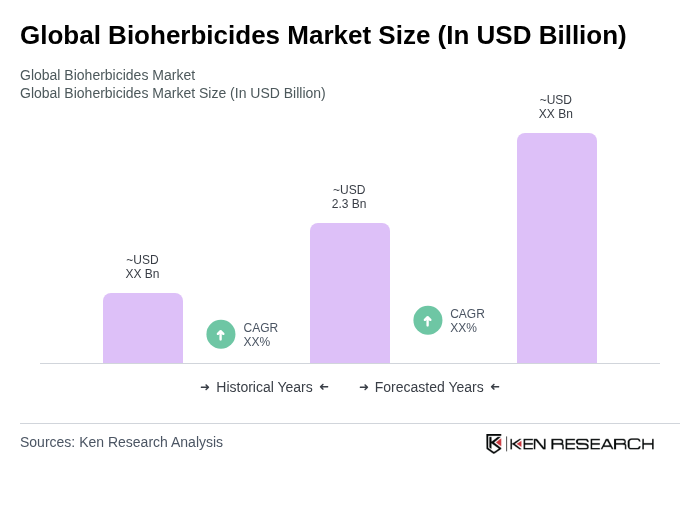
The Global Bioherbicides Market, valued at USD 2.3 Bn, is growing due to rising organic farming, environmental awareness, and regulations favoring bio-based solutions.

Region:Global

Author(s):Shubham

Product Code:KRAD0905

Pages:99

Published On:November 2025
About the Report

Base Year 2024

Global Bioherbicides Market Overview

  • The Global Bioherbicides Market is valued at USD 2.3 billion, based on a five?year historical analysis. This growth is primarily driven by the increasing demand for sustainable agricultural practices, rising awareness of the harmful effects of synthetic herbicides, and the growing trend towards organic farming. The market is also supported by advancements in biotechnology, such as improved microbial formulations and precision application technologies, which enhance the efficacy and adoption of bioherbicides. Additionally, the expansion of organic food markets and stricter residue regulations are accelerating the shift towards bio-based solutions.
  • Key players in this market include the United States, Germany, and Brazil. The United States leads due to its advanced agricultural technology, significant investment in research and development, and early adoption of biological crop protection. Germany benefits from stringent regulations on chemical herbicides, promoting the adoption of bioherbicides, while Brazil's large agricultural sector and increasing focus on sustainable practices further contribute to its market prominence. These countries are also supported by robust government incentives and active collaborations between public and private sectors.
  • In 2023, the European Union implemented Directive 2009/128/EC on the Sustainable Use of Pesticides, issued by the European Parliament and Council. This directive mandates member states to reduce chemical pesticide use and encourages the adoption of alternative methods, including bioherbicides. Operational requirements include integrated pest management, promotion of non-chemical alternatives, and periodic review of national action plans. The regulation aims to promote environmental sustainability and protect biodiversity, significantly impacting the bioherbicides market.
Global Bioherbicides Market Size

Global Bioherbicides Market Segmentation

By Type:The bioherbicides market is segmented into microbial bioherbicides, biochemical bioherbicides, plant-based bioherbicides, and others. Microbial bioherbicides are gaining traction due to their effectiveness, eco-friendliness, and ability to target specific weed species without harming crops or beneficial organisms. These products utilize naturally occurring bacteria, fungi, or viruses to control weeds, appealing to environmentally conscious consumers and farmers. Biochemical bioherbicides leverage natural compounds such as allelochemicals and plant extracts to inhibit weed growth. The increasing shift towards organic farming and regulatory pressure on synthetic herbicides are driving demand for both microbial and biochemical bioherbicides, making them preferred choices in sustainable agriculture.
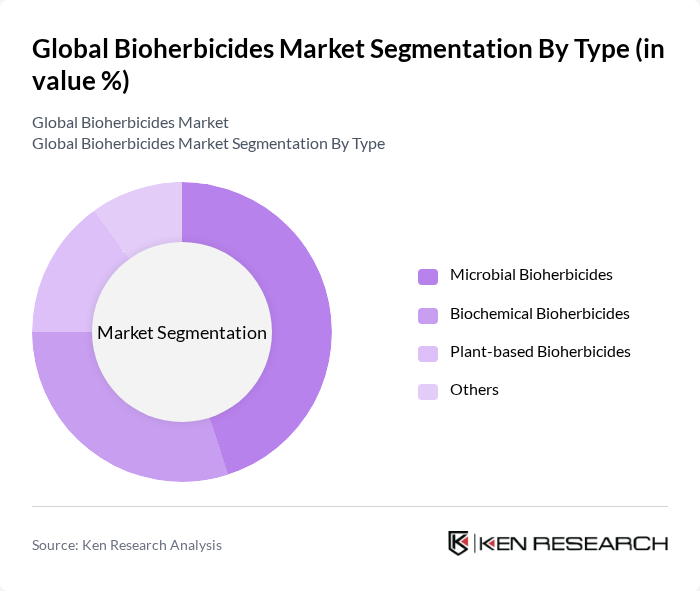
Global Bioherbicides Market segmentation by Type.

By End-User:The bioherbicides market is segmented by end-user into agriculture, horticulture, forestry, and others. The agriculture sector dominates the market, driven by the increasing need for sustainable farming practices, regulatory restrictions on chemical herbicides, and the rising adoption of organic farming. Farmers are increasingly turning to bioherbicides to manage weed populations while maintaining soil health and minimizing environmental impact. Horticulture is also a significant segment, as gardeners and landscape professionals seek eco-friendly solutions for weed control in ornamental and turf settings. The growing awareness of the benefits of bioherbicides in supporting biodiversity and reducing chemical residues is further propelling these market segments.
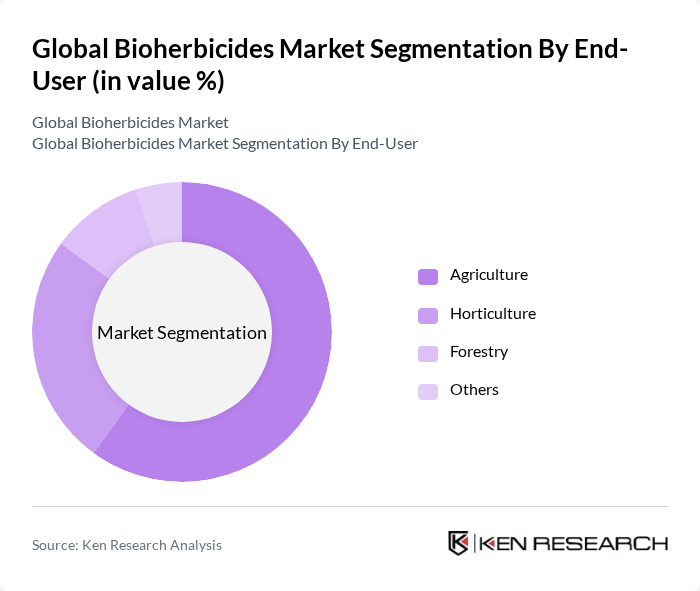
Global Bioherbicides Market segmentation by End-User.

Global Bioherbicides Market Competitive Landscape

The Global Bioherbicides Market is characterized by a dynamic mix of regional and international players. Leading participants such as BASF SE, Bayer AG, Syngenta AG, Marrone Bio Innovations Inc., BioWorks, Inc., Certis Biologicals (formerly Certis USA LLC), FMC Corporation, DuPont de Nemours, Inc., Novozymes A/S, Emery Oleochemicals, Verdesian Life Sciences, Bioherbicides Australia Pty Ltd, Ecopesticides International, Inc., Hindustan Bio-Tech, Certified Organics Australia Pty Ltd contribute to innovation, geographic expansion, and service delivery in this space.

BASF SE

1865

Ludwigshafen, Germany

Bayer AG

1863

Leverkusen, Germany

Syngenta AG

2000

Basel, Switzerland

Marrone Bio Innovations Inc.

2006

Fresno, California, USA

BioWorks, Inc.

1996

Victor, New York, USA

Company

Establishment Year

Headquarters

Group Size (Large, Medium, or Small as per industry convention)

Revenue Growth Rate (Bioherbicide Segment)

Market Penetration Rate (by Region or Crop Type)

R&D Intensity (Bioherbicide-related Expenditure as % of Revenue)

Product Portfolio Breadth (Number of Registered Bioherbicide Products)

Regulatory Approval Success Rate

Global Bioherbicides Market Industry Analysis

Growth Drivers

  • Increasing Demand for Organic Farming:The global organic farming market is projected to reach $320 billion in future, driven by consumer preferences for chemical-free produce. In future, the organic farmland area increased by approximately 1.7 million hectares, reaching 76.4 million hectares globally. This surge in organic farming directly correlates with the rising demand for bioherbicides, as farmers seek sustainable alternatives to synthetic herbicides to meet organic certification requirements and consumer expectations for environmentally friendly practices.
  • Rising Awareness of Environmental Sustainability:A recent survey indicated that 70% of consumers prioritize sustainability in their purchasing decisions, influencing agricultural practices. The global market for sustainable agriculture is expected to grow to $1 trillion in future. This heightened awareness drives farmers to adopt bioherbicides, which are perceived as eco-friendly solutions that reduce chemical runoff and promote biodiversity, aligning with the increasing consumer demand for sustainable food production methods.
  • Government Support and Subsidies for Bioherbicides:In future, governments worldwide are expected to allocate over $5 billion in subsidies for organic farming initiatives, including bioherbicide development. Countries like the U.S. and EU member states are implementing policies that encourage the use of bioherbicides through financial incentives and grants. This support not only lowers the financial barriers for farmers but also fosters innovation in bioherbicide formulations, enhancing their market penetration and adoption rates.

Market Challenges

  • Limited Awareness Among Farmers:Despite the benefits of bioherbicides, a significant knowledge gap persists among farmers, with only 30% aware of their availability and advantages. This lack of awareness can hinder adoption rates, particularly in regions where traditional farming practices dominate. Educational initiatives and outreach programs are essential to bridge this gap, as farmers often rely on familiar synthetic herbicides, limiting the market potential for bioherbicides.
  • High Initial Costs of Bioherbicide Products:The average cost of bioherbicide products can be 20-30% higher than synthetic alternatives, posing a financial challenge for farmers, especially smallholders. In future, the average price of bioherbicides was approximately $150 per liter compared to $100 for synthetic herbicides. This price disparity can deter farmers from switching to bioherbicides, necessitating strategies to reduce production costs and improve affordability to enhance market adoption.

Global Bioherbicides Market Future Outlook

The future of the bioherbicides market appears promising, driven by increasing consumer demand for organic products and a shift towards sustainable agricultural practices. As governments continue to implement stricter regulations on chemical herbicides, the bioherbicide sector is likely to experience accelerated growth. Additionally, ongoing research and development efforts are expected to yield innovative bioherbicide formulations, enhancing efficacy and expanding their application across various crops, thereby solidifying their role in modern agriculture.

Market Opportunities

  • Expansion into Emerging Markets:Emerging markets, particularly in Asia and Africa, present significant growth opportunities for bioherbicides. With a combined population exceeding 3 billion, these regions are witnessing a rapid shift towards sustainable agriculture. By in future, investments in agricultural technology in these markets are projected to exceed $10 billion, creating a favorable environment for bioherbicide adoption and market penetration.
  • Development of New Bioherbicide Products:The ongoing research into plant-based and microbial bioherbicides is expected to yield innovative products that cater to diverse agricultural needs. In future, the investment in bioherbicide R&D is anticipated to reach $1.5 billion, fostering the development of effective solutions that can compete with synthetic herbicides, thus expanding the market and enhancing farmer adoption rates.

Scope of the Report

SegmentSub-Segments
By Type

Microbial Bioherbicides

Biochemical Bioherbicides

Plant-based Bioherbicides

Others

By End-User

Agriculture

Horticulture

Forestry

Others

By Application

Crop Protection

Non-Crop Applications

Turf and Ornamental

Others

By Formulation

Liquid Formulations

Granular Formulations

Others

By Distribution Channel

Direct Sales

Retail Sales

Online Sales

Others

By Region

North America

Europe

Asia-Pacific

Latin America

Middle East & Africa

By Policy Support

Subsidies

Tax Exemptions

Research Grants

Others

By Source

Microbial

Biochemical

Others

By Crop Type

Agricultural Crops

Non-Agricultural Crops

By Mode of Application

Seed Treatment

Soil Application

Foliar

Post-Harvest

By Mode of Action

Photosynthesis Inhibition

Enzyme Targeting

Others

Key Target Audience

Investors and Venture Capitalist Firms

Government and Regulatory Bodies (e.g., Environmental Protection Agency, Food and Drug Administration)

Manufacturers and Producers of Bioherbicides

Distributors and Retailers of Agricultural Products

Biotechnology Firms

Agricultural Cooperatives

Industry Associations (e.g., Biopesticide Industry Alliance)

Financial Institutions and Banks

Players Mentioned in the Report:

BASF SE

Bayer AG

Syngenta AG

Marrone Bio Innovations Inc.

BioWorks, Inc.

Certis Biologicals (formerly Certis USA LLC)

FMC Corporation

DuPont de Nemours, Inc.

Novozymes A/S

Emery Oleochemicals

Verdesian Life Sciences

Bioherbicides Australia Pty Ltd

Ecopesticides International, Inc.

Hindustan Bio-Tech

Certified Organics Australia Pty Ltd

Table of Contents

Market Assessment Phase

1. Executive Summary and Approach


2. Global Bioherbicides Market Overview

2.1 Key Insights and Strategic Recommendations

2.2 Global Bioherbicides Market Overview

2.3 Definition and Scope

2.4 Evolution of Market Ecosystem

2.5 Timeline of Key Regulatory Milestones

2.6 Value Chain & Stakeholder Mapping

2.7 Business Cycle Analysis

2.8 Policy & Incentive Landscape


3. Global Bioherbicides Market Analysis

3.1 Growth Drivers

3.1.1 Increasing demand for organic farming
3.1.2 Rising awareness of environmental sustainability
3.1.3 Government support and subsidies for bioherbicides
3.1.4 Technological advancements in bioherbicide formulations

3.2 Market Challenges

3.2.1 Limited awareness among farmers
3.2.2 High initial costs of bioherbicide products
3.2.3 Regulatory hurdles in product approval
3.2.4 Competition from synthetic herbicides

3.3 Market Opportunities

3.3.1 Expansion into emerging markets
3.3.2 Development of new bioherbicide products
3.3.3 Collaborations with agricultural organizations
3.3.4 Increasing consumer preference for organic products

3.4 Market Trends

3.4.1 Growing adoption of integrated pest management
3.4.2 Rise in research and development activities
3.4.3 Shift towards sustainable agricultural practices
3.4.4 Increasing investment in bio-based products

3.5 Government Regulation

3.5.1 Stricter regulations on chemical herbicides
3.5.2 Incentives for organic farming practices
3.5.3 Guidelines for bioherbicide registration
3.5.4 Support for research in bioherbicide development

4. SWOT Analysis


5. Stakeholder Analysis


6. Porter's Five Forces Analysis


7. Global Bioherbicides Market Market Size, 2019-2024

7.1 By Value

7.2 By Volume

7.3 By Average Selling Price


8. Global Bioherbicides Market Segmentation

8.1 By Type

8.1.1 Microbial Bioherbicides
8.1.2 Biochemical Bioherbicides
8.1.3 Plant-based Bioherbicides
8.1.4 Others

8.2 By End-User

8.2.1 Agriculture
8.2.2 Horticulture
8.2.3 Forestry
8.2.4 Others

8.3 By Application

8.3.1 Crop Protection
8.3.2 Non-Crop Applications
8.3.3 Turf and Ornamental
8.3.4 Others

8.4 By Formulation

8.4.1 Liquid Formulations
8.4.2 Granular Formulations
8.4.3 Others

8.5 By Distribution Channel

8.5.1 Direct Sales
8.5.2 Retail Sales
8.5.3 Online Sales
8.5.4 Others

8.6 By Region

8.6.1 North America
8.6.2 Europe
8.6.3 Asia-Pacific
8.6.4 Latin America
8.6.5 Middle East & Africa

8.7 By Policy Support

8.7.1 Subsidies
8.7.2 Tax Exemptions
8.7.3 Research Grants
8.7.4 Others

8.8 By Source

8.8.1 Microbial
8.8.2 Biochemical
8.8.3 Others

8.9 By Crop Type

8.9.1 Agricultural Crops
8.9.2 Non-Agricultural Crops

8.10 By Mode of Application

8.10.1 Seed Treatment
8.10.2 Soil Application
8.10.3 Foliar
8.10.4 Post-Harvest

8.11 By Mode of Action

8.11.1 Photosynthesis Inhibition
8.11.2 Enzyme Targeting
8.11.3 Others

9. Global Bioherbicides Market Competitive Analysis

9.1 Market Share of Key Players

9.2 Cross Comparison of Key Players

9.2.1 Company Name
9.2.2 Group Size (Large, Medium, or Small as per industry convention)
9.2.3 Revenue Growth Rate (Bioherbicide Segment)
9.2.4 Market Penetration Rate (by Region or Crop Type)
9.2.5 R&D Intensity (Bioherbicide-related Expenditure as % of Revenue)
9.2.6 Product Portfolio Breadth (Number of Registered Bioherbicide Products)
9.2.7 Regulatory Approval Success Rate
9.2.8 Distribution Network Strength (Global/Regional Reach)
9.2.9 Strategic Partnerships/Collaborations (Number and Type)
9.2.10 Sustainability/ESG Score (Relevant to Bioherbicides)

9.3 SWOT Analysis of Top Players

9.4 Pricing Analysis

9.5 Detailed Profile of Major Companies

9.5.1 BASF SE
9.5.2 Bayer AG
9.5.3 Syngenta AG
9.5.4 Marrone Bio Innovations Inc.
9.5.5 BioWorks, Inc.
9.5.6 Certis Biologicals (formerly Certis USA LLC)
9.5.7 FMC Corporation
9.5.8 DuPont de Nemours, Inc.
9.5.9 Novozymes A/S
9.5.10 Emery Oleochemicals
9.5.11 Verdesian Life Sciences
9.5.12 Bioherbicides Australia Pty Ltd
9.5.13 Ecopesticides International, Inc.
9.5.14 Hindustan Bio-Tech
9.5.15 Certified Organics Australia Pty Ltd

10. Global Bioherbicides Market End-User Analysis

10.1 Procurement Behavior of Key Ministries

10.1.1 Government Procurement Policies
10.1.2 Budget Allocations for Bioherbicides
10.1.3 Collaboration with Agricultural Departments
10.1.4 Others

10.2 Corporate Spend on Infrastructure & Energy

10.2.1 Investment in Sustainable Practices
10.2.2 Budget for Bioherbicide Implementation
10.2.3 Partnerships with Bioherbicide Suppliers
10.2.4 Others

10.3 Pain Point Analysis by End-User Category

10.3.1 Challenges in Adoption of Bioherbicides
10.3.2 Cost-related Issues
10.3.3 Efficacy Concerns
10.3.4 Others

10.4 User Readiness for Adoption

10.4.1 Awareness Levels
10.4.2 Training and Support Needs
10.4.3 Infrastructure Readiness
10.4.4 Others

10.5 Post-Deployment ROI and Use Case Expansion

10.5.1 Measurement of ROI
10.5.2 Case Studies of Successful Implementations
10.5.3 Potential for Scaling Use Cases
10.5.4 Others

11. Global Bioherbicides Market Future Size, 2025-2030

11.1 By Value

11.2 By Volume

11.3 By Average Selling Price


Go-To-Market Strategy Phase

1. Whitespace Analysis + Business Model Canvas

1.1 Market Gaps Identification

1.2 Business Model Development


2. Marketing and Positioning Recommendations

2.1 Branding Strategies

2.2 Product USPs


3. Distribution Plan

3.1 Urban Retail vs Rural NGO Tie-ups


4. Channel & Pricing Gaps

4.1 Underserved Routes

4.2 Pricing Bands


5. Unmet Demand & Latent Needs

5.1 Category Gaps

5.2 Consumer Segments


6. Customer Relationship

6.1 Loyalty Programs

6.2 After-sales Service


7. Value Proposition

7.1 Sustainability

7.2 Integrated Supply Chains


8. Key Activities

8.1 Regulatory Compliance

8.2 Branding

8.3 Distribution Setup


9. Entry Strategy Evaluation

9.1 Domestic Market Entry Strategy

9.1.1 Product Mix
9.1.2 Pricing Band
9.1.3 Packaging

9.2 Export Entry Strategy

9.2.1 Target Countries
9.2.2 Compliance Roadmap

10. Entry Mode Assessment

10.1 JV

10.2 Greenfield

10.3 M&A

10.4 Distributor Model


11. Capital and Timeline Estimation

11.1 Capital Requirements

11.2 Timelines


12. Control vs Risk Trade-Off

12.1 Ownership vs Partnerships


13. Profitability Outlook

13.1 Breakeven Analysis

13.2 Long-term Sustainability


14. Potential Partner List

14.1 Distributors

14.2 JVs

14.3 Acquisition Targets


15. Execution Roadmap

15.1 Phased Plan for Market Entry

15.1.1 Market Setup
15.1.2 Market Entry
15.1.3 Growth Acceleration
15.1.4 Scale & Stabilize

15.2 Key Activities and Milestones

15.2.1 Milestone Planning
15.2.2 Activity Tracking

Research Methodology

ApproachModellingSample

Phase 1: Approach1

Desk Research

  • Analysis of market reports from agricultural and environmental organizations
  • Review of academic journals and publications on bioherbicide efficacy and trends
  • Examination of government regulations and policies affecting bioherbicide usage

Primary Research

  • Interviews with agronomists and researchers specializing in bioherbicides
  • Surveys with farmers and agricultural producers utilizing bioherbicides
  • Focus groups with distributors and retailers of bioherbicide products

Validation & Triangulation

  • Cross-validation of findings with industry reports and expert opinions
  • Triangulation of data from primary and secondary sources for accuracy
  • Sanity checks through feedback from a panel of agricultural experts

Phase 2: Market Size Estimation1

Top-down Assessment

  • Estimation of market size based on global agricultural spending trends
  • Segmentation by crop type and geographical region for targeted analysis
  • Incorporation of growth rates from organic farming initiatives

Bottom-up Modeling

  • Volume estimates derived from sales data of leading bioherbicide products
  • Cost analysis based on production and distribution expenses
  • Market share calculations based on firm-level performance metrics

Forecasting & Scenario Analysis

  • Multi-variable forecasting using trends in sustainable agriculture and consumer preferences
  • Scenario modeling based on potential regulatory changes and environmental impacts
  • Development of baseline, optimistic, and pessimistic market projections through 2030

Phase 3: CATI Sample Composition1

Scope Item/SegmentSample SizeTarget Respondent Profiles
Organic Farming Practices100Farm Owners, Agricultural Consultants
Bioherbicide Product Development60R&D Managers, Product Development Scientists
Distribution Channels for Bioherbicides50Supply Chain Managers, Retail Buyers
Market Adoption Rates80Agricultural Extension Officers, Crop Advisors
Consumer Awareness and Preferences40End-users, Agricultural Educators

Frequently Asked Questions

What is the current value of the Global Bioherbicides Market?

The Global Bioherbicides Market is valued at approximately USD 2.3 billion, reflecting a significant growth trend driven by the demand for sustainable agricultural practices and the shift towards organic farming.

What factors are driving the growth of the bioherbicides market?

Which countries are leading in the bioherbicides market?

What are the main types of bioherbicides available in the market?

Other Regional/Country Reports

Indonesia Bioherbicides Market

Malaysia Bioherbicides Market

KSA Bioherbicides Market

APAC Bioherbicides Market

SEA Bioherbicides Market

Vietnam Bioherbicides Market

Other Adjacent Reports

Brazil Biopesticides Market

Bahrain Organic Farming Market

UAE Sustainable Agriculture Market

Australia Crop Protection Market Outlook to 2027FKuwait Agricultural Biotechnology Market Size, Share, Growth Drivers, Trends, Opportunities & Forecast 2025–2030

Kuwait Microbial Pesticides Market

Germany Plant Extracts Market

Malaysia Weed Management Market

UAE Precision Farming Market

Philippines Organic Food Production Market

Why Buy From Us?

Refine Robust Result (RRR) Framework

What makes us stand out is that our consultants follow Robust, Refine and Result (RRR) methodology. Robust for clear definitions, approaches and sanity checking, Refine for differentiating respondents' facts and opinions, and Result for presenting data with story.

Our Reach Is Unmatched

We have set a benchmark in the industry by offering our clients with syndicated and customized market research reports featuring coverage of entire market as well as meticulous research and analyst insights.

Shifting the Research Paradigm

While we don't replace traditional research, we flip the method upside down. Our dual approach of Top Bottom & Bottom Top ensures quality deliverable by not just verifying company fundamentals but also looking at the sector and macroeconomic factors.

More Insights-Better Decisions

With one step in the future, our research team constantly tries to show you the bigger picture. We help with some of the tough questions you may encounter along the way: How is the industry positioned? Best marketing channel? KPI's of competitors? By aligning every element, we help maximize success.

Transparency and Trust

Our report gives you instant access to the answers and sources that other companies might choose to hide. We elaborate each steps of research methodology we have used and showcase you the sample size to earn your trust.

Round the Clock Support

If you need any support, we are here! We pride ourselves on universe strength, data quality, and quick, friendly, and professional service.

Why Clients Choose Us?

400000+
Reports in repository
150+
Consulting projects a year
100+
Analysts
8000+
Client Queries in 2022








