About the Report
Base Year 2024Listen to the audio summary
Global Biotechnology Instruments Market Overview
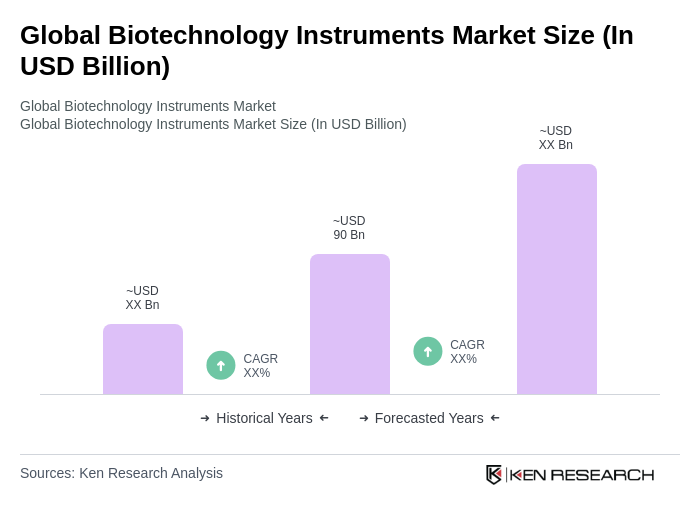
- The Global Biotechnology Instruments Market is valued at USD 90 billion, based on a five-year historical analysis. This growth is primarily driven by advancements in technology, increasing investments in research and development, and the rising demand for personalized medicine; industry trackers consistently cite precision medicine adoption and chronic disease burden as core demand drivers for instruments across IVD, genomics, and proteomics.
- Key players in this market include the United States, Germany, and China. The U.S. leads due to its robust healthcare infrastructure, significant R&D investments, and a high concentration of biotechnology and life-science tools firms; North America is consistently the largest regional market for biotech instruments in recent analyses, aligning with high adoption of IVD and lab technologies. Germany benefits from strong life sciences manufacturing and instrument innovation; Europe remains a major hub for instrument production and adoption. China is rapidly expanding its biotechnology sector, supported by government initiatives and a large population base, contributing to rising demand for sequencing, IVD, and bioprocess equipment.
- The 21st Century Cures Act was enacted prior to 2023 and continues to shape U.S. biomedical innovation by accelerating product development pathways and supporting advanced technologies, real?world evidence, and precision medicine initiatives; it is frequently referenced by FDA and analysts as enabling faster innovation adoption in diagnostics and life-science tools. While not implemented in 2023, its ongoing provisions and related FDA programs support the adoption of digital and personalized technologies that benefit biotechnology instruments markets.
Global Biotechnology Instruments Market Segmentation
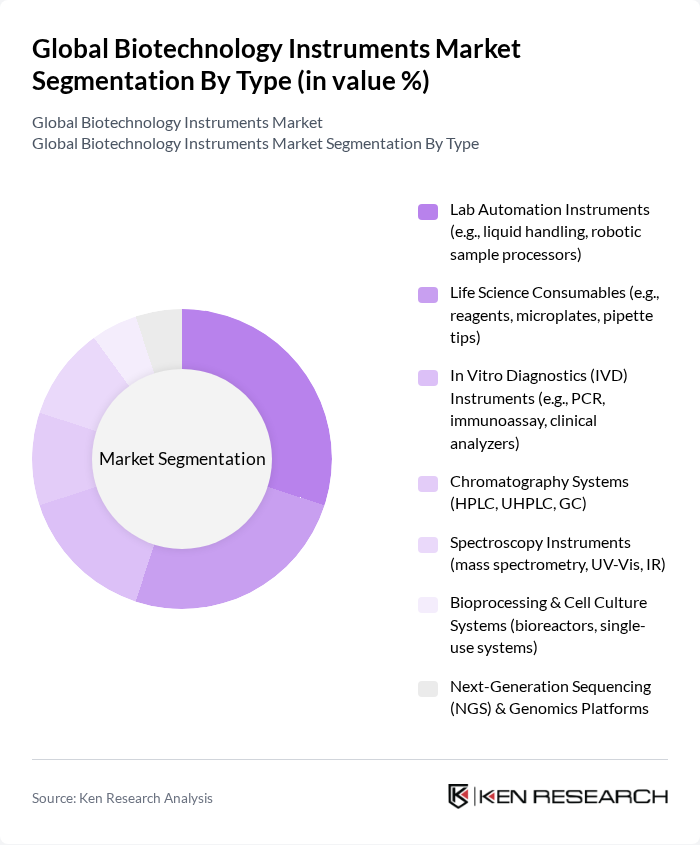
By Type:The biotechnology instruments market can be segmented into various types, including Lab Automation Instruments, Life Science Consumables, In Vitro Diagnostics (IVD) Instruments, Chromatography Systems, Spectroscopy Instruments, Bioprocessing & Cell Culture Systems, and Next-Generation Sequencing (NGS) & Genomics Platforms. Among these, Lab Automation Instruments and Life Science Consumables are particularly significant due to their essential roles in enhancing laboratory efficiency and supporting research activities.
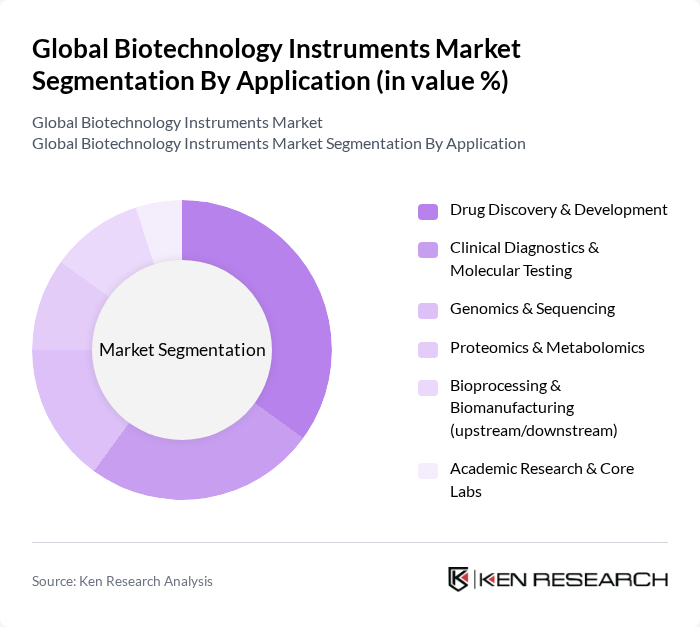
By Application:The applications of biotechnology instruments encompass Drug Discovery & Development, Clinical Diagnostics & Molecular Testing, Genomics & Sequencing, Proteomics & Metabolomics, Bioprocessing & Biomanufacturing, and Academic Research & Core Labs. The Drug Discovery & Development segment is particularly dominant, driven by the increasing need for innovative therapies and the growing investment in pharmaceutical research; rising use of molecular and cell analysis tools, high IVD adoption, and expanding sequencing in clinical and research settings underpin these applications.
Global Biotechnology Instruments Market Competitive Landscape
The Global Biotechnology Instruments Market is characterized by a dynamic mix of regional and international players. Leading participants such as Thermo Fisher Scientific Inc., Agilent Technologies Inc., Bio-Rad Laboratories, Inc., Revvity, Inc. (formerly PerkinElmer’s life sciences), Eppendorf SE, Sartorius AG, Merck KGaA (Merck Life Science), Roche Diagnostics (F. Hoffmann-La Roche Ltd.), Illumina, Inc., QIAGEN N.V., Siemens Healthineers AG, Abbott Laboratories, Becton, Dickinson and Company (BD), Danaher Corporation (Beckman Coulter, Cytiva, Cepheid), Waters Corporation, Bruker Corporation, Shimadzu Corporation, Tecan Group AG, Hamilton Company, Oxford Nanopore Technologies plc contribute to innovation, geographic expansion, and service delivery in this space.
Global Biotechnology Instruments Market Industry Analysis
Growth Drivers
- Increasing Demand for Personalized Medicine:The global personalized medicine market is projected to reach $2.5 trillion in future, driven by advancements in genomics and biotechnology. This surge is fueled by the growing prevalence of chronic diseases, with the World Health Organization reporting that non-communicable diseases account for approximately 71% of global deaths. As healthcare shifts towards tailored treatments, the demand for biotechnology instruments that facilitate genetic testing and biomarker discovery is expected to rise significantly, enhancing market growth.
- Advancements in Genomic Technologies:The global genomics market is anticipated to reach $62 billion in future, reflecting a compound annual growth rate of 10.5%. Innovations in next-generation sequencing (NGS) and CRISPR technologies are driving this growth, enabling more efficient and accurate genetic analysis. The National Institutes of Health reported a 20% increase in funding for genomic research in future, indicating strong governmental support for advancements that will further propel the biotechnology instruments market.
- Rising Investments in Biopharmaceutical R&D:Global biopharmaceutical R&D spending is projected to exceed $200 billion in future, driven by the need for innovative therapies. According to the Pharmaceutical Research and Manufacturers of America, biopharmaceutical companies invested $83 billion in R&D in future. This influx of capital is expected to enhance the development of biotechnology instruments, as companies seek advanced tools for drug discovery and development, thereby stimulating market growth.
Market Challenges
- High Costs of Biotechnology Instruments:The average cost of advanced biotechnology instruments can exceed $100,000, posing a significant barrier for smaller laboratories and research institutions. According to a report by the National Science Foundation, nearly 30% of research facilities cite budget constraints as a primary challenge in acquiring necessary equipment. This financial hurdle limits access to cutting-edge technologies, potentially stifling innovation and slowing market growth in the biotechnology sector.
- Stringent Regulatory Frameworks:The biotechnology sector faces rigorous regulatory scrutiny, particularly from agencies like the FDA and EMA. Compliance with these regulations can extend product development timelines by an average of 18 months, according to industry reports. The complexity of navigating these frameworks can deter investment and slow the introduction of new biotechnology instruments, creating a challenging environment for companies aiming to innovate and expand their market presence.
Global Biotechnology Instruments Market Future Outlook
The biotechnology instruments market is poised for significant evolution, driven by technological advancements and increasing demand for personalized healthcare solutions. As automation and artificial intelligence become integral to laboratory processes, efficiency and accuracy in research will improve. Furthermore, the rise of point-of-care testing is expected to enhance accessibility to diagnostic tools, particularly in emerging markets. These trends indicate a dynamic future for the biotechnology instruments sector, with opportunities for innovation and growth on the horizon.
Market Opportunities
- Expansion in Emerging Markets:Emerging markets, particularly in Asia-Pacific, are projected to experience a 15% increase in biotechnology investments in future. This growth is driven by rising healthcare expenditures and government initiatives to boost local biotech industries. Companies that strategically enter these markets can capitalize on the increasing demand for advanced biotechnology instruments, enhancing their global footprint and revenue potential.
- Collaborations with Research Institutions:Partnerships between biotechnology firms and academic research institutions are expected to increase, with funding for collaborative projects projected to reach $10 billion in future. These collaborations can accelerate innovation and product development, providing companies with access to cutting-edge research and technology. By leveraging shared resources, firms can enhance their product offerings and strengthen their competitive position in the market.
Scope of the Report
| Segment | Sub-Segments |
|---|---|
| By Type | Lab Automation Instruments (e.g., liquid handling, robotic sample processors) Life Science Consumables (e.g., reagents, microplates, pipette tips) In Vitro Diagnostics (IVD) Instruments (e.g., PCR, immunoassay, clinical analyzers) Chromatography Systems (HPLC, UHPLC, GC) Spectroscopy Instruments (mass spectrometry, UV-Vis, IR) Bioprocessing & Cell Culture Systems (bioreactors, single-use systems) Next-Generation Sequencing (NGS) & Genomics Platforms |
| By Application | Drug Discovery & Development Clinical Diagnostics & Molecular Testing Genomics & Sequencing Proteomics & Metabolomics Bioprocessing & Biomanufacturing (upstream/downstream) Academic Research & Core Labs |
| By End-User | Pharmaceutical & Biotechnology Companies Government & Academic Institutes Hospitals, Clinical & Diagnostic Laboratories Contract Research & Manufacturing Organizations (CROs/CMOs/CDMOs) Others (industrial labs, environmental, food testing) |
| By Distribution Channel | Direct Sales Authorized Distributors/Value-Added Resellers Online/ eCommerce Tender/Institutional Procurement |
| By Region | North America (U.S., Canada, Mexico) Europe (Germany, U.K., France, Italy, Spain, Rest of Europe) Asia-Pacific (China, Japan, India, South Korea, Australia, Rest of APAC) Latin America (Brazil, Argentina, Rest of Latin America) Middle East & Africa (GCC, South Africa, Rest of MEA) Others |
| By Price Range | Low-End Instruments Mid-Range Instruments High-End Instruments |
| By Service Type | Maintenance & Repair Services Calibration & Validation Services Installation, Training & Consulting Services Managed Services & Service Contracts |
Key Target Audience
Investors and Venture Capitalist Firms
Government and Regulatory Bodies (e.g., U.S. Food and Drug Administration, European Medicines Agency)
Biotechnology and Pharmaceutical Companies
Contract Research Organizations (CROs)
Healthcare Providers and Laboratories
Biotechnology Instrument Manufacturers
Industry Associations (e.g., Biotechnology Innovation Organization)
Public Health Agencies (e.g., Centers for Disease Control and Prevention)
Players Mentioned in the Report:
Thermo Fisher Scientific Inc.
Agilent Technologies Inc.
Bio-Rad Laboratories, Inc.
Revvity, Inc. (formerly PerkinElmers life sciences)
Eppendorf SE
Sartorius AG
Merck KGaA (Merck Life Science)
Roche Diagnostics (F. Hoffmann-La Roche Ltd.)
Illumina, Inc.
QIAGEN N.V.
Siemens Healthineers AG
Abbott Laboratories
Becton, Dickinson and Company (BD)
Danaher Corporation (Beckman Coulter, Cytiva, Cepheid)
Waters Corporation
Bruker Corporation
Shimadzu Corporation
Tecan Group AG
Hamilton Company
Oxford Nanopore Technologies plc
Table of Contents
Market Assessment Phase
1. Executive Summary and Approach
2. Global Biotechnology Instruments Market Overview
2.1 Key Insights and Strategic Recommendations
2.2 Global Biotechnology Instruments Market Overview
2.3 Definition and Scope
2.4 Evolution of Market Ecosystem
2.5 Timeline of Key Regulatory Milestones
2.6 Value Chain & Stakeholder Mapping
2.7 Business Cycle Analysis
2.8 Policy & Incentive Landscape
3. Global Biotechnology Instruments Market Analysis
3.1 Growth Drivers
3.1.1 Increasing Demand for Personalized Medicine
3.1.2 Advancements in Genomic Technologies
3.1.3 Rising Investments in Biopharmaceutical R&D
3.1.4 Growing Focus on Biomanufacturing Processes
3.2 Market Challenges
3.2.1 High Costs of Biotechnology Instruments
3.2.2 Stringent Regulatory Frameworks
3.2.3 Rapid Technological Changes
3.2.4 Limited Skilled Workforce
3.3 Market Opportunities
3.3.1 Expansion in Emerging Markets
3.3.2 Collaborations with Research Institutions
3.3.3 Development of Innovative Products
3.3.4 Increasing Adoption of Automation in Laboratories
3.4 Market Trends
3.4.1 Integration of AI and Machine Learning
3.4.2 Shift Towards Sustainable Practices
3.4.3 Growth of Point-of-Care Testing
3.4.4 Rise in Contract Research Organizations (CROs)
3.5 Government Regulation
3.5.1 Compliance with FDA Guidelines
3.5.2 EU Regulations on Biotech Products
3.5.3 Environmental Protection Standards
3.5.4 Intellectual Property Rights Enforcement
4. SWOT Analysis
5. Stakeholder Analysis
6. Porter's Five Forces Analysis
7. Global Biotechnology Instruments Market Market Size, 2019-2024
7.1 By Value
7.2 By Volume
7.3 By Average Selling Price
8. Global Biotechnology Instruments Market Segmentation
8.1 By Type
8.1.1 Lab Automation Instruments (e.g., liquid handling, robotic sample processors)
8.1.2 Life Science Consumables (e.g., reagents, microplates, pipette tips)
8.1.3 In Vitro Diagnostics (IVD) Instruments (e.g., PCR, immunoassay, clinical analyzers)
8.1.4 Chromatography Systems (HPLC, UHPLC, GC)
8.1.5 Spectroscopy Instruments (mass spectrometry, UV-Vis, IR)
8.1.6 Bioprocessing & Cell Culture Systems (bioreactors, single-use systems)
8.1.7 Next-Generation Sequencing (NGS) & Genomics Platforms
8.2 By Application
8.2.1 Drug Discovery & Development
8.2.2 Clinical Diagnostics & Molecular Testing
8.2.3 Genomics & Sequencing
8.2.4 Proteomics & Metabolomics
8.2.5 Bioprocessing & Biomanufacturing (upstream/downstream)
8.2.6 Academic Research & Core Labs
8.3 By End-User
8.3.1 Pharmaceutical & Biotechnology Companies
8.3.2 Government & Academic Institutes
8.3.3 Hospitals, Clinical & Diagnostic Laboratories
8.3.4 Contract Research & Manufacturing Organizations (CROs/CMOs/CDMOs)
8.3.5 Others (industrial labs, environmental, food testing)
8.4 By Distribution Channel
8.4.1 Direct Sales
8.4.2 Authorized Distributors/Value-Added Resellers
8.4.3 Online/ eCommerce
8.4.4 Tender/Institutional Procurement
8.5 By Region
8.5.1 North America (U.S., Canada, Mexico)
8.5.2 Europe (Germany, U.K., France, Italy, Spain, Rest of Europe)
8.5.3 Asia-Pacific (China, Japan, India, South Korea, Australia, Rest of APAC)
8.5.4 Latin America (Brazil, Argentina, Rest of Latin America)
8.5.5 Middle East & Africa (GCC, South Africa, Rest of MEA)
8.5.6 Others
8.6 By Price Range
8.6.1 Low-End Instruments
8.6.2 Mid-Range Instruments
8.6.3 High-End Instruments
8.7 By Service Type
8.7.1 Maintenance & Repair Services
8.7.2 Calibration & Validation Services
8.7.3 Installation, Training & Consulting Services
8.7.4 Managed Services & Service Contracts
9. Global Biotechnology Instruments Market Competitive Analysis
9.1 Market Share of Key Players
9.2 Cross Comparison of Key Players
9.2.1 Company Name (entity-level, biotechnology instruments portfolio)
9.2.2 Group Size (Large, Mid, Small; by global revenue)
9.2.3 Biotechnology Instruments Revenue and Growth (YoY/CAGR)
9.2.4 Geographic Footprint (regions served, installed base)
9.2.5 Product Portfolio Breadth (number of platforms/categories covered)
9.2.6 R&D Intensity (R&D spend as % of revenue; patents filed)
9.2.7 Innovation Velocity (time-to-market, new launches per year)
9.2.8 Pricing & Contracting (ASP trends, service contracts, reagent rental)
9.2.9 Channel Strength (direct vs distributor mix; key partnerships)
9.2.10 Quality & Compliance (ISO/FDA/IVDR status, field service KPIs)
9.2.11 Customer Retention/Net Revenue Retention (instruments + consumables)
9.2.12 Aftermarket Mix (consumables/services as % of revenue)
9.2.13 Market Share and Share Momentum (by segment/region)
9.3 SWOT Analysis of Top Players
9.4 Pricing Analysis
9.5 Detailed Profile of Major Companies
9.5.1 Thermo Fisher Scientific Inc.
9.5.2 Agilent Technologies Inc.
9.5.3 Bio-Rad Laboratories, Inc.
9.5.4 Revvity, Inc. (formerly PerkinElmer’s life sciences)
9.5.5 Eppendorf SE
9.5.6 Sartorius AG
9.5.7 Merck KGaA (Merck Life Science)
9.5.8 Roche Diagnostics (F. Hoffmann-La Roche Ltd.)
9.5.9 Illumina, Inc.
9.5.10 QIAGEN N.V.
9.5.11 Siemens Healthineers AG
9.5.12 Abbott Laboratories
9.5.13 Becton, Dickinson and Company (BD)
9.5.14 Danaher Corporation (Beckman Coulter, Cytiva, Cepheid)
9.5.15 Waters Corporation
9.5.16 Bruker Corporation
9.5.17 Shimadzu Corporation
9.5.18 Tecan Group AG
9.5.19 Hamilton Company
9.5.20 Oxford Nanopore Technologies plc
10. Global Biotechnology Instruments Market End-User Analysis
10.1 Procurement Behavior of Key Ministries
10.1.1 Government Funding Trends
10.1.2 Procurement Processes
10.1.3 Key Decision-Makers
10.2 Corporate Spend on Infrastructure & Energy
10.2.1 Budget Allocations
10.2.2 Investment Priorities
10.2.3 Infrastructure Development Plans
10.3 Pain Point Analysis by End-User Category
10.3.1 Equipment Reliability Issues
10.3.2 Training and Support Needs
10.3.3 Cost Management Challenges
10.4 User Readiness for Adoption
10.4.1 Technology Acceptance Levels
10.4.2 Training Requirements
10.4.3 Infrastructure Readiness
10.5 Post-Deployment ROI and Use Case Expansion
10.5.1 Performance Metrics
10.5.2 User Feedback Mechanisms
10.5.3 Future Use Case Development
11. Global Biotechnology Instruments Market Future Size, 2025-2030
11.1 By Value
11.2 By Volume
11.3 By Average Selling Price
Go-To-Market Strategy Phase
1. Whitespace Analysis + Business Model Canvas
1.1 Market Gaps Identification
1.2 Value Proposition Development
1.3 Revenue Streams Analysis
1.4 Key Partnerships
1.5 Cost Structure Analysis
1.6 Customer Segmentation
1.7 Channels of Distribution
2. Marketing and Positioning Recommendations
2.1 Branding Strategies
2.2 Product USPs
2.3 Target Market Identification
2.4 Communication Strategies
2.5 Digital Marketing Approaches
3. Distribution Plan
3.1 Urban Retail Strategies
3.2 Rural NGO Tie-Ups
3.3 Online Distribution Channels
3.4 Direct Sales Approaches
4. Channel & Pricing Gaps
4.1 Underserved Routes
4.2 Pricing Bands Analysis
4.3 Competitor Pricing Strategies
5. Unmet Demand & Latent Needs
5.1 Category Gaps
5.2 Consumer Segments Analysis
5.3 Emerging Trends Identification
6. Customer Relationship
6.1 Loyalty Programs
6.2 After-Sales Service
6.3 Customer Feedback Mechanisms
7. Value Proposition
7.1 Sustainability Initiatives
7.2 Integrated Supply Chains
7.3 Competitive Advantages
8. Key Activities
8.1 Regulatory Compliance
8.2 Branding Initiatives
8.3 Distribution Setup
9. Entry Strategy Evaluation
9.1 Domestic Market Entry Strategy
9.1.1 Product Mix Considerations
9.1.2 Pricing Band Strategies
9.1.3 Packaging Innovations
9.2 Export Entry Strategy
9.2.1 Target Countries Identification
9.2.2 Compliance Roadmap Development
10. Entry Mode Assessment
10.1 Joint Ventures
10.2 Greenfield Investments
10.3 Mergers & Acquisitions
10.4 Distributor Model Evaluation
11. Capital and Timeline Estimation
11.1 Capital Requirements
11.2 Timelines for Implementation
12. Control vs Risk Trade-Off
12.1 Ownership Considerations
12.2 Partnerships Evaluation
13. Profitability Outlook
13.1 Breakeven Analysis
13.2 Long-Term Sustainability Strategies
14. Potential Partner List
14.1 Distributors
14.2 Joint Ventures
14.3 Acquisition Targets
15. Execution Roadmap
15.1 Phased Plan for Market Entry
15.1.1 Market Setup
15.1.2 Market Entry
15.1.3 Growth Acceleration
15.1.4 Scale & Stabilize
15.2 Key Activities and Milestones
15.2.1 Milestone Identification
15.2.2 Activity Scheduling
Research Methodology
Phase 1: Approach1
Desk Research
- Analysis of industry reports from biotechnology associations and market research firms
- Review of scientific publications and patents related to biotechnology instruments
- Examination of government and regulatory body publications on biotechnology standards
Primary Research
- Interviews with R&D heads at leading biotechnology firms
- Surveys with laboratory managers and technicians using biotechnology instruments
- Field interviews with industry experts and consultants in biotechnology
Validation & Triangulation
- Cross-validation of findings through multiple data sources including trade publications and expert opinions
- Triangulation of market data with sales figures and industry growth rates
- Sanity checks through expert panel discussions and feedback sessions
Phase 2: Market Size Estimation1
Top-down Assessment
- Estimation of market size based on global biotechnology spending trends
- Segmentation by application areas such as pharmaceuticals, diagnostics, and research
- Incorporation of growth rates from emerging markets and technological advancements
Bottom-up Modeling
- Collection of sales data from key biotechnology instrument manufacturers
- Estimation of market share based on product categories and geographic regions
- Volume x price analysis for each segment to derive total market value
Forecasting & Scenario Analysis
- Multi-variable forecasting using historical data and market trends
- Scenario analysis based on potential regulatory changes and technological disruptions
- Development of baseline, optimistic, and pessimistic market projections through 2030
Phase 3: CATI Sample Composition1
| Scope Item/Segment | Sample Size | Target Respondent Profiles |
|---|---|---|
| Pharmaceutical Biotechnology Instruments | 120 | R&D Managers, Quality Control Analysts |
| Diagnostic Equipment in Biotechnology | 100 | Laboratory Technicians, Clinical Researchers |
| Research and Development Tools | 80 | Biotech Scientists, Product Development Managers |
| Biotechnology Instrumentation for Agriculture | 70 | Agricultural Scientists, Field Researchers |
| Environmental Biotechnology Instruments | 60 | Environmental Analysts, Sustainability Officers |
Frequently Asked Questions
What is the current value of the Global Biotechnology Instruments Market?
The Global Biotechnology Instruments Market is valued at approximately USD 90 billion, driven by technological advancements, increased R&D investments, and the growing demand for personalized medicine, particularly in areas like IVD, genomics, and proteomics.
Which regions are leading in the Biotechnology Instruments Market?
What are the main types of biotechnology instruments?
What applications drive the demand for biotechnology instruments?
Other Regional/Country Reports
Indonesia Biotechnology Instruments Market
Malaysia Biotechnology Instruments Market
APAC Biotechnology Instruments Market
Why Buy From Us?

What makes us stand out is that our consultants follow Robust, Refine and Result (RRR) methodology. Robust for clear definitions, approaches and sanity checking, Refine for differentiating respondents' facts and opinions, and Result for presenting data with story.

We have set a benchmark in the industry by offering our clients with syndicated and customized market research reports featuring coverage of entire market as well as meticulous research and analyst insights.

While we don't replace traditional research, we flip the method upside down. Our dual approach of Top Bottom & Bottom Top ensures quality deliverable by not just verifying company fundamentals but also looking at the sector and macroeconomic factors.

With one step in the future, our research team constantly tries to show you the bigger picture. We help with some of the tough questions you may encounter along the way: How is the industry positioned? Best marketing channel? KPI's of competitors? By aligning every element, we help maximize success.

Our report gives you instant access to the answers and sources that other companies might choose to hide. We elaborate each steps of research methodology we have used and showcase you the sample size to earn your trust.

If you need any support, we are here! We pride ourselves on universe strength, data quality, and quick, friendly, and professional service.