About the Report
Base Year 2024Listen to the audio summary
Global Books Market Overview
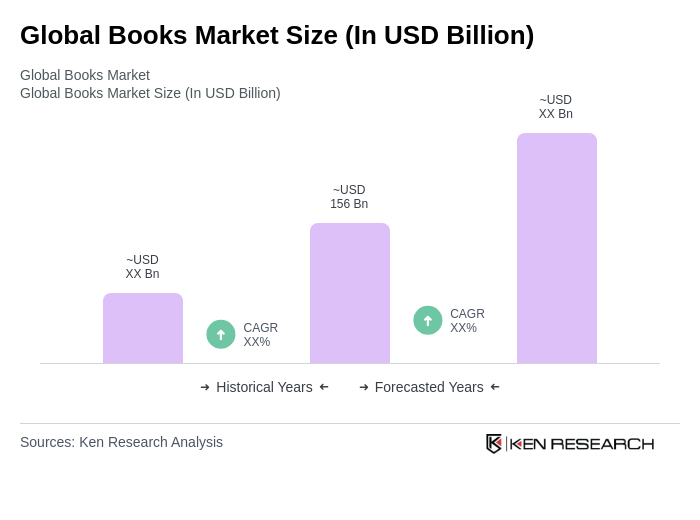
- The Global Books Market is valued at USD 156 billion, based on a five-year historical analysis. This growth is primarily driven by the increasing demand for diverse reading materials, the rise of e-books, the expansion of online retail channels, and the growing influence of audiobooks and subscription-based models. The market has seen a significant shift towards digital formats, with consumers increasingly favoring convenience and accessibility in their reading habits. Artificial intelligence is also enhancing user experience through personalized recommendations and streamlined content creation, further accelerating digital adoption .
- Key players in this market include the United States, the United Kingdom, Germany, and China. The dominance of these countries can be attributed to their strong publishing industries, high literacy rates, robust distribution networks, and technological advancements in digital publishing. Additionally, cultural factors and a rich literary heritage contribute to the sustained demand for books in these regions. North America holds the largest market share, while Asia Pacific is the fastest-growing region .
- In 2023, the European Union implemented Directive (EU) 2019/882, known as the European Accessibility Act, issued by the European Parliament and Council. This regulation mandates that publishers provide accessible formats of their titles, including e-books and audiobooks, to ensure that individuals with disabilities can access literature. The directive sets operational requirements for accessibility, covering digital and physical formats, and requires compliance from publishers operating within the EU .
Global Books Market Segmentation
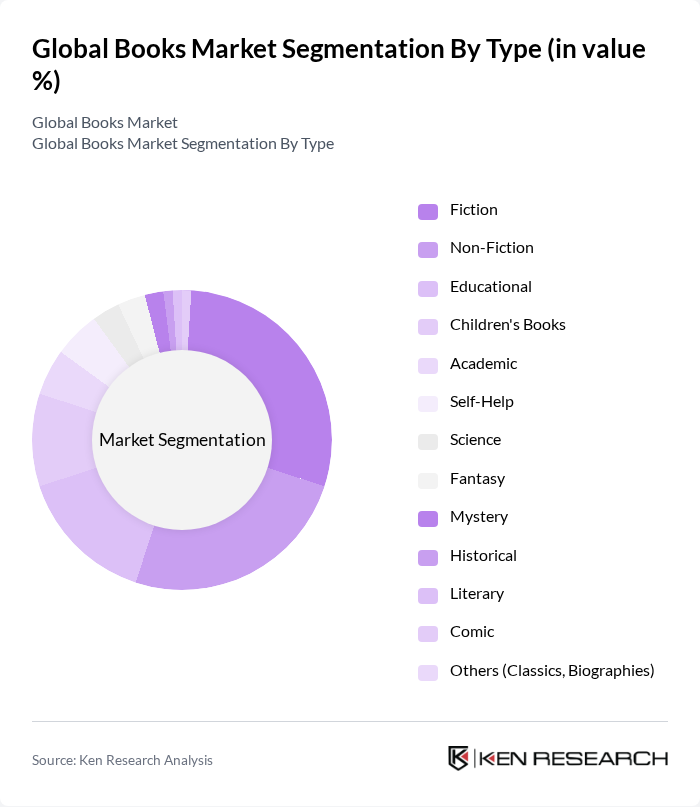
By Type:The market is segmented into various types of books, including Fiction, Non-Fiction, Educational, Children's Books, Academic, Self-Help, Science, Fantasy, Mystery, Historical, Literary, Comic, and Others (Classics, Biographies). Among these, Fiction and Non-Fiction remain the most prominent segments, driven by consumer preferences for storytelling and factual content. The rise of self-publishing and digital platforms has contributed to the growth of niche genres, such as poetry, graphic novels, and audiobooks, further expanding the overall market .
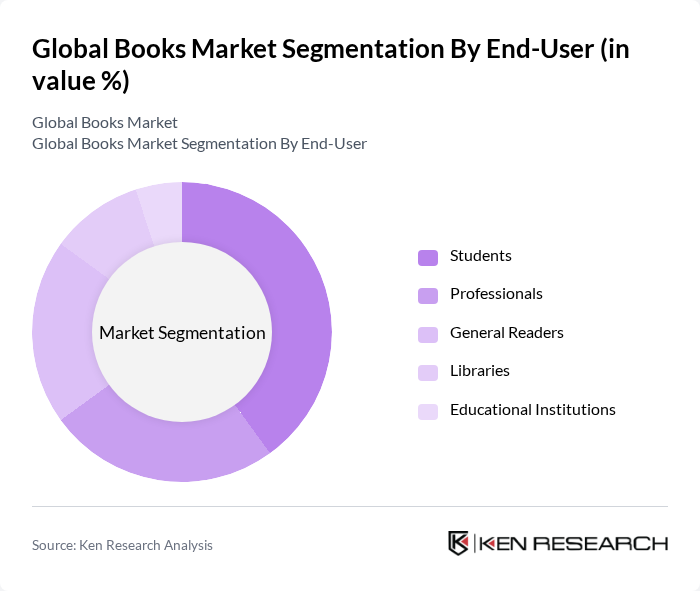
By End-User:The end-user segmentation includes Students, Professionals, General Readers, Libraries, and Educational Institutions. The student segment is the largest, driven by the demand for textbooks and educational materials, especially digital and interactive formats. Professionals also contribute significantly, seeking resources for career development and skill enhancement. Libraries and educational institutions play a crucial role in promoting reading culture and providing access to a wide range of books, with increasing adoption of digital lending and e-book platforms .
Global Books Market Competitive Landscape
The Global Books Market is characterized by a dynamic mix of regional and international players. Leading participants such as Penguin Random House, HarperCollins Publishers, Simon & Schuster, Hachette Livre, John Wiley & Sons (Wiley), Macmillan Publishers (Holtzbrinck Publishing Group), Scholastic Corporation, Bloomsbury Publishing, Springer Nature, Oxford University Press, Cambridge University Press & Assessment, Ingram Content Group, Cengage Group, Elsevier, Amazon Publishing, Pearson PLC, McGraw-Hill Education, IDW Media Holdings, Walt Disney Company (Marvel Comics), Morris Publishing contribute to innovation, geographic expansion, and service delivery in this space.
Global Books Market Industry Analysis
Growth Drivers
- Increasing Digital Adoption:The global digital book market is projected to reach $25 billion by 2025, driven by the rise in e-readers and mobile devices. In future, over 35% of book sales were digital, reflecting a significant shift in consumer behavior. The World Bank reports that internet penetration in developing regions is expected to exceed 65% in future, further enhancing access to digital content. This trend is crucial for expanding the reader base and increasing overall book consumption.
- Rise in Self-Publishing:Self-publishing has surged, with over 1.5 million titles published in future alone, representing a 50% increase from the previous year. This growth is supported by platforms like Amazon Kindle Direct Publishing, which reported a 30% rise in author registrations. The self-publishing market is projected to contribute approximately $2 billion to the overall book market in future, empowering authors and diversifying available content, thus attracting a broader audience.
- Growth of E-commerce Platforms:E-commerce sales of books reached $15 billion in future, accounting for 55% of total book sales. The increasing popularity of online shopping, driven by platforms like Amazon and local e-commerce sites, has made books more accessible. The International Monetary Fund (IMF) forecasts a 7% growth in global e-commerce in future, which will likely enhance book sales further. This trend is pivotal for reaching consumers who prefer online purchasing over traditional retail.
Market Challenges
- Competition from Digital Media:The rise of digital media, including streaming services and social media, poses a significant challenge to traditional book sales. In future, digital media consumption increased by 20%, drawing attention away from print and e-books. The World Economic Forum indicates that younger demographics are increasingly favoring video content, which could lead to a decline in reading habits. This shift necessitates innovative strategies to engage readers and retain market share.
- Supply Chain Disruptions:Ongoing supply chain issues have impacted the availability of printed books, with delays reported in shipping and production. In future, 75% of publishers experienced disruptions, leading to a 25% increase in delivery times. The World Bank highlights that global shipping costs remain elevated, affecting profit margins. These challenges require publishers to adapt their logistics and inventory management to ensure timely delivery and maintain customer satisfaction.
Global Books Market Future Outlook
The future of the books market appears promising, driven by technological advancements and evolving consumer preferences. The integration of augmented reality in books is expected to enhance reader engagement, while subscription services are likely to attract a younger audience. Additionally, the focus on sustainability in publishing practices will resonate with environmentally conscious consumers. As the market adapts to these trends, it is poised for growth, with innovative formats and distribution channels emerging to meet diverse reader needs.
Market Opportunities
- Expansion into Emerging Markets:Emerging markets present significant growth opportunities, with a projected increase in book consumption by 40% in future. Countries like India and Brazil are experiencing rising literacy rates and disposable incomes, creating a larger audience for books. Publishers can capitalize on this trend by localizing content and leveraging digital platforms to reach these new readers effectively.
- Development of Audiobooks:The audiobook segment is rapidly growing, with sales reaching $2 billion in future, a 30% increase from the previous year. This trend is driven by the convenience of audio formats for busy consumers. As smartphone penetration continues to rise, the potential for audiobooks to capture a larger market share is substantial, offering publishers a lucrative avenue for expansion and diversification.
Scope of the Report
| Segment | Sub-Segments |
|---|---|
| By Type | Fiction Non-Fiction Educational Children's Books Academic Self-Help Science Fantasy Mystery Historical Literary Comic Others (Classics, Biographies) |
| By End-User | Students Professionals General Readers Libraries Educational Institutions |
| By Sales Channel | Online Retail Mass Merchandisers Specialty Bookstores Local Book Shops Direct Sales Book Fairs Subscription Services |
| By Format | Print (Hard Copy) E-books Audiobooks |
| By Genre | Mystery Romance Science Fiction Fantasy Biography |
| By Distribution Mode | Wholesale Retail Direct-to-Consumer |
| By Price Range | Budget Mid-Range Premium |
Key Target Audience
Investors and Venture Capitalist Firms
Government and Regulatory Bodies (e.g., National Endowment for the Arts, Federal Trade Commission)
Publishers and Publishing Houses
Distributors and Retailers
Book Wholesalers
Library Systems and Associations
Content Aggregators and Digital Platforms
Trade Associations (e.g., American Booksellers Association)
Players Mentioned in the Report:
Penguin Random House
HarperCollins Publishers
Simon & Schuster
Hachette Livre
John Wiley & Sons (Wiley)
Macmillan Publishers (Holtzbrinck Publishing Group)
Scholastic Corporation
Bloomsbury Publishing
Springer Nature
Oxford University Press
Cambridge University Press & Assessment
Ingram Content Group
Cengage Group
Elsevier
Amazon Publishing
Pearson PLC
McGraw-Hill Education
IDW Media Holdings
Walt Disney Company (Marvel Comics)
Morris Publishing
Table of Contents
Market Assessment Phase
1. Executive Summary and Approach
2. Global Books Market Overview
2.1 Key Insights and Strategic Recommendations
2.2 Global Books Market Overview
2.3 Definition and Scope
2.4 Evolution of Market Ecosystem
2.5 Timeline of Key Regulatory Milestones
2.6 Value Chain & Stakeholder Mapping
2.7 Business Cycle Analysis
2.8 Policy & Incentive Landscape
3. Global Books Market Analysis
3.1 Growth Drivers
3.1.1 Increasing Digital Adoption
3.1.2 Rise in Self-Publishing
3.1.3 Growth of E-commerce Platforms
3.1.4 Demand for Educational Materials
3.2 Market Challenges
3.2.1 Competition from Digital Media
3.2.2 Supply Chain Disruptions
3.2.3 Changing Consumer Preferences
3.2.4 Pricing Pressures
3.3 Market Opportunities
3.3.1 Expansion into Emerging Markets
3.3.2 Development of Audiobooks
3.3.3 Collaborations with Educational Institutions
3.3.4 Niche Genre Publishing
3.4 Market Trends
3.4.1 Growth of Subscription Services
3.4.2 Increased Focus on Sustainability
3.4.3 Integration of Augmented Reality
3.4.4 Rise of Independent Bookstores
3.5 Government Regulation
3.5.1 Copyright Laws
3.5.2 Tax Incentives for Publishers
3.5.3 Regulations on E-commerce
3.5.4 Standards for Educational Materials
4. SWOT Analysis
5. Stakeholder Analysis
6. Porter's Five Forces Analysis
7. Global Books Market Market Size, 2019-2024
7.1 By Value
7.2 By Volume
7.3 By Average Selling Price
8. Global Books Market Segmentation
8.1 By Type
8.1.1 Fiction
8.1.2 Non-Fiction
8.1.3 Educational
8.1.4 Children's Books
8.1.5 Academic
8.1.6 Self-Help
8.1.7 Science
8.1.8 Fantasy
8.1.9 Mystery
8.1.10 Historical
8.1.11 Literary
8.1.12 Comic
8.1.13 Others (Classics, Biographies)
8.2 By End-User
8.2.1 Students
8.2.2 Professionals
8.2.3 General Readers
8.2.4 Libraries
8.2.5 Educational Institutions
8.3 By Sales Channel
8.3.1 Online Retail
8.3.2 Mass Merchandisers
8.3.3 Specialty Bookstores
8.3.4 Local Book Shops
8.3.5 Direct Sales
8.3.6 Book Fairs
8.3.7 Subscription Services
8.4 By Format
8.4.1 Print (Hard Copy)
8.4.2 E-books
8.4.3 Audiobooks
8.5 By Genre
8.5.1 Mystery
8.5.2 Romance
8.5.3 Science Fiction
8.5.4 Fantasy
8.5.5 Biography
8.6 By Distribution Mode
8.6.1 Wholesale
8.6.2 Retail
8.6.3 Direct-to-Consumer
8.7 By Price Range
8.7.1 Budget
8.7.2 Mid-Range
8.7.3 Premium
9. Global Books Market Competitive Analysis
9.1 Market Share of Key Players
9.2 Cross Comparison of Key Players
9.2.1 Company Name
9.2.2 Group Size (Large, Medium, or Small as per industry convention)
9.2.3 Total Revenue (USD)
9.2.4 Revenue Growth Rate (%)
9.2.5 Market Share (%)
9.2.6 Geographic Presence (Number of Countries/Regions)
9.2.7 Product Portfolio Breadth (Number of Titles/Formats)
9.2.8 Digital Sales Share (%)
9.2.9 Print Sales Share (%)
9.2.10 Customer Retention Rate (%)
9.2.11 Distribution Network Efficiency (e.g., Average Delivery Time)
9.2.12 Brand Recognition Index
9.2.13 R&D/Innovation Spend (% of Revenue)
9.2.14 Sustainability Initiatives (e.g., % Recycled Paper Use)
9.3 SWOT Analysis of Top Players
9.4 Pricing Analysis
9.5 Detailed Profile of Major Companies
9.5.1 Penguin Random House
9.5.2 HarperCollins Publishers
9.5.3 Simon & Schuster
9.5.4 Hachette Livre
9.5.5 John Wiley & Sons (Wiley)
9.5.6 Macmillan Publishers (Holtzbrinck Publishing Group)
9.5.7 Scholastic Corporation
9.5.8 Bloomsbury Publishing
9.5.9 Springer Nature
9.5.10 Oxford University Press
9.5.11 Cambridge University Press & Assessment
9.5.12 Ingram Content Group
9.5.13 Cengage Group
9.5.14 Elsevier
9.5.15 Amazon Publishing
9.5.16 Pearson PLC
9.5.17 McGraw-Hill Education
9.5.18 IDW Media Holdings
9.5.19 Walt Disney Company (Marvel Comics)
9.5.20 Morris Publishing
10. Global Books Market End-User Analysis
10.1 Procurement Behavior of Key Ministries
10.1.1 Budget Allocation for Educational Materials
10.1.2 Preference for Local Publishers
10.1.3 Evaluation Criteria for Procurement
10.2 Corporate Spend on Infrastructure & Energy
10.2.1 Investment in Digital Learning Resources
10.2.2 Funding for Library Development
10.3 Pain Point Analysis by End-User Category
10.3.1 Accessibility of Educational Materials
10.3.2 Affordability of Books
10.4 User Readiness for Adoption
10.4.1 Familiarity with E-books
10.4.2 Interest in Audiobooks
10.5 Post-Deployment ROI and Use Case Expansion
10.5.1 Increased Engagement Metrics
10.5.2 Expansion into New Genres
11. Global Books Market Future Size, 2025-2030
11.1 By Value
11.2 By Volume
11.3 By Average Selling Price
Go-To-Market Strategy Phase
1. Whitespace Analysis + Business Model Canvas
1.1 Market Gaps Identification
1.2 Value Proposition Development
1.3 Revenue Streams Analysis
1.4 Key Partnerships Exploration
1.5 Customer Segmentation
1.6 Cost Structure Assessment
1.7 Competitive Advantage Analysis
2. Marketing and Positioning Recommendations
2.1 Branding Strategies
2.2 Product USPs
3. Distribution Plan
3.1 Urban Retail vs Rural NGO Tie-ups
4. Channel & Pricing Gaps
4.1 Underserved Routes
4.2 Pricing Bands
5. Unmet Demand & Latent Needs
5.1 Category Gaps
5.2 Consumer Segments
6. Customer Relationship
6.1 Loyalty Programs
6.2 After-sales Service
7. Value Proposition
7.1 Sustainability
7.2 Integrated Supply Chains
8. Key Activities
8.1 Regulatory Compliance
8.2 Branding
8.3 Distribution Setup
9. Entry Strategy Evaluation
9.1 Domestic Market Entry Strategy
9.1.1 Product Mix
9.1.2 Pricing Band
9.1.3 Packaging
9.2 Export Entry Strategy
9.2.1 Target Countries
9.2.2 Compliance Roadmap
10. Entry Mode Assessment
10.1 JV
10.2 Greenfield
10.3 M&A
10.4 Distributor Model
11. Capital and Timeline Estimation
11.1 Capital Requirements
11.2 Timelines
12. Control vs Risk Trade-Off
12.1 Ownership vs Partnerships
13. Profitability Outlook
13.1 Breakeven Analysis
13.2 Long-term Sustainability
14. Potential Partner List
14.1 Distributors
14.2 JVs
14.3 Acquisition Targets
15. Execution Roadmap
15.1 Phased Plan for Market Entry
15.1.1 Market Setup
15.1.2 Market Entry
15.1.3 Growth Acceleration
15.1.4 Scale & Stabilize
15.2 Key Activities and Milestones
15.2.1 Milestone Planning
15.2.2 Activity Tracking
Research Methodology
Phase 1: Approach1
Desk Research
- Analysis of global book sales data from industry reports and market research publications
- Review of publishing industry statistics from organizations such as the International Publishers Association
- Examination of consumer trends and preferences through online surveys and social media analytics
Primary Research
- Interviews with key stakeholders in the publishing industry, including publishers and distributors
- Focus groups with avid readers to understand purchasing behaviors and preferences
- Surveys targeting librarians and educators to gauge demand for various book genres
Validation & Triangulation
- Cross-validation of findings with sales data from major online and brick-and-mortar retailers
- Triangulation of insights from primary interviews with secondary data sources
- Sanity checks through expert panel reviews comprising industry veterans and analysts
Phase 2: Market Size Estimation1
Top-down Assessment
- Estimation of total book market size based on global publishing revenue figures
- Segmentation of the market by genre, format (print vs. digital), and geographic region
- Incorporation of trends in self-publishing and independent authors into market size calculations
Bottom-up Modeling
- Collection of sales data from a representative sample of publishers across various genres
- Estimation of average book prices and sales volumes to derive revenue figures
- Analysis of distribution channels and their impact on overall market dynamics
Forecasting & Scenario Analysis
- Multi-factor regression analysis incorporating variables such as e-book adoption rates and demographic shifts
- Scenario modeling based on potential impacts of economic fluctuations and technological advancements
- Development of baseline, optimistic, and pessimistic forecasts through 2030
Phase 3: CATI Sample Composition1
| Scope Item/Segment | Sample Size | Target Respondent Profiles |
|---|---|---|
| Trade Publishers | 100 | Publishing Executives, Sales Managers |
| Independent Bookstores | 60 | Store Owners, Inventory Managers |
| Online Retail Platforms | 70 | eCommerce Managers, Marketing Directors |
| Library Systems | 50 | Librarians, Acquisition Managers |
| Self-Publishing Authors | 40 | Independent Authors, Marketing Consultants |
Frequently Asked Questions
What is the current value of the Global Books Market?
The Global Books Market is valued at approximately USD 156 billion, reflecting a significant growth trend driven by the increasing demand for diverse reading materials, the rise of e-books, and the expansion of online retail channels.
Which regions dominate the Global Books Market?
What are the main segments of the Global Books Market?
How is digital adoption impacting the Global Books Market?
Other Regional/Country Reports
Indonesia Books Market
Malaysia Books Market
APAC Books Market
SEA Books Market
Other Adjacent Reports
Germany E-Books Market
Bahrain Audiobooks Market Report Size Share Growth Drivers Trends Opportunities & Forecast 2025–2030Belgium Self-Publishing Market
UAE Educational Technology Market
UK Online Retail Market Outlook to 2025Kuwait Printing Services Market
India Digital Media Market Size, Share & Forecast, By Media Format, Revenue Model & Platform, 2026-2031Germany Subscription Services Market
Thailand Content Creation Market
UAE Library Management Market
Why Buy From Us?

What makes us stand out is that our consultants follow Robust, Refine and Result (RRR) methodology. Robust for clear definitions, approaches and sanity checking, Refine for differentiating respondents' facts and opinions, and Result for presenting data with story.

We have set a benchmark in the industry by offering our clients with syndicated and customized market research reports featuring coverage of entire market as well as meticulous research and analyst insights.

While we don't replace traditional research, we flip the method upside down. Our dual approach of Top Bottom & Bottom Top ensures quality deliverable by not just verifying company fundamentals but also looking at the sector and macroeconomic factors.

With one step in the future, our research team constantly tries to show you the bigger picture. We help with some of the tough questions you may encounter along the way: How is the industry positioned? Best marketing channel? KPI's of competitors? By aligning every element, we help maximize success.

Our report gives you instant access to the answers and sources that other companies might choose to hide. We elaborate each steps of research methodology we have used and showcase you the sample size to earn your trust.

If you need any support, we are here! We pride ourselves on universe strength, data quality, and quick, friendly, and professional service.