About the Report
Base Year 2024Global Bridge Construction Market Overview
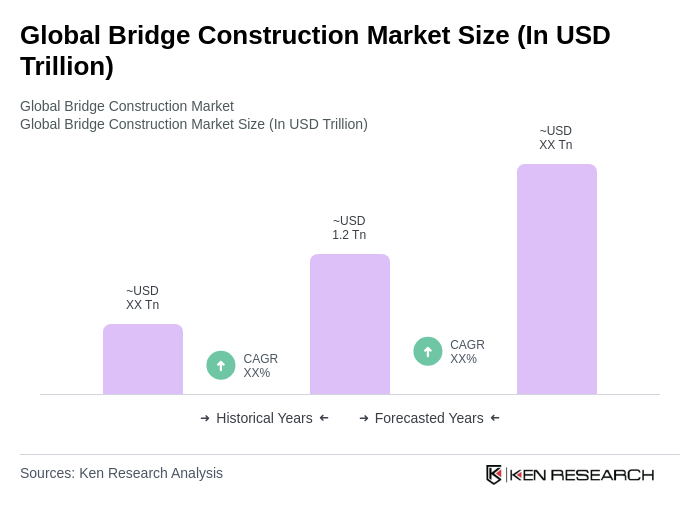
- The Global Bridge Construction Market is valued at USD 1.2 trillion, based on a five-year historical analysis. This growth is primarily driven by increasing urbanization, substantial government investments in infrastructure, and the need for modern transportation networks. The demand for innovative bridge designs and advanced materials has surged, reflecting the industry's adaptation to sustainability concerns and technological advancements such as prefabricated elements, segmental construction, and digital tools like building information modeling and AI-based monitoring. These trends have enabled faster project delivery and improved safety and quality .
- Key players in this market includethe United States, China, and India, which dominate due to their extensive infrastructure development projects and significant government funding. The United States leads in advanced engineering and technology, China excels in large-scale construction capabilities, and India is rapidly expanding its infrastructure to support its growing economy. Asia Pacific currently holds the largest market share, accounting for nearly half of global bridge construction activity .
- In 2023, the European Union implemented theEU Green Deal, which mandates that all new infrastructure projects, including bridges, must meet stringent sustainability criteria. This regulation, issued by the European Commission, aims to reduce carbon emissions and promote the use of eco-friendly materials. The EU Green Deal requires compliance with environmental standards such as lifecycle carbon assessments and the use of recycled or low-impact materials, significantly impacting the bridge construction sector by encouraging innovation and stricter environmental compliance .
Global Bridge Construction Market Segmentation
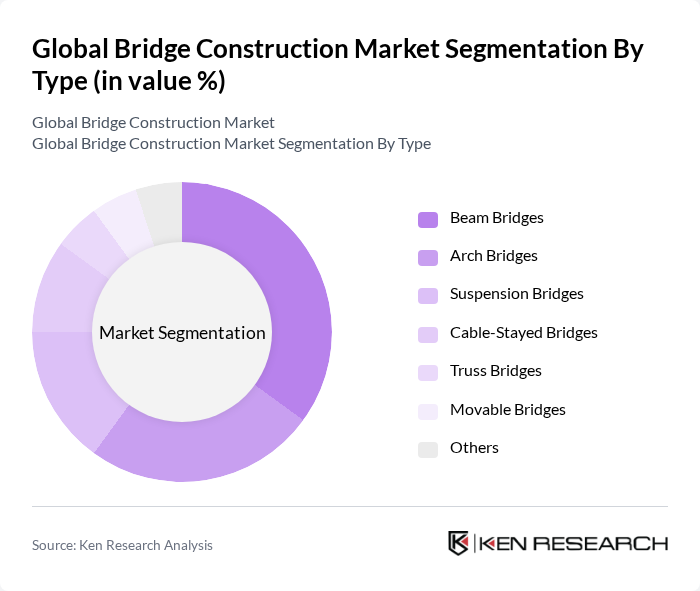
By Type:The bridge construction market is segmented into various types, including Beam Bridges, Arch Bridges, Suspension Bridges, Cable-Stayed Bridges, Truss Bridges, Movable Bridges, and Others. Among these,Beam Bridgesare the most widely used due to their simplicity, cost-effectiveness, and suitability for short to medium spans, making them a preferred choice for many construction projects.Arch Bridgesare gaining popularity for their aesthetic appeal and ability to span longer distances without intermediate supports. The demand forSuspensionandCable-Stayed Bridgesis increasing in urban areas where space constraints and architectural considerations are paramount, particularly for major river crossings and metropolitan infrastructure .
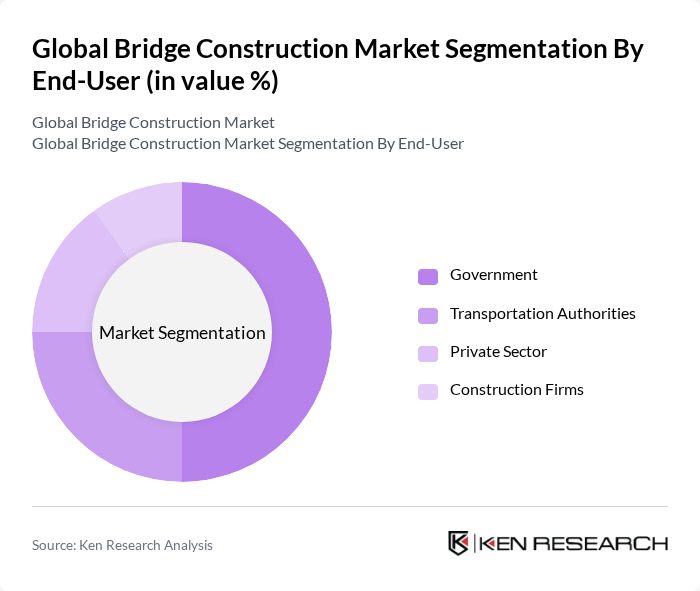
By End-User:The end-user segmentation includes Government, Transportation Authorities, Private Sector, and Construction Firms. TheGovernment sectoris the largest end-user, driven by public infrastructure projects and funding for transportation networks.Transportation Authoritiesplay a significant role, as they are responsible for maintaining and upgrading existing bridge infrastructure. ThePrivate Sectoris increasingly involved in public-private partnerships, whileConstruction Firmsare essential for executing projects across all segments. The trend toward collaborative delivery models and integrated project teams is strengthening the role of private and construction stakeholders in large-scale bridge projects .
Global Bridge Construction Market Competitive Landscape
The Global Bridge Construction Market is characterized by a dynamic mix of regional and international players. Leading participants such as Bechtel Corporation, Fluor Corporation, Kiewit Corporation, Skanska AB, Turner Construction Company, Jacobs Engineering Group, AECOM, Balfour Beatty plc, Vinci SA, STRABAG SE, PCL Construction Enterprises, Inc., SNC-Lavalin Group Inc., T.Y. Lin International, HDR, Inc., STV Group, China Communications Construction Company Ltd. (CCCC), China Railway Group Limited (CREC), Samsung C&T Corporation, TCDD Ta??mac?l?k A.?., Obayashi Corporation contribute to innovation, geographic expansion, and service delivery in this space.
Global Bridge Construction Market Industry Analysis
Growth Drivers
- Increasing Infrastructure Investment:In future, global infrastructure investment is projected to reach approximately $4.5 trillion, driven by government initiatives and private sector participation. Countries like China and India are leading with investments of $1.2 trillion and $600 billion, respectively, focusing on enhancing transportation networks. This surge in funding is expected to significantly boost bridge construction activities, as governments prioritize infrastructure to support economic growth and urban development.
- Urbanization and Population Growth:The United Nations estimates that by future, over 56% of the global population will reside in urban areas, increasing the demand for efficient transportation systems. This urbanization trend is particularly pronounced in Asia, where cities like Jakarta and Manila are experiencing rapid growth. As urban populations swell, the need for new bridges to alleviate congestion and improve connectivity becomes critical, driving market expansion in bridge construction.
- Technological Advancements in Construction:The integration of advanced technologies such as Building Information Modeling (BIM) and 3D printing is revolutionizing bridge construction. In future, the global market for construction technology is expected to exceed $1 trillion, with significant investments in smart bridge technologies. These innovations enhance project efficiency, reduce costs, and improve safety, making them essential drivers for the bridge construction market as companies seek to adopt more efficient practices.
Market Challenges
- High Initial Capital Investment:The construction of bridges often requires substantial upfront capital, with costs ranging from $1 million for small projects to over $100 million for large-scale infrastructure. In future, the average cost of bridge construction is projected to increase by 5% due to rising material prices and labor costs. This financial barrier can deter investment, particularly in regions with limited funding sources, impacting overall market growth.
- Environmental Regulations and Compliance:Stricter environmental regulations are becoming a significant challenge for bridge construction projects. In future, compliance costs are expected to rise by 10% as governments enforce more rigorous environmental assessments and sustainability standards. These regulations can lead to project delays and increased costs, complicating the construction process and potentially limiting the number of projects that can be undertaken in sensitive ecological areas.
Global Bridge Construction Market Future Outlook
The future of the bridge construction market appears promising, driven by ongoing urbanization and technological advancements. As cities expand, the demand for innovative and sustainable bridge solutions will grow. Additionally, the increasing focus on resilience against climate change will push for the adoption of durable materials and designs. Companies that leverage digital tools for project management and embrace smart technologies will likely gain a competitive edge, positioning themselves favorably in this evolving landscape.
Market Opportunities
- Adoption of Sustainable Construction Practices:The shift towards sustainable construction is creating opportunities for companies to innovate. In future, the global green building market is expected to reach $1.5 trillion, encouraging bridge builders to adopt eco-friendly materials and practices. This trend not only meets regulatory demands but also appeals to environmentally conscious stakeholders, enhancing market competitiveness.
- Public-Private Partnerships (PPPs):The rise of PPPs is transforming the funding landscape for bridge projects. In future, it is estimated that PPPs will account for 30% of infrastructure investments globally, providing a viable alternative to traditional funding. This model allows for shared risk and resource allocation, enabling more ambitious bridge projects to be realized, particularly in regions with budget constraints.
Scope of the Report
| Segment | Sub-Segments |
|---|---|
| By Type | Beam Bridges Arch Bridges Suspension Bridges Cable-Stayed Bridges Truss Bridges Movable Bridges Others |
| By End-User | Government Transportation Authorities Private Sector Construction Firms |
| By Region | North America Europe Asia-Pacific Latin America Middle East & Africa |
| By Material | Steel Concrete Composite Materials Others |
| By Construction Method | Traditional Construction Modular Construction Precast Construction Others |
| By Financing Model | Public Funding Private Investment Public-Private Partnerships Others |
| By Project Size | Small Scale Medium Scale Large Scale Others |
Key Target Audience
Investors and Venture Capitalist Firms
Government and Regulatory Bodies (e.g., Federal Highway Administration, National Transportation Safety Board)
Construction and Engineering Firms
Infrastructure Development Agencies
Material Suppliers and Manufacturers
Project Management Organizations
Insurance Companies and Risk Assessment Firms
Environmental and Sustainability Organizations
Players Mentioned in the Report:
Bechtel Corporation
Fluor Corporation
Kiewit Corporation
Skanska AB
Turner Construction Company
Jacobs Engineering Group
AECOM
Balfour Beatty plc
Vinci SA
STRABAG SE
PCL Construction Enterprises, Inc.
SNC-Lavalin Group Inc.
T.Y. Lin International
HDR, Inc.
STV Group
China Communications Construction Company Ltd. (CCCC)
China Railway Group Limited (CREC)
Samsung C&T Corporation
TCDD Tasmaclk A.S.
Obayashi Corporation
Table of Contents
Market Assessment Phase
1. Executive Summary and Approach
2. Global Bridge Construction Market Overview
2.1 Key Insights and Strategic Recommendations
2.2 Global Bridge Construction Market Overview
2.3 Definition and Scope
2.4 Evolution of Market Ecosystem
2.5 Timeline of Key Regulatory Milestones
2.6 Value Chain & Stakeholder Mapping
2.7 Business Cycle Analysis
2.8 Policy & Incentive Landscape
3. Global Bridge Construction Market Analysis
3.1 Growth Drivers
3.1.1 Increasing Infrastructure Investment
3.1.2 Urbanization and Population Growth
3.1.3 Technological Advancements in Construction
3.1.4 Government Initiatives for Transportation Development
3.2 Market Challenges
3.2.1 High Initial Capital Investment
3.2.2 Environmental Regulations and Compliance
3.2.3 Supply Chain Disruptions
3.2.4 Skilled Labor Shortages
3.3 Market Opportunities
3.3.1 Adoption of Sustainable Construction Practices
3.3.2 Expansion into Emerging Markets
3.3.3 Public-Private Partnerships (PPPs)
3.3.4 Innovations in Materials and Design
3.4 Market Trends
3.4.1 Smart Bridge Technologies
3.4.2 Modular and Prefabricated Construction
3.4.3 Increased Focus on Resilience and Durability
3.4.4 Integration of Digital Tools in Project Management
3.5 Government Regulation
3.5.1 Safety Standards and Compliance Regulations
3.5.2 Environmental Impact Assessments
3.5.3 Funding and Grant Programs
3.5.4 Zoning and Land Use Regulations
4. SWOT Analysis
5. Stakeholder Analysis
6. Porter's Five Forces Analysis
7. Global Bridge Construction Market Market Size, 2019-2024
7.1 By Value
7.2 By Volume
7.3 By Average Selling Price
8. Global Bridge Construction Market Segmentation
8.1 By Type
8.1.1 Beam Bridges
8.1.2 Arch Bridges
8.1.3 Suspension Bridges
8.1.4 Cable-Stayed Bridges
8.1.5 Truss Bridges
8.1.6 Movable Bridges
8.1.7 Others
8.2 By End-User
8.2.1 Government
8.2.2 Transportation Authorities
8.2.3 Private Sector
8.2.4 Construction Firms
8.3 By Region
8.3.1 North America
8.3.2 Europe
8.3.3 Asia-Pacific
8.3.4 Latin America
8.3.5 Middle East & Africa
8.4 By Material
8.4.1 Steel
8.4.2 Concrete
8.4.3 Composite Materials
8.4.4 Others
8.5 By Construction Method
8.5.1 Traditional Construction
8.5.2 Modular Construction
8.5.3 Precast Construction
8.5.4 Others
8.6 By Financing Model
8.6.1 Public Funding
8.6.2 Private Investment
8.6.3 Public-Private Partnerships
8.6.4 Others
8.7 By Project Size
8.7.1 Small Scale
8.7.2 Medium Scale
8.7.3 Large Scale
8.7.4 Others
9. Global Bridge Construction Market Competitive Analysis
9.1 Market Share of Key Players
9.2 Cross Comparison of Key Players
9.2.1 Company Name
9.2.2 Group Size (Large, Medium, or Small as per industry convention)
9.2.3 Revenue Growth Rate (annual %)
9.2.4 Market Share (%)
9.2.5 Number of Major Bridge Projects Completed (last 5 years)
9.2.6 Average Project Completion Time (months)
9.2.7 Order Backlog (USD billions)
9.2.8 Geographic Footprint (number of countries)
9.2.9 Innovation Index (patents, R&D spend)
9.2.10 Safety Record (incidents per million hours)
9.2.11 Sustainability Score (ESG ratings, green certifications)
9.2.12 Client Satisfaction Score
9.3 SWOT Analysis of Top Players
9.4 Pricing Analysis
9.5 Detailed Profile of Major Companies
9.5.1 Bechtel Corporation
9.5.2 Fluor Corporation
9.5.3 Kiewit Corporation
9.5.4 Skanska AB
9.5.5 Turner Construction Company
9.5.6 Jacobs Engineering Group
9.5.7 AECOM
9.5.8 Balfour Beatty plc
9.5.9 Vinci SA
9.5.10 STRABAG SE
9.5.11 PCL Construction Enterprises, Inc.
9.5.12 SNC-Lavalin Group Inc.
9.5.13 T.Y. Lin International
9.5.14 HDR, Inc.
9.5.15 STV Group
9.5.16 China Communications Construction Company Ltd. (CCCC)
9.5.17 China Railway Group Limited (CREC)
9.5.18 Samsung C&T Corporation
9.5.19 TCDD Ta??mac?l?k A.?.
9.5.20 Obayashi Corporation
10. Global Bridge Construction Market End-User Analysis
10.1 Procurement Behavior of Key Ministries
10.1.1 Government Infrastructure Projects
10.1.2 Budget Allocation Trends
10.1.3 Contracting Procedures
10.1.4 Stakeholder Engagement
10.2 Corporate Spend on Infrastructure & Energy
10.2.1 Investment Trends
10.2.2 Budget Prioritization
10.2.3 Long-term Planning
10.3 Pain Point Analysis by End-User Category
10.3.1 Delays in Project Approvals
10.3.2 Cost Overruns
10.3.3 Quality Assurance Issues
10.4 User Readiness for Adoption
10.4.1 Technology Adoption Rates
10.4.2 Training and Skill Development
10.5 Post-Deployment ROI and Use Case Expansion
10.5.1 Performance Metrics
10.5.2 Case Studies of Successful Projects
10.5.3 Future Expansion Plans
11. Global Bridge Construction Market Future Size, 2025-2030
11.1 By Value
11.2 By Volume
11.3 By Average Selling Price
Go-To-Market Strategy Phase
1. Whitespace Analysis + Business Model Canvas
1.1 Market Gaps Identification
1.2 Value Proposition Development
1.3 Revenue Streams Analysis
1.4 Cost Structure Evaluation
1.5 Key Partnerships
1.6 Customer Segments
1.7 Channels
2. Marketing and Positioning Recommendations
2.1 Branding Strategies
2.2 Product USPs
2.3 Target Market Identification
2.4 Communication Strategies
3. Distribution Plan
3.1 Urban Retail Strategies
3.2 Rural NGO Tie-ups
3.3 Logistics and Supply Chain Management
4. Channel & Pricing Gaps
4.1 Underserved Routes
4.2 Pricing Bands Analysis
4.3 Competitive Pricing Strategies
5. Unmet Demand & Latent Needs
5.1 Category Gaps
5.2 Consumer Segments
5.3 Emerging Trends
6. Customer Relationship
6.1 Loyalty Programs
6.2 After-sales Service
6.3 Customer Feedback Mechanisms
7. Value Proposition
7.1 Sustainability Initiatives
7.2 Integrated Supply Chains
7.3 Competitive Advantages
8. Key Activities
8.1 Regulatory Compliance
8.2 Branding Efforts
8.3 Distribution Setup
9. Entry Strategy Evaluation
9.1 Domestic Market Entry Strategy
9.1.1 Product Mix
9.1.2 Pricing Band
9.1.3 Packaging
9.2 Export Entry Strategy
9.2.1 Target Countries
9.2.2 Compliance Roadmap
10. Entry Mode Assessment
10.1 Joint Ventures
10.2 Greenfield Investments
10.3 Mergers & Acquisitions
10.4 Distributor Model
11. Capital and Timeline Estimation
11.1 Capital Requirements
11.2 Timelines
12. Control vs Risk Trade-Off
12.1 Ownership vs Partnerships
13. Profitability Outlook
13.1 Breakeven Analysis
13.2 Long-term Sustainability
14. Potential Partner List
14.1 Distributors
14.2 Joint Ventures
14.3 Acquisition Targets
15. Execution Roadmap
15.1 Phased Plan for Market Entry
15.1.1 Market Setup
15.1.2 Market Entry
15.1.3 Growth Acceleration
15.1.4 Scale & Stabilize
15.2 Key Activities and Milestones
15.2.1 Milestone Planning
15.2.2 Activity Tracking
Research Methodology
Phase 1: Approach1
Desk Research
- Industry reports from global construction associations and market research firms
- Government publications on infrastructure spending and bridge construction projects
- Academic journals and case studies focusing on innovative bridge technologies and materials
Primary Research
- Interviews with civil engineers and project managers involved in major bridge projects
- Surveys with construction firms specializing in bridge design and construction
- Focus groups with urban planners and transportation officials to understand regional needs
Validation & Triangulation
- Cross-validation of data from multiple sources including trade publications and expert interviews
- Triangulation of market trends with historical data and future projections
- Sanity checks through expert panel reviews and feedback from industry stakeholders
Phase 2: Market Size Estimation1
Top-down Assessment
- Analysis of national infrastructure budgets and allocations for bridge construction
- Segmentation of the market by bridge type (e.g., suspension, arch, beam) and geographic region
- Incorporation of trends in public-private partnerships and funding mechanisms
Bottom-up Modeling
- Estimation of project costs based on historical data from completed bridge projects
- Volume of bridge construction projects initiated annually across different regions
- Cost breakdown by materials, labor, and technology used in bridge construction
Forecasting & Scenario Analysis
- Multi-factor regression analysis incorporating economic indicators and urbanization rates
- Scenario modeling based on potential changes in government policies and funding
- Baseline, optimistic, and pessimistic forecasts through 2035 based on market dynamics
Phase 3: CATI Sample Composition1
| Scope Item/Segment | Sample Size | Target Respondent Profiles |
|---|---|---|
| Urban Bridge Projects | 120 | Civil Engineers, Project Managers |
| Rural Infrastructure Development | 90 | Local Government Officials, Contractors |
| Innovative Bridge Technologies | 60 | Research Scientists, Technology Developers |
| Public-Private Partnership Projects | 50 | Investment Analysts, Policy Makers |
| Bridge Maintenance and Rehabilitation | 70 | Maintenance Managers, Infrastructure Inspectors |
Frequently Asked Questions
What is the current value of the Global Bridge Construction Market?
The Global Bridge Construction Market is valued at approximately USD 1.2 trillion, reflecting significant growth driven by urbanization, government investments in infrastructure, and the demand for modern transportation networks.
What factors are driving growth in the bridge construction market?
Which countries are leading in bridge construction?
What types of bridges are most commonly constructed?
Other Regional/Country Reports
Indonesia Bridge Construction Market
Malaysia Bridge Construction Market
APAC Bridge Construction Market
SEA Bridge Construction Market
Other Adjacent Reports
South Africa Road Construction Market
Qatar Tunnel Construction Market
Brazil Railway Infrastructure Market
India Construction Materials Market Size, Share & Forecast, By Material Type, Application & End User, 2026-2031Global Civil Engineering Market Size, Share & Forecast, By Service Type, Application & Customer Type, 2026-2031Belgium Heavy Machinery Market
Thailand Sustainable Infrastructure Market
Malaysia Urban Development Market
Indonesia Transportation Engineering Market
Oman Environmental Impact Assessment Market
Why Buy From Us?

What makes us stand out is that our consultants follow Robust, Refine and Result (RRR) methodology. Robust for clear definitions, approaches and sanity checking, Refine for differentiating respondents' facts and opinions, and Result for presenting data with story.

We have set a benchmark in the industry by offering our clients with syndicated and customized market research reports featuring coverage of entire market as well as meticulous research and analyst insights.

While we don't replace traditional research, we flip the method upside down. Our dual approach of Top Bottom & Bottom Top ensures quality deliverable by not just verifying company fundamentals but also looking at the sector and macroeconomic factors.

With one step in the future, our research team constantly tries to show you the bigger picture. We help with some of the tough questions you may encounter along the way: How is the industry positioned? Best marketing channel? KPI's of competitors? By aligning every element, we help maximize success.

Our report gives you instant access to the answers and sources that other companies might choose to hide. We elaborate each steps of research methodology we have used and showcase you the sample size to earn your trust.

If you need any support, we are here! We pride ourselves on universe strength, data quality, and quick, friendly, and professional service.