About the Report
Base Year 2024Global Canned Food Market Overview
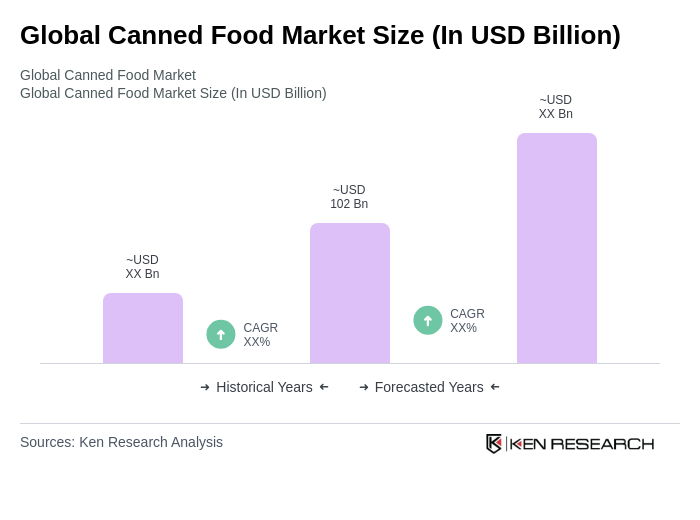
- The Global Canned Food Market is valued at USD 102 billion, based on a five-year historical analysis. This growth is primarily driven by increasing demand for convenient, shelf-stable foods and the rise in ready-to-eat consumption among working populations. Clean-label shifts toward lower-sodium, additive-free recipes and sustainable packaging are further supporting demand.
- Key markets include the United States, China, and Germany. North America holds a leading share, reflecting the United States’ large consumer base and developed food processing sector; Europe remains significant with strong brands and exports, including Germany’s established canned categories; and China’s urbanization and changing dietary habits underpin growing consumption.
- European Union rules currently restrict the use of bisphenol A (BPA) in food-contact materials, but a blanket mandate requiring all canned food packaging to be BPA-free by 2024 is not in force. Ongoing EU risk management includes strict migration limits and assessments, while manufacturers increasingly adopt BPA-NI (non-intent) coatings to address safety and consumer expectations.
Global Canned Food Market Segmentation
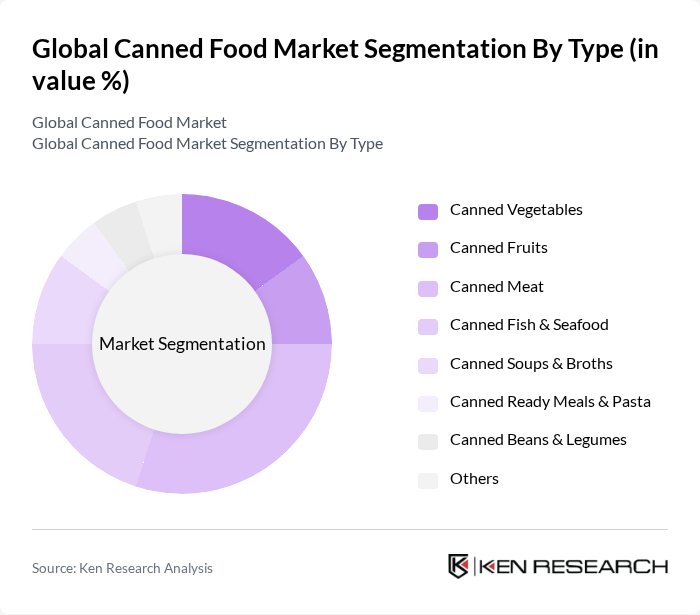
By Type:The canned food market is segmented into Canned Vegetables, Canned Fruits, Canned Meat, Canned Fish & Seafood, Canned Soups & Broths, Canned Ready Meals & Pasta, Canned Beans & Legumes, and Others. Canned Meat and Canned Fish & Seafood represent major protein-led segments; premium tinned fish trends and diversified protein preferences have notably lifted the Canned Fish & Seafood category in recent years, while convenience and protein density support Canned Meat demand.
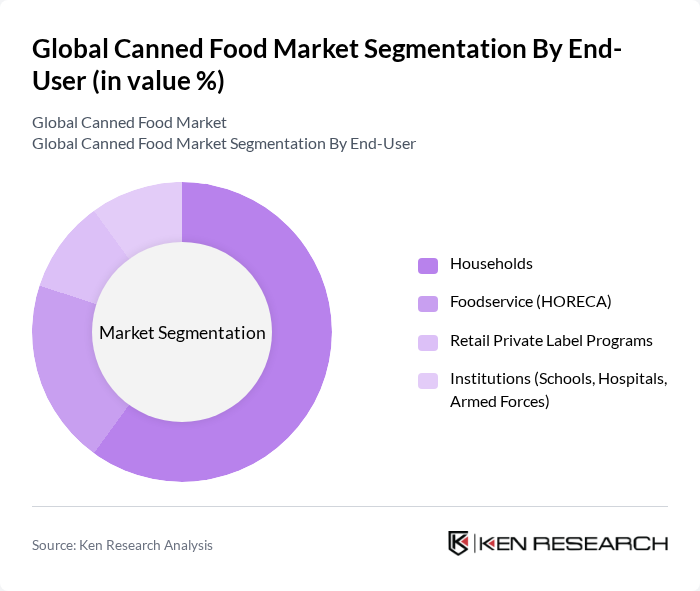
By End-User:The end-user segmentation includes Households, Foodservice (HORECA), Retail Private Label Programs, and Institutions (Schools, Hospitals, Armed Forces). Households dominate, supported by home cooking, pantry stocking of shelf-stable items, and quick-meal convenience; supermarkets, hypermarkets, and expanding e-commerce channels facilitate this demand.
Global Canned Food Market Competitive Landscape
The Global Canned Food Market is characterized by a dynamic mix of regional and international players. Leading participants such as Nestlé S.A., The Kraft Heinz Company, Del Monte Pacific Limited, Conagra Brands, Inc., Campbell Soup Company, General Mills, Inc., B&G Foods, Inc., Hormel Foods Corporation, Thai Union Group PCL, Bonduelle S.A., Ayam Brand (Ayam Sarl), Princes Limited, Dole plc, Apetit Oyj, Natura &Co (Maçarico S.A.) contribute to innovation, geographic expansion, and service delivery in this space.
Global Canned Food Market Industry Analysis
Growth Drivers
- Increasing Consumer Demand for Convenience Foods:The global canned food market is experiencing a surge in demand, driven by the fast-paced lifestyles of consumers. In future, the convenience food sector is projected to reach $1.6 trillion, with canned foods representing a significant portion. This trend is particularly evident in urban areas, where 62% of consumers prioritize quick meal solutions. The growing number of working professionals and dual-income households further fuels this demand, as they seek time-saving food options.
- Rising Shelf Life and Storage Benefits:Canned foods offer extended shelf life, making them an attractive option for consumers. In future, the average shelf life of canned goods is estimated to be around 3-6 years, significantly reducing food waste. This longevity appeals to budget-conscious consumers, with 72% of households indicating that they prefer products that last longer. Additionally, the compact storage requirements of canned foods make them ideal for small living spaces, further driving their popularity.
- Expansion of Retail Channels:The proliferation of retail channels is enhancing the accessibility of canned foods. In future, e-commerce sales in the food sector are expected to exceed $350 billion, with canned foods being a key category. Major retailers are increasingly offering online purchasing options, catering to the growing preference for home delivery. Furthermore, the expansion of convenience stores and supermarkets in emerging markets is facilitating greater availability, thus boosting overall sales in the canned food segment.
Market Challenges
- Competition from Fresh and Frozen Alternatives:The canned food market faces stiff competition from fresh and frozen food options, which are often perceived as healthier. In future, the fresh food market is projected to reach $1.3 trillion, posing a significant challenge to canned food sales. Consumers are increasingly prioritizing fresh produce, with 57% indicating a preference for fresh over canned. This trend necessitates innovation in the canned food sector to maintain market share and appeal to health-conscious consumers.
- Perception of Nutritional Value:The perception that canned foods are less nutritious than fresh options continues to hinder market growth. In future, 42% of consumers express concerns about the nutritional content of canned goods, particularly regarding sodium levels and preservatives. This perception is compounded by increasing health awareness, with 68% of consumers actively seeking healthier food choices. Addressing these concerns through product reformulation and transparent labeling is essential for improving consumer trust and expanding market reach.
Global Canned Food Market Future Outlook
The future of the canned food market appears promising, driven by evolving consumer preferences and technological advancements. As health-conscious trends continue to rise, manufacturers are likely to innovate with organic and health-focused products. Additionally, the growth of e-commerce will facilitate broader market access, particularly in emerging regions. With sustainability becoming a priority, the adoption of eco-friendly packaging solutions will also play a crucial role in attracting environmentally aware consumers, ensuring the market remains competitive and relevant.
Market Opportunities
- Innovations in Packaging Technology:The development of smart packaging technologies presents a significant opportunity for the canned food market. Innovations such as QR codes and freshness indicators can enhance consumer engagement and trust. In future, the smart packaging market is expected to grow to $35 billion, providing canned food manufacturers with tools to communicate product quality and safety effectively, thereby attracting more health-conscious consumers.
- Development of Organic and Health-focused Products:The increasing demand for organic and health-oriented food options offers a lucrative opportunity for canned food producers. In future, the organic food market is projected to reach $350 billion, with consumers willing to pay a premium for healthier choices. By expanding their product lines to include organic canned goods, manufacturers can tap into this growing segment, appealing to a broader audience and enhancing brand loyalty.
Scope of the Report
| Segment | Sub-Segments |
|---|---|
| By Type | Canned Vegetables Canned Fruits Canned Meat Canned Fish & Seafood Canned Soups & Broths Canned Ready Meals & Pasta Canned Beans & Legumes Others |
| By End-User | Households Foodservice (HORECA) Retail Private Label Programs Institutions (Schools, Hospitals, Armed Forces) |
| By Distribution Channel | Supermarkets/Hypermarkets Convenience & Grocery Stores Online Retail/E-commerce Specialty Stores Foodservice Distributors |
| By Packaging Type | Metal Cans (Tinplate/Aluminum) Glass Jars Flexible Pouches (Retort) Paper-based Composite Cans Others |
| By Price Range | Economy Mid-range Premium |
| By Brand Type | Private Label National Brands Regional/Local Brands |
| By Nutritional/Claim | Low/No Sodium Organic High Protein BPA-NI/BPA-free Packaging No Added Sugar Others |
Key Target Audience
Investors and Venture Capitalist Firms
Government and Regulatory Bodies (e.g., Food and Drug Administration, European Food Safety Authority)
Manufacturers and Producers
Distributors and Retailers
Food Safety and Quality Assurance Organizations
Packaging Suppliers and Innovators
Trade Associations and Industry Groups
Logistics and Supply Chain Management Firms
Players Mentioned in the Report:
Nestle S.A.
The Kraft Heinz Company
Del Monte Pacific Limited
Conagra Brands, Inc.
Campbell Soup Company
General Mills, Inc.
B&G Foods, Inc.
Hormel Foods Corporation
Thai Union Group PCL
Bonduelle S.A.
Ayam Brand (Ayam Sarl)
Princes Limited
Dole plc
Apetit Oyj
Natura &Co (Macarico S.A.)
Table of Contents
Market Assessment Phase
1. Executive Summary and Approach
2. Global Canned Food Market Overview
2.1 Key Insights and Strategic Recommendations
2.2 Global Canned Food Market Overview
2.3 Definition and Scope
2.4 Evolution of Market Ecosystem
2.5 Timeline of Key Regulatory Milestones
2.6 Value Chain & Stakeholder Mapping
2.7 Business Cycle Analysis
2.8 Policy & Incentive Landscape
3. Global Canned Food Market Analysis
3.1 Growth Drivers
3.1.1 Increasing Consumer Demand for Convenience Foods
3.1.2 Rising Shelf Life and Storage Benefits
3.1.3 Expansion of Retail Channels
3.1.4 Health and Nutritional Awareness
3.2 Market Challenges
3.2.1 Competition from Fresh and Frozen Alternatives
3.2.2 Perception of Nutritional Value
3.2.3 Regulatory Compliance Costs
3.2.4 Supply Chain Disruptions
3.3 Market Opportunities
3.3.1 Innovations in Packaging Technology
3.3.2 Growth in E-commerce Sales
3.3.3 Expansion into Emerging Markets
3.3.4 Development of Organic and Health-focused Products
3.4 Market Trends
3.4.1 Increasing Popularity of Plant-based Options
3.4.2 Sustainable and Eco-friendly Packaging
3.4.3 Rise of Ready-to-eat Meals
3.4.4 Focus on Local Sourcing
3.5 Government Regulation
3.5.1 Food Safety Standards
3.5.2 Labeling Requirements
3.5.3 Import and Export Regulations
3.5.4 Environmental Regulations
4. SWOT Analysis
5. Stakeholder Analysis
6. Porter's Five Forces Analysis
7. Global Canned Food Market Market Size, 2019-2024
7.1 By Value
7.2 By Volume
7.3 By Average Selling Price
8. Global Canned Food Market Segmentation
8.1 By Type
8.1.1 Canned Vegetables
8.1.2 Canned Fruits
8.1.3 Canned Meat
8.1.4 Canned Fish & Seafood
8.1.5 Canned Soups & Broths
8.1.6 Canned Ready Meals & Pasta
8.1.7 Canned Beans & Legumes
8.1.8 Others
8.2 By End-User
8.2.1 Households
8.2.2 Foodservice (HORECA)
8.2.3 Retail Private Label Programs
8.2.4 Institutions (Schools, Hospitals, Armed Forces)
8.3 By Distribution Channel
8.3.1 Supermarkets/Hypermarkets
8.3.2 Convenience & Grocery Stores
8.3.3 Online Retail/E-commerce
8.3.4 Specialty Stores
8.3.5 Foodservice Distributors
8.4 By Packaging Type
8.4.1 Metal Cans (Tinplate/Aluminum)
8.4.2 Glass Jars
8.4.3 Flexible Pouches (Retort)
8.4.4 Paper-based Composite Cans
8.4.5 Others
8.5 By Price Range
8.5.1 Economy
8.5.2 Mid-range
8.5.3 Premium
8.6 By Brand Type
8.6.1 Private Label
8.6.2 National Brands
8.6.3 Regional/Local Brands
8.7 By Nutritional/Claim
8.7.1 Low/No Sodium
8.7.2 Organic
8.7.3 High Protein
8.7.4 BPA-NI/BPA-free Packaging
8.7.5 No Added Sugar
8.7.6 Others
9. Global Canned Food Market Competitive Analysis
9.1 Market Share of Key Players
9.2 KPIs for Cross Comparison of Key Players
9.2.1 Company Name (Entity and Primary Canned Categories)
9.2.2 Group Size (Global, Regional, Niche)
9.2.3 Canned Food Revenue (USD) and YoY Growth
9.2.4 Geographic Footprint (No. of Countries/Regions Served)
9.2.5 Market Share by Segment (e.g., Vegetables, Meat/Seafood, Soup)
9.2.6 Distribution Mix (% Super/Hyper, Convenience, E-commerce, Foodservice)
9.2.7 SKU Count and Product Diversification Index
9.2.8 Pricing Architecture (Value/Mid/Premium mix)
9.2.9 Private Label Exposure (% of revenue as PL supplier or PL share in category)
9.2.10 Innovation Pipeline (New launches/12 months; Clean label/organic/BPA-NI share)
9.2.11 Manufacturing Footprint (No. of plants; captive vs. co-pack)
9.2.12 Sustainability KPIs (Recycled content in cans, GHG intensity/ton, water use/ton)
9.2.13 Customer Retention/Repeat Rate (where reported) and Brand Awareness Index
9.2.14 Procurement Risk Metrics (Top-3 metal input exposure, fish stock certifications)
9.3 SWOT Analysis of Top Players
9.4 Pricing Analysis
9.5 Detailed Profile of Major Companies
9.5.1 Nestlé S.A.
9.5.2 The Kraft Heinz Company
9.5.3 Del Monte Pacific Limited
9.5.4 Conagra Brands, Inc.
9.5.5 Campbell Soup Company
9.5.6 General Mills, Inc.
9.5.7 B&G Foods, Inc.
9.5.8 Hormel Foods Corporation
9.5.9 Thai Union Group PCL
9.5.10 Bonduelle S.A.
9.5.11 Ayam Brand (Ayam Sarl)
9.5.12 Princes Limited
9.5.13 Dole plc
9.5.14 Apetit Oyj
9.5.15 Natura &Co (Maçarico S.A.)
10. Global Canned Food Market End-User Analysis
10.1 Procurement Behavior of Key Ministries
10.1.1 Government Procurement Policies
10.1.2 Budget Allocations for Canned Foods
10.1.3 Supplier Selection Criteria
10.2 Corporate Spend on Infrastructure & Energy
10.2.1 Investment in Food Processing Facilities
10.2.2 Energy Efficiency Initiatives
10.2.3 Infrastructure Development for Distribution
10.3 Pain Point Analysis by End-User Category
10.3.1 Supply Chain Inefficiencies
10.3.2 Quality Control Issues
10.3.3 Cost Management Challenges
10.4 User Readiness for Adoption
10.4.1 Awareness of Canned Food Benefits
10.4.2 Willingness to Switch from Fresh Products
10.4.3 Availability of Canned Food Options
10.5 Post-Deployment ROI and Use Case Expansion
10.5.1 Measurement of Cost Savings
10.5.2 Customer Satisfaction Metrics
10.5.3 Opportunities for Product Line Expansion
11. Global Canned Food Market Future Size, 2025-2030
11.1 By Value
11.2 By Volume
11.3 By Average Selling Price
Go-To-Market Strategy Phase
1. Whitespace Analysis + Business Model Canvas
1.1 Market Gaps Identification
1.2 Business Model Framework
2. Marketing and Positioning Recommendations
2.1 Branding Strategies
2.2 Product USPs
3. Distribution Plan
3.1 Urban Retail Strategies
3.2 Rural NGO Tie-ups
4. Channel & Pricing Gaps
4.1 Underserved Routes
4.2 Pricing Bands Analysis
5. Unmet Demand & Latent Needs
5.1 Category Gaps
5.2 Consumer Segments
6. Customer Relationship
6.1 Loyalty Programs
6.2 After-sales Service
7. Value Proposition
7.1 Sustainability Initiatives
7.2 Integrated Supply Chains
8. Key Activities
8.1 Regulatory Compliance
8.2 Branding Efforts
8.3 Distribution Setup
9. Entry Strategy Evaluation
9.1 Domestic Market Entry Strategy
9.1.1 Product Mix Considerations
9.1.2 Pricing Band Strategy
9.1.3 Packaging Innovations
9.2 Export Entry Strategy
9.2.1 Target Countries Identification
9.2.2 Compliance Roadmap Development
10. Entry Mode Assessment
10.1 Joint Ventures
10.2 Greenfield Investments
10.3 Mergers & Acquisitions
10.4 Distributor Model Evaluation
11. Capital and Timeline Estimation
11.1 Capital Requirements Analysis
11.2 Timelines for Market Entry
12. Control vs Risk Trade-Off
12.1 Ownership vs Partnerships
13. Profitability Outlook
13.1 Breakeven Analysis
13.2 Long-term Sustainability Strategies
14. Potential Partner List
14.1 Distributors
14.2 Joint Ventures
14.3 Acquisition Targets
15. Execution Roadmap
15.1 Phased Plan for Market Entry
15.1.1 Market Setup
15.1.2 Market Entry
15.1.3 Growth Acceleration
15.1.4 Scale & Stabilize
15.2 Key Activities and Milestones
15.2.1 Milestone Planning
15.2.2 Activity Tracking
Research Methodology
Phase 1: Approach1
Desk Research
- Analysis of industry reports from global food and beverage organizations
- Review of market trends and forecasts from trade publications and market research firms
- Examination of government publications and food safety regulations impacting canned food production
Primary Research
- Interviews with key stakeholders in the canned food supply chain, including manufacturers and distributors
- Surveys targeting consumers to understand preferences and purchasing behavior regarding canned foods
- Focus groups with nutritionists and dietitians to gather insights on health perceptions of canned foods
Validation & Triangulation
- Cross-validation of data from multiple sources, including sales data and consumer surveys
- Triangulation of findings from industry experts and market analysts to ensure accuracy
- Sanity checks through expert panel reviews to validate assumptions and projections
Phase 2: Market Size Estimation1
Top-down Assessment
- Estimation of the global canned food market size based on overall food industry revenue
- Segmentation analysis by product type, including vegetables, fruits, meats, and seafood
- Incorporation of regional market dynamics and growth rates from key geographic areas
Bottom-up Modeling
- Collection of sales data from leading canned food manufacturers to establish baseline figures
- Analysis of distribution channels and retail sales to estimate market penetration
- Volume and pricing analysis to derive revenue estimates for various canned food segments
Forecasting & Scenario Analysis
- Utilization of time-series analysis to project future market growth based on historical data
- Scenario modeling based on economic indicators, consumer trends, and health awareness
- Development of best-case, worst-case, and most-likely scenarios through 2030
Phase 3: CATI Sample Composition1
| Scope Item/Segment | Sample Size | Target Respondent Profiles |
|---|---|---|
| Consumer Preferences for Canned Vegetables | 150 | Household Shoppers, Nutrition-Conscious Consumers |
| Market Insights from Canned Meat Producers | 100 | Production Managers, Quality Assurance Officers |
| Retail Distribution Channels for Canned Foods | 120 | Retail Managers, Supply Chain Coordinators |
| Health Trends Impacting Canned Food Consumption | 80 | Health Professionals, Dietitians |
| Export Market Dynamics for Canned Seafood | 90 | Export Managers, Seafood Industry Analysts |
Frequently Asked Questions
What is the current value of the Global Canned Food Market?
The Global Canned Food Market is valued at approximately USD 102 billion, reflecting a significant growth trend driven by increasing consumer demand for convenient, shelf-stable food options and the rise in ready-to-eat meals among busy populations.
Which regions are the key markets for canned food?
What are the main types of canned food products available?
How does the shelf life of canned foods benefit consumers?
Other Regional/Country Reports
Indonesia Canned Food Market
Malaysia Canned Food Market
APAC Canned Food Market
Why Buy From Us?

What makes us stand out is that our consultants follow Robust, Refine and Result (RRR) methodology. Robust for clear definitions, approaches and sanity checking, Refine for differentiating respondents' facts and opinions, and Result for presenting data with story.

We have set a benchmark in the industry by offering our clients with syndicated and customized market research reports featuring coverage of entire market as well as meticulous research and analyst insights.

While we don't replace traditional research, we flip the method upside down. Our dual approach of Top Bottom & Bottom Top ensures quality deliverable by not just verifying company fundamentals but also looking at the sector and macroeconomic factors.

With one step in the future, our research team constantly tries to show you the bigger picture. We help with some of the tough questions you may encounter along the way: How is the industry positioned? Best marketing channel? KPI's of competitors? By aligning every element, we help maximize success.

Our report gives you instant access to the answers and sources that other companies might choose to hide. We elaborate each steps of research methodology we have used and showcase you the sample size to earn your trust.

If you need any support, we are here! We pride ourselves on universe strength, data quality, and quick, friendly, and professional service.