About the Report
Base Year 2024Listen to the audio summary
Global Car Wash Market Overview
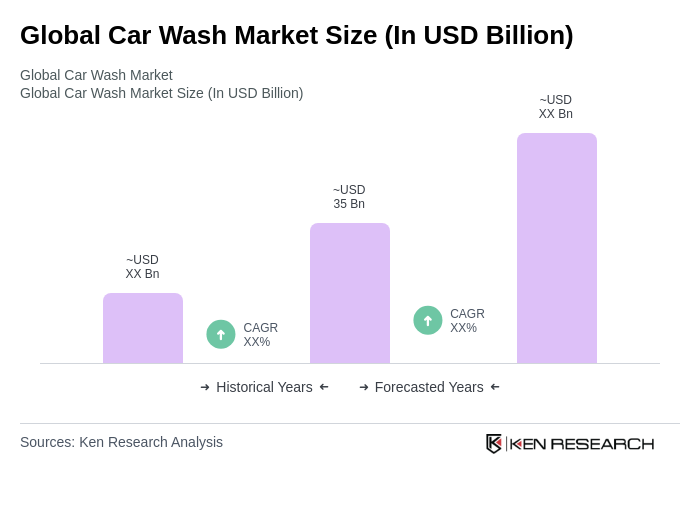
- The Global Car Wash Market is valued at USD 35 billion, based on a five?year historical analysis.
- Key countries driving market activity include the United States, Germany, and China, supported by large vehicle fleets, high professional car wash adoption, and dense facility networks; North America leads revenue share, while Europe has a mature automated/in?bay ecosystem and China’s urbanization expands addressable demand.
- Water stewardship is a prominent regulatory and operational focus in the U.S. market, with states and municipalities encouraging or requiring practices such as reclaim/recycle systems and discharge control; however, a uniform federal mandate requiring at least 50% recycling in all car wash facilities is not in effect, and requirements vary by jurisdiction.
Global Car Wash Market Segmentation
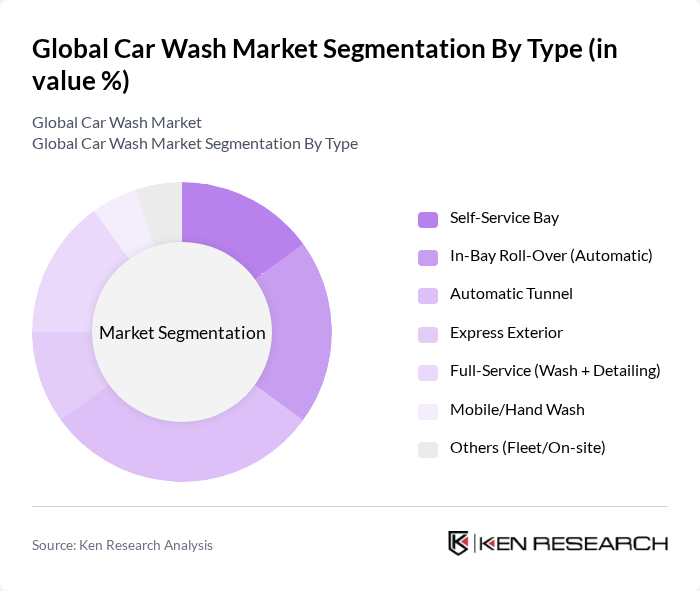
By Type:The car wash market is segmented into various types, including Self-Service Bay, In-Bay Roll-Over (Automatic), Automatic Tunnel, Express Exterior, Full-Service (Wash + Detailing), Mobile/Hand Wash, and Others (Fleet/On-site). Among these, theAutomatic Tunnelsegment is widely cited as a leading format in mature markets due to high throughput, consistency, and alignment with subscription models (unlimited plans), which has accelerated the consumer shift from manual/self-wash to automated formats.
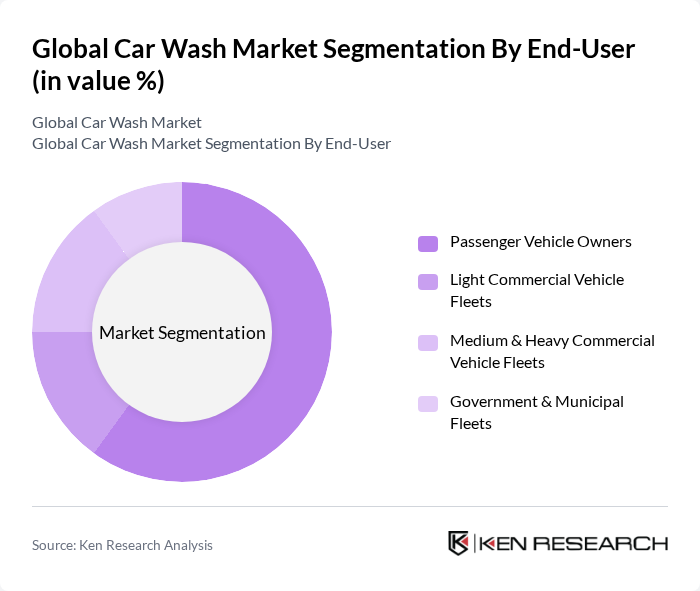
By End-User:The end-user segmentation includes Passenger Vehicle Owners, Light Commercial Vehicle Fleets, Medium & Heavy Commercial Vehicle Fleets, and Government & Municipal Fleets. ThePassenger Vehicle Ownerssegment remains the largest contributor, supported by professional wash preference over at-home washing in mature markets, growing vehicle parc, urbanization, and adoption of subscription plans that increase visit frequency and spend.
Global Car Wash Market Competitive Landscape
The Global Car Wash Market is characterized by a dynamic mix of regional and international players. Leading participants such as Mister Car Wash, Inc., Zips Car Wash, Quick Quack Car Wash, Autobell Car Wash, IMO Car Wash Group, Tommy’s Express Car Wash, Super Star Car Wash, Splash Car Wash, True Blue Car Wash, LLC, Hoffman Car Wash, Wash Depot Holdings Inc., Driven Brands Car Wash (Take 5 Car Wash), Clean Streak Ventures, El Car Wash, International Car Wash Group (ICWG) contribute to innovation, geographic expansion, and service delivery in this space.
Global Car Wash Market Industry Analysis
Growth Drivers
- Increasing Vehicle Ownership:The global vehicle ownership rate is projected to reach 1.5 billion units by 2024, driven by rising disposable incomes and urbanization. Countries like India and China are experiencing significant growth, with vehicle ownership increasing by 10% annually. This surge in vehicle numbers directly correlates with the demand for car wash services, as more vehicles on the road necessitate regular cleaning and maintenance to preserve their value and appearance.
- Rising Environmental Awareness:With 70% of consumers prioritizing eco-friendly practices, the car wash industry is adapting to meet these expectations. The global market for eco-friendly car wash products is expected to exceed $1 billion by 2024. This shift is driven by increased awareness of water conservation and pollution, prompting car wash operators to adopt sustainable practices, such as using biodegradable soaps and water recycling systems, thereby attracting environmentally conscious customers.
- Technological Advancements in Car Wash Systems:The integration of advanced technologies, such as automated washing systems and mobile apps, is revolutionizing the car wash industry. In 2024, the market for automated car wash systems is anticipated to grow by 15%, driven by innovations that enhance efficiency and customer experience. These technologies not only reduce labor costs but also improve service speed, making car washes more appealing to busy consumers seeking convenience.
Market Challenges
- High Initial Investment Costs:Establishing a car wash facility requires significant capital investment, often exceeding $500,000 for equipment and infrastructure. This financial barrier can deter new entrants, particularly in regions with limited access to financing. Additionally, ongoing maintenance costs can further strain budgets, making it challenging for operators to achieve profitability in a competitive market where price sensitivity is high.
- Competition from DIY Car Wash Solutions:The rise of DIY car wash solutions, including home washing kits and self-service stations, poses a significant challenge to traditional car wash businesses. In 2024, it is estimated that DIY solutions will capture approximately 30% of the market share, as consumers seek cost-effective alternatives. This trend forces established car wash operators to innovate and differentiate their services to retain customers who may opt for cheaper, at-home options.
Global Car Wash Market Future Outlook
The future of the car wash industry appears promising, driven by technological advancements and changing consumer preferences. As automated systems become more prevalent, efficiency and customer satisfaction will likely improve. Additionally, the increasing focus on sustainability will push operators to adopt eco-friendly practices, aligning with consumer demand for environmentally responsible services. The integration of mobile payment solutions will further enhance convenience, making car wash services more accessible and appealing to a broader audience.
Market Opportunities
- Expansion into Emerging Markets:Emerging markets, particularly in Asia and Africa, present significant growth opportunities for car wash services. With vehicle ownership rising rapidly in these regions, the demand for professional car wash services is expected to increase. By 2024, the potential market size in these areas could exceed $500 million, offering lucrative prospects for businesses willing to invest in local operations and tailored services.
- Development of Subscription-Based Services:Subscription-based car wash services are gaining traction, providing customers with convenience and cost savings. By 2024, it is projected that subscription models could account for 20% of the market, appealing to consumers seeking hassle-free solutions. This model not only ensures steady revenue for operators but also fosters customer loyalty, as subscribers are more likely to return for regular services.
Scope of the Report
| Segment | Sub-Segments |
|---|---|
| By Type | Self-Service Bay In-Bay Roll-Over (Automatic) Automatic Tunnel Express Exterior Full-Service (Wash + Detailing) Mobile/Hand Wash Others (Fleet/On-site) |
| By End-User | Passenger Vehicle Owners Light Commercial Vehicle Fleets Medium & Heavy Commercial Vehicle Fleets Government & Municipal Fleets |
| By Service Model | Single-Service Wash Subscription-Based Unlimited Full-Service (Wash + Interior + Detailing) Add-on Services (Wax, Ceramic, Tire Shine) |
| By Mode of Payment | Cash Card/NFC (Cashless) Mobile App Payments Membership/Subscription |
| By Ownership | Independent Operators Franchised/Chain Operators |
| By Geography | North America Europe Asia-Pacific Middle East & Africa South America |
Key Target Audience
Investors and Venture Capitalist Firms
Government and Regulatory Bodies (e.g., Environmental Protection Agency, Department of Transportation)
Manufacturers and Producers of Car Wash Equipment
Distributors and Retailers of Car Wash Products
Franchise Owners and Operators of Car Wash Chains
Technology Providers for Car Wash Systems
Industry Associations (e.g., International Carwash Association)
Financial Institutions and Banks
Players Mentioned in the Report:
Mister Car Wash, Inc.
Zips Car Wash
Quick Quack Car Wash
Autobell Car Wash
IMO Car Wash Group
Tommys Express Car Wash
Super Star Car Wash
Splash Car Wash
True Blue Car Wash, LLC
Hoffman Car Wash
Wash Depot Holdings Inc.
Driven Brands Car Wash (Take 5 Car Wash)
Clean Streak Ventures
El Car Wash
International Car Wash Group (ICWG)
Table of Contents
Market Assessment Phase
1. Executive Summary and Approach
2. Global Car Wash Market Overview
2.1 Key Insights and Strategic Recommendations
2.2 Global Car Wash Market Overview
2.3 Definition and Scope
2.4 Evolution of Market Ecosystem
2.5 Timeline of Key Regulatory Milestones
2.6 Value Chain & Stakeholder Mapping
2.7 Business Cycle Analysis
2.8 Policy & Incentive Landscape
3. Global Car Wash Market Analysis
3.1 Growth Drivers
3.1.1 Increasing Vehicle Ownership
3.1.2 Rising Environmental Awareness
3.1.3 Technological Advancements in Car Wash Systems
3.1.4 Urbanization and Busy Lifestyles
3.2 Market Challenges
3.2.1 High Initial Investment Costs
3.2.2 Competition from DIY Car Wash Solutions
3.2.3 Regulatory Compliance Issues
3.2.4 Seasonal Demand Fluctuations
3.3 Market Opportunities
3.3.1 Expansion into Emerging Markets
3.3.2 Adoption of Eco-Friendly Products
3.3.3 Integration of Mobile Payment Solutions
3.3.4 Development of Subscription-Based Services
3.4 Market Trends
3.4.1 Growth of Automated Car Wash Systems
3.4.2 Increasing Use of Waterless Car Wash Products
3.4.3 Shift Towards Mobile Car Wash Services
3.4.4 Focus on Customer Experience and Convenience
3.5 Government Regulation
3.5.1 Water Usage Regulations
3.5.2 Environmental Protection Standards
3.5.3 Health and Safety Compliance
3.5.4 Waste Management Policies
4. SWOT Analysis
5. Stakeholder Analysis
6. Porter's Five Forces Analysis
7. Global Car Wash Market Market Size, 2019-2024
7.1 By Value
7.2 By Volume
7.3 By Average Selling Price
8. Global Car Wash Market Segmentation
8.1 By Type
8.1.1 Self-Service Bay
8.1.2 In-Bay Roll-Over (Automatic)
8.1.3 Automatic Tunnel
8.1.4 Express Exterior
8.1.5 Full-Service (Wash + Detailing)
8.1.6 Mobile/Hand Wash
8.1.7 Others (Fleet/On-site)
8.2 By End-User
8.2.1 Passenger Vehicle Owners
8.2.2 Light Commercial Vehicle Fleets
8.2.3 Medium & Heavy Commercial Vehicle Fleets
8.2.4 Government & Municipal Fleets
8.3 By Service Model
8.3.1 Single-Service Wash
8.3.2 Subscription-Based Unlimited
8.3.3 Full-Service (Wash + Interior + Detailing)
8.3.4 Add-on Services (Wax, Ceramic, Tire Shine)
8.4 By Mode of Payment
8.4.1 Cash
8.4.2 Card/NFC (Cashless)
8.4.3 Mobile App Payments
8.4.4 Membership/Subscription
8.5 By Ownership
8.5.1 Independent Operators
8.5.2 Franchised/Chain Operators
8.6 By Geography
8.6.1 North America
8.6.2 Europe
8.6.3 Asia-Pacific
8.6.4 Middle East & Africa
8.6.5 South America
9. Global Car Wash Market Competitive Analysis
9.1 Market Share of Key Players
9.2 Cross Comparison of Key Players
9.2.1 Company Name
9.2.2 Network Size (Sites/Locations)
9.2.3 Annual Wash Volumes (Millions of washes)
9.2.4 Same-Store Sales Growth (YoY)
9.2.5 Membership Subscribers (Unlimited Plans)
9.2.6 Revenue per Site (USD)
9.2.7 Average Ticket/Transaction Value (USD)
9.2.8 Customer Retention/Churn Rate
9.2.9 Geographic Footprint (Regions/Countries)
9.2.10 Water/Energy Use per Wash (Efficiency)
9.2.11 Uptime/Throughput (Cars per hour)
9.2.12 Service Mix (% Express vs Full-Service)
9.2.13 Pricing Strategy (Tiered/Unlimited/Pay-per-wash)
9.2.14 M&A Activity (Sites acquired YoY)
9.3 SWOT Analysis of Top Players
9.4 Pricing Analysis
9.5 Detailed Profile of Major Companies
9.5.1 Mister Car Wash, Inc.
9.5.2 Zips Car Wash
9.5.3 Quick Quack Car Wash
9.5.4 Autobell Car Wash
9.5.5 IMO Car Wash Group
9.5.6 Tommy’s Express Car Wash
9.5.7 Super Star Car Wash
9.5.8 Splash Car Wash
9.5.9 True Blue Car Wash, LLC
9.5.10 Hoffman Car Wash
9.5.11 Wash Depot Holdings Inc.
9.5.12 Driven Brands Car Wash (Take 5 Car Wash)
9.5.13 Clean Streak Ventures
9.5.14 El Car Wash
9.5.15 International Car Wash Group (ICWG)
10. Global Car Wash Market End-User Analysis
10.1 Procurement Behavior of Key Ministries
10.1.1 Budget Allocation for Vehicle Maintenance
10.1.2 Preference for Eco-Friendly Services
10.1.3 Frequency of Service Utilization
10.2 Corporate Spend on Infrastructure & Energy
10.2.1 Investment in Fleet Maintenance
10.2.2 Budget for Car Wash Services
10.2.3 Energy Efficiency Initiatives
10.3 Pain Point Analysis by End-User Category
10.3.1 Time Constraints
10.3.2 Quality of Service
10.3.3 Cost of Services
10.4 User Readiness for Adoption
10.4.1 Awareness of Car Wash Benefits
10.4.2 Acceptance of New Technologies
10.4.3 Willingness to Pay for Premium Services
10.5 Post-Deployment ROI and Use Case Expansion
10.5.1 Measurement of Service Effectiveness
10.5.2 Customer Feedback and Improvement
10.5.3 Expansion of Service Offerings
11. Global Car Wash Market Future Size, 2025-2030
11.1 By Value
11.2 By Volume
11.3 By Average Selling Price
Go-To-Market Strategy Phase
1. Whitespace Analysis + Business Model Canvas
1.1 Market Gaps Identification
1.2 Value Proposition Development
1.3 Revenue Streams Analysis
1.4 Customer Segmentation
1.5 Key Partnerships
1.6 Cost Structure
1.7 Channels of Distribution
2. Marketing and Positioning Recommendations
2.1 Branding Strategies
2.2 Product USPs
2.3 Target Audience Identification
2.4 Marketing Channels
2.5 Promotional Activities
3. Distribution Plan
3.1 Urban Retail Strategies
3.2 Rural NGO Tie-Ups
3.3 Online Distribution Channels
3.4 Partnerships with Local Businesses
4. Channel & Pricing Gaps
4.1 Underserved Routes
4.2 Pricing Bands Analysis
4.3 Competitor Pricing Comparison
4.4 Customer Willingness to Pay
5. Unmet Demand & Latent Needs
5.1 Category Gaps
5.2 Consumer Segments Analysis
5.3 Service Customization Opportunities
5.4 Emerging Trends in Consumer Preferences
6. Customer Relationship
6.1 Loyalty Programs
6.2 After-Sales Service
6.3 Customer Feedback Mechanisms
6.4 Engagement Strategies
7. Value Proposition
7.1 Sustainability Initiatives
7.2 Integrated Supply Chains
7.3 Customer-Centric Services
7.4 Competitive Differentiation
8. Key Activities
8.1 Regulatory Compliance
8.2 Branding Initiatives
8.3 Distribution Setup
8.4 Training and Development
9. Entry Strategy Evaluation
9.1 Domestic Market Entry Strategy
9.1.1 Product Mix
9.1.2 Pricing Band
9.1.3 Packaging Strategies
9.2 Export Entry Strategy
9.2.1 Target Countries
9.2.2 Compliance Roadmap
10. Entry Mode Assessment
10.1 Joint Ventures
10.2 Greenfield Investments
10.3 Mergers & Acquisitions
10.4 Distributor Model
11. Capital and Timeline Estimation
11.1 Capital Requirements
11.2 Timelines for Implementation
12. Control vs Risk Trade-Off
12.1 Ownership vs Partnerships
12.2 Risk Mitigation Strategies
13. Profitability Outlook
13.1 Breakeven Analysis
13.2 Long-Term Sustainability
14. Potential Partner List
14.1 Distributors
14.2 Joint Ventures
14.3 Acquisition Targets
15. Execution Roadmap
15.1 Phased Plan for Market Entry
15.1.1 Market Setup
15.1.2 Market Entry
15.1.3 Growth Acceleration
15.1.4 Scale & Stabilize
15.2 Key Activities and Milestones
15.2.1 Activity Planning
15.2.2 Milestone Tracking
Research Methodology
Phase 1: Approach1
Desk Research
- Industry reports from automotive and car wash associations
- Market analysis from government publications and trade journals
- Consumer behavior studies and trends from market research firms
Primary Research
- Interviews with owners and managers of car wash facilities
- Surveys targeting car wash equipment suppliers and service providers
- Focus groups with consumers to understand preferences and behaviors
Validation & Triangulation
- Cross-validation of data from multiple industry sources and reports
- Triangulation of findings from primary interviews and secondary data
- Sanity checks through expert panel reviews and feedback sessions
Phase 2: Market Size Estimation1
Top-down Assessment
- Analysis of total automotive service market size and growth rates
- Segmentation by car wash types: automatic, self-service, and full-service
- Incorporation of regional growth trends and demographic factors
Bottom-up Modeling
- Estimation of average revenue per car wash based on service offerings
- Volume estimates based on the number of vehicles serviced annually
- Cost analysis of equipment and operational expenses for different car wash types
Forecasting & Scenario Analysis
- Multi-factor regression analysis incorporating economic indicators and consumer spending
- Scenario modeling based on technological advancements and environmental regulations
- Baseline, optimistic, and pessimistic forecasts through 2030
Phase 3: CATI Sample Composition1
| Scope Item/Segment | Sample Size | Target Respondent Profiles |
|---|---|---|
| Full-Service Car Wash Facilities | 100 | Owners, Operations Managers |
| Automatic Car Wash Systems | 80 | Equipment Suppliers, Service Technicians |
| Self-Service Car Wash Stations | 70 | Franchise Owners, Site Managers |
| Mobile Car Wash Services | 60 | Business Owners, Operations Managers |
| Consumer Preferences in Car Wash Services | 120 | Car Owners, Regular Users of Car Wash Services |
Frequently Asked Questions
What is the current value of the Global Car Wash Market?
The Global Car Wash Market is valued at approximately USD 35 billion, based on a five-year historical analysis. This valuation reflects the growing demand for car wash services driven by increasing vehicle ownership and consumer preferences for professional cleaning.
Which regions are leading in the Global Car Wash Market?
What are the main types of car wash services available?
Who are the primary end-users in the car wash market?
Other Regional/Country Reports
Why Buy From Us?

What makes us stand out is that our consultants follow Robust, Refine and Result (RRR) methodology. Robust for clear definitions, approaches and sanity checking, Refine for differentiating respondents' facts and opinions, and Result for presenting data with story.

We have set a benchmark in the industry by offering our clients with syndicated and customized market research reports featuring coverage of entire market as well as meticulous research and analyst insights.

While we don't replace traditional research, we flip the method upside down. Our dual approach of Top Bottom & Bottom Top ensures quality deliverable by not just verifying company fundamentals but also looking at the sector and macroeconomic factors.

With one step in the future, our research team constantly tries to show you the bigger picture. We help with some of the tough questions you may encounter along the way: How is the industry positioned? Best marketing channel? KPI's of competitors? By aligning every element, we help maximize success.

Our report gives you instant access to the answers and sources that other companies might choose to hide. We elaborate each steps of research methodology we have used and showcase you the sample size to earn your trust.

If you need any support, we are here! We pride ourselves on universe strength, data quality, and quick, friendly, and professional service.