








Ken Research Logo

Global Chocolate Based Spreads Market

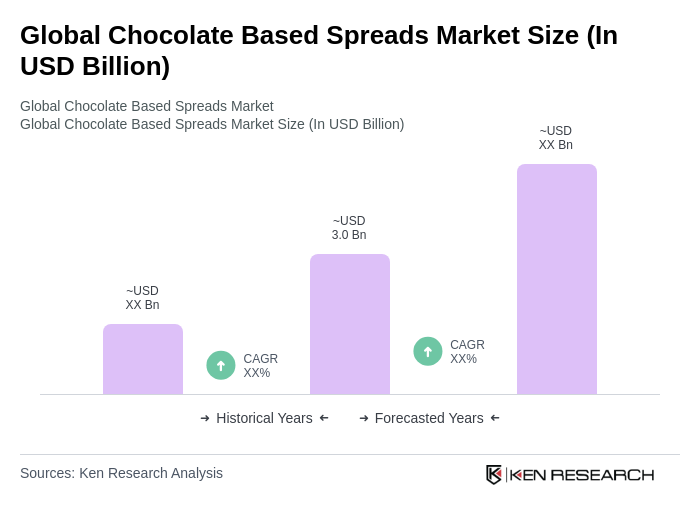
The global chocolate based spreads market, valued at USD 3.0 billion, is growing due to rising disposable incomes, health-oriented innovations, and expansion in emerging markets.

Region:Global

Author(s):Rebecca

Product Code:KRAA2863

Pages:88

Published On:August 2025
About the Report

Base Year 2024

Global Chocolate Based Spreads Market Overview

  • The Global Chocolate Based Spreads Market is valued at USD 3.0 billion, based on a five-year historical analysis. This growth is primarily driven by rising disposable incomes, busier lifestyles favoring convenient snacks, and increasing demand for premium and health-oriented chocolate spreads, such as organic, sugar-reduced, and vegan varieties. The market is also benefiting from product innovation, flavor diversification, and the expanding use of chocolate spreads in breakfast and baking applications .
  • Key players in this market include countries such as the United States, Germany, and France, which dominate due to their robust chocolate manufacturing industries, high per capita consumption of chocolate products, and well-established distribution networks that facilitate widespread market penetration .
  • In 2023, the European Union introduced Regulation (EU) 2023/915, issued by the European Commission, which sets maximum levels for certain contaminants, including sugar, in food products such as chocolate spreads. This regulation requires manufacturers to comply with specific sugar and contaminant thresholds, encouraging the development of healthier chocolate spread formulations and supporting ongoing innovation to meet evolving consumer health preferences .
Global Chocolate Based Spreads Market Size

Global Chocolate Based Spreads Market Segmentation

By Type:The chocolate-based spreads market is segmented into Hazelnut Chocolate Spread, Milk Chocolate Spread, Dark Chocolate Spread, White Chocolate Spread, Organic Chocolate Spread, Vegan Chocolate Spread, Almond Chocolate Spread, and Others. Hazelnut Chocolate Spread remains the most popular, accounting for the largest market share due to its premium appeal, rich flavor, and versatility. The segment is further strengthened by the growing trend of indulgence, premiumization, and the increasing use of chocolate spreads in breakfast, desserts, and baking applications. The demand for organic and vegan chocolate spreads is also rising, reflecting consumer interest in healthier and plant-based options .

Global Chocolate Based Spreads Market segmentation by Type.

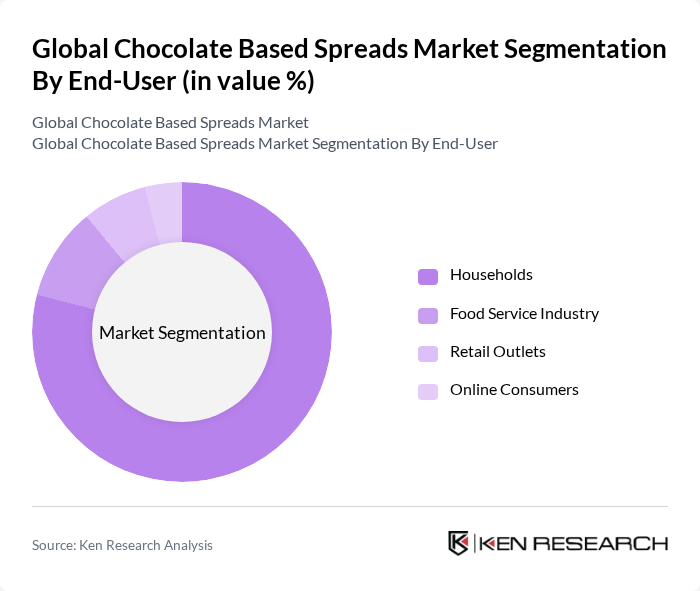
By End-User:The market is also segmented by end-user, including Households, Food Service Industry, Retail Outlets, and Online Consumers. Households represent the largest segment, driven by the increasing trend of home cooking, baking, and daily breakfast consumption, where chocolate spreads are a staple. The convenience of online shopping and the expansion of e-commerce platforms have further contributed to growth, making a wide variety of chocolate spreads accessible to consumers globally .
Global Chocolate Based Spreads Market segmentation by End-User.

Global Chocolate Based Spreads Market Competitive Landscape

The Global Chocolate Based Spreads Market is characterized by a dynamic mix of regional and international players. Leading participants such as Ferrero S.p.A., The Hershey Company, Unilever PLC, Mondelez International, Inc., Nestlé S.A., Kraft Heinz Company, Dr. Oetker GmbH, Lotus Bakeries NV (Biscoff), The J.M. Smucker Company, Nutella (Ferrero S.p.A.), Al Ain Food & Beverages (Chocodate), Lindt & Sprüngli AG, Pip & Nut Ltd., Sweet Freedom Ltd., Meridian Foods Ltd. contribute to innovation, geographic expansion, and service delivery in this space.

Ferrero S.p.A.

1946

Alba, Italy

The Hershey Company

1894

Hershey, Pennsylvania, USA

Unilever PLC

1929

London, United Kingdom

Mondelez International, Inc.

2012

Chicago, Illinois, USA

Nestlé S.A.

1866

Vevey, Switzerland

Company

Establishment Year

Headquarters

Group Size (Large, Medium, or Small as per industry convention)

Revenue Growth Rate (YoY %)

Market Share (%)

Geographic Presence (No. of countries/regions)

Product Portfolio Breadth (No. of SKUs)

Pricing Strategy (Premium, Mid-range, Economy)

Global Chocolate Based Spreads Market Industry Analysis

Growth Drivers

  • Increasing Consumer Demand for Convenience Foods:The global demand for convenience foods is projected to reach $1.3 trillion in future, driven by busy lifestyles and the need for quick meal solutions. Chocolate-based spreads, as versatile products, cater to this trend, offering easy-to-use options for breakfast and snacks. The rise in dual-income households, which accounted for 65% of families in future, further fuels this demand, as consumers seek time-saving food alternatives that do not compromise on taste or quality.
  • Rising Popularity of Chocolate as a Flavor:Chocolate remains one of the most favored flavors globally, with the chocolate flavor market valued at approximately $50 billion in future. This popularity is reflected in the increasing incorporation of chocolate in various food products, including spreads. The trend is supported by consumer preferences for indulgent flavors, with 75% of consumers indicating a preference for chocolate over other flavors in spreads, thus driving growth in the chocolate-based spreads segment.
  • Growth in the Breakfast Spread Market:The breakfast spread market is expected to grow significantly, with a projected value of $15 billion in future. This growth is attributed to changing breakfast habits, where consumers are increasingly opting for spreads that offer convenience and taste. Chocolate-based spreads are particularly popular among younger demographics, with 60% of millennials choosing chocolate spreads for breakfast, thus contributing to the overall expansion of this market segment.

Market Challenges

  • Fluctuating Raw Material Prices:The chocolate industry faces significant challenges due to the volatility of cocoa prices, which can fluctuate between $2,200 to $3,200 per metric ton. This instability affects production costs for chocolate-based spreads, leading to potential price increases for consumers. In future, cocoa prices surged by 25% due to supply chain disruptions, impacting profit margins for manufacturers and creating uncertainty in pricing strategies.
  • Health Concerns Related to Sugar Consumption:With rising health awareness, consumers are increasingly concerned about sugar intake, which has led to a decline in demand for high-sugar products. In future, 45% of consumers reported reducing their sugar consumption, impacting sales of traditional chocolate spreads. This shift poses a challenge for manufacturers to reformulate products to meet health standards while maintaining taste, thus complicating product development and marketing strategies.

Global Chocolate Based Spreads Market Future Outlook

The future of the chocolate-based spreads market appears promising, driven by evolving consumer preferences towards healthier and more sustainable options. As the market adapts to these trends, innovations in product formulations and packaging will likely play a crucial role. Additionally, the expansion of e-commerce platforms is expected to enhance accessibility, allowing brands to reach a broader audience. Companies that prioritize sustainability and health-conscious products are poised to capture significant market share in the coming years.

Market Opportunities

  • Introduction of Organic and Natural Spreads:The demand for organic and natural food products is on the rise, with the organic food market projected to reach $350 billion in future. This trend presents an opportunity for chocolate-based spread manufacturers to develop organic variants, appealing to health-conscious consumers. By leveraging this trend, companies can differentiate their products and potentially increase market share in a competitive landscape.
  • Expansion into Emerging Markets:Emerging markets, particularly in Asia and Africa, are witnessing a growing middle class with increasing disposable incomes. The chocolate-based spreads market in these regions is expected to grow significantly, with a projected increase of 20% annually. By targeting these markets, companies can tap into new consumer bases, driving sales and brand recognition in previously underrepresented areas.

Scope of the Report

SegmentSub-Segments
By Type

Hazelnut Chocolate Spread

Milk Chocolate Spread

Dark Chocolate Spread

White Chocolate Spread

Organic Chocolate Spread

Vegan Chocolate Spread

Almond Chocolate Spread

Others

By End-User

Households

Food Service Industry

Retail Outlets

Online Consumers

By Packaging Type

Glass Jars

Plastic Containers

Pouches

Tubs

By Distribution Channel

Supermarkets/Hypermarkets

Convenience Stores

Online Retail

Specialty Stores

By Price Range

Premium

Mid-Range

Economy

By Flavor Profile

Sweet

Nutty

Spicy

By Region

North America

Europe

Asia-Pacific

Latin America

Middle East & Africa

Others

Key Target Audience

Investors and Venture Capitalist Firms

Government and Regulatory Bodies (e.g., Food and Drug Administration, European Food Safety Authority)

Manufacturers and Producers

Distributors and Retailers

Food Service Providers

Packaging Suppliers

Industry Associations (e.g., National Confectioners Association)

Financial Institutions

Players Mentioned in the Report:

Ferrero S.p.A.

The Hershey Company

Unilever PLC

Mondelez International, Inc.

Nestle S.A.

Kraft Heinz Company

Dr. Oetker GmbH

Lotus Bakeries NV (Biscoff)

The J.M. Smucker Company

Nutella (Ferrero S.p.A.)

Al Ain Food & Beverages (Chocodate)

Lindt & Sprungli AG

Pip & Nut Ltd.

Sweet Freedom Ltd.

Meridian Foods Ltd.

Table of Contents

Market Assessment Phase

1. Executive Summary and Approach


2. Global Chocolate Based Spreads Market Overview

2.1 Key Insights and Strategic Recommendations

2.2 Global Chocolate Based Spreads Market Overview

2.3 Definition and Scope

2.4 Evolution of Market Ecosystem

2.5 Timeline of Key Regulatory Milestones

2.6 Value Chain & Stakeholder Mapping

2.7 Business Cycle Analysis

2.8 Policy & Incentive Landscape


3. Global Chocolate Based Spreads Market Analysis

3.1 Growth Drivers

3.1.1 Increasing consumer demand for convenience foods
3.1.2 Rising popularity of chocolate as a flavor
3.1.3 Growth in the breakfast spread market
3.1.4 Expansion of retail distribution channels

3.2 Market Challenges

3.2.1 Fluctuating raw material prices
3.2.2 Health concerns related to sugar consumption
3.2.3 Intense competition among key players
3.2.4 Regulatory challenges in food safety

3.3 Market Opportunities

3.3.1 Introduction of organic and natural spreads
3.3.2 Expansion into emerging markets
3.3.3 Development of innovative packaging solutions
3.3.4 Collaborations with food service providers

3.4 Market Trends

3.4.1 Increasing focus on sustainability in production
3.4.2 Growth of e-commerce for food products
3.4.3 Rising interest in premium and artisanal products
3.4.4 Shift towards healthier product formulations

3.5 Government Regulation

3.5.1 Labeling requirements for food products
3.5.2 Regulations on food safety standards
3.5.3 Import/export tariffs on cocoa products
3.5.4 Nutritional guidelines affecting product formulations

4. SWOT Analysis


5. Stakeholder Analysis


6. Porter's Five Forces Analysis


7. Global Chocolate Based Spreads Market Market Size, 2019-2024

7.1 By Value

7.2 By Volume

7.3 By Average Selling Price


8. Global Chocolate Based Spreads Market Segmentation

8.1 By Type

8.1.1 Hazelnut Chocolate Spread
8.1.2 Milk Chocolate Spread
8.1.3 Dark Chocolate Spread
8.1.4 White Chocolate Spread
8.1.5 Organic Chocolate Spread
8.1.6 Vegan Chocolate Spread
8.1.7 Almond Chocolate Spread
8.1.8 Others

8.2 By End-User

8.2.1 Households
8.2.2 Food Service Industry
8.2.3 Retail Outlets
8.2.4 Online Consumers

8.3 By Packaging Type

8.3.1 Glass Jars
8.3.2 Plastic Containers
8.3.3 Pouches
8.3.4 Tubs

8.4 By Distribution Channel

8.4.1 Supermarkets/Hypermarkets
8.4.2 Convenience Stores
8.4.3 Online Retail
8.4.4 Specialty Stores

8.5 By Price Range

8.5.1 Premium
8.5.2 Mid-Range
8.5.3 Economy

8.6 By Flavor Profile

8.6.1 Sweet
8.6.2 Nutty
8.6.3 Spicy

8.7 By Region

8.7.1 North America
8.7.2 Europe
8.7.3 Asia-Pacific
8.7.4 Latin America
8.7.5 Middle East & Africa
8.7.6 Others

9. Global Chocolate Based Spreads Market Competitive Analysis

9.1 Market Share of Key Players

9.2 Cross Comparison of Key Players

9.2.1 Company Name
9.2.2 Group Size (Large, Medium, or Small as per industry convention)
9.2.3 Revenue Growth Rate (YoY %)
9.2.4 Market Share (%)
9.2.5 Geographic Presence (No. of countries/regions)
9.2.6 Product Portfolio Breadth (No. of SKUs)
9.2.7 Pricing Strategy (Premium, Mid-range, Economy)
9.2.8 Distribution Channel Reach (No. of channels)
9.2.9 Brand Equity Score
9.2.10 Innovation Rate (New launches/year)

9.3 SWOT Analysis of Top Players

9.4 Pricing Analysis

9.5 Detailed Profile of Major Companies

9.5.1 Ferrero S.p.A.
9.5.2 The Hershey Company
9.5.3 Unilever PLC
9.5.4 Mondelez International, Inc.
9.5.5 Nestlé S.A.
9.5.6 Kraft Heinz Company
9.5.7 Dr. Oetker GmbH
9.5.8 Lotus Bakeries NV (Biscoff)
9.5.9 The J.M. Smucker Company
9.5.10 Nutella (Ferrero S.p.A.)
9.5.11 Al Ain Food & Beverages (Chocodate)
9.5.12 Lindt & Sprüngli AG
9.5.13 Pip & Nut Ltd.
9.5.14 Sweet Freedom Ltd.
9.5.15 Meridian Foods Ltd.

10. Global Chocolate Based Spreads Market End-User Analysis

10.1 Procurement Behavior of Key Ministries

10.1.1 Government contracts for food supplies
10.1.2 Budget allocation for public health initiatives
10.1.3 Preferences for local vs. imported products

10.2 Corporate Spend on Infrastructure & Energy

10.2.1 Investment in sustainable sourcing
10.2.2 Budget for marketing and promotions
10.2.3 Expenditure on research and development

10.3 Pain Point Analysis by End-User Category

10.3.1 Quality consistency issues
10.3.2 Supply chain disruptions
10.3.3 Price sensitivity among consumers

10.4 User Readiness for Adoption

10.4.1 Awareness of health benefits
10.4.2 Acceptance of new product flavors
10.4.3 Willingness to pay for premium products

10.5 Post-Deployment ROI and Use Case Expansion

10.5.1 Metrics for measuring product success
10.5.2 Opportunities for product line extensions
10.5.3 Feedback mechanisms for continuous improvement

11. Global Chocolate Based Spreads Market Future Size, 2025-2030

11.1 By Value

11.2 By Volume

11.3 By Average Selling Price


Go-To-Market Strategy Phase

1. Whitespace Analysis + Business Model Canvas

1.1 Market gaps and opportunities

1.2 Value proposition development

1.3 Revenue model identification

1.4 Key partnerships and resources

1.5 Customer segments and relationships

1.6 Channels for distribution

1.7 Cost structure analysis


2. Marketing and Positioning Recommendations

2.1 Branding strategies

2.2 Product USPs

2.3 Target audience identification

2.4 Communication strategies

2.5 Digital marketing initiatives


3. Distribution Plan

3.1 Urban retail strategies

3.2 Rural NGO tie-ups

3.3 E-commerce partnerships

3.4 Direct-to-consumer models


4. Channel & Pricing Gaps

4.1 Underserved routes

4.2 Pricing bands analysis

4.3 Competitor pricing strategies

4.4 Consumer price sensitivity


5. Unmet Demand & Latent Needs

5.1 Category gaps

5.2 Consumer segments analysis

5.3 Product innovation opportunities


6. Customer Relationship

6.1 Loyalty programs

6.2 After-sales service

6.3 Customer feedback systems


7. Value Proposition

7.1 Sustainability initiatives

7.2 Integrated supply chains

7.3 Community engagement strategies


8. Key Activities

8.1 Regulatory compliance

8.2 Branding efforts

8.3 Distribution setup


9. Entry Strategy Evaluation

9.1 Domestic Market Entry Strategy

9.1.1 Product mix considerations
9.1.2 Pricing band strategies
9.1.3 Packaging innovations

9.2 Export Entry Strategy

9.2.1 Target countries analysis
9.2.2 Compliance roadmap development

10. Entry Mode Assessment

10.1 Joint Ventures

10.2 Greenfield investments

10.3 Mergers & Acquisitions

10.4 Distributor Model


11. Capital and Timeline Estimation

11.1 Capital requirements

11.2 Timelines for market entry


12. Control vs Risk Trade-Off

12.1 Ownership considerations

12.2 Partnerships evaluation


13. Profitability Outlook

13.1 Breakeven analysis

13.2 Long-term sustainability strategies


14. Potential Partner List

14.1 Distributors

14.2 Joint Ventures

14.3 Acquisition targets


15. Execution Roadmap

15.1 Phased Plan for Market Entry

15.1.1 Market Setup
15.1.2 Market Entry
15.1.3 Growth Acceleration
15.1.4 Scale & Stabilize

15.2 Key Activities and Milestones

15.2.1 Milestone tracking
15.2.2 Activity scheduling

Research Methodology

ApproachModellingSample

Phase 1: Approach1

Desk Research

  • Market reports from industry associations such as the International Cocoa Organization
  • Analysis of consumer trends through publications from food and beverage market research firms
  • Review of trade statistics and import/export data from government databases

Primary Research

  • Interviews with product development managers at leading chocolate spread manufacturers
  • Surveys with retailers and distributors to understand market dynamics and consumer preferences
  • Focus groups with consumers to gather insights on taste preferences and brand loyalty

Validation & Triangulation

  • Cross-validation of findings through multiple data sources including sales data and consumer surveys
  • Triangulation of market size estimates using both top-down and bottom-up approaches
  • Sanity checks through expert panel reviews involving industry veterans and market analysts

Phase 2: Market Size Estimation1

Top-down Assessment

  • Estimation of market size based on global chocolate consumption trends and growth rates
  • Segmentation of the market by product type, including hazelnut, milk chocolate, and dark chocolate spreads
  • Incorporation of regional market dynamics and consumer behavior variations

Bottom-up Modeling

  • Collection of sales data from key players in the chocolate spread market
  • Estimation of average selling prices and volume sold across different distribution channels
  • Analysis of growth rates based on historical sales data and emerging market trends

Forecasting & Scenario Analysis

  • Multi-factor regression analysis incorporating economic indicators and consumer spending patterns
  • Scenario modeling based on potential market disruptions such as supply chain issues or health trends
  • Development of baseline, optimistic, and pessimistic forecasts through 2030

Phase 3: CATI Sample Composition1

Scope Item/SegmentSample SizeTarget Respondent Profiles
Retail Chocolate Spread Sales100Store Managers, Category Buyers
Consumer Preferences in Chocolate Spreads120Household Consumers, Food Enthusiasts
Distribution Channel Insights80Wholesalers, Distributors
Market Trends and Innovations60Product Developers, Marketing Managers
Health and Wellness Impact on Chocolate Spreads40Nutritional Experts, Health-Conscious Consumers

Frequently Asked Questions

What is the current value of the Global Chocolate Based Spreads Market?

The Global Chocolate Based Spreads Market is valued at approximately USD 3.0 billion, reflecting a robust growth trajectory driven by rising disposable incomes and increasing demand for convenient and premium chocolate spread options.

What factors are driving the growth of the chocolate-based spreads market?

Which countries dominate the chocolate-based spreads market?

What are the main types of chocolate-based spreads available in the market?

Other Adjacent Reports

Why Buy From Us?

Refine Robust Result (RRR) Framework

What makes us stand out is that our consultants follow Robust, Refine and Result (RRR) methodology. Robust for clear definitions, approaches and sanity checking, Refine for differentiating respondents' facts and opinions, and Result for presenting data with story.

Our Reach Is Unmatched

We have set a benchmark in the industry by offering our clients with syndicated and customized market research reports featuring coverage of entire market as well as meticulous research and analyst insights.

Shifting the Research Paradigm

While we don't replace traditional research, we flip the method upside down. Our dual approach of Top Bottom & Bottom Top ensures quality deliverable by not just verifying company fundamentals but also looking at the sector and macroeconomic factors.

More Insights-Better Decisions

With one step in the future, our research team constantly tries to show you the bigger picture. We help with some of the tough questions you may encounter along the way: How is the industry positioned? Best marketing channel? KPI's of competitors? By aligning every element, we help maximize success.

Transparency and Trust

Our report gives you instant access to the answers and sources that other companies might choose to hide. We elaborate each steps of research methodology we have used and showcase you the sample size to earn your trust.

Round the Clock Support

If you need any support, we are here! We pride ourselves on universe strength, data quality, and quick, friendly, and professional service.

Why Clients Choose Us?

400000+
Reports in repository
150+
Consulting projects a year
100+
Analysts
8000+
Client Queries in 2022