About the Report
Base Year 2024Listen to the audio summary
Indonesia Honey Market Overview
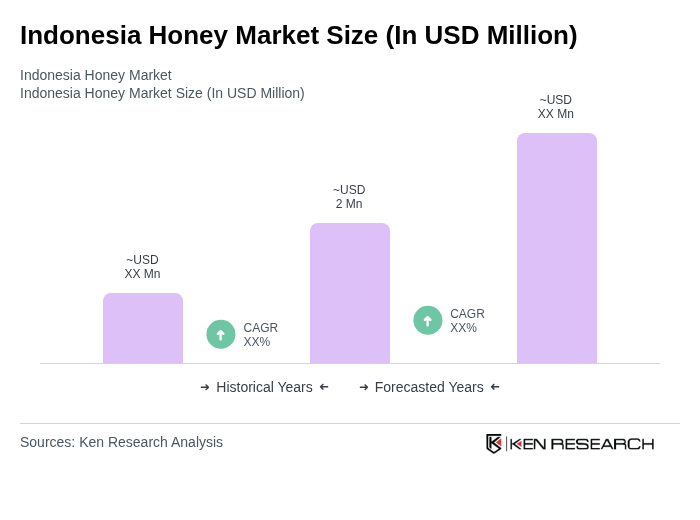
- The Indonesia Honey Market is valued at USD 2 million, based on a five-year historical analysis. This market size reflects a substantial contraction in recent years, primarily due to fluctuating domestic production and volatile export demand. Growth drivers include increasing health consciousness among consumers, rising demand for natural sweeteners, and the expansion of the food and beverage industry. There is a notable uptick in the consumption of honey as a healthier alternative to sugar, with organic and raw honey varieties seeing heightened interest, especially among wellness-focused consumers and boutique food brands. The market is also shaped by seasonal pricing trends and a shift toward traceable, sustainably produced honey.
- Key producing regions include Java, Bali, and Sumatra, which dominate the market due to their favorable climatic conditions for beekeeping and honey production. These regions are recognized for their diverse flora, contributing to high-quality honey varieties. The presence of established beekeeping communities and strong local demand further reinforces their market leadership.
- The Indonesian government regulates honey production and beekeeping through the Peraturan Menteri Pertanian Republik Indonesia Nomor 19/Permentan/OT.140/3/2011 (Regulation of the Minister of Agriculture No. 19/2011), which sets operational standards for honey quality, organic certification, and sustainable beekeeping practices. This regulation mandates compliance with production hygiene, labeling, and certification requirements, supporting local beekeepers in enhancing honey quality and production efficiency while safeguarding environmental sustainability .
Indonesia Honey Market Segmentation
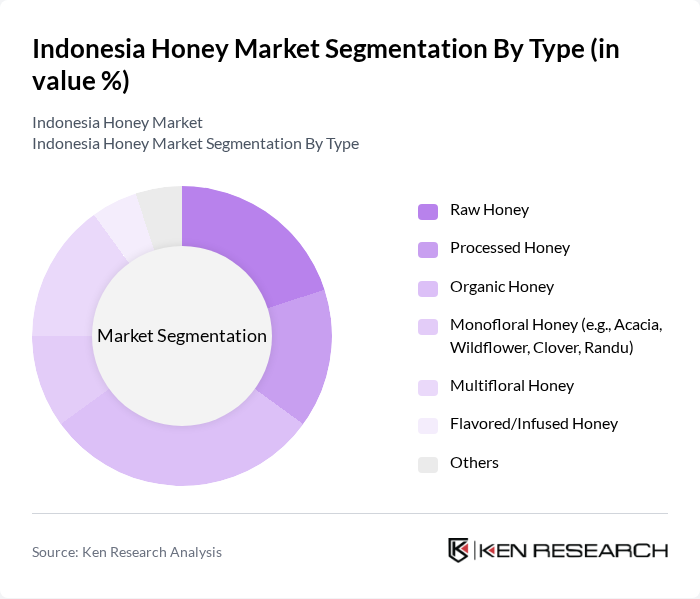
By Type:The market is segmented into Raw Honey, Processed Honey, Organic Honey, Monofloral Honey (e.g., Acacia, Wildflower, Clover, Randu), Multifloral Honey, Flavored/Infused Honey, and Others. Organic Honey is gaining traction due to increasing consumer preference for natural and chemical-free products, with demand for Monofloral Honey also rising, driven by unique flavors and perceived health benefits. Specialty and raw honey are particularly sought after by wellness brands and boutique food manufacturers, reflecting a shift toward premium and traceable products.
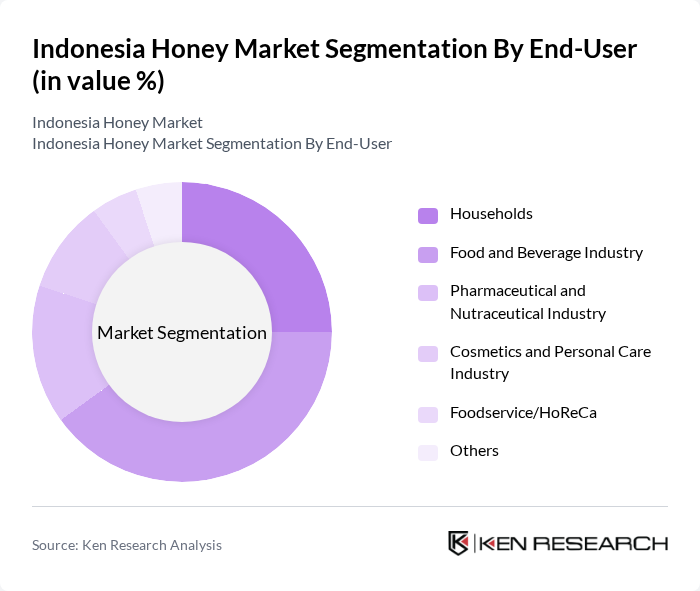
By End-User:The market is segmented by end-users, including Households, Food and Beverage Industry, Pharmaceutical and Nutraceutical Industry, Cosmetics and Personal Care Industry, Foodservice/HoReCa, and Others. The Food and Beverage Industry is the leading segment, driven by the increasing incorporation of honey in various food products and beverages, as well as the growing trend of health-conscious eating. Household consumption remains robust, supported by the perception of honey as a natural health product.
Indonesia Honey Market Competitive Landscape
The Indonesia Honey Market is characterized by a dynamic mix of regional and international players. Leading participants such as PT. Madu Pramuka, PT. Madu TJ (Tresno Joyo), PT. Air Mancur, PT. Natura Nusantara (NASA), PT. Madu Uray, PT. Madu Hutan Lestari, PT. Madu Bina Apiari Indonesia, PT. Madu Nusantara, PT. Madu Sehat Alami, PT. Madu Al Shifa Indonesia, PT. Madu Sumbawa Asli, PT. Madu Hutan Borneo, PT. Madu Kencana, PT. Madu Alam Asri, PT. Madu Citra Rasa contribute to innovation, geographic expansion, and service delivery in this space.
Indonesia Honey Market Industry Analysis
Growth Drivers
- Increasing Health Consciousness:The Indonesian population is becoming increasingly health-conscious, with a notable rise in the consumption of natural products. In future, the health and wellness market in Indonesia is projected to reach approximately $12 billion, reflecting a growing preference for organic and natural food options. This trend is driving the demand for honey, as consumers seek healthier alternatives to refined sugars, with honey sales expected to increase by 16% annually, according to industry reports.
- Rising Demand for Natural Sweeteners:The shift towards natural sweeteners is evident, with honey being a preferred choice among consumers. In future, the demand for natural sweeteners in Indonesia is anticipated to exceed 220,000 tons, driven by the increasing awareness of the health benefits associated with honey. This trend is further supported by the growing number of health food stores and organic markets, which are projected to increase by 22% in the next year, enhancing honey's market presence.
- Expansion of E-commerce Platforms:The rapid growth of e-commerce in Indonesia is significantly impacting honey sales. In future, online retail sales are expected to reach $60 billion, with food and beverage categories, including honey, experiencing substantial growth. E-commerce platforms are facilitating easier access to a variety of honey products, allowing local producers to reach a broader audience. This shift is projected to increase online honey sales by 35%, reflecting changing consumer purchasing behaviors.
Market Challenges
- Quality Control Issues:Quality control remains a significant challenge in the Indonesian honey market. In future, it is estimated that over 45% of honey products on the market do not meet established quality standards, leading to consumer distrust. This issue is exacerbated by the lack of stringent regulations and testing facilities, which hampers the ability to ensure product authenticity and safety, ultimately affecting market growth and consumer confidence.
- Competition from Imported Honey:The Indonesian honey market faces stiff competition from imported honey, which often comes at lower prices. In future, imports are expected to account for approximately 35% of the total honey market, primarily from countries like Australia and New Zealand. This influx of cheaper alternatives poses a challenge for local producers, who struggle to compete on price while maintaining quality, potentially leading to market share losses.
Indonesia Honey Market Future Outlook
The future of the Indonesian honey market appears promising, driven by increasing health awareness and the growing popularity of natural sweeteners. As e-commerce continues to expand, local producers are likely to benefit from enhanced distribution channels. Additionally, the trend towards sustainable and organic products is expected to gain momentum, encouraging innovation in honey production. With government support and rising consumer demand, the market is poised for significant growth, fostering opportunities for both local and international players.
Market Opportunities
- Export Potential to ASEAN Countries:Indonesia has significant export potential for honey to neighboring ASEAN countries, with a combined market size of over $1.2 billion. By leveraging its unique floral varieties, Indonesia can position itself as a premium honey supplier, tapping into the growing demand for natural products in the region, which is projected to increase by 30% in the next five years.
- Development of Organic Honey Products:The development of organic honey products presents a lucrative opportunity, as consumer interest in organic foods continues to rise. In future, the organic food market in Indonesia is expected to reach $2 billion, with honey being a key segment. By focusing on organic certification and sustainable practices, producers can attract health-conscious consumers and differentiate their products in a competitive market.
Scope of the Report
| Segment | Sub-Segments |
|---|---|
| By Type | Raw Honey Processed Honey Organic Honey Monofloral Honey (e.g., Acacia, Wildflower, Clover, Randu) Multifloral Honey Flavored/Infused Honey Others |
| By End-User | Households Food and Beverage Industry Pharmaceutical and Nutraceutical Industry Cosmetics and Personal Care Industry Foodservice/HoReCa Others |
| By Packaging Type | Glass Jars Plastic Bottles Sachets/Sticks Bulk Packaging (Drums, Tins) Others |
| By Distribution Channel | Supermarkets/Hypermarkets Online Retail/E-commerce Specialty Health Stores Traditional Markets Direct Sales (Farmers/Beekeepers) Others |
| By Region | Java Sumatra Bali Sulawesi Kalimantan Papua Others |
| By Consumer Demographics | Age Group (Children, Adults, Seniors) Income Level (Low, Middle, High) Urban vs Rural Others |
| By Product Form | Liquid Honey Honeycomb Honey Powder Honey Sticks/Sachets Others |
Key Target Audience
Investors and Venture Capitalist Firms
Government and Regulatory Bodies (e.g., Ministry of Agriculture, National Food Agency)
Honey Producers and Beekeeping Associations
Food and Beverage Manufacturers
Exporters and Importers of Honey
Retail Chains and Supermarkets
Health and Wellness Companies
Natural Product Distributors
Players Mentioned in the Report:
PT. Madu Pramuka
PT. Madu TJ (Tresno Joyo)
PT. Air Mancur
PT. Natura Nusantara (NASA)
PT. Madu Uray
PT. Madu Hutan Lestari
PT. Madu Bina Apiari Indonesia
PT. Madu Nusantara
PT. Madu Sehat Alami
PT. Madu Al Shifa Indonesia
PT. Madu Sumbawa Asli
PT. Madu Hutan Borneo
PT. Madu Kencana
PT. Madu Alam Asri
PT. Madu Citra Rasa
Table of Contents
Market Assessment Phase
1. Executive Summary and Approach
2. Indonesia Honey Market Overview
2.1 Key Insights and Strategic Recommendations
2.2 Indonesia Honey Market Overview
2.3 Definition and Scope
2.4 Evolution of Market Ecosystem
2.5 Timeline of Key Regulatory Milestones
2.6 Value Chain & Stakeholder Mapping
2.7 Business Cycle Analysis
2.8 Policy & Incentive Landscape
3. Indonesia Honey Market Analysis
3.1 Growth Drivers
3.1.1 Increasing Health Consciousness
3.1.2 Rising Demand for Natural Sweeteners
3.1.3 Expansion of E-commerce Platforms
3.1.4 Government Support for Beekeeping
3.2 Market Challenges
3.2.1 Quality Control Issues
3.2.2 Competition from Imported Honey
3.2.3 Lack of Consumer Awareness
3.2.4 Environmental Factors Affecting Beekeeping
3.3 Market Opportunities
3.3.1 Export Potential to ASEAN Countries
3.3.2 Development of Organic Honey Products
3.3.3 Collaborations with Health and Wellness Brands
3.3.4 Investment in Beekeeping Technology
3.4 Market Trends
3.4.1 Growing Popularity of Raw Honey
3.4.2 Increased Use of Honey in Cosmetics
3.4.3 Rise of Local Honey Brands
3.4.4 Focus on Sustainable Beekeeping Practices
3.5 Government Regulation
3.5.1 Honey Quality Standards
3.5.2 Import Tariffs on Honey
3.5.3 Beekeeping Licensing Requirements
3.5.4 Support Programs for Local Beekeepers
4. SWOT Analysis
5. Stakeholder Analysis
6. Porter's Five Forces Analysis
7. Indonesia Honey Market Market Size, 2019-2024
7.1 By Value
7.2 By Volume
7.3 By Average Selling Price
8. Indonesia Honey Market Segmentation
8.1 By Type
8.1.1 Raw Honey
8.1.2 Processed Honey
8.1.3 Organic Honey
8.1.4 Monofloral Honey (e.g., Acacia, Wildflower, Clover, Randu)
8.1.5 Multifloral Honey
8.1.6 Flavored/Infused Honey
8.1.7 Others
8.2 By End-User
8.2.1 Households
8.2.2 Food and Beverage Industry
8.2.3 Pharmaceutical and Nutraceutical Industry
8.2.4 Cosmetics and Personal Care Industry
8.2.5 Foodservice/HoReCa
8.2.6 Others
8.3 By Packaging Type
8.3.1 Glass Jars
8.3.2 Plastic Bottles
8.3.3 Sachets/Sticks
8.3.4 Bulk Packaging (Drums, Tins)
8.3.5 Others
8.4 By Distribution Channel
8.4.1 Supermarkets/Hypermarkets
8.4.2 Online Retail/E-commerce
8.4.3 Specialty Health Stores
8.4.4 Traditional Markets
8.4.5 Direct Sales (Farmers/Beekeepers)
8.4.6 Others
8.5 By Region
8.5.1 Java
8.5.2 Sumatra
8.5.3 Bali
8.5.4 Sulawesi
8.5.5 Kalimantan
8.5.6 Papua
8.5.7 Others
8.6 By Consumer Demographics
8.6.1 Age Group (Children, Adults, Seniors)
8.6.2 Income Level (Low, Middle, High)
8.6.3 Urban vs Rural
8.6.4 Others
8.7 By Product Form
8.7.1 Liquid Honey
8.7.2 Honeycomb
8.7.3 Honey Powder
8.7.4 Honey Sticks/Sachets
8.7.5 Others
9. Indonesia Honey Market Competitive Analysis
9.1 Market Share of Key Players
9.2 Cross Comparison of Key Players
9.2.1 Company Name
9.2.2 Group Size (Large, Medium, or Small as per industry convention)
9.2.3 Annual Revenue (IDR/USD)
9.2.4 Revenue Growth Rate (%)
9.2.5 Market Share (%)
9.2.6 Production Capacity (tons/year)
9.2.7 Geographic Coverage (Regions/Provinces Served)
9.2.8 Product Portfolio Breadth (Number of SKUs/Variants)
9.2.9 Distribution Channel Diversity
9.2.10 Export Ratio (% of Revenue from Exports)
9.2.11 Pricing Strategy (Premium, Mass, Value)
9.2.12 Brand Recognition Score
9.2.13 Certification & Quality Compliance (e.g., BPOM, Halal, Organic)
9.2.14 Customer Satisfaction Index
9.3 SWOT Analysis of Top Players
9.4 Pricing Analysis
9.5 Detailed Profile of Major Companies
9.5.1 PT. Madu Pramuka
9.5.2 PT. Madu TJ (Tresno Joyo)
9.5.3 PT. Air Mancur
9.5.4 PT. Natura Nusantara (NASA)
9.5.5 PT. Madu Uray
9.5.6 PT. Madu Hutan Lestari
9.5.7 PT. Madu Bina Apiari Indonesia
9.5.8 PT. Madu Nusantara
9.5.9 PT. Madu Sehat Alami
9.5.10 PT. Madu Al Shifa Indonesia
9.5.11 PT. Madu Sumbawa Asli
9.5.12 PT. Madu Hutan Borneo
9.5.13 PT. Madu Kencana
9.5.14 PT. Madu Alam Asri
9.5.15 PT. Madu Citra Rasa
10. Indonesia Honey Market End-User Analysis
10.1 Procurement Behavior of Key Ministries
10.1.1 Ministry of Health
10.1.2 Ministry of Agriculture
10.1.3 Ministry of Trade
10.1.4 Ministry of Industry
10.2 Corporate Spend on Infrastructure & Energy
10.2.1 Investment in Beekeeping Facilities
10.2.2 Funding for Research and Development
10.3 Pain Point Analysis by End-User Category
10.3.1 Quality Assurance Issues
10.3.2 Supply Chain Disruptions
10.4 User Readiness for Adoption
10.4.1 Awareness of Health Benefits
10.4.2 Accessibility of Products
10.5 Post-Deployment ROI and Use Case Expansion
10.5.1 Increased Sales from Health Products
10.5.2 Expansion into New Markets
11. Indonesia Honey Market Future Size, 2025-2030
11.1 By Value
11.2 By Volume
11.3 By Average Selling Price
Go-To-Market Strategy Phase
1. Whitespace Analysis + Business Model Canvas
1.1 Market Gaps Identification
1.2 Business Model Development
2. Marketing and Positioning Recommendations
2.1 Branding Strategies
2.2 Product USPs
3. Distribution Plan
3.1 Urban Retail vs Rural NGO Tie-ups
4. Channel & Pricing Gaps
4.1 Underserved Routes
4.2 Pricing Bands
5. Unmet Demand & Latent Needs
5.1 Category Gaps
5.2 Consumer Segments
6. Customer Relationship
6.1 Loyalty Programs
6.2 After-sales Service
7. Value Proposition
7.1 Sustainability
7.2 Integrated Supply Chains
8. Key Activities
8.1 Regulatory Compliance
8.2 Branding
8.3 Distribution Setup
9. Entry Strategy Evaluation
9.1 Domestic Market Entry Strategy
9.1.1 Product Mix
9.1.2 Pricing Band
9.1.3 Packaging
9.2 Export Entry Strategy
9.2.1 Target Countries
9.2.2 Compliance Roadmap
10. Entry Mode Assessment
10.1 JV
10.2 Greenfield
10.3 M&A
10.4 Distributor Model
11. Capital and Timeline Estimation
11.1 Capital Requirements
11.2 Timelines
12. Control vs Risk Trade-Off
12.1 Ownership vs Partnerships
13. Profitability Outlook
13.1 Breakeven Analysis
13.2 Long-term Sustainability
14. Potential Partner List
14.1 Distributors
14.2 JVs
14.3 Acquisition Targets
15. Execution Roadmap
15.1 Phased Plan for Market Entry
15.1.1 Market Setup
15.1.2 Market Entry
15.1.3 Growth Acceleration
15.1.4 Scale & Stabilize
15.2 Key Activities and Milestones
15.2.1 Activity Timeline
15.2.2 Milestone Tracking
Research Methodology
Phase 1: Approach1
Desk Research
- Analysis of industry reports from agricultural and honey production associations in Indonesia
- Review of government publications and trade statistics related to honey production and consumption
- Examination of academic journals and market studies focusing on apiculture and honey market trends
Primary Research
- Interviews with beekeepers and honey producers to gather insights on production practices and challenges
- Surveys with distributors and retailers to understand market dynamics and consumer preferences
- Field visits to honey production facilities to observe operational processes and quality control measures
Validation & Triangulation
- Cross-validation of findings through multiple data sources, including trade data and expert opinions
- Triangulation of market size estimates using production, consumption, and export data
- Sanity checks through expert panel reviews involving industry stakeholders and market analysts
Phase 2: Market Size Estimation1
Top-down Assessment
- Estimation of total honey market size based on national agricultural output and consumption patterns
- Segmentation of the market by product type (e.g., raw honey, processed honey) and distribution channels
- Incorporation of trends in health consciousness and organic product demand influencing market growth
Bottom-up Modeling
- Collection of production data from local beekeepers and honey producers to establish baseline volumes
- Analysis of pricing structures across different honey types and market segments
- Volume x price calculations to derive revenue estimates for various market segments
Forecasting & Scenario Analysis
- Multi-factor regression analysis incorporating variables such as consumer trends, export potential, and regulatory impacts
- Scenario modeling based on potential changes in environmental policies and agricultural practices
- Development of baseline, optimistic, and pessimistic forecasts through 2030
Phase 3: CATI Sample Composition1
| Scope Item/Segment | Sample Size | Target Respondent Profiles |
|---|---|---|
| Honey Producers | 60 | Beekeepers, Farm Owners |
| Retail Market Insights | 50 | Retail Managers, Product Buyers |
| Consumer Preferences | 100 | Health-Conscious Consumers, Organic Product Shoppers |
| Export Market Analysis | 40 | Export Managers, Trade Analysts |
| Regulatory Impact Assessment | 40 | Policy Makers, Industry Regulators |
Frequently Asked Questions
What is the current value of the Indonesia Honey Market?
The Indonesia Honey Market is valued at approximately USD 2 million, reflecting a contraction in recent years due to fluctuating domestic production and volatile export demand. However, growth is driven by increasing health consciousness and demand for natural sweeteners.
Which regions in Indonesia are the primary honey producers?
What types of honey are popular in the Indonesian market?
What are the main drivers of growth in the Indonesia Honey Market?
Other Regional/Country Reports
Malaysia Honey Market
KSA Honey Market
APAC Honey Market
SEA Honey Market
Vietnam Honey Market
Thailand Honey Market
Other Adjacent Reports
Belgium Apiculture Equipment Market
UAE Natural Sweeteners Market Organic Foods MarketKuwait Nutraceuticals Market Size, Share & Forecast, By Product Type, Application & Distribution Channel, 2026–2032Indonesia Cosmetics Ingredients Market
UAE Pharmaceutical Excipients MarketIndia Food Processing Market Size, Share & Forecast, By Product Type, End-Use Industry & Distribution Channel, 2025-2032Vietnam Beekeeping Services Market
Qatar Sustainable Agriculture Market
Egypt Health Supplements Market
Why Buy From Us?

What makes us stand out is that our consultants follow Robust, Refine and Result (RRR) methodology. Robust for clear definitions, approaches and sanity checking, Refine for differentiating respondents' facts and opinions, and Result for presenting data with story.

We have set a benchmark in the industry by offering our clients with syndicated and customized market research reports featuring coverage of entire market as well as meticulous research and analyst insights.

While we don't replace traditional research, we flip the method upside down. Our dual approach of Top Bottom & Bottom Top ensures quality deliverable by not just verifying company fundamentals but also looking at the sector and macroeconomic factors.

With one step in the future, our research team constantly tries to show you the bigger picture. We help with some of the tough questions you may encounter along the way: How is the industry positioned? Best marketing channel? KPI's of competitors? By aligning every element, we help maximize success.

Our report gives you instant access to the answers and sources that other companies might choose to hide. We elaborate each steps of research methodology we have used and showcase you the sample size to earn your trust.

If you need any support, we are here! We pride ourselves on universe strength, data quality, and quick, friendly, and professional service.