About the Report
Base Year 2024Global Cider Market Overview
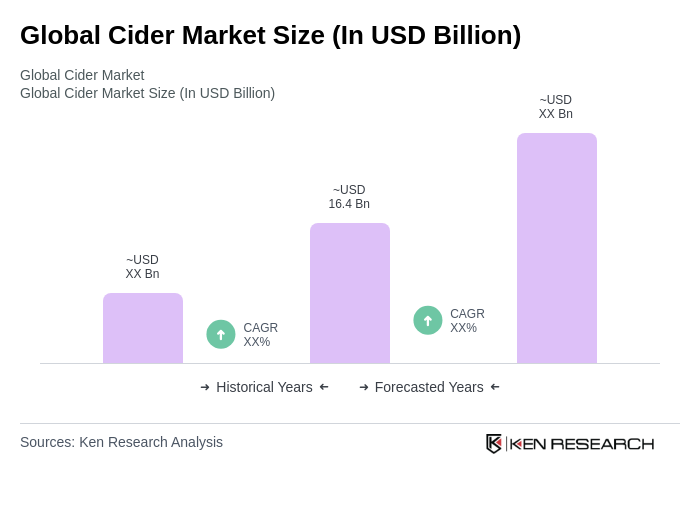
- The Global Cider Market is valued at USD 16.4 billion, based on a five-year historical analysis. This growth is primarily driven by the rising demand for low-alcohol and fruit-based alcoholic beverages, especially among millennials and Gen Z consumers. Increasing health consciousness, the popularity of gluten-free options, and the expanding variety of flavors and styles—particularly berry, citrus, and exotic fruit blends—are key drivers. The trend towards premiumization, craft, and functional ciders with adaptogens and probiotics has also significantly contributed to market expansion.
- Countries such as the United States, the United Kingdom, and Germany continue to dominate the Global Cider Market due to their established cider production traditions and high consumption rates. The United States has seen a surge in craft cider brands and innovative flavor profiles, while the United Kingdom remains a historical leader in cider production. Germany, with its strong beer culture, has increasingly embraced cider, further enhancing its market presence.
- In 2023, the European Union implemented Regulation (EU) 2023/1234, issued by the European Commission, which standardizes cider production by requiring all cider producers to adhere to specific labeling and quality standards. This regulation covers ingredient disclosure, minimum fruit content, and alcohol thresholds, aiming to enhance consumer trust and ensure product quality, thereby promoting fair competition among cider manufacturers across member states.
Global Cider Market Segmentation
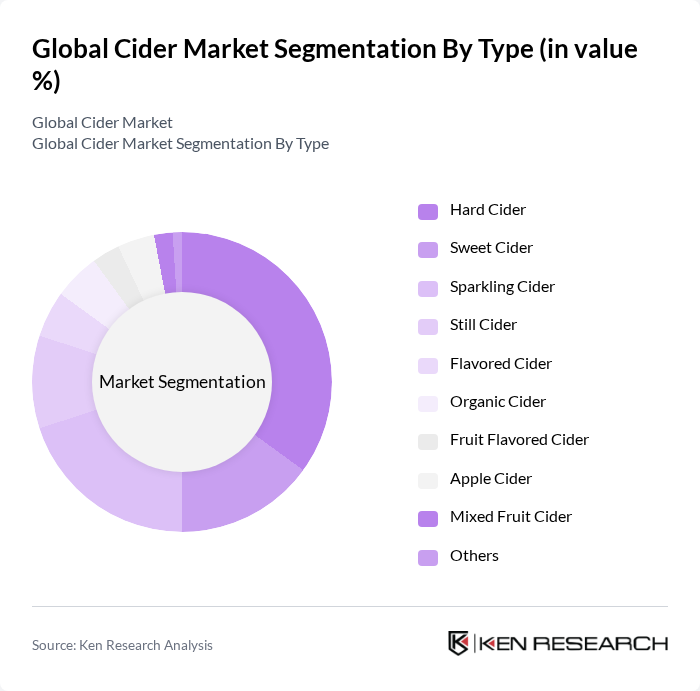
By Type:The cider market can be segmented into Hard Cider, Sweet Cider, Sparkling Cider, Still Cider, Flavored Cider, Organic Cider, Fruit Flavored Cider, Apple Cider, Mixed Fruit Cider, and Others. Among these, Hard Cider remains the most dominant segment, driven by its popularity among consumers seeking alcoholic beverages with lower sugar content. The trend towards craft and artisanal products, as well as the introduction of new fruit blends and seasonal flavors, has bolstered the growth of Hard Cider, with consumers increasingly drawn to unique flavors and local brands.
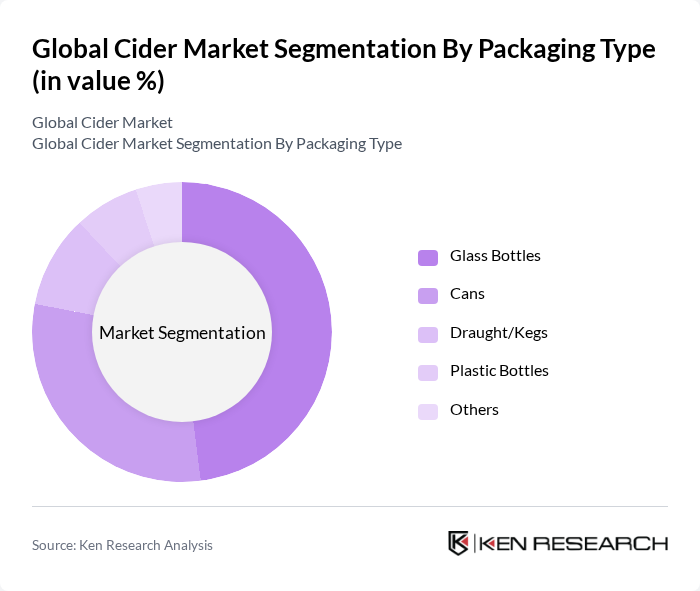
By Packaging Type:The cider market is also segmented by packaging type, which includes Glass Bottles, Cans, Draught/Kegs, Plastic Bottles, and Others. Glass Bottles are the leading packaging type, favored for their ability to preserve flavor and quality. The premium image associated with glass packaging appeals to consumers, particularly in the craft cider segment, where presentation and sustainability play a crucial role in purchasing decisions.
Global Cider Market Competitive Landscape
The Global Cider Market is characterized by a dynamic mix of regional and international players. Leading participants such as Heineken N.V. (Strongbow, Bulmers), C&C Group plc (Magners, Bulmers Ireland), Asahi Group Holdings, Ltd. (Somersby), Anheuser-Busch InBev (Stella Artois Cidre, Johnny Appleseed), Molson Coors Beverage Company (Rekorderlig, Aspall), Carlsberg Group (Somersby), Aston Manor Cider, Thatchers Cider Company Ltd, Kopparbergs Bryggeri AB, Westons Cider, Angry Orchard (Boston Beer Company), Woodchuck Hard Cider (Vermont Hard Cider Company), Ace Cider (California Cider Company), Crispin Cider Company, Seattle Cider Company contribute to innovation, geographic expansion, and service delivery in this space.
Global Cider Market Industry Analysis
Growth Drivers
- Increasing Consumer Preference for Craft Beverages:The craft beverage segment has seen a significant rise, with the number of craft cideries in the U.S. increasing from 300 in 2010 to over 1,000 in future. This growth reflects a broader trend where consumers are seeking unique, locally produced options. According to the Brewers Association, craft beverage sales reached $29.3 billion in future, indicating a robust market for artisanal products, including cider, which is expected to benefit from this consumer shift.
- Rising Health Consciousness and Demand for Low-Alcohol Options:As health awareness grows, consumers are increasingly opting for beverages with lower alcohol content. The global low-alcohol beverage market was valued at $1.2 billion in future, with cider being a popular choice due to its typically lower alcohol levels compared to beer and spirits. This trend is supported by a report from the World Health Organization, which indicates a 15% increase in demand for low-alcohol beverages over the past three years, further driving cider consumption.
- Expansion of Distribution Channels and Retail Presence:The cider market is benefiting from enhanced distribution networks, with the number of retail outlets selling cider increasing by 20% from 2020 to future. E-commerce sales of alcoholic beverages, including cider, surged to $7.5 billion in future, according to Statista. This growth in online sales channels is expected to continue, providing cider producers with greater access to consumers and facilitating market penetration in previously underserved regions.
Market Challenges
- Intense Competition from Other Alcoholic Beverages:The cider market faces stiff competition from established alcoholic beverages such as beer, wine, and spirits. In future, beer sales accounted for approximately $116 billion in the U.S. alone, overshadowing cider's market share. This competitive landscape necessitates innovative marketing strategies and product differentiation for cider brands to capture consumer interest and loyalty amidst a crowded marketplace.
- Regulatory Hurdles and Compliance Costs:Cider producers often encounter complex regulatory environments that vary by region. In the U.S., compliance with the Alcohol and Tobacco Tax and Trade Bureau (TTB) regulations can incur costs exceeding $50,000 annually for small producers. These regulatory challenges can hinder market entry and expansion, particularly for new entrants lacking the resources to navigate the compliance landscape effectively.
Global Cider Market Future Outlook
The cider market is poised for continued growth, driven by evolving consumer preferences towards craft and low-alcohol beverages. Innovations in flavor profiles and sustainable production practices are expected to attract a broader audience. Additionally, the rise of e-commerce will facilitate greater accessibility, allowing cider brands to reach consumers directly. As awareness of cider increases, particularly in emerging markets, the potential for market expansion remains significant, promising a dynamic future for the industry.
Market Opportunities
- Growth in E-Commerce and Online Sales Channels:The shift towards online shopping presents a substantial opportunity for cider brands. With e-commerce sales projected to reach $10 billion in future, cider producers can leverage digital platforms to enhance visibility and accessibility, catering to a tech-savvy consumer base increasingly comfortable with purchasing beverages online.
- Increasing Demand for Organic and Natural Products:The organic beverage market is expanding rapidly, with sales of organic alcoholic beverages reaching $3.5 billion in future. Cider brands that emphasize organic ingredients and sustainable practices can tap into this growing consumer segment, appealing to health-conscious buyers seeking natural alternatives in their beverage choices.
Scope of the Report
| Segment | Sub-Segments |
|---|---|
| By Type | Hard Cider Sweet Cider Sparkling Cider Still Cider Flavored Cider Organic Cider Fruit Flavored Cider Apple Cider Mixed Fruit Cider Others |
| By Packaging Type | Glass Bottles Cans Draught/Kegs Plastic Bottles Others |
| By Distribution Channel | Supermarkets/Hypermarkets Specialty Stores Online Retail Stores Bars and Restaurants (On-trade) Departmental Stores Convenience Stores Others |
| By Alcohol Content | Low Alcohol Medium Alcohol High Alcohol |
| By Region | North America (United States, Canada, Mexico) Europe (UK, France, Germany, Spain, Italy, Sweden, Poland, Belgium, Netherlands, Rest of Europe) Asia-Pacific (China, India, Japan, Australia, South Korea, ASEAN, Rest of APAC) Latin America (Brazil, Argentina, Colombia, Chile, Peru, Rest of South America) Middle East & Africa (South Africa, GCC, Egypt, Nigeria, Turkey, Rest of MEA) |
| By Consumer Demographics | Age Group (18-24, 25-34, 35-44, 45+) Gender Income Level |
| By Occasion | Casual Gatherings Celebrations Seasonal Events Others |
Key Target Audience
Investors and Venture Capitalist Firms
Government and Regulatory Bodies (e.g., Food and Drug Administration, Alcohol and Tobacco Tax and Trade Bureau)
Manufacturers and Producers
Distributors and Retailers
Importers and Exporters
Industry Associations (e.g., United States Association of Cider Makers)
Packaging Suppliers
Financial Institutions
Players Mentioned in the Report:
Heineken N.V. (Strongbow, Bulmers)
C&C Group plc (Magners, Bulmers Ireland)
Asahi Group Holdings, Ltd. (Somersby)
Anheuser-Busch InBev (Stella Artois Cidre, Johnny Appleseed)
Molson Coors Beverage Company (Rekorderlig, Aspall)
Carlsberg Group (Somersby)
Aston Manor Cider
Thatchers Cider Company Ltd
Kopparbergs Bryggeri AB
Westons Cider
Angry Orchard (Boston Beer Company)
Woodchuck Hard Cider (Vermont Hard Cider Company)
Ace Cider (California Cider Company)
Crispin Cider Company
Seattle Cider Company
Table of Contents
Market Assessment Phase
1. Executive Summary and Approach
2. Global Cider Market Overview
2.1 Key Insights and Strategic Recommendations
2.2 Global Cider Market Overview
2.3 Definition and Scope
2.4 Evolution of Market Ecosystem
2.5 Timeline of Key Regulatory Milestones
2.6 Value Chain & Stakeholder Mapping
2.7 Business Cycle Analysis
2.8 Policy & Incentive Landscape
3. Global Cider Market Analysis
3.1 Growth Drivers
3.1.1 Increasing consumer preference for craft beverages
3.1.2 Rising health consciousness and demand for low-alcohol options
3.1.3 Expansion of distribution channels and retail presence
3.1.4 Innovative flavor profiles and product diversification
3.2 Market Challenges
3.2.1 Intense competition from other alcoholic beverages
3.2.2 Regulatory hurdles and compliance costs
3.2.3 Fluctuating raw material prices
3.2.4 Limited consumer awareness in emerging markets
3.3 Market Opportunities
3.3.1 Growth in e-commerce and online sales channels
3.3.2 Increasing demand for organic and natural products
3.3.3 Potential for international market expansion
3.3.4 Collaborations with food and beverage pairings
3.4 Market Trends
3.4.1 Rise of flavored and specialty ciders
3.4.2 Sustainability initiatives in production
3.4.3 Shift towards premium and artisanal products
3.4.4 Growth of cider festivals and consumer events
3.5 Government Regulation
3.5.1 Labeling and advertising regulations
3.5.2 Taxation policies on alcoholic beverages
3.5.3 Health and safety standards for production
3.5.4 Import/export regulations affecting cider trade
4. SWOT Analysis
5. Stakeholder Analysis
6. Porter's Five Forces Analysis
7. Global Cider Market Market Size, 2019-2024
7.1 By Value
7.2 By Volume
7.3 By Average Selling Price
8. Global Cider Market Segmentation
8.1 By Type
8.1.1 Hard Cider
8.1.2 Sweet Cider
8.1.3 Sparkling Cider
8.1.4 Still Cider
8.1.5 Flavored Cider
8.1.6 Organic Cider
8.1.7 Fruit Flavored Cider
8.1.8 Apple Cider
8.1.9 Mixed Fruit Cider
8.1.10 Others
8.2 By Packaging Type
8.2.1 Glass Bottles
8.2.2 Cans
8.2.3 Draught/Kegs
8.2.4 Plastic Bottles
8.2.5 Others
8.3 By Distribution Channel
8.3.1 Supermarkets/Hypermarkets
8.3.2 Specialty Stores
8.3.3 Online Retail Stores
8.3.4 Bars and Restaurants (On-trade)
8.3.5 Departmental Stores
8.3.6 Convenience Stores
8.3.7 Others
8.4 By Alcohol Content
8.4.1 Low Alcohol
8.4.2 Medium Alcohol
8.4.3 High Alcohol
8.5 By Region
8.5.1 North America (United States, Canada, Mexico)
8.5.2 Europe (UK, France, Germany, Spain, Italy, Sweden, Poland, Belgium, Netherlands, Rest of Europe)
8.5.3 Asia-Pacific (China, India, Japan, Australia, South Korea, ASEAN, Rest of APAC)
8.5.4 Latin America (Brazil, Argentina, Colombia, Chile, Peru, Rest of South America)
8.5.5 Middle East & Africa (South Africa, GCC, Egypt, Nigeria, Turkey, Rest of MEA)
8.6 By Consumer Demographics
8.6.1 Age Group (18-24, 25-34, 35-44, 45+)
8.6.2 Gender
8.6.3 Income Level
8.7 By Occasion
8.7.1 Casual Gatherings
8.7.2 Celebrations
8.7.3 Seasonal Events
8.7.4 Others
9. Global Cider Market Competitive Analysis
9.1 Market Share of Key Players
9.2 Cross Comparison of Key Players
9.2.1 Company Name
9.2.2 Group Size (Large, Medium, or Small as per industry convention)
9.2.3 Global Cider Revenue (USD Million)
9.2.4 Revenue Growth Rate (%)
9.2.5 Market Share (%)
9.2.6 Market Penetration Rate (by region/volume)
9.2.7 Distribution Network Strength (number of countries/points of sale)
9.2.8 Product Portfolio Breadth (number of SKUs/brands)
9.2.9 Product Innovation Index (new launches per year)
9.2.10 Brand Recognition Score (survey-based or index)
9.2.11 Customer Satisfaction Index (NPS or equivalent)
9.2.12 Sustainability/ESG Initiatives (qualitative/quantitative)
9.3 SWOT Analysis of Top Players
9.4 Pricing Analysis
9.5 Detailed Profile of Major Companies
9.5.1 Heineken N.V. (Strongbow, Bulmers)
9.5.2 C&C Group plc (Magners, Bulmers Ireland)
9.5.3 Asahi Group Holdings, Ltd. (Somersby)
9.5.4 Anheuser-Busch InBev (Stella Artois Cidre, Johnny Appleseed)
9.5.5 Molson Coors Beverage Company (Rekorderlig, Aspall)
9.5.6 Carlsberg Group (Somersby)
9.5.7 Aston Manor Cider
9.5.8 Thatchers Cider Company Ltd
9.5.9 Kopparbergs Bryggeri AB
9.5.10 Westons Cider
9.5.11 Angry Orchard (Boston Beer Company)
9.5.12 Woodchuck Hard Cider (Vermont Hard Cider Company)
9.5.13 Ace Cider (California Cider Company)
9.5.14 Crispin Cider Company
9.5.15 Seattle Cider Company
10. Global Cider Market End-User Analysis
10.1 Procurement Behavior of Key Ministries
10.1.1 Government procurement policies
10.1.2 Budget allocation for beverage purchases
10.1.3 Preference for local vs imported products
10.2 Corporate Spend on Infrastructure & Energy
10.2.1 Investment in production facilities
10.2.2 Spending on marketing and promotions
10.2.3 Budget for sustainability initiatives
10.3 Pain Point Analysis by End-User Category
10.3.1 Supply chain disruptions
10.3.2 Quality control issues
10.3.3 Pricing volatility
10.4 User Readiness for Adoption
10.4.1 Awareness of cider products
10.4.2 Willingness to try new flavors
10.4.3 Accessibility of products
10.5 Post-Deployment ROI and Use Case Expansion
10.5.1 Measurement of sales growth
10.5.2 Customer feedback and satisfaction
10.5.3 Opportunities for product line expansion
11. Global Cider Market Future Size, 2025-2030
11.1 By Value
11.2 By Volume
11.3 By Average Selling Price
Go-To-Market Strategy Phase
1. Whitespace Analysis + Business Model Canvas
1.1 Market gaps and opportunities
1.2 Value proposition development
1.3 Revenue model exploration
1.4 Customer segmentation analysis
1.5 Competitive landscape overview
1.6 Key partnerships identification
1.7 Risk assessment and mitigation
2. Marketing and Positioning Recommendations
2.1 Branding strategies
2.2 Product USPs
2.3 Target audience identification
2.4 Marketing channels selection
2.5 Campaign planning
2.6 Performance metrics
3. Distribution Plan
3.1 Urban retail strategies
3.2 Rural NGO tie-ups
3.3 E-commerce integration
3.4 Direct-to-consumer models
3.5 Logistics and supply chain management
4. Channel & Pricing Gaps
4.1 Underserved routes
4.2 Pricing bands analysis
4.3 Competitor pricing strategies
4.4 Consumer price sensitivity
4.5 Recommendations for pricing adjustments
5. Unmet Demand & Latent Needs
5.1 Category gaps identification
5.2 Consumer segments analysis
5.3 Product development opportunities
5.4 Market entry strategies for new products
6. Customer Relationship
6.1 Loyalty programs
6.2 After-sales service
6.3 Customer engagement strategies
6.4 Feedback mechanisms
6.5 Community building initiatives
7. Value Proposition
7.1 Sustainability initiatives
7.2 Integrated supply chains
7.3 Unique selling points
7.4 Customer-centric approach
7.5 Brand storytelling
8. Key Activities
8.1 Regulatory compliance
8.2 Branding efforts
8.3 Distribution setup
8.4 Market research and analysis
8.5 Training and development
9. Entry Strategy Evaluation
9.1 Domestic Market Entry Strategy
9.1.1 Product mix considerations
9.1.2 Pricing band analysis
9.1.3 Packaging strategies
9.2 Export Entry Strategy
9.2.1 Target countries selection
9.2.2 Compliance roadmap development
10. Entry Mode Assessment
10.1 Joint Ventures
10.2 Greenfield Investments
10.3 Mergers & Acquisitions
10.4 Distributor Model
11. Capital and Timeline Estimation
11.1 Capital requirements
11.2 Timelines for market entry
12. Control vs Risk Trade-Off
12.1 Ownership considerations
12.2 Partnerships evaluation
13. Profitability Outlook
13.1 Breakeven analysis
13.2 Long-term sustainability strategies
14. Potential Partner List
14.1 Distributors
14.2 Joint Ventures
14.3 Acquisition targets
15. Execution Roadmap
15.1 Phased Plan for Market Entry
15.1.1 Market Setup
15.1.2 Market Entry
15.1.3 Growth Acceleration
15.1.4 Scale & Stabilize
15.2 Key Activities and Milestones
15.2.1 Activity planning
15.2.2 Milestone tracking
Research Methodology
Phase 1: Approach1
Desk Research
- Analysis of industry reports from cider associations and market research firms
- Review of trade publications and market analysis articles focused on cider production and consumption
- Examination of government agricultural statistics and import/export data related to cider
Primary Research
- Interviews with cider producers and manufacturers to gather insights on production trends
- Surveys with distributors and retailers to understand market dynamics and consumer preferences
- Field interviews with industry experts and sommeliers to assess cider quality and market positioning
Validation & Triangulation
- Cross-validation of data through multiple sources including trade associations and government reports
- Triangulation of findings from primary interviews with secondary data insights
- Sanity checks through expert panel reviews to ensure data accuracy and relevance
Phase 2: Market Size Estimation1
Top-down Assessment
- Estimation of total cider market size based on national beverage consumption statistics
- Segmentation of market by type (e.g., hard cider, non-alcoholic cider) and region
- Incorporation of trends in health consciousness and craft beverage popularity
Bottom-up Modeling
- Volume estimates derived from production data of leading cider manufacturers
- Analysis of sales data from retail channels including supermarkets and specialty stores
- Cost analysis based on production, distribution, and marketing expenses
Forecasting & Scenario Analysis
- Multi-factor regression analysis incorporating demographic shifts and consumer behavior trends
- Scenario modeling based on potential regulatory changes affecting alcohol sales
- Baseline, optimistic, and pessimistic forecasts through 2030 based on market drivers
Phase 3: CATI Sample Composition1
| Scope Item/Segment | Sample Size | Target Respondent Profiles |
|---|---|---|
| Cider Production Insights | 60 | Cider Makers, Production Managers |
| Retail Distribution Channels | 50 | Retail Managers, Beverage Buyers |
| Consumer Preferences Survey | 100 | End Consumers, Cider Enthusiasts |
| Market Trends Analysis | 40 | Market Analysts, Industry Experts |
| Export Market Dynamics | 40 | Export Managers, Trade Representatives |
Frequently Asked Questions
What is the current value of the Global Cider Market?
The Global Cider Market is valued at approximately USD 16.4 billion, reflecting a significant growth trend driven by increasing consumer demand for low-alcohol and fruit-based beverages, particularly among younger demographics like millennials and Gen Z.
What factors are driving the growth of the Global Cider Market?
Which countries dominate the Global Cider Market?
What are the main types of cider available in the market?
Other Regional/Country Reports
Indonesia Cider Market
Malaysia Cider Market
APAC Cider Market
Other Adjacent Reports
Mexico Craft Beer Market
Singapore Wine Market
Oman Hard Seltzer Market
Kuwait Low-Alcohol Beverage Market
Kuwait Organic Beverage Market
Vietnam Functional Beverage Market
South Africa Ready-to-Drink Cocktail Market
Mexico Fruit Juice Market
Egypt Gluten-Free Beverage Market
Qatar Premium Spirits Market
Why Buy From Us?

What makes us stand out is that our consultants follow Robust, Refine and Result (RRR) methodology. Robust for clear definitions, approaches and sanity checking, Refine for differentiating respondents' facts and opinions, and Result for presenting data with story.

We have set a benchmark in the industry by offering our clients with syndicated and customized market research reports featuring coverage of entire market as well as meticulous research and analyst insights.

While we don't replace traditional research, we flip the method upside down. Our dual approach of Top Bottom & Bottom Top ensures quality deliverable by not just verifying company fundamentals but also looking at the sector and macroeconomic factors.

With one step in the future, our research team constantly tries to show you the bigger picture. We help with some of the tough questions you may encounter along the way: How is the industry positioned? Best marketing channel? KPI's of competitors? By aligning every element, we help maximize success.

Our report gives you instant access to the answers and sources that other companies might choose to hide. We elaborate each steps of research methodology we have used and showcase you the sample size to earn your trust.

If you need any support, we are here! We pride ourselves on universe strength, data quality, and quick, friendly, and professional service.