About the Report
Base Year 2024Global Cigar Market Overview
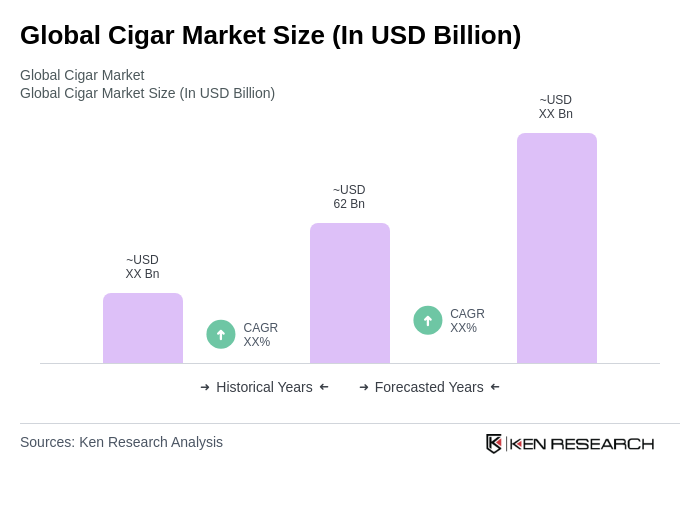
- The Global Cigar Market is valued at approximately USD 62 billion, based on a five-year historical analysis, with recent assessments placing the market value in the low?sixties in USD billions.
- This growth is primarily driven by increasing consumer interest in premium and artisanal products, ongoing premiumization, and the social aspect of cigar consumption; flavored and infused offerings have expanded assortments in several markets, attracting younger?adult demographics, though regulatory scrutiny is intensifying around flavors.
- Key players in this market include countries like the United States, Cuba, and the Dominican Republic. The U.S. is a leading market by revenue and distribution reach, Cuba remains globally recognized for premium handmade cigars, and the Dominican Republic is a major producer and exporter of premium long?filler cigars.
- In 2023, the U.S. government advanced stricter measures on tobacco marketing and flavored products through FDA actions and proposed rules, including strengthened health warning requirements for cigars and steps toward prohibiting characterizing flavors in cigars to reduce youth appeal; these actions constrain promotional tactics aimed at younger audiences.
Global Cigar Market Segmentation
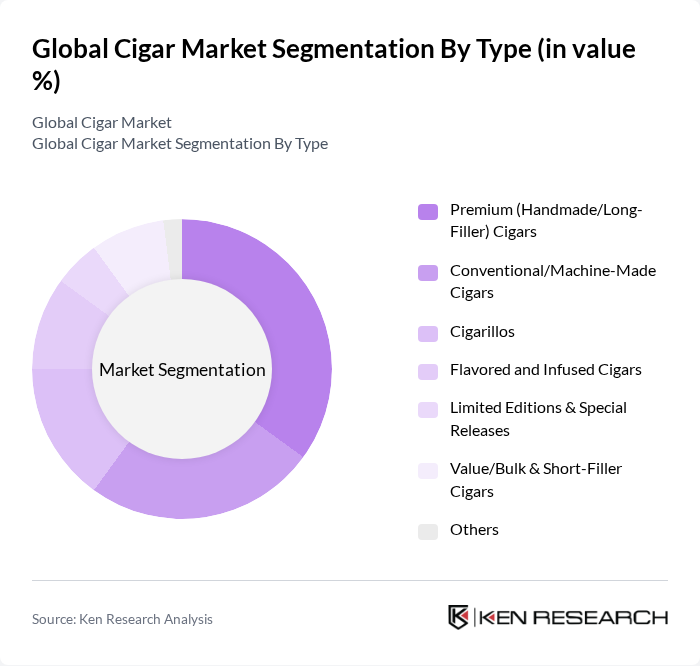
By Type:The cigar market is segmented into various types, including Premium (Handmade/Long-Filler) Cigars, Conventional/Machine-Made Cigars, Cigarillos, Flavored and Infused Cigars, Limited Editions & Special Releases, Value/Bulk & Short-Filler Cigars, and Others. Among these, Premium Cigars are gaining traction due to perceived quality, craftsmanship, and premiumization trends among adult consumers and collectors. Flavored and Infused Cigars have seen demand in certain channels and regions—especially among younger?adult consumers—though flavor regulations are tightening in key markets.
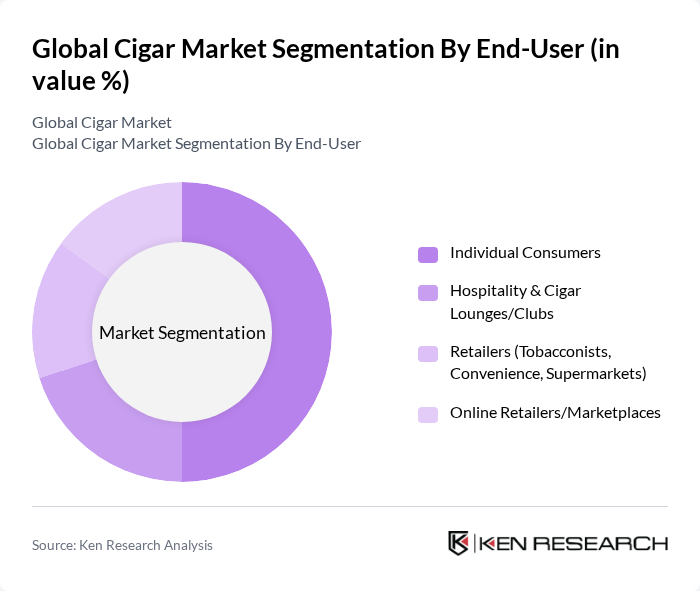
By End-User:The end-user segmentation includes Individual Consumers, Hospitality & Cigar Lounges/Clubs, Retailers (Tobacconists, Convenience, Supermarkets), and Online Retailers/Marketplaces. Individual Consumers dominate the market, supported by personal consumption and the social culture of cigar use. Cigar lounges and clubs continue to gain prominence as curated venues for premium experiences, while specialty retail and online channels expand availability and assortment.
Global Cigar Market Competitive Landscape
The Global Cigar Market is characterized by a dynamic mix of regional and international players. Leading participants such as Altria Group, Inc. (John Middleton Co.), Imperial Brands PLC (Tabacalera/Altadis S.A.), Scandinavian Tobacco Group A/S (STG), Oettinger Davidoff AG, Swisher International, Inc. (Swisher Sweets), General Cigar Company, Inc. (Part of Scandinavian Tobacco Group), Habanos S.A. (Cuban State-Owned; Cohiba, Montecristo), Drew Estate (A Subsidiary of Swisher), J.C. Newman Cigar Company, Padrón Cigars, Rocky Patel Premium Cigars, Arturo Fuente Cigar Company, Oliva Cigar Co. (STG), Plasencia Cigars, A.J. Fernandez Cigars contribute to innovation, geographic expansion, and service delivery in this space.
Global Cigar Market Industry Analysis
Growth Drivers
- Increasing Demand for Premium Cigars:The premium cigar segment has seen a notable increase, with sales reaching approximately 1.6 billion units in the future. This growth is driven by affluent consumers seeking high-quality products, with the luxury cigar market projected to grow by 4% annually. The rise in disposable income, particularly in regions like North America and Europe, has led to a surge in demand for premium brands, which often feature unique blends and craftsmanship that appeal to discerning smokers.
- Rising Popularity of Cigar Lounges:Cigar lounges have become social hubs, with over 1,200 new establishments opening globally in the future. These lounges cater to a growing demographic of cigar enthusiasts, providing a space for relaxation and community. The trend is supported by a 15% increase in cigar-related events, which further promotes the culture of cigar smoking. This environment encourages consumers to explore various brands and types, enhancing overall market growth.
- Expansion of Online Retail Channels:The online retail sector for cigars has expanded significantly, with e-commerce sales estimated at $600 million in the future. This growth is attributed to the convenience of online shopping and the ability to access a wider variety of products. With over 65% of consumers preferring to purchase cigars online, retailers are investing in digital marketing strategies to attract this audience. The trend is expected to continue as more consumers embrace online shopping for premium products.
Market Challenges
- Stringent Regulatory Frameworks:The cigar industry faces significant challenges due to stringent regulations imposed by governments worldwide. For instance, the U.S. Food and Drug Administration (FDA) has implemented strict guidelines that affect marketing and distribution, leading to increased compliance costs. In the future, compliance costs for manufacturers rose by 12%, impacting profit margins. These regulations can hinder market entry for new brands and limit growth opportunities for existing players.
- Health Concerns and Anti-Tobacco Campaigns:Growing health concerns surrounding tobacco use have led to intensified anti-tobacco campaigns globally. In the future, public health organizations reported a 12% increase in funding for anti-smoking initiatives, which often target cigars as well. This heightened scrutiny can deter potential consumers and negatively impact sales. Additionally, the stigma associated with tobacco products may lead to a decline in new smokers entering the market, posing a long-term challenge for growth.
Global Cigar Market Future Outlook
The future of the cigar market appears promising, driven by evolving consumer preferences and lifestyle changes. As the demand for premium and artisanal products continues to rise, manufacturers are likely to innovate with unique blends and sustainable practices. Additionally, the expansion of online retail channels will facilitate access to a broader audience. However, navigating regulatory challenges and health concerns will be crucial for sustained growth. Overall, the market is poised for a dynamic evolution in the coming years.
Market Opportunities
- Emerging Markets with Growing Middle Class:Emerging markets, particularly in Asia and Africa, present significant opportunities for growth. With a projected increase of 350 million individuals entering the middle class in the future, demand for premium cigars is expected to rise. This demographic shift offers manufacturers a chance to introduce their products to new consumers eager for luxury experiences.
- Collaborations with Luxury Brands:Collaborations between cigar brands and luxury lifestyle brands can create unique product offerings that appeal to affluent consumers. Such partnerships can enhance brand visibility and attract new customers. In the future, collaborations have already shown a 30% increase in sales for participating brands, indicating a lucrative opportunity for market players to leverage luxury associations.
Scope of the Report
| Segment | Sub-Segments |
|---|---|
| By Type | Premium (Handmade/Long-Filler) Cigars Conventional/Machine?Made Cigars Cigarillos Flavored and Infused Cigars Limited Editions & Special Releases Value/Bulk & Short?Filler Cigars Others |
| By End-User | Individual Consumers Hospitality & Cigar Lounges/Clubs Retailers (Tobacconists, Convenience, Supermarkets) Online Retailers/Marketplaces |
| By Distribution Channel | Offline Retail (Tobacconists, Duty?Free, Convenience) Wholesalers/Distributors E?commerce Direct?to?Consumer (Brand Boutiques/Clubs) |
| By Price Range | Premium Mid?Range Budget/Value |
| By Flavor Profile | Non?Flavored (Natural) Flavored (Sweet/Infused) Spicy/Earthy Herbal/Tea/Novelty |
| By Packaging Type | Boxes/Cartons Tins Bundles/Pouches |
| By Occasion | Celebrations & Gifting Leisure/Social Smoking Collectors/Aficionados Others |
Key Target Audience
Investors and Venture Capitalist Firms
Government and Regulatory Bodies (e.g., Food and Drug Administration, World Health Organization)
Manufacturers and Producers
Distributors and Retailers
Importers and Exporters
Industry Associations (e.g., Cigar Association of America)
Financial Institutions
Market Analysts and Industry Experts
Players Mentioned in the Report:
Altria Group, Inc. (John Middleton Co.)
Imperial Brands PLC (Tabacalera/Altadis S.A.)
Scandinavian Tobacco Group A/S (STG)
Oettinger Davidoff AG
Swisher International, Inc. (Swisher Sweets)
General Cigar Company, Inc. (Part of Scandinavian Tobacco Group)
Habanos S.A. (Cuban State-Owned; Cohiba, Montecristo)
Drew Estate (A Subsidiary of Swisher)
J.C. Newman Cigar Company
Padron Cigars
Rocky Patel Premium Cigars
Arturo Fuente Cigar Company
Oliva Cigar Co. (STG)
Plasencia Cigars
A.J. Fernandez Cigars
Table of Contents
Market Assessment Phase
1. Executive Summary and Approach
2. Global Cigar Market Overview
2.1 Key Insights and Strategic Recommendations
2.2 Global Cigar Market Overview
2.3 Definition and Scope
2.4 Evolution of Market Ecosystem
2.5 Timeline of Key Regulatory Milestones
2.6 Value Chain & Stakeholder Mapping
2.7 Business Cycle Analysis
2.8 Policy & Incentive Landscape
3. Global Cigar Market Analysis
3.1 Growth Drivers
3.1.1 Increasing Demand for Premium Cigars
3.1.2 Rising Popularity of Cigar Lounges
3.1.3 Growth in Disposable Income
3.1.4 Expansion of Online Retail Channels
3.2 Market Challenges
3.2.1 Stringent Regulatory Frameworks
3.2.2 Health Concerns and Anti-Tobacco Campaigns
3.2.3 Fluctuating Raw Material Prices
3.2.4 Competition from Alternative Smoking Products
3.3 Market Opportunities
3.3.1 Emerging Markets with Growing Middle Class
3.3.3 Collaborations with Luxury Brands
3.3.4 Expansion into Non-Traditional Markets
3.4 Market Trends
3.4.1 Increasing Interest in Organic and Natural Cigars
3.4.2 Rise of Cigar Subscription Services
3.4.3 Growth of Cigar Events and Festivals
3.4.4 Shift Towards Sustainable Production Practices
3.5 Government Regulation
3.5.1 Taxation Policies on Tobacco Products
3.5.2 Advertising Restrictions
3.5.3 Packaging and Labeling Requirements
3.5.4 Age Restrictions for Purchase
4. SWOT Analysis
5. Stakeholder Analysis
6. Porter's Five Forces Analysis
7. Global Cigar Market Market Size, 2019-2024
7.1 By Value
7.2 By Volume
7.3 By Average Selling Price
8. Global Cigar Market Segmentation
8.1 By Type
8.1.1 Premium (Handmade/Long-Filler) Cigars
8.1.2 Conventional/Machine?Made Cigars
8.1.3 Cigarillos
8.1.4 Flavored and Infused Cigars
8.1.5 Limited Editions & Special Releases
8.1.6 Value/Bulk & Short?Filler Cigars
8.1.7 Others
8.2 By End-User
8.2.1 Individual Consumers
8.2.2 Hospitality & Cigar Lounges/Clubs
8.2.3 Retailers (Tobacconists, Convenience, Supermarkets)
8.2.4 Online Retailers/Marketplaces
8.3 By Distribution Channel
8.3.1 Offline Retail (Tobacconists, Duty?Free, Convenience)
8.3.2 Wholesalers/Distributors
8.3.3 E?commerce
8.3.4 Direct?to?Consumer (Brand Boutiques/Clubs)
8.4 By Price Range
8.4.1 Premium
8.4.2 Mid?Range
8.4.3 Budget/Value
8.5 By Flavor Profile
8.5.1 Non?Flavored (Natural)
8.5.2 Flavored (Sweet/Infused)
8.5.3 Spicy/Earthy
8.5.4 Herbal/Tea/Novelty
8.6 By Packaging Type
8.6.1 Boxes/Cartons
8.6.2 Tins
8.6.3 Bundles/Pouches
8.7 By Occasion
8.7.1 Celebrations & Gifting
8.7.2 Leisure/Social Smoking
8.7.3 Collectors/Aficionados
8.7.4 Others
9. Global Cigar Market Competitive Analysis
9.1 Market Share of Key Players
9.2 Cross Comparison of Key Players
9.2.1 Company Name
9.2.2 Group Size (Global Conglomerate, Large, Mid?Sized, Boutique)
9.2.3 Net Sales from Cigars (USD) and Share of Total Revenue
9.2.4 Volume Shipped (Million Sticks/Boxes) and CAGR
9.2.5 Geographic Footprint (No. of Countries/Regions Served)
9.2.6 Portfolio Mix (Premium vs Machine?Made vs Cigarillos, %)
9.2.7 Average Realized Price per Stick/Box
9.2.8 Distribution Reach (No. of retail doors, DTC/e?commerce presence)
9.2.9 Brand Equity Indicators (awards, ratings 90+ counts, social/search index)
9.2.10 Compliance & Regulatory Risk Exposure (tax/menthol/flavor bans)
9.2.11 Innovation Pipeline (new SKUs, limited editions per year)
9.2.12 Operating Margin for Cigar Segment
9.3 SWOT Analysis of Top Players
9.4 Pricing Analysis
9.5 Detailed Profile of Major Companies
9.5.1 Altria Group, Inc. (John Middleton Co.)
9.5.2 Imperial Brands PLC (Tabacalera/Altadis S.A.)
9.5.3 Scandinavian Tobacco Group A/S (STG)
9.5.4 Oettinger Davidoff AG
9.5.5 Swisher International, Inc. (Swisher Sweets)
9.5.6 General Cigar Company, Inc. (Part of Scandinavian Tobacco Group)
9.5.7 Habanos S.A. (Cuban State-Owned; Cohiba, Montecristo)
9.5.8 Drew Estate (A Subsidiary of Swisher)
9.5.9 J.C. Newman Cigar Company
9.5.10 Padrón Cigars
9.5.11 Rocky Patel Premium Cigars
9.5.12 Arturo Fuente Cigar Company
9.5.13 Oliva Cigar Co. (STG)
9.5.14 Plasencia Cigars
9.5.15 A.J. Fernandez Cigars
10. Global Cigar Market End-User Analysis
10.1 Procurement Behavior of Key Ministries
10.1.1 Government Procurement Policies
10.1.2 Budget Allocations for Tobacco Products
10.1.3 Compliance with Health Regulations
10.2 Corporate Spend on Infrastructure & Energy
10.2.1 Investment in Cigar Production Facilities
10.2.2 Expenditure on Marketing and Branding
10.2.3 Funding for Research and Development
10.3 Pain Point Analysis by End-User Category
10.3.1 Quality Assurance Issues
10.3.2 Supply Chain Disruptions
10.3.3 Regulatory Compliance Challenges
10.4 User Readiness for Adoption
10.4.1 Awareness of Cigar Varieties
10.4.2 Acceptance of New Flavors
10.4.3 Willingness to Pay for Premium Products
10.5 Post-Deployment ROI and Use Case Expansion
10.5.1 Customer Feedback Mechanisms
10.5.2 Sales Growth Post-Implementation
10.5.3 Opportunities for Upselling
11. Global Cigar Market Future Size, 2025-2030
11.1 By Value
11.2 By Volume
11.3 By Average Selling Price
Go-To-Market Strategy Phase
1. Whitespace Analysis + Business Model Canvas
1.1 Market Gaps Identification
1.2 Value Proposition Development
1.3 Revenue Streams Analysis
1.4 Cost Structure Evaluation
1.5 Key Partnerships Exploration
1.6 Customer Segments Definition
1.7 Channels of Distribution
2. Marketing and Positioning Recommendations
2.1 Branding Strategies
2.2 Product USPs
3. Distribution Plan
3.1 Urban Retail vs Rural NGO Tie-Ups
4. Channel & Pricing Gaps
4.1 Underserved Routes
4.2 Pricing Bands
5. Unmet Demand & Latent Needs
5.1 Category Gaps
5.2 Consumer Segments
6. Customer Relationship
6.1 Loyalty Programs
6.2 After-Sales Service
7. Value Proposition
7.1 Sustainability
7.2 Integrated Supply Chains
8. Key Activities
8.1 Regulatory Compliance
8.2 Branding
8.3 Distribution Setup
9. Entry Strategy Evaluation
9.1 Domestic Market Entry Strategy
9.1.1 Product Mix
9.1.2 Pricing Band
9.1.3 Packaging
9.2 Export Entry Strategy
9.2.1 Target Countries
9.2.2 Compliance Roadmap
10. Entry Mode Assessment
10.1 JV
10.2 Greenfield
10.3 M&A
10.4 Distributor Model
11. Capital and Timeline Estimation
11.1 Capital Requirements
11.2 Timelines
12. Control vs Risk Trade-Off
12.1 Ownership vs Partnerships
13. Profitability Outlook
13.1 Breakeven Analysis
13.2 Long-Term Sustainability
14. Potential Partner List
14.1 Distributors
14.2 JVs
14.3 Acquisition Targets
15. Execution Roadmap
15.1 Phased Plan for Market Entry
15.1.1 Market Setup
15.1.2 Market Entry
15.1.3 Growth Acceleration
15.1.4 Scale & Stabilize
15.2 Key Activities and Milestones
15.2.1 Milestone Planning
15.2.2 Activity Tracking
Research Methodology
Phase 1: Approach1
Desk Research
- Analysis of industry reports from global tobacco associations and market research firms
- Review of trade publications and market analysis articles focusing on cigar consumption trends
- Examination of government regulations and taxation policies affecting the cigar market
Primary Research
- Interviews with cigar manufacturers and distributors to gather insights on production and sales
- Surveys targeting cigar retailers to understand consumer preferences and purchasing behavior
- Field interviews with industry experts and sommeliers to assess market trends and product innovations
Validation & Triangulation
- Cross-validation of data from multiple sources, including sales data and consumer surveys
- Triangulation of findings from desk research and primary interviews to ensure consistency
- Sanity checks through expert panel reviews to validate market assumptions and forecasts
Phase 2: Market Size Estimation1
Top-down Assessment
- Estimation of market size based on overall tobacco market revenue and segment analysis
- Breakdown of cigar consumption by region, demographic, and product type
- Incorporation of historical growth rates and market trends to project future growth
Bottom-up Modeling
- Collection of sales data from leading cigar brands and retailers to establish baseline figures
- Estimation of average price points and volume sold across different cigar categories
- Analysis of distribution channels and their impact on overall market size
Forecasting & Scenario Analysis
- Multi-factor regression analysis incorporating economic indicators and consumer behavior trends
- Scenario modeling based on potential regulatory changes and shifts in consumer preferences
- Development of baseline, optimistic, and pessimistic forecasts through 2030
Phase 3: CATI Sample Composition1
| Scope Item/Segment | Sample Size | Target Respondent Profiles |
|---|---|---|
| Cigar Retailers | 140 | Store Owners, Sales Managers |
| Cigar Manufacturers | 100 | Production Managers, Marketing Directors |
| Cigar Enthusiasts | 120 | Regular Consumers, Hobbyists |
| Distribution Channels | 80 | Logistics Coordinators, Supply Chain Managers |
| Industry Experts | 50 | Market Analysts, Tobacco Specialists |
Frequently Asked Questions
What is the current value of the Global Cigar Market?
The Global Cigar Market is valued at approximately USD 62 billion, based on a five-year historical analysis. Recent assessments indicate that the market remains in the low-sixties in USD billions, reflecting ongoing growth and consumer interest.
What factors are driving the growth of the Global Cigar Market?
Which countries are key players in the Global Cigar Market?
What regulatory challenges does the Global Cigar Market face?
Other Regional/Country Reports
Indonesia Cigar Market
Malaysia Cigar Market
SEA Cigar Market
Why Buy From Us?

What makes us stand out is that our consultants follow Robust, Refine and Result (RRR) methodology. Robust for clear definitions, approaches and sanity checking, Refine for differentiating respondents' facts and opinions, and Result for presenting data with story.

We have set a benchmark in the industry by offering our clients with syndicated and customized market research reports featuring coverage of entire market as well as meticulous research and analyst insights.

While we don't replace traditional research, we flip the method upside down. Our dual approach of Top Bottom & Bottom Top ensures quality deliverable by not just verifying company fundamentals but also looking at the sector and macroeconomic factors.

With one step in the future, our research team constantly tries to show you the bigger picture. We help with some of the tough questions you may encounter along the way: How is the industry positioned? Best marketing channel? KPI's of competitors? By aligning every element, we help maximize success.

Our report gives you instant access to the answers and sources that other companies might choose to hide. We elaborate each steps of research methodology we have used and showcase you the sample size to earn your trust.

If you need any support, we are here! We pride ourselves on universe strength, data quality, and quick, friendly, and professional service.