About the Report
Base Year 2024Global Dredging Equipment Market Overview
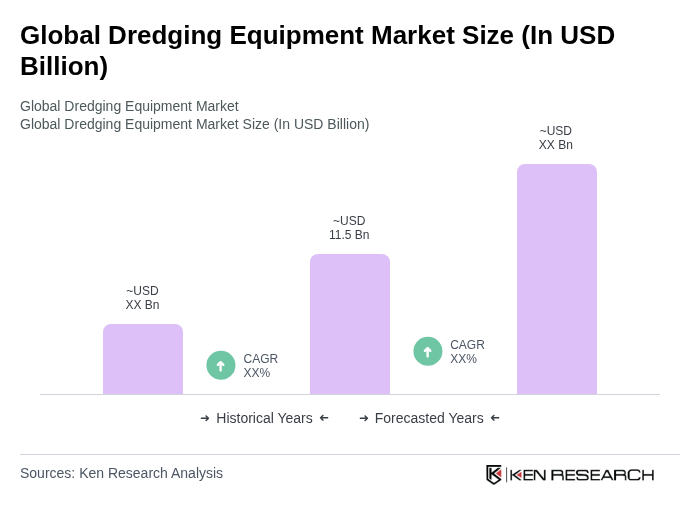
- The Global Dredging Equipment Market is valued at USD 11.5 billion, based on a five-year historical analysis. This growth is primarily driven by increasing investments in infrastructure development, rapid urbanization, and the need for environmental restoration projects. The demand for dredging equipment has surged due to the expansion of ports, waterways, and coastal protection initiatives, which are essential for economic growth and sustainability. Recent trends include the adoption of advanced dredging technologies, such as fuel-efficient and low-emission dredgers, and real-time monitoring systems to enhance operational efficiency and environmental compliance .
- Key players in this market include countries like the Netherlands, China, and the United States, which dominate due to their advanced maritime infrastructure and significant investments in dredging technologies. The Netherlands, with its extensive network of canals and rivers, has a long-standing tradition in dredging, while China’s rapid urbanization and port expansion projects have led to a substantial increase in dredging activities. Asia Pacific, particularly China and India, is experiencing robust growth due to large-scale infrastructure projects and expanding maritime trade .
- The Marine Strategy Framework Directive (Directive 2008/56/EC) issued by the European Parliament and Council in 2008, mandates EU member states to achieve good environmental status of marine waters and protect the marine environment across Europe. This regulation emphasizes the importance of sustainable dredging practices, requiring compliance with operational thresholds and environmental impact assessments, and has led to increased demand for eco-friendly dredging technologies .
Global Dredging Equipment Market Segmentation
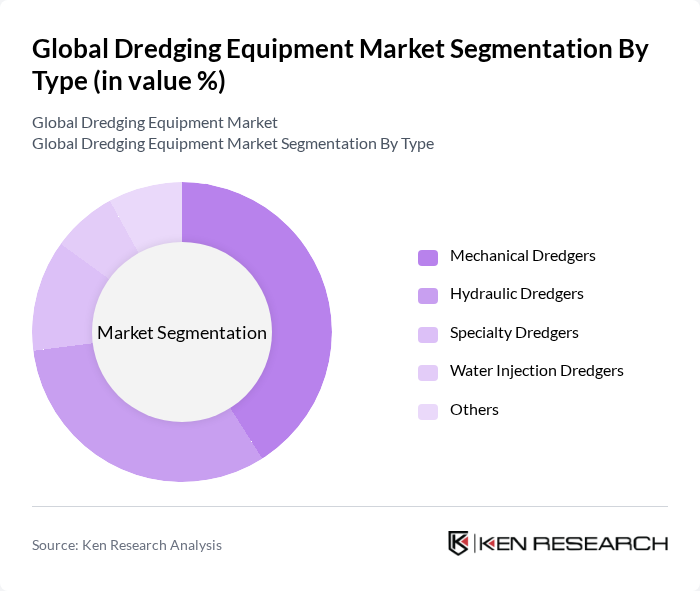
By Type:The dredging equipment market can be segmented into Mechanical Dredgers, Hydraulic Dredgers, Specialty Dredgers, Water Injection Dredgers, and Others. Mechanical Dredgers currently hold the largest market share, driven by their suitability for removing compacted materials and handling heavy-duty excavation projects with precision. Hydraulic Dredgers remain critical for operations in challenging environments, especially where sediment management and environmental sustainability are prioritized. The adoption of specialty dredgers and water injection dredgers is increasing, particularly for projects requiring minimal environmental disturbance and advanced sediment control .
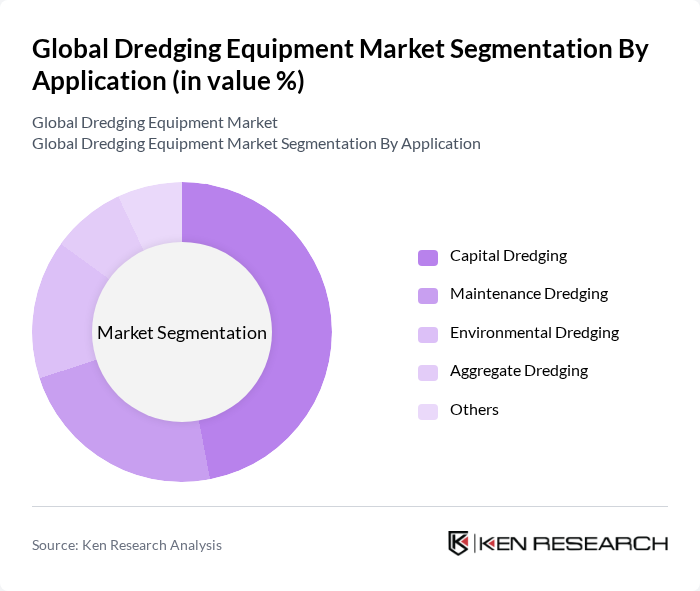
By Application:The applications of dredging equipment include Capital Dredging, Maintenance Dredging, Environmental Dredging, Aggregate Dredging, and Others. Capital Dredging is the most significant segment, driven by the need for new ports and waterways to accommodate growing trade and shipping activities. Maintenance dredging remains vital for keeping existing ports and waterways operational, while environmental dredging is gaining traction as governments prioritize restoration and compliance with environmental directives. Aggregate dredging supports the construction industry by providing essential raw materials .
Global Dredging Equipment Market Competitive Landscape
The Global Dredging Equipment Market is characterized by a dynamic mix of regional and international players. Leading participants such as Royal IHC, Damen Shipyards Group, Jan De Nul Group, Boskalis Westminster, Caterpillar Inc., Liebherr Group, Hitachi Construction Machinery, Hyundai Heavy Industries, Van Oord, DEME Group, Terramare Oy, SRS Dredging, China Communications Construction Company (CCCC), Penta-Ocean Construction Co., Ltd., McNally Bharat Engineering Company Limited, TCDD Ta??mac?l?k A.?. contribute to innovation, geographic expansion, and service delivery in this space.
Global Dredging Equipment Market Industry Analysis
Growth Drivers
- Increasing Demand for Coastal Protection:The global coastal protection market is projected to reach $20 billion in future, driven by rising sea levels and extreme weather events. Countries like the United States and the Netherlands are investing heavily in dredging projects to enhance coastal defenses. For instance, the U.S. Army Corps of Engineers allocated $1.5 billion for coastal resilience projects in future, highlighting the urgent need for effective dredging solutions to protect vulnerable coastlines.
- Expansion of Port Infrastructure:The global port infrastructure investment is expected to exceed $200 billion in future, with significant projects underway in Asia and Europe. For example, the Port of Rotterdam is undergoing a €1.5 billion expansion to accommodate larger vessels. This expansion necessitates advanced dredging equipment to deepen and widen shipping channels, thereby driving demand for innovative dredging solutions that can handle increased cargo volumes efficiently.
- Rising Investments in Underwater Construction:The underwater construction market is anticipated to grow to $15 billion in future, fueled by increased offshore oil and gas exploration and renewable energy projects. Notably, the offshore wind sector is projected to attract $50 billion in investments globally. This surge in underwater activities requires sophisticated dredging equipment to facilitate the installation of foundations and cables, thereby creating a robust demand for advanced dredging technologies.
Market Challenges
- High Operational Costs:The operational costs associated with dredging projects can be substantial, often exceeding $1 million per day for large-scale operations. Factors such as fuel prices, equipment maintenance, and labor contribute to these high costs. For instance, the rising price of diesel fuel, which has increased by 30% in future, significantly impacts the overall expenditure of dredging companies, making it challenging to maintain profitability in competitive markets.
- Environmental Regulations:Stricter environmental regulations are increasingly impacting dredging operations. In the European Union, compliance with the Marine Strategy Framework Directive requires extensive environmental assessments before project initiation. These regulations can delay project timelines and increase costs, with compliance costs averaging around $500,000 per project. As a result, companies must invest in eco-friendly technologies to meet these stringent requirements, adding to operational complexities.
Global Dredging Equipment Market Future Outlook
The future of the dredging equipment market appears promising, driven by technological advancements and a growing emphasis on sustainability. Automation and IoT integration are expected to enhance operational efficiency, reducing costs and improving safety. Additionally, as governments increasingly prioritize infrastructure development, public-private partnerships will likely play a crucial role in funding dredging projects. This collaborative approach will facilitate innovation and the adoption of eco-friendly practices, ensuring the industry adapts to evolving environmental standards and market demands.
Market Opportunities
- Growth in Emerging Markets:Emerging markets, particularly in Asia and Africa, are witnessing rapid urbanization and infrastructure development. Countries like India and Nigeria are investing heavily in port expansions and coastal protection, creating significant opportunities for dredging equipment suppliers. The projected $50 billion investment in India's Ganga River rejuvenation project exemplifies the potential for growth in these regions, driving demand for advanced dredging solutions.
- Development of Eco-Friendly Dredging Technologies:The increasing focus on sustainability presents opportunities for companies developing eco-friendly dredging technologies. Innovations such as electric dredgers and sediment management systems are gaining traction. For instance, the introduction of hybrid dredging vessels can reduce emissions by up to 40%, aligning with global sustainability goals. This shift towards greener technologies will not only enhance operational efficiency but also improve compliance with environmental regulations.
Scope of the Report
| Segment | Sub-Segments |
|---|---|
| By Type | Mechanical Dredgers Hydraulic Dredgers Specialty Dredgers Water Injection Dredgers Others |
| By Application | Capital Dredging Maintenance Dredging Environmental Dredging Aggregate Dredging Others |
| By End-User | Government and Municipal Authorities Oil & Gas Energy & Mining Construction Environmental Protection Agencies Shipping & Logistics Others |
| By Region | North America Latin America Western Europe Eastern Europe Balkan & Baltic Countries Russia & Belarus Central Asia East Asia South Asia & Pacific Middle East & Africa |
| By Equipment Size | Small Dredgers Medium Dredgers Large Dredgers Others |
| By Technology | Conventional Dredging Advanced Dredging Technologies Eco-friendly Dredging Solutions Others |
| By Investment Source | Public Funding Private Investments International Aid Others |
Key Target Audience
Investors and Venture Capitalist Firms
Government and Regulatory Bodies (e.g., U.S. Army Corps of Engineers, Environmental Protection Agency)
Manufacturers and Producers
Marine and Dredging Contractors
Port Authorities and Harbor Management Agencies
Environmental Organizations and NGOs
Financial Institutions
Infrastructure Development Agencies
Players Mentioned in the Report:
Royal IHC
Damen Shipyards Group
Jan De Nul Group
Boskalis Westminster
Caterpillar Inc.
Liebherr Group
Hitachi Construction Machinery
Hyundai Heavy Industries
Van Oord
DEME Group
Terramare Oy
SRS Dredging
China Communications Construction Company (CCCC)
Penta-Ocean Construction Co., Ltd.
McNally Bharat Engineering Company Limited
TCDD Tasmaclk A.S.
Table of Contents
Market Assessment Phase
1. Executive Summary and Approach
2. Global Dredging Equipment Market Overview
2.1 Key Insights and Strategic Recommendations
2.2 Global Dredging Equipment Market Overview
2.3 Definition and Scope
2.4 Evolution of Market Ecosystem
2.5 Timeline of Key Regulatory Milestones
2.6 Value Chain & Stakeholder Mapping
2.7 Business Cycle Analysis
2.8 Policy & Incentive Landscape
3. Global Dredging Equipment Market Analysis
3.1 Growth Drivers
3.1.1 Increasing demand for coastal protection
3.1.2 Expansion of port infrastructure
3.1.3 Rising investments in underwater construction
3.1.4 Technological advancements in dredging equipment
3.2 Market Challenges
3.2.1 High operational costs
3.2.2 Environmental regulations
3.2.3 Limited availability of skilled labor
3.2.4 Competition from alternative methods
3.3 Market Opportunities
3.3.1 Growth in emerging markets
3.3.2 Development of eco-friendly dredging technologies
3.3.3 Public-private partnerships in infrastructure projects
3.3.4 Increased focus on sustainable dredging practices
3.4 Market Trends
3.4.1 Adoption of automation in dredging operations
3.4.2 Integration of IoT in dredging equipment
3.4.3 Shift towards rental models for equipment
3.4.4 Growing emphasis on safety and compliance
3.5 Government Regulation
3.5.1 Emission control regulations
3.5.2 Safety standards for dredging operations
3.5.3 Licensing requirements for dredging activities
3.5.4 Environmental impact assessments
4. SWOT Analysis
5. Stakeholder Analysis
6. Porter's Five Forces Analysis
7. Global Dredging Equipment Market Market Size, 2019-2024
7.1 By Value
7.2 By Volume
7.3 By Average Selling Price
8. Global Dredging Equipment Market Segmentation
8.1 By Type
8.1.1 Mechanical Dredgers
8.1.2 Hydraulic Dredgers
8.1.3 Specialty Dredgers
8.1.4 Water Injection Dredgers
8.1.5 Others
8.2 By Application
8.2.1 Capital Dredging
8.2.2 Maintenance Dredging
8.2.3 Environmental Dredging
8.2.4 Aggregate Dredging
8.2.5 Others
8.3 By End-User
8.3.1 Government and Municipal Authorities
8.3.2 Oil & Gas
8.3.3 Energy & Mining
8.3.4 Construction
8.3.5 Environmental Protection Agencies
8.3.6 Shipping & Logistics
8.3.7 Others
8.4 By Region
8.4.1 North America
8.4.2 Latin America
8.4.3 Western Europe
8.4.4 Eastern Europe
8.4.5 Balkan & Baltic Countries
8.4.6 Russia & Belarus
8.4.7 Central Asia
8.4.8 East Asia
8.4.9 South Asia & Pacific
8.4.10 Middle East & Africa
8.5 By Equipment Size
8.5.1 Small Dredgers
8.5.2 Medium Dredgers
8.5.3 Large Dredgers
8.5.4 Others
8.6 By Technology
8.6.1 Conventional Dredging
8.6.2 Advanced Dredging Technologies
8.6.3 Eco-friendly Dredging Solutions
8.6.4 Others
8.7 By Investment Source
8.7.1 Public Funding
8.7.2 Private Investments
8.7.3 International Aid
8.7.4 Others
9. Global Dredging Equipment Market Competitive Analysis
9.1 Market Share of Key Players
9.2 KPIs for Cross Comparison of Key Players
9.2.1 Company Name
9.2.2 Group Size (Large, Medium, Small)
9.2.3 Annual Revenue (USD)
9.2.4 Revenue Growth Rate (%)
9.2.5 Global Fleet Size (Number of Dredgers)
9.2.6 Geographic Coverage (Number of Countries/Regions)
9.2.7 Market Share (%)
9.2.8 Major Application Segments Served
9.2.9 Investment in R&D (% of Revenue)
9.2.10 Number of Patents/Innovations
9.2.11 Environmental Compliance Certifications
9.2.12 Customer Base (Number of Clients)
9.2.13 Contract Win Rate (%)
9.2.14 Operational Efficiency Ratio
9.2.15 Product Diversification Index
9.3 SWOT Analysis of Top Players
9.4 Pricing Analysis
9.5 Detailed Profile of Major Companies
9.5.1 Royal IHC
9.5.2 Damen Shipyards Group
9.5.3 Jan De Nul Group
9.5.4 Boskalis Westminster
9.5.5 Caterpillar Inc.
9.5.6 Liebherr Group
9.5.7 Hitachi Construction Machinery
9.5.8 Hyundai Heavy Industries
9.5.9 Van Oord
9.5.10 DEME Group
9.5.11 Terramare Oy
9.5.12 SRS Dredging
9.5.13 China Communications Construction Company (CCCC)
9.5.14 Penta-Ocean Construction Co., Ltd.
9.5.15 McNally Bharat Engineering Company Limited
9.5.16 TCDD Ta??mac?l?k A.?.
10. Global Dredging Equipment Market End-User Analysis
10.1 Procurement Behavior of Key Ministries
10.1.1 Budget Allocation Trends
10.1.2 Decision-Making Processes
10.1.3 Contracting Practices
10.1.4 Supplier Selection Criteria
10.2 Corporate Spend on Infrastructure & Energy
10.2.1 Investment Trends in Dredging Projects
10.2.2 Budgeting for Maintenance and Upgrades
10.2.3 Long-term Infrastructure Planning
10.2.4 Collaboration with Private Sector
10.3 Pain Point Analysis by End-User Category
10.3.1 Budget Constraints
10.3.2 Project Delays
10.3.3 Regulatory Compliance Issues
10.3.4 Equipment Availability
10.4 User Readiness for Adoption
10.4.1 Training and Skill Development Needs
10.4.2 Technology Acceptance Levels
10.4.3 Infrastructure Readiness
10.4.4 Financial Preparedness
10.5 Post-Deployment ROI and Use Case Expansion
10.5.1 Performance Metrics Evaluation
10.5.2 Long-term Cost Savings
10.5.3 Expansion into New Applications
10.5.4 User Feedback and Iteration
11. Global Dredging Equipment Market Future Size, 2025-2030
11.1 By Value
11.2 By Volume
11.3 By Average Selling Price
Go-To-Market Strategy Phase
1. Whitespace Analysis + Business Model Canvas
1.1 Market Gaps Identification
1.2 Value Proposition Development
1.3 Revenue Streams Analysis
1.4 Cost Structure Evaluation
1.5 Key Partnerships Exploration
1.6 Customer Segmentation
1.7 Channels of Distribution
2. Marketing and Positioning Recommendations
2.1 Branding Strategies
2.2 Product USPs
2.3 Target Market Identification
2.4 Communication Strategies
2.5 Digital Marketing Approaches
3. Distribution Plan
3.1 Urban Retail Strategies
3.2 Rural NGO Tie-ups
3.3 Direct Sales Channels
3.4 Online Distribution Models
4. Channel & Pricing Gaps
4.1 Underserved Routes
4.2 Pricing Bands Analysis
4.3 Competitor Pricing Strategies
5. Unmet Demand & Latent Needs
5.1 Category Gaps Identification
5.2 Consumer Segments Analysis
5.3 Emerging Trends Exploration
6. Customer Relationship
6.1 Loyalty Programs Development
6.2 After-sales Service Strategies
6.3 Customer Feedback Mechanisms
7. Value Proposition
7.1 Sustainability Initiatives
7.2 Integrated Supply Chains
7.3 Competitive Advantages
8. Key Activities
8.1 Regulatory Compliance
8.2 Branding Initiatives
8.3 Distribution Setup
9. Entry Strategy Evaluation
9.1 Domestic Market Entry Strategy
9.1.1 Product Mix Considerations
9.1.2 Pricing Band Strategies
9.1.3 Packaging Solutions
9.2 Export Entry Strategy
9.2.1 Target Countries Identification
9.2.2 Compliance Roadmap Development
10. Entry Mode Assessment
10.1 Joint Ventures
10.2 Greenfield Investments
10.3 Mergers & Acquisitions
10.4 Distributor Model Evaluation
11. Capital and Timeline Estimation
11.1 Capital Requirements Analysis
11.2 Timelines for Implementation
12. Control vs Risk Trade-Off
12.1 Ownership vs Partnerships
12.2 Risk Mitigation Strategies
13. Profitability Outlook
13.1 Breakeven Analysis
13.2 Long-term Sustainability Strategies
14. Potential Partner List
14.1 Distributors
14.2 Joint Ventures
14.3 Acquisition Targets
15. Execution Roadmap
15.1 Phased Plan for Market Entry
15.1.1 Market Setup
15.1.2 Market Entry
15.1.3 Growth Acceleration
15.1.4 Scale & Stabilize
15.2 Key Activities and Milestones
15.2.1 Milestone Planning
15.2.2 Activity Tracking
Research Methodology
Phase 1: Approach1
Desk Research
- Industry reports from global dredging associations and maritime organizations
- Market analysis publications from government agencies and trade bodies
- Technical papers and white papers on dredging technologies and innovations
Primary Research
- Interviews with project managers at leading dredging companies
- Surveys with marine engineers and equipment manufacturers
- Field interviews with operators and maintenance personnel in dredging operations
Validation & Triangulation
- Cross-validation of data from multiple industry sources and expert opinions
- Triangulation of market size estimates using historical data and current trends
- Sanity checks through feedback from industry panels and focus groups
Phase 2: Market Size Estimation1
Top-down Assessment
- Analysis of global infrastructure spending and its impact on dredging demand
- Segmentation of the market by dredging type (capital, maintenance, and environmental)
- Incorporation of regional growth trends and government initiatives in coastal development
Bottom-up Modeling
- Volume estimates based on fleet size and operational capacity of dredging vessels
- Cost analysis derived from equipment pricing and operational expenditures
- Revenue projections based on project contracts and historical bidding data
Forecasting & Scenario Analysis
- Multi-variable regression analysis incorporating economic indicators and environmental regulations
- Scenario modeling based on potential shifts in maritime trade and climate change impacts
- Baseline, optimistic, and pessimistic forecasts through 2035
Phase 3: CATI Sample Composition1
| Scope Item/Segment | Sample Size | Target Respondent Profiles |
|---|---|---|
| Capital Dredging Projects | 60 | Project Managers, Civil Engineers |
| Maintenance Dredging Operations | 50 | Operations Managers, Marine Surveyors |
| Environmental Dredging Initiatives | 40 | Environmental Engineers, Regulatory Compliance Officers |
| Dredging Equipment Manufacturing | 45 | Product Development Managers, Sales Directors |
| Maritime Infrastructure Development | 55 | Urban Planners, Government Officials |
Frequently Asked Questions
What is the current value of the Global Dredging Equipment Market?
The Global Dredging Equipment Market is valued at approximately USD 11.5 billion, driven by infrastructure development, urbanization, and environmental restoration projects. This market is expected to grow further due to increasing demand for advanced dredging technologies and sustainable practices.
What are the main drivers of growth in the dredging equipment market?
Which countries dominate the Global Dredging Equipment Market?
What types of dredging equipment are available in the market?
Other Regional/Country Reports
Indonesia Dredging Equipment Market
Malaysia Dredging Equipment Market
KSA Dredging Equipment Market
APAC Dredging Equipment Market
SEA Dredging Equipment Market
Vietnam Dredging Equipment Market
Other Adjacent Reports
Malaysia Port Infrastructure Market
South Korea Coastal Protection Market
Kuwait Environmental Remediation Market
UAE Offshore Wind Energy MarketJapan Underwater Mining Market
China Shipbuilding Market Outlook to 2030: Size, Share, Growth and TrendsSingapore Hydraulic Engineering Market
Germany Sediment Management Market
Belgium Flood Control Equipment Market
Why Buy From Us?

What makes us stand out is that our consultants follow Robust, Refine and Result (RRR) methodology. Robust for clear definitions, approaches and sanity checking, Refine for differentiating respondents' facts and opinions, and Result for presenting data with story.

We have set a benchmark in the industry by offering our clients with syndicated and customized market research reports featuring coverage of entire market as well as meticulous research and analyst insights.

While we don't replace traditional research, we flip the method upside down. Our dual approach of Top Bottom & Bottom Top ensures quality deliverable by not just verifying company fundamentals but also looking at the sector and macroeconomic factors.

With one step in the future, our research team constantly tries to show you the bigger picture. We help with some of the tough questions you may encounter along the way: How is the industry positioned? Best marketing channel? KPI's of competitors? By aligning every element, we help maximize success.

Our report gives you instant access to the answers and sources that other companies might choose to hide. We elaborate each steps of research methodology we have used and showcase you the sample size to earn your trust.

If you need any support, we are here! We pride ourselves on universe strength, data quality, and quick, friendly, and professional service.