About the Report
Base Year 2024Global Edible Insects Market Overview
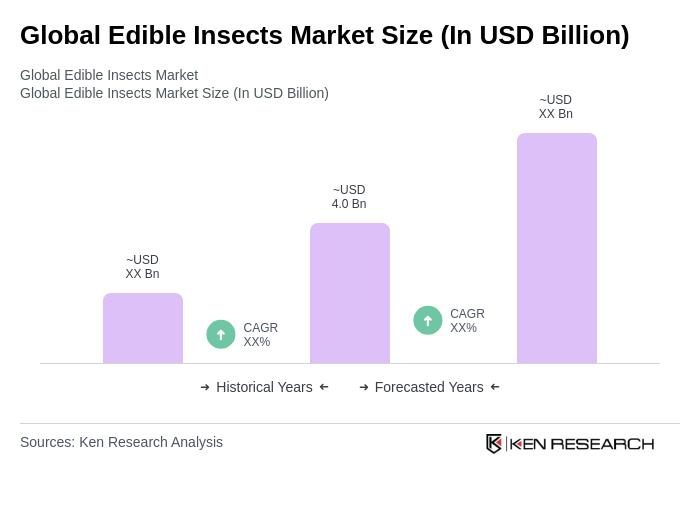
- The Global Edible Insects Market is valued at USD 4.0 billion, based on a five-year historical analysis. This growth is primarily driven by increasing consumer awareness of sustainable food sources, rising protein demand, and the environmental benefits of insect farming. The market has gained traction as a viable alternative to traditional livestock, contributing to its expansion across various regions .
- Countries such as Thailand, the Netherlands, and the United States dominate the Global Edible Insects Market due to their advanced agricultural practices, supportive regulatory frameworks, and growing consumer acceptance of insect-based products. Thailand leads with its long-standing tradition of insect consumption, while the Netherlands is recognized for its innovative insect farming technologies and research initiatives. The United States is experiencing rapid growth due to increased investment in commercial insect farming and evolving consumer preferences .
- In 2023, the European Union implemented regulations to ensure the safety and quality of edible insects, mandating that all insect-based food products undergo rigorous safety assessments before market entry. This regulation aims to enhance consumer confidence and promote the sustainable use of insects as a food source, aligning with the EU's broader goals of food security and environmental sustainability .
Global Edible Insects Market Segmentation
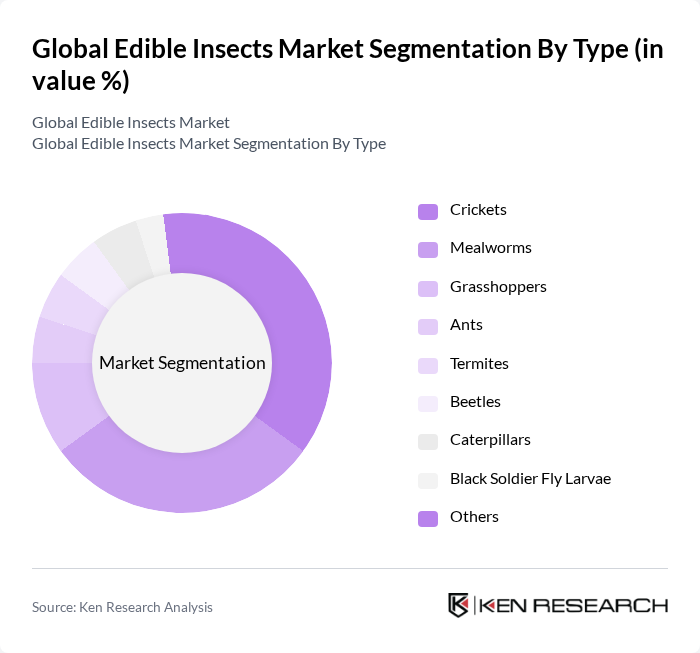
By Type:The edible insects market is segmented into various types, including Crickets, Mealworms, Grasshoppers, Ants, Termites, Beetles, Caterpillars, Black Soldier Fly Larvae, and Others. Among these, crickets and mealworms are the most popular due to their high protein content, efficient feed conversion, and versatility in food and feed applications. Crickets are particularly favored for their nutritional profile and are widely used in protein bars, snacks, and powders, while mealworms are gaining traction in both animal feed and human food products due to their mild flavor and ease of farming .
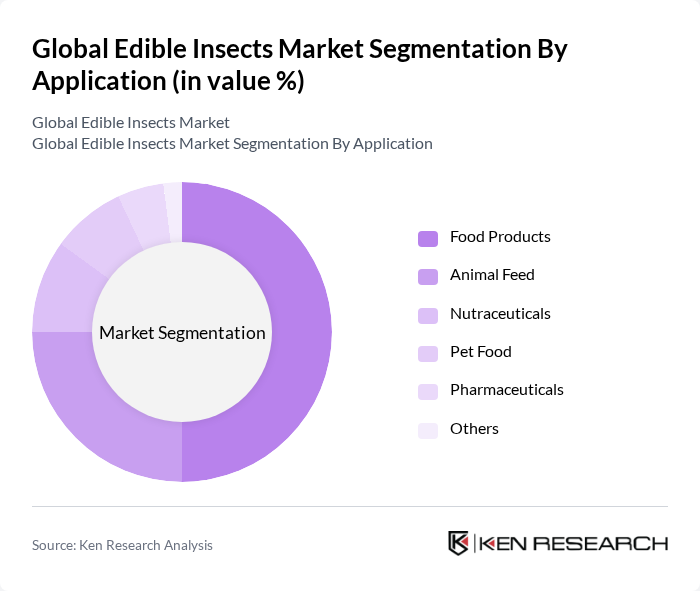
By Application:The applications of edible insects include Food Products, Animal Feed, Nutraceuticals, Pet Food, Pharmaceuticals, and Others. The food products segment is the most significant, driven by the rising trend of protein-rich snacks, functional foods, and sustainable health foods. Insect protein is increasingly being incorporated into protein bars, snacks, baked goods, and meat alternatives, appealing to health-conscious consumers and those seeking environmentally friendly protein sources. Animal feed and pet food segments are also expanding rapidly due to the nutritional benefits and cost-effectiveness of insect-based ingredients .
Global Edible Insects Market Competitive Landscape
The Global Edible Insects Market is characterized by a dynamic mix of regional and international players. Leading participants such as Aspire Food Group, Exo Protein, Cricket Flours, Tiny Farms, Protix, Ynsect, Bugsolutely, Eat Grub, Six Foods, The Cricket Company, Hargol FoodTech, AgriProtein, Gourmet Grubb, Beta Bugs, Innovafeed, FarmInsect, LIVIN farms, Haocheng Mealworms, Beta Hatch contribute to innovation, geographic expansion, and service delivery in this space.
Global Edible Insects Market Industry Analysis
Growth Drivers
- Increasing Demand for Sustainable Protein Sources:The global population is projected to reach 9.7 billion by 2050, leading to a significant rise in protein demand. Edible insects, which require 80% less feed than traditional livestock, present a sustainable alternative. For instance, crickets produce 12 times more protein per feed unit than cattle. This efficiency aligns with the UN's Food and Agriculture Organization's (FAO) recommendations, driving interest in insect-based protein as a viable solution to food security challenges.
- Rising Awareness of Nutritional Benefits:Edible insects are rich in protein, vitamins, and minerals, making them an attractive option for health-conscious consumers. For example, crickets contain 60% protein by weight and are high in omega-3 fatty acids. As awareness of these nutritional benefits grows, particularly among millennials and Gen Z, the demand for insect-based products is expected to increase. The global health food market, valued at $1.3 trillion in future, is likely to incorporate more insect-based options, further driving growth.
- Supportive Government Policies:Governments worldwide are increasingly recognizing the potential of edible insects as a sustainable food source. In future, the European Union allocated €5 million to research and promote insect farming technologies. Additionally, countries like Thailand and the Netherlands have established regulatory frameworks to support insect farming. These initiatives not only enhance production capabilities but also encourage investment in the sector, fostering a conducive environment for market growth in the None region.
Market Challenges
- Consumer Acceptance and Perception Issues:Despite the nutritional benefits, consumer acceptance of edible insects remains a significant barrier. A survey indicated that 60% of consumers in the None region are hesitant to try insect-based products due to cultural perceptions and aversions. This challenge is compounded by limited marketing efforts to educate consumers about the benefits of insects as food, hindering market penetration and growth potential in the region.
- Regulatory Hurdles in Different Regions:The regulatory landscape for edible insects varies significantly across regions, creating challenges for producers. In the None region, stringent food safety regulations require extensive testing and certification processes, which can take up to 18 months. This lengthy approval process can deter new entrants and slow down innovation in the sector. Additionally, inconsistent regulations across borders complicate export opportunities, limiting market expansion for established companies.
Global Edible Insects Market Future Outlook
The future of the edible insects market appears promising, driven by increasing consumer awareness and a shift towards sustainable food sources. Innovations in farming technologies and product development are expected to enhance production efficiency and product variety. As more companies enter the market, competition will likely spur further advancements. Additionally, collaborations with established food brands will facilitate wider acceptance and distribution, paving the way for a more robust market presence in the None region.
Market Opportunities
- Expansion into New Geographical Markets:Emerging markets in Asia and Africa present significant opportunities for edible insect producers. With a growing middle class and increasing protein demand, these regions are likely to embrace insect-based products. For instance, the Asian food market is projected to reach $1.8 trillion in future, providing a fertile ground for expansion and innovation in edible insect offerings.
- Development of Value-Added Products:There is a growing trend towards value-added insect products, such as protein bars and snacks. The global snack food market, valued at $450 billion in future, is increasingly incorporating insect protein. Companies that innovate in this space can capture a share of this lucrative market, appealing to health-conscious consumers seeking convenient and nutritious snack options.
Scope of the Report
| Segment | Sub-Segments |
|---|---|
| By Type | Crickets Mealworms Grasshoppers Ants Termites Beetles Caterpillars Black Soldier Fly Larvae Others |
| By Application | Food Products Animal Feed Nutraceuticals Pet Food Pharmaceuticals Others |
| By Distribution Channel | Online Retail Supermarkets/Hypermarkets Specialty Stores Direct Sales Food Service (Restaurants, Cafés) Others |
| By Region | North America Europe Asia-Pacific Latin America Middle East & Africa |
| By Consumer Segment | Health-Conscious Consumers Environmentally Conscious Consumers Gourmet Food Enthusiasts Pet Owners Livestock Producers Others |
| By Product Form | Whole Insects Insect Powder Insect Protein Bars Insect Snacks Insect Oil Others |
| By Price Range | Premium Mid-Range Budget Others |
Key Target Audience
Investors and Venture Capitalist Firms
Government and Regulatory Bodies (e.g., Food and Agriculture Organization, European Food Safety Authority)
Manufacturers and Producers
Distributors and Retailers
Food Processing Companies
Food Safety and Quality Assurance Organizations
Environmental and Sustainability Organizations
Health and Nutrition Agencies
Players Mentioned in the Report:
Aspire Food Group
Exo Protein
Cricket Flours
Tiny Farms
Protix
Ynsect
Bugsolutely
Eat Grub
Six Foods
The Cricket Company
Hargol FoodTech
AgriProtein
Gourmet Grubb
Beta Bugs
Innovafeed
FarmInsect
LIVIN farms
Haocheng Mealworms
Beta Hatch
Table of Contents
Market Assessment Phase
1. Executive Summary and Approach
2. Global Edible Insects Market Overview
2.1 Key Insights and Strategic Recommendations
2.2 Global Edible Insects Market Overview
2.3 Definition and Scope
2.4 Evolution of Market Ecosystem
2.5 Timeline of Key Regulatory Milestones
2.6 Value Chain & Stakeholder Mapping
2.7 Business Cycle Analysis
2.8 Policy & Incentive Landscape
3. Global Edible Insects Market Analysis
3.1 Growth Drivers
3.1.1 Increasing Demand for Sustainable Protein Sources
3.1.2 Rising Awareness of Nutritional Benefits
3.1.3 Supportive Government Policies
3.1.4 Innovations in Insect Farming Technologies
3.2 Market Challenges
3.2.1 Consumer Acceptance and Perception Issues
3.2.2 Regulatory Hurdles in Different Regions
3.2.3 Competition from Traditional Protein Sources
3.2.4 Supply Chain and Distribution Limitations
3.3 Market Opportunities
3.3.1 Expansion into New Geographical Markets
3.3.2 Development of Value-Added Products
3.3.3 Collaborations with Food Industry Players
3.3.4 Increasing Investment in Research and Development
3.4 Market Trends
3.4.1 Growth of Online Retail Channels
3.4.2 Rising Popularity of Insect-Based Snacks
3.4.3 Focus on Sustainable and Ethical Sourcing
3.4.4 Integration of Insects in Animal Feed
3.5 Government Regulation
3.5.1 Food Safety Standards for Edible Insects
3.5.2 Labeling Requirements for Insect Products
3.5.3 Import and Export Regulations
3.5.4 Environmental Regulations Impacting Production
4. SWOT Analysis
5. Stakeholder Analysis
6. Porter's Five Forces Analysis
7. Global Edible Insects Market Market Size, 2019-2024
7.1 By Value
7.2 By Volume
7.3 By Average Selling Price
8. Global Edible Insects Market Segmentation
8.1 By Type
8.1.1 Crickets
8.1.2 Mealworms
8.1.3 Grasshoppers
8.1.4 Ants
8.1.5 Termites
8.1.6 Beetles
8.1.7 Caterpillars
8.1.8 Black Soldier Fly Larvae
8.1.9 Others
8.2 By Application
8.2.1 Food Products
8.2.2 Animal Feed
8.2.3 Nutraceuticals
8.2.4 Pet Food
8.2.5 Pharmaceuticals
8.2.6 Others
8.3 By Distribution Channel
8.3.1 Online Retail
8.3.2 Supermarkets/Hypermarkets
8.3.3 Specialty Stores
8.3.4 Direct Sales
8.3.5 Food Service (Restaurants, Cafés)
8.3.6 Others
8.4 By Region
8.4.1 North America
8.4.2 Europe
8.4.3 Asia-Pacific
8.4.4 Latin America
8.4.5 Middle East & Africa
8.5 By Consumer Segment
8.5.1 Health-Conscious Consumers
8.5.2 Environmentally Conscious Consumers
8.5.3 Gourmet Food Enthusiasts
8.5.4 Pet Owners
8.5.5 Livestock Producers
8.5.6 Others
8.6 By Product Form
8.6.1 Whole Insects
8.6.2 Insect Powder
8.6.3 Insect Protein Bars
8.6.4 Insect Snacks
8.6.5 Insect Oil
8.6.6 Others
8.7 By Price Range
8.7.1 Premium
8.7.2 Mid-Range
8.7.3 Budget
8.7.4 Others
9. Global Edible Insects Market Competitive Analysis
9.1 Market Share of Key Players
9.2 Cross Comparison of Key Players
9.2.1 Company Name
9.2.2 Group Size (Large, Medium, or Small as per industry convention)
9.2.3 Revenue Growth Rate (YoY %)
9.2.4 Market Penetration Rate (by region and segment)
9.2.5 Customer Retention Rate (%)
9.2.6 Product Diversification Index (number of product types and applications)
9.2.7 Pricing Strategy (premium, value, budget)
9.2.8 Supply Chain Efficiency (lead time, cost per unit delivered)
9.2.9 Brand Recognition Score (survey-based or digital reach)
9.2.10 Innovation Rate (number of patents, new product launches per year)
9.2.11 Sustainability Score (carbon footprint, resource use per kg protein)
9.2.12 Regulatory Compliance Track Record
9.3 SWOT Analysis of Top Players
9.4 Pricing Analysis
9.5 Detailed Profile of Major Companies
9.5.1 Aspire Food Group
9.5.2 Exo Protein
9.5.3 Cricket Flours
9.5.4 Tiny Farms
9.5.5 Protix
9.5.6 Ynsect
9.5.7 Bugsolutely
9.5.8 Eat Grub
9.5.9 Six Foods
9.5.10 The Cricket Company
9.5.11 Hargol FoodTech
9.5.12 AgriProtein
9.5.13 Gourmet Grubb
9.5.14 Beta Bugs
9.5.15 Innovafeed
9.5.16 FarmInsect
9.5.17 LIVIN farms
9.5.18 Haocheng Mealworms
9.5.19 Beta Hatch
10. Global Edible Insects Market End-User Analysis
10.1 Procurement Behavior of Key Ministries
10.1.1 Government Initiatives for Sustainable Protein
10.1.2 Budget Allocations for Edible Insect Programs
10.1.3 Partnerships with Research Institutions
10.1.4 Regulatory Compliance Requirements
10.2 Corporate Spend on Infrastructure & Energy
10.2.1 Investment in Insect Farming Facilities
10.2.2 Energy Efficiency Initiatives
10.2.3 Infrastructure Development for Distribution
10.3 Pain Point Analysis by End-User Category
10.3.1 Supply Chain Disruptions
10.3.2 Quality Assurance Challenges
10.3.3 Market Access Issues
10.4 User Readiness for Adoption
10.4.1 Awareness and Education Levels
10.4.2 Willingness to Pay for Edible Insects
10.4.3 Perceived Health Benefits
10.5 Post-Deployment ROI and Use Case Expansion
10.5.1 Measurement of Economic Benefits
10.5.2 Expansion into New Product Lines
10.5.3 Long-term Sustainability Assessments
11. Global Edible Insects Market Future Size, 2025-2030
11.1 By Value
11.2 By Volume
11.3 By Average Selling Price
Go-To-Market Strategy Phase
1. Whitespace Analysis + Business Model Canvas
1.1 Identification of Market Gaps
1.2 Business Model Development
2. Marketing and Positioning Recommendations
2.1 Branding Strategies
2.2 Product USPs
3. Distribution Plan
3.1 Urban Retail Strategies
3.2 Rural NGO Tie-ups
4. Channel & Pricing Gaps
4.1 Underserved Routes
4.2 Pricing Bands
5. Unmet Demand & Latent Needs
5.1 Category Gaps
5.2 Consumer Segments
6. Customer Relationship
6.1 Loyalty Programs
6.2 After-sales Service
7. Value Proposition
7.1 Sustainability Initiatives
7.2 Integrated Supply Chains
8. Key Activities
8.1 Regulatory Compliance
8.2 Branding Efforts
8.3 Distribution Setup
9. Entry Strategy Evaluation
9.1 Domestic Market Entry Strategy
9.1.1 Product Mix Considerations
9.1.2 Pricing Band Strategies
9.1.3 Packaging Innovations
9.2 Export Entry Strategy
9.2.1 Target Countries for Expansion
9.2.2 Compliance Roadmap for Exports
10. Entry Mode Assessment
10.1 Joint Ventures
10.2 Greenfield Investments
10.3 Mergers & Acquisitions
10.4 Distributor Model
11. Capital and Timeline Estimation
11.1 Capital Requirements
11.2 Timelines for Market Entry
12. Control vs Risk Trade-Off
12.1 Ownership vs Partnerships
13. Profitability Outlook
13.1 Breakeven Analysis
13.2 Long-term Sustainability
14. Potential Partner List
14.1 Distributors
14.2 Joint Ventures
14.3 Acquisition Targets
15. Execution Roadmap
15.1 Phased Plan for Market Entry
15.1.1 Market Setup
15.1.2 Market Entry
15.1.3 Growth Acceleration
15.1.4 Scale & Stabilize
15.2 Key Activities and Milestones
15.2.1 Milestone Planning
15.2.2 Activity Tracking
Research Methodology
Phase 1: Approach1
Desk Research
- Market reports from industry associations such as the Food and Agriculture Organization (FAO)
- Academic journals and publications focusing on entomophagy and sustainable food sources
- Government publications and policy documents related to food safety and insect farming
Primary Research
- Interviews with entomologists and experts in insect farming practices
- Surveys with food manufacturers and distributors involved in edible insect products
- Field visits to insect farming operations and processing facilities
Validation & Triangulation
- Cross-validation of data from multiple sources including trade publications and market surveys
- Triangulation of findings from expert interviews and secondary data analysis
- Sanity checks through feedback from industry panels and focus groups
Phase 2: Market Size Estimation1
Top-down Assessment
- Analysis of global food market trends and the growing acceptance of edible insects
- Estimation of market size based on consumption patterns in key regions
- Incorporation of demographic data and consumer behavior studies related to protein sources
Bottom-up Modeling
- Volume estimates based on production capacities of leading insect farms
- Pricing analysis of various edible insect products across different markets
- Calculation of market size based on projected sales volumes and average selling prices
Forecasting & Scenario Analysis
- Multi-variable forecasting using trends in sustainability and protein demand
- Scenario analysis based on regulatory changes and consumer acceptance rates
- Development of baseline, optimistic, and pessimistic market growth projections through 2030
Phase 3: CATI Sample Composition1
| Scope Item/Segment | Sample Size | Target Respondent Profiles |
|---|---|---|
| Insect Farming Operations | 60 | Farm Owners, Production Managers |
| Food Product Manufacturers | 60 | Product Development Managers, Quality Assurance Officers |
| Retailers of Edible Insects | 40 | Category Managers, Purchasing Agents |
| Consumers of Edible Insects | 100 | Health-Conscious Consumers, Sustainability Advocates |
| Regulatory Bodies | 40 | Food Safety Inspectors, Policy Makers |
Frequently Asked Questions
What is the current value of the Global Edible Insects Market?
The Global Edible Insects Market is valued at approximately USD 4.0 billion, driven by increasing consumer awareness of sustainable food sources, rising protein demand, and the environmental benefits of insect farming.
Which countries are leading in the Edible Insects Market?
What regulations has the European Union implemented for edible insects?
What types of edible insects are most popular in the market?
Other Regional/Country Reports
Indonesia Edible Insects Market
Malaysia Edible Insects Market
APAC Edible Insects Market
Why Buy From Us?

What makes us stand out is that our consultants follow Robust, Refine and Result (RRR) methodology. Robust for clear definitions, approaches and sanity checking, Refine for differentiating respondents' facts and opinions, and Result for presenting data with story.

We have set a benchmark in the industry by offering our clients with syndicated and customized market research reports featuring coverage of entire market as well as meticulous research and analyst insights.

While we don't replace traditional research, we flip the method upside down. Our dual approach of Top Bottom & Bottom Top ensures quality deliverable by not just verifying company fundamentals but also looking at the sector and macroeconomic factors.

With one step in the future, our research team constantly tries to show you the bigger picture. We help with some of the tough questions you may encounter along the way: How is the industry positioned? Best marketing channel? KPI's of competitors? By aligning every element, we help maximize success.

Our report gives you instant access to the answers and sources that other companies might choose to hide. We elaborate each steps of research methodology we have used and showcase you the sample size to earn your trust.

If you need any support, we are here! We pride ourselves on universe strength, data quality, and quick, friendly, and professional service.