About the Report
Base Year 2024US Edible Insects Market Overview
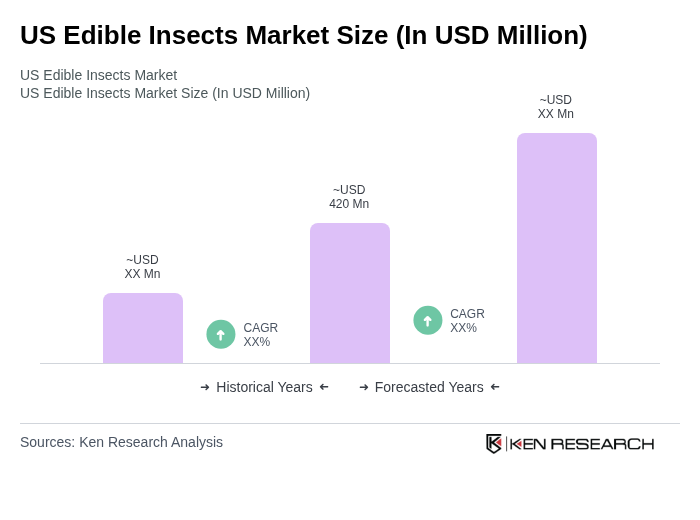
- The US Edible Insects Market is valued at USD 420 million, based on a five-year historical analysis. This growth is primarily driven by increasing consumer awareness of sustainable food sources, rising protein demand, and the environmental benefits of insect farming. The market has seen a surge in interest from both consumers and investors, leading to innovations in product offerings and distribution channels. Key drivers include the high nutritional value of insects, reduced environmental footprint compared to traditional livestock, and rapid adoption of insect-based protein in mainstream food and beverage products. Industry players are investing in automated farming technologies and advanced processing systems to scale production and improve product accessibility .
- Key states in this market include California, Texas, and New York, which lead due to their large populations, progressive food cultures, and robust agricultural sectors. These states have experienced a rise in both startups and established companies focusing on edible insects, supported by local initiatives and sustainability-focused consumer bases that encourage the adoption of alternative proteins .
- Edible insect products in the US are regulated under the Federal Food, Drug, and Cosmetic Act (FFDCA), administered by the US Food and Drug Administration (FDA). The FFDCA requires that insect-based foods meet the same safety, labeling, and manufacturing standards as other food products, including scientific and common name labeling, facility registration, and compliance with Good Manufacturing Practices. This regulatory oversight ensures product safety and supports consumer confidence in the edible insects market .
US Edible Insects Market Segmentation
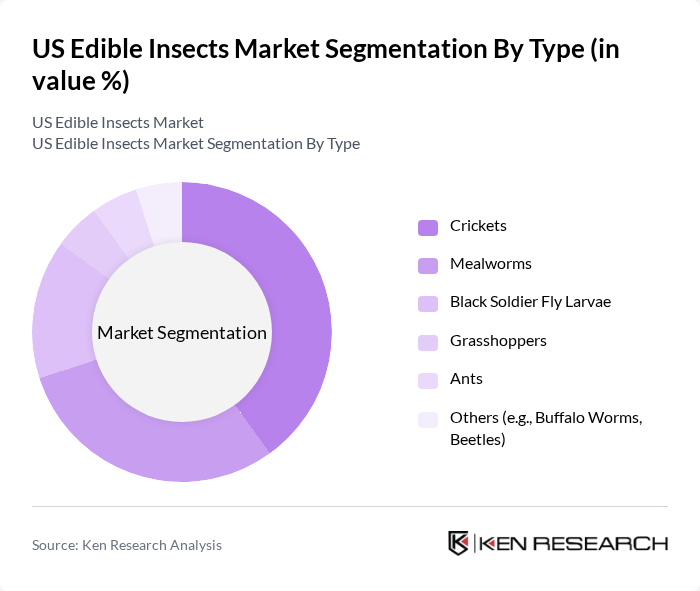
By Type:The edible insects market is segmented into various types, including Crickets, Mealworms, Black Soldier Fly Larvae, Grasshoppers, Ants, and Others (e.g., Buffalo Worms, Beetles). Among these, crickets and mealworms are the most popular due to their high protein content, established farming practices, and versatility in food applications. Crickets are widely used in protein bars, snacks, and powders, while mealworms are favored for their ease of farming, nutritional benefits, and use in both human food and animal feed. The trend of incorporating insects into mainstream diets is accelerating as consumers seek sustainable, high-protein alternatives and as food manufacturers introduce familiar formats such as protein bars and baked goods .
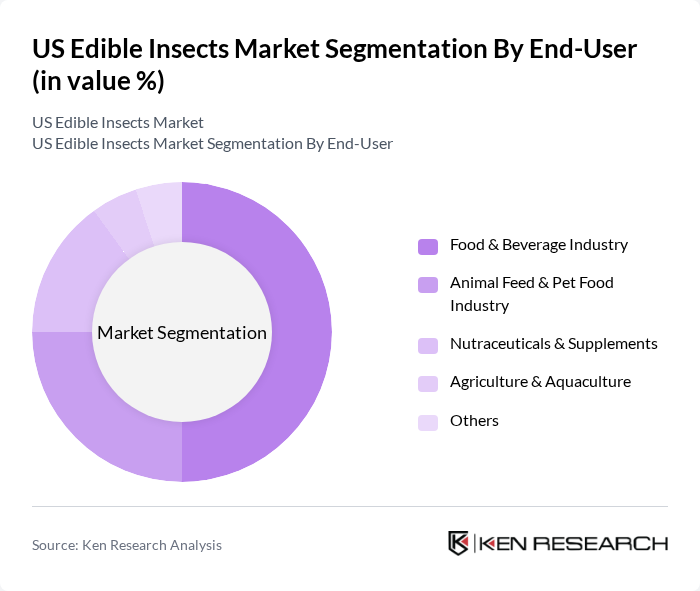
By End-User:The market is segmented by end-user into the Food & Beverage Industry, Animal Feed & Pet Food Industry, Nutraceuticals & Supplements, Agriculture & Aquaculture, and Others. The Food & Beverage Industry is the leading segment, driven by the increasing incorporation of edible insects into snacks, protein bars, and health foods. This trend is fueled by a growing consumer base that prioritizes health, sustainability, and alternative proteins. The Animal Feed & Pet Food Industry is also significant, as insects provide a high-protein, resource-efficient alternative to traditional feed sources, appealing to environmentally conscious pet owners and livestock producers. The Nutraceuticals & Supplements segment is expanding as insect-derived ingredients are recognized for their nutritional and functional benefits .
US Edible Insects Market Competitive Landscape
The US Edible Insects Market is characterized by a dynamic mix of regional and international players. Leading participants such as Aspire Food Group, Exo Protein, Cricket Flours, Tiny Farms, Six Foods, EnviroFlight, Chapul, All Things Bugs, Bitty Foods, Cowboy Cricket Farms, Little Herds, Griopro, Entomo Farms, Armstrong Crickets, Jimini’s contribute to innovation, geographic expansion, and service delivery in this space.
US Edible Insects Market Industry Analysis
Growth Drivers
- Increasing Consumer Awareness of Sustainable Protein Sources:The US population is becoming increasingly aware of the environmental impact of traditional livestock farming, which contributes approximately14.5 percentof global greenhouse gas emissions. In future, the demand for sustainable protein sources is projected to rise, withof consumers actively seeking alternatives. This shift is driven by educational campaigns and documentaries highlighting the benefits of edible insects, which require significantly less land and water compared to conventional protein sources.
- Rising Demand for Alternative Protein Sources:The US alternative protein market is expected to reachin future, with edible insects playing a crucial role. As consumers increasingly adopt plant-based and insect-based diets, the demand for protein alternatives is surging. Insect protein is not only rich in essential amino acids but also offers a lower carbon footprint, making it an attractive option for health-conscious and environmentally aware consumers, particularly millennials and Gen Z.
- Government Support and Favorable Regulations:In future, the US government is expected to allocateto support research and development in the edible insect sector. This funding aims to enhance farming practices and processing technologies. Additionally, the FDA's recent guidelines on edible insect consumption have streamlined regulatory processes, encouraging startups and established companies to invest in insect farming, thereby fostering market growth and innovation in the industry.
Market Challenges
- Consumer Acceptance and Perception Issues:Despite the benefits, consumer acceptance of edible insects remains a significant challenge. A survey indicated thatof Americans are hesitant to try insect-based products due to cultural perceptions and aversions. This reluctance can hinder market penetration and growth, as companies struggle to educate consumers about the nutritional and environmental advantages of incorporating insects into their diets.
- Regulatory Hurdles and Compliance Costs:The edible insect industry faces complex regulatory frameworks that vary by state, leading to increased compliance costs. In future, companies may incur up toannually to meet FDA and state-level regulations. These financial burdens can deter new entrants and limit the scalability of existing businesses, ultimately affecting the overall growth of the edible insect market in the US.
US Edible Insects Market Future Outlook
The US edible insects market is poised for significant growth as consumer preferences shift towards sustainable and alternative protein sources. Innovations in farming and processing technologies are expected to enhance production efficiency, while government support will further bolster industry development. As awareness of the environmental benefits of edible insects increases, more food products incorporating insect protein will likely emerge, catering to health-conscious consumers and expanding market reach across various demographics.
Market Opportunities
- Expansion into New Food Product Categories:The potential for edible insects to be integrated into various food products, such as protein bars and baked goods, presents a lucrative opportunity. With the US snack market valued atin future, incorporating insect protein can attract health-conscious consumers seeking innovative and nutritious options, thereby driving sales and market growth.
- Development of Insect-Based Animal Feed:The rising demand for sustainable animal feed is another promising opportunity. The global animal feed market is projected to reachin future, with insect protein offering a cost-effective and environmentally friendly alternative. By tapping into this market, companies can diversify their product offerings and contribute to sustainable agricultural practices.
Scope of the Report
| Segment | Sub-Segments |
|---|---|
| By Type | Crickets Mealworms Black Soldier Fly Larvae Grasshoppers Ants Others (e.g., Buffalo Worms, Beetles) |
| By End-User | Food & Beverage Industry Animal Feed & Pet Food Industry Nutraceuticals & Supplements Agriculture & Aquaculture Others |
| By Product Form | Whole Insects Insect Powder/Flour Protein Bars & Snacks Insect Oil Others (e.g., Capsules, Extracts) |
| By Distribution Channel | Online Retail Supermarkets/Hypermarkets Specialty Health Food Stores Foodservice (Restaurants, Cafés) Others |
| By Region | Northeast Midwest South West |
| By Consumer Demographics | Age Group (18-24, 25-34, 35-44, 45+) Income Level (Low, Middle, High) Lifestyle Preferences (Health-conscious, Eco-friendly, Fitness Enthusiasts) Others |
| By Application | Snacks Protein Supplements Pet Food & Animal Feed Bakery & Confectionery Others |
Key Target Audience
Investors and Venture Capitalist Firms
Government and Regulatory Bodies (e.g., Food and Drug Administration, United States Department of Agriculture)
Manufacturers and Producers
Distributors and Retailers
Food Safety Authorities (e.g., Centers for Disease Control and Prevention)
Industry Associations (e.g., North American Edible Insect Coalition)
Food Product Developers
Export and Import Agencies (e.g., U.S. Customs and Border Protection)
Players Mentioned in the Report:
Aspire Food Group
Exo Protein
Cricket Flours
Tiny Farms
Six Foods
EnviroFlight
Chapul
All Things Bugs
Bitty Foods
Cowboy Cricket Farms
Little Herds
Griopro
Entomo Farms
Armstrong Crickets
Jiminis
Table of Contents
Market Assessment Phase
1. Executive Summary and Approach
2. US Edible Insects Market Overview
2.1 Key Insights and Strategic Recommendations
2.2 US Edible Insects Market Overview
2.3 Definition and Scope
2.4 Evolution of Market Ecosystem
2.5 Timeline of Key Regulatory Milestones
2.6 Value Chain & Stakeholder Mapping
2.7 Business Cycle Analysis
2.8 Policy & Incentive Landscape
3. US Edible Insects Market Analysis
3.1 Growth Drivers
3.1.1 Increasing consumer awareness of sustainable protein sources
3.1.2 Rising demand for alternative protein sources
3.1.3 Government support and favorable regulations
3.1.4 Innovations in edible insect farming and processing
3.2 Market Challenges
3.2.1 Consumer acceptance and perception issues
3.2.2 Regulatory hurdles and compliance costs
3.2.3 Competition from traditional protein sources
3.2.4 Supply chain and distribution challenges
3.3 Market Opportunities
3.3.1 Expansion into new food product categories
3.3.2 Development of insect-based animal feed
3.3.3 Export opportunities to international markets
3.3.4 Collaborations with food tech startups
3.4 Market Trends
3.4.1 Growth of online retail channels for edible insects
3.4.2 Increasing investment in insect farming technology
3.4.3 Rising popularity of insect-based snacks
3.4.4 Focus on sustainability and environmental impact
3.5 Government Regulation
3.5.1 FDA guidelines on edible insect consumption
3.5.2 State-level regulations on insect farming
3.5.3 Labeling requirements for insect-based products
3.5.4 Import/export regulations for edible insects
4. SWOT Analysis
5. Stakeholder Analysis
6. Porter's Five Forces Analysis
7. US Edible Insects Market Market Size, 2019-2024
7.1 By Value
7.2 By Volume
7.3 By Average Selling Price
8. US Edible Insects Market Segmentation
8.1 By Type
8.1.1 Crickets
8.1.2 Mealworms
8.1.3 Black Soldier Fly Larvae
8.1.4 Grasshoppers
8.1.5 Ants
8.1.6 Others (e.g., Buffalo Worms, Beetles)
8.2 By End-User
8.2.1 Food & Beverage Industry
8.2.2 Animal Feed & Pet Food Industry
8.2.3 Nutraceuticals & Supplements
8.2.4 Agriculture & Aquaculture
8.2.5 Others
8.3 By Product Form
8.3.1 Whole Insects
8.3.2 Insect Powder/Flour
8.3.3 Protein Bars & Snacks
8.3.4 Insect Oil
8.3.5 Others (e.g., Capsules, Extracts)
8.4 By Distribution Channel
8.4.1 Online Retail
8.4.2 Supermarkets/Hypermarkets
8.4.3 Specialty Health Food Stores
8.4.4 Foodservice (Restaurants, Cafés)
8.4.5 Others
8.5 By Region
8.5.1 Northeast
8.5.2 Midwest
8.5.3 South
8.5.4 West
8.6 By Consumer Demographics
8.6.1 Age Group (18-24, 25-34, 35-44, 45+)
8.6.2 Income Level (Low, Middle, High)
8.6.3 Lifestyle Preferences (Health-conscious, Eco-friendly, Fitness Enthusiasts)
8.6.4 Others
8.7 By Application
8.7.1 Snacks
8.7.2 Protein Supplements
8.7.3 Pet Food & Animal Feed
8.7.4 Bakery & Confectionery
8.7.5 Others
9. US Edible Insects Market Competitive Analysis
9.1 Market Share of Key Players
9.2 Cross Comparison of Key Players
9.2.1 Company Name
9.2.2 Group Size (Large, Medium, or Small as per industry convention)
9.2.3 Annual Revenue (USD)
9.2.4 Revenue Growth Rate (%)
9.2.5 Market Penetration (US Market Share %)
9.2.6 Number of Product SKUs
9.2.7 Distribution Channel Diversity (Online, Retail, Foodservice, etc.)
9.2.8 Supply Chain Integration Level
9.2.9 Brand Recognition/Awareness Index
9.2.10 R&D/Innovation Investment (% of Revenue)
9.2.11 Sustainability Score (e.g., use of renewable energy, waste reduction)
9.3 SWOT Analysis of Top Players
9.4 Pricing Analysis
9.5 Detailed Profile of Major Companies
9.5.1 Aspire Food Group
9.5.2 Exo Protein
9.5.3 Cricket Flours
9.5.4 Tiny Farms
9.5.5 Six Foods
9.5.6 EnviroFlight
9.5.7 Chapul
9.5.8 All Things Bugs
9.5.9 Bitty Foods
9.5.10 Cowboy Cricket Farms
9.5.11 Little Herds
9.5.12 Griopro
9.5.13 Entomo Farms
9.5.14 Armstrong Crickets
9.5.15 Jimini’s
10. US Edible Insects Market End-User Analysis
10.1 Procurement Behavior of Key Ministries
10.1.1 Federal procurement policies
10.1.2 State-level initiatives for sustainable food sources
10.1.3 Partnerships with local suppliers
10.1.4 Budget allocations for alternative proteins
10.2 Corporate Spend on Infrastructure & Energy
10.2.1 Investment in sustainable food production
10.2.2 Funding for research and development
10.2.3 Expenditure on marketing and consumer education
10.2.4 Collaborations with food tech companies
10.3 Pain Point Analysis by End-User Category
10.3.1 Cost of production
10.3.2 Consumer acceptance challenges
10.3.3 Regulatory compliance issues
10.3.4 Supply chain disruptions
10.4 User Readiness for Adoption
10.4.1 Awareness of edible insect benefits
10.4.2 Willingness to try insect-based products
10.4.3 Availability of products in local markets
10.4.4 Educational initiatives to promote acceptance
10.5 Post-Deployment ROI and Use Case Expansion
10.5.1 Measurement of consumer feedback
10.5.2 Analysis of sales growth
10.5.3 Expansion into new product lines
10.5.4 Long-term sustainability assessments
11. US Edible Insects Market Future Size, 2025-2030
11.1 By Value
11.2 By Volume
11.3 By Average Selling Price
Go-To-Market Strategy Phase
1. Whitespace Analysis + Business Model Canvas
1.1 Identification of market gaps
1.2 Value proposition development
1.3 Revenue stream analysis
1.4 Cost structure evaluation
1.5 Key partnerships and resources
1.6 Customer segments identification
1.7 Channels for distribution
2. Marketing and Positioning Recommendations
2.1 Branding strategies
2.2 Product USPs
2.3 Target audience segmentation
2.4 Communication strategies
2.5 Digital marketing initiatives
2.6 Influencer partnerships
2.7 Event marketing opportunities
3. Distribution Plan
3.1 Urban retail strategies
3.2 Rural NGO tie-ups
3.3 E-commerce platforms
3.4 Direct-to-consumer models
3.5 Wholesale distribution channels
3.6 Logistics and supply chain management
3.7 Inventory management practices
4. Channel & Pricing Gaps
4.1 Underserved routes
4.2 Pricing bands analysis
4.3 Competitor pricing strategies
4.4 Consumer willingness to pay
4.5 Discounting strategies
4.6 Bundling opportunities
4.7 Seasonal pricing adjustments
5. Unmet Demand & Latent Needs
5.1 Category gaps in product offerings
5.2 Consumer segments with high potential
5.3 Emerging trends in food consumption
5.4 Innovations in product development
5.5 Feedback mechanisms for product improvement
5.6 Market research initiatives
5.7 Collaboration with culinary experts
6. Customer Relationship
6.1 Loyalty programs
6.2 After-sales service
6.3 Customer feedback loops
6.4 Community engagement strategies
6.5 Educational workshops
6.6 Social media interaction
6.7 Customer support channels
7. Value Proposition
7.1 Sustainability initiatives
7.2 Integrated supply chains
7.3 Health benefits of edible insects
7.4 Cost-effectiveness of production
7.5 Nutritional advantages
7.6 Environmental impact reduction
7.7 Community support and development
8. Key Activities
8.1 Regulatory compliance
8.2 Branding efforts
8.3 Distribution setup
8.4 Market research and analysis
8.5 Product development cycles
8.6 Training and development programs
8.7 Partnership development
9. Entry Strategy Evaluation
9.1 Domestic Market Entry Strategy
9.1.1 Product mix considerations
9.1.2 Pricing band strategies
9.1.3 Packaging innovations
9.2 Export Entry Strategy
9.2.1 Target countries analysis
9.2.2 Compliance roadmap development
10. Entry Mode Assessment
10.1 Joint Ventures
10.2 Greenfield investments
10.3 Mergers and Acquisitions
10.4 Distributor Model evaluation
11. Capital and Timeline Estimation
11.1 Capital requirements analysis
11.2 Timelines for market entry
12. Control vs Risk Trade-Off
12.1 Ownership considerations
12.2 Partnerships evaluation
13. Profitability Outlook
13.1 Breakeven analysis
13.2 Long-term sustainability assessments
14. Potential Partner List
14.1 Distributors
14.2 Joint Ventures
14.3 Acquisition targets
15. Execution Roadmap
15.1 Phased Plan for Market Entry
15.1.1 Market Setup
15.1.2 Market Entry
15.1.3 Growth Acceleration
15.1.4 Scale & Stabilize
15.2 Key Activities and Milestones
15.2.1 Milestone tracking
15.2.2 Activity scheduling
Research Methodology
Phase 1: Approach1
Desk Research
- Market reports from industry associations such as the North American Edible Insect Coalition
- Government publications on food safety regulations and guidelines from the FDA
- Academic journals and articles focusing on entomophagy and consumer acceptance studies
Primary Research
- Interviews with key stakeholders in the edible insect supply chain, including farmers and processors
- Surveys targeting consumers to gauge awareness and acceptance of edible insects as food
- Focus groups with chefs and food industry professionals to understand culinary applications
Validation & Triangulation
- Cross-validation of findings through multiple data sources, including sales data and consumer surveys
- Triangulation of insights from industry experts and market trends to ensure consistency
- Sanity checks through expert panel discussions to validate assumptions and projections
Phase 2: Market Size Estimation1
Top-down Assessment
- Analysis of the overall food market size and estimating the share of edible insects
- Segmentation by product types such as whole insects, protein powders, and snacks
- Incorporation of trends in sustainability and protein alternatives influencing market growth
Bottom-up Modeling
- Volume estimates based on production capacities of leading edible insect farms
- Pricing analysis of various edible insect products across different distribution channels
- Calculation of market size based on projected consumption rates and demographic trends
Forecasting & Scenario Analysis
- Multi-factor regression analysis incorporating factors such as dietary trends and environmental concerns
- Scenario modeling based on potential regulatory changes and market entry of new players
- Development of baseline, optimistic, and pessimistic forecasts through 2030
Phase 3: CATI Sample Composition1
| Scope Item/Segment | Sample Size | Target Respondent Profiles |
|---|---|---|
| Consumer Awareness and Acceptance | 120 | General Consumers, Health-Conscious Individuals |
| Food Industry Professionals | 80 | Chefs, Restaurant Owners, Food Product Developers |
| Retail Market Insights | 60 | Grocery Store Managers, Specialty Food Retailers |
| Edible Insect Producers | 50 | Farm Owners, Production Managers |
| Regulatory and Policy Experts | 40 | Food Safety Officials, Regulatory Consultants |
Frequently Asked Questions
What is the current value of the US Edible Insects Market?
The US Edible Insects Market is valued at approximately USD 420 million, reflecting a growing interest in sustainable food sources and alternative proteins. This market is expected to expand significantly as consumer awareness and demand for insect-based products increase.
What are the main drivers of growth in the US Edible Insects Market?
Which states are leading in the US Edible Insects Market?
What types of edible insects are most popular in the US?
Other Regional/Country Reports
Indonesia Edible Insects Market
Malaysia Edible Insects Market
APAC Edible Insects Market
Other Adjacent Reports
Singapore Plant-Based Food Market
South Korea Sustainable Agriculture Market
India Nutraceutical Market Outlook to 2030Qatar Animal Feed Market Outlook To 2030Bahrain Pet Food Market Report Size Share Growth Drivers Trends Opportunities & Forecast 2025–2030UAE Functional Food MarketQatar Organic Snack Market
UAE food processing equipment market size, share, growth drivers, trends, opportunities & forecast 2025–2030India Biofertilizer Market (2023-2029)Why Buy From Us?

What makes us stand out is that our consultants follow Robust, Refine and Result (RRR) methodology. Robust for clear definitions, approaches and sanity checking, Refine for differentiating respondents' facts and opinions, and Result for presenting data with story.

We have set a benchmark in the industry by offering our clients with syndicated and customized market research reports featuring coverage of entire market as well as meticulous research and analyst insights.

While we don't replace traditional research, we flip the method upside down. Our dual approach of Top Bottom & Bottom Top ensures quality deliverable by not just verifying company fundamentals but also looking at the sector and macroeconomic factors.

With one step in the future, our research team constantly tries to show you the bigger picture. We help with some of the tough questions you may encounter along the way: How is the industry positioned? Best marketing channel? KPI's of competitors? By aligning every element, we help maximize success.

Our report gives you instant access to the answers and sources that other companies might choose to hide. We elaborate each steps of research methodology we have used and showcase you the sample size to earn your trust.

If you need any support, we are here! We pride ourselves on universe strength, data quality, and quick, friendly, and professional service.