About the Report
Base Year 2024Global Electrical Insulation Tape Market Overview
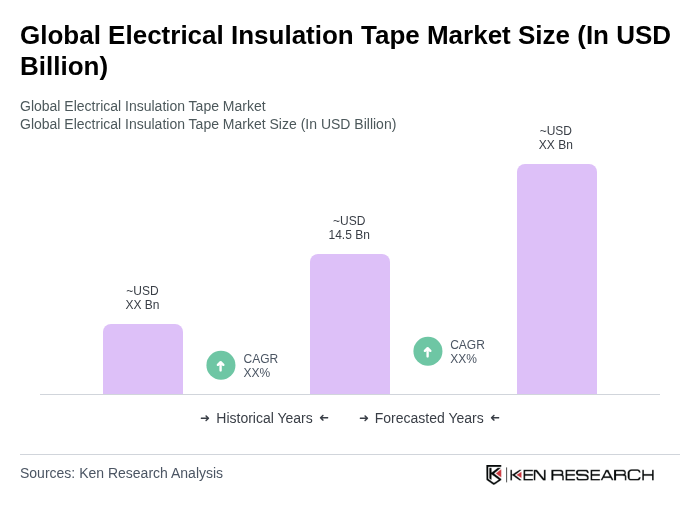
- The Global Electrical Insulation Tape Market is valued at approximately USD 14.5 billion, based on a five?year analysis of leading industry sources. This growth is primarily driven by the increasing demand for electrical insulation in various industries, including construction, automotive, and electronics, supported by rising electrification, complex wiring harnesses, and miniaturized electronics. The rising focus on safety standards and regulations regarding electrical installations, along with ongoing maintenance of electrical infrastructure, has further propelled the market as companies seek reliable insulation solutions to prevent electrical hazards and improve durability.
- Key players in this market are concentrated in regions such as North America, Europe, and Asia?Pacific, with Asia?Pacific holding the largest share, followed by North America and Europe. Countries like the United States and Germany are important due to their advanced manufacturing capabilities and strong automotive and electronics sectors, while the United States alone accounted for electrical insulation tape revenues of more than USD 2.6 billion in its domestic market. Additionally, rapid industrialization and infrastructure expansion in countries like China and India, together with growth in consumer electronics and power infrastructure, have led to a surge in demand for electrical insulation products, making them significant contributors to market growth.
- In the United States, stricter safety requirements for electrical installations in residential and commercial buildings continue to be driven by updates to the National Electrical Code (NEC), formally known as NFPA 70, issued by the National Fire Protection Association and widely adopted into state and local building codes. Recent NEC editions have reinforced provisions for conductor insulation, wiring methods, and protection of splices and terminations, which in practice increases the use of certified insulating materials such as electrical insulation tapes that meet UL and ANSI/IEC performance standards. These regulatory and code?driven requirements, combined with enforcement through building inspection and product certification, support growing demand for high?quality electrical insulation tape in the market.
Global Electrical Insulation Tape Market Segmentation
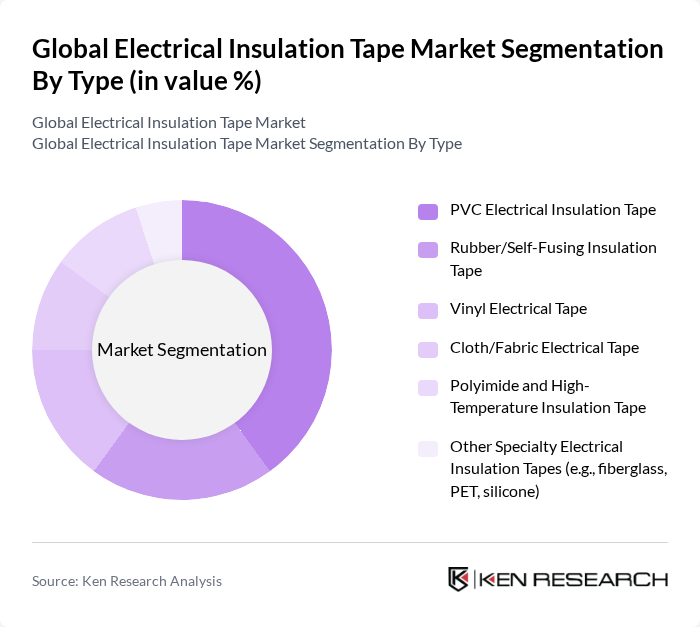
By Type:The electrical insulation tape market is segmented into various types, including PVC Electrical Insulation Tape, Rubber/Self?Fusing Insulation Tape, Vinyl Electrical Tape, Cloth/Fabric Electrical Tape, Polyimide and High?Temperature Insulation Tape, and Other Specialty Electrical Insulation Tapes. PVC Electrical Insulation Tape is the most widely used product category, supported by its good dielectric strength, flame retardancy options, ease of application, and competitive cost, making it suitable for low? to medium?voltage wiring, harness wrapping, and color coding in residential, commercial, and industrial environments. Rubber and self?fusing tapes are increasingly adopted for higher?voltage joints, moisture sealing, and outdoor applications, while high?temperature polyimide and specialty tapes are gaining traction in electronics, EVs, and aerospace where heat and chemical resistance are critical.
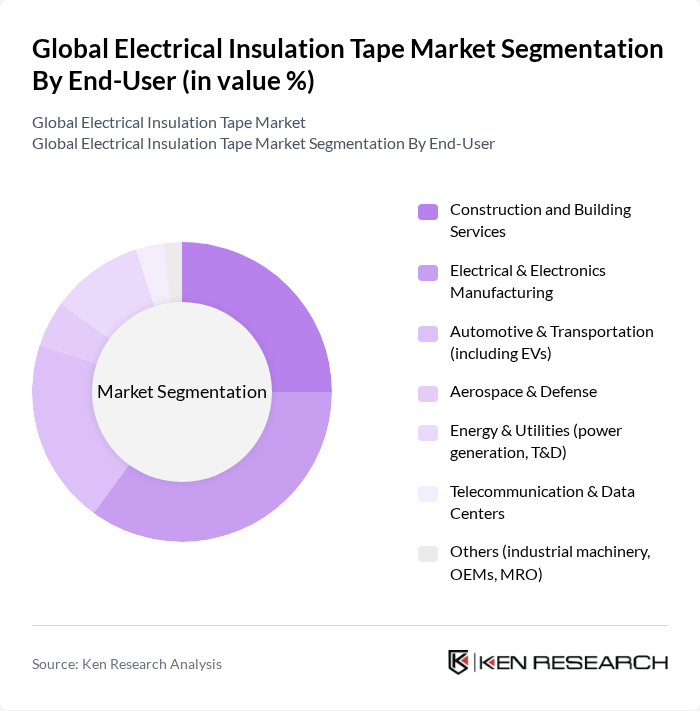
By End-User:The market is also segmented by end?user industries, including Construction and Building Services, Electrical & Electronics Manufacturing, Automotive & Transportation (including EVs), Aerospace & Defense, Energy & Utilities (power generation, T&D), Telecommunication & Data Centers, and Others (industrial machinery, OEMs, MRO). The Electrical & Electronics Manufacturing sector is the largest end?user, supported by the growing production of consumer electronics, industrial control equipment, and communication devices that require tape for wire harnessing, coil insulation, PCB masking, and component protection. The automotive sector is also witnessing significant growth due to the rising demand for electric and hybrid vehicles, where complex high?voltage cable harnesses, battery packs, and onboard electronics necessitate high?performance insulation materials with heat, abrasion, and chemical resistance. Construction, energy, and telecom applications additionally use electrical insulation tapes for cable bundling, phase identification, maintenance, and protection in power distribution and communication networks.
Global Electrical Insulation Tape Market Competitive Landscape
The Global Electrical Insulation Tape Market is characterized by a dynamic mix of regional and international players. Leading participants such as 3M Company, Nitto Denko Corporation, Avery Dennison Corporation, tesa SE, Compagnie de Saint?Gobain S.A., Intertape Polymer Group Inc. (IPG), Scapa Group Ltd. (a Mativ Holdings company), Henkel AG & Co. KGaA, Sika AG, Achem Technology Corporation, Shurtape Technologies, LLC, HellermannTyton Group, Teraoka Seisakusho Co., Ltd., Pidilite Industries Limited, and Yamato International Corporation contribute to innovation, geographic expansion, and service delivery in this space.
Global Electrical Insulation Tape Market Industry Analysis
Growth Drivers
- Increasing Demand for Electrical Insulation:The global electrical insulation tape market is experiencing heightened demand across various sectors, including automotive, electronics, and construction. In future, the automotive industry alone is projected to consume approximately 1.5 billion square meters of insulation tape, driven by the increasing production of electric vehicles, which require enhanced insulation for safety and efficiency. This trend is supported by a projected 25% growth in electric vehicle sales, reaching approximately 12.5 million units globally.
- Technological Advancements in Tape Manufacturing:Innovations in manufacturing processes are significantly enhancing the quality and performance of electrical insulation tapes. In future, the introduction of advanced polymer materials is expected to improve thermal resistance and durability, with manufacturers investing over $600 million in R&D. This investment is anticipated to yield products that can withstand temperatures exceeding 220°C, catering to industries with stringent performance requirements, thus driving market growth.
- Rising Awareness of Safety Standards:The increasing emphasis on safety standards and regulations is propelling the demand for high-quality electrical insulation tapes. In future, compliance with international safety standards, such as IEC 60664, is expected to drive the market, as companies face penalties exceeding $1.5 million for non-compliance. This regulatory landscape encourages manufacturers to produce superior insulation products, thereby enhancing market growth and consumer safety.
Market Challenges
- Fluctuating Raw Material Prices:The electrical insulation tape market faces significant challenges due to the volatility of raw material prices, particularly for polymers and adhesives. In future, the price of key materials is projected to fluctuate by up to 20%, driven by geopolitical tensions and supply chain disruptions. This unpredictability can lead to increased production costs, impacting profit margins for manufacturers and potentially leading to higher prices for consumers.
- Intense Competition Among Manufacturers:The market is characterized by intense competition, with over 250 manufacturers vying for market share. In future, the top five companies are expected to account for only 28% of the market, indicating a fragmented landscape. This competition pressures companies to continuously innovate and reduce prices, which can strain resources and limit profitability, posing a significant challenge for smaller players in the industry.
Global Electrical Insulation Tape Market Future Outlook
The future of the electrical insulation tape market appears promising, driven by ongoing technological advancements and a shift towards sustainable practices. As industries increasingly adopt smart electrical systems, the demand for specialized insulation tapes tailored for specific applications is expected to rise. Furthermore, the growing focus on eco-friendly materials will likely lead to the development of innovative products that meet both performance and environmental standards, fostering market expansion in the coming years.
Market Opportunities
- Expansion in Emerging Markets:Emerging markets, particularly in Asia-Pacific, are witnessing rapid industrialization, creating significant opportunities for electrical insulation tape manufacturers. In future, the region is expected to see a 30% increase in demand, driven by infrastructure development and rising consumer electronics production, presenting a lucrative avenue for market players to explore.
- Development of Eco-Friendly Insulation Tapes:The growing emphasis on sustainability presents an opportunity for manufacturers to innovate eco-friendly insulation tapes. In future, the market for biodegradable insulation materials is projected to reach $250 million, driven by consumer demand for environmentally responsible products. This trend encourages companies to invest in sustainable materials, enhancing their market position and appeal to eco-conscious consumers.
Scope of the Report
| Segment | Sub-Segments |
|---|---|
| By Type | PVC Electrical Insulation Tape Rubber/Self?Fusing Insulation Tape Vinyl Electrical Tape Cloth/Fabric Electrical Tape Polyimide and High?Temperature Insulation Tape Other Specialty Electrical Insulation Tapes (e.g., fiberglass, PET, silicone) |
| By End-User | Construction and Building Services Electrical & Electronics Manufacturing Automotive & Transportation (including EVs) Aerospace & Defense Energy & Utilities (power generation, T&D) Telecommunication & Data Centers Others (industrial machinery, OEMs, MRO) |
| By Application | Electrical Wires and Cables Insulation Motors and Generators Winding Insulation Transformers and Coil Insulation Switchgear and Control Panels Wire Harnessing and Bundling Repair, Maintenance & Splicing Others (surface protection, shielding, marking) |
| By Material | Polyvinyl Chloride (PVC) Rubber and Ethylene Propylene Rubber (EPR) Polyethylene (PE) and Polyolefin Polyester (PET) and Polyimide Films Cloth/Fabric (glass cloth, cotton) Others (silicone, fluoropolymer, paper) |
| By Thickness | Up to 0.13 mm (standard household/low?voltage) mm to 0.20 mm Above 0.20 mm Custom/Other Thicknesses |
| By Color | Black Single?Color Phase Identification Tapes (red, yellow, blue, green, etc.) Green/Yellow Earth & Grounding Tapes Multi?Color and Printed Identification Tapes Others (transparent, specialty coded) |
| By Region | North America Europe Asia-Pacific Latin America Middle East & Africa |
Key Target Audience
Investors and Venture Capitalist Firms
Government and Regulatory Bodies (e.g., U.S. Consumer Product Safety Commission, European Chemicals Agency)
Manufacturers and Producers
Distributors and Retailers
Electrical and Electronics Industry Stakeholders
Automotive Industry Players
Construction and Building Material Suppliers
Financial Institutions
Players Mentioned in the Report:
3M Company
Nitto Denko Corporation
Avery Dennison Corporation
tesa SE
Compagnie de Saint-Gobain S.A.
Intertape Polymer Group Inc. (IPG)
Scapa Group Ltd. (a Mativ Holdings company)
Henkel AG & Co. KGaA
Sika AG
Achem Technology Corporation
Shurtape Technologies, LLC
HellermannTyton Group
Teraoka Seisakusho Co., Ltd.
Pidilite Industries Limited
Yamato International Corporation
Table of Contents
Market Assessment Phase
1. Executive Summary and Approach
2. Global Electrical Insulation Tape Market Overview
2.1 Key Insights and Strategic Recommendations
2.2 Global Electrical Insulation Tape Market Overview
2.3 Definition and Scope
2.4 Evolution of Market Ecosystem
2.5 Timeline of Key Regulatory Milestones
2.6 Value Chain & Stakeholder Mapping
2.7 Business Cycle Analysis
2.8 Policy & Incentive Landscape
3. Global Electrical Insulation Tape Market Analysis
3.1 Growth Drivers
3.1.1 Increasing demand for electrical insulation in various industries
3.1.2 Technological advancements in tape manufacturing
3.1.3 Rising awareness of safety standards and regulations
3.1.4 Growth in renewable energy sectors
3.2 Market Challenges
3.2.1 Fluctuating raw material prices
3.2.2 Intense competition among manufacturers
3.2.3 Regulatory compliance complexities
3.2.4 Limited awareness in emerging markets
3.3 Market Opportunities
3.3.1 Expansion in emerging markets
3.3.2 Development of eco-friendly insulation tapes
3.3.3 Increasing investments in infrastructure projects
3.3.4 Collaborations with technology providers
3.4 Market Trends
3.4.1 Shift towards sustainable and recyclable materials
3.4.2 Growth in smart electrical systems
3.4.3 Customization of insulation tapes for specific applications
3.4.4 Digitalization in manufacturing processes
3.5 Government Regulation
3.5.1 Compliance with international safety standards
3.5.2 Incentives for using eco-friendly materials
3.5.3 Regulations on waste management and disposal
3.5.4 Standards for electrical safety in construction
4. SWOT Analysis
5. Stakeholder Analysis
6. Porter's Five Forces Analysis
7. Global Electrical Insulation Tape Market Market Size, 2019-2024
7.1 By Value
7.2 By Volume
7.3 By Average Selling Price
8. Global Electrical Insulation Tape Market Segmentation
8.1 By Type
8.1.1 PVC Electrical Insulation Tape
8.1.2 Rubber/Self?Fusing Insulation Tape
8.1.3 Vinyl Electrical Tape
8.1.4 Cloth/Fabric Electrical Tape
8.1.5 Polyimide and High?Temperature Insulation Tape
8.1.6 Other Specialty Electrical Insulation Tapes (e.g., fiberglass, PET, silicone)
8.2 By End-User
8.2.1 Construction and Building Services
8.2.2 Electrical & Electronics Manufacturing
8.2.3 Automotive & Transportation (including EVs)
8.2.4 Aerospace & Defense
8.2.5 Energy & Utilities (power generation, T&D)
8.2.6 Telecommunication & Data Centers
8.2.7 Others (industrial machinery, OEMs, MRO)
8.3 By Application
8.3.1 Electrical Wires and Cables Insulation
8.3.2 Motors and Generators Winding Insulation
8.3.3 Transformers and Coil Insulation
8.3.4 Switchgear and Control Panels
8.3.5 Wire Harnessing and Bundling
8.3.6 Repair, Maintenance & Splicing
8.3.7 Others (surface protection, shielding, marking)
8.4 By Material
8.4.1 Polyvinyl Chloride (PVC)
8.4.2 Rubber and Ethylene Propylene Rubber (EPR)
8.4.3 Polyethylene (PE) and Polyolefin
8.4.4 Polyester (PET) and Polyimide Films
8.4.5 Cloth/Fabric (glass cloth, cotton)
8.4.6 Others (silicone, fluoropolymer, paper)
8.5 By Thickness
8.5.1 Up to 0.13 mm (standard household/low?voltage)
8.5.2 0.13 mm to 0.20 mm
8.5.3 Above 0.20 mm
8.5.4 Custom/Other Thicknesses
8.6 By Color
8.6.1 Black
8.6.2 Single?Color Phase Identification Tapes (red, yellow, blue, green, etc.)
8.6.3 Green/Yellow Earth & Grounding Tapes
8.6.4 Multi?Color and Printed Identification Tapes
8.6.5 Others (transparent, specialty coded)
8.7 By Region
8.7.1 North America
8.7.2 Europe
8.7.3 Asia-Pacific
8.7.4 Latin America
8.7.5 Middle East & Africa
9. Global Electrical Insulation Tape Market Competitive Analysis
9.1 Market Share of Key Players
9.2 Cross Comparison of Key Players
9.2.1 Company Name
9.2.2 Global Electrical Insulation Tape Revenue (USD million)
9.2.3 Electrical Insulation Tape Revenue Share in Total Company Revenue (%)
9.2.4 3–5 Year CAGR in Electrical Insulation Tape Segment (%)
9.2.5 Product Portfolio Breadth (number of SKUs / tape families by material & voltage class)
9.2.6 Geographic Footprint (number of production sites / distribution countries)
9.2.7 Key End?Use Exposure (share of sales to electrical & electronics, automotive, construction, utilities)
9.2.8 R&D Intensity (% of revenue spent on adhesives, high?temperature and eco?friendly tapes)
9.2.9 Average Selling Price Band by Material (PVC vs rubber vs high?performance films)
9.2.10 Innovation Pipeline (number of new insulation tape launches/patents in last 3 years)
9.2.11 Strategic Partnerships & OEM Approvals (major OEM/utility qualifications and standards compliance)
9.3 SWOT Analysis of Top Players
9.4 Pricing Analysis
9.5 Detailed Profile of Major Companies
9.5.1 3M Company
9.5.2 Nitto Denko Corporation
9.5.3 Avery Dennison Corporation
9.5.4 tesa SE
9.5.5 Compagnie de Saint-Gobain S.A.
9.5.6 Intertape Polymer Group Inc. (IPG)
9.5.7 Scapa Group Ltd. (a Mativ Holdings company)
9.5.8 Henkel AG & Co. KGaA
9.5.9 Sika AG
9.5.10 Achem Technology Corporation
9.5.11 Shurtape Technologies, LLC
9.5.12 HellermannTyton Group
9.5.13 Teraoka Seisakusho Co., Ltd.
9.5.14 Pidilite Industries Limited
9.5.15 Yamato International Corporation
10. Global Electrical Insulation Tape Market End-User Analysis
10.1 Procurement Behavior of Key Ministries
10.1.1 Budget Allocation Trends
10.1.2 Decision-Making Processes
10.1.3 Supplier Selection Criteria
10.1.4 Contract Management Practices
10.2 Corporate Spend on Infrastructure & Energy
10.2.1 Investment Trends in Electrical Infrastructure
10.2.2 Spending Patterns in Renewable Energy
10.2.3 Budgeting for Safety Compliance
10.2.4 Long-term Contracts vs. Spot Purchases
10.3 Pain Point Analysis by End-User Category
10.3.1 Quality Assurance Issues
10.3.2 Supply Chain Disruptions
10.3.3 Cost Management Challenges
10.3.4 Regulatory Compliance Difficulties
10.4 User Readiness for Adoption
10.4.1 Awareness of Product Benefits
10.4.2 Training and Support Needs
10.4.3 Adoption Barriers
10.4.4 Feedback Mechanisms
10.5 Post-Deployment ROI and Use Case Expansion
10.5.1 Measurement of ROI
10.5.2 Case Studies of Successful Implementations
10.5.3 Opportunities for Upselling
10.5.4 Future Use Cases
11. Global Electrical Insulation Tape Market Future Size, 2025-2030
11.1 By Value
11.2 By Volume
11.3 By Average Selling Price
Go-To-Market Strategy Phase
1. Whitespace Analysis + Business Model Canvas
1.1 Market Gaps Identification
1.2 Business Model Framework
2. Marketing and Positioning Recommendations
2.1 Branding Strategies
2.2 Product USPs
3. Distribution Plan
3.1 Urban Retail vs Rural NGO Tie-ups
4. Channel & Pricing Gaps
4.1 Underserved Routes
4.2 Pricing Bands
5. Unmet Demand & Latent Needs
5.1 Category Gaps
5.2 Consumer Segments
6. Customer Relationship
6.1 Loyalty Programs
6.2 After-sales Service
7. Value Proposition
7.1 Sustainability
7.2 Integrated Supply Chains
8. Key Activities
8.1 Regulatory Compliance
8.2 Branding
8.3 Distribution Setup
9. Entry Strategy Evaluation
9.1 Domestic Market Entry Strategy
9.1.1 Product Mix
9.1.2 Pricing Band
9.1.3 Packaging
9.2 Export Entry Strategy
9.2.1 Target Countries
9.2.2 Compliance Roadmap
10. Entry Mode Assessment
10.1 JV
10.2 Greenfield
10.3 M&A
10.4 Distributor Model
11. Capital and Timeline Estimation
11.1 Capital Requirements
11.2 Timelines
12. Control vs Risk Trade-Off
12.1 Ownership vs Partnerships
13. Profitability Outlook
13.1 Breakeven Analysis
13.2 Long-term Sustainability
14. Potential Partner List
14.1 Distributors
14.2 JVs
14.3 Acquisition Targets
15. Execution Roadmap
15.1 Phased Plan for Market Entry
15.1.1 Market Setup
15.1.2 Market Entry
15.1.3 Growth Acceleration
15.1.4 Scale & Stabilize
15.2 Key Activities and Milestones
15.2.1 Milestone Planning
15.2.2 Activity Tracking
Research Methodology
Phase 1: Approach1
Desk Research
- Industry reports from leading market research firms focusing on electrical insulation materials
- Trade publications and journals detailing advancements in electrical insulation tape technology
- Government publications and standards from organizations such as ASTM and IEC relevant to electrical insulation
Primary Research
- Interviews with product managers at major electrical tape manufacturers
- Surveys with electrical engineers and technicians regarding usage patterns and preferences
- Field interviews with distributors and retailers in the electrical supplies sector
Validation & Triangulation
- Cross-validation of data from multiple sources including sales data and market trends
- Triangulation of insights from primary interviews with secondary research findings
- Sanity checks through expert panels comprising industry veterans and market analysts
Phase 2: Market Size Estimation1
Top-down Assessment
- Analysis of global electrical insulation tape market size based on revenue from key regions
- Segmentation by application areas such as automotive, electronics, and construction
- Incorporation of macroeconomic factors influencing demand, such as infrastructure development
Bottom-up Modeling
- Estimation of market size based on production volumes from leading manufacturers
- Cost analysis of raw materials and production processes for various types of insulation tapes
- Volume x price calculations to derive revenue estimates for different market segments
Forecasting & Scenario Analysis
- Multi-variable forecasting using historical growth rates and emerging market trends
- Scenario analysis based on potential regulatory changes and technological advancements
- Development of baseline, optimistic, and pessimistic market projections through 2030
Phase 3: CATI Sample Composition1
| Scope Item/Segment | Sample Size | Target Respondent Profiles |
|---|---|---|
| Automotive Electrical Insulation | 110 | Automotive Engineers, Product Development Managers |
| Consumer Electronics Applications | 85 | Product Managers, R&D Engineers |
| Construction Industry Usage | 75 | Construction Project Managers, Electrical Contractors |
| Industrial Applications | 95 | Maintenance Supervisors, Operations Managers |
| Retail Distribution Insights | 65 | Supply Chain Managers, Retail Buyers |
Frequently Asked Questions
What is the current value of the Global Electrical Insulation Tape Market?
The Global Electrical Insulation Tape Market is valued at approximately USD 14.5 billion, driven by increasing demand across various industries such as construction, automotive, and electronics, as well as a focus on safety standards and regulations.
What are the main drivers of growth in the electrical insulation tape market?
Which regions dominate the electrical insulation tape market?
What types of electrical insulation tapes are available in the market?
Other Regional/Country Reports
Indonesia Electrical Insulation Tape Market
Malaysia Electrical Insulation Tape Market
KSA Electrical Insulation Tape Market
APAC Electrical Insulation Tape Market
SEA Electrical Insulation Tape Market
Vietnam Electrical Insulation Tape Market
Other Adjacent Reports
Brazil Electrical Wiring Harness Market
Malaysia Adhesive Tapes Market
Germany Polymer Insulation Materials Market
Kuwait Automotive Electronics (ECUs, Sensors, Controllers) Market Size, Share, Growth Drivers, Trends, Opportunities, Competitive Landscape & Forecast 2025–2030India Construction Materials Market Outlook to 2030Indonesia Power Distribution Equipment Market
UAE Electronics Manufacturing Services MarketGermany Aerospace Materials Market
Oman Renewable Energy Equipment Market
Indonesia Telecommunication Infrastructure Market
Why Buy From Us?

What makes us stand out is that our consultants follow Robust, Refine and Result (RRR) methodology. Robust for clear definitions, approaches and sanity checking, Refine for differentiating respondents' facts and opinions, and Result for presenting data with story.

We have set a benchmark in the industry by offering our clients with syndicated and customized market research reports featuring coverage of entire market as well as meticulous research and analyst insights.

While we don't replace traditional research, we flip the method upside down. Our dual approach of Top Bottom & Bottom Top ensures quality deliverable by not just verifying company fundamentals but also looking at the sector and macroeconomic factors.

With one step in the future, our research team constantly tries to show you the bigger picture. We help with some of the tough questions you may encounter along the way: How is the industry positioned? Best marketing channel? KPI's of competitors? By aligning every element, we help maximize success.

Our report gives you instant access to the answers and sources that other companies might choose to hide. We elaborate each steps of research methodology we have used and showcase you the sample size to earn your trust.

If you need any support, we are here! We pride ourselves on universe strength, data quality, and quick, friendly, and professional service.