About the Report
Base Year 2024Global Emergency Medical Services (EMS) Products Market Overview
- The Global Emergency Medical Services (EMS) Products Market is valued at USD 31 billion, based on a five-year historical analysis. This growth is primarily driven by the increasing demand for advanced medical technologies, rising incidences of emergencies, the growing emphasis on improving healthcare infrastructure across various regions, and continuous advancements in portable defibrillators, sophisticated life support systems, and telemedicine options.
- Key players in this market include the United States, Germany, and Japan, which dominate due to their advanced healthcare systems, significant investments in medical technology, and a high prevalence of emergency medical services. These countries have established robust regulatory frameworks and healthcare policies that support the growth of EMS products.
- The Emergency Medical Services for Children (EMSC) program, authorized under the EMS for Children Reauthorization Act of 2023 issued by the U.S. Health Resources and Services Administration, aims to improve the quality of emergency care for children. This initiative includes funding for training, equipment, and research, ensuring that EMS providers are equipped to handle pediatric emergencies effectively through standards for pediatric readiness in EMS systems and compliance requirements for state-level performance measures.
 Products Market.png "Global Emergency Medical Services (EMS) Products Market Size")
Global Emergency Medical Services (EMS) Products Market Segmentation
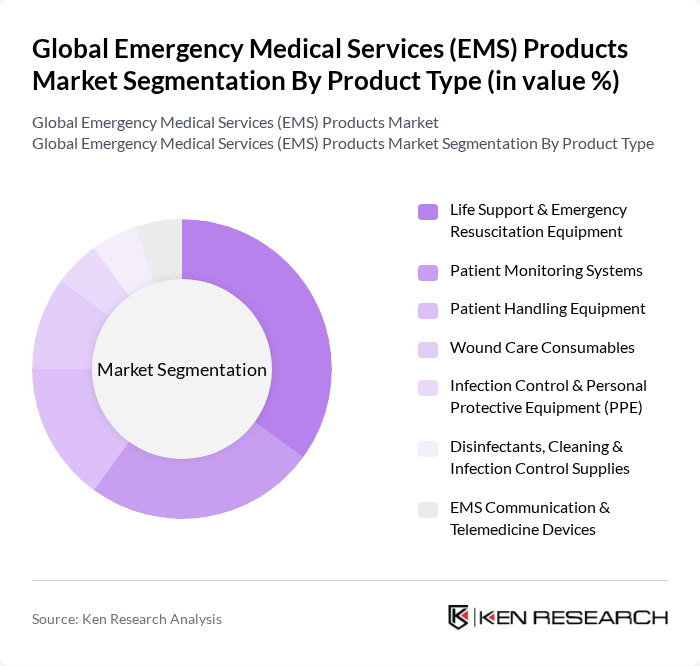
By Product Type:The product type segmentation includes various categories that cater to different needs within the EMS sector. The dominant sub-segment is Life Support & Emergency Resuscitation Equipment, which includes defibrillators, ventilators, and laryngoscopes. This segment is crucial due to the increasing number of cardiac emergencies and the need for immediate life-saving interventions. Patient Monitoring Systems also hold significant market share, driven by the growing demand for real-time health monitoring in emergency situations. The focus on advanced technology and patient safety continues to propel these segments forward.
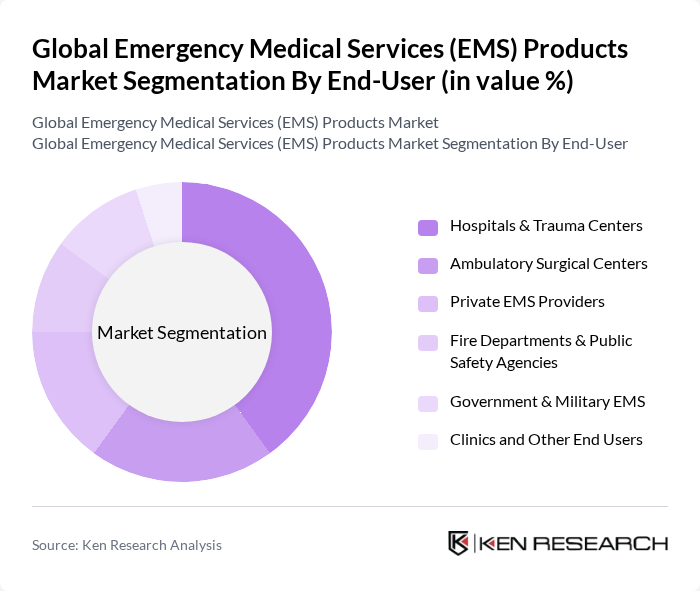
By End-User:The end-user segmentation highlights the various sectors utilizing EMS products, with Hospitals & Trauma Centers being the leading segment. This dominance is attributed to the high volume of emergency cases handled in hospitals, necessitating advanced EMS products for effective patient care. Private EMS Providers also play a significant role, driven by the increasing demand for rapid response services in urban areas. The growing trend of outsourcing emergency services to private entities further supports the expansion of this segment.
Global Emergency Medical Services (EMS) Products Market Competitive Landscape
The Global Emergency Medical Services (EMS) Products Market is characterized by a dynamic mix of regional and international players. Leading participants such as Stryker Corporation, Medtronic plc, ZOLL Medical Corporation (an Asahi Kasei company), Philips Healthcare (Koninklijke Philips N.V.), GE HealthCare Technologies Inc., Smiths Medical (ICU Medical, Inc.), Cardinal Health, Inc., 3M Company, Teleflex Incorporated, B. Braun Melsungen AG, Smith & Nephew plc, Fresenius Kabi AG, Ferno-Washington, Inc., Masimo Corporation, Global Medical Response, Inc. contribute to innovation, geographic expansion, and service delivery in this space.
Global Emergency Medical Services (EMS) Products Market Industry Analysis
Growth Drivers
- Increasing Demand for Advanced Medical Technologies:The global healthcare expenditure is projected to reach $10 trillion in future, driving the demand for advanced EMS products. Innovations such as automated external defibrillators (AEDs) and advanced life support systems are becoming essential. In future, the market for EMS technologies was valued at approximately $32 billion, reflecting a significant increase in investment towards enhancing emergency response capabilities, particularly in urban areas where population density is high.
- Rising Incidence of Emergencies and Disasters:The World Health Organization reported that natural disasters affected over 210 million people globally in future, leading to an increased need for effective EMS solutions. The frequency of emergencies, including accidents and health crises, necessitates rapid response capabilities. In future, it is estimated that emergency medical services will respond to over 55 million incidents, highlighting the critical need for advanced EMS products to manage these situations effectively.
- Government Initiatives to Enhance Healthcare Infrastructure:Governments worldwide are investing heavily in healthcare infrastructure, with an estimated $1.6 trillion allocated for healthcare improvements in future. This includes funding for EMS systems, which are crucial for timely medical interventions. For instance, the U.S. government has committed $110 billion to enhance emergency services, ensuring that EMS providers are equipped with the latest technologies and training to improve patient outcomes during emergencies.
Market Challenges
- High Costs of Advanced EMS Products:The financial burden of advanced EMS products remains a significant challenge, with costs for essential equipment like ambulances and life-support systems exceeding $210,000. Many healthcare providers struggle to allocate sufficient budgets for these technologies, particularly in low-income regions. In future, it is projected that 42% of EMS providers will face budget constraints, limiting their ability to invest in necessary upgrades and maintenance.
- Regulatory Hurdles and Compliance Issues:The EMS sector is subject to stringent regulations, which can delay the introduction of new products. Compliance with standards set by organizations such as the FDA and ISO can take years, hindering innovation. In future, it is estimated that 32% of new EMS products will face regulatory delays, impacting the timely availability of advanced solutions in the market and affecting overall service delivery.
Global Emergency Medical Services (EMS) Products Market Future Outlook
The future of the EMS products market is poised for transformation, driven by technological advancements and a growing emphasis on patient-centered care. As telemedicine and remote monitoring become integral to emergency response, the integration of AI and machine learning will enhance decision-making processes. Furthermore, the focus on sustainability will lead to the development of eco-friendly EMS products, aligning with global environmental goals. These trends will shape the market landscape, ensuring that EMS providers can deliver efficient and effective care in diverse settings.
Market Opportunities
- Technological Advancements in EMS Products:The rapid evolution of technology presents significant opportunities for innovation in EMS products. With an expected investment of $6 billion in R&D for EMS technologies in future, companies can develop smarter, more efficient solutions that enhance emergency response capabilities and improve patient outcomes.
- Expansion of Telemedicine and Remote Monitoring:The telemedicine market is projected to reach $180 billion in future, creating opportunities for EMS providers to integrate remote monitoring solutions. This expansion allows for real-time patient data transmission, enabling better pre-hospital care and improving overall emergency response effectiveness in various regions.
Scope of the Report
| Segment | Sub-Segments |
|---|---|
| By Product Type | Life Support & Emergency Resuscitation Equipment (defibrillators, ventilators, laryngoscopes, others) Patient Monitoring Systems (ECG monitors, pulse oximeters, capnography, others) Patient Handling Equipment (stretchers, wheelchairs, stair chairs, others) Wound Care Consumables (dressings & bandages, sutures & staples, others) Infection Control & Personal Protective Equipment (PPE) Disinfectants, Cleaning & Infection Control Supplies EMS Communication & Telemedicine Devices |
| By End-User | Hospitals & Trauma Centers Ambulatory Surgical Centers Private EMS Providers Fire Departments & Public Safety Agencies Government & Military EMS Clinics and Other End Users |
| By Application | Cardiac Care Trauma Injuries Respiratory Care Oncology & Critical Care Support Disaster & Mass Casualty Response Other Applications |
| By Region | North America Europe Asia-Pacific Latin America Middle East & Africa |
| By Technology / Level of Care | Basic Life Support (BLS) Equipment Advanced Life Support (ALS) Equipment Telemedicine & Connected EMS Solutions Mobile Health (mHealth) Applications for EMS Other EMS Technologies |
| By Service Environment | Pre-hospital & Out-of-hospital EMS Settings In-hospital Emergency & Critical Care Settings Air Ambulance & Transport EMS Other EMS Service Environments |
| By Procurement / Funding Source | Public / Government-funded Procurement Private Healthcare & Corporate Procurement Non-profit, NGO & Donor-funded Procurement Hybrid and Other Funding Models |
Key Target Audience
Investors and Venture Capitalist Firms
Government and Regulatory Bodies (e.g., U.S. Department of Health and Human Services, European Medicines Agency)
Manufacturers and Producers of EMS Equipment
Distributors and Retailers of Medical Supplies
Emergency Medical Service Providers
Healthcare Organizations and Hospitals
Industry Associations (e.g., National Association of Emergency Medical Technicians)
Financial Institutions and Investment Banks
Players Mentioned in the Report:
Stryker Corporation
Medtronic plc
ZOLL Medical Corporation (an Asahi Kasei company)
Philips Healthcare (Koninklijke Philips N.V.)
GE HealthCare Technologies Inc.
Smiths Medical (ICU Medical, Inc.)
Cardinal Health, Inc.
3M Company
Teleflex Incorporated
B. Braun Melsungen AG
Smith & Nephew plc
Fresenius Kabi AG
Ferno-Washington, Inc.
Masimo Corporation
Global Medical Response, Inc.
Table of Contents
Market Assessment Phase
1. Executive Summary and Approach
2. Global Emergency Medical Services (EMS) Products Market Overview
2.1 Key Insights and Strategic Recommendations
2.2 Global Emergency Medical Services (EMS) Products Market Overview
2.3 Definition and Scope
2.4 Evolution of Market Ecosystem
2.5 Timeline of Key Regulatory Milestones
2.6 Value Chain & Stakeholder Mapping
2.7 Business Cycle Analysis
2.8 Policy & Incentive Landscape
3. Global Emergency Medical Services (EMS) Products Market Analysis
3.1 Growth Drivers
3.1.1 Increasing demand for advanced medical technologies
3.1.2 Rising incidence of emergencies and disasters
3.1.3 Government initiatives to enhance healthcare infrastructure
3.1.4 Growing awareness of emergency medical services
3.2 Market Challenges
3.2.1 High costs of advanced EMS products
3.2.2 Regulatory hurdles and compliance issues
3.2.3 Limited access to EMS in rural areas
3.2.4 Shortage of trained personnel
3.3 Market Opportunities
3.3.1 Technological advancements in EMS products
3.3.2 Expansion of telemedicine and remote monitoring
3.3.3 Increasing public-private partnerships
3.3.4 Growth in emerging markets
3.4 Market Trends
3.4.1 Integration of AI and machine learning in EMS
3.4.2 Shift towards mobile and portable EMS solutions
3.4.3 Focus on patient-centered care
3.4.4 Emphasis on sustainability and eco-friendly products
3.5 Government Regulation
3.5.1 Standards for EMS equipment and services
3.5.2 Licensing requirements for EMS providers
3.5.3 Funding and reimbursement policies
3.5.4 Compliance with health and safety regulations
4. SWOT Analysis
5. Stakeholder Analysis
6. Porter's Five Forces Analysis
7. Global Emergency Medical Services (EMS) Products Market Market Size, 2019-2024
7.1 By Value
7.2 By Volume
7.3 By Average Selling Price
8. Global Emergency Medical Services (EMS) Products Market Segmentation
8.1 By Product Type
8.1.1 Life Support & Emergency Resuscitation Equipment (defibrillators, ventilators, laryngoscopes, others)
8.1.2 Patient Monitoring Systems (ECG monitors, pulse oximeters, capnography, others)
8.1.3 Patient Handling Equipment (stretchers, wheelchairs, stair chairs, others)
8.1.4 Wound Care Consumables (dressings & bandages, sutures & staples, others)
8.1.5 Infection Control & Personal Protective Equipment (PPE)
8.1.6 Disinfectants, Cleaning & Infection Control Supplies
8.1.7 EMS Communication & Telemedicine Devices
8.2 By End-User
8.2.1 Hospitals & Trauma Centers
8.2.2 Ambulatory Surgical Centers
8.2.3 Private EMS Providers
8.2.4 Fire Departments & Public Safety Agencies
8.2.5 Government & Military EMS
8.2.6 Clinics and Other End Users
8.3 By Application
8.3.1 Cardiac Care
8.3.2 Trauma Injuries
8.3.3 Respiratory Care
8.3.4 Oncology & Critical Care Support
8.3.5 Disaster & Mass Casualty Response
8.3.6 Other Applications
8.4 By Region
8.4.1 North America
8.4.2 Europe
8.4.3 Asia-Pacific
8.4.4 Latin America
8.4.5 Middle East & Africa
8.5 By Technology / Level of Care
8.5.1 Basic Life Support (BLS) Equipment
8.5.2 Advanced Life Support (ALS) Equipment
8.5.3 Telemedicine & Connected EMS Solutions
8.5.4 Mobile Health (mHealth) Applications for EMS
8.5.5 Other EMS Technologies
8.6 By Service Environment
8.6.1 Pre-hospital & Out-of-hospital EMS Settings
8.6.2 In-hospital Emergency & Critical Care Settings
8.6.3 Air Ambulance & Transport EMS
8.6.4 Other EMS Service Environments
8.7 By Procurement / Funding Source
8.7.1 Public / Government-funded Procurement
8.7.2 Private Healthcare & Corporate Procurement
8.7.3 Non-profit, NGO & Donor-funded Procurement
8.7.4 Hybrid and Other Funding Models
9. Global Emergency Medical Services (EMS) Products Market Competitive Analysis
9.1 Market Share of Key Players
9.2 Cross Comparison of Key Players
9.2.1 Company Name
9.2.2 EMS Products Revenue (USD Million)
9.2.3 EMS Products Revenue CAGR (Historical 3–5 Years)
9.2.4 Share of EMS Products in Total Company Healthcare Revenue
9.2.5 Geographic Revenue Mix (Developed vs Emerging Markets)
9.2.6 Product Portfolio Breadth (Number of EMS Product Categories Addressed)
9.2.7 New Product Launches / Regulatory Approvals per Year
9.2.8 Average Selling Price (ASP) Positioning by Key Product Lines
9.2.9 Installed Base of Key EMS Devices (e.g., defibrillators, monitors)
9.2.10 R&D Intensity in EMS Products (R&D Spend as % of EMS Revenue)
9.2.11 Strategic Partnerships & Distribution Network Coverage
9.2.12 Service & Maintenance Contract Penetration
9.3 SWOT Analysis of Top Players
9.4 Pricing Analysis
9.5 Detailed Profile of Major Companies
9.5.1 Stryker Corporation
9.5.2 Medtronic plc
9.5.3 ZOLL Medical Corporation (an Asahi Kasei company)
9.5.4 Philips Healthcare (Koninklijke Philips N.V.)
9.5.5 GE HealthCare Technologies Inc.
9.5.6 Smiths Medical (ICU Medical, Inc.)
9.5.7 Cardinal Health, Inc.
9.5.8 3M Company
9.5.9 Teleflex Incorporated
9.5.10 B. Braun Melsungen AG
9.5.11 Smith & Nephew plc
9.5.12 Fresenius Kabi AG
9.5.13 Ferno-Washington, Inc.
9.5.14 Masimo Corporation
9.5.15 Global Medical Response, Inc.
10. Global Emergency Medical Services (EMS) Products Market End-User Analysis
10.1 Procurement Behavior of Key Ministries
10.1.1 Budget Allocation Trends
10.1.2 Decision-Making Processes
10.1.3 Supplier Selection Criteria
10.1.4 Contracting Practices
10.2 Corporate Spend on Infrastructure & Energy
10.2.1 Investment Priorities
10.2.2 Spending Patterns
10.2.3 Funding Sources
10.2.4 Cost Management Strategies
10.3 Pain Point Analysis by End-User Category
10.3.1 Challenges Faced by Hospitals
10.3.2 Issues Encountered by Private EMS Providers
10.3.3 Concerns of Government Agencies
10.3.4 Others
10.4 User Readiness for Adoption
10.4.1 Training and Support Needs
10.4.2 Technology Acceptance Levels
10.4.3 Infrastructure Readiness
10.4.4 Others
10.5 Post-Deployment ROI and Use Case Expansion
10.5.1 Measurement of Success
10.5.2 Expansion Opportunities
10.5.3 User Feedback Mechanisms
10.5.4 Others
11. Global Emergency Medical Services (EMS) Products Market Future Size, 2025-2030
11.1 By Value
11.2 By Volume
11.3 By Average Selling Price
Go-To-Market Strategy Phase
1. Whitespace Analysis + Business Model Canvas
1.1 Market Gaps Identification
1.2 Business Model Development
2. Marketing and Positioning Recommendations
2.1 Branding Strategies
2.2 Product USPs
3. Distribution Plan
3.1 Urban Retail Strategies
3.2 Rural NGO Tie-Ups
4. Channel & Pricing Gaps
4.1 Underserved Routes
4.2 Pricing Bands
5. Unmet Demand & Latent Needs
5.1 Category Gaps
5.2 Consumer Segments
6. Customer Relationship
6.1 Loyalty Programs
6.2 After-Sales Service
7. Value Proposition
7.1 Sustainability Initiatives
7.2 Integrated Supply Chains
8. Key Activities
8.1 Regulatory Compliance
8.2 Branding Efforts
8.3 Distribution Setup
9. Entry Strategy Evaluation
9.1 Domestic Market Entry Strategy
9.1.1 Product Mix
9.1.2 Pricing Band
9.1.3 Packaging
9.2 Export Entry Strategy
9.2.1 Target Countries
9.2.2 Compliance Roadmap
10. Entry Mode Assessment
10.1 Joint Ventures
10.2 Greenfield Investments
10.3 Mergers & Acquisitions
10.4 Distributor Model
11. Capital and Timeline Estimation
11.1 Capital Requirements
11.2 Timelines
12. Control vs Risk Trade-Off
12.1 Ownership Considerations
12.2 Partnerships
13. Profitability Outlook
13.1 Breakeven Analysis
13.2 Long-Term Sustainability
14. Potential Partner List
14.1 Distributors
14.2 Joint Ventures
14.3 Acquisition Targets
15. Execution Roadmap
15.1 Phased Plan for Market Entry
15.1.1 Market Setup
15.1.2 Market Entry
15.1.3 Growth Acceleration
15.1.4 Scale & Stabilize
15.2 Key Activities and Milestones
15.2.1 Milestone Planning
15.2.2 Activity Tracking
Research Methodology
Phase 1: Approach1
Desk Research
- Analysis of industry reports from global health organizations and EMS associations
- Review of market trends and forecasts from healthcare market research publications
- Examination of regulatory frameworks and compliance guidelines from health authorities
Primary Research
- Interviews with EMS product manufacturers and suppliers
- Surveys with emergency medical personnel and first responders
- Focus groups with healthcare administrators and procurement officers
Validation & Triangulation
- Cross-validation of findings through multiple data sources including sales data and expert opinions
- Triangulation of market insights from primary interviews and secondary research findings
- Sanity checks conducted through expert panel reviews and feedback sessions
Phase 2: Market Size Estimation1
Top-down Assessment
- Estimation of total EMS market size based on healthcare expenditure and emergency response budgets
- Segmentation by product categories such as medical devices, vehicles, and software solutions
- Incorporation of regional market dynamics and demographic factors influencing EMS demand
Bottom-up Modeling
- Collection of sales data from leading EMS product manufacturers
- Estimation of unit sales based on historical data and growth trends
- Analysis of pricing strategies and cost structures across different product segments
Forecasting & Scenario Analysis
- Multi-variable forecasting using factors such as population growth, urbanization, and healthcare reforms
- Scenario analysis based on potential changes in regulatory environments and technological advancements
- Development of baseline, optimistic, and pessimistic market projections through 2030
Phase 3: CATI Sample Composition1
| Scope Item/Segment | Sample Size | Target Respondent Profiles |
|---|---|---|
| Emergency Medical Equipment Suppliers | 120 | Product Managers, Sales Directors |
| Ambulance Service Providers | 90 | Operations Managers, Fleet Supervisors |
| Healthcare Facility Administrators | 80 | Procurement Officers, Facility Managers |
| First Responder Training Organizations | 70 | Training Coordinators, Program Directors |
| Government Health Agencies | 60 | Policy Makers, Health Program Managers |
Frequently Asked Questions
What is the current value of the Global Emergency Medical Services (EMS) Products Market?
The Global Emergency Medical Services (EMS) Products Market is valued at approximately USD 31 billion, reflecting significant growth driven by advancements in medical technology and increasing demand for emergency services.
What factors are driving the growth of the EMS Products Market?
Which countries are leading in the EMS Products Market?
What is the significance of the Emergency Medical Services for Children (EMSC) program?
Other Regional/Country Reports
Indonesia Emergency Medical Services Ems Products Market
Malaysia Emergency Medical Services Ems Products Market
KSA Emergency Medical Services Ems Products Market
APAC Emergency Medical Services Ems Products Market
SEA Emergency Medical Services Ems Products Market
Other Adjacent Reports
Bahrain Ambulance Services Market
Indonesia Telemedicine Market
Malaysia Patient Monitoring Systems Market
Philippines Defibrillator Market
Kuwait Ventilator Market
Philippines Critical Care Equipment Market
Germany Medical Imaging Market
South Korea Wound Care Products Market
Belgium Respiratory Care Devices Market
Bahrain Cardiovascular Devices Market
Why Buy From Us?

What makes us stand out is that our consultants follow Robust, Refine and Result (RRR) methodology. Robust for clear definitions, approaches and sanity checking, Refine for differentiating respondents' facts and opinions, and Result for presenting data with story.

We have set a benchmark in the industry by offering our clients with syndicated and customized market research reports featuring coverage of entire market as well as meticulous research and analyst insights.

While we don't replace traditional research, we flip the method upside down. Our dual approach of Top Bottom & Bottom Top ensures quality deliverable by not just verifying company fundamentals but also looking at the sector and macroeconomic factors.

With one step in the future, our research team constantly tries to show you the bigger picture. We help with some of the tough questions you may encounter along the way: How is the industry positioned? Best marketing channel? KPI's of competitors? By aligning every element, we help maximize success.

Our report gives you instant access to the answers and sources that other companies might choose to hide. We elaborate each steps of research methodology we have used and showcase you the sample size to earn your trust.

If you need any support, we are here! We pride ourselves on universe strength, data quality, and quick, friendly, and professional service.