About the Report
Base Year 2024Global Enterprise Collaboration Market Overview
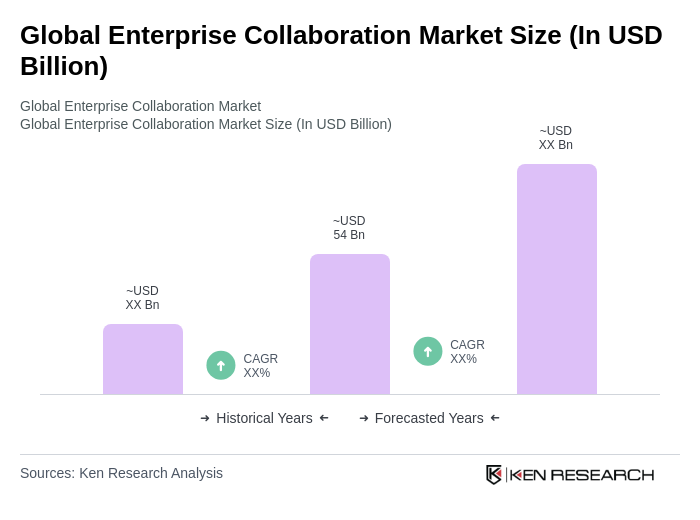
- The Global Enterprise Collaboration Market is valued at approximately USD 54 billion, based on a five-year historical analysis. This growth is primarily driven by the increasing need for remote and hybrid work solutions, enhanced communication tools, and the rise of digital transformation initiatives across various industries. The demand for seamless collaboration tools has surged as organizations seek to improve productivity, streamline operations, and support distributed teams in a competitive landscape.
- Key players in this market include the United States, Germany, and the United Kingdom, which dominate due to their advanced technological infrastructure, high adoption rates of digital tools, and significant investments in innovation. These countries have established themselves as leaders in enterprise collaboration by fostering a culture of collaboration and supporting startups and established companies in developing cutting-edge solutions.
- In 2023, the European Union implemented the Digital Services Act, which aims to create a safer digital space and establish clear responsibilities for online platforms. This regulation impacts the enterprise collaboration market by ensuring that companies adhere to strict guidelines regarding user data protection and transparency, thereby influencing the development and deployment of collaboration tools.
Global Enterprise Collaboration Market Segmentation
By Component:This segmentation includes Solutions and Services. The Solutions sub-segment encompasses Unified Communication, Team Collaboration Software, Video Conferencing, Project Management, Document Sharing, and Instant Messaging. The Services sub-segment includes Consulting, Integration & Deployment, and Support & Maintenance.
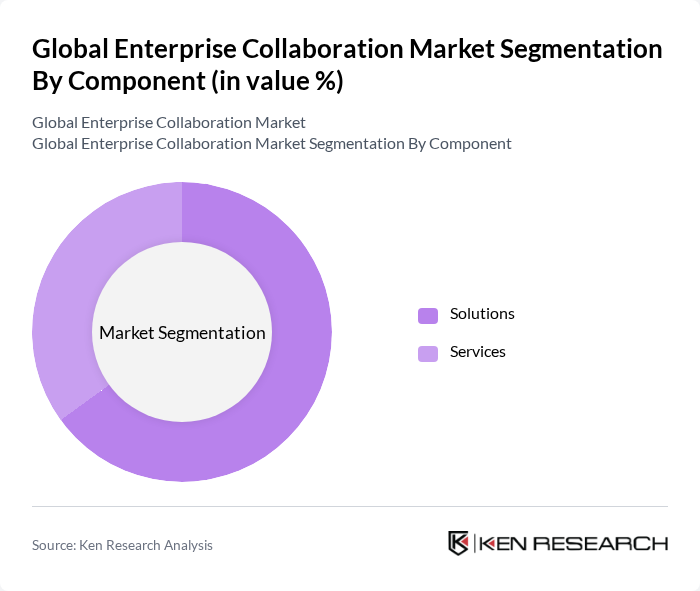
The Solutions sub-segment is dominating the market, driven by the increasing demand for integrated communication tools that enhance collaboration among teams. Unified Communication and Team Collaboration Software are particularly popular as organizations prioritize real-time communication and project management capabilities. The shift towards remote and hybrid work has further accelerated the adoption of video conferencing and document sharing solutions, making them essential for modern enterprises. As a result, the Solutions segment is expected to maintain its leadership position in the market.
By Deployment Mode:This segmentation includes Cloud-Based Solutions, On-Premises Solutions, and Hybrid Deployment. Each deployment mode offers unique advantages, catering to different organizational needs and preferences.
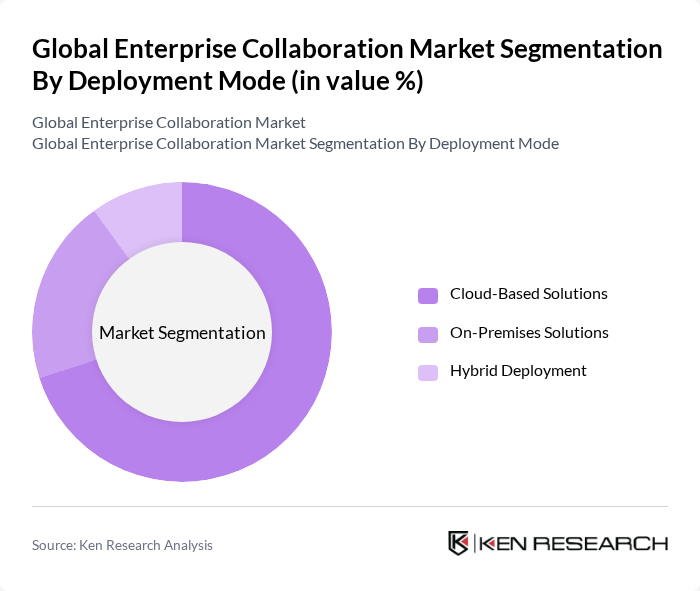
Cloud-Based Solutions are leading the market due to their scalability, cost-effectiveness, and ease of access. Organizations are increasingly opting for cloud solutions to facilitate remote work and collaboration, as they allow teams to connect from anywhere with an internet connection. The flexibility and reduced IT overhead associated with cloud deployments make them particularly attractive for small and medium enterprises, further solidifying their dominance in the market.
Global Enterprise Collaboration Market Competitive Landscape
The Global Enterprise Collaboration Market is characterized by a dynamic mix of regional and international players. Leading participants such as Microsoft Corporation, Slack Technologies, LLC, Zoom Video Communications, Inc., Cisco Systems, Inc., Google LLC, Atlassian Corporation Plc, Trello, Inc., Asana, Inc., Monday.com Ltd., Box, Inc., Dropbox, Inc., Salesforce, Inc., SAP SE, IBM Corporation, ServiceNow, Inc., Adobe Inc., Meta Platforms, Inc. (Workplace), RingCentral, Inc., Zoho Corporation Pvt. Ltd., Citrix Systems, Inc. contribute to innovation, geographic expansion, and service delivery in this space.
Global Enterprise Collaboration Market Industry Analysis
Growth Drivers
- Increasing Remote Work Adoption:The global remote workforce is projected to reach 1.87 billion in future, driven by the need for flexibility and work-life balance. This shift has led to a surge in demand for collaboration tools, with companies investing approximately $20 billion in remote work technologies. As organizations adapt to hybrid models, the need for effective communication and collaboration solutions becomes paramount, further propelling market growth in the enterprise collaboration sector.
- Demand for Enhanced Communication Tools:The global market for communication tools is expected to exceed $50 billion in future, reflecting a growing emphasis on seamless interaction among teams. Businesses are increasingly prioritizing tools that facilitate real-time communication, with 70% of organizations reporting a need for improved collaboration solutions. This demand is driven by the necessity for efficient workflows and the ability to connect teams across various locations, enhancing productivity and engagement.
- Integration of AI and Automation:The integration of AI in collaboration tools is anticipated to grow significantly, with investments in AI technologies projected to reach $126 billion in future. AI-driven features, such as automated scheduling and intelligent document management, are becoming essential for enhancing productivity. Companies are leveraging these technologies to streamline operations, reduce manual tasks, and improve decision-making processes, thereby driving the adoption of advanced collaboration solutions in enterprises.
Market Challenges
- Data Security Concerns:With the rise of remote work, data security has become a critical challenge, as 60% of organizations report increased cyber threats. The global cost of data breaches is expected to reach $5 trillion in future, prompting enterprises to invest heavily in security measures. This concern can hinder the adoption of collaboration tools, as organizations prioritize secure solutions that comply with stringent regulations, impacting market growth.
- High Implementation Costs:The initial investment required for deploying enterprise collaboration tools can be substantial, with costs averaging around $100,000 for mid-sized companies. This financial barrier can deter organizations from adopting new technologies, especially in uncertain economic climates. As companies weigh the benefits against the costs, many may delay or limit their investment in collaboration solutions, affecting overall market expansion.
Global Enterprise Collaboration Market Future Outlook
The future of the enterprise collaboration market is poised for significant transformation, driven by technological advancements and evolving workplace dynamics. As organizations increasingly embrace hybrid work models, the demand for integrated collaboration solutions will intensify. Companies will focus on enhancing user experience and adopting cloud-based platforms, which are expected to streamline workflows. Additionally, the rise of AI and machine learning will further optimize collaboration tools, making them more intuitive and efficient for users across various sectors.
Market Opportunities
- Growth in Mobile Collaboration Tools:The mobile collaboration tools market is projected to grow significantly, with an estimated value of $15 billion in future. This growth is driven by the increasing reliance on mobile devices for work, as 80% of employees use smartphones for business communication. Companies that develop mobile-friendly solutions will capture a larger share of the market, catering to the needs of a mobile workforce.
- Expansion into Emerging Markets:Emerging markets are expected to present substantial growth opportunities, with a projected increase in technology adoption rates. In future, regions like Asia-Pacific are anticipated to see a 25% rise in enterprise collaboration tool usage. Companies that strategically enter these markets can leverage the growing demand for digital solutions, enhancing their global footprint and driving revenue growth.
Scope of the Report
| Segment | Sub-Segments |
|---|---|
| By Component | Solutions (Unified Communication, Team Collaboration Software, Video Conferencing, Project Management, Document Sharing, Instant Messaging) Services (Consulting, Integration & Deployment, Support & Maintenance) |
| By Deployment Mode | Cloud-Based Solutions On-Premises Solutions Hybrid Deployment |
| By Application | Internal Communication External Communication Project Collaboration Customer Engagement |
| By End-User | Small and Medium Enterprises (SMEs) Large Enterprises Government Organizations Educational Institutions |
| By Industry Vertical | IT and Telecommunications Healthcare and Life Sciences Finance and Banking Retail Education Logistics and Travel |
| By Region | North America Europe Asia-Pacific Latin America Middle East & Africa |
| By Pricing Model | Subscription-Based One-Time License Fee Freemium Model Others |
Key Target Audience
Investors and Venture Capitalist Firms
Government and Regulatory Bodies (e.g., Federal Communications Commission, European Commission)
Technology Providers
Telecommunications Companies
Corporate Enterprises
Software Development Firms
Industry Associations
Financial Institutions
Players Mentioned in the Report:
Microsoft Corporation
Slack Technologies, LLC
Zoom Video Communications, Inc.
Cisco Systems, Inc.
Google LLC
Atlassian Corporation Plc
Trello, Inc.
Asana, Inc.
Monday.com Ltd.
Box, Inc.
Dropbox, Inc.
Salesforce, Inc.
SAP SE
IBM Corporation
ServiceNow, Inc.
Adobe Inc.
Meta Platforms, Inc. (Workplace)
RingCentral, Inc.
Zoho Corporation Pvt. Ltd.
Citrix Systems, Inc.
Table of Contents
Market Assessment Phase
1. Executive Summary and Approach
2. Global Enterprise Collaboration Market Overview
2.1 Key Insights and Strategic Recommendations
2.2 Global Enterprise Collaboration Market Overview
2.3 Definition and Scope
2.4 Evolution of Market Ecosystem
2.5 Timeline of Key Regulatory Milestones
2.6 Value Chain & Stakeholder Mapping
2.7 Business Cycle Analysis
2.8 Policy & Incentive Landscape
3. Global Enterprise Collaboration Market Analysis
3.1 Growth Drivers
3.1.1 Increasing Remote Work Adoption
3.1.2 Demand for Enhanced Communication Tools
3.1.3 Integration of AI and Automation
3.1.4 Rising Need for Team Collaboration Solutions
3.2 Market Challenges
3.2.1 Data Security Concerns
3.2.2 High Implementation Costs
3.2.3 Resistance to Change in Organizations
3.2.4 Fragmented Market with Numerous Players
3.3 Market Opportunities
3.3.1 Growth in Mobile Collaboration Tools
3.3.2 Expansion into Emerging Markets
3.3.3 Development of Customizable Solutions
3.3.4 Partnerships with IT Service Providers
3.4 Market Trends
3.4.1 Shift Towards Cloud-Based Solutions
3.4.2 Increasing Use of Video Conferencing Tools
3.4.3 Focus on User Experience and Interface Design
3.4.4 Adoption of Collaborative Project Management Tools
3.5 Government Regulation
3.5.1 Data Protection Regulations
3.5.2 Compliance with Remote Work Policies
3.5.3 Standards for Digital Communication Tools
3.5.4 Incentives for Technology Adoption in Enterprises
4. SWOT Analysis
5. Stakeholder Analysis
6. Porter's Five Forces Analysis
7. Global Enterprise Collaboration Market Market Size, 2019-2024
7.1 By Value
7.2 By Volume
7.3 By Average Selling Price
8. Global Enterprise Collaboration Market Segmentation
8.1 By Component
8.1.1 Solutions (Unified Communication, Team Collaboration Software, Video Conferencing, Project Management, Document Sharing, Instant Messaging)
8.1.2 Services (Consulting, Integration & Deployment, Support & Maintenance)
8.2 By Deployment Mode
8.2.1 Cloud-Based Solutions
8.2.2 On-Premises Solutions
8.2.3 Hybrid Deployment
8.3 By Application
8.3.1 Internal Communication
8.3.2 External Communication
8.3.3 Project Collaboration
8.3.4 Customer Engagement
8.4 By End-User
8.4.1 Small and Medium Enterprises (SMEs)
8.4.2 Large Enterprises
8.4.3 Government Organizations
8.4.4 Educational Institutions
8.5 By Industry Vertical
8.5.1 IT and Telecommunications
8.5.2 Healthcare and Life Sciences
8.5.3 Finance and Banking
8.5.4 Retail
8.5.5 Education
8.5.6 Logistics and Travel
8.6 By Region
8.6.1 North America
8.6.2 Europe
8.6.3 Asia-Pacific
8.6.4 Latin America
8.6.5 Middle East & Africa
8.7 By Pricing Model
8.7.1 Subscription-Based
8.7.2 One-Time License Fee
8.7.3 Freemium Model
8.7.4 Others
9. Global Enterprise Collaboration Market Competitive Analysis
9.1 Market Share of Key Players
9.2 KPIs for Cross Comparison of Key Players
9.2.1 Company Name
9.2.2 Group Size (Large, Medium, or Small as per industry convention)
9.2.3 Annual Revenue
9.2.4 Revenue Growth Rate (%)
9.2.5 Customer Retention Rate (%)
9.2.6 Market Penetration Rate (%)
9.2.7 Average Deal Size (USD)
9.2.8 Pricing Strategy (Subscription, Freemium, Enterprise Licensing)
9.2.9 Product Innovation Rate (Number of Major Feature Releases per Year)
9.2.10 Customer Satisfaction Score (CSAT/NPS)
9.2.11 Brand Recognition Index
9.2.12 Geographic Coverage (Number of Countries/Regions Served)
9.2.13 Integration Capability (Number of Supported Third-Party Platforms)
9.3 SWOT Analysis of Top Players
9.4 Pricing Analysis
9.5 Detailed Profile of Major Companies
9.5.1 Microsoft Corporation
9.5.2 Slack Technologies, LLC
9.5.3 Zoom Video Communications, Inc.
9.5.4 Cisco Systems, Inc.
9.5.5 Google LLC
9.5.6 Atlassian Corporation Plc
9.5.7 Trello, Inc.
9.5.8 Asana, Inc.
9.5.9 Monday.com Ltd.
9.5.10 Box, Inc.
9.5.11 Dropbox, Inc.
9.5.12 Salesforce, Inc.
9.5.13 SAP SE
9.5.14 IBM Corporation
9.5.15 ServiceNow, Inc.
9.5.16 Adobe Inc.
9.5.17 Meta Platforms, Inc. (Workplace)
9.5.18 RingCentral, Inc.
9.5.19 Zoho Corporation Pvt. Ltd.
9.5.20 Citrix Systems, Inc.
10. Global Enterprise Collaboration Market End-User Analysis
10.1 Procurement Behavior of Key Ministries
10.1.1 Budget Allocation Trends
10.1.2 Decision-Making Processes
10.1.3 Preferred Vendor Selection Criteria
10.2 Corporate Spend on Infrastructure & Energy
10.2.1 Investment in Collaboration Tools
10.2.2 Budgeting for IT Infrastructure
10.2.3 Spending on Training and Support
10.3 Pain Point Analysis by End-User Category
10.3.1 Communication Barriers
10.3.2 Integration Issues with Existing Systems
10.3.3 User Adoption Challenges
10.4 User Readiness for Adoption
10.4.1 Training Needs Assessment
10.4.2 Technology Familiarity Levels
10.4.3 Change Management Strategies
10.5 Post-Deployment ROI and Use Case Expansion
10.5.1 Measurement of Success Metrics
10.5.2 Expansion of Use Cases
10.5.3 Long-Term Value Realization
11. Global Enterprise Collaboration Market Future Size, 2025-2030
11.1 By Value
11.2 By Volume
11.3 By Average Selling Price
Go-To-Market Strategy Phase
1. Whitespace Analysis + Business Model Canvas
1.1 Market Gaps Identification
1.2 Value Proposition Development
1.3 Revenue Streams Analysis
1.4 Cost Structure Evaluation
1.5 Key Partnerships Exploration
1.6 Customer Segmentation
1.7 Channels to Market
2. Marketing and Positioning Recommendations
2.1 Branding Strategies
2.2 Product USPs
2.3 Target Audience Identification
2.4 Communication Strategies
2.5 Digital Marketing Approaches
2.6 Content Marketing Plans
2.7 Social Media Engagement
3. Distribution Plan
3.1 Urban Retail Strategies
3.2 Rural NGO Tie-Ups
3.3 Online Distribution Channels
3.4 Direct Sales Approaches
3.5 Partnerships with Distributors
3.6 Logistics and Supply Chain Management
4. Channel & Pricing Gaps
4.1 Underserved Routes
4.2 Pricing Bands Analysis
4.3 Competitor Pricing Strategies
4.4 Customer Willingness to Pay
4.5 Discounting Strategies
4.6 Bundling Opportunities
5. Unmet Demand & Latent Needs
5.1 Category Gaps Identification
5.2 Consumer Segments Analysis
5.3 Emerging Trends Exploration
5.4 Feedback Mechanisms
5.5 Innovation Opportunities
6. Customer Relationship
6.1 Loyalty Programs
6.2 After-Sales Service
6.3 Customer Feedback Loops
6.4 Engagement Strategies
6.5 Retention Tactics
7. Value Proposition
7.1 Sustainability Initiatives
7.2 Integrated Supply Chains
7.3 Unique Selling Points
7.4 Customer-Centric Approaches
7.5 Competitive Advantages
8. Key Activities
8.1 Regulatory Compliance
8.2 Branding Efforts
8.3 Distribution Setup
8.4 Training and Development
8.5 Market Research Activities
9. Entry Strategy Evaluation
9.1 Domestic Market Entry Strategy
9.1.1 Product Mix Considerations
9.1.2 Pricing Band Analysis
9.1.3 Packaging Strategies
9.2 Export Entry Strategy
9.2.1 Target Countries Identification
9.2.2 Compliance Roadmap Development
10. Entry Mode Assessment
10.1 Joint Ventures
10.2 Greenfield Investments
10.3 Mergers and Acquisitions
10.4 Distributor Model Evaluation
11. Capital and Timeline Estimation
11.1 Capital Requirements
11.2 Timelines for Implementation
12. Control vs Risk Trade-Off
12.1 Ownership Considerations
12.2 Partnerships Evaluation
13. Profitability Outlook
13.1 Breakeven Analysis
13.2 Long-Term Sustainability Strategies
14. Potential Partner List
14.1 Distributors
14.2 Joint Ventures
14.3 Acquisition Targets
15. Execution Roadmap
15.1 Phased Plan for Market Entry
15.1.1 Market Setup
15.1.2 Market Entry
15.1.3 Growth Acceleration
15.1.4 Scale & Stabilize
15.2 Key Activities and Milestones
15.2.1 Milestone Planning
15.2.2 Activity Tracking
Research Methodology
Phase 1: Approach1
Desk Research
- Analysis of industry reports from leading market research firms focusing on collaboration tools
- Review of white papers and case studies published by enterprise collaboration software providers
- Examination of market trends and forecasts from reputable business journals and online databases
Primary Research
- Interviews with IT managers and collaboration tool users across various industries
- Surveys targeting HR professionals to understand collaboration needs and challenges
- Focus groups with project managers to gather insights on tool effectiveness and user experience
Validation & Triangulation
- Cross-validation of findings through multiple data sources, including user feedback and sales data
- Triangulation of qualitative insights from interviews with quantitative data from surveys
- Sanity checks conducted through expert panel reviews comprising industry veterans
Phase 2: Market Size Estimation1
Top-down Assessment
- Estimation of market size based on global IT spending trends and collaboration software adoption rates
- Segmentation of the market by industry verticals such as healthcare, finance, and education
- Incorporation of growth rates from emerging markets and digital transformation initiatives
Bottom-up Modeling
- Collection of data on subscription rates and user bases from leading collaboration platforms
- Estimation of average revenue per user (ARPU) across different sectors
- Calculation of total market size based on firm-level data and user engagement metrics
Forecasting & Scenario Analysis
- Multi-factor regression analysis incorporating factors such as remote work trends and technological advancements
- Scenario modeling based on varying levels of enterprise adoption and investment in collaboration tools
- Development of baseline, optimistic, and pessimistic forecasts through 2030
Phase 3: CATI Sample Composition1
| Scope Item/Segment | Sample Size | Target Respondent Profiles |
|---|---|---|
| Enterprise Collaboration Tools in IT Sector | 120 | IT Managers, Software Developers |
| Collaboration Software Usage in Healthcare | 90 | Healthcare Administrators, IT Specialists |
| Remote Work Collaboration in Education | 60 | Educators, IT Coordinators |
| Collaboration Needs in Financial Services | 70 | Finance Managers, Compliance Officers |
| Project Management Tools in Manufacturing | 50 | Project Managers, Operations Directors |
Frequently Asked Questions
What is the current value of the Global Enterprise Collaboration Market?
The Global Enterprise Collaboration Market is valued at approximately USD 54 billion, driven by the increasing demand for remote and hybrid work solutions, enhanced communication tools, and digital transformation initiatives across various industries.
What are the key drivers of growth in the Enterprise Collaboration Market?
Which countries are leading in the Enterprise Collaboration Market?
How has the Digital Services Act impacted the Enterprise Collaboration Market?
Other Regional/Country Reports
Indonesia Enterprise Collaboration Market
Malaysia Enterprise Collaboration Market
Why Buy From Us?

What makes us stand out is that our consultants follow Robust, Refine and Result (RRR) methodology. Robust for clear definitions, approaches and sanity checking, Refine for differentiating respondents' facts and opinions, and Result for presenting data with story.

We have set a benchmark in the industry by offering our clients with syndicated and customized market research reports featuring coverage of entire market as well as meticulous research and analyst insights.

While we don't replace traditional research, we flip the method upside down. Our dual approach of Top Bottom & Bottom Top ensures quality deliverable by not just verifying company fundamentals but also looking at the sector and macroeconomic factors.

With one step in the future, our research team constantly tries to show you the bigger picture. We help with some of the tough questions you may encounter along the way: How is the industry positioned? Best marketing channel? KPI's of competitors? By aligning every element, we help maximize success.

Our report gives you instant access to the answers and sources that other companies might choose to hide. We elaborate each steps of research methodology we have used and showcase you the sample size to earn your trust.

If you need any support, we are here! We pride ourselves on universe strength, data quality, and quick, friendly, and professional service.