About the Report
Base Year 2024Global Extrusion Machinery Market Overview
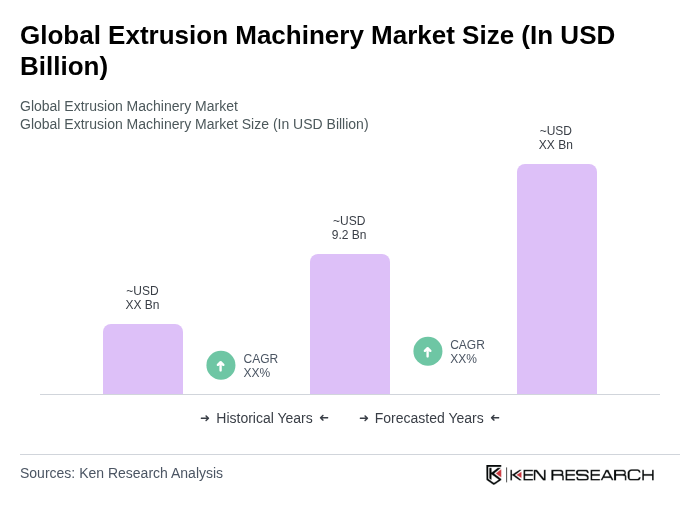
- The Global Extrusion Machinery Market is valued at USD 9.2 billion, based on a five-year historical analysis. This growth is primarily driven by the increasing demand for extruded products across industries such as packaging, automotive, and construction. Key growth drivers include the adoption of lightweight and durable materials, rapid industrialization, and the integration of automation and smart manufacturing technologies that improve production efficiency and product quality. Additionally, the growing emphasis on sustainability and recycling is prompting manufacturers to invest in advanced extrusion solutions, further fueling market expansion.
- Key players in this market include the United States, Germany, and China, which dominate due to their robust manufacturing capabilities and technological advancements. The U.S. benefits from a strong automotive and aerospace sector, Germany is recognized for its engineering excellence and innovation in machinery, and China, as a manufacturing powerhouse, has a vast production base supporting both domestic and international demand. Asia Pacific, led by China, holds the largest regional market share, driven by rapid industrialization and infrastructure investments.
- In 2023, the European Union implemented the Machinery Directive 2006/42/EC, issued by the European Parliament and the Council, which mandates that all extrusion machinery placed on the EU market must meet specific safety and environmental standards. This regulation requires manufacturers to ensure machinery is designed and constructed to minimize risks to workers and the environment, including compliance with essential health and safety requirements, CE marking, and conformity assessment procedures.
Global Extrusion Machinery Market Segmentation
By Type:The extrusion machinery market is segmented into Single Screw Extruders, Twin Screw Extruders, Multi-layer Extruders, Direct Extrusion, Indirect Extrusion, Hydrostatic Extrusion, and Others. Each type serves distinct applications and industries, offering specific advantages in efficiency, product quality, and versatility. Single Screw Extruders are widely used for their simplicity and cost-effectiveness, especially in mass production of plastic products. Twin Screw Extruders are preferred for high mixing and compounding capabilities, suitable for complex formulations and advanced material processing.
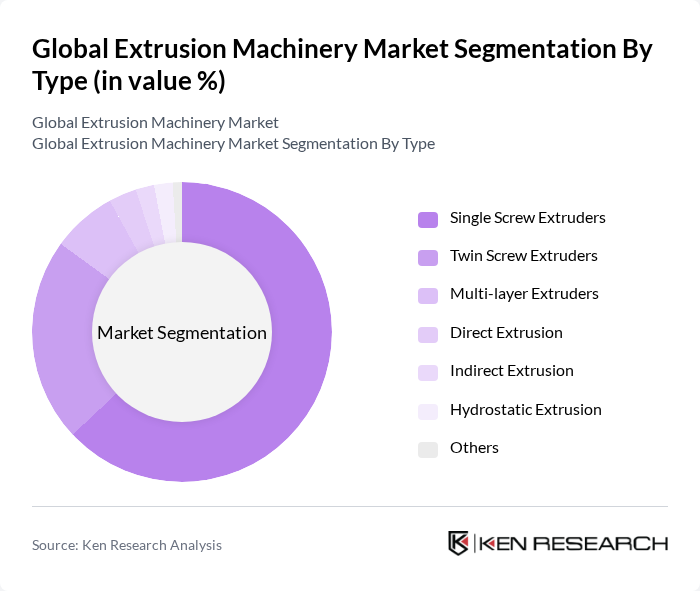
The Single Screw Extruders segment is currently dominating the market due to their operational simplicity, cost-effectiveness, and versatility in processing a wide range of materials. They are extensively used in the production of plastic products, which remain in high demand across packaging, construction, and automotive sectors. Twin Screw Extruders are gaining traction for applications requiring intensive mixing and compounding, particularly in advanced material processing and specialty plastics. The preference for Single Screw Extruders is driven by their ease of operation and maintenance, making them a popular choice among manufacturers.
By End-User:The market is segmented by end-user industries, including Packaging, Automotive, Construction, Consumer Goods, Food & Beverage, Healthcare, Aerospace & Defense, and Others. Each sector has unique requirements for extrusion machinery, shaping demand dynamics. The Packaging segment leads due to the ongoing demand for flexible, durable, and sustainable packaging solutions, driven by e-commerce growth and consumer goods expansion. Automotive follows, propelled by the need for lightweight materials to improve fuel efficiency and performance. Construction remains a key segment, with extrusion machinery supporting infrastructure development and advanced building materials.
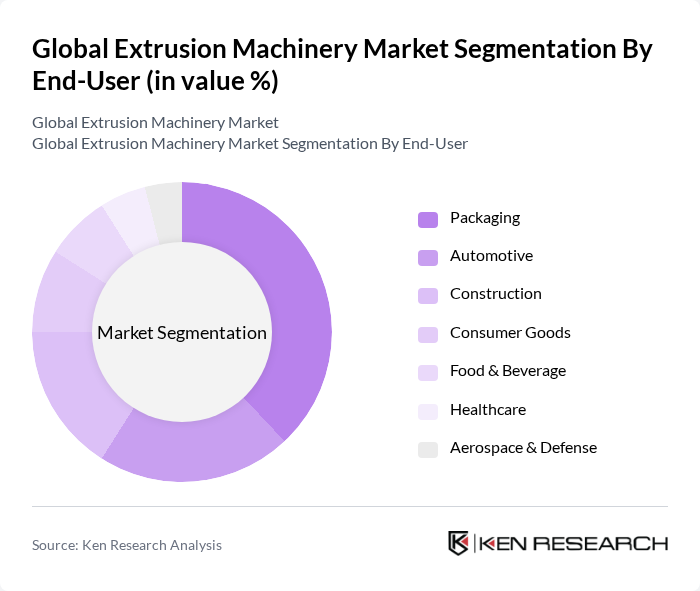
The Packaging segment leads the market due to the increasing demand for flexible and durable packaging solutions across industries. The rise in e-commerce and consumer goods has further fueled this demand, as companies seek efficient and sustainable packaging options. The Automotive sector follows closely, driven by the need for lightweight materials that enhance fuel efficiency and performance. Sustainability initiatives and environmental regulations are also influencing growth in the Packaging and Automotive segments.
Global Extrusion Machinery Market Competitive Landscape
The Global Extrusion Machinery Market is characterized by a dynamic mix of regional and international players. Leading participants such as KraussMaffei Group, Milacron Holdings Corp., Reifenhäuser GmbH & Co. KG Maschinenfabrik, Battenfeld-Cincinnati Group, Davis-Standard LLC, Coperion GmbH, NFM Welding Engineers, Inc., The Japan Steel Works, Ltd., Bausano & Figli S.p.A., SML Maschinengesellschaft mbH, HPM Corporation, Graham Engineering Corporation, Erema Engineering Recycling Maschinen und Anlagen Ges.m.b.H., Clextral SAS, Kautex Maschinenbau GmbH, AMUT S.p.A., WENGER MANUFACTURING, INC., Extrusion Technik USA, Inc., BC Extrusion Holding GmbH contribute to innovation, geographic expansion, and service delivery in this space.
Global Extrusion Machinery Market Industry Analysis
Growth Drivers
- Increasing Demand for Lightweight Materials:The global push for lightweight materials is significantly driving the extrusion machinery market. In future, the lightweight materials market is projected to reach approximately $250 billion, with a notable increase in sectors like automotive and aerospace. This demand is fueled by the need for improved fuel efficiency and reduced emissions, prompting manufacturers to invest in advanced extrusion technologies that cater to these requirements, thereby enhancing production capabilities and efficiency.
- Advancements in Extrusion Technology:Technological innovations in extrusion processes are enhancing production efficiency and product quality. In future, the global investment in extrusion technology is expected to exceed $20 billion, driven by the integration of automation and smart technologies. These advancements enable manufacturers to produce complex profiles and multi-layered products, meeting the evolving demands of various industries, including packaging and construction, which are increasingly reliant on high-performance materials.
- Rising Applications in Packaging and Construction:The packaging and construction sectors are experiencing robust growth, with the global packaging market projected to reach $1.5 trillion by future. This surge is attributed to the increasing demand for sustainable and efficient packaging solutions. Extrusion machinery plays a crucial role in producing materials such as films and sheets, which are essential for modern packaging applications, thus driving the market's expansion in these sectors significantly.
Market Challenges
- High Initial Investment Costs:The extrusion machinery market faces significant challenges due to high initial investment costs, which can exceed $600,000 for advanced systems. This financial barrier limits access for small and medium-sized enterprises (SMEs) that may struggle to secure funding. As a result, many potential players are deterred from entering the market, which can stifle innovation and competition, ultimately affecting overall market growth.
- Fluctuating Raw Material Prices:The extrusion industry is heavily impacted by the volatility of raw material prices, particularly for polymers and metals. In future, the price of polyethylene is expected to fluctuate between $1,300 and $1,700 per ton, influenced by global supply chain disruptions and geopolitical tensions. These fluctuations can lead to unpredictable production costs, making it challenging for manufacturers to maintain profitability and pricing strategies in a competitive market.
Global Extrusion Machinery Market Future Outlook
The future of the extrusion machinery market appears promising, driven by technological advancements and increasing demand for sustainable solutions. As industries adopt Industry 4.0 practices, the integration of automation and IoT technologies will enhance operational efficiency and product customization. Furthermore, the growing emphasis on eco-friendly processes will likely lead to innovations in machinery design, enabling manufacturers to meet stringent environmental regulations while capitalizing on emerging market opportunities in developing regions.
Market Opportunities
- Expansion in Emerging Markets:Emerging markets, particularly in Asia-Pacific and Latin America, present significant growth opportunities for extrusion machinery. With a combined population exceeding 4.5 billion and increasing industrialization, these regions are expected to see a surge in demand for advanced manufacturing technologies, creating a favorable environment for market expansion and investment.
- Development of Eco-Friendly Extrusion Processes:The shift towards sustainability is driving the development of eco-friendly extrusion processes. In future, investments in green technologies are projected to reach $15 billion, as manufacturers seek to reduce their carbon footprint. This trend not only aligns with global environmental goals but also opens new avenues for innovation and differentiation in the extrusion machinery market.
Scope of the Report
| Segment | Sub-Segments |
|---|---|
| By Type | Single Screw Extruders Twin Screw Extruders Multi-layer Extruders Direct Extrusion Indirect Extrusion Hydrostatic Extrusion Others |
| By End-User | Packaging Automotive Construction Consumer Goods Food & Beverage Healthcare Aerospace & Defense Others |
| By Material | Plastics (Thermoplastics, Thermosetting Plastics) Metals (Aluminum, Steel, Others) Rubber Composites Others |
| By Application | Film and Sheet Extrusion Pipe and Profile Extrusion Coating and Laminating Wire & Cable Extrusion Others |
| By Region | North America Europe Asia-Pacific Latin America Middle East & Africa |
| By Technology | Conventional Extrusion Advanced Extrusion Technologies (Automation, Smart Manufacturing, IoT-enabled) Others |
| By Investment Source | Private Investments Public Funding Joint Ventures Others |
Key Target Audience
Investors and Venture Capitalist Firms
Government and Regulatory Bodies (e.g., U.S. Department of Commerce, European Commission)
Manufacturers and Producers of Extrusion Machinery
Distributors and Retailers of Industrial Equipment
Trade Associations in the Manufacturing Sector
Equipment Maintenance and Service Providers
Raw Material Suppliers for Extrusion Processes
Financial Institutions and Investment Banks
Players Mentioned in the Report:
KraussMaffei Group
Milacron Holdings Corp.
Reifenhauser GmbH & Co. KG Maschinenfabrik
Battenfeld-Cincinnati Group
Davis-Standard LLC
Coperion GmbH
NFM Welding Engineers, Inc.
The Japan Steel Works, Ltd.
Bausano & Figli S.p.A.
SML Maschinengesellschaft mbH
HPM Corporation
Graham Engineering Corporation
Erema Engineering Recycling Maschinen und Anlagen Ges.m.b.H.
Clextral SAS
Kautex Maschinenbau GmbH
AMUT S.p.A.
WENGER MANUFACTURING, INC.
Extrusion Technik USA, Inc.
BC Extrusion Holding GmbH
Table of Contents
Market Assessment Phase
1. Executive Summary and Approach
2. Global Extrusion Machinery Market Overview
2.1 Key Insights and Strategic Recommendations
2.2 Global Extrusion Machinery Market Overview
2.3 Definition and Scope
2.4 Evolution of Market Ecosystem
2.5 Timeline of Key Regulatory Milestones
2.6 Value Chain & Stakeholder Mapping
2.7 Business Cycle Analysis
2.8 Policy & Incentive Landscape
3. Global Extrusion Machinery Market Analysis
3.1 Growth Drivers
3.1.1 Increasing demand for lightweight materials
3.1.2 Advancements in extrusion technology
3.1.3 Rising applications in packaging and construction
3.1.4 Growth in automotive and aerospace industries
3.2 Market Challenges
3.2.1 High initial investment costs
3.2.2 Fluctuating raw material prices
3.2.3 Stringent environmental regulations
3.2.4 Competition from alternative manufacturing processes
3.3 Market Opportunities
3.3.1 Expansion in emerging markets
3.3.2 Development of eco-friendly extrusion processes
3.3.3 Integration of automation and IoT technologies
3.3.4 Customization and specialization of machinery
3.4 Market Trends
3.4.1 Increasing focus on sustainability
3.4.2 Adoption of Industry 4.0 practices
3.4.3 Growth in demand for multi-layered products
3.4.4 Rise of smart manufacturing solutions
3.5 Government Regulation
3.5.1 Compliance with energy efficiency standards
3.5.2 Regulations on waste management and recycling
3.5.3 Safety standards for machinery operation
3.5.4 Incentives for adopting green technologies
4. SWOT Analysis
5. Stakeholder Analysis
6. Porter's Five Forces Analysis
7. Global Extrusion Machinery Market Market Size, 2019-2024
7.1 By Value
7.2 By Volume
7.3 By Average Selling Price
8. Global Extrusion Machinery Market Segmentation
8.1 By Type
8.1.1 Single Screw Extruders
8.1.2 Twin Screw Extruders
8.1.3 Multi-layer Extruders
8.1.4 Direct Extrusion
8.1.5 Indirect Extrusion
8.1.6 Hydrostatic Extrusion
8.1.7 Others
8.2 By End-User
8.2.1 Packaging
8.2.2 Automotive
8.2.3 Construction
8.2.4 Consumer Goods
8.2.5 Food & Beverage
8.2.6 Healthcare
8.2.7 Aerospace & Defense
8.2.8 Others
8.3 By Material
8.3.1 Plastics (Thermoplastics, Thermosetting Plastics)
8.3.2 Metals (Aluminum, Steel, Others)
8.3.3 Rubber
8.3.4 Composites
8.3.5 Others
8.4 By Application
8.4.1 Film and Sheet Extrusion
8.4.2 Pipe and Profile Extrusion
8.4.3 Coating and Laminating
8.4.4 Wire & Cable Extrusion
8.4.5 Others
8.5 By Region
8.5.1 North America
8.5.2 Europe
8.5.3 Asia-Pacific
8.5.4 Latin America
8.5.5 Middle East & Africa
8.6 By Technology
8.6.1 Conventional Extrusion
8.6.2 Advanced Extrusion Technologies (Automation, Smart Manufacturing, IoT-enabled)
8.6.3 Others
8.7 By Investment Source
8.7.1 Private Investments
8.7.2 Public Funding
8.7.3 Joint Ventures
8.7.4 Others
9. Global Extrusion Machinery Market Competitive Analysis
9.1 Market Share of Key Players
9.2 Cross Comparison of Key Players
9.2.1 Company Name
9.2.2 Group Size (Large, Medium, or Small as per industry convention)
9.2.3 Revenue Growth Rate (YoY %)
9.2.4 Market Share (%)
9.2.5 Global Footprint (Number of Countries/Regions Served)
9.2.6 Production Capacity (Units per Year or Tons per Year)
9.2.7 R&D Investment (% of Revenue)
9.2.8 Product Portfolio Breadth (Number of Product Lines)
9.2.9 Technology Adoption Level (Automation, Industry 4.0, IoT)
9.2.10 Customer Base Diversification (Key End-User Segments)
9.2.11 Sustainability Initiatives (Recycling, Energy Efficiency)
9.2.12 Supply Chain Efficiency (Lead Time, On-Time Delivery Rate)
9.2.13 After-Sales Service Quality (Customer Satisfaction Score)
9.3 SWOT Analysis of Top Players
9.4 Pricing Analysis
9.5 Detailed Profile of Major Companies
9.5.1 KraussMaffei Group
9.5.2 Milacron Holdings Corp.
9.5.3 Reifenhäuser GmbH & Co. KG Maschinenfabrik
9.5.4 Battenfeld-Cincinnati Group
9.5.5 Davis-Standard LLC
9.5.6 Coperion GmbH
9.5.7 NFM Welding Engineers, Inc.
9.5.8 The Japan Steel Works, Ltd.
9.5.9 Bausano & Figli S.p.A.
9.5.10 SML Maschinengesellschaft mbH
9.5.11 HPM Corporation
9.5.12 Graham Engineering Corporation
9.5.13 Erema Engineering Recycling Maschinen und Anlagen Ges.m.b.H.
9.5.14 Clextral SAS
9.5.15 Kautex Maschinenbau GmbH
9.5.16 AMUT S.p.A.
9.5.17 WENGER MANUFACTURING, INC.
9.5.18 Extrusion Technik USA, Inc.
9.5.19 BC Extrusion Holding GmbH
10. Global Extrusion Machinery Market End-User Analysis
10.1 Procurement Behavior of Key Ministries
10.1.1 Government procurement policies
10.1.2 Budget allocation trends
10.1.3 Supplier selection criteria
10.1.4 Contract management practices
10.2 Corporate Spend on Infrastructure & Energy
10.2.1 Investment trends in machinery
10.2.2 Budgeting for maintenance and upgrades
10.2.3 Spending on R&D for new technologies
10.2.4 Cost-benefit analysis of machinery investments
10.3 Pain Point Analysis by End-User Category
10.3.1 Challenges in sourcing materials
10.3.2 Issues with machinery downtime
10.3.3 Difficulty in meeting regulatory standards
10.3.4 Need for skilled labor
10.4 User Readiness for Adoption
10.4.1 Awareness of new technologies
10.4.2 Training and support requirements
10.4.3 Financial readiness for investment
10.4.4 Infrastructure readiness
10.5 Post-Deployment ROI and Use Case Expansion
10.5.1 Measurement of ROI post-implementation
10.5.2 Case studies of successful deployments
10.5.3 Opportunities for scaling operations
10.5.4 Feedback mechanisms for continuous improvement
11. Global Extrusion Machinery Market Future Size, 2025-2030
11.1 By Value
11.2 By Volume
11.3 By Average Selling Price
Go-To-Market Strategy Phase
1. Whitespace Analysis + Business Model Canvas
1.1 Market gaps identification
1.2 Value proposition development
1.3 Revenue model exploration
1.4 Customer segmentation analysis
1.5 Competitive landscape overview
1.6 Key partnerships identification
1.7 Risk assessment
2. Marketing and Positioning Recommendations
2.1 Branding strategies
2.2 Product USPs
2.3 Target market identification
2.4 Communication strategies
2.5 Digital marketing initiatives
2.6 Trade show participation
2.7 Customer engagement tactics
3. Distribution Plan
3.1 Urban retail strategies
3.2 Rural NGO tie-ups
3.3 Online distribution channels
3.4 Direct sales approach
3.5 Logistics and supply chain management
3.6 Partnership with distributors
3.7 Inventory management practices
4. Channel & Pricing Gaps
4.1 Underserved routes
4.2 Pricing bands analysis
4.3 Competitor pricing strategies
4.4 Customer willingness to pay
4.5 Value-based pricing models
4.6 Discounting strategies
4.7 Bundling offers
5. Unmet Demand & Latent Needs
5.1 Category gaps
5.2 Consumer segments analysis
5.3 Emerging trends identification
5.4 Product development opportunities
5.5 Customer feedback incorporation
5.6 Market research insights
5.7 Future demand forecasting
6. Customer Relationship
6.1 Loyalty programs
6.2 After-sales service
6.3 Customer support strategies
6.4 Feedback collection mechanisms
6.5 Relationship management tools
6.6 Community engagement initiatives
6.7 Customer education programs
7. Value Proposition
7.1 Sustainability initiatives
7.2 Integrated supply chains
7.3 Cost-saving measures
7.4 Quality assurance practices
7.5 Innovation in product offerings
7.6 Customer-centric approach
7.7 Competitive differentiation
8. Key Activities
8.1 Regulatory compliance
8.2 Branding efforts
8.3 Distribution setup
8.4 Training and development
8.5 Market monitoring
8.6 Stakeholder engagement
8.7 Performance evaluation
9. Entry Strategy Evaluation
9.1 Domestic Market Entry Strategy
9.1.1 Product mix considerations
9.1.2 Pricing band analysis
9.1.3 Packaging strategies
9.2 Export Entry Strategy
9.2.1 Target countries selection
9.2.2 Compliance roadmap development
10. Entry Mode Assessment
10.1 Joint Ventures
10.2 Greenfield investments
10.3 Mergers & Acquisitions
10.4 Distributor Model
10.5 Risk assessment of entry modes
10.6 Strategic fit evaluation
10.7 Long-term sustainability considerations
11. Capital and Timeline Estimation
11.1 Capital requirements
11.2 Timelines for market entry
11.3 Financial projections
11.4 Funding sources identification
11.5 Budget allocation strategies
11.6 Cost management practices
11.7 Risk mitigation strategies
12. Control vs Risk Trade-Off
12.1 Ownership considerations
12.2 Partnerships evaluation
12.3 Risk management frameworks
12.4 Control mechanisms
12.5 Strategic alignment
12.6 Long-term relationship management
12.7 Exit strategies
13. Profitability Outlook
13.1 Breakeven analysis
13.2 Long-term sustainability
13.3 Profit margin optimization
13.4 Revenue diversification strategies
13.5 Cost reduction initiatives
13.6 Financial health monitoring
13.7 Investment return analysi
Research Methodology
Phase 1: Approach1
Desk Research
- Industry reports from global extrusion machinery associations and trade bodies
- Market analysis publications from leading research firms focusing on machinery and manufacturing
- Government publications and statistical data on manufacturing output and machinery imports/exports
Primary Research
- Interviews with key decision-makers in extrusion machinery manufacturing companies
- Surveys targeting end-users in industries such as packaging, automotive, and construction
- Field visits to manufacturing plants to gather insights on operational challenges and technology adoption
Validation & Triangulation
- Cross-validation of data from multiple sources including industry reports and expert interviews
- Triangulation of market trends with historical data and future projections
- Sanity checks through expert panel discussions to ensure data reliability
Phase 2: Market Size Estimation1
Top-down Assessment
- Analysis of global manufacturing output to estimate the demand for extrusion machinery
- Segmentation of the market by application areas such as food packaging, automotive parts, and consumer goods
- Incorporation of macroeconomic indicators and industry growth rates to refine estimates
Bottom-up Modeling
- Collection of sales data from leading extrusion machinery manufacturers
- Estimation of market share based on production capacity and sales volume
- Cost analysis of machinery based on material inputs and technological advancements
Forecasting & Scenario Analysis
- Utilization of time-series analysis to project future market trends based on historical data
- Scenario modeling based on varying levels of technological adoption and regulatory impacts
- Development of baseline, optimistic, and pessimistic forecasts through 2030
Phase 3: CATI Sample Composition1
| Scope Item/Segment | Sample Size | Target Respondent Profiles |
|---|---|---|
| Food Packaging Machinery | 100 | Production Managers, Quality Assurance Managers |
| Automotive Components Extrusion | 80 | Engineering Managers, Supply Chain Managers |
| Construction Material Extrusion | 70 | Project Managers, Procurement Specialists |
| Consumer Goods Manufacturing | 90 | Operations Managers, Product Development Managers |
| Medical Device Production | 60 | Regulatory Affairs Managers, Manufacturing Engineers |
Frequently Asked Questions
What is the current value of the Global Extrusion Machinery Market?
The Global Extrusion Machinery Market is valued at approximately USD 9.2 billion, reflecting a robust growth trajectory driven by increasing demand across various industries, including packaging, automotive, and construction.
What are the key drivers of growth in the extrusion machinery market?
Which regions dominate the Global Extrusion Machinery Market?
What types of extrusion machinery are available in the market?
Other Regional/Country Reports
Indonesia Extrusion Machinery Market
Malaysia Extrusion Machinery Market
KSA Extrusion Machinery Market
SEA Extrusion Machinery Market
Other Adjacent Reports
Belgium Injection Molding Machinery Market
Brazil Blow Molding Machinery Market
Brazil Thermoforming Machinery Market
Japan Packaging Equipment Market
Thailand Plastic Recycling Machinery Market
KSA Polymer Processing Market
Belgium Automotive Parts Manufacturing Market
UAE Construction Materials Production Market
Malaysia Food Processing Equipment Market Size, Share & Forecast, By Equipment Type, Application & Automation Level, 2026–2031Singapore Aerospace Components Manufacturing Market
Why Buy From Us?

What makes us stand out is that our consultants follow Robust, Refine and Result (RRR) methodology. Robust for clear definitions, approaches and sanity checking, Refine for differentiating respondents' facts and opinions, and Result for presenting data with story.

We have set a benchmark in the industry by offering our clients with syndicated and customized market research reports featuring coverage of entire market as well as meticulous research and analyst insights.

While we don't replace traditional research, we flip the method upside down. Our dual approach of Top Bottom & Bottom Top ensures quality deliverable by not just verifying company fundamentals but also looking at the sector and macroeconomic factors.

With one step in the future, our research team constantly tries to show you the bigger picture. We help with some of the tough questions you may encounter along the way: How is the industry positioned? Best marketing channel? KPI's of competitors? By aligning every element, we help maximize success.

Our report gives you instant access to the answers and sources that other companies might choose to hide. We elaborate each steps of research methodology we have used and showcase you the sample size to earn your trust.

If you need any support, we are here! We pride ourselves on universe strength, data quality, and quick, friendly, and professional service.