About the Report
Base Year 2024Listen to the audio summary
Global Facial Injectables Market Overview
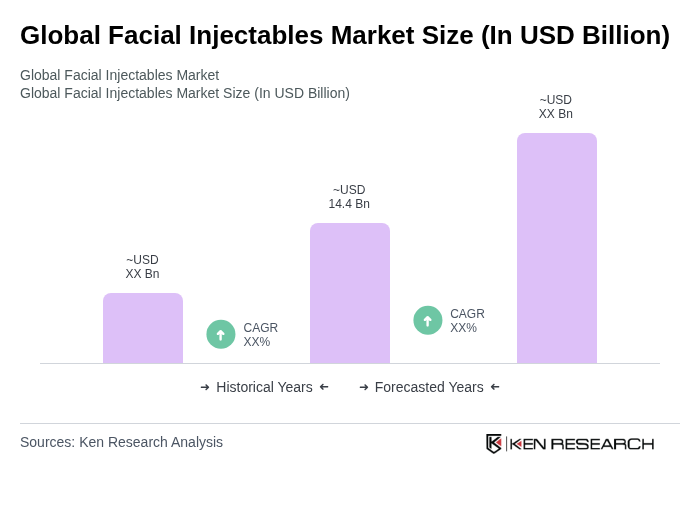
- The Global Facial Injectables Market is valued at USD 14.4 billion, based on a five?year analysis of leading industry sources. Growth is driven by rising demand for minimally invasive aesthetic treatments spurred by an aging population seeking non-surgical anti-aging solutions, especially in urban centers where “lunchtime” procedures and social-media-influenced beauty standards encourage early adoption of injectables. Innovations such as longer-lasting hyaluronic acid formulations, combination therapies with neuromodulators, and regenerative injectables (e.g., biostimulatory fillers and collagen-inducing products) further bolster market appeal.
- Key players in this market include AbbVie (Allergan Aesthetics), Galderma, Ipsen, Merz Aesthetics, Revance Therapeutics, and Sinclair Pharma, along with other regional and emerging brands. These companies play a significant role in driving growth and maintaining high standards in aesthetic injectables through innovation in neuromodulators and fillers, life?cycle extensions of established brands (such as new indications and expanded label claims), digital engagement with consumers, and strategic partnerships to extend market reach. North America dominates the market, holding the largest revenue share, driven by high disposable income, a dense network of aesthetic providers, and strong brand penetration, while Asia-Pacific is rapidly expanding due to medical tourism, a growing middle class, and increasing interest in beauty and anti-aging treatments.
- In the United States, facial injectables are regulated as prescription medical products by the U.S. Food and Drug Administration (FDA) under the Federal Food, Drug, and Cosmetic Act and, for certain dermal fillers, specific premarket approval or 510(k) clearance requirements. The FDA requires robust clinical evaluation of neuromodulators and soft tissue fillers for safety and effectiveness, mandates that they be supplied on prescription, and stipulates that administration should be performed by licensed or appropriately trained healthcare professionals, supported by detailed labeling and risk information. This regulatory framework aims to ensure product quality, minimize adverse events, and maintain high standards in aesthetic practice, which can also increase operational and compliance complexity for manufacturers and providers.
Global Facial Injectables Market Segmentation
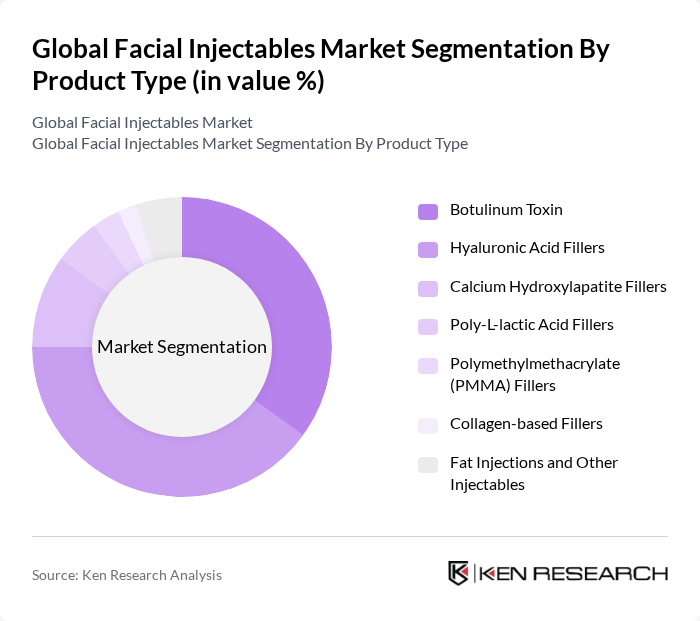
By Product Type:The product type segmentation of the market includes various injectables that cater to different aesthetic needs. Hyaluronic acid fillers hold a leading share among dermal fillers due to their versatility, reversibility, and strong safety profile in facial rejuvenation, volume restoration, and contouring. Botulinum toxin also accounts for a substantial portion of the market and is widely used for dynamic wrinkle reduction and facial line softening. The increasing consumer preference for non-invasive or minimally invasive procedures, rising awareness of aesthetic treatments, expanding indications (both cosmetic and therapeutic), and broader availability in medspas and clinics are driving demand for these products across age groups.
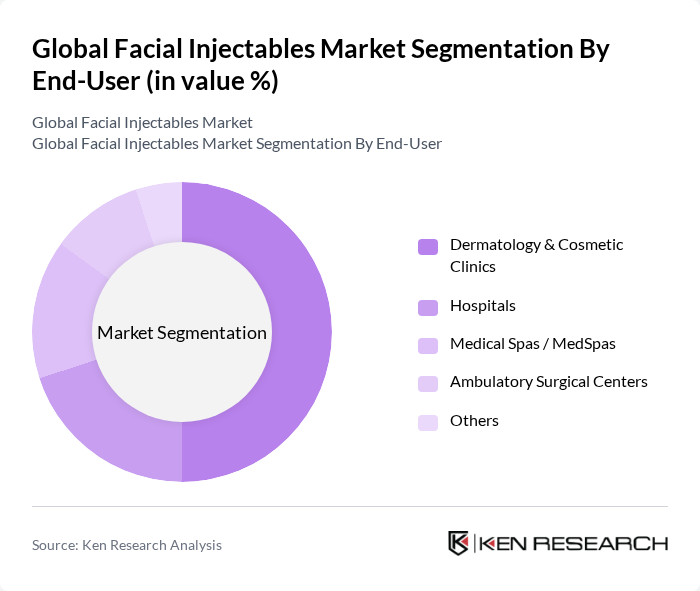
By End-User:The end-user segmentation highlights the various settings where facial injectables are administered. Dermatology and cosmetic clinics are the leading end-users, driven by the increasing number of aesthetic procedures performed in these specialized settings and the concentration of trained injectors. Hospitals and medical spas also contribute significantly to the market, as they offer comprehensive service portfolios that include injectables, often integrated with skin care, laser, and surgical options. The growing trend of self-care, younger demographics entering the aesthetics category, and increasing acceptance of “preventive” treatments are propelling demand across these end-user categories, with medspas in particular gaining share as a convenient and consumer-friendly channel.
Global Facial Injectables Market Competitive Landscape
The Global Facial Injectables Market is characterized by a dynamic mix of regional and international players. Leading participants such as AbbVie (Allergan Aesthetics), Galderma, Revance Therapeutics, Ipsen, Merz Aesthetics, Sientra, Hugel, Prollenium Medical Technologies, Medytox, Teoxane, Sinclair Pharma, Croma-Pharma, Suneva Medical, Bloomage Biotechnology, and other emerging and regional players contribute to innovation, geographic expansion, and service delivery in this space.
Global Facial Injectables Market Industry Analysis
Growth Drivers
- Rising U.S. Disposable Income:The average disposable household income in the U.S. is projected to increase from USD 16,118 in the past to USD 17,451 in the future. This growth in disposable income enables consumers to allocate more funds towards elective services, including facial injectables. As individuals prioritize aesthetic enhancements, the demand for non-surgical procedures is expected to rise significantly, reflecting a broader trend in consumer spending on personal care and beauty services.
- Expanding Aging Population:The U.S. population aged 65 and older was approximately 58 million in the past, with projections indicating an increase to around 82 million in future. This demographic shift is driving demand for anti-aging treatments, particularly minimally invasive facial injectables. As older adults seek to maintain a youthful appearance, the market for injectables is expected to expand, catering to the needs of this growing segment of the population.
- Greater Market Value in 2024:The global facial injectables market is valued at USD 12.53 billion in future, indicating robust consumer demand and market activity. This valuation reflects the increasing acceptance of aesthetic treatments across various demographics, driven by factors such as social media influence and the desire for enhanced personal appearance. The strong market value underscores the potential for growth and innovation within the injectables sector.
Market Challenges
- Supply Chain and Tariff-Driven Cost Pressures:The imposition of U.S. tariffs on select injectable products in future has raised input costs significantly. These tariffs disrupt supply chains and challenge pricing strategies for clinics reliant on imported products. As a result, the increased costs may limit accessibility for consumers, potentially dampening the growth of the facial injectables market in the short term.
- Technical Complexity and Infrastructure Limitations:The distribution of facial injectables often requires complex cold chain logistics and specialized training for practitioners. These technical challenges can hinder market penetration, particularly in developing regions where infrastructure may be lacking. As a result, accessibility to high-quality injectables may be limited, posing a significant challenge to market growth and consumer adoption.
Global Facial Injectables Market Future Outlook
The future of the facial injectables market appears promising, driven by innovations in product development and increasing consumer interest in personalized aesthetic solutions. Emerging trends such as regenerative injectables that stimulate natural collagen production and the integration of AI for treatment planning are expected to enhance service delivery. Additionally, the growing acceptance of combination treatments, which blend injectables with other aesthetic procedures, will likely attract a broader consumer base, further propelling market growth.
Market Opportunities
- AI and Digital Service Expansion:The rise of digital platforms facilitating virtual consultations is a significant opportunity for the facial injectables market. These platforms enhance patient education and accessibility, allowing consumers to engage with aesthetic services from the comfort of their homes. This trend is expected to drive market growth by reaching a wider audience and improving service delivery.
- Growth in Emerging Markets (Asia-Pacific, Latin America):Emerging markets, particularly in Asia-Pacific and Latin America, present substantial growth opportunities for facial injectables. Rising disposable incomes and increasing cultural acceptance of aesthetic treatments are driving demand in these regions. Companies that tailor their strategies to local preferences can capitalize on this untapped market potential, fostering significant growth in the coming years.
Scope of the Report
| Segment | Sub-Segments |
|---|---|
| By Product Type | Botulinum Toxin Hyaluronic Acid Fillers Calcium Hydroxylapatite Fillers Poly-L-lactic Acid Fillers Polymethylmethacrylate (PMMA) Fillers Collagen-based Fillers Fat Injections and Other Injectables |
| By End-User | Dermatology & Cosmetic Clinics Hospitals Medical Spas / MedSpas Ambulatory Surgical Centers Others |
| By Application | Wrinkle Reduction & Facial Line Smoothing Lip Augmentation / Enhancement Facial Contouring (Cheeks, Chin, Jawline) Scar & Acne Scar Treatment Volume Restoration & Face Lift-like Indications Therapeutic Uses (e.g., bruxism, migraine) Others |
| By Distribution Channel | Direct Sales to Clinics and Hospitals Distributors and Wholesalers Online / E-commerce Channels Retail & Hospital Pharmacies Others |
| By Region | North America Europe Asia-Pacific Latin America Middle East & Africa |
| By Consumer Demographics | Age Group (18-30, 31-45, 46-60, 60+) Gender (Male, Female) Income Level (Low, Middle, High) Others |
| By Treatment Duration | Short-term Treatments (< 12 months) Long-term / Semi-permanent Treatments (? 12 months) Others |
Key Target Audience
Investors and Venture Capitalist Firms
Government and Regulatory Bodies (e.g., Food and Drug Administration, European Medicines Agency)
Manufacturers and Producers
Distributors and Retailers
Healthcare Providers and Clinics
Pharmaceutical Companies
Industry Associations
Financial Institutions
Players Mentioned in the Report:
AbbVie (Allergan Aesthetics)
Galderma
Revance Therapeutics
Ipsen
Merz Aesthetics
Sientra
Hugel
Prollenium Medical Technologies
Medytox
Teoxane
Sinclair Pharma
Croma-Pharma
Suneva Medical
Bloomage Biotechnology
Other Emerging and Regional Players
Table of Contents
Market Assessment Phase
1. Executive Summary and Approach
2. Global Facial Injectables Market Overview
2.1 Key Insights and Strategic Recommendations
2.2 Global Facial Injectables Market Overview
2.3 Definition and Scope
2.4 Evolution of Market Ecosystem
2.5 Timeline of Key Regulatory Milestones
2.6 Value Chain & Stakeholder Mapping
2.7 Business Cycle Analysis
2.8 Policy & Incentive Landscape
3. Global Facial Injectables Market Analysis
3.1 Growth Drivers
3.1.1 Increasing demand for non-surgical aesthetic procedures
3.1.2 Rising awareness about facial aesthetics
3.1.3 Technological advancements in injectables
3.1.4 Growing geriatric population seeking cosmetic enhancements
3.2 Market Challenges
3.2.1 High cost of procedures
3.2.2 Risk of adverse effects and complications
3.2.3 Regulatory hurdles and compliance issues
3.2.4 Competition from alternative cosmetic treatments
3.3 Market Opportunities
3.3.1 Expansion into emerging markets
3.3.2 Development of innovative products
3.3.3 Increasing popularity of minimally invasive procedures
3.3.4 Collaborations with dermatologists and plastic surgeons
3.4 Market Trends
3.4.1 Rising popularity of personalized injectables
3.4.2 Growth of online consultations and telemedicine
3.4.3 Increasing focus on sustainability in product development
3.4.4 Emergence of hybrid treatment options
3.5 Government Regulation
3.5.1 Stricter safety and efficacy standards
3.5.2 Mandatory reporting of adverse events
3.5.3 Guidelines for marketing and advertising injectables
3.5.4 Licensing requirements for practitioners
4. SWOT Analysis
5. Stakeholder Analysis
6. Porter's Five Forces Analysis
7. Global Facial Injectables Market Market Size, 2019-2024
7.1 By Value
7.2 By Volume
7.3 By Average Selling Price
8. Global Facial Injectables Market Segmentation
8.1 By Product Type
8.1.1 Botulinum Toxin
8.1.2 Hyaluronic Acid Fillers
8.1.3 Calcium Hydroxylapatite Fillers
8.1.4 Poly-L-lactic Acid Fillers
8.1.5 Polymethylmethacrylate (PMMA) Fillers
8.1.6 Collagen-based Fillers
8.1.7 Fat Injections and Other Injectables
8.2 By End-User
8.2.1 Dermatology & Cosmetic Clinics
8.2.2 Hospitals
8.2.3 Medical Spas / MedSpas
8.2.4 Ambulatory Surgical Centers
8.2.5 Others
8.3 By Application
8.3.1 Wrinkle Reduction & Facial Line Smoothing
8.3.2 Lip Augmentation / Enhancement
8.3.3 Facial Contouring (Cheeks, Chin, Jawline)
8.3.4 Scar & Acne Scar Treatment
8.3.5 Volume Restoration & Face Lift-like Indications
8.3.6 Therapeutic Uses (e.g., bruxism, migraine)
8.3.7 Others
8.4 By Distribution Channel
8.4.1 Direct Sales to Clinics and Hospitals
8.4.2 Distributors and Wholesalers
8.4.3 Online / E-commerce Channels
8.4.4 Retail & Hospital Pharmacies
8.4.5 Others
8.5 By Region
8.5.1 North America
8.5.2 Europe
8.5.3 Asia-Pacific
8.5.4 Latin America
8.5.5 Middle East & Africa
8.6 By Consumer Demographics
8.6.1 Age Group (18-30, 31-45, 46-60, 60+)
8.6.2 Gender (Male, Female)
8.6.3 Income Level (Low, Middle, High)
8.6.4 Others
8.7 By Treatment Duration
8.7.1 Short-term Treatments (< 12 months)
8.7.2 Long-term / Semi-permanent Treatments (? 12 months)
8.7.3 Others
9. Global Facial Injectables Market Competitive Analysis
9.1 Market Share of Key Players
9.2 Cross Comparison of Key Players
9.2.1 Company Name
9.2.2 Company Size (Large, Medium, Small)
9.2.3 Global Facial Injectable Revenue (USD Million)
9.2.4 3–5 Year Revenue CAGR in Facial Injectables (%)
9.2.5 Global Market Share in Facial Injectables (%)
9.2.6 Number of Facial Injectable Procedures Supported Annually
9.2.7 Average Selling Price (ASP) by Key Product Line
9.2.8 R&D Intensity (% of Revenue Spent on R&D)
9.2.9 New Product / Indication Approvals (Last 3 Years)
9.2.10 Geographic Footprint (Number of Countries with Regulatory Approval)
9.2.11 Channel Mix (% Sales through Clinics, Hospitals, MedSpas, Online)
9.2.12 EBITDA Margin for Aesthetics / Injectables Business (%)
9.2.13 Return on Invested Capital (ROIC) – Aesthetic Portfolio (%)
9.2.14 Brand Equity Metrics (e.g., aided awareness, NPS where available)
9.3 SWOT Analysis of Top Players
9.4 Pricing Analysis
9.5 Detailed Profile of Major Companies
9.5.1 AbbVie (Allergan Aesthetics)
9.5.2 Galderma
9.5.3 Revance Therapeutics
9.5.4 Ipsen
9.5.5 Merz Aesthetics
9.5.6 Sientra
9.5.7 Hugel
9.5.8 Prollenium Medical Technologies
9.5.9 Medytox
9.5.10 Teoxane
9.5.11 Sinclair Pharma
9.5.12 Croma-Pharma
9.5.13 Suneva Medical
9.5.14 Bloomage Biotechnology
9.5.15 Other Emerging and Regional Players
10. Global Facial Injectables Market End-User Analysis
10.1 Procurement Behavior of Key Ministries
10.1.1 Budget Allocation for Aesthetic Procedures
10.1.2 Decision-Making Process
10.1.3 Preferred Suppliers
10.1.4 Compliance with Regulatory Standards
10.2 Corporate Spend on Infrastructure & Energy
10.2.1 Investment in Aesthetic Clinics
10.2.2 Funding for Research and Development
10.2.3 Marketing Expenditure
10.2.4 Training and Development Costs
10.3 Pain Point Analysis by End-User Category
10.3.1 Accessibility to Quality Products
10.3.2 Affordability of Treatments
10.3.3 Availability of Skilled Practitioners
10.3.4 Awareness of Treatment Options
10.4 User Readiness for Adoption
10.4.1 Awareness Levels
10.4.2 Attitudes Towards Aesthetic Procedures
10.4.3 Financial Preparedness
10.4.4 Access to Information
10.5 Post-Deployment ROI and Use Case Expansion
10.5.1 Measurement of Treatment Effectiveness
10.5.2 Customer Feedback Mechanisms
10.5.3 Opportunities for Upselling
10.5.4 Long-term Client Relationships
11. Global Facial Injectables Market Future Size, 2025-2030
11.1 By Value
11.2 By Volume
11.3 By Average Selling Price
Go-To-Market Strategy Phase
1. Whitespace Analysis + Business Model Canvas
1.1 Market Gaps Identification
1.2 Value Proposition Development
1.3 Revenue Streams Analysis
1.4 Cost Structure Evaluation
1.5 Key Partnerships Exploration
1.6 Customer Segmentation
1.7 Channels of Distribution
2. Marketing and Positioning Recommendations
2.1 Branding Strategies
2.2 Product USPs
2.3 Target Audience Identification
2.4 Communication Strategy
2.5 Digital Marketing Approaches
2.6 Offline Marketing Strategies
2.7 Performance Metrics
3. Distribution Plan
3.1 Urban Retail Strategies
3.2 Rural NGO Tie-ups
3.3 Online Distribution Channels
3.4 Partnerships with Clinics
3.5 Logistics and Supply Chain Management
3.6 Inventory Management
3.7 Customer Service Framework
4. Channel & Pricing Gaps
4.1 Underserved Routes
4.2 Pricing Bands Analysis
4.3 Competitor Pricing Strategies
4.4 Customer Willingness to Pay
4.5 Value-Based Pricing Models
4.6 Discount and Promotion Strategies
4.7 Pricing Adjustments Based on Market Feedback
5. Unmet Demand & Latent Needs
5.1 Category Gaps
5.2 Consumer Segments Analysis
5.3 Emerging Trends Identification
5.4 Product Development Opportunities
5.5 Market Entry Strategies for New Products
5.6 Customer Feedback Integration
5.7 Future Demand Projections
6. Customer Relationship
6.1 Loyalty Programs
6.2 After-sales Service
6.3 Customer Engagement Strategies
6.4 Feedback Mechanisms
6.5 Community Building Initiatives
6.6 Customer Education Programs
6.7 Relationship Management Tools
7. Value Proposition
7.1 Sustainability Initiatives
7.2 Integrated Supply Chains
7.3 Unique Selling Points
7.4 Customer-Centric Innovations
7.5 Competitive Advantages
7.6 Market Differentiation Strategies
7.7 Long-term Value Creation
8. Key Activities
8.1 Regulatory Compliance
8.2 Branding Initiatives
8.3 Distribution Setup
8.4 Training and Development
8.5 Market Research Activities
8.6 Stakeholder Engagement
8.7 Performance Monitoring
9. Entry Strategy Evaluation
9.1 Domestic Market Entry Strategy
9.1.1 Product Mix
9.1.2 Pricing Band
9.1.3 Packaging Considerations
9.2 Export Entry Strategy
9.2.1 Target Countries
9.2.2 Compliance Roadmap
10. Entry Mode Assessment
10.1 Joint Ventures
10.2 Greenfield Investments
10.3 Mergers & Acquisitions
10.4 Distributor Model
10.5 Risk Assessment
10.6 Strategic Fit Evaluation
10.7 Long-term Partnership Considerations
11. Capital and Timeline Estimation
11.1 Capital Requirements
11.2 Timelines for Implementation
11.3 Financial Projections
11.4 Funding Sources
11.5 Budget Allocation
11.6 Cost-Benefit Analysis
11.7 Risk Mitigation Strategies
12. Control vs Risk Trade-Off
12.1 Ownership vs Partnerships
12.2 Risk Management Framework
12.3 Control Mechanisms
12.4 Strategic Alliances
12.5 Performance Metrics
12.6 Exit Strategies
12.7 Long-term Sustainability Considerations
13. Profitability Outlook
13.1 Breakeven Analysis
13.2 Long-term Sustainability
13.3 Profit Margin Projections
13.4 Revenue Growth Strategies
13.5 Cost Management Techniques
13.6 Financial Health Indicators
13.7 Market Positioning for Profitability
14. Potential Partner List
14.1 Distributors
14.2 Joint Ventures
14.3 Acquisition Targets
14.4 Strategic Collaborations
14.5 Industry Associations
14.6 Research Institutions
14.7 Regulatory Bodies
15. Execution Roadmap
15.1 Phased Plan for Market Entry
15.1.1 Market Setup
15.1.2 Market Entry
15.1.3 Growth Acceleration
15.1.4 Scale & Stabilize
15.2 Key Activities and Milestones
15.2.1 Initial Launch Activities
15.2.2 Mid-term Evaluation
15.2.3 Long-term Growth Strategies
15.2.4 Performance Review
Research Methodology
Phase 1: Approach1
Desk Research
- Market reports from industry associations such as the American Society for Aesthetic Plastic Surgery
- Analysis of published articles and journals focusing on facial injectables and aesthetic treatments
- Review of regulatory guidelines and safety standards from health authorities like the FDA and EMA
Primary Research
- Interviews with dermatologists and plastic surgeons specializing in facial injectables
- Surveys conducted with aesthetic clinic owners and managers to gauge market trends
- Focus groups with patients who have undergone facial injectable treatments to understand consumer preferences
Validation & Triangulation
- Cross-validation of findings through multiple expert interviews and industry reports
- Triangulation of data from clinical studies, market surveys, and sales data
- Sanity checks through feedback from a panel of industry experts and stakeholders
Phase 2: Market Size Estimation1
Top-down Assessment
- Estimation of market size based on global healthcare expenditure on aesthetic procedures
- Segmentation of market data by geographical regions and demographic profiles
- Incorporation of growth rates from historical data and projected trends in cosmetic procedures
Bottom-up Modeling
- Collection of sales data from leading manufacturers of facial injectables
- Estimation of average treatment costs and frequency of procedures across different demographics
- Volume estimates based on clinic-level data and patient inflow statistics
Forecasting & Scenario Analysis
- Multi-variable forecasting models incorporating economic indicators and consumer behavior trends
- Scenario analysis based on potential regulatory changes and market disruptions
- Development of baseline, optimistic, and pessimistic market growth projections through 2030
Phase 3: CATI Sample Composition1
| Scope Item/Segment | Sample Size | Target Respondent Profiles |
|---|---|---|
| Dermatology Clinics | 100 | Dermatologists, Clinic Managers |
| Aesthetic Surgery Centers | 80 | Plastic Surgeons, Medical Directors |
| Cosmetic Product Manufacturers | 70 | Product Development Managers, Marketing Executives |
| Patient Experience Surveys | 120 | Recent Patients, Aesthetic Treatment Seekers |
| Regulatory Bodies | 50 | Regulatory Affairs Specialists, Compliance Officers |
Frequently Asked Questions
What is the current value of the Global Facial Injectables Market?
The Global Facial Injectables Market is valued at approximately USD 14.4 billion, reflecting a significant demand for minimally invasive aesthetic treatments, particularly among an aging population seeking non-surgical anti-aging solutions.
What factors are driving the growth of the facial injectables market?
Who are the major players in the facial injectables market?
What types of products are included in the facial injectables market?
Other Regional/Country Reports
Indonesia Facial Injectables Market
Malaysia Facial Injectables Market
KSA Facial Injectables Market
APAC Facial Injectables Market
Other Adjacent Reports
Malaysia Cosmetic Surgery Market
APAC medical spa market size, share, growth drivers, trends, opportunities & forecast 2025–2030India Anti-Aging Products Market Size, Share & Forecast, By Product Type, Price Tier & Distribution Channel, 2025-2032Qatar Regenerative Medicine Market Report Size Share Growth Drivers Trends Opportunities & Forecast 2025–2030Indonesia Skin Care Products Market Size, Share & Forecast, By Product Type, Price Tier & Distribution Channel, 2026–2032Egypt Plastic Surgery Market
India Beauty and Personal Care Market Size, Share & Forecast, By Product Type, Price Tier & Distribution Channel, 2026-2031Why Buy From Us?

What makes us stand out is that our consultants follow Robust, Refine and Result (RRR) methodology. Robust for clear definitions, approaches and sanity checking, Refine for differentiating respondents' facts and opinions, and Result for presenting data with story.

We have set a benchmark in the industry by offering our clients with syndicated and customized market research reports featuring coverage of entire market as well as meticulous research and analyst insights.

While we don't replace traditional research, we flip the method upside down. Our dual approach of Top Bottom & Bottom Top ensures quality deliverable by not just verifying company fundamentals but also looking at the sector and macroeconomic factors.

With one step in the future, our research team constantly tries to show you the bigger picture. We help with some of the tough questions you may encounter along the way: How is the industry positioned? Best marketing channel? KPI's of competitors? By aligning every element, we help maximize success.

Our report gives you instant access to the answers and sources that other companies might choose to hide. We elaborate each steps of research methodology we have used and showcase you the sample size to earn your trust.

If you need any support, we are here! We pride ourselves on universe strength, data quality, and quick, friendly, and professional service.