Global Fetal Bovine Serum Market

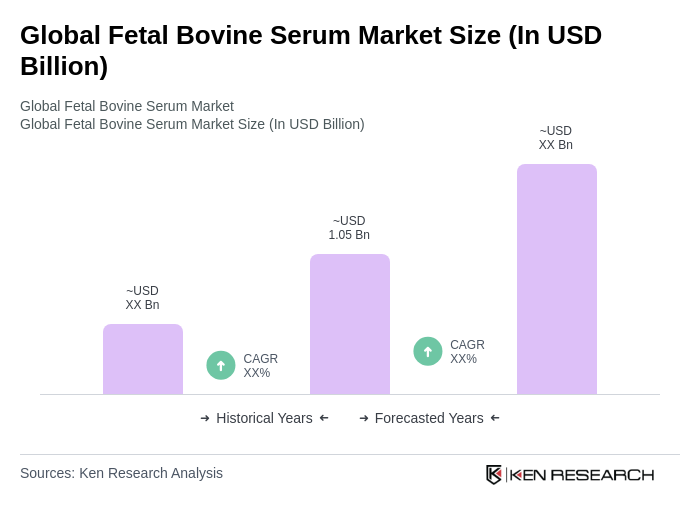
Global Fetal Bovine Serum Market, valued at USD 1.05 Bn, grows due to rising demand in biotechnology, pharmaceuticals, and regenerative medicine, with key segments in heat-inactivated types and pharma end-users.

Region:Global

Author(s):Dev

Product Code:KRAA3022

Pages:89

Published On:August 2025
About the Report

Base Year 2024

Global Fetal Bovine Serum Market Overview

  • The Global Fetal Bovine Serum Market is valued at USD 1.05 billion, based on a five-year historical analysis. This growth is primarily driven by the increasing demand for fetal bovine serum in research and development activities, particularly in the fields of biotechnology and pharmaceuticals. The rising prevalence of chronic diseases, the expansion of cell-based therapies, and the need for advanced therapeutic solutions have further fueled the market's expansion. Additionally, the market is propelled by the growing adoption of biopharmaceuticals, increasing investments in regenerative medicine, and the broadening of vaccine production, as well as advancements in serum-based research technologies .
  • Key players in this market include the United States, Germany, and China, which dominate due to their robust pharmaceutical and biotechnology sectors. The presence of advanced research facilities, significant investments in healthcare innovation, and strong infrastructure for life sciences research in these countries contribute to their leading positions in the fetal bovine serum market .
  • In 2023, the United States Department of Agriculture (USDA) updated its Animal Welfare Act Regulations to enhance the ethical sourcing of animal-derived products, including fetal bovine serum. The regulation, titled "Animal Welfare Act and Animal Welfare Regulations, 2023," requires all suppliers to comply with strict animal welfare standards, including traceability of source animals, humane treatment, and documentation of supply chain practices. These measures are designed to promote sustainable industry practices and ensure the quality and safety of serum used in research and clinical applications .
Global Fetal Bovine Serum Market Size

Global Fetal Bovine Serum Market Segmentation

By Type:The market is segmented into various types of fetal bovine serum, including Heat-Inactivated Fetal Bovine Serum, Non-Heat-Inactivated Fetal Bovine Serum, Charcoal-Stripped Fetal Bovine Serum, Chromatographically Processed Fetal Bovine Serum, Dialyzed Fetal Bovine Serum, Exosome-Depleted Fetal Bovine Serum, Stem Cell Fetal Bovine Serum, and Others. Among these, Heat-Inactivated Fetal Bovine Serum is the most dominant segment due to its widespread use in cell culture applications, where the inactivation of complement proteins is crucial for experimental consistency and reliability. The demand for specialized FBS types, such as exosome-depleted and stem cell FBS, is also rising in advanced research and regenerative medicine applications .
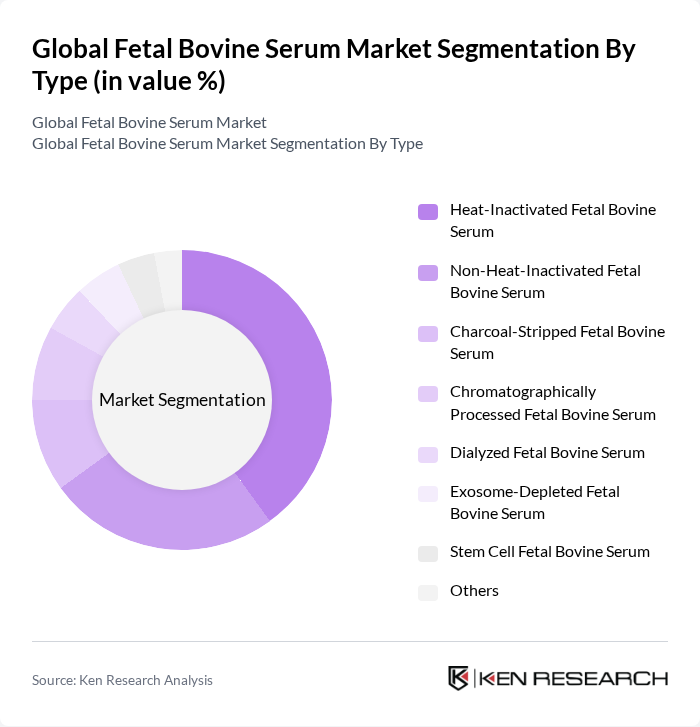
Global Fetal Bovine Serum Market segmentation by Type.

By End-User:The end-user segmentation includes Pharmaceutical Companies, Biotechnology Firms, Academic and Research Institutions, Diagnostic Laboratories, Contract Research Organizations (CROs), and Others. Pharmaceutical Companies are the leading end-users, driven by the increasing demand for innovative drug development, the expansion of biologics and vaccine production, and the need for high-quality serum in clinical trials and research. Biotechnology firms and academic institutions also represent significant market shares due to their roles in advanced research and product development .
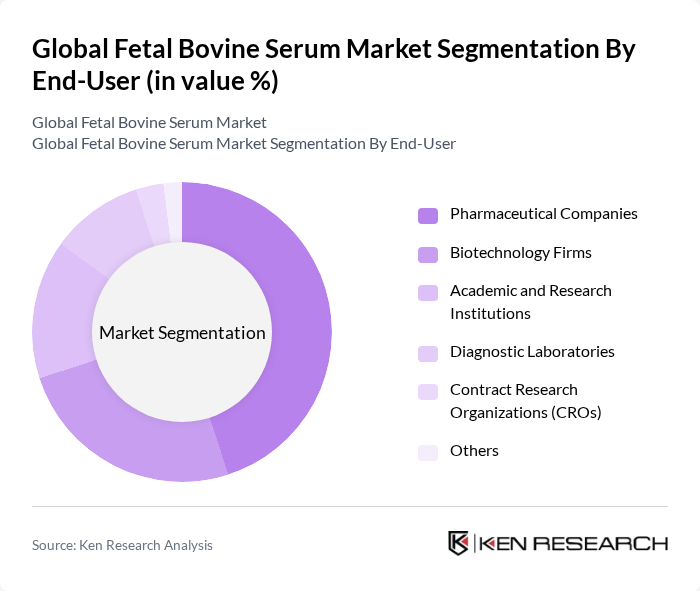
Global Fetal Bovine Serum Market segmentation by End-User.

Global Fetal Bovine Serum Market Competitive Landscape

The Global Fetal Bovine Serum Market is characterized by a dynamic mix of regional and international players. Leading participants such as Thermo Fisher Scientific Inc., Merck KGaA, Cytiva (formerly GE Healthcare Life Sciences), Bovogen Biologicals Pty Ltd, Corning Incorporated, HiMedia Laboratories Pvt. Ltd., Bio-Techne Corporation, Rocky Mountain Biologicals, GeminiBio, Biowest, Atlas Biologicals Inc., Lonza Group AG, MP Biomedicals Inc., PAN Biotech GmbH, Sartorius AG, TCS Biosciences Ltd., Tissue Culture Biologicals, Itoham Yonekyu Holdings Inc., Grifols S.A., VWR International, LLC contribute to innovation, geographic expansion, and service delivery in this space.

Thermo Fisher Scientific Inc.

1956

Waltham, Massachusetts, USA

Merck KGaA

1668

Darmstadt, Germany

Cytiva

2020

Marlborough, Massachusetts, USA

Bovogen Biologicals Pty Ltd

1988

Keilor, Victoria, Australia

Corning Incorporated

1851

Corning, New York, USA

Company

Establishment Year

Headquarters

Group Size (Large, Medium, or Small as per industry convention)

Revenue Growth Rate (YoY %)

Market Share (%)

Geographic Reach (Number of Countries/Regions Served)

Product Portfolio Breadth (Number of FBS Product Types)

Quality Certifications (e.g., GMP, ISO)

Global Fetal Bovine Serum Market Industry Analysis

Growth Drivers

  • Increasing Demand for Biopharmaceuticals:The biopharmaceutical sector is projected to reach $500 billion in future, driven by advancements in drug development and personalized medicine. This surge is significantly increasing the demand for fetal bovine serum (FBS), which is essential for cell culture in vaccine production and therapeutic development. The World Health Organization reported a 10% annual increase in biopharmaceuticals, indicating a robust market for FBS as a critical component in research and production processes.
  • Growth in Cell Culture Applications:The global cell culture market is expected to exceed $25 billion in future, with a compound annual growth rate (CAGR) of 12%. This growth is largely attributed to the rising applications of cell culture in drug discovery, regenerative medicine, and vaccine production. FBS remains a vital supplement in these applications, providing essential growth factors and nutrients, thus driving its demand in the biotechnology and pharmaceutical industries.
  • Rising Investments in Research and Development:Global R&D spending is projected to reach $2 trillion in future, with significant allocations towards biotechnology and pharmaceuticals. This increase in funding is fostering innovation and the development of new therapies, which rely heavily on FBS for cell culture. The National Institutes of Health reported a 5% increase in funding for biomedical research, further emphasizing the critical role of FBS in advancing scientific discovery and product development.

Market Challenges

  • Ethical Concerns Regarding Animal Sourcing:The sourcing of fetal bovine serum raises ethical issues related to animal welfare, leading to increased scrutiny from regulatory bodies and the public. In future, approximately 60% of consumers expressed concerns about animal-derived products, prompting companies to seek alternatives. This shift could hinder the growth of FBS usage as organizations strive to align with ethical standards and consumer preferences for cruelty-free products.
  • Regulatory Compliance Issues:The FBS market faces stringent regulations regarding animal welfare and product quality. Compliance with Good Manufacturing Practices (GMP) and other regulatory frameworks can be costly and time-consuming. In future, the FDA is expected to increase inspections by 15%, which may lead to higher operational costs for manufacturers. These challenges can restrict market entry for new players and impact the overall growth of the FBS market.

Global Fetal Bovine Serum Market Future Outlook

The future of the fetal bovine serum market appears promising, driven by technological advancements and a growing focus on sustainable practices. As the biotechnology sector continues to expand, the demand for high-quality FBS will likely increase. Additionally, the development of serum-free media and alternative sourcing methods may mitigate ethical concerns, allowing for broader acceptance. Collaborations between industry players and research institutions are expected to foster innovation, enhancing the market's resilience against challenges and positioning it for sustainable growth.

Market Opportunities

  • Increasing Adoption in Regenerative Medicine:The regenerative medicine market is projected to reach $100 billion in future, creating significant opportunities for FBS. As researchers explore cell therapies and tissue engineering, the demand for high-quality serum to support these applications will rise, positioning FBS as a critical resource in this rapidly evolving field.
  • Expansion into Emerging Markets:Emerging markets, particularly in Asia-Pacific and Latin America, are experiencing rapid growth in biotechnology and pharmaceutical sectors. With a projected increase in healthcare spending of 8% annually, these regions present lucrative opportunities for FBS suppliers. Establishing a presence in these markets can enhance revenue streams and drive global market expansion.

Scope of the Report

SegmentSub-Segments
By Type

Heat-Inactivated Fetal Bovine Serum

Non-Heat-Inactivated Fetal Bovine Serum

Charcoal-Stripped Fetal Bovine Serum

Chromatographically Processed Fetal Bovine Serum

Dialyzed Fetal Bovine Serum

Exosome-Depleted Fetal Bovine Serum

Stem Cell Fetal Bovine Serum

Others

By End-User

Pharmaceutical Companies

Biotechnology Firms

Academic and Research Institutions

Diagnostic Laboratories

Contract Research Organizations (CROs)

Others

By Application

Cell Culture

Vaccine Production

Diagnostic Testing

Drug Discovery

In Vitro Fertilization

Others

By Source

North America

Europe

Asia-Pacific

Latin America

Middle East & Africa

Others

By Distribution Channel

Direct Sales

Online Sales

Distributors

Others

By Quality Grade

Premium Grade

Standard Grade

Research Grade

Others

By Packaging Type

Bulk Packaging

Single-Use Packaging

Others

Key Target Audience

Investors and Venture Capitalist Firms

Government and Regulatory Bodies (e.g., Food and Drug Administration, European Medicines Agency)

Manufacturers and Producers of Fetal Bovine Serum

Biotechnology and Pharmaceutical Companies

Bioresearch and Laboratory Supply Companies

Industry Associations (e.g., International Society for Stem Cell Research)

Quality Control and Testing Laboratories

Financial Institutions and Investment Banks

Players Mentioned in the Report:

Thermo Fisher Scientific Inc.

Merck KGaA

Cytiva (formerly GE Healthcare Life Sciences)

Bovogen Biologicals Pty Ltd

Corning Incorporated

HiMedia Laboratories Pvt. Ltd.

Bio-Techne Corporation

Rocky Mountain Biologicals

GeminiBio

Biowest

Atlas Biologicals Inc.

Lonza Group AG

MP Biomedicals Inc.

PAN Biotech GmbH

Sartorius AG

TCS Biosciences Ltd.

Tissue Culture Biologicals

Itoham Yonekyu Holdings Inc.

Grifols S.A.

VWR International, LLC

Table of Contents

Market Assessment Phase

1. Executive Summary and Approach


2. Global Fetal Bovine Serum Market Overview

2.1 Key Insights and Strategic Recommendations

2.2 Global Fetal Bovine Serum Market Overview

2.3 Definition and Scope

2.4 Evolution of Market Ecosystem

2.5 Timeline of Key Regulatory Milestones

2.6 Value Chain & Stakeholder Mapping

2.7 Business Cycle Analysis

2.8 Policy & Incentive Landscape


3. Global Fetal Bovine Serum Market Analysis

3.1 Growth Drivers

3.1.1 Increasing Demand for Biopharmaceuticals
3.1.2 Growth in Cell Culture Applications
3.1.3 Rising Investments in Research and Development
3.1.4 Expansion of the Biotechnology Sector

3.2 Market Challenges

3.2.1 Ethical Concerns Regarding Animal Sourcing
3.2.2 Regulatory Compliance Issues
3.2.3 Fluctuating Prices of Raw Materials
3.2.4 Competition from Alternative Products

3.3 Market Opportunities

3.3.1 Increasing Adoption in Regenerative Medicine
3.3.2 Expansion into Emerging Markets
3.3.3 Development of Serum-Free Media
3.3.4 Collaborations with Research Institutions

3.4 Market Trends

3.4.1 Shift Towards Sustainable Sourcing
3.4.2 Technological Advancements in Serum Production
3.4.3 Growing Preference for High-Quality Products
3.4.4 Increased Focus on Quality Control Standards

3.5 Government Regulation

3.5.1 Guidelines on Animal Welfare
3.5.2 Regulations on Import and Export of Biological Materials
3.5.3 Compliance with Good Manufacturing Practices (GMP)
3.5.4 Standards for Quality Assurance in Bioprocessing

4. SWOT Analysis


5. Stakeholder Analysis


6. Porter's Five Forces Analysis


7. Global Fetal Bovine Serum Market Market Size, 2019-2024

7.1 By Value

7.2 By Volume

7.3 By Average Selling Price


8. Global Fetal Bovine Serum Market Segmentation

8.1 By Type

8.1.1 Heat-Inactivated Fetal Bovine Serum
8.1.2 Non-Heat-Inactivated Fetal Bovine Serum
8.1.3 Charcoal-Stripped Fetal Bovine Serum
8.1.4 Chromatographically Processed Fetal Bovine Serum
8.1.5 Dialyzed Fetal Bovine Serum
8.1.6 Exosome-Depleted Fetal Bovine Serum
8.1.7 Stem Cell Fetal Bovine Serum
8.1.8 Others

8.2 By End-User

8.2.1 Pharmaceutical Companies
8.2.2 Biotechnology Firms
8.2.3 Academic and Research Institutions
8.2.4 Diagnostic Laboratories
8.2.5 Contract Research Organizations (CROs)
8.2.6 Others

8.3 By Application

8.3.1 Cell Culture
8.3.2 Vaccine Production
8.3.3 Diagnostic Testing
8.3.4 Drug Discovery
8.3.5 In Vitro Fertilization
8.3.6 Others

8.4 By Source

8.4.1 North America
8.4.2 Europe
8.4.3 Asia-Pacific
8.4.4 Latin America
8.4.5 Middle East & Africa
8.4.6 Others

8.5 By Distribution Channel

8.5.1 Direct Sales
8.5.2 Online Sales
8.5.3 Distributors
8.5.4 Others

8.6 By Quality Grade

8.6.1 Premium Grade
8.6.2 Standard Grade
8.6.3 Research Grade
8.6.4 Others

8.7 By Packaging Type

8.7.1 Bulk Packaging
8.7.2 Single-Use Packaging
8.7.3 Others

9. Global Fetal Bovine Serum Market Competitive Analysis

9.1 Market Share of Key Players

9.2 KPIs for Cross Comparison of Key Players

9.2.1 Company Name
9.2.2 Group Size (Large, Medium, or Small as per industry convention)
9.2.3 Revenue Growth Rate (YoY %)
9.2.4 Market Share (%)
9.2.5 Geographic Reach (Number of Countries/Regions Served)
9.2.6 Product Portfolio Breadth (Number of FBS Product Types)
9.2.7 Quality Certifications (e.g., GMP, ISO)
9.2.8 Supply Chain Reliability (Lead Time, On-Time Delivery %)
9.2.9 Pricing Strategy (Premium, Standard, Value)
9.2.10 R&D Investment (% of Revenue)
9.2.11 Customer Segmentation (Pharma, Biotech, Academic, CRO, Diagnostic)
9.2.12 Innovation Rate (New Product Launches/Year)
9.2.13 Sustainability Practices (Traceability, Ethical Sourcing)
9.2.14 Brand Recognition Score

9.3 SWOT Analysis of Top Players

9.4 Pricing Analysis

9.5 Detailed Profile of Major Companies

9.5.1 Thermo Fisher Scientific Inc.
9.5.2 Merck KGaA
9.5.3 Cytiva (formerly GE Healthcare Life Sciences)
9.5.4 Bovogen Biologicals Pty Ltd
9.5.5 Corning Incorporated
9.5.6 HiMedia Laboratories Pvt. Ltd.
9.5.7 Bio-Techne Corporation
9.5.8 Rocky Mountain Biologicals
9.5.9 GeminiBio
9.5.10 Biowest
9.5.11 Atlas Biologicals Inc.
9.5.12 Lonza Group AG
9.5.13 MP Biomedicals Inc.
9.5.14 PAN Biotech GmbH
9.5.15 Sartorius AG
9.5.16 TCS Biosciences Ltd.
9.5.17 Tissue Culture Biologicals
9.5.18 Itoham Yonekyu Holdings Inc.
9.5.19 Grifols S.A.
9.5.20 VWR International, LLC

10. Global Fetal Bovine Serum Market End-User Analysis

10.1 Procurement Behavior of Key Ministries

10.1.1 Government Research Institutions
10.1.2 Public Health Organizations
10.1.3 Veterinary Services

10.2 Corporate Spend on Infrastructure & Energy

10.2.1 Investment in Biopharmaceutical Facilities
10.2.2 Funding for Research and Development
10.2.3 Expenditure on Quality Control Systems

10.3 Pain Point Analysis by End-User Category

10.3.1 Supply Chain Disruptions
10.3.2 Quality Assurance Challenges
10.3.3 Cost Management Issues

10.4 User Readiness for Adoption

10.4.1 Awareness of Fetal Bovine Serum Benefits
10.4.2 Training and Support Needs
10.4.3 Infrastructure Readiness

10.5 Post-Deployment ROI and Use Case Expansion

10.5.1 Measurement of Effectiveness
10.5.2 Scalability of Applications
10.5.3 Long-term Cost Savings

11. Global Fetal Bovine Serum Market Future Size, 2025-2030

11.1 By Value

11.2 By Volume

11.3 By Average Selling Price


Go-To-Market Strategy Phase

1. Whitespace Analysis + Business Model Canvas

1.1 Market Gaps Identification

1.2 Value Proposition Development

1.3 Revenue Model Structuring

1.4 Key Partnerships Exploration

1.5 Customer Segmentation Analysis

1.6 Competitive Landscape Overview

1.7 Risk Assessment


2. Marketing and Positioning Recommendations

2.1 Branding Strategies

2.2 Product USPs

2.3 Target Market Identification

2.4 Communication Strategy

2.5 Digital Marketing Approaches

2.6 Customer Engagement Tactics


3. Distribution Plan

3.1 Urban Retail Strategies

3.2 Rural NGO Tie-ups

3.3 Online Distribution Channels

3.4 Direct Sales Approaches

3.5 Partnership with Distributors


4. Channel & Pricing Gaps

4.1 Underserved Routes

4.2 Pricing Bands Analysis

4.3 Competitor Pricing Comparison

4.4 Customer Willingness to Pay


5. Unmet Demand & Latent Needs

5.1 Category Gaps Identification

5.2 Consumer Segments Analysis

5.3 Emerging Trends Exploration


6. Customer Relationship

6.1 Loyalty Programs

6.2 After-sales Service

6.3 Customer Feedback Mechanisms


7. Value Proposition

7.1 Sustainability Initiatives

7.2 Integrated Supply Chains

7.3 Competitive Advantages


8. Key Activities

8.1 Regulatory Compliance

8.2 Branding Efforts

8.3 Distribution Setup


9. Entry Strategy Evaluation

9.1 Domestic Market Entry Strategy

9.1.1 Product Mix Considerations
9.1.2 Pricing Band Strategy
9.1.3 Packaging Solutions

9.2 Export Entry Strategy

9.2.1 Target Countries Identification
9.2.2 Compliance Roadmap Development

10. Entry Mode Assessment

10.1 Joint Ventures

10.2 Greenfield Investments

10.3 Mergers & Acquisitions

10.4 Distributor Model Evaluation


11. Capital and Timeline Estimation

11.1 Capital Requirements

11.2 Timelines for Implementation


12. Control vs Risk Trade-Off

12.1 Ownership Considerations

12.2 Partnerships Evaluation


13. Profitability Outlook

13.1 Breakeven Analysis

13.2 Long-term Sustainability Strategies


14. Potential Partner List

14.1 Distributors

14.2 Joint Ventures

14.3 Acquisition Targets


15. Execution Roadmap

15.1 Phased Plan for Market Entry

15.1.1 Market Setup
15.1.2 Market Entry
15.1.3 Growth Acceleration
15.1.4 Scale & Stabilize

15.2 Key Activities and Milestones

15.2.1 Milestone Planning
15.2.2 Activity Tracking

Research Methodology

ApproachModellingSample

Phase 1: Approach1

Desk Research

  • Analysis of industry reports from veterinary and biopharmaceutical associations
  • Review of scientific publications and journals focusing on fetal bovine serum applications
  • Examination of market trends and forecasts from agricultural and livestock market studies

Primary Research

  • Interviews with key opinion leaders in the biopharmaceutical and research sectors
  • Surveys targeting laboratory managers and procurement specialists in research institutions
  • Field interviews with livestock producers and serum suppliers to gather firsthand insights

Validation & Triangulation

  • Cross-validation of data through multiple industry sources and expert opinions
  • Triangulation of findings from primary interviews and secondary data sources
  • Sanity checks conducted through expert panel discussions and feedback sessions

Phase 2: Market Size Estimation1

Top-down Assessment

  • Estimation of global market size based on veterinary and pharmaceutical spending
  • Segmentation by application areas such as cell culture, vaccine production, and diagnostics
  • Incorporation of regional market dynamics and regulatory impacts on serum usage

Bottom-up Modeling

  • Volume estimates derived from production capacities of leading serum manufacturers
  • Cost analysis based on pricing trends and supply chain logistics
  • Calculation of market size using volume x price methodology across different regions

Forecasting & Scenario Analysis

  • Multi-variable regression analysis incorporating factors like R&D investment and livestock trends
  • Scenario modeling based on potential regulatory changes and market disruptions
  • Development of baseline, optimistic, and pessimistic forecasts through 2030

Phase 3: CATI Sample Composition1

Scope Item/SegmentSample SizeTarget Respondent Profiles
Biopharmaceutical Research Facilities100Lab Managers, Research Scientists
Veterinary Clinics and Hospitals60Veterinarians, Clinic Administrators
Livestock Production Companies50Farm Managers, Procurement Officers
Academic Research Institutions70Research Directors, Laboratory Technicians
Regulatory Bodies and Associations40Policy Makers, Compliance Officers

Frequently Asked Questions

What is the current value of the Global Fetal Bovine Serum Market?

The Global Fetal Bovine Serum Market is valued at approximately USD 1.05 billion, driven by increasing demand in biotechnology and pharmaceutical research and development activities.

What factors are driving the growth of the Fetal Bovine Serum Market?

Which countries are leading in the Fetal Bovine Serum Market?

What are the main types of Fetal Bovine Serum available in the market?

Other Regional/Country Reports

Other Adjacent Reports

Thailand Cell Culture Media Market

Kuwait Biopharmaceutical Manufacturing Market

UAE Regenerative Medicine Market

Bahrain Vaccine Development Market

Philippines Stem Cell Therapy Market

Japan Biotechnology Research Market

Kuwait Laboratory Reagents Market

Singapore Animal-Derived Products Market

Qatar Serum Alternatives Market

Brazil Pharmaceutical R&D Market

Why Buy From Us?

Refine Robust Result (RRR) Framework

What makes us stand out is that our consultants follow Robust, Refine and Result (RRR) methodology. Robust for clear definitions, approaches and sanity checking, Refine for differentiating respondents' facts and opinions, and Result for presenting data with story.

Our Reach Is Unmatched

We have set a benchmark in the industry by offering our clients with syndicated and customized market research reports featuring coverage of entire market as well as meticulous research and analyst insights.

Shifting the Research Paradigm

While we don't replace traditional research, we flip the method upside down. Our dual approach of Top Bottom & Bottom Top ensures quality deliverable by not just verifying company fundamentals but also looking at the sector and macroeconomic factors.

More Insights-Better Decisions

With one step in the future, our research team constantly tries to show you the bigger picture. We help with some of the tough questions you may encounter along the way: How is the industry positioned? Best marketing channel? KPI's of competitors? By aligning every element, we help maximize success.

Transparency and Trust

Our report gives you instant access to the answers and sources that other companies might choose to hide. We elaborate each steps of research methodology we have used and showcase you the sample size to earn your trust.

Round the Clock Support

If you need any support, we are here! We pride ourselves on universe strength, data quality, and quick, friendly, and professional service.

Why Clients Choose Us?

400000+
Reports in repository
150+
Consulting projects a year
100+
Analysts
8000+
Client Queries in 2022








