Global Food Beverage Air Filtration Market Size Share Growth Drivers Trends Opportunities & Forecast 2025–2030

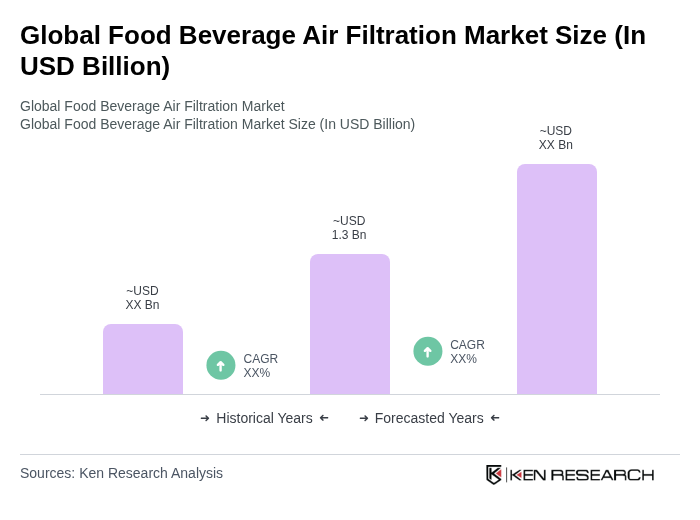
The global food and beverage air filtration market, valued at USD 1.3 billion, grows due to strict safety standards and tech innovations for better air quality in processing.

Region:Global

Author(s):Dev

Product Code:KRAC3569

Pages:87

Published On:January 2026
About the Report

Base Year 2024

Global Food Beverage Air Filtration Market Overview

  • The Global Food Beverage Air Filtration Market is valued at USD 1.3 billion, based on a five-year historical analysis of recent industry estimates for food and beverage air filters and air filtration systems. This growth is primarily driven by increasing health and safety regulations, rising consumer awareness regarding food quality, and the need for efficient air filtration systems in food and beverage processing facilities. The market is also influenced by technological advancements in filtration media and system design, such as energy-efficient HEPA and ULPA filters and low-pressure-drop configurations, which enhance air quality, reduce operating costs, and improve overall process reliability.
  • Key players in this market include the United States, Germany, and China, which dominate due to their robust food and beverage processing industries, extensive packaged and processed food production, and significant investments in advanced filtration technologies. Stringent food safety and hygiene frameworks, such as hazard analysis and critical control point (HACCP) implementation and advanced hygiene standards in North America, Europe, and Asia, combined with the presence of major equipment manufacturers and large-scale production hubs, further contribute to their market leadership.
  • In the United States, air quality requirements relevant to food and beverage facilities are primarily driven by federal food safety and sanitation law rather than a single dedicated rule for air filtration systems in food plants. The Food Safety Modernization Act (FSMA) – specifically the Current Good Manufacturing Practice, Hazard Analysis, and Risk-Based Preventive Controls for Human Food rule issued by the U.S. Food and Drug Administration (21 CFR Part 117, 2015) – requires facilities to control environmental and air-related hazards as part of their preventive controls and hygienic design programs, leading processors to adopt advanced air filtration solutions to minimize airborne contaminants and support compliance and consumer trust.
Global Food Beverage Air Filtration Market Size

Global Food Beverage Air Filtration Market Segmentation

By Filter Type:The market is segmented into various filter types, including HEPA Filters, ULPA Filters, Activated Carbon Filters, Electrostatic Precipitators, Dust Collectors & Cartridge Collectors, Cyclone Separators, and Others. HEPA and ULPA filters together account for the largest share of revenues in food and beverage air filtration, reflecting their high efficiency in capturing fine particulates and microorganisms that can compromise product safety, particularly in food and ingredients, dairy, and bottled water applications. Among these, HEPA Filters are the most widely used due to their proven effectiveness in maintaining controlled, hygienic air conditions in production and packaging areas where air quality is critical.
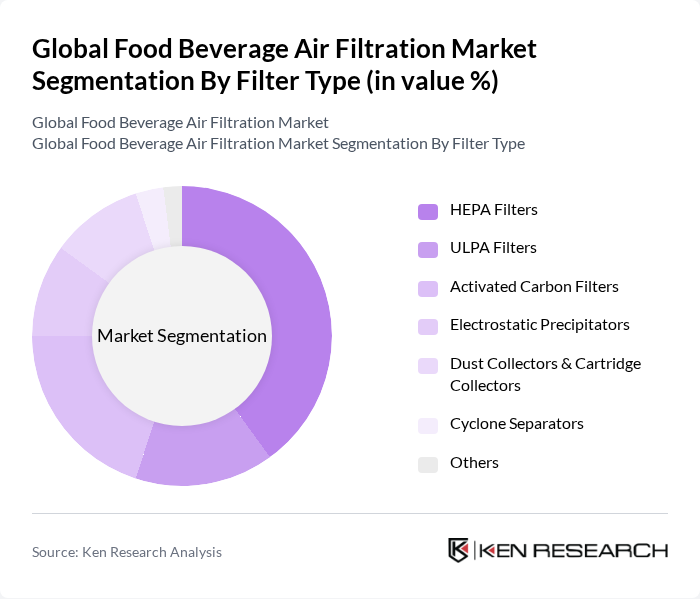
Global Food Beverage Air Filtration Market segmentation by Filter Type.

By Product:The product segmentation includes Industrial Air Filters, Dust Collectors, Mist Collectors, Cartridge Collectors, and Others. Industrial air filtration systems, including centralized HVAC-integrated filters, process-area filter housings, and cleanroom-grade air handling units, dominate this segment due to their extensive application in large-scale food and beverage manufacturing environments where continuous control of airborne particles, odors, and microorganisms is essential for compliance with food safety management systems and for protecting product quality and shelf life.
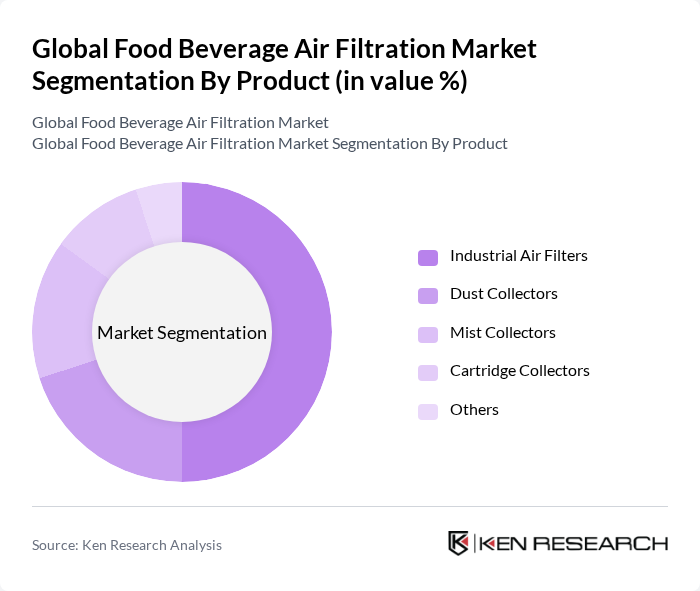
Global Food Beverage Air Filtration Market segmentation by Product.

Global Food Beverage Air Filtration Market Competitive Landscape

The Global Food Beverage Air Filtration Market is characterized by a dynamic mix of regional and international players. Leading participants such as Camfil Group, Donaldson Company, Inc., 3M Company, AAF International (Daikin Group), Filtration Group Corporation, Parker-Hannifin Corporation, Honeywell International Inc., Daikin Industries, Ltd., TROX GmbH, Swegon Group AB, Air Products and Chemicals, Inc., MANN+HUMMEL Group, Lennox International Inc., Systemair AB, and other prominent regional players contribute to innovation, geographic expansion, and service delivery in this space by offering high-efficiency particulate filters, activated carbon solutions, and complete air handling systems tailored to food and beverage production requirements.

Camfil Group

1963

Stockholm, Sweden

Donaldson Company, Inc.

1915

Bloomington, Minnesota, USA

3M Company

1902

Saint Paul, Minnesota, USA

AAF International (Daikin Group)

1921

Louisville, Kentucky, USA

Filtration Group Corporation

2009

Chicago, Illinois, USA

Company

Establishment Year

Headquarters

Group Size (Large, Medium, or Small as per industry convention)

Revenue (USD Million)

Revenue CAGR (3–5 Years)

EBITDA Margin (%)

Market Share (%) in Food & Beverage Air Filtration

Geographic Footprint (Number of Countries / Regions Served)

Global Food Beverage Air Filtration Market Industry Analysis

Growth Drivers

  • Increasing Demand for Food Safety and Quality:The global food safety market is projected to reach $20.5 billion in future, driven by heightened consumer expectations for quality. In future, foodborne illnesses affected approximately 600 million people worldwide, emphasizing the need for stringent safety measures. Enhanced air filtration systems are crucial in maintaining food quality, as they reduce contaminants and pathogens, thereby supporting the food industry's commitment to safety and quality assurance.
  • Stringent Regulations on Air Quality in Food Processing:Regulatory bodies, including the FDA and EPA, have implemented stricter air quality standards, mandating the use of advanced filtration systems in food processing facilities. In future, compliance costs for food manufacturers are expected to rise by 15%, pushing them to invest in effective air filtration solutions. This regulatory pressure is a significant driver for the adoption of air filtration technologies, ensuring cleaner production environments.
  • Technological Advancements in Filtration Systems:The air filtration technology market is anticipated to grow significantly, with innovations such as HEPA and activated carbon filters becoming more prevalent. In future, the market for advanced filtration technologies is projected to reach $8 billion, driven by improvements in efficiency and effectiveness. These advancements not only enhance air quality but also reduce operational costs, making them attractive investments for food and beverage manufacturers.

Market Challenges

  • High Initial Investment Costs:The upfront costs associated with installing advanced air filtration systems can be prohibitive for many food processing companies. In future, the average installation cost for a high-efficiency filtration system is estimated at $150,000, which can deter smaller businesses from upgrading. This financial barrier limits market penetration and adoption rates, particularly in regions with lower economic resources.
  • Limited Awareness of Air Filtration Benefits:Despite the clear advantages of air filtration systems, many food manufacturers remain unaware of their benefits. A survey conducted in future indicated that 40% of small to medium-sized enterprises (SMEs) lack knowledge about air quality management. This gap in awareness hinders market growth, as companies may overlook the importance of investing in air filtration technologies to ensure food safety and compliance.

Global Food Beverage Air Filtration Market Future Outlook

The future of the food beverage air filtration market appears promising, driven by increasing regulatory pressures and technological advancements. As food safety becomes a paramount concern, manufacturers are expected to prioritize investments in advanced filtration systems. Additionally, the integration of IoT technologies will enhance monitoring and efficiency, allowing for real-time adjustments. The focus on sustainability will further propel the development of eco-friendly filtration solutions, aligning with global trends towards greener practices in food production.

Market Opportunities

  • Expansion in Emerging Markets:Emerging markets, particularly in Asia and Africa, present significant growth opportunities for air filtration systems. With rising disposable incomes and urbanization, the demand for processed food is increasing. In future, these regions are expected to see a 25% rise in food processing activities, driving the need for effective air filtration solutions to ensure compliance with international safety standards.
  • Development of Eco-Friendly Filtration Solutions:The growing emphasis on sustainability is creating opportunities for the development of eco-friendly filtration technologies. In future, the market for green filtration solutions is projected to grow by 30%, as companies seek to reduce their environmental footprint. Innovations such as biodegradable filters and energy-efficient systems will not only meet regulatory requirements but also appeal to environmentally conscious consumers.

Scope of the Report

SegmentSub-Segments
By Filter Type

HEPA Filters

ULPA Filters

Activated Carbon Filters

Electrostatic Precipitators

Dust Collectors & Cartridge Collectors

Cyclone Separators

Others

By Product

Industrial Air Filters

Dust Collectors

Mist Collectors

Cartridge Collectors

Others

By Application

Beverage Processing

Dairy Processing

Meat Processing

Bakery & Confectionery

Food & Ingredients

Bottled Water & Other Beverages

Others

By Process

Air Purification

Odor Control

Contaminant & Particulate Removal

Microbial Control

Others

By Material Type

Fiberglass

Synthetic Polymer Media

Activated Carbon

Metal Mesh

Others

By End User

Food Manufacturers

Beverage Companies

Dairy Producers

Restaurants & Commercial Kitchens

Others

By Region

North America

Europe

Asia-Pacific

Latin America

Middle East & Africa

Key Target Audience

Investors and Venture Capitalist Firms

Government and Regulatory Bodies (e.g., Food and Drug Administration, Environmental Protection Agency)

Manufacturers and Producers of Air Filtration Systems

Food and Beverage Processing Companies

Distributors and Retailers of Air Filtration Products

Technology Providers for Air Filtration Solutions

Industry Associations (e.g., International Food and Beverage Alliance)

Financial Institutions and Banks

Players Mentioned in the Report:

Camfil Group

Donaldson Company, Inc.

3M Company

AAF International (Daikin Group)

Filtration Group Corporation

Parker-Hannifin Corporation

Honeywell International Inc.

Daikin Industries, Ltd.

TROX GmbH

Swegon Group AB

Air Products and Chemicals, Inc.

MANN+HUMMEL Group

Lennox International Inc.

Systemair AB

Other Prominent Regional Players

Table of Contents

Market Assessment Phase

1. Executive Summary and Approach


2. Global Food Beverage Air Filtration Market Overview

2.1 Key Insights and Strategic Recommendations

2.2 Global Food Beverage Air Filtration Market Overview

2.3 Definition and Scope

2.4 Evolution of Market Ecosystem

2.5 Timeline of Key Regulatory Milestones

2.6 Value Chain & Stakeholder Mapping

2.7 Business Cycle Analysis

2.8 Policy & Incentive Landscape


3. Global Food Beverage Air Filtration Market Analysis

3.1 Growth Drivers

3.1.1 Increasing demand for food safety and quality
3.1.2 Stringent regulations on air quality in food processing
3.1.3 Technological advancements in filtration systems
3.1.4 Rising consumer awareness regarding health and hygiene

3.2 Market Challenges

3.2.1 High initial investment costs
3.2.2 Limited awareness of air filtration benefits
3.2.3 Variability in regulatory standards across regions
3.2.4 Competition from alternative purification technologies

3.3 Market Opportunities

3.3.1 Expansion in emerging markets
3.2.2 Development of eco-friendly filtration solutions
3.3.3 Integration of IoT in air filtration systems
3.3.4 Collaborations with food and beverage manufacturers

3.4 Market Trends

3.4.1 Shift towards sustainable and energy-efficient solutions
3.4.2 Increasing automation in food processing facilities
3.4.3 Growing preference for modular filtration systems
3.4.4 Rise in demand for customized filtration solutions

3.5 Government Regulation

3.5.1 Implementation of stricter air quality standards
3.5.2 Incentives for adopting green technologies
3.5.3 Regulations on emissions from food processing plants
3.5.4 Guidelines for maintenance and operation of filtration systems

4. SWOT Analysis


5. Stakeholder Analysis


6. Porter's Five Forces Analysis


7. Global Food Beverage Air Filtration Market Market Size, 2019-2024

7.1 By Value

7.2 By Volume

7.3 By Average Selling Price


8. Global Food Beverage Air Filtration Market Segmentation

8.1 By Filter Type

8.1.1 HEPA Filters
8.1.2 ULPA Filters
8.1.3 Activated Carbon Filters
8.1.4 Electrostatic Precipitators
8.1.5 Dust Collectors & Cartridge Collectors
8.1.6 Cyclone Separators
8.1.7 Others

8.2 By Product

8.2.1 Industrial Air Filters
8.2.2 Dust Collectors
8.2.3 Mist Collectors
8.2.4 Cartridge Collectors
8.2.5 Others

8.3 By Application

8.3.1 Beverage Processing
8.3.2 Dairy Processing
8.3.3 Meat Processing
8.3.4 Bakery & Confectionery
8.3.5 Food & Ingredients
8.3.6 Bottled Water & Other Beverages
8.3.7 Others

8.4 By Process

8.4.1 Air Purification
8.4.2 Odor Control
8.4.3 Contaminant & Particulate Removal
8.4.4 Microbial Control
8.4.5 Others

8.5 By Material Type

8.5.1 Fiberglass
8.5.2 Synthetic Polymer Media
8.5.3 Activated Carbon
8.5.4 Metal Mesh
8.5.5 Others

8.6 By End User

8.6.1 Food Manufacturers
8.6.2 Beverage Companies
8.6.3 Dairy Producers
8.6.4 Restaurants & Commercial Kitchens
8.6.5 Others

8.7 By Region

8.7.1 North America
8.7.2 Europe
8.7.3 Asia-Pacific
8.7.4 Latin America
8.7.5 Middle East & Africa

9. Global Food Beverage Air Filtration Market Competitive Analysis

9.1 Market Share of Key Players

9.2 Cross Comparison of Key Players

9.2.1 Company Name
9.2.2 Group Size (Large, Medium, or Small as per industry convention)
9.2.3 Revenue (USD Million)
9.2.4 Revenue CAGR (3–5 Years)
9.2.5 EBITDA Margin (%)
9.2.6 Market Share (%) in Food & Beverage Air Filtration
9.2.7 Geographic Footprint (Number of Countries / Regions Served)
9.2.8 Installed Base in F&B Facilities (Number of Sites)
9.2.9 R&D Spend (% of Revenue)
9.2.10 New Product Launches (Last 3 Years)
9.2.11 Average Selling Price Positioning (vs. Market Index)
9.2.12 Key F&B Client Count (Top 50 Accounts)

9.3 SWOT Analysis of Top Players

9.4 Pricing Analysis

9.5 Detailed Profile of Major Companies

9.5.1 Camfil Group
9.5.2 Donaldson Company, Inc.
9.5.3 3M Company
9.5.4 AAF International (Daikin Group)
9.5.5 Filtration Group Corporation
9.5.6 Parker-Hannifin Corporation
9.5.7 Honeywell International Inc.
9.5.8 Daikin Industries, Ltd.
9.5.9 TROX GmbH
9.5.10 Swegon Group AB
9.5.11 Air Products and Chemicals, Inc.
9.5.12 MANN+HUMMEL Group
9.5.13 Lennox International Inc.
9.5.14 Systemair AB
9.5.15 Other Prominent Regional Players

10. Global Food Beverage Air Filtration Market End-User Analysis

10.1 Procurement Behavior of Key Ministries

10.1.1 Government procurement policies
10.1.2 Budget allocation for food safety
10.1.3 Evaluation criteria for suppliers
10.1.4 Collaboration with industry stakeholders

10.2 Corporate Spend on Infrastructure & Energy

10.2.1 Investment in air quality improvement
10.2.2 Budgeting for compliance with regulations
10.2.3 Funding for technology upgrades
10.2.4 Cost-benefit analysis of filtration systems

10.3 Pain Point Analysis by End-User Category

10.3.1 Challenges in maintaining air quality
10.3.2 Cost implications of filtration systems
10.3.3 Need for reliable suppliers
10.3.4 Integration with existing systems

10.4 User Readiness for Adoption

10.4.1 Awareness of filtration benefits
10.4.2 Training and support requirements
10.4.3 Financial readiness for investment
10.4.4 Technological adaptability

10.5 Post-Deployment ROI and Use Case Expansion

10.5.1 Measurement of air quality improvements
10.5.2 Cost savings from reduced downtime
10.5.3 Expansion into new applications
10.5.4 Long-term sustainability benefits

11. Global Food Beverage Air Filtration Market Future Size, 2025-2030

11.1 By Value

11.2 By Volume

11.3 By Average Selling Price


Go-To-Market Strategy Phase

1. Whitespace Analysis + Business Model Canvas

1.1 Market gaps and opportunities

1.2 Value proposition development

1.3 Revenue model exploration

1.4 Customer segmentation analysis

1.5 Competitive landscape overview

1.6 Key partnerships identification

1.7 Risk assessment and mitigation


2. Marketing and Positioning Recommendations

2.1 Branding strategies

2.2 Product USPs

2.3 Target audience identification

2.4 Communication strategy

2.5 Digital marketing initiatives

2.6 Trade show participation

2.7 Customer engagement tactics


3. Distribution Plan

3.1 Urban retail vs rural NGO tie-ups

3.2 Direct sales strategies

3.3 Online distribution channels

3.4 Partnerships with distributors

3.5 Logistics and supply chain management

3.6 Inventory management practices

3.7 Customer service and support


4. Channel & Pricing Gaps

4.1 Underserved routes

4.2 Pricing bands

4.3 Competitor pricing analysis

4.4 Value-based pricing strategies

4.5 Discounts and promotions

4.6 Bundling opportunities

4.7 Price elasticity considerations


5. Unmet Demand & Latent Needs

5.1 Category gaps

5.2 Consumer segments

5.3 Emerging trends analysis

5.4 Feedback from end-users

5.5 Innovation opportunities

5.6 Market entry barriers

5.7 Future demand forecasting


6. Customer Relationship

6.1 Loyalty programs

6.2 After-sales service

6.3 Customer feedback mechanisms

6.4 Relationship management strategies

6.5 Community engagement initiatives

6.6 Customer education programs

6.7 Retention strategies


7. Value Proposition

7.1 Sustainability

7.2 Integrated supply chains

7.3 Cost-effectiveness

7.4 Quality assurance

7.5 Innovation and technology

7.6 Customer-centric approach

7.7 Long-term partnerships


8. Key Activities

8.1 Regulatory compliance

8.2 Branding

8.3 Distribution setup

8.4 Training and development

8.5 Market research and analysis

8.6 Performance monitoring

8.7 Stakeholder engagement


9. Entry Strategy Evaluation

9.1 Domestic Market Entry Strategy

9.1.1 Product mix
9.1.2 Pricing band
9.1.3 Packaging
9.1.4 Marketing approach
9.1.5 Distribution channels
9.1.6 Customer engagement
9.1.7 Risk management

9.2 Export Entry Strategy

9.2.1 Target countries
9.2.2 Compliance roadmap
9.2.3 Market entry barriers
9.2.4 Distribution partnerships
9.2.5 Marketing localization
9.2.6 Regulatory considerations
9.2.7 Risk assessment

10. Entry Mode Assessment

10.1 JV

10.2 Greenfield

10.3 M&A

10.4 Distributor Model

10.5 Risk vs. control analysis

10.6 Strategic fit evaluation

10.7 Long-term sustainability


11. Capital and Timeline Estimation

11.1 Capital requirements

11.2 Timelines

11.3 Funding sources

11.4 Financial projections

11.5 Investment risks

11.6 Milestone tracking

11.7 Resource allocation


12. Control vs Risk Trade-Off

12.1 Ownership vs Partnerships

12.2 Risk management strategies

12.3 Control mechanisms

12.4 Partnership evaluation

12.5 Long-term implications

12.6 Flexibility considerations

12.7 Exit strategies


13. Profitability Outlook

13.1 Breakeven analysis

13.2 Long-term sustainability

13.3 Profit margin analysis

13.4 Revenue growth projections

13.5 Cost management strategies

13.6 Financial health indicators

13.7 Market positioning impact


14. Potential Partner List

14.1 Distributors

14.2 JVs

14.3 Acquisition targets

14.4 Strategic alliances

14.5 Industry collaborations

14.6 Research partnerships

14.7 Technology providers


15. Execution Roadmap

15.1 Phased Plan for Market Entry

15.1.1 Market Setup
15.1.2 Market Entry
15.1.3 Growth Acceleration
15.1.4 Scale & Stabilize

15.2 Key Activities and Milestones

15.2.1 Initial setup
15.2.2 Launch activities
15.2.3 Performance reviews
15.2.4 Expansion plans
15.2.5 Stakeholder engagement
15.2.6 Continuous improvement
15.2.7 Long-term strategy alignment

Research Methodology

ApproachModellingSample

Phase 1: Approach1

Desk Research

  • Industry reports from global food and beverage associations
  • Market analysis publications from leading research firms
  • Regulatory documents and guidelines from food safety authorities

Primary Research

  • Interviews with air filtration technology providers in the food and beverage sector
  • Surveys with quality assurance managers in food processing companies
  • Field interviews with maintenance supervisors in beverage manufacturing plants

Validation & Triangulation

  • Cross-validation of data from multiple industry sources and expert opinions
  • Triangulation of market trends with historical data and future projections
  • Sanity checks through feedback from industry panels and focus groups

Phase 2: Market Size Estimation1

Top-down Assessment

  • Analysis of global food and beverage market size and growth rates
  • Segmentation by application areas such as dairy, meat, and beverages
  • Incorporation of regional market dynamics and consumer trends

Bottom-up Modeling

  • Estimation of air filtration demand based on production volumes in food and beverage sectors
  • Cost analysis of air filtration systems and their installation in various facilities
  • Volume x cost basis for different filtration technologies used in the industry

Forecasting & Scenario Analysis

  • Multi-factor regression analysis considering health regulations and environmental standards
  • Scenario modeling based on technological advancements and market adoption rates
  • Baseline, optimistic, and pessimistic forecasts through 2030

Phase 3: CATI Sample Composition1

Scope Item/SegmentSample SizeTarget Respondent Profiles
Dairy Processing Facilities110Production Managers, Quality Control Supervisors
Meat Processing Plants90Operations Directors, Safety Compliance Officers
Beverage Manufacturing Units95Maintenance Managers, Engineering Heads
Packaged Food Companies75Supply Chain Managers, Facility Managers
Food Safety Regulatory Bodies60Regulatory Affairs Specialists, Compliance Managers

Frequently Asked Questions

What is the current value of the Global Food Beverage Air Filtration Market?

The Global Food Beverage Air Filtration Market is valued at approximately USD 1.3 billion, reflecting a significant growth driven by increasing health and safety regulations, consumer awareness regarding food quality, and the demand for efficient air filtration systems in food processing facilities.

What are the main drivers of growth in the food beverage air filtration market?

Which filter types dominate the food beverage air filtration market?

What challenges does the food beverage air filtration market face?

Other Regional/Country Reports

Indonesia Food Beverage Air Filtration Market

Malaysia Food Beverage Air Filtration Market

KSA Food Beverage Air Filtration Market

APAC Food Beverage Air Filtration Market

SEA Food Beverage Air Filtration Market

Vietnam Food Beverage Air Filtration Market

Why Buy From Us?

Refine Robust Result (RRR) Framework

What makes us stand out is that our consultants follow Robust, Refine and Result (RRR) methodology. Robust for clear definitions, approaches and sanity checking, Refine for differentiating respondents' facts and opinions, and Result for presenting data with story.

Our Reach Is Unmatched

We have set a benchmark in the industry by offering our clients with syndicated and customized market research reports featuring coverage of entire market as well as meticulous research and analyst insights.

Shifting the Research Paradigm

While we don't replace traditional research, we flip the method upside down. Our dual approach of Top Bottom & Bottom Top ensures quality deliverable by not just verifying company fundamentals but also looking at the sector and macroeconomic factors.

More Insights-Better Decisions

With one step in the future, our research team constantly tries to show you the bigger picture. We help with some of the tough questions you may encounter along the way: How is the industry positioned? Best marketing channel? KPI's of competitors? By aligning every element, we help maximize success.

Transparency and Trust

Our report gives you instant access to the answers and sources that other companies might choose to hide. We elaborate each steps of research methodology we have used and showcase you the sample size to earn your trust.

Round the Clock Support

If you need any support, we are here! We pride ourselves on universe strength, data quality, and quick, friendly, and professional service.

Why Clients Choose Us?

400000+
Reports in repository
150+
Consulting projects a year
100+
Analysts
8000+
Client Queries in 2022








