About the Report
Base Year 2024Listen to the audio summary
Global Football Clubs Market Overview
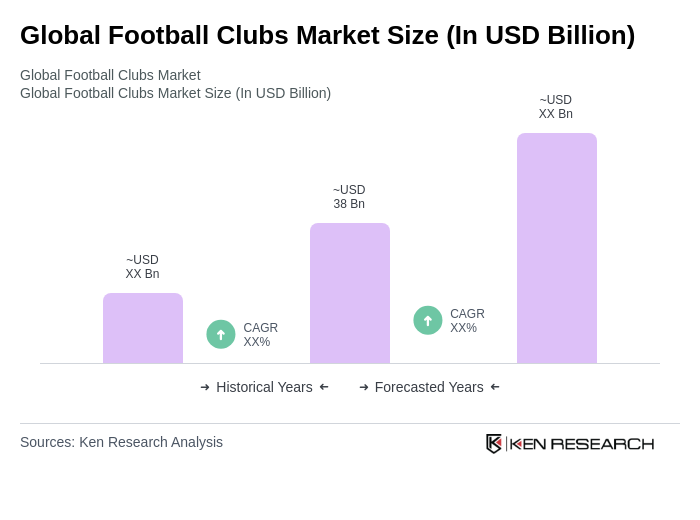
- The Global Football Clubs Market is valued at USD 38 billion, based on a five-year historical analysis. This valuation reflects the aggregate revenue of leading clubs and the broader ecosystem, driven by surging global fan engagement, substantial broadcasting contracts, and the expansion of digital platforms that boost club visibility and monetization opportunities. The market has experienced notable growth in sponsorship agreements and merchandise sales, underscoring the sport's escalating worldwide popularity .
- Countries such as England, Spain, Germany, and Italy continue to lead the market, attributed to their deep-rooted football traditions, competitive domestic leagues, and the presence of globally recognized clubs. Major cities including London, Barcelona, and Munich serve as epicenters, hosting clubs that draw millions of fans and attract significant investment, reinforcing their roles as football industry hubs .
- The Union of European Football Associations (UEFA) introduced the Financial Fair Play (FFP) Regulations, most recently updated in 2023, to ensure financial sustainability among football clubs. Under these rules, clubs participating in UEFA competitions must balance their books, limit losses, and comply with spending thresholds on player transfers and wages. The FFP Regulations, issued by UEFA in 2023, require clubs to submit regular financial disclosures and adhere to squad cost ratios, with non-compliance resulting in sanctions such as fines or competition bans .
Global Football Clubs Market Segmentation
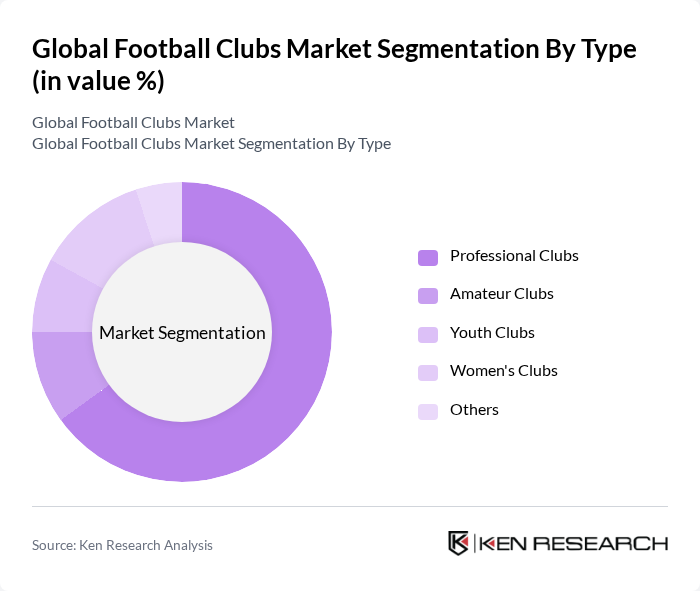
By Type:The market is segmented into professional, amateur, youth, women's, and other clubs. Professional clubs hold the largest share, driven by established fan bases, robust revenue streams, and consistent performance in domestic and international competitions. These clubs attract elite talent and major sponsorships, resulting in heightened visibility and financial strength. Amateur and youth clubs, while contributing less to total market revenue, play a pivotal role in grassroots development and the cultivation of future professional players .
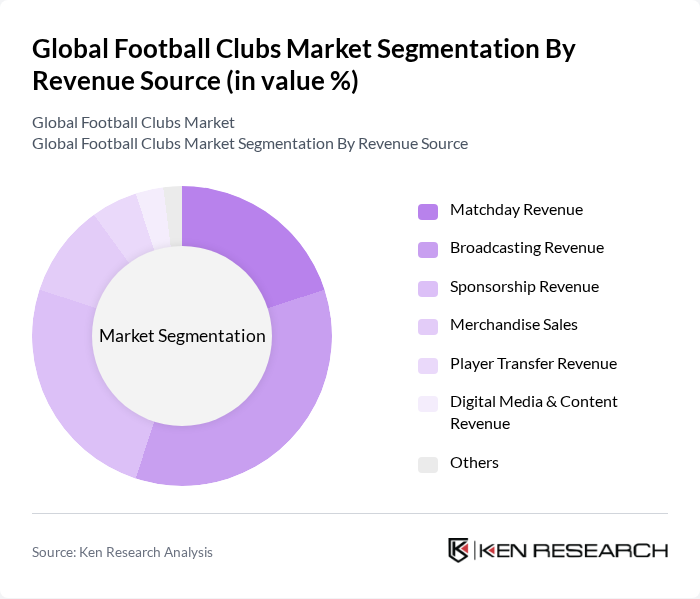
By Revenue Source:Football club revenues are derived from matchday income, broadcasting rights, sponsorships, merchandise sales, player transfers, digital media, and other channels. Broadcasting revenue remains the largest contributor, fueled by international television deals and global viewership. Commercial revenue, encompassing sponsorship and merchandise, is also a major driver, especially for top-tier clubs. Matchday revenue is significant for clubs with large stadiums and loyal fan bases, while digital media and content are emerging as growth areas .
Global Football Clubs Market Competitive Landscape
The Global Football Clubs Market is characterized by a dynamic mix of regional and international players. Leading participants such as Manchester United F.C., FC Barcelona, Real Madrid C.F., FC Bayern Munich, Liverpool F.C., Paris Saint-Germain F.C., Manchester City F.C., Chelsea F.C., Juventus F.C., Arsenal F.C., Tottenham Hotspur F.C., Borussia Dortmund, FC Internazionale Milano (Inter Milan), AC Milan, AFC Ajax, SL Benfica, Atlético de Madrid, Olympique Lyonnais, Rangers F.C., Flamengo contribute to innovation, geographic expansion, and service delivery in this space.
Global Football Clubs Market Industry Analysis
Growth Drivers
- Increasing Global Fan Engagement:The global football fan base is estimated to reach 4 billion by in future, driven by enhanced digital engagement strategies. Clubs are leveraging social media platforms, with over 4 billion active users engaging with football content. This engagement translates into increased match attendance, with stadiums reporting an average occupancy rate of 85%. The rise in fan engagement is further supported by the growing popularity of international tournaments, which attract millions of viewers and boost club visibility.
- Rising Sponsorship and Advertising Revenues:Sponsorship revenues for football clubs are projected to exceed $40 billion in future, reflecting a robust growth trajectory. Major brands are increasingly investing in football, with top clubs securing multi-million dollar deals. For instance, the English Premier League clubs collectively earned approximately $1.5 billion in sponsorships in the most recent completed season. This influx of funds is crucial for clubs to enhance their competitive edge and invest in player development and facilities.
- Expansion of Digital Media Platforms:The digital media landscape is evolving, with football clubs generating over $3 billion in revenue from digital channels in future. Streaming services and social media platforms are pivotal in reaching younger audiences, with 70% of fans aged 18-34 preferring online content. Clubs are capitalizing on this trend by creating exclusive digital content, which not only enhances fan loyalty but also opens new revenue streams through subscriptions and advertising partnerships.
Market Challenges
- Financial Sustainability of Clubs:Many football clubs face financial challenges, with over 50% of clubs in Europe reporting losses in the last financial year. The average debt level for clubs in the top five European leagues is around $8 billion, raising concerns about long-term sustainability. This financial strain is exacerbated by rising player wages and transfer fees, which can hinder clubs' ability to invest in infrastructure and youth development.
- Regulatory Compliance Issues:Clubs are increasingly challenged by complex regulatory frameworks, particularly regarding Financial Fair Play (FFP) regulations. In future, UEFA reported that 20 clubs faced investigations for potential FFP violations, which could lead to sanctions, including fines and transfer bans. Compliance with these regulations is critical for maintaining competitive balance and financial health, yet navigating these rules can be resource-intensive for clubs, especially smaller ones.
Global Football Clubs Market Future Outlook
The future of the football clubs market is poised for significant transformation, driven by technological advancements and evolving fan expectations. Clubs are increasingly investing in data analytics to enhance player performance and fan engagement. Additionally, the integration of virtual reality and augmented reality technologies is expected to revolutionize the fan experience, making matches more interactive. As clubs continue to explore new revenue streams and adapt to changing market dynamics, the focus on sustainability and social responsibility will also shape their strategies moving forward.
Market Opportunities
- Expansion into Emerging Markets:Emerging markets, particularly in Asia and Africa, present significant growth opportunities for football clubs. With a combined population of over 4.5 billion, these regions are witnessing a surge in football popularity. Clubs can tap into this potential by establishing grassroots programs and partnerships, which could lead to increased merchandise sales and fan engagement, ultimately boosting revenues.
- Development of Women's Football:The women's football sector is rapidly growing, with participation rates increasing by 30% globally since 2020. Investment in women's leagues and clubs is projected to reach $1.5 billion by in future. This growth presents clubs with the opportunity to diversify their brand and attract new sponsorship deals, as well as engage a broader audience, enhancing overall market presence.
Scope of the Report
| Segment | Sub-Segments |
|---|---|
| By Type | Professional Clubs Amateur Clubs Youth Clubs Women's Clubs Others |
| By Revenue Source | Matchday Revenue Broadcasting Revenue Sponsorship Revenue Merchandise Sales Player Transfer Revenue Digital Media & Content Revenue Others |
| By League Type | Domestic Leagues International Leagues Youth Leagues Women's Leagues Esports & Virtual Leagues Others |
| By Geographic Presence | Europe North America South America Asia-Pacific Middle East & Africa Others |
| By Fan Engagement Method | Social Media Engagement Live Events and Matches Digital Content and Streaming Merchandise Promotions Mobile Apps & Fantasy Leagues Others |
| By Club Size | Large Clubs Medium Clubs Small Clubs Others |
| By Ownership Structure | Privately Owned Publicly Traded Community Owned Consortium/Investor Owned Others |
Key Target Audience
Investors and Venture Capitalist Firms
Government and Regulatory Bodies (e.g., FIFA, UEFA)
Sports Marketing Agencies
Broadcasting Networks and Media Companies
Sponsorship and Advertising Firms
Merchandising and Licensing Companies
Stadium and Venue Operators
Sports Analytics and Data Firms
Players Mentioned in the Report:
Manchester United F.C.
FC Barcelona
Real Madrid C.F.
FC Bayern Munich
Liverpool F.C.
Paris Saint-Germain F.C.
Manchester City F.C.
Chelsea F.C.
Juventus F.C.
Arsenal F.C.
Tottenham Hotspur F.C.
Borussia Dortmund
FC Internazionale Milano (Inter Milan)
AC Milan
AFC Ajax
SL Benfica
Atletico de Madrid
Olympique Lyonnais
Rangers F.C.
Flamengo
Table of Contents
Market Assessment Phase
1. Executive Summary and Approach
2. Global Football Clubs Market Overview
2.1 Key Insights and Strategic Recommendations
2.2 Global Football Clubs Market Overview
2.3 Definition and Scope
2.4 Evolution of Market Ecosystem
2.5 Timeline of Key Regulatory Milestones
2.6 Value Chain & Stakeholder Mapping
2.7 Business Cycle Analysis
2.8 Policy & Incentive Landscape
3. Global Football Clubs Market Analysis
3.1 Growth Drivers
3.1.1 Increasing Global Fan Engagement
3.1.2 Rising Sponsorship and Advertising Revenues
3.1.3 Expansion of Digital Media Platforms
3.1.4 Growth in Merchandise Sales
3.2 Market Challenges
3.2.1 Financial Sustainability of Clubs
3.2.2 Regulatory Compliance Issues
3.2.3 Competition from Other Sports
3.2.4 Impact of Economic Downturns
3.3 Market Opportunities
3.3.1 Expansion into Emerging Markets
3.3.2 Development of Women's Football
3.3.3 Enhanced Fan Experience through Technology
3.3.4 Strategic Partnerships and Collaborations
3.4 Market Trends
3.4.1 Increased Investment in Youth Academies
3.4.2 Growth of Esports and Virtual Football
3.4.3 Focus on Sustainability and Social Responsibility
3.4.4 Rise of Data Analytics in Player Performance
3.5 Government Regulation
3.5.1 Financial Fair Play Regulations
3.5.2 Player Transfer Regulations
3.5.3 Broadcasting Rights Regulations
3.5.4 Health and Safety Regulations
4. SWOT Analysis
5. Stakeholder Analysis
6. Porter's Five Forces Analysis
7. Global Football Clubs Market Market Size, 2019-2024
7.1 By Value
7.2 By Volume
7.3 By Average Selling Price
8. Global Football Clubs Market Segmentation
8.1 By Type
8.1.1 Professional Clubs
8.1.2 Amateur Clubs
8.1.3 Youth Clubs
8.1.4 Women's Clubs
8.1.5 Others
8.2 By Revenue Source
8.2.1 Matchday Revenue
8.2.2 Broadcasting Revenue
8.2.3 Sponsorship Revenue
8.2.4 Merchandise Sales
8.2.5 Player Transfer Revenue
8.2.6 Digital Media & Content Revenue
8.2.7 Others
8.3 By League Type
8.3.1 Domestic Leagues
8.3.2 International Leagues
8.3.3 Youth Leagues
8.3.4 Women's Leagues
8.3.5 Esports & Virtual Leagues
8.3.6 Others
8.4 By Geographic Presence
8.4.1 Europe
8.4.2 North America
8.4.3 South America
8.4.4 Asia-Pacific
8.4.5 Middle East & Africa
8.4.6 Others
8.5 By Fan Engagement Method
8.5.1 Social Media Engagement
8.5.2 Live Events and Matches
8.5.3 Digital Content and Streaming
8.5.4 Merchandise Promotions
8.5.5 Mobile Apps & Fantasy Leagues
8.5.6 Others
8.6 By Club Size
8.6.1 Large Clubs
8.6.2 Medium Clubs
8.6.3 Small Clubs
8.6.4 Others
8.7 By Ownership Structure
8.7.1 Privately Owned
8.7.2 Publicly Traded
8.7.3 Community Owned
8.7.4 Consortium/Investor Owned
8.7.5 Others
9. Global Football Clubs Market Competitive Analysis
9.1 Market Share of Key Players
9.2 KPIs for Cross Comparison of Key Players
9.2.1 Club Name
9.2.2 Group Size (Large, Medium, Small)
9.2.3 Annual Revenue (USD)
9.2.4 Revenue Growth Rate (%)
9.2.5 Matchday Revenue (USD)
9.2.6 Sponsorship Revenue (USD)
9.2.7 Broadcasting Revenue (USD)
9.2.8 Merchandise Sales (USD)
9.2.9 Player Transfer Balance (Net Spend/Income)
9.2.10 Fan Engagement (Social Media Followers, Engagement Rate)
9.2.11 Stadium Capacity & Utilization (%)
9.2.12 Global Fan Base (Estimated)
9.2.13 Trophies Won (Last 5 Years)
9.2.14 Digital Content Revenue (USD)
9.2.15 ESG/Sustainability Initiatives
9.3 SWOT Analysis of Top Players
9.4 Pricing Analysis
9.5 List of Major Companies
9.5.1 Manchester United F.C.
9.5.2 FC Barcelona
9.5.3 Real Madrid C.F.
9.5.4 FC Bayern Munich
9.5.5 Liverpool F.C.
9.5.6 Paris Saint-Germain F.C.
9.5.7 Manchester City F.C.
9.5.8 Chelsea F.C.
9.5.9 Juventus F.C.
9.5.10 Arsenal F.C.
9.5.11 Tottenham Hotspur F.C.
9.5.12 Borussia Dortmund
9.5.13 FC Internazionale Milano (Inter Milan)
9.5.14 AC Milan
9.5.15 AFC Ajax
9.5.16 SL Benfica
9.5.17 Atlético de Madrid
9.5.18 Olympique Lyonnais
9.5.19 Rangers F.C.
9.5.20 Flamengo
10. Global Football Clubs Market End-User Analysis
10.1 Procurement Behavior of Key Ministries
10.1.1 Government Funding for Sports
10.1.2 Sponsorship Deals with Clubs
10.1.3 Infrastructure Development Initiatives
10.2 Corporate Spend on Infrastructure & Energy
10.2.1 Investment in Stadium Facilities
10.2.2 Energy Efficiency Initiatives
10.2.3 Corporate Sponsorships
10.3 Pain Point Analysis by End-User Category
10.3.1 Financial Constraints
10.3.2 Regulatory Compliance Challenges
10.3.3 Fan Engagement Difficulties
10.4 User Readiness for Adoption
10.4.1 Technology Adoption in Clubs
10.4.2 Fan Engagement Platforms
10.5 Post-Deployment ROI and Use Case Expansion
10.5.1 Revenue Growth from New Initiatives
10.5.2 Expansion of Fan Base
10.5.3 Increased Merchandise Sales
11. Global Football Clubs Market Future Size, 2025-2030
11.1 By Value
11.2 By Volume
11.3 By Average Selling Price
Go-To-Market Strategy Phase
1. Whitespace Analysis + Business Model Canvas
1.1 Market Gaps Identification
1.2 Business Model Development
2. Marketing and Positioning Recommendations
2.1 Branding Strategies
2.2 Product USPs
3. Distribution Plan
3.1 Urban Retail Strategies
3.2 Rural NGO Tie-ups
4. Channel & Pricing Gaps
4.1 Underserved Routes
4.2 Pricing Bands Analysis
5. Unmet Demand & Latent Needs
5.1 Category Gaps
5.2 Consumer Segments
6. Customer Relationship
6.1 Loyalty Programs
6.2 After-sales Service
7. Value Proposition
7.1 Sustainability Initiatives
7.2 Integrated Supply Chains
8. Key Activities
8.1 Regulatory Compliance
8.2 Branding Efforts
8.3 Distribution Setup
9. Entry Strategy Evaluation
9.1 Domestic Market Entry Strategy
9.1.1 Product Mix Considerations
9.1.2 Pricing Band Strategy
9.1.3 Packaging Approaches
9.2 Export Entry Strategy
9.2.1 Target Countries
9.2.2 Compliance Roadmap
10. Entry Mode Assessment
10.1 Joint Ventures
10.2 Greenfield Investments
10.3 Mergers & Acquisitions
10.4 Distributor Model
11. Capital and Timeline Estimation
11.1 Capital Requirements
11.2 Timelines for Implementation
12. Control vs Risk Trade-Off
12.1 Ownership vs Partnerships
13. Profitability Outlook
13.1 Breakeven Analysis
13.2 Long-term Sustainability
14. Potential Partner List
14.1 Distributors
14.2 Joint Ventures
14.3 Acquisition Targets
15. Execution Roadmap
15.1 Phased Plan for Market Entry
15.1.1 Market Setup
15.1.2 Market Entry
15.1.3 Growth Acceleration
15.1.4 Scale & Stabilize
15.2 Key Activities and Milestones
15.2.1 Milestone Planning
15.2.2 Activity Tracking
Research Methodology
Phase 1: Approach1
Desk Research
- Analysis of market reports from global football governing bodies and associations
- Review of financial statements and annual reports from leading football clubs
- Examination of industry publications and market analysis from sports marketing firms
Primary Research
- Interviews with club executives, including CEOs and Marketing Directors
- Surveys with fans and season ticket holders to gauge engagement and spending
- Focus groups with sports analysts and commentators to understand market trends
Validation & Triangulation
- Cross-validation of data through multiple sources, including ticket sales and merchandise revenue
- Triangulation of insights from primary interviews with secondary data findings
- Sanity checks through expert panel reviews comprising sports economists and analysts
Phase 2: Market Size Estimation1
Top-down Assessment
- Estimation of total market size based on global sports revenue reports
- Segmentation by geographical regions and club tiers (e.g., Premier League, La Liga)
- Incorporation of sponsorship and broadcasting revenue trends
Bottom-up Modeling
- Analysis of ticket sales data from major football clubs
- Estimation of merchandise sales based on club popularity and fan base size
- Revenue projections based on historical performance and growth rates
Forecasting & Scenario Analysis
- Multi-factor regression analysis incorporating fan engagement metrics and economic indicators
- Scenario modeling based on potential changes in broadcasting rights and sponsorship deals
- Baseline, optimistic, and pessimistic forecasts through 2030
Phase 3: CATI Sample Composition1
| Scope Item/Segment | Sample Size | Target Respondent Profiles |
|---|---|---|
| Fan Engagement Strategies | 100 | Marketing Directors, Fan Engagement Managers |
| Merchandise Sales Analysis | 80 | Retail Managers, E-commerce Directors |
| Broadcasting Revenue Insights | 60 | Media Rights Managers, Financial Analysts |
| Sponsorship Deal Evaluations | 50 | Sponsorship Managers, Brand Partnership Executives |
| Club Financial Performance | 70 | Club CFOs, Financial Analysts |
Frequently Asked Questions
What is the current valuation of the Global Football Clubs Market?
The Global Football Clubs Market is valued at approximately USD 38 billion, reflecting the revenue generated by leading clubs and the overall ecosystem, driven by fan engagement, broadcasting contracts, and digital platform expansion.
Which countries lead the Global Football Clubs Market?
What are the main revenue sources for football clubs?
What are the Financial Fair Play (FFP) Regulations?
Other Regional/Country Reports
Indonesia Football Clubs Market
Malaysia Football Clubs Market
APAC Football Clubs Market
SEA Football Clubs Market
Other Adjacent Reports
Qatar Sports Broadcasting Market
Malaysia Sports Sponsorship Market
Egypt Sports Merchandise Market
Thailand Player Transfer Market
Malaysia Stadium Management Market
South Korea Digital Media Platforms Market
Bahrain sports analytics market Size, Share, Growth Drivers, Trends, Opportunities & Forecast 2025–2030UAE Esports MarketKuwait Sports Tourism Market Report Size, Share, Growth Drivers, Trends, Opportunities & Forecast 2025–2030Qatar Athletic Apparel Market
Why Buy From Us?

What makes us stand out is that our consultants follow Robust, Refine and Result (RRR) methodology. Robust for clear definitions, approaches and sanity checking, Refine for differentiating respondents' facts and opinions, and Result for presenting data with story.

We have set a benchmark in the industry by offering our clients with syndicated and customized market research reports featuring coverage of entire market as well as meticulous research and analyst insights.

While we don't replace traditional research, we flip the method upside down. Our dual approach of Top Bottom & Bottom Top ensures quality deliverable by not just verifying company fundamentals but also looking at the sector and macroeconomic factors.

With one step in the future, our research team constantly tries to show you the bigger picture. We help with some of the tough questions you may encounter along the way: How is the industry positioned? Best marketing channel? KPI's of competitors? By aligning every element, we help maximize success.

Our report gives you instant access to the answers and sources that other companies might choose to hide. We elaborate each steps of research methodology we have used and showcase you the sample size to earn your trust.

If you need any support, we are here! We pride ourselves on universe strength, data quality, and quick, friendly, and professional service.