About the Report
Base Year 2024Global Hardfacing Welding Market Overview
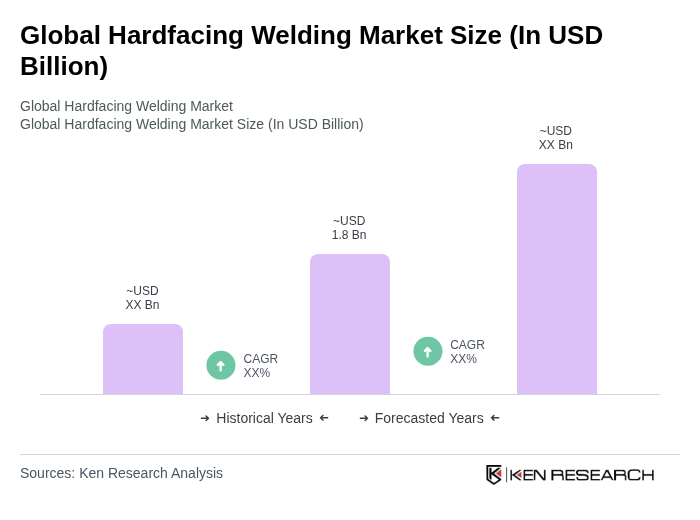
- The Global Hardfacing Welding Market is valued at USD 1.8 billion, based on a five-year historical analysis. This growth is primarily driven by the increasing demand for durable and wear-resistant materials across various industries, including mining, construction, and oil & gas, where hardfacing significantly improves component life and reduces downtime. The need for maintenance and repair of equipment has also contributed significantly to the market's expansion, as hardfacing welding provides effective solutions for prolonging the life of machinery in heavy-duty and high-wear environments.
- Key players in this market include the United States, Germany, and China, which dominate due to their advanced manufacturing capabilities, strong industrial bases, and extensive mining, construction, energy, and manufacturing sectors. The presence of major companies and a well-established supply chain in these countries further enhances their market position, with North America, Europe, and Asia Pacific collectively accounting for the majority of global demand. Additionally, the growing focus on infrastructure development, resource extraction, and heavy equipment utilization in these regions supports the demand for hardfacing welding solutions.
- In the United States, federal and state-level environmental and occupational safety regulations are increasingly shaping sustainable practices in the welding industry, including hardfacing applications. Key frameworks include the National Emission Standards for Hazardous Air Pollutants (NESHAP) for area sources in metal fabrication and finishing issued by the U.S. Environmental Protection Agency under 40 CFR Part 63, Subpart XXXXXX, which sets limits on hazardous air pollutants and requires emission control, work practice standards, and recordkeeping for welding and related operations. In parallel, the Occupational Safety and Health Administration’s Welding, Cutting, and Brazing Standard (29 CFR 1910.252) mandates controls on fumes, ventilation, and safe handling of consumables, indirectly encouraging the adoption of lower-emission processes and consumables in hardfacing. These measures collectively aim to reduce the environmental and health impact of welding operations while supporting innovation in cleaner hardfacing technologies.
Global Hardfacing Welding Market Segmentation
By Type:The hardfacing welding market can be segmented into various types, including Hardfacing Electrodes (Stick), Hardfacing Flux-Cored Wires, Hardfacing Solid Wires, Hardfacing Metal Powders, and Hardfacing Weld Overlay Plates. Each of these subsegments plays a crucial role in different applications and industries, from manual repair welding to automated overlay and thermal spray processes.
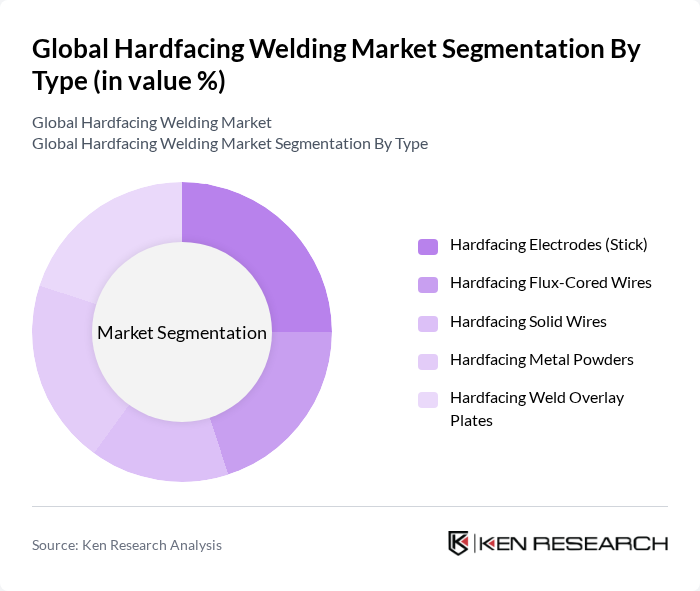
The Hardfacing Electrodes (Stick) segment is currently leading the market in terms of installed base and widespread use in field repair due to its versatility, ability to operate with relatively simple equipment, and suitability for out?of?position and remote-site welding. This type of hardfacing is favored in repair and maintenance welding, particularly in industries such as mining, construction, and agriculture, where equipment is subjected to harsh conditions and frequent on-site rebuilds. The demand for hardfacing electrodes is driven by their ability to provide strong welds and resistance to abrasion, impact, and metal?to?metal wear, making them a preferred choice among welders for maintenance applications.
By End-User Industry:The hardfacing welding market is segmented by end-user industries, including Mining & Quarrying, Oil & Gas and Petrochemicals, Construction & Infrastructure Equipment, Agriculture & Forestry Equipment, Power Generation (Thermal, Hydro & Renewables), Metal Manufacturing & Cement, and Others (Recycling, Marine, Rail). Each of these industries has unique requirements that drive the demand for hardfacing solutions, ranging from severe abrasion and impact in mining to corrosion and erosion in oil & gas and power generation.
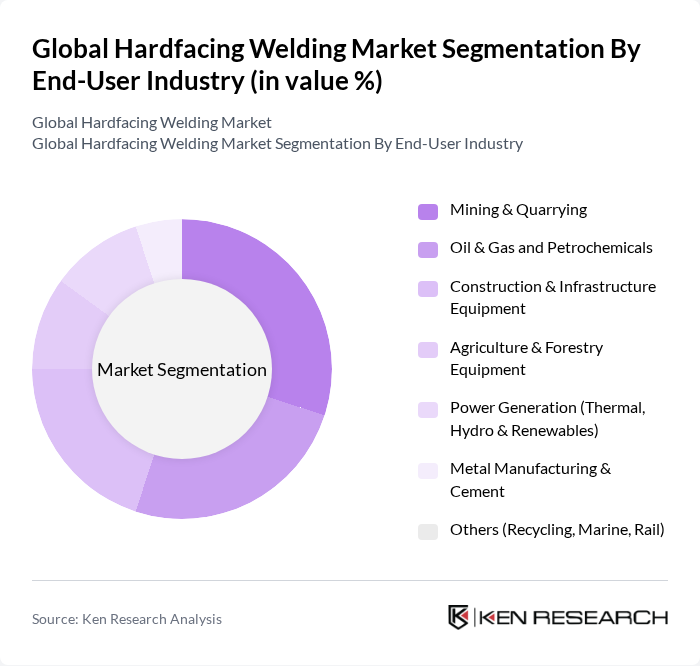
The Mining & Quarrying segment is the dominant end-user industry for hardfacing welding solutions, aligning with the high share of mining, construction, and oil & gas in overall hardfacing demand highlighted by recent market studies. This is primarily due to the high wear and tear experienced by mining equipment such as buckets, crushers, conveyor components, and earthmoving tools, which necessitates frequent maintenance and repair. The harsh operating conditions in mining environments drive the demand for durable hardfacing materials that can withstand extreme abrasion, impact, and erosion, making this segment a key driver of market growth and a focal point for product development by leading suppliers.
Global Hardfacing Welding Market Competitive Landscape
The Global Hardfacing Welding Market is characterized by a dynamic mix of regional and international players. Leading participants such as The Lincoln Electric Company, ESAB Corporation, Illinois Tool Works Inc. (ITW Welding), voestalpine Böhler Welding GmbH, Welding Alloys Group, Castolin Eutectic, Oerlikon Metco (a Metco division of OC Oerlikon), Waldun Group, Polymet Corporation, Kjellberg Finsterwalde Plasma und Maschinen GmbH, DAIHEN Corporation, Arc Specialties, Inc., F.W. Winter Inc. & Co., A.W. Chesterton Company, Dura-Metal (Dura-Metal (S) Pte Ltd and affiliates) contribute to innovation, geographic expansion, and service delivery in this space.
Global Hardfacing Welding Market Industry Analysis
Growth Drivers
- Increasing Demand for Wear-Resistant Materials:The global demand for wear-resistant materials is projected to reach 1.5 million tons in future, driven by industries such as mining, construction, and manufacturing. This surge is attributed to the need for enhanced durability and performance in equipment, which is critical for reducing operational downtime. The World Bank estimates that global industrial production will grow by around 2% to 3% in future, further fueling the demand for hardfacing welding solutions that extend the lifespan of machinery.
- Technological Advancements in Welding Processes:Innovations in welding technologies, such as laser and plasma welding, are expected to enhance the efficiency and precision of hardfacing applications. The global welding equipment market is anticipated to reach tens of billions of USD in value in future, reflecting steady growth in demand for automated and high-precision welding systems. These advancements not only improve the quality of welds but also reduce material waste, aligning with the increasing focus on sustainable manufacturing practices across various sectors.
- Rising Industrialization and Infrastructure Development:Rapid industrialization in emerging economies, particularly in Asia-Pacific, is projected to drive significant growth in the hardfacing welding market. The Asian Development Bank indicates that infrastructure investment needs in the region amount to about USD 1.7 trillion annually to maintain growth, reduce poverty, and respond to climate change, creating robust demand for durable materials and protective solutions. This investment will create a robust demand for hardfacing solutions to protect critical infrastructure, such as roads and bridges, from wear and tear, thereby enhancing their longevity and performance.
Market Challenges
- High Initial Investment Costs:The high upfront costs associated with advanced hardfacing welding technologies can deter small and medium-sized enterprises (SMEs) from adopting these solutions. For instance, the initial investment for automated welding systems can range from USD 50,000 to USD 200,000, depending on the technology. This financial barrier is particularly significant in regions where capital availability is limited, hindering the overall market growth and adoption of innovative welding solutions.
- Lack of Skilled Workforce:The hardfacing welding industry faces a critical shortage of skilled labor, with an estimated 30% of welding positions remaining unfilled in future. This skills gap is exacerbated by an aging workforce and insufficient training programs. According to the American Welding Society, the broader welding industry in the United States alone will need hundreds of thousands of new welding professionals in future to meet demand, reflecting a sustained skills shortage. This challenge limits the ability of companies to implement advanced welding techniques effectively, impacting productivity and quality.
Global Hardfacing Welding Market Future Outlook
The future of the hardfacing welding market appears promising, driven by ongoing technological advancements and increasing industrial applications. As industries prioritize sustainability, the integration of eco-friendly materials and processes will become essential. Additionally, the rise of automation and IoT in welding operations will enhance efficiency and precision. Companies that invest in workforce training and innovative technologies will likely gain a competitive edge, positioning themselves favorably in a rapidly evolving market landscape.
Market Opportunities
- Expansion in Emerging Markets:Emerging markets, particularly in Asia and Africa, present significant growth opportunities for hardfacing welding solutions. With increasing industrial activities and infrastructure projects, the demand for durable materials is expected to rise. The World Bank projects that many developing regions will experience industrial output growth in the low- to mid-single-digit percentage range in future, creating a favorable environment for hardfacing applications.
- Development of Eco-Friendly Hardfacing Materials:The growing emphasis on sustainability is driving the development of eco-friendly hardfacing materials. Companies that innovate in this area can tap into a market that values environmental responsibility. Research by international organizations and industry reports indicates that the global market for environmentally friendly or “green” materials is substantial and expanding in future, providing a lucrative opportunity for hardfacing welding firms to align with these trends and attract environmentally conscious clients.
Scope of the Report
| Segment | Sub-Segments |
|---|---|
| By Type | Hardfacing Electrodes (Stick) Hardfacing Flux-Cored Wires Hardfacing Solid Wires Hardfacing Metal Powders Hardfacing Weld Overlay Plates |
| By End-User Industry | Mining & Quarrying Oil & Gas and Petrochemicals Construction & Infrastructure Equipment Agriculture & Forestry Equipment Power Generation (Thermal, Hydro & Renewables) Metal Manufacturing & Cement Others (Recycling, Marine, Rail) |
| By Application | Repair and Maintenance Welding New Equipment & OEM Manufacturing Surface Protection / Wear & Corrosion Protection Dimensional Restoration & Rebuilding |
| By Material / Alloy System | Iron-based Alloys (High-Cr Iron, Martensitic, Austenitic) Cobalt-based Alloys (e.g., Stellite-type) Nickel-based Alloys Carbide-based Systems (Tungsten, Chromium Carbide) Others (Ceramic- and Composite-based Overlays) |
| By Hardfacing Process | Shielded Metal Arc Welding (SMAW) Flux-Cored Arc Welding (FCAW) Gas Metal Arc Welding (GMAW / MIG-MAG) Gas Tungsten Arc Welding (GTAW / TIG) Submerged Arc Welding (SAW) Plasma Transferred Arc (PTA) & Laser Cladding Oxy-fuel & Thermal Spraying |
| By Region | North America Europe Asia-Pacific Latin America Middle East & Africa |
| By Customer Type | OEMs (Original Equipment Manufacturers) Service Providers & Repair Shops Distributors & Stockists End-users (In-house Maintenance) |
Key Target Audience
Investors and Venture Capitalist Firms
Government and Regulatory Bodies (e.g., Environmental Protection Agency, Occupational Safety and Health Administration)
Manufacturers and Producers of Hardfacing Materials
Distributors and Retailers of Welding Equipment
Heavy Machinery and Equipment Manufacturers
Industry Associations (e.g., American Welding Society, International Institute of Welding)
Financial Institutions and Banks
Trade Organizations and Export Councils
Players Mentioned in the Report:
The Lincoln Electric Company
ESAB Corporation
Illinois Tool Works Inc. (ITW Welding)
voestalpine Bohler Welding GmbH
Welding Alloys Group
Castolin Eutectic
Oerlikon Metco (a Metco division of OC Oerlikon)
Waldun Group
Polymet Corporation
Kjellberg Finsterwalde Plasma und Maschinen GmbH
DAIHEN Corporation
Arc Specialties, Inc.
F.W. Winter Inc. & Co.
A.W. Chesterton Company
Dura-Metal (Dura-Metal (S) Pte Ltd and affiliates)
Table of Contents
Market Assessment Phase
1. Executive Summary and Approach
2. Global Hardfacing Welding Market Overview
2.1 Key Insights and Strategic Recommendations
2.2 Global Hardfacing Welding Market Overview
2.3 Definition and Scope
2.4 Evolution of Market Ecosystem
2.5 Timeline of Key Regulatory Milestones
2.6 Value Chain & Stakeholder Mapping
2.7 Business Cycle Analysis
2.8 Policy & Incentive Landscape
3. Global Hardfacing Welding Market Analysis
3.1 Growth Drivers
3.1.1 Increasing demand for wear-resistant materials
3.1.2 Technological advancements in welding processes
3.1.3 Rising industrialization and infrastructure development
3.1.4 Growing awareness of cost-effective maintenance solutions
3.2 Market Challenges
3.2.1 High initial investment costs
3.2.2 Lack of skilled workforce
3.2.3 Stringent environmental regulations
3.2.4 Competition from alternative surface treatment methods
3.3 Market Opportunities
3.3.1 Expansion in emerging markets
3.3.2 Development of eco-friendly hardfacing materials
3.3.3 Increasing applications in various industries
3.3.4 Collaborations and partnerships for innovation
3.4 Market Trends
3.4.1 Shift towards automated welding technologies
3.4.2 Growing focus on sustainability and recycling
3.4.3 Integration of IoT in welding processes
3.4.4 Customization of hardfacing solutions
3.5 Government Regulation
3.5.1 Compliance with international welding standards
3.5.2 Regulations on hazardous materials
3.5.3 Incentives for adopting advanced welding technologies
3.5.4 Safety regulations in industrial applications
4. SWOT Analysis
5. Stakeholder Analysis
6. Porter's Five Forces Analysis
7. Global Hardfacing Welding Market Market Size, 2019-2024
7.1 By Value
7.2 By Volume
7.3 By Average Selling Price
8. Global Hardfacing Welding Market Segmentation
8.1 By Type
8.1.1 Hardfacing Electrodes (Stick)
8.1.2 Hardfacing Flux-Cored Wires
8.1.3 Hardfacing Solid Wires
8.1.4 Hardfacing Metal Powders
8.1.5 Hardfacing Weld Overlay Plates
8.2 By End-User Industry
8.2.1 Mining & Quarrying
8.2.2 Oil & Gas and Petrochemicals
8.2.3 Construction & Infrastructure Equipment
8.2.4 Agriculture & Forestry Equipment
8.2.5 Power Generation (Thermal, Hydro & Renewables)
8.2.6 Metal Manufacturing & Cement
8.2.7 Others (Recycling, Marine, Rail)
8.3 By Application
8.3.1 Repair and Maintenance Welding
8.3.2 New Equipment & OEM Manufacturing
8.3.3 Surface Protection / Wear & Corrosion Protection
8.3.4 Dimensional Restoration & Rebuilding
8.4 By Material / Alloy System
8.4.1 Iron-based Alloys (High-Cr Iron, Martensitic, Austenitic)
8.4.2 Cobalt-based Alloys (e.g., Stellite-type)
8.4.3 Nickel-based Alloys
8.4.4 Carbide-based Systems (Tungsten, Chromium Carbide)
8.4.5 Others (Ceramic- and Composite-based Overlays)
8.5 By Hardfacing Process
8.5.1 Shielded Metal Arc Welding (SMAW)
8.5.2 Flux-Cored Arc Welding (FCAW)
8.5.3 Gas Metal Arc Welding (GMAW / MIG-MAG)
8.5.4 Gas Tungsten Arc Welding (GTAW / TIG)
8.5.5 Submerged Arc Welding (SAW)
8.5.6 Plasma Transferred Arc (PTA) & Laser Cladding
8.5.7 Oxy-fuel & Thermal Spraying
8.6 By Region
8.6.1 North America
8.6.2 Europe
8.6.3 Asia-Pacific
8.6.4 Latin America
8.6.5 Middle East & Africa
8.7 By Customer Type
8.7.1 OEMs (Original Equipment Manufacturers)
8.7.2 Service Providers & Repair Shops
8.7.3 Distributors & Stockists
8.7.4 End-users (In-house Maintenance)
9. Global Hardfacing Welding Market Competitive Analysis
9.1 Market Share of Key Players
9.2 Cross Comparison of Key Players
9.2.1 Company Name
9.2.2 Group Size (Global, Regional, or Niche Player)
9.2.3 Hardfacing Welding Revenue (US$ Mn)
9.2.4 Hardfacing-specific Revenue Growth Rate (CAGR)
9.2.5 Geographic Footprint (Number of Countries / Regions Served)
9.2.6 End-user Coverage Breadth (Number of Core Industries Served)
9.2.7 Product Portfolio Depth (Number of Hardfacing Alloys & Processes Offered)
9.2.8 R&D Intensity (% of Revenue Spent on R&D)
9.2.9 Capex in Production & Cladding Capacity (US$ Mn)
9.2.10 Average Selling Price Positioning (Premium, Mid-range, Value)
9.2.11 Key Channel Strength (Direct vs Distribution Sales Mix)
9.2.12 On-time Delivery / Lead Time Performance
9.2.13 Strategic Partnerships & OEM Tie-ups (Count/Significance)
9.2.14 Share of Aftermarket / Repair & Maintenance Revenue
9.3 SWOT Analysis of Top Players
9.4 Pricing Analysis
9.5 Detailed Profile of Major Companies
9.5.1 The Lincoln Electric Company
9.5.2 ESAB Corporation
9.5.3 Illinois Tool Works Inc. (ITW Welding)
9.5.4 voestalpine Böhler Welding GmbH
9.5.5 Welding Alloys Group
9.5.6 Castolin Eutectic
9.5.7 Oerlikon Metco (a Metco division of OC Oerlikon)
9.5.8 Waldun Group
9.5.9 Polymet Corporation
9.5.10 Kjellberg Finsterwalde Plasma und Maschinen GmbH
9.5.11 DAIHEN Corporation
9.5.12 Arc Specialties, Inc.
9.5.13 F.W. Winter Inc. & Co.
9.5.14 A.W. Chesterton Company
9.5.15 Dura-Metal (Dura-Metal (S) Pte Ltd and affiliates)
10. Global Hardfacing Welding Market End-User Analysis
10.1 Procurement Behavior of Key Ministries
10.1.1 Government contracts and tenders
10.1.2 Budget allocation for infrastructure projects
10.1.3 Compliance with procurement regulations
10.1.4 Evaluation criteria for suppliers
10.2 Corporate Spend on Infrastructure & Energy
10.2.1 Investment trends in industrial sectors
10.2.2 Budgeting for maintenance and repairs
10.2.3 Long-term contracts with suppliers
10.2.4 Cost-benefit analysis of hardfacing solutions
10.3 Pain Point Analysis by End-User Category
10.3.1 Equipment downtime
10.3.2 High maintenance costs
10.3.3 Quality of hardfacing materials
10.3.4 Availability of skilled labor
10.4 User Readiness for Adoption
10.4.1 Awareness of hardfacing benefits
10.4.2 Training and support requirements
10.4.3 Financial readiness for investment
10.4.4 Technological readiness for implementation
10.5 Post-Deployment ROI and Use Case Expansion
10.5.1 Measurement of cost savings
10.5.2 Performance tracking of hardfaced components
10.5.3 Opportunities for scaling applications
10.5.4 Feedback mechanisms for continuous improvement
11. Global Hardfacing Welding Market Future Size, 2025-2030
11.1 By Value
11.2 By Volume
11.3 By Average Selling Price
Go-To-Market Strategy Phase
1. Whitespace Analysis + Business Model Canvas
1.1 Market gaps and opportunities
1.2 Value proposition development
1.3 Revenue model exploration
1.4 Customer segmentation analysis
1.5 Competitive landscape overview
2. Marketing and Positioning Recommendations
2.1 Branding strategies
2.2 Product USPs
2.3 Target audience identification
2.4 Communication strategies
2.5 Digital marketing initiatives
3. Distribution Plan
3.1 Urban retail vs rural NGO tie-ups
3.2 Direct sales strategies
3.3 Online distribution channels
3.4 Partnerships with distributors
3.5 Logistics and supply chain management
4. Channel & Pricing Gaps
4.1 Underserved routes
4.2 Pricing bands
4.3 Competitor pricing analysis
4.4 Value-based pricing strategies
4.5 Discount and promotion strategies
5. Unmet Demand & Latent Needs
5.1 Category gaps
5.2 Consumer segments
5.3 Product development opportunities
5.4 Market entry strategies
5.5 Customer feedback integration
6. Customer Relationship
6.1 Loyalty programs
6.2 After-sales service
6.3 Customer engagement strategies
6.4 Feedback and improvement loops
6.5 Community building initiatives
7. Value Proposition
7.1 Sustainability
7.2 Integrated supply chains
7.3 Cost-effectiveness
7.4 Quality assurance
7.5 Innovation and technology
8. Key Activities
8.1 Regulatory compliance
8.2 Branding
8.3 Distribution setup
8.4 Training and development
8.5 Market research and analysis
9. Entry Strategy Evaluation
9.1 Domestic Market Entry Strategy
9.1.1 Product mix
9.1.2 Pricing band
9.1.3 Packaging
9.1.4 Marketing approach
9.1.5 Distribution channels
9.2 Export Entry Strategy
9.2.1 Target countries
9.2.2 Compliance roadmap
9.2.3 Market entry barriers
9.2.4 Partnership opportunities
9.2.5 Risk assessment
10. Entry Mode Assessment
10.1 JV
10.2 Greenfield
10.3 M&A
10.4 Distributor Model
10.5 Evaluation criteria
11. Capital and Timeline Estimation
11.1 Capital requirements
11.2 Timelines
11.3 Funding sources
11.4 Financial projections
11.5 Risk management strategies
12. Control vs Risk Trade-Off
12.1 Ownership vs Partnerships
12.2 Risk assessment
12.3 Control mechanisms
12.4 Strategic alliances
12.5 Exit strategies
13. Profitability Outlook
13.1 Breakeven analysis
13.2 Long-term sustainability
13.3 Profit margin analysis
13.4 Revenue forecasting
13.5 Cost management strategies
14. Potential Partner List
14.1 Distributors
14.2 JVs
14.3 Acquisition targets
14.4 Strategic partnerships
14.5 Collaboration opportunities
15. Execution Roadmap
15.1 Phased Plan for Market Entry
15.1.1 Market Setup
15.1.2 Market Entry
15.1.3 Growth Acceleration
15.1.4 Scale & Stabilize
1
Research Methodology
Phase 1: Approach1
Desk Research
- Industry reports from welding associations and trade organizations
- Market analysis from government publications and trade statistics
- Technical papers and journals focusing on hardfacing technologies
Primary Research
- Interviews with welding engineers and technical experts in hardfacing
- Surveys with procurement managers in manufacturing sectors
- Field visits to welding workshops and industrial plants
Validation & Triangulation
- Cross-validation of data from multiple industry sources and reports
- Triangulation of insights from primary interviews and secondary data
- Sanity checks through expert panels comprising industry veterans
Phase 2: Market Size Estimation1
Top-down Assessment
- Analysis of global welding market size and growth trends
- Segmentation by application areas such as oil & gas, construction, and manufacturing
- Incorporation of regional market dynamics and demand drivers
Bottom-up Modeling
- Estimation of hardfacing material consumption based on industry usage
- Cost analysis of hardfacing processes across different sectors
- Volume estimates derived from production capacities of key players
Forecasting & Scenario Analysis
- Multi-variable forecasting using economic indicators and industry growth rates
- Scenario planning based on technological advancements and regulatory changes
- Baseline, optimistic, and pessimistic forecasts through 2030
Phase 3: CATI Sample Composition1
| Scope Item/Segment | Sample Size | Target Respondent Profiles |
|---|---|---|
| Oil & Gas Hardfacing Applications | 45 | Welding Engineers, Project Managers |
| Construction Industry Hardfacing | 40 | Site Managers, Equipment Operators |
| Manufacturing Sector Hardfacing | 45 | Production Managers, Quality Control Inspectors |
| Aerospace Hardfacing Technologies | 40 | R&D Engineers, Compliance Officers |
| Automotive Hardfacing Solutions | 40 | Procurement Specialists, Design Engineers |
Frequently Asked Questions
What is the current value of the Global Hardfacing Welding Market?
The Global Hardfacing Welding Market is valued at approximately USD 1.8 billion, driven by the increasing demand for durable and wear-resistant materials across various industries such as mining, construction, and oil & gas.
What are the primary drivers of growth in the hardfacing welding market?
Which regions dominate the Global Hardfacing Welding Market?
What types of hardfacing welding materials are available?
Other Regional/Country Reports
Indonesia Hardfacing Welding Market
Malaysia Hardfacing Welding Market
KSA Hardfacing Welding Market
APAC Hardfacing Welding Market
SEA Hardfacing Welding Market
Other Adjacent Reports
Japan Surface Engineering Market
South Korea Abrasion Resistant Materials Market
Saudi Arabia Thermal Spray Coatings Market Size, Share & Forecast, By Coating Material, End-Use Industry & Technology, 2026–2031Global Mining Equipment MarketJapan Oil and Gas Equipment Market
Australia Construction Machinery Market Size, Share & Forecast, By Product Type, End-Use Industry & Sales Channel, 2026-2031Mexico Industrial Maintenance Services Market
KSA Metal Fabrication Market
Qatar Power Generation Equipment Market
Why Buy From Us?

What makes us stand out is that our consultants follow Robust, Refine and Result (RRR) methodology. Robust for clear definitions, approaches and sanity checking, Refine for differentiating respondents' facts and opinions, and Result for presenting data with story.

We have set a benchmark in the industry by offering our clients with syndicated and customized market research reports featuring coverage of entire market as well as meticulous research and analyst insights.

While we don't replace traditional research, we flip the method upside down. Our dual approach of Top Bottom & Bottom Top ensures quality deliverable by not just verifying company fundamentals but also looking at the sector and macroeconomic factors.

With one step in the future, our research team constantly tries to show you the bigger picture. We help with some of the tough questions you may encounter along the way: How is the industry positioned? Best marketing channel? KPI's of competitors? By aligning every element, we help maximize success.

Our report gives you instant access to the answers and sources that other companies might choose to hide. We elaborate each steps of research methodology we have used and showcase you the sample size to earn your trust.

If you need any support, we are here! We pride ourselves on universe strength, data quality, and quick, friendly, and professional service.