About the Report
Base Year 2024Vietnam Welding Consumables Market Overview
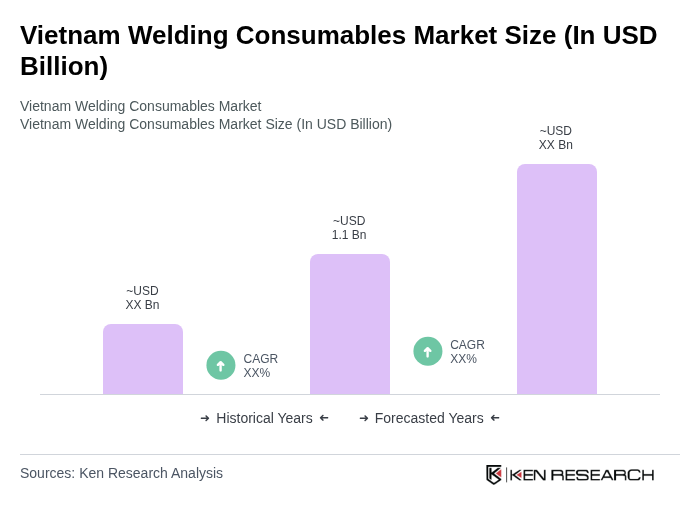
- The Vietnam Welding Consumables Market is valued at USD 1.1 billion, based on a five-year historical analysis. This growth is primarily driven by the rapid industrialization and infrastructure development in the country, alongside the increasing demand from various sectors such as construction, automotive, shipbuilding, and general manufacturing. The market has seen a significant rise in the adoption of advanced welding technologies, automation, and higher-efficiency consumables, which has further fueled the demand for high-quality welding electrodes, wires, and fluxes.
- Key cities dominating the market include Ho Chi Minh City, Hanoi, and Da Nang. Ho Chi Minh City stands out due to its robust industrial base, concentration of manufacturing clusters, and significant commercial and residential construction activities, while Hanoi serves as the political and administrative center, driving demand for welding consumables in infrastructure and government-backed projects. Da Nang, with its strategic coastal location and role as a central logistics and industrial hub, is pivotal for shipbuilding, port infrastructure, and marine engineering industries, contributing to the overall market growth.
- In 2023, the Vietnamese government implemented regulations aimed at enhancing the quality standards of welding consumables. This includes mandatory compliance with international and national standards such as the National Technical Regulation on Welding and Allied Processes – QCVN 26:2016/BGTVT issued by the Ministry of Transport, which refers to ISO-based welding procedure and welder qualification requirements for industrial and shipbuilding applications, as well as the application of TCVN/ISO standards for welding materials quality, safety, and environmental performance. These frameworks have led to increased investments in testing, certification, and research and development by local manufacturers and importers to ensure consistent product quality, traceability, and improved occupational safety and environmental compliance across major welding operations.
Vietnam Welding Consumables Market Segmentation
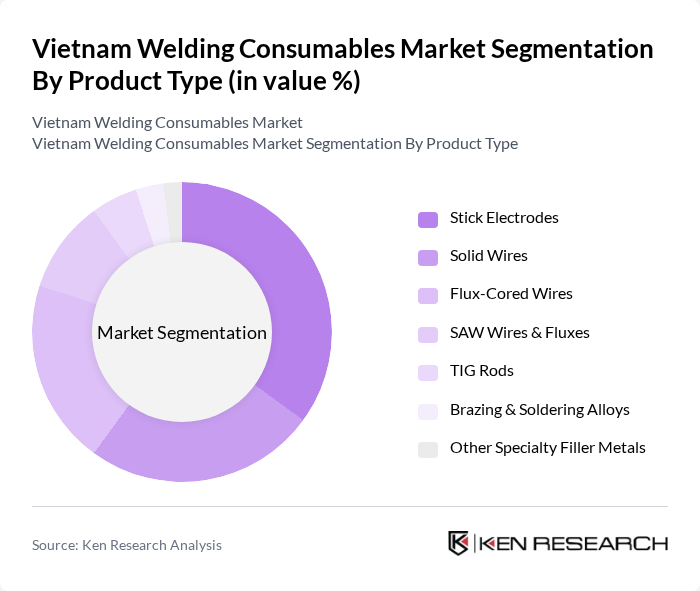
By Product Type:The product type segmentation includes various categories of welding consumables that cater to different welding processes and applications. The dominant sub-segment in this category is Stick Electrodes, which remain widely used due to their versatility, portability, and suitability for outdoor and on-site construction and maintenance welding. Solid Wires and Flux-Cored Wires also hold significant market shares, driven by their higher deposition rates, suitability for semi-automatic and robotic welding, and efficiency in industrial fabrication, automotive, and shipbuilding applications. The demand for these products is influenced by the growing construction, manufacturing, and metal fabrication sectors in Vietnam, which require reliable, high-productivity, and high-performance welding materials tailored to carbon steel, low-alloy steel, and stainless-steel applications.
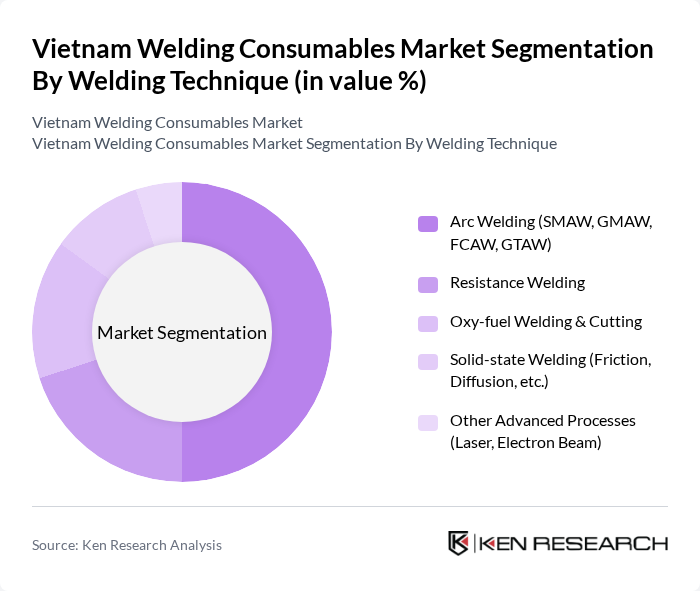
By Welding Technique:The welding technique segmentation encompasses various methods employed in the welding process. Arc Welding, particularly Shielded Metal Arc Welding (SMAW) and Gas Metal Arc Welding (GMAW), dominates this segment due to its widespread application in construction, steel fabrication, shipbuilding, and general manufacturing in Asia-Pacific, including Vietnam. Flux-Cored Arc Welding (FCAW) and Gas Tungsten Arc Welding (GTAW/TIG) are increasingly used where higher productivity or precision and better weld quality are required. Resistance Welding and Oxy-fuel Welding are also significant, catering to specific industrial needs such as automotive body assembly, metal furniture, and on-site cutting and repair. The increasing adoption of advanced welding techniques, such as Laser and Electron Beam welding, is gradually gaining traction in high-value fabrication, electronics, and precision engineering, driven by the demand for tighter tolerances, automation, and improved efficiency in high-tech industries and export-oriented manufacturing.
Vietnam Welding Consumables Market Competitive Landscape
The Vietnam Welding Consumables Market is characterized by a dynamic mix of regional and international players. Leading participants such as The Lincoln Electric Company (Vietnam operations), ESAB Group (Vietnam operations), Kobe Steel (Kobelco Welding) Vietnam, Voestalpine Böhler Welding (regional presence serving Vietnam), Hyundai Welding Vietnam, Dai Dong Tieng Welding Materials JSC, Kim Tin Group (welding consumables division), Weldcom Industry JSC, Hubei Jiuqiang Welding Material, Hunan Yujing Welding Material, Hubei Huazhong Welding Material, Hunan Jinxin Welding Material, Hubei Yihua Welding Material, Other Notable Regional and Local Players contribute to innovation, geographic expansion, and service delivery in this space.
Vietnam Welding Consumables Market Industry Analysis
Growth Drivers
- Increasing Demand from Construction and Manufacturing Sectors:The construction sector in Vietnam is projected to grow by 8.5% in future, driven by significant infrastructure projects. The manufacturing sector, contributing 19% to the GDP, is also expanding, with a focus on automotive and electronics. This growth fuels the demand for welding consumables, as construction and manufacturing require robust welding solutions to meet quality and safety standards, thereby enhancing market potential.
- Technological Advancements in Welding Processes:The adoption of advanced welding technologies, such as laser and robotic welding, is increasing in Vietnam. In future, investments in automation are expected to reach $1.5 billion, enhancing efficiency and precision in welding applications. These technological advancements not only improve productivity but also reduce operational costs, driving the demand for high-quality welding consumables that can withstand modern welding techniques.
- Government Initiatives to Boost Infrastructure Development:The Vietnamese government has allocated $35 billion for infrastructure development in future, focusing on transportation and energy sectors. This investment is expected to create a surge in construction activities, leading to increased demand for welding consumables. Government policies promoting foreign investments and public-private partnerships further enhance the market landscape, providing opportunities for local and international suppliers.
Market Challenges
- Fluctuating Raw Material Prices:The welding consumables market faces challenges due to volatile raw material prices, particularly steel and alloys. In future, the price of steel is projected to fluctuate between $750 and $850 per ton, impacting production costs for welding consumables. This volatility can lead to unpredictable pricing strategies, affecting profit margins and market stability for manufacturers and suppliers in Vietnam.
- Intense Competition Among Local and International Players:The Vietnamese welding consumables market is characterized by intense competition, with over 120 local and international players. In future, the market is expected to see a 20% increase in new entrants, intensifying price competition and innovation demands. This competitive landscape challenges existing companies to differentiate their products and maintain market share while managing operational costs effectively.
Vietnam Welding Consumables Market Future Outlook
The Vietnam welding consumables market is poised for significant growth, driven by increasing investments in infrastructure and technological advancements. As the government continues to prioritize infrastructure projects, the demand for high-quality welding consumables will rise. Additionally, the integration of automation and digital technologies in manufacturing processes will further enhance efficiency. Companies that adapt to these trends and focus on sustainability will likely capture a larger market share, positioning themselves favorably in the evolving landscape.
Market Opportunities
- Expansion of the Automotive and Aerospace Industries:The automotive industry in Vietnam is expected to grow by 12% in future, creating substantial demand for welding consumables. The aerospace sector, with projected investments of $2.5 billion, will also require advanced welding solutions, presenting a lucrative opportunity for manufacturers to cater to these expanding markets.
- Development of Eco-Friendly Welding Consumables:With increasing environmental regulations, the demand for eco-friendly welding consumables is on the rise. In future, the market for sustainable welding materials is projected to grow by 25%, driven by consumer preferences for green solutions. Companies that innovate in this area can gain a competitive edge and meet regulatory requirements effectively.
Scope of the Report
| Segment | Sub-Segments |
|---|---|
| By Product Type | Stick Electrodes Solid Wires Flux-Cored Wires SAW Wires & Fluxes TIG Rods Brazing & Soldering Alloys Other Specialty Filler Metals |
| By Welding Technique | Arc Welding (SMAW, GMAW, FCAW, GTAW) Resistance Welding Oxy-fuel Welding & Cutting Solid-state Welding (Friction, Diffusion, etc.) Other Advanced Processes (Laser, Electron Beam) |
| By End-user Industry | Building & Construction Automotive & Auto Components Shipbuilding & Marine Oil & Gas, Pipeline & Petrochemical Power Generation & Energy (incl. Renewables) Heavy Engineering & General Manufacturing Aerospace & Defense Maintenance, Repair & Overhaul (MRO) Others |
| By Material Type | Carbon Steel Low Alloy & High-strength Steel Stainless Steel Aluminum & Aluminum Alloys Nickel & Nickel Alloys Copper & Copper Alloys Other Alloys & Special Materials |
| By Distribution Channel | Direct Sales to Key Accounts & Projects Industrial Distributors & Dealers Welding Equipment & Tool Retailers E-commerce & Online Channels Others |
| By Region | Northern Vietnam (incl. Hanoi & industrial clusters) Central Vietnam (incl. Da Nang & coastal industrial zones) Southern Vietnam (incl. Ho Chi Minh City & Mekong region) Other Emerging Industrial Provinces |
| By Customer Type | Large Enterprises & EPC Contractors SMEs & Local Fabricators Government & State-owned Enterprises (SOEs) Trading Houses & Stockists Others |
Key Target Audience
Investors and Venture Capitalist Firms
Government and Regulatory Bodies (e.g., Ministry of Industry and Trade, Vietnam National Chemical Group)
Manufacturers and Producers
Distributors and Retailers
Construction and Infrastructure Companies
Automotive and Aerospace Industries
Industry Associations (e.g., Vietnam Welding Association)
Financial Institutions
Players Mentioned in the Report:
The Lincoln Electric Company (Vietnam operations)
ESAB Group (Vietnam operations)
Kobe Steel (Kobelco Welding) Vietnam
Voestalpine Bohler Welding (regional presence serving Vietnam)
Hyundai Welding Vietnam
Dai Dong Tieng Welding Materials JSC
Kim Tin Group (welding consumables division)
Weldcom Industry JSC
Hubei Jiuqiang Welding Material
Hunan Yujing Welding Material
Hubei Huazhong Welding Material
Hunan Jinxin Welding Material
Hubei Yihua Welding Material
Other Notable Regional and Local Players
Table of Contents
Market Assessment Phase
1. Executive Summary and Approach
2. Vietnam Welding Consumables Market Overview
2.1 Key Insights and Strategic Recommendations
2.2 Vietnam Welding Consumables Market Overview
2.3 Definition and Scope
2.4 Evolution of Market Ecosystem
2.5 Timeline of Key Regulatory Milestones
2.6 Value Chain & Stakeholder Mapping
2.7 Business Cycle Analysis
2.8 Policy & Incentive Landscape
3. Vietnam Welding Consumables Market Analysis
3.1 Growth Drivers
3.1.1 Increasing demand from construction and manufacturing sectors
3.1.2 Technological advancements in welding processes
3.1.3 Government initiatives to boost infrastructure development
3.1.4 Rising adoption of automation in welding applications
3.2 Market Challenges
3.2.1 Fluctuating raw material prices
3.2.2 Intense competition among local and international players
3.2.3 Regulatory compliance and environmental concerns
3.2.4 Skilled labor shortages in the welding industry
3.3 Market Opportunities
3.3.1 Expansion of the automotive and aerospace industries
3.3.2 Growth in renewable energy projects
3.3.3 Increasing investments in smart manufacturing
3.3.4 Development of eco-friendly welding consumables
3.4 Market Trends
3.4.1 Shift towards automation and robotics in welding
3.4.2 Rising demand for high-performance welding materials
3.4.3 Focus on sustainability and green welding solutions
3.4.4 Integration of digital technologies in welding processes
3.5 Government Regulation
3.5.1 Standards for welding consumables quality
3.5.2 Environmental regulations on emissions
3.5.3 Safety regulations for welding operations
3.5.4 Incentives for adopting advanced welding technologies
4. SWOT Analysis
5. Stakeholder Analysis
6. Porter's Five Forces Analysis
7. Vietnam Welding Consumables Market Market Size, 2019-2024
7.1 By Value
7.2 By Volume
7.3 By Average Selling Price
8. Vietnam Welding Consumables Market Segmentation
8.1 By Product Type
8.1.1 Stick Electrodes
8.1.2 Solid Wires
8.1.3 Flux-Cored Wires
8.1.4 SAW Wires & Fluxes
8.1.5 TIG Rods
8.1.6 Brazing & Soldering Alloys
8.1.7 Other Specialty Filler Metals
8.2 By Welding Technique
8.2.1 Arc Welding (SMAW, GMAW, FCAW, GTAW)
8.2.2 Resistance Welding
8.2.3 Oxy-fuel Welding & Cutting
8.2.4 Solid-state Welding (Friction, Diffusion, etc.)
8.2.5 Other Advanced Processes (Laser, Electron Beam)
8.3 By End-user Industry
8.3.1 Building & Construction
8.3.2 Automotive & Auto Components
8.3.3 Shipbuilding & Marine
8.3.4 Oil & Gas, Pipeline & Petrochemical
8.3.5 Power Generation & Energy (incl. Renewables)
8.3.6 Heavy Engineering & General Manufacturing
8.3.7 Aerospace & Defense
8.3.8 Maintenance, Repair & Overhaul (MRO)
8.3.9 Others
8.4 By Material Type
8.4.1 Carbon Steel
8.4.2 Low Alloy & High-strength Steel
8.4.3 Stainless Steel
8.4.4 Aluminum & Aluminum Alloys
8.4.5 Nickel & Nickel Alloys
8.4.6 Copper & Copper Alloys
8.4.7 Other Alloys & Special Materials
8.5 By Distribution Channel
8.5.1 Direct Sales to Key Accounts & Projects
8.5.2 Industrial Distributors & Dealers
8.5.3 Welding Equipment & Tool Retailers
8.5.4 E-commerce & Online Channels
8.5.5 Others
8.6 By Region
8.6.1 Northern Vietnam (incl. Hanoi & industrial clusters)
8.6.2 Central Vietnam (incl. Da Nang & coastal industrial zones)
8.6.3 Southern Vietnam (incl. Ho Chi Minh City & Mekong region)
8.6.4 Other Emerging Industrial Provinces
8.7 By Customer Type
8.7.1 Large Enterprises & EPC Contractors
8.7.2 SMEs & Local Fabricators
8.7.3 Government & State-owned Enterprises (SOEs)
8.7.4 Trading Houses & Stockists
8.7.5 Others
9. Vietnam Welding Consumables Market Competitive Analysis
9.1 Market Share of Key Players
9.2 Cross Comparison of Key Players
9.2.1 Company Name
9.2.2 Group Size (Global, Regional, or Local Player)
9.2.3 Vietnam Welding Consumables Revenue (USD, Latest FY)
9.2.4 3-year Vietnam Revenue CAGR (%)
9.2.5 Vietnam Market Share (%)
9.2.6 EBITDA Margin (%) for Vietnam Operations
9.2.7 Average Realized Price per kg (USD/kg)
9.2.8 Product Mix (% by key consumable categories)
9.2.9 Distribution Reach (no. of distributors / provinces covered)
9.2.10 Key End-user Exposure (% of sales by top 3 industries)
9.2.11 Capex Intensity (% of revenue invested in Vietnam per year)
9.2.12 R&D and New Product Introduction Frequency (launches/year)
9.2.13 Tender Win Rate / Key Project Conversion Rate (%)
9.2.14 Days Sales Outstanding (DSO) and Working Capital Cycle (days)
9.2.15 ESG / Sustainability Scores or Certifications (where available)
9.3 SWOT Analysis of Top Players
9.4 Pricing Analysis
9.5 Detailed Profile of Major Companies
9.5.1 The Lincoln Electric Company (Vietnam operations)
9.5.2 ESAB Group (Vietnam operations)
9.5.3 Kobe Steel (Kobelco Welding) Vietnam
9.5.4 Voestalpine Böhler Welding (regional presence serving Vietnam)
9.5.5 Hyundai Welding Vietnam
9.5.6 Dai Dong Tieng Welding Materials JSC
9.5.7 Kim Tin Group (welding consumables division)
9.5.8 Weldcom Industry JSC
9.5.9 Hubei Jiuqiang Welding Material
9.5.10 Hunan Yujing Welding Material
9.5.11 Hubei Huazhong Welding Material
9.5.12 Hunan Jinxin Welding Material
9.5.13 Hubei Yihua Welding Material
9.5.14 Other Notable Regional and Local Players
10. Vietnam Welding Consumables Market End-User Analysis
10.1 Procurement Behavior of Key Ministries
10.1.1 Key procurement processes
10.1.2 Budget allocation trends
10.1.3 Preferred suppliers and brands
10.1.4 Compliance requirements
10.2 Corporate Spend on Infrastructure & Energy
10.2.1 Investment trends in infrastructure projects
10.2.2 Energy sector spending patterns
10.2.3 Impact of government policies on spending
10.3 Pain Point Analysis by End-User Category
10.3.1 Challenges faced by construction companies
10.3.2 Issues in the automotive sector
10.3.3 Pain points in shipbuilding
10.4 User Readiness for Adoption
10.4.1 Awareness of new technologies
10.4.2 Training and skill development needs
10.4.3 Adoption barriers
10.5 Post-Deployment ROI and Use Case Expansion
10.5.1 Measurement of ROI post-implementation
10.5.2 Case studies of successful deployments
10.5.3 Opportunities for scaling use cases
11. Vietnam Welding Consumables Market Future Size, 2025-2030
11.1 By Value
11.2 By Volume
11.3 By Average Selling Price
Go-To-Market Strategy Phase
1. Whitespace Analysis + Business Model Canvas
1.1 Identification of market gaps
1.3 Value proposition development
1.4 Revenue streams
1.5 Cost structure analysis
1.6 Key partnerships
1.7 Customer segments
2. Marketing and Positioning Recommendations
2.1 Branding strategies
2.2 Product USPs
2.3 Target market identification
2.4 Communication strategies
2.5 Digital marketing approaches
2.6 Trade show participation
2.7 Customer engagement tactics
3. Distribution Plan
3.1 Urban retail strategies
3.2 Rural NGO tie-ups
3.3 E-commerce integration
3.4 Logistics and supply chain management
3.5 Distribution partnerships
3.6 Inventory management
3.7 Customer service considerations
4. Channel & Pricing Gaps
4.1 Underserved routes
4.2 Pricing bands analysis
4.3 Competitor pricing strategies
4.4 Customer willingness to pay
4.5 Price elasticity considerations
4.6 Discounting strategies
4.7 Bundling opportunities
5. Unmet Demand & Latent Needs
5.1 Category gaps
5.2 Consumer segments analysis
5.3 Emerging trends identification
5.4 Customer feedback mechanisms
5.5 Innovation opportunities
5.6 Market entry barriers
5.7 Future demand forecasting
6. Customer Relationship
6.1 Loyalty programs
6.2 After-sales service
6.3 Customer feedback loops
6.4 Relationship management strategies
6.5 Community engagement
6.6 Customer education initiatives
6.7 Retention strategies
7. Value Proposition
7.1 Sustainability initiatives
7.2 Integrated supply chains
7.3 Cost-saving measures
7.4 Quality assurance processes
7.5 Customer-centric innovations
7.6 Competitive advantages
7.7 Long-term partnerships
8. Key Activities
8.1 Regulatory compliance
8.2 Branding efforts
8.3 Distribution setup
8.4 Training and development
8.5 Market research
8.6 Performance monitoring
8.7 Stakeholder engagement
9. Entry Strategy Evaluation
9.1 Domestic Market Entry Strategy
9.1.1 Product mix considerations
9.1.2 Pricing band analysis
9.1.3 Packaging strategies
9.2 Export Entry Strategy
9.2.1 Target countries identification
9.2.2 Compliance roadmap development
10. Entry Mode Assessment
10.1 Joint Ventures
10.2 Greenfield investments
10.3 Mergers & Acquisitions
10.4 Distributor Model
11. Capital and Timeline Estimation
11.1 Capital requirements analysis
11.2 Timelines for market entry
12. Control vs Risk Trade-Off
12.1 Ownership considerations
12.2 Partnerships evaluation
13. Profitability Outlook
13.1 Breakeven analysis
13.2 Long-term sustainability strategies
14. Potential Partner List
14.1 Distributors
14.2 Joint Ventures
14.3 Acquisition targets
15. Execution Roadmap
15.1 Phased Plan for Market Entry
15.1.1 Market Setup
15.1.2 Market Entry
15.1.3 Growth Acceleration
15.1.4 Scale & Stabilize
15.2 Key Activities and Milestones
15.2.1 Milestone tracking
15.2.2 Activity scheduling
Research Methodology
Phase 1: Approach1
Desk Research
- Industry reports from the Vietnam Ministry of Industry and Trade
- Market analysis publications from local welding associations
- Statistical data from the General Statistics Office of Vietnam
Primary Research
- Interviews with key stakeholders in the welding consumables supply chain
- Surveys targeting manufacturers and distributors of welding products
- Field visits to welding workshops and industrial sites for firsthand insights
Validation & Triangulation
- Cross-validation of data from multiple industry sources and reports
- Triangulation of findings from primary interviews and secondary data
- Sanity checks through expert reviews from industry veterans
Phase 2: Market Size Estimation1
Top-down Assessment
- Analysis of national welding consumables consumption trends
- Segmentation by application areas such as construction, automotive, and manufacturing
- Incorporation of government infrastructure spending forecasts
Bottom-up Modeling
- Volume estimates based on production capacities of major welding consumables manufacturers
- Cost analysis derived from pricing models of various welding consumables
- Estimation of market share based on sales data from key players
Forecasting & Scenario Analysis
- Multi-variable regression analysis considering economic growth and industrial activity
- Scenario planning based on potential regulatory changes and market dynamics
- Development of baseline, optimistic, and pessimistic market forecasts through 2030
Phase 3: CATI Sample Composition1
| Scope Item/Segment | Sample Size | Target Respondent Profiles |
|---|---|---|
| Manufacturing Sector Welding Consumables | 120 | Production Managers, Quality Control Supervisors |
| Construction Industry Welding Applications | 100 | Site Managers, Project Engineers |
| Automotive Welding Processes | 80 | Manufacturing Engineers, Procurement Specialists |
| Welding Equipment Distributors | 90 | Sales Managers, Product Line Managers |
| Research & Development in Welding Technologies | 60 | R&D Engineers, Technical Directors |
Frequently Asked Questions
What is the current value of the Vietnam Welding Consumables Market?
The Vietnam Welding Consumables Market is valued at approximately USD 1.1 billion, reflecting significant growth driven by industrialization and infrastructure development across various sectors, including construction, automotive, and shipbuilding.
What factors are driving the growth of the Vietnam Welding Consumables Market?
Which cities are the main contributors to the Vietnam Welding Consumables Market?
What are the main product types in the Vietnam Welding Consumables Market?
Other Regional/Country Reports
Indonesia Welding Consumables Market
Malaysia Welding Consumables Market
KSA Welding Consumables Market
APAC Welding Consumables Market
SEA Welding Consumables Market
Other Adjacent Reports
Japan Metal Fabrication Market
Indonesia Steel Production Market
Europe Industrial Gases Market Size, Share & Forecast, By Gas Type, End-Use Industry & Supply Mode, 2026-2031Global Aerospace Manufacturing Market Outlook to 2030UAE Sustainable Materials Market
Why Buy From Us?

What makes us stand out is that our consultants follow Robust, Refine and Result (RRR) methodology. Robust for clear definitions, approaches and sanity checking, Refine for differentiating respondents' facts and opinions, and Result for presenting data with story.

We have set a benchmark in the industry by offering our clients with syndicated and customized market research reports featuring coverage of entire market as well as meticulous research and analyst insights.

While we don't replace traditional research, we flip the method upside down. Our dual approach of Top Bottom & Bottom Top ensures quality deliverable by not just verifying company fundamentals but also looking at the sector and macroeconomic factors.

With one step in the future, our research team constantly tries to show you the bigger picture. We help with some of the tough questions you may encounter along the way: How is the industry positioned? Best marketing channel? KPI's of competitors? By aligning every element, we help maximize success.

Our report gives you instant access to the answers and sources that other companies might choose to hide. We elaborate each steps of research methodology we have used and showcase you the sample size to earn your trust.

If you need any support, we are here! We pride ourselves on universe strength, data quality, and quick, friendly, and professional service.