About the Report
Base Year 2024Global Hospice Market Overview
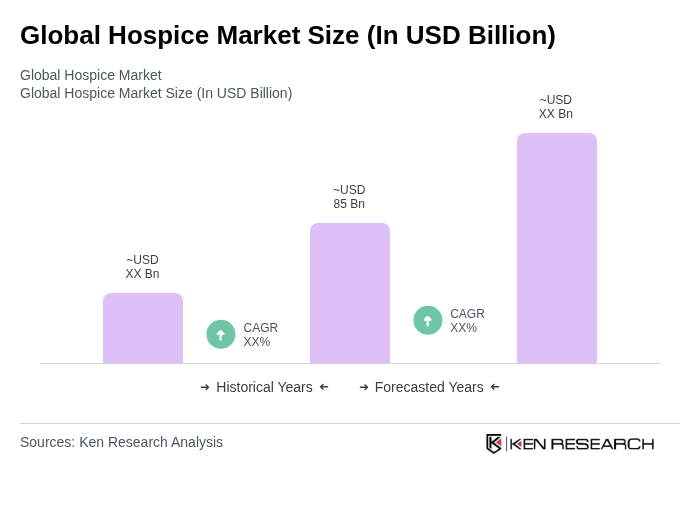
- The Global Hospice Market is valued at USD 85 billion, based on a five-year historical analysis of multiple industry sources. This growth is primarily driven by the increasing aging population, rising prevalence of chronic and life?limiting diseases such as cancer, cardiovascular and neurodegenerative conditions, and a growing preference for home-based and community-based care models. The demand for hospice services has surged as families seek compassionate, multidisciplinary end-of-life care options that prioritize comfort, symptom management, psychosocial support, and quality of life.
- The United States dominates the hospice market due to its advanced healthcare infrastructure, high healthcare expenditure, a large Medicare-covered aging population, and a well-established reimbursement framework for hospice services through Medicare, Medicaid, and private insurers. North America holds the largest share of global hospice revenues, with the U.S. accounting for the majority of this demand. Other significant markets include Germany and the United Kingdom, where government policies and national palliative care strategies support hospice and specialist palliative care services, and where a cultural shift towards home-based and community hospice care continues to enhance market growth.
- The Hospice Quality Reporting Program (HQRP) is a mandatory reporting program under the U.S. Centers for Medicare & Medicaid Services (CMS) Hospice Quality Reporting Requirements, established pursuant to Section 3004 of the Patient Protection and Affordable Care Act and implemented through successive CMS Hospice Wage Index and Payment Rate Update and Quality Reporting final rules. Under this program, Medicare-certified hospice providers must submit standardized quality measures (including Hospice Item Set and Consumer Assessment of Healthcare Providers and Systems Hospice Survey) as a condition of full payment, with noncompliance resulting in a payment reduction. The regulation aims to enhance transparency, public reporting, and accountability in hospice services, ensuring that patients receive high-quality, person?centered care tailored to their needs.
Global Hospice Market Segmentation
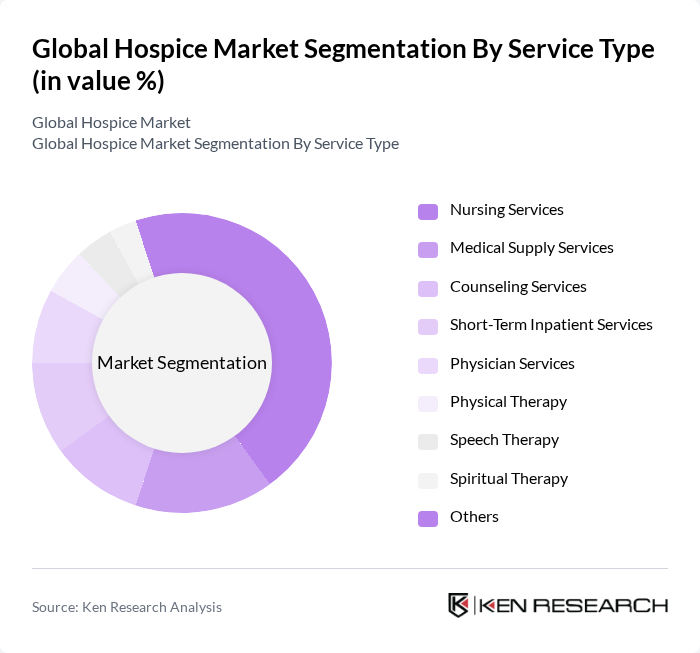
By Service Type:The service type segmentation includes various categories such as Nursing Services, Medical Supply Services, Counseling Services, Short-Term Inpatient Services, Physician Services, Physical Therapy, Speech Therapy, Spiritual Therapy, and Others. This structure is aligned with common industry categorizations used for hospice and hospice care markets. Each of these services plays a crucial role in providing comprehensive care to patients in hospice settings, combining medical, psychosocial, and spiritual support. Nursing Services are generally the largest service component, reflecting the essential role of nurses in symptom control, medication management, coordination of care, and ongoing patient and family support during end-of-life stages.
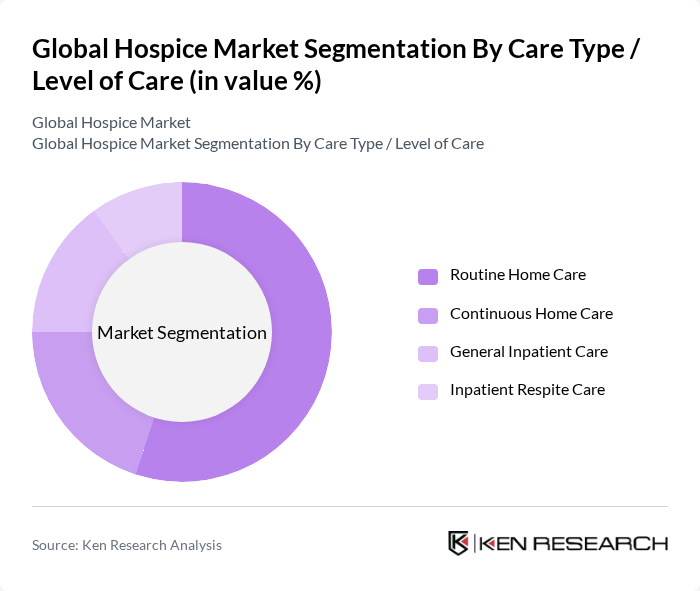
By Care Type / Level of Care:This segmentation includes Routine Home Care, Continuous Home Care, General Inpatient Care, and Inpatient Respite Care, which mirrors the principal levels of care defined in many hospice reimbursement and care models (e.g., Medicare hospice levels of care). Routine Home Care is the most prevalent type, as it allows patients to receive care in the comfort of their homes or long-term care settings, which is increasingly preferred by families and supported by payers. Continuous Home Care is also gaining traction, particularly for patients with complex symptoms or acute episodes requiring more intensive nursing and caregiver support in the home environment.
Global Hospice Market Competitive Landscape
The Global Hospice Market is characterized by a dynamic mix of regional and international players. Leading participants such as VITAS Healthcare (Chemed Corporation), Kindred Hospice, Amedisys, Inc., Brookdale Senior Living, Inc., Seasons Hospice & Palliative Care, Crossroads Hospice & Palliative Care, Compassus, Heart to Heart Hospice, LHC Group, Inc., Encompass Health Corporation, ProMedica Hospice, AccentCare, Inc., Harbor Light Hospice, Hospice of the Valley, and other notable regional hospice providers contribute to innovation, geographic expansion, and service delivery in this space.
Global Hospice Market Industry Analysis
Growth Drivers
- Increasing Aging Population:The global population aged 65 and older is projected to reach 1.5 billion by 2050, according to the United Nations. This demographic shift is driving demand for hospice services, as older adults typically require more end-of-life care. In future, approximately 21% of the population in developed countries will be over 65, significantly increasing the need for specialized hospice care tailored to this age group.
- Rising Prevalence of Chronic Diseases:The World Health Organization reports that chronic diseases account for approximately 74% of all deaths globally, with conditions like heart disease and cancer being prevalent. In future, it is estimated that over 55 million people will be diagnosed with terminal illnesses, necessitating hospice care. This growing patient base is a critical driver for the expansion of hospice services, as families seek compassionate care options for their loved ones.
- Growing Awareness of Palliative Care:Awareness of the benefits of palliative care is increasing, with studies indicating that many patients prefer to receive care at home. In future, educational initiatives and advocacy efforts are expected to reach over 110 million individuals, promoting hospice services as a viable option for end-of-life care. This heightened awareness is crucial for driving demand and acceptance of hospice care within communities.
Market Challenges
- Limited Funding and Reimbursement Issues:Funding for hospice services remains a significant challenge, with only 62% of hospice providers reporting adequate reimbursement rates. In future, the average reimbursement per patient is projected to be around $160 per day, which may not cover the full cost of care. This financial strain can limit service availability and quality, impacting patient access to necessary hospice services.
- Shortage of Trained Healthcare Professionals:The hospice sector faces a critical shortage of trained professionals, with estimates indicating a need for an additional 120,000 hospice workers in future. This shortage is exacerbated by high turnover rates and insufficient training programs. As demand for hospice care increases, the lack of qualified personnel poses a significant barrier to providing high-quality end-of-life care.
Global Hospice Market Future Outlook
The future of the hospice market is poised for significant transformation, driven by technological advancements and a shift towards patient-centered care. As telehealth services become more integrated into hospice care, accessibility and efficiency will improve, allowing for better patient management. Additionally, the expansion of community-based programs will enhance service delivery, ensuring that more individuals receive compassionate care in their preferred environments, ultimately reshaping the landscape of end-of-life care.
Market Opportunities
- Technological Advancements in Care Delivery:Innovations such as remote monitoring and telehealth platforms are expected to enhance hospice care delivery. In future, the adoption of these technologies could improve patient outcomes and reduce costs, making hospice services more efficient and accessible to a broader population.
- Partnerships with Healthcare Providers:Collaborations between hospice organizations and hospitals can streamline patient transitions to hospice care. In future, strategic partnerships are anticipated to increase, facilitating better resource sharing and improving overall patient care, which can lead to enhanced service offerings and patient satisfaction.
Scope of the Report
| Segment | Sub-Segments |
|---|---|
| By Service Type | Nursing Services Medical Supply Services Counseling Services Short-Term Inpatient Services Physician Services Physical Therapy Speech Therapy Spiritual Therapy Others |
| By Care Type / Level of Care | Routine Home Care Continuous Home Care General Inpatient Care Inpatient Respite Care |
| By Service Provider | Hospice Care Centers Home Care Settings Hospitals Skilled Nursing Facilities Other Service Providers |
| By Patient Diagnosis | Cancer Dementia and Neurodegenerative Disorders Cardiovascular Diseases Respiratory Diseases Renal Diseases Other Life-Limiting Conditions |
| By Age Group | Pediatric Patients Adult Patients Geriatric Patients |
| By Payer / Payment Source | Public Payers (e.g., Medicare, Medicaid, National Health Systems) Private Health Insurance Self-Pay / Out-of-Pocket Payments Charitable / Donor-Funded Programs Others |
| By Region | North America Europe Asia-Pacific Latin America Middle East & Africa |
Key Target Audience
Investors and Venture Capitalist Firms
Government and Regulatory Bodies (e.g., Centers for Medicare & Medicaid Services, National Institute for Health and Care Excellence)
Hospice Care Providers
Healthcare Insurance Companies
Pharmaceutical Companies
Medical Equipment Suppliers
Non-Profit Organizations and Foundations
Healthcare Policy Makers
Players Mentioned in the Report:
VITAS Healthcare (Chemed Corporation)
Kindred Hospice
Amedisys, Inc.
Brookdale Senior Living, Inc.
Seasons Hospice & Palliative Care
Crossroads Hospice & Palliative Care
Compassus
Heart to Heart Hospice
LHC Group, Inc.
Encompass Health Corporation
ProMedica Hospice
AccentCare, Inc.
Harbor Light Hospice
Hospice of the Valley
Other Notable Regional Hospice Providers
Table of Contents
Market Assessment Phase
1. Executive Summary and Approach
2. Global Hospice Market Overview
2.1 Key Insights and Strategic Recommendations
2.2 Global Hospice Market Overview
2.3 Definition and Scope
2.4 Evolution of Market Ecosystem
2.5 Timeline of Key Regulatory Milestones
2.6 Value Chain & Stakeholder Mapping
2.7 Business Cycle Analysis
2.8 Policy & Incentive Landscape
3. Global Hospice Market Analysis
3.1 Growth Drivers
3.1.1 Increasing Aging Population
3.1.2 Rising Prevalence of Chronic Diseases
3.1.3 Growing Awareness of Palliative Care
3.1.4 Expansion of Hospice Services
3.2 Market Challenges
3.2.1 Limited Funding and Reimbursement Issues
3.2.2 Shortage of Trained Healthcare Professionals
3.2.3 Regulatory Compliance Burdens
3.2.4 Public Misconceptions about Hospice Care
3.3 Market Opportunities
3.3.1 Technological Advancements in Care Delivery
3.3.2 Partnerships with Healthcare Providers
3.3.3 Expansion into Emerging Markets
3.3.4 Development of Innovative Care Models
3.4 Market Trends
3.4.1 Increased Focus on Home-Based Care
3.4.2 Integration of Telehealth Services
3.4.3 Emphasis on Patient-Centered Care
3.4.4 Growth of Community-Based Hospice Programs
3.5 Government Regulation
3.5.1 Medicare Hospice Benefit Regulations
3.5.2 State Licensing Requirements
3.5.3 Quality Reporting Mandates
3.5.4 Patient Rights and Safety Regulations
4. SWOT Analysis
5. Stakeholder Analysis
6. Porter's Five Forces Analysis
7. Global Hospice Market Market Size, 2019-2024
7.1 By Value
7.2 By Volume
7.3 By Average Selling Price
8. Global Hospice Market Segmentation
8.1 By Service Type
8.1.1 Nursing Services
8.1.2 Medical Supply Services
8.1.3 Counseling Services
8.1.4 Short-Term Inpatient Services
8.1.5 Physician Services
8.1.6 Physical Therapy
8.1.7 Speech Therapy
8.1.8 Spiritual Therapy
8.1.9 Others
8.2 By Care Type / Level of Care
8.2.1 Routine Home Care
8.2.2 Continuous Home Care
8.2.3 General Inpatient Care
8.2.4 Inpatient Respite Care
8.3 By Service Provider
8.3.1 Hospice Care Centers
8.3.2 Home Care Settings
8.3.3 Hospitals
8.3.4 Skilled Nursing Facilities
8.3.5 Other Service Providers
8.4 By Patient Diagnosis
8.4.1 Cancer
8.4.2 Dementia and Neurodegenerative Disorders
8.4.3 Cardiovascular Diseases
8.4.4 Respiratory Diseases
8.4.5 Renal Diseases
8.4.6 Other Life-Limiting Conditions
8.5 By Age Group
8.5.1 Pediatric Patients
8.5.2 Adult Patients
8.5.3 Geriatric Patients
8.6 By Payer / Payment Source
8.6.1 Public Payers (e.g., Medicare, Medicaid, National Health Systems)
8.6.2 Private Health Insurance
8.6.3 Self-Pay / Out-of-Pocket Payments
8.6.4 Charitable / Donor-Funded Programs
8.6.5 Others
8.7 By Region
8.7.1 North America
8.7.2 Europe
8.7.3 Asia-Pacific
8.7.4 Latin America
8.7.5 Middle East & Africa
9. Global Hospice Market Competitive Analysis
9.1 Market Share of Key Players
9.2 Cross Comparison of Key Players
9.2.1 Company Name
9.2.2 Group Size (Large, Medium, or Small as per industry convention)
9.2.3 Annual Revenue (USD, latest FY)
9.2.4 3-Year Revenue CAGR (%)
9.2.5 EBITDA Margin (%)
9.2.6 Hospice Patient Census (Average Daily Census)
9.2.7 Number of Locations / Facilities
9.2.8 Average Length of Stay (Days)
9.2.9 Payer Mix (% Revenue by Payer Type)
9.2.10 Staff-to-Patient Ratio
9.2.11 Quality of Care Indicators (e.g., Re-hospitalization Rate, Symptom Control)
9.2.12 Family / Caregiver Satisfaction Scores
9.2.13 Referral Conversion Rate
9.2.14 Market Share by Region / Core Geography
9.2.15 M&A and Network Expansion Activity
9.3 SWOT Analysis of Top Players
9.4 Pricing Analysis
9.5 Detailed Profile of Major Companies
9.5.1 VITAS Healthcare (Chemed Corporation)
9.5.2 Kindred Hospice
9.5.3 Amedisys, Inc.
9.5.4 Brookdale Senior Living, Inc.
9.5.5 Seasons Hospice & Palliative Care
9.5.6 Crossroads Hospice & Palliative Care
9.5.7 Compassus
9.5.8 Heart to Heart Hospice
9.5.9 LHC Group, Inc.
9.5.10 Encompass Health Corporation
9.5.11 ProMedica Hospice
9.5.12 AccentCare, Inc.
9.5.13 Harbor Light Hospice
9.5.14 Hospice of the Valley
9.5.15 Other Notable Regional Hospice Providers
10. Global Hospice Market End-User Analysis
10.1 Procurement Behavior of Key Ministries
10.1.1 Budget Allocation for Hospice Services
10.1.2 Decision-Making Processes
10.1.3 Evaluation Criteria for Service Providers
10.1.4 Stakeholder Engagement Strategies
10.2 Corporate Spend on Infrastructure & Energy
10.2.1 Investment in Hospice Facilities
10.2.2 Funding for Staff Training
10.2.3 Expenditure on Technology Integration
10.2.4 Budget for Community Outreach Programs
10.3 Pain Point Analysis by End-User Category
10.3.1 Patient Needs and Expectations
10.3.2 Family Concerns and Support Requirements
10.3.3 Healthcare Provider Challenges
10.3.4 Payer Perspectives on Cost and Quality
10.4 User Readiness for Adoption
10.4.1 Awareness of Hospice Services
10.4.2 Perceived Value of Hospice Care
10.4.3 Barriers to Accessing Services
10.4.4 Training and Support Needs
10.5 Post-Deployment ROI and Use Case Expansion
10.5.1 Measurement of Care Outcomes
10.5.2 Cost Savings Analysis
10.5.3 Patient and Family Satisfaction Metrics
10.5.4 Opportunities for Service Expansion
11. Global Hospice Market Future Size, 2025-2030
11.1 By Value
11.2 By Volume
11.3 By Average Selling Price
Go-To-Market Strategy Phase
1. Whitespace Analysis + Business Model Canvas
1.1 Market Gaps Identification
1.2 Value Proposition Development
1.3 Revenue Streams Analysis
1.4 Cost Structure Evaluation
1.5 Key Partnerships Exploration
1.6 Customer Segmentation
1.7 Channels of Distribution
2. Marketing and Positioning Recommendations
2.1 Branding Strategies
2.2 Product USPs
2.3 Target Audience Identification
2.4 Communication Strategies
2.5 Digital Marketing Approaches
2.6 Community Engagement Initiatives
2.7 Feedback Mechanisms
3. Distribution Plan
3.1 Urban Retail vs Rural NGO Tie-Ups
3.2 Logistics and Supply Chain Management
3.3 Partnership with Local Organizations
3.4 Distribution Channel Optimization
3.5 Inventory Management Strategies
3.6 Customer Service Framework
3.7 Performance Metrics
4. Channel & Pricing Gaps
4.1 Underserved Routes
4.2 Pricing Bands
4.3 Competitive Pricing Analysis
4.4 Value-Based Pricing Strategies
4.5 Discounts and Promotions
4.6 Customer Perception of Pricing
4.7 Price Sensitivity Analysis
5. Unmet Demand & Latent Needs
5.1 Category Gaps
5.2 Consumer Segments
5.3 Emerging Trends
5.4 Service Enhancement Opportunities
5.5 Feedback from Stakeholders
5.6 Market Research Insights
5.7 Future Demand Projections
6. Customer Relationship
6.1 Loyalty Programs
6.2 After-Sales Service
6.3 Customer Engagement Strategies
6.4 Feedback and Improvement Mechanisms
6.5 Relationship Management Tools
6.6 Community Building Initiatives
6.7 Customer Retention Strategies
7. Value Proposition
7.1 Sustainability
7.2 Integrated Supply Chains
7.3 Unique Selling Points
7.4 Customer-Centric Approaches
7.5 Competitive Advantages
7.6 Value Delivery Mechanisms
7.7 Market Differentiation Strategies
8. Key Activities
8.1 Regulatory Compliance
8.2 Branding
8.3 Distribution Setup
8.4 Staff Training and Development
8.5 Quality Assurance Processes
8.6 Community Outreach Programs
8.7 Performance Monitoring
9. Entry Strategy Evaluation
9.1 Domestic Market Entry Strategy
9.1.1 Product Mix
9.1.2 Pricing Band
9.1.3 Packaging
9.2 Export Entry Strategy
9.2.1 Target Countries
9.2.2 Compliance Roadmap
10. Entry Mode Assessment
10.1 JV
10.2 Greenfield
10.3 M&A
10.4 Distributor Model
11. Capital and Timeline Estimation
11.1 Capital Requirements
11.2 Timelines
12. Control vs Risk Trade-Off
12.1 Ownership vs Partnerships
13. Profitability Outlook
13.1 Breakeven Analysis
13.2 Long-Term Sustainability
14. Potential Partner List
14.1 Distributors
14.2 JVs
14.3 Acquisition Targets
15. Execution Roadmap
15.1 Phased Plan for Market Entry
15.1.1 Market Setup
15.1.2 Market Entry
15.1.3 Growth Acceleration
15.1.4 Scale & Stabilize
15.2 Key Activities and Milestones
15.2.1 Activity Planning
15.2.2 Milestone Tracking
Research Methodology
Phase 1: Approach1
Desk Research
- Analysis of global hospice market reports from healthcare organizations and industry associations
- Review of published articles and white papers on hospice care trends and patient demographics
- Examination of government health statistics and regulatory frameworks affecting hospice services
Primary Research
- Interviews with hospice care providers, including administrators and clinical staff
- Surveys conducted with patients and families utilizing hospice services to gather qualitative insights
- Focus groups with healthcare professionals to discuss challenges and innovations in hospice care
Validation & Triangulation
- Cross-validation of findings through multiple data sources, including market reports and expert opinions
- Triangulation of qualitative insights from interviews with quantitative data from surveys
- Sanity checks through expert panel reviews comprising hospice care leaders and policymakers
Phase 2: Market Size Estimation1
Top-down Assessment
- Estimation of total addressable market based on national healthcare expenditure on palliative care
- Segmentation of market size by geographic regions and types of hospice services offered
- Incorporation of demographic trends, including aging population statistics and chronic illness prevalence
Bottom-up Modeling
- Collection of service utilization rates from leading hospice providers across various regions
- Operational cost analysis based on service delivery models and reimbursement rates
- Volume x cost calculations for different service types, including in-home care and inpatient facilities
Forecasting & Scenario Analysis
- Multi-factor regression analysis incorporating factors such as healthcare policy changes and technological advancements
- Scenario modeling based on potential shifts in public perception and funding for hospice services
- Development of baseline, optimistic, and pessimistic forecasts through 2030
Phase 3: CATI Sample Composition1
| Scope Item/Segment | Sample Size | Target Respondent Profiles |
|---|---|---|
| Inpatient Hospice Facilities | 100 | Facility Administrators, Clinical Directors |
| Home-Based Hospice Care | 80 | Home Care Nurses, Patient Care Coordinators |
| Palliative Care Programs | 70 | Program Managers, Healthcare Policy Analysts |
| Hospice Volunteer Programs | 50 | Volunteer Coordinators, Community Outreach Managers |
| Patient and Family Experiences | 90 | Patients, Family Caregivers |
Frequently Asked Questions
What is the current value of the Global Hospice Market?
The Global Hospice Market is valued at approximately USD 85 billion, driven by factors such as an aging population and the rising prevalence of chronic diseases. This market is expected to grow as families increasingly seek compassionate end-of-life care options.
What factors are driving the growth of the Global Hospice Market?
Which regions dominate the Global Hospice Market?
What are the main types of services offered in hospice care?
Other Regional/Country Reports
Indonesia Hospice Market
Malaysia Hospice Market
KSA Hospice Market
APAC Hospice Market
SEA Hospice Market
Vietnam Hospice Market
Other Adjacent Reports
Philippines Palliative Care Market
Saudi Arabia Africa Home Healthcare Market Report Size Share Growth Drivers Trends Opportunities & Forecast 2025–2030Oman Geriatric Care Market
Middle East Chronic Disease Management Market Size, Share, Growth Drivers, Trends, Opportunities & Forecast 2025–2030Global Africa Telehealth Market Report Size Share Growth Drivers Trends Opportunities & Forecast 2025–2030Mexico Pain Management Market
India Senior Living Market Outlook to 2030Germany Long-Term Care Market
KSA Assisted Living Market
Kuwait Nursing Services Market
Why Buy From Us?

What makes us stand out is that our consultants follow Robust, Refine and Result (RRR) methodology. Robust for clear definitions, approaches and sanity checking, Refine for differentiating respondents' facts and opinions, and Result for presenting data with story.

We have set a benchmark in the industry by offering our clients with syndicated and customized market research reports featuring coverage of entire market as well as meticulous research and analyst insights.

While we don't replace traditional research, we flip the method upside down. Our dual approach of Top Bottom & Bottom Top ensures quality deliverable by not just verifying company fundamentals but also looking at the sector and macroeconomic factors.

With one step in the future, our research team constantly tries to show you the bigger picture. We help with some of the tough questions you may encounter along the way: How is the industry positioned? Best marketing channel? KPI's of competitors? By aligning every element, we help maximize success.

Our report gives you instant access to the answers and sources that other companies might choose to hide. We elaborate each steps of research methodology we have used and showcase you the sample size to earn your trust.

If you need any support, we are here! We pride ourselves on universe strength, data quality, and quick, friendly, and professional service.