Global Household Insecticides Market

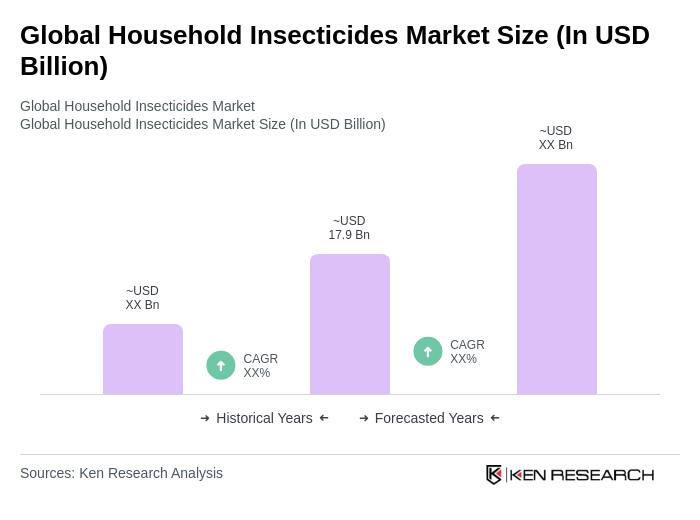
The global household insecticides market, valued at USD 17.9 billion, is growing due to rising urbanization, health concerns, and demand for eco-friendly products targeting pests like mosquitoes.

Region:Global

Author(s):Geetanshi

Product Code:KRAA2361

Pages:92

Published On:August 2025
About the Report

Base Year 2024

Global Household Insecticides Market Overview

  • The Global Household Insecticides Market is valued at USD 17.9 billion, based on a five-year historical analysis. This growth is primarily driven by increasing urbanization, rising disposable incomes, and heightened awareness regarding health and hygiene. The demand for effective pest control solutions has surged, particularly in urban areas where insect infestations are more prevalent. Additionally, there is a growing consumer preference for eco-friendly and natural insecticide formulations, and technological advancements in product delivery and application methods are further supporting market expansion .
  • Key players in this market include the United States, China, and India, which dominate due to their large populations and rapid urbanization. The increasing prevalence of vector-borne diseases in these regions has led to a higher demand for household insecticides, making them critical markets for manufacturers and suppliers. Asia Pacific currently holds the largest market share, accounting for over 43% of global demand .
  • In 2023, the U.S. Environmental Protection Agency (EPA) implemented stricter regulations on the use of certain chemical insecticides, mandating that all household insecticide products must undergo rigorous safety assessments. The regulation, under the Federal Insecticide, Fungicide, and Rodenticide Act (FIFRA), requires manufacturers to provide comprehensive data on product safety, efficacy, and environmental impact before approval for market release. This regulatory framework aims to ensure consumer safety and environmental protection, thereby influencing product formulations and market dynamics .
Global Household Insecticides Market Size

Global Household Insecticides Market Segmentation

By Product Type:The product type segmentation includes various forms of household insecticides, each catering to different consumer preferences and usage scenarios. The subsegments are Aerosol Sprays, Liquid Concentrates, Granules, Baits, Powders, Foggers, Traps & Strips, and Others. Among these, aerosol sprays are particularly popular due to their ease of use and effectiveness in quickly eliminating pests. The convenience of application and immediate results make aerosol sprays a preferred choice for consumers, driving their dominance in the market. The market is also witnessing increased demand for natural and botanical-based products, reflecting the shift toward safer and environmentally friendly options .
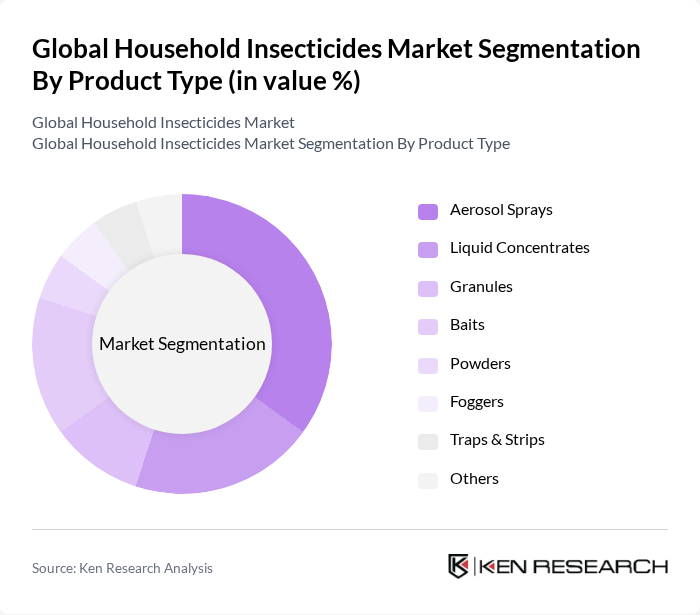
Global Household Insecticides Market segmentation by Product Type.

By Insect Type:This segmentation focuses on the types of insects targeted by household insecticides, including Mosquitoes & Flies, Termites, Bedbugs & Beetles, Ants & Cockroaches, Rats & Other Rodents, and Other Insect Types. Mosquitoes and flies are the most common pests, leading to a significant demand for insecticides designed to combat these insects. The increasing awareness of the health risks associated with mosquito-borne diseases has further propelled the market for products targeting these pests. Seasonal spikes in vector-borne diseases and public health campaigns also contribute to the demand for insecticide products .

Global Household Insecticides Market segmentation by Insect Type.

Global Household Insecticides Market Competitive Landscape

The Global Household Insecticides Market is characterized by a dynamic mix of regional and international players. Leading participants such as S. C. Johnson & Son, Inc., Reckitt Benckiser Group plc, Bayer AG, Syngenta AG, BASF SE, Terminix Global Holdings, Inc., Rentokil Initial plc, Ecolab Inc., Godrej Consumer Products Limited, Spectrum Brands Holdings, Inc., Central Garden & Pet Company, Amvac Chemical Corporation, FMC Corporation, Sumitomo Chemical Co., Ltd., Earth Chemical Co., Ltd., Dabur India Limited, Jyothy Laboratories Ltd., Tiger Brands Limited, Pelgar International Limited, Amplecta AB contribute to innovation, geographic expansion, and service delivery in this space.

S. C. Johnson & Son, Inc.

1886

Racine, Wisconsin, USA

Reckitt Benckiser Group plc

1823

Slough, England

Bayer AG

1863

Leverkusen, Germany

Syngenta AG

2000

Basel, Switzerland

BASF SE

1865

Ludwigshafen, Germany

Company

Establishment Year

Headquarters

Group Size (Large, Medium, or Small as per industry convention)

Revenue (USD, latest fiscal year)

Revenue Growth Rate (CAGR, 3-5 years)

Market Share (%)

Geographic Presence (Number of countries/regions)

Product Portfolio Breadth (Number of SKUs/brands)

Global Household Insecticides Market Industry Analysis

Growth Drivers

  • Increasing Urbanization:Urbanization is a significant driver for the household insecticides market, with the United Nations projecting that in future, approximately 56% of the global population will reside in urban areas. This shift leads to higher pest infestations due to denser living conditions. In cities, the average household size is decreasing, resulting in more individual units requiring pest control solutions. Consequently, urban households are increasingly investing in insecticides to maintain hygiene and comfort, driving market growth.
  • Rising Health Awareness:Health awareness is on the rise, with a survey indicating that 78% of consumers prioritize pest control to prevent disease transmission. The World Health Organization reports that vector-borne diseases, such as malaria and dengue, affect millions annually, prompting households to adopt insecticides as preventive measures. This heightened awareness is leading to increased sales of household insecticides, as consumers seek effective solutions to protect their families from health risks associated with pests.
  • Technological Advancements in Formulations:The household insecticides market is benefiting from technological advancements, with the introduction of innovative formulations that enhance efficacy and safety. For instance, the development of microencapsulation technology allows for controlled release of active ingredients, improving effectiveness. In future, the global market for advanced insecticide formulations is expected to reach $1.3 billion, reflecting a growing preference for products that combine performance with reduced toxicity, appealing to health-conscious consumers.

Market Challenges

  • Stringent Regulatory Framework:The household insecticides market faces challenges due to stringent regulations imposed by governments worldwide. In future, the European Chemicals Agency (ECHA) is expected to enforce stricter compliance measures, requiring extensive testing and documentation for new products. This regulatory landscape can delay product launches and increase costs for manufacturers, potentially limiting market growth. Companies must navigate these complexities to ensure compliance while maintaining competitive pricing.
  • Environmental Concerns:Growing environmental concerns are impacting the household insecticides market, as consumers and regulators increasingly prioritize sustainability. In future, it is estimated that 65% of consumers will prefer eco-friendly products, leading to a decline in demand for traditional chemical insecticides. This shift poses a challenge for manufacturers who must adapt their product lines to meet consumer expectations while addressing environmental impacts, which can be costly and time-consuming.

Global Household Insecticides Market Future Outlook

The future of the household insecticides market appears promising, driven by increasing urbanization and a growing focus on health and safety. As consumers become more aware of pest-related health risks, the demand for effective insecticides is expected to rise. Additionally, the trend towards eco-friendly products will likely shape product development, pushing manufacturers to innovate. Companies that embrace sustainable practices and advanced technologies will be well-positioned to capture market share in this evolving landscape.

Market Opportunities

  • Expansion in Emerging Markets:Emerging markets present significant growth opportunities for household insecticides, with a projected increase in urban populations. In future, countries like India and Brazil are expected to see a 15% rise in household insecticide consumption, driven by rising disposable incomes and urbanization. This trend offers manufacturers a chance to expand their market presence and cater to the growing demand for pest control solutions.
  • Development of Eco-Friendly Products:The demand for eco-friendly insecticides is on the rise, with a projected market value of $600 million by future. Consumers are increasingly seeking products that are safe for both their families and the environment. Companies that invest in research and development of biodegradable and non-toxic formulations will not only meet consumer demand but also enhance their brand reputation, leading to increased sales and market share.

Scope of the Report

SegmentSub-Segments
By Product Type

Aerosol Sprays

Liquid Concentrates

Granules

Baits

Powders

Foggers

Traps & Strips

Others

By Insect Type

Mosquitoes & Flies

Termites

Bedbugs & Beetles

Ants & Cockroaches

Rats & Other Rodents

Other Insect Types

By Chemical Type

Synthetic (e.g., Pyrethroids, Organophosphates)

Natural (e.g., Citronella Oil, Geraniol Oil)

By Application

Indoor Use

Outdoor Use

By Distribution Channel

Online Retail

Supermarkets/Hypermarkets

Specialty Stores

Direct Sales

By Packaging Type

Bottles

Cans

Pouches

Bulk Packaging

By Price Range

Low Price

Mid Price

Premium Price

By Geography

North America

Europe

Asia-Pacific

South America

Middle East & Africa

Key Target Audience

Investors and Venture Capitalist Firms

Government and Regulatory Bodies (e.g., Environmental Protection Agency, Food and Drug Administration)

Manufacturers and Producers

Distributors and Retailers

Public Health Organizations (e.g., World Health Organization)

Industry Associations (e.g., American Chemistry Council)

Financial Institutions

Importers and Exporters

Players Mentioned in the Report:

S. C. Johnson & Son, Inc.

Reckitt Benckiser Group plc

Bayer AG

Syngenta AG

BASF SE

Terminix Global Holdings, Inc.

Rentokil Initial plc

Ecolab Inc.

Godrej Consumer Products Limited

Spectrum Brands Holdings, Inc.

Central Garden & Pet Company

Amvac Chemical Corporation

FMC Corporation

Sumitomo Chemical Co., Ltd.

Earth Chemical Co., Ltd.

Dabur India Limited

Jyothy Laboratories Ltd.

Tiger Brands Limited

Pelgar International Limited

Amplecta AB

Table of Contents

Market Assessment Phase

1. Executive Summary and Approach


2. Global Household Insecticides Market Overview

2.1 Key Insights and Strategic Recommendations

2.2 Global Household Insecticides Market Overview

2.3 Definition and Scope

2.4 Evolution of Market Ecosystem

2.5 Timeline of Key Regulatory Milestones

2.6 Value Chain & Stakeholder Mapping

2.7 Business Cycle Analysis

2.8 Policy & Incentive Landscape


3. Global Household Insecticides Market Analysis

3.1 Growth Drivers

3.1.1 Increasing Urbanization
3.1.2 Rising Health Awareness
3.1.3 Growth in Pest Infestation
3.1.4 Technological Advancements in Formulations

3.2 Market Challenges

3.2.1 Stringent Regulatory Framework
3.2.2 Environmental Concerns
3.2.3 Competition from Natural Alternatives
3.2.4 Price Sensitivity Among Consumers

3.3 Market Opportunities

3.3.1 Expansion in Emerging Markets
3.3.2 Development of Eco-Friendly Products
3.3.3 E-commerce Growth
3.3.4 Strategic Partnerships and Collaborations

3.4 Market Trends

3.4.1 Shift Towards Organic Insecticides
3.4.2 Increased Use of Smart Pest Control Solutions
3.4.3 Rising Demand for Ready-to-Use Products
3.4.4 Focus on Sustainable Packaging

3.5 Government Regulation

3.5.1 Registration and Approval Processes
3.5.2 Labeling Requirements
3.5.3 Restrictions on Certain Chemicals
3.5.4 Environmental Impact Assessments

4. SWOT Analysis


5. Stakeholder Analysis


6. Porter's Five Forces Analysis


7. Global Household Insecticides Market Market Size, 2019-2024

7.1 By Value

7.2 By Volume

7.3 By Average Selling Price


8. Global Household Insecticides Market Segmentation

8.1 By Product Type

8.1.1 Aerosol Sprays
8.1.2 Liquid Concentrates
8.1.3 Granules
8.1.4 Baits
8.1.5 Powders
8.1.6 Foggers
8.1.7 Traps & Strips
8.1.8 Others

8.2 By Insect Type

8.2.1 Mosquitoes & Flies
8.2.2 Termites
8.2.3 Bedbugs & Beetles
8.2.4 Ants & Cockroaches
8.2.5 Rats & Other Rodents
8.2.6 Other Insect Types

8.3 By Chemical Type

8.3.1 Synthetic (e.g., Pyrethroids, Organophosphates)
8.3.2 Natural (e.g., Citronella Oil, Geraniol Oil)

8.4 By Application

8.4.1 Indoor Use
8.4.2 Outdoor Use

8.5 By Distribution Channel

8.5.1 Online Retail
8.5.2 Supermarkets/Hypermarkets
8.5.3 Specialty Stores
8.5.4 Direct Sales

8.6 By Packaging Type

8.6.1 Bottles
8.6.2 Cans
8.6.3 Pouches
8.6.4 Bulk Packaging

8.7 By Price Range

8.7.1 Low Price
8.7.2 Mid Price
8.7.3 Premium Price

8.8 By Geography

8.8.1 North America
8.8.2 Europe
8.8.3 Asia-Pacific
8.8.4 South America
8.8.5 Middle East & Africa

9. Global Household Insecticides Market Competitive Analysis

9.1 Market Share of Key Players

9.2 Cross Comparison of Key Players

9.2.1 Company Name
9.2.2 Group Size (Large, Medium, or Small as per industry convention)
9.2.3 Revenue (USD, latest fiscal year)
9.2.4 Revenue Growth Rate (CAGR, 3-5 years)
9.2.5 Market Share (%)
9.2.6 Geographic Presence (Number of countries/regions)
9.2.7 Product Portfolio Breadth (Number of SKUs/brands)
9.2.8 R&D Intensity (R&D spend as % of revenue)
9.2.9 Sustainability Initiatives (e.g., % eco-friendly products)
9.2.10 Distribution Network Strength (e.g., number of retail points, e-commerce penetration)
9.2.11 Customer Retention Rate (%)
9.2.12 Brand Equity Score (as per industry benchmarks)
9.2.13 Innovation Rate (new product launches/year)

9.3 SWOT Analysis of Top Players

9.4 Pricing Analysis

9.5 Detailed Profile of Major Companies

9.5.1 S. C. Johnson & Son, Inc.
9.5.2 Reckitt Benckiser Group plc
9.5.3 Bayer AG
9.5.4 Syngenta AG
9.5.5 BASF SE
9.5.6 Terminix Global Holdings, Inc.
9.5.7 Rentokil Initial plc
9.5.8 Ecolab Inc.
9.5.9 Godrej Consumer Products Limited
9.5.10 Spectrum Brands Holdings, Inc.
9.5.11 Central Garden & Pet Company
9.5.12 Amvac Chemical Corporation
9.5.13 FMC Corporation
9.5.14 Sumitomo Chemical Co., Ltd.
9.5.15 Earth Chemical Co., Ltd.
9.5.16 Dabur India Limited
9.5.17 Jyothy Laboratories Ltd.
9.5.18 Tiger Brands Limited
9.5.19 Pelgar International Limited
9.5.20 Amplecta AB

10. Global Household Insecticides Market End-User Analysis

10.1 Procurement Behavior of Key Ministries

10.1.1 Budget Allocation Trends
10.1.2 Decision-Making Processes
10.1.3 Supplier Selection Criteria

10.2 Corporate Spend on Infrastructure & Energy

10.2.1 Investment Trends in Pest Control
10.2.2 Budgeting for Maintenance and Upgrades

10.3 Pain Point Analysis by End-User Category

10.3.1 Effectiveness of Products
10.3.2 Safety Concerns
10.3.3 Availability of Products

10.4 User Readiness for Adoption

10.4.1 Awareness of New Products
10.4.2 Training and Support Needs

10.5 Post-Deployment ROI and Use Case Expansion

10.5.1 Measurement of Effectiveness
10.5.2 Feedback Mechanisms

11. Global Household Insecticides Market Future Size, 2025-2030

11.1 By Value

11.2 By Volume

11.3 By Average Selling Price


Go-To-Market Strategy Phase

1. Whitespace Analysis + Business Model Canvas

1.1 Market Gaps Identification

1.2 Value Proposition Development

1.3 Revenue Streams Analysis

1.4 Cost Structure Evaluation

1.5 Key Partnerships Identification

1.6 Customer Segments Definition

1.7 Channels of Distribution


2. Marketing and Positioning Recommendations

2.1 Branding Strategies

2.2 Product USPs


3. Distribution Plan

3.1 Urban Retail vs Rural NGO Tie-ups


4. Channel & Pricing Gaps

4.1 Underserved Routes

4.2 Pricing Bands


5. Unmet Demand & Latent Needs

5.1 Category Gaps

5.2 Consumer Segments


6. Customer Relationship

6.1 Loyalty Programs

6.2 After-sales Service


7. Value Proposition

7.1 Sustainability

7.2 Integrated Supply Chains


8. Key Activities

8.1 Regulatory Compliance

8.2 Branding

8.3 Distribution Setup


9. Entry Strategy Evaluation

9.1 Domestic Market Entry Strategy

9.1.1 Product Mix
9.1.2 Pricing Band
9.1.3 Packaging

9.2 Export Entry Strategy

9.2.1 Target Countries
9.2.2 Compliance Roadmap

10. Entry Mode Assessment

10.1 JV

10.2 Greenfield

10.3 M&A

10.4 Distributor Model


11. Capital and Timeline Estimation

11.1 Capital Requirements

11.2 Timelines


12. Control vs Risk Trade-Off

12.1 Ownership vs Partnerships


13. Profitability Outlook

13.1 Breakeven Analysis

13.2 Long-term Sustainability


14. Potential Partner List

14.1 Distributors

14.2 JVs

14.3 Acquisition Targets


15. Execution Roadmap

15.1 Phased Plan for Market Entry

15.1.1 Market Setup
15.1.2 Market Entry
15.1.3 Growth Acceleration
15.1.4 Scale & Stabilize

15.2 Key Activities and Milestones

15.2.1 Activity Planning
15.2.2 Milestone Tracking

Research Methodology

ApproachModellingSample

Phase 1: Approach1

Desk Research

  • Analysis of market reports from industry associations such as the Global Pest Management Coalition
  • Review of academic journals and publications on household insecticides and pest control methods
  • Examination of government publications and regulatory frameworks affecting the insecticide market

Primary Research

  • Interviews with product managers at leading household insecticide manufacturers
  • Surveys with retailers and distributors to understand market dynamics and consumer preferences
  • Field visits to retail outlets to observe product placement and consumer buying behavior

Validation & Triangulation

  • Cross-validation of data from multiple sources including trade publications and market surveys
  • Triangulation of findings from primary interviews with secondary data insights
  • Sanity checks through expert panels comprising industry veterans and market analysts

Phase 2: Market Size Estimation1

Top-down Assessment

  • Estimation of total market size based on national household insecticide consumption statistics
  • Segmentation of the market by product type (aerosols, sprays, baits, etc.) and geography
  • Incorporation of trends in urbanization and pest prevalence rates influencing market growth

Bottom-up Modeling

  • Collection of sales data from key manufacturers and distributors to establish baseline figures
  • Estimation of average selling prices across different product categories
  • Volume estimates based on consumer purchasing patterns and seasonal demand fluctuations

Forecasting & Scenario Analysis

  • Utilization of time-series analysis to project future market trends based on historical data
  • Scenario modeling based on potential regulatory changes and environmental concerns
  • Development of best-case, worst-case, and most-likely market growth scenarios through 2030

Phase 3: CATI Sample Composition1

Scope Item/SegmentSample SizeTarget Respondent Profiles
Retail Market Insights100Store Managers, Category Buyers
Consumer Preferences Survey120Household Decision Makers, Pest Control Users
Distribution Channel Analysis80Wholesalers, Distributors
Regulatory Impact Assessment60Compliance Officers, Environmental Consultants
Market Trend Evaluation70Market Analysts, Industry Experts

Frequently Asked Questions

What is the current value of the Global Household Insecticides Market?

The Global Household Insecticides Market is valued at approximately USD 17.9 billion, reflecting a significant growth trend driven by urbanization, rising disposable incomes, and increased health awareness regarding pest control solutions.

What factors are driving the growth of the household insecticides market?

Which regions dominate the Global Household Insecticides Market?

What are the main product types in the household insecticides market?

Other Regional/Country Reports

Indonesia Global Household Insecticides Market

Malaysia Global Household Insecticides Market

KSA Global Household Insecticides Market

APAC Global Household Insecticides Market

SEA Global Household Insecticides Market

Vietnam Global Household Insecticides Market

Other Adjacent Reports

Vietnam pest control services market size, share, growth drivers, trends, opportunities & forecast 2025–2030

Germany Agricultural Pesticides Market

Germany Insect Repellents Market

South Africa Home Cleaning Products Market

Philippines Vector Control Products Market

UAE Rodenticides Market

Vietnam Fumigants Market

Egypt Eco-Friendly Pesticides Market

Philippines Commercial Insecticides Market

Mexico Public Health Pesticides Market

Why Buy From Us?

Refine Robust Result (RRR) Framework

What makes us stand out is that our consultants follow Robust, Refine and Result (RRR) methodology. Robust for clear definitions, approaches and sanity checking, Refine for differentiating respondents' facts and opinions, and Result for presenting data with story.

Our Reach Is Unmatched

We have set a benchmark in the industry by offering our clients with syndicated and customized market research reports featuring coverage of entire market as well as meticulous research and analyst insights.

Shifting the Research Paradigm

While we don't replace traditional research, we flip the method upside down. Our dual approach of Top Bottom & Bottom Top ensures quality deliverable by not just verifying company fundamentals but also looking at the sector and macroeconomic factors.

More Insights-Better Decisions

With one step in the future, our research team constantly tries to show you the bigger picture. We help with some of the tough questions you may encounter along the way: How is the industry positioned? Best marketing channel? KPI's of competitors? By aligning every element, we help maximize success.

Transparency and Trust

Our report gives you instant access to the answers and sources that other companies might choose to hide. We elaborate each steps of research methodology we have used and showcase you the sample size to earn your trust.

Round the Clock Support

If you need any support, we are here! We pride ourselves on universe strength, data quality, and quick, friendly, and professional service.

Why Clients Choose Us?

400000+
Reports in repository
150+
Consulting projects a year
100+
Analysts
8000+
Client Queries in 2022








