Region:Global
Author(s):Rebecca
Product Code:KRAC8472
Pages:96
Published On:November 2025
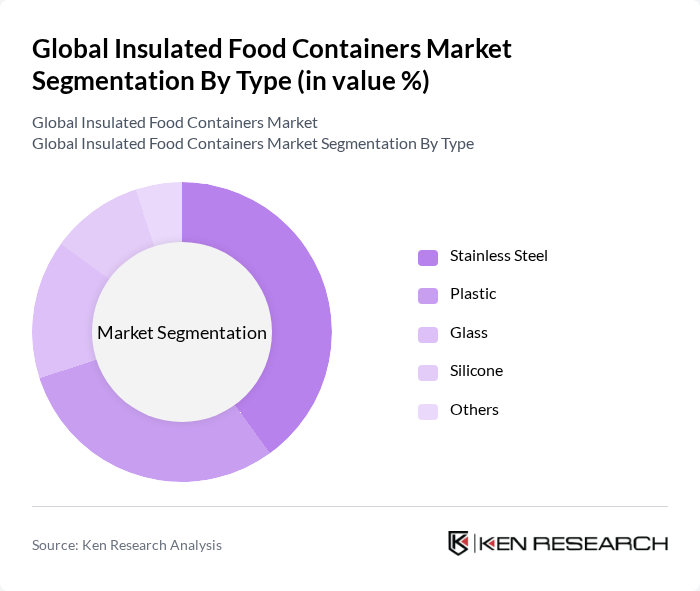
By Type:The market is segmented into various types of insulated food containers, including Vacuum Insulated Containers, Stainless Steel, Plastic, Glass, Silicone, and Others. Among these, Stainless Steel containers are gaining popularity due to their durability, insulation properties, and eco-friendliness, with the stainless steel segment expected to grow at a considerable rate in terms of revenue. Plastic containers are also widely used due to their lightweight nature and affordability. The demand for Glass and Silicone containers is growing as consumers become more health-conscious and seek alternatives to plastic.
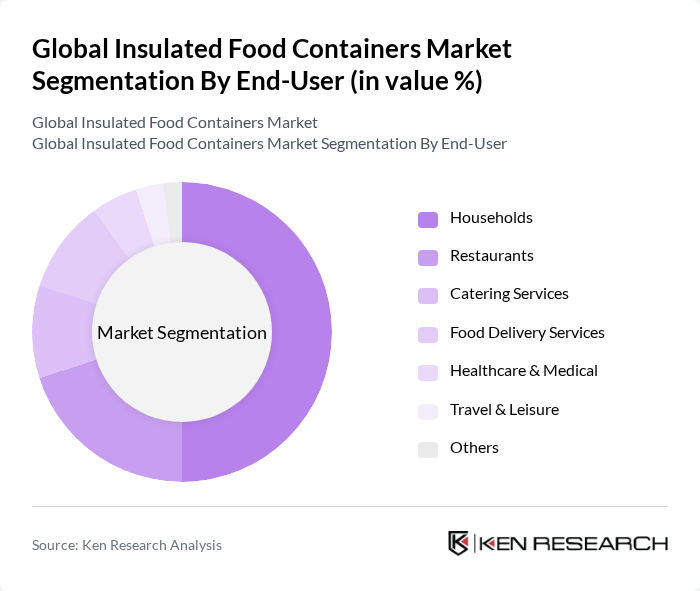
By End-User:The end-user segmentation includes Households, Restaurants, Catering Services, Food Delivery Services, Healthcare & Medical, Travel & Leisure, and Others. Households represent the largest segment, driven by the increasing trend of meal prepping and the need for convenient food storage solutions. Restaurants and Catering Services are also significant users, as they require efficient food storage to maintain quality and safety during service.
The Global Insulated Food Containers Market is characterized by a dynamic mix of regional and international players. Leading participants such as Thermos LLC, Zojirushi Corporation, Tupperware Brands Corporation, Stanley (Newell Brands), Rubbermaid (Newell Brands), Contigo (Newell Brands), Hydro Flask (Helen of Troy Limited), CamelBak Products LLC, OXO International, Igloo Products Corp., LunchBots, Klean Kanteen, S'well, Aladdin (Newell Brands), Coleman (Newell Brands), Sonoco ThermoSafe, Huhtamaki, Smurfit Kappa, Anchor Packaging LLC, Genpak LLC, Inline Plastics Corp., Cambro Manufacturing, YETI COOLERS, LLC, KingStar Industries Co., Ltd, BARTH GmbH, MARKO FOAM PRODUCTS contribute to innovation, geographic expansion, and service delivery in this space.
The future of the insulated food containers market appears promising, driven by ongoing trends in sustainability and technological innovation. As consumers increasingly prioritize eco-friendly products, manufacturers are likely to invest in sustainable materials and smart technologies. Additionally, the rise of e-commerce and food delivery services will further enhance market growth, creating new avenues for product distribution. Companies that adapt to these trends will be well-positioned to capture emerging market segments and meet evolving consumer demands.
| Segment | Sub-Segments |
|---|---|
| By Type | Stainless Steel Plastic Glass Silicone Others |
| By End-User | Households Restaurants Catering Services Food Delivery Services Healthcare & Medical Travel & Leisure Others |
| By Material | BPA-Free Plastic Recyclable Materials Insulated Foam Polypropylene Others |
| By Design | Traditional Containers Modular Containers Stackable Containers Single-Wall Double-Wall Vacuum-Insulated Triple-Wall Others |
| By Capacity | Less than 1 Liter to 2 Liters to 3 Liters More than 3 Liters Below 30 oz 50 oz 70 oz Above 70 oz |
| By Distribution Channel | Online Retail Supermarkets/Hypermarkets Specialty Stores Foodservice Distributors Others |
| By Price Range | Budget Mid-Range Premium Others |
| Scope Item/Segment | Sample Size | Target Respondent Profiles |
|---|---|---|
| Retail Market Insights | 100 | Store Managers, Category Buyers |
| Food Service Industry Feedback | 80 | Restaurant Owners, Catering Managers |
| Consumer Preferences Survey | 120 | Household Consumers, Health-Conscious Shoppers |
| Distribution Channel Analysis | 60 | Logistics Coordinators, Supply Chain Analysts |
| Product Development Insights | 50 | R&D Managers, Product Designers |
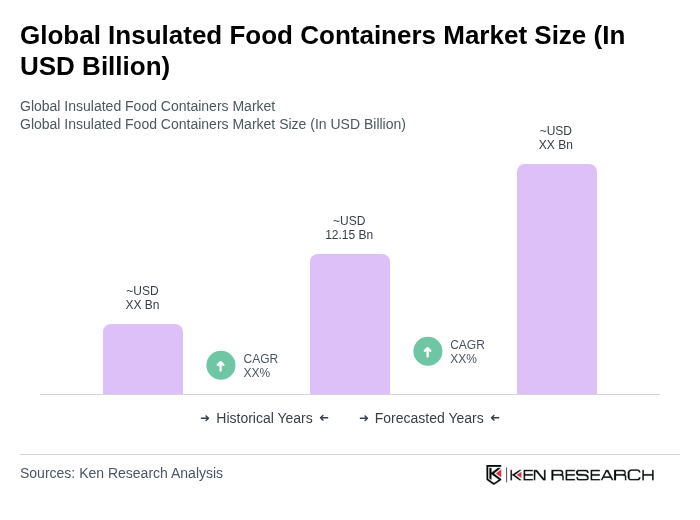
The Global Insulated Food Containers Market is valued at approximately USD 12.15 billion, reflecting a significant growth trend driven by increasing consumer demand for convenient food storage solutions and heightened awareness regarding food safety.

What makes us stand out is that our consultants follow Robust, Refine and Result (RRR) methodology. Robust for clear definitions, approaches and sanity checking, Refine for differentiating respondents' facts and opinions, and Result for presenting data with story.

We have set a benchmark in the industry by offering our clients with syndicated and customized market research reports featuring coverage of entire market as well as meticulous research and analyst insights.

While we don't replace traditional research, we flip the method upside down. Our dual approach of Top Bottom & Bottom Top ensures quality deliverable by not just verifying company fundamentals but also looking at the sector and macroeconomic factors.

With one step in the future, our research team constantly tries to show you the bigger picture. We help with some of the tough questions you may encounter along the way: How is the industry positioned? Best marketing channel? KPI's of competitors? By aligning every element, we help maximize success.

Our report gives you instant access to the answers and sources that other companies might choose to hide. We elaborate each steps of research methodology we have used and showcase you the sample size to earn your trust.

If you need any support, we are here! We pride ourselves on universe strength, data quality, and quick, friendly, and professional service.













