About the Report
Base Year 2024Global Insulin Infusion Pumps Market Overview
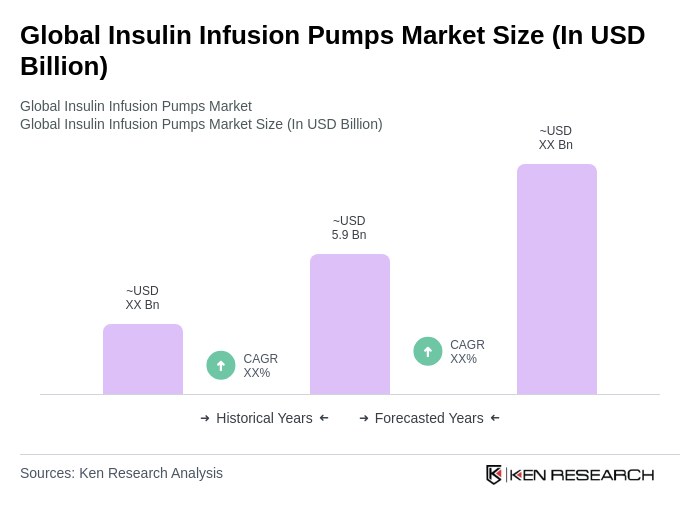
- The Global Insulin Infusion Pumps Market is valued at USD 5.9 billion, based on a five-year historical analysis. This growth is primarily driven by the increasing prevalence of diabetes, advancements in technology (notably automated insulin delivery and interoperability with continuous glucose monitoring), and rising awareness regarding intensive diabetes management. The demand for insulin infusion pumps has surged as they offer more precise insulin delivery and can reduce hypoglycemia while improving time?in?range for suitable patients.
- Key players in this market include the United States, Germany, and Japan, which dominate due to advanced healthcare infrastructure, higher disposable incomes, strong reimbursement frameworks, and significant investments in diabetes care technologies; these countries also host leading pump and CGM innovators and have large installed patient bases.
- In 2023, the U.S. government continued to require insulin pumps to meet stringent safety and efficacy standards under the Food and Drug Administration’s medical device framework (including premarket submissions and special controls where applicable) before marketing authorization, reinforcing patient safety and device quality.
Global Insulin Infusion Pumps Market Segmentation
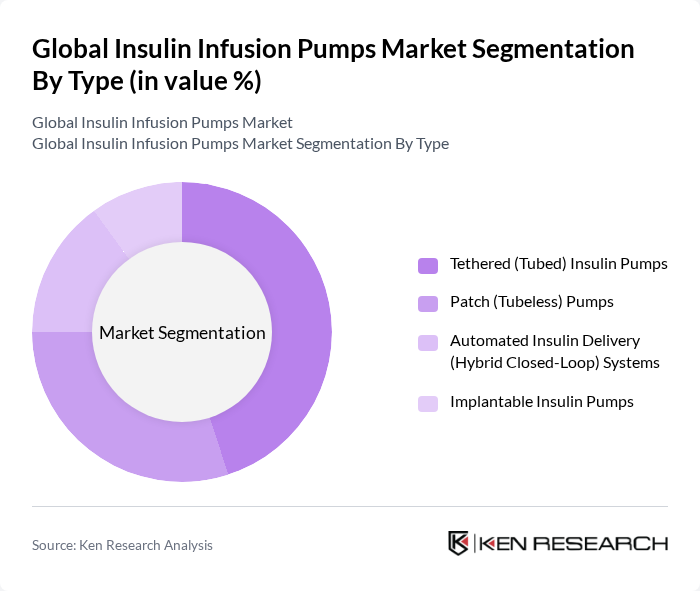
By Type:The market is segmented into four main types of insulin infusion pumps: Tethered (Tubed) Insulin Pumps, Patch (Tubeless) Pumps, Automated Insulin Delivery (Hybrid Closed-Loop) Systems, and Implantable Insulin Pumps. Among these, Tethered (Tubed) Insulin Pumps are the most widely used due to their reliability, broad reimbursement, and established clinical evidence. However, Patch (Tubeless) Pumps are gaining traction due to convenience, reduced on?body footprint, and ease of use, particularly among younger patients and those seeking a more discreet option; adoption is further supported by integration with CGM and app-based control in newer systems.
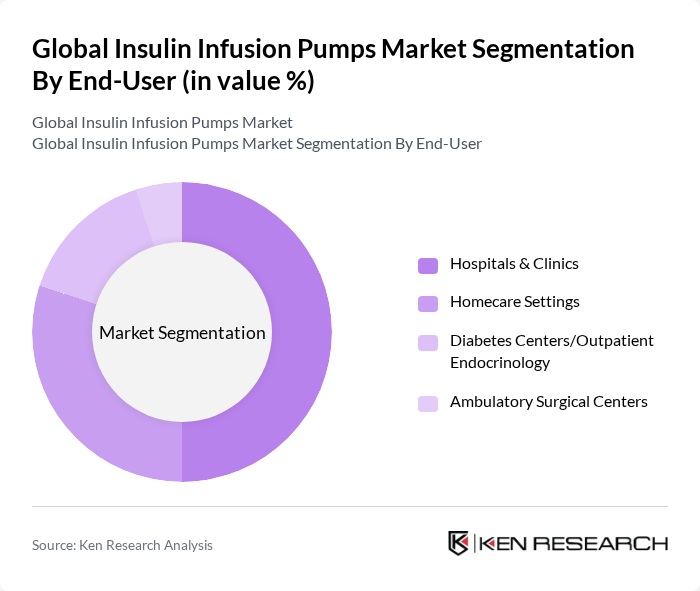
By End-User:The end-user segmentation includes Hospitals & Clinics, Homecare Settings, Diabetes Centers/Outpatient Endocrinology, and Ambulatory Surgical Centers. Hospitals & Clinics dominate due to comprehensive diabetes programs, initiation/training infrastructure, and access to advanced technologies. However, Homecare Settings are rapidly growing as patients increasingly prefer home-based management supported by connected pumps, remote monitoring, and telehealth-enabled training and follow?up.
Global Insulin Infusion Pumps Market Competitive Landscape
The Global Insulin Infusion Pumps Market is characterized by a dynamic mix of regional and international players. Leading participants such as Medtronic plc (MiniMed), Insulet Corporation (Omnipod), Tandem Diabetes Care, Inc., Roche Diabetes Care (Accu?Chek/Diabetes Care), Ypsomed AG (mylife YpsoPump), SOOIL Developments Co., Ltd. (DANA Diabecare), Medtrum Technologies Inc., EOFlow Co., Ltd. (EOPatch), Beta Bionics, Inc., Debiotech SA, Abbott Diabetes Care (CGM ecosystem partner), Dexcom, Inc. (CGM ecosystem partner), Diabeloop SA (AID algorithm partner), CeQur SA, VIVI Diabetes (formerly ViCentra) – Kaleido contribute to innovation, geographic expansion, and service delivery in this space.
Additional validated insights and current trends - Strong adoption of hybrid closed-loop systems integrating pumps with CGM and control algorithms is a key growth driver, improving glycemic metrics and user satisfaction; multiple vendors are advancing AID features and smartphone/app connectivity. - Patch/tubeless pumps are expanding rapidly due to simplified onboarding, reduced supply burden, and favorable payer coverage in mature markets. - Hospital initiation with transition to homecare and remote follow-up is increasingly common, aligning with broader outpatient diabetes management and telehealth models.
Global Insulin Infusion Pumps Market Industry Analysis
Growth Drivers
- Increasing Prevalence of Diabetes:The global diabetes prevalence is projected to reach, according to the International Diabetes Federation. This rising number significantly drives the demand for insulin infusion pumps, as more patients require effective management solutions. The increasing incidence of Type 1 and Type 2 diabetes, particularly in regions like North America and Europe, underscores the urgent need for advanced insulin delivery systems to improve patient outcomes and quality of life.
- Technological Advancements in Insulin Delivery:Innovations in insulin delivery technology, such as smart insulin pumps and continuous glucose monitoring systems, are enhancing patient experience and adherence. For instance, the integration of mobile applications with insulin pumps allows for real-time data tracking and management. The global investment in diabetes technology is expected to exceed, reflecting a strong trend towards more efficient and user-friendly insulin delivery solutions that cater to diverse patient needs.
- Rising Awareness about Diabetes Management:Increased awareness campaigns and educational programs about diabetes management are contributing to the growth of the insulin infusion pump market. In future, it is estimated that overof diabetes patients will actively seek advanced management solutions. This shift is supported by healthcare organizations and governments promoting better diabetes care, leading to higher adoption rates of insulin pumps as patients become more informed about their treatment options and the benefits of technology in managing their condition.
Market Challenges
- High Cost of Insulin Infusion Pumps:The average cost of insulin infusion pumps can range fromto, which poses a significant barrier for many patients, especially in low-income regions. This high price point limits accessibility and adoption rates, particularly in emerging markets where healthcare budgets are constrained. As a result, many patients may opt for less effective treatment options, hindering overall market growth and patient outcomes in diabetes management.
- Regulatory Hurdles in Product Approval:The regulatory landscape for medical devices, including insulin infusion pumps, is complex and varies by region. In future, the average time for product approval can exceeddue to stringent FDA and CE marking requirements. These delays can stifle innovation and market entry for new technologies, as companies face challenges in navigating the regulatory processes, ultimately affecting the availability of advanced insulin delivery solutions for patients.
Global Insulin Infusion Pumps Market Future Outlook
The future of the insulin infusion pump market appears promising, driven by ongoing technological advancements and increasing patient-centric care initiatives. As healthcare systems evolve, the integration of digital health solutions and automated insulin delivery systems will likely enhance treatment efficacy. Furthermore, the rise of telehealth services is expected to facilitate better diabetes management, allowing patients to access care remotely. These trends indicate a shift towards more personalized and efficient diabetes care solutions, ultimately improving patient outcomes and satisfaction.
Market Opportunities
- Expansion in Emerging Markets:Emerging markets, particularly in Asia and Africa, present significant growth opportunities for insulin infusion pump manufacturers. With diabetes prevalence rising rapidly in these regions, the demand for affordable and effective insulin delivery solutions is increasing. Companies that tailor their products to meet local needs and pricing structures can capture a substantial market share, driving overall growth in the industry.
- Development of Advanced Insulin Delivery Systems:The ongoing development of advanced insulin delivery systems, such as closed-loop systems and smart pens, offers substantial market potential. These innovations not only improve patient adherence but also enhance glycemic control. As research and development investments in diabetes care technologies continue to rise, the introduction of these advanced systems is expected to create new revenue streams and improve patient outcomes significantly.
Scope of the Report
| Segment | Sub-Segments |
|---|---|
| By Type | Tethered (Tubed) Insulin Pumps Patch (Tubeless) Pumps Automated Insulin Delivery (Hybrid Closed-Loop) Systems Implantable Insulin Pumps |
| By End-User | Hospitals & Clinics Homecare Settings Diabetes Centers/Outpatient Endocrinology Ambulatory Surgical Centers |
| By Distribution Channel | Direct Sales (Manufacturer to Patient/Provider) Specialty Pharmacies & DME Providers Online (Manufacturer Portals and Authorized E-commerce) Medical Device Distributors |
| By Region | North America Europe Asia-Pacific Latin America Middle East & Africa |
| By Patient Type | Type 1 Diabetes Insulin-requiring Type 2 Diabetes Pediatric (18 years) Adult (19–64 years) Geriatric (65+ years) |
| By Product Features | CGM Integration & Interoperability Mobile App/Bluetooth Connectivity Customizable Basal/Bolus & Advanced Algorithms Waterproofing, Form Factor & Wear Time |
| By Component | Pump Device Infusion Sets & Cannulas Reservoirs/Cartridges & Pods Batteries/Power & Chargers |
| By Price Range | Entry-Level Mid-Range Premium |
Key Target Audience
Investors and Venture Capitalist Firms
Government and Regulatory Bodies (e.g., Food and Drug Administration, European Medicines Agency)
Manufacturers and Producers
Distributors and Retailers
Healthcare Providers and Hospitals
Insurance Companies and Payers
Industry Associations and Advocacy Groups
Pharmaceutical Companies
Players Mentioned in the Report:
Medtronic plc (MiniMed)
Insulet Corporation (Omnipod)
Tandem Diabetes Care, Inc.
Roche Diabetes Care (AccuChek/Diabetes Care)
Ypsomed AG (mylife YpsoPump)
SOOIL Developments Co., Ltd. (DANA Diabecare)
Medtrum Technologies Inc.
EOFlow Co., Ltd. (EOPatch)
Beta Bionics, Inc.
Debiotech SA
Abbott Diabetes Care (CGM ecosystem partner)
Dexcom, Inc. (CGM ecosystem partner)
Diabeloop SA (AID algorithm partner)
CeQur SA
VIVI Diabetes (formerly ViCentra) Kaleido
Table of Contents
Market Assessment Phase
1. Executive Summary and Approach
2. Global Insulin Infusion Pumps Market Overview
2.1 Key Insights and Strategic Recommendations
2.2 Global Insulin Infusion Pumps Market Overview
2.3 Definition and Scope
2.4 Evolution of Market Ecosystem
2.5 Timeline of Key Regulatory Milestones
2.6 Value Chain & Stakeholder Mapping
2.7 Business Cycle Analysis
2.8 Policy & Incentive Landscape
3. Global Insulin Infusion Pumps Market Analysis
3.1 Growth Drivers
3.1.1 Increasing prevalence of diabetes
3.1.2 Technological advancements in insulin delivery
3.1.3 Rising awareness about diabetes management
3.1.4 Growing demand for personalized healthcare solutions
3.2 Market Challenges
3.2.1 High cost of insulin infusion pumps
3.2.2 Regulatory hurdles in product approval
3.2.3 Limited reimbursement policies
3.2.4 Technical issues and product recalls
3.3 Market Opportunities
3.3.1 Expansion in emerging markets
3.3.2 Development of advanced insulin delivery systems
3.3.3 Collaborations with healthcare providers
3.3.4 Increasing investment in diabetes care technologies
3.4 Market Trends
3.4.1 Integration of digital health solutions
3.4.2 Shift towards automated insulin delivery systems
3.4.3 Growing focus on patient-centric care
3.4.4 Rise in telehealth services for diabetes management
3.5 Government Regulation
3.5.1 FDA guidelines for insulin delivery devices
3.5.2 CE marking requirements in Europe
3.5.3 Health Canada regulations for medical devices
3.5.4 Reimbursement policies for diabetes management tools
4. SWOT Analysis
5. Stakeholder Analysis
6. Porter's Five Forces Analysis
7. Global Insulin Infusion Pumps Market Market Size, 2019-2024
7.1 By Value
7.2 By Volume
7.3 By Average Selling Price
8. Global Insulin Infusion Pumps Market Segmentation
8.1 By Type
8.1.1 Tethered (Tubed) Insulin Pumps
8.1.2 Patch (Tubeless) Pumps
8.1.3 Automated Insulin Delivery (Hybrid Closed-Loop) Systems
8.1.4 Implantable Insulin Pumps
8.2 By End-User
8.2.1 Hospitals & Clinics
8.2.2 Homecare Settings
8.2.3 Diabetes Centers/Outpatient Endocrinology
8.2.4 Ambulatory Surgical Centers
8.3 By Distribution Channel
8.3.1 Direct Sales (Manufacturer to Patient/Provider)
8.3.2 Specialty Pharmacies & DME Providers
8.3.3 Online (Manufacturer Portals and Authorized E-commerce)
8.3.4 Medical Device Distributors
8.4 By Region
8.4.1 North America
8.4.2 Europe
8.4.3 Asia-Pacific
8.4.4 Latin America
8.4.5 Middle East & Africa
8.5 By Patient Type
8.5.1 Type 1 Diabetes
8.5.2 Insulin?requiring Type 2 Diabetes
8.5.3 Pediatric (?18 years)
8.5.4 Adult (19–64 years)
8.5.5 Geriatric (65+ years)
8.6 By Product Features
8.6.1 CGM Integration & Interoperability
8.6.2 Mobile App/Bluetooth Connectivity
8.6.3 Customizable Basal/Bolus & Advanced Algorithms
8.6.4 Waterproofing, Form Factor & Wear Time
8.7 By Component
8.7.1 Pump Device
8.7.2 Infusion Sets & Cannulas
8.7.3 Reservoirs/Cartridges & Pods
8.7.4 Batteries/Power & Chargers
8.8 By Price Range
8.8.1 Entry-Level
8.8.2 Mid-Range
8.8.3 Premium
9. Global Insulin Infusion Pumps Market Competitive Analysis
9.1 Market Share of Key Players
9.2 Cross Comparison of Key Players
9.2.1 Company Name
9.2.2 Installed Base (Active Pump Users)
9.2.3 Pump Revenues (Diabetes Segment)
9.2.4 YoY Revenue Growth (Pumps & Consumables)
9.2.5 Gross Margin (Pumps vs. Disposables)
9.2.6 Average Selling Price (Device and Pod/Set)
9.2.7 Reimbursement Coverage Breadth (Markets/Plans)
9.2.8 Geographic Footprint (Countries with Commercial Sales)
9.2.9 Product Portfolio Breadth (Tubed/Patch/AID/CGM?integrated)
9.2.10 Innovation Velocity (Regulatory Approvals, Releases per 24 months)
9.2.11 Interoperability (iCGM/AID integrations, partner ecosystem)
9.2.12 Supply Continuity & Recall History
9.2.13 Customer Retention/Upgrade Rate
9.2.14 Net Promoter Score (NPS)/Customer Satisfaction
9.2.15 Distribution Channel Mix (Direct vs. DME/Pharmacy)
9.3 SWOT Analysis of Top Players
9.4 Pricing Analysis
9.5 Detailed Profile of Major Companies
9.5.1 Medtronic plc (MiniMed)
9.5.2 Insulet Corporation (Omnipod)
9.5.3 Tandem Diabetes Care, Inc.
9.5.4 Roche Diabetes Care (Accu?Chek/Diabetes Care)
9.5.5 Ypsomed AG (mylife YpsoPump)
9.5.6 SOOIL Developments Co., Ltd. (DANA Diabecare)
9.5.7 Medtrum Technologies Inc.
9.5.8 EOFlow Co., Ltd. (EOPatch)
9.5.9 Beta Bionics, Inc.
9.5.10 Debiotech SA
9.5.11 Abbott Diabetes Care (CGM ecosystem partner)
9.5.12 Dexcom, Inc. (CGM ecosystem partner)
9.5.13 Diabeloop SA (AID algorithm partner)
9.5.14 CeQur SA
9.5.15 VIVI Diabetes (formerly ViCentra) – Kaleido
10. Global Insulin Infusion Pumps Market End-User Analysis
10.1 Procurement Behavior of Key Ministries
10.1.1 Government procurement policies
10.1.2 Budget allocation for diabetes care
10.1.3 Collaboration with healthcare providers
10.2 Corporate Spend on Infrastructure & Energy
10.2.1 Investment in diabetes management programs
10.2.2 Funding for medical technology
10.2.3 Partnerships with technology firms
10.3 Pain Point Analysis by End-User Category
10.3.1 Accessibility of insulin pumps
10.3.2 Affordability of diabetes management solutions
10.3.3 Training and support for users
10.4 User Readiness for Adoption
10.4.1 Awareness of insulin pump benefits
10.4.2 Training programs for healthcare professionals
10.4.3 User feedback and satisfaction surveys
10.5 Post-Deployment ROI and Use Case Expansion
10.5.1 Cost savings from improved diabetes management
10.5.2 Expansion of use cases in different demographics
10.5.3 Long-term health outcomes and benefits
11. Global Insulin Infusion Pumps Market Future Size, 2025-2030
11.1 By Value
11.2 By Volume
11.3 By Average Selling Price
Go-To-Market Strategy Phase
1. Whitespace Analysis + Business Model Canvas
1.1
2. Marketing and Positioning Recommendations
2.1
3. Distribution Plan
3.1
4. Channel & Pricing Gaps
4.1
5. Unmet Demand & Latent Needs
5.1
6. Customer Relationship
6.1
7. Value Proposition
7.1
8. Key Activities
8.1
9. Entry Strategy Evaluation
9.1 Domestic Market Entry Strategy
9.1.1
9.2 Export Entry Strategy
9.2.1
10. Entry Mode Assessment
10.1
11. Capital and Timeline Estimation
11.1
12. Control vs Risk Trade-Off
12.1
13. Profitability Outlook
13.1
14. Potential Partner List
14.1
15. Execution Roadmap
15.1 Phased Plan for Market Entry
15.1.1
15.2 Key Activities and Milestones
15.2.1
Research Methodology
Phase 1: Approach1
Desk Research
- Analysis of market reports from healthcare organizations and industry associations
- Review of published articles in medical journals focusing on diabetes management technologies
- Examination of regulatory documents from health authorities regarding insulin infusion pump approvals
Primary Research
- Interviews with endocrinologists and diabetes care specialists to understand clinical preferences
- Surveys with patients using insulin infusion pumps to gather user experience data
- Discussions with medical device manufacturers to gain insights on product features and innovations
Validation & Triangulation
- Cross-validation of findings through multiple expert interviews and focus groups
- Triangulation of data from clinical studies, market reports, and expert opinions
- Sanity checks through feedback from a panel of healthcare professionals
Phase 2: Market Size Estimation1
Top-down Assessment
- Estimation of total addressable market based on diabetes prevalence statistics
- Segmentation of market size by geographical regions and demographic factors
- Incorporation of trends in diabetes management and technological advancements in insulin delivery
Bottom-up Modeling
- Collection of sales data from leading insulin pump manufacturers
- Estimation of average selling prices and market penetration rates
- Volume estimates based on patient population and treatment adherence rates
Forecasting & Scenario Analysis
- Multi-variable forecasting using factors such as healthcare expenditure and technological adoption rates
- Scenario analysis based on potential regulatory changes and market entry of new players
- Development of baseline, optimistic, and pessimistic market growth projections through 2030
Phase 3: CATI Sample Composition1
| Scope Item/Segment | Sample Size | Target Respondent Profiles |
|---|---|---|
| Endocrinologist Insights | 90 | Endocrinologists, Diabetes Care Specialists |
| Patient User Experience | 120 | Diabetes Patients, Caregivers |
| Healthcare Provider Perspectives | 80 | Nurses, Diabetes Educators |
| Manufacturer Feedback | 60 | Product Managers, R&D Directors |
| Market Trends Analysis | 70 | Healthcare Analysts, Market Researchers |
Frequently Asked Questions
What is the current value of the Global Insulin Infusion Pumps Market?
The Global Insulin Infusion Pumps Market is valued at approximately USD 5.9 billion, driven by the increasing prevalence of diabetes and advancements in insulin delivery technology, including automated systems and continuous glucose monitoring integration.
What are the main types of insulin infusion pumps available?
Which regions dominate the Global Insulin Infusion Pumps Market?
What are the key growth drivers for the insulin infusion pumps market?
Other Regional/Country Reports
Indonesia Insulin Infusion Pumps Market
Malaysia Insulin Infusion Pumps Market
Why Buy From Us?

What makes us stand out is that our consultants follow Robust, Refine and Result (RRR) methodology. Robust for clear definitions, approaches and sanity checking, Refine for differentiating respondents' facts and opinions, and Result for presenting data with story.

We have set a benchmark in the industry by offering our clients with syndicated and customized market research reports featuring coverage of entire market as well as meticulous research and analyst insights.

While we don't replace traditional research, we flip the method upside down. Our dual approach of Top Bottom & Bottom Top ensures quality deliverable by not just verifying company fundamentals but also looking at the sector and macroeconomic factors.

With one step in the future, our research team constantly tries to show you the bigger picture. We help with some of the tough questions you may encounter along the way: How is the industry positioned? Best marketing channel? KPI's of competitors? By aligning every element, we help maximize success.

Our report gives you instant access to the answers and sources that other companies might choose to hide. We elaborate each steps of research methodology we have used and showcase you the sample size to earn your trust.

If you need any support, we are here! We pride ourselves on universe strength, data quality, and quick, friendly, and professional service.