About the Report
Base Year 2024Global Luxury Yacht Market Overview
- The Global Luxury Yacht Market is valued at USD 8.7 billion, based on a five-year historical analysis. This growth is primarily driven by increasing disposable incomes among high-net-worth individuals, a rising trend in luxury travel, and the growing popularity of yacht charters. The market has seen a surge in demand for both new and pre-owned yachts, reflecting a shift in consumer preferences towards personalized and unique experiences on the water. Additional growth drivers include the expansion of yacht tourism, technological advancements in yacht design, and the adoption of eco-friendly materials and propulsion systems.
- Key players in this market include countries such as the United States, Italy, and France, which dominate due to their established yacht manufacturing industries and strong maritime traditions. The presence of luxury yacht shows and events in these regions further enhances their market position, attracting affluent buyers and fostering innovation in yacht design and technology. Europe leads the market with the largest regional share, supported by robust infrastructure and a high concentration of manufacturers.
- In 2023, the European Union implemented regulations aimed at enhancing the sustainability of the luxury yacht industry. The Regulation (EU) 2019/1242, issued by the European Parliament and Council, sets CO? emission performance standards for new vessels, requiring all new yachts to meet stringent environmental criteria including emissions reductions and energy efficiency measures. This initiative is part of a broader effort to promote eco-friendly practices within the maritime sector, encouraging manufacturers to adopt greener technologies and materials.

Global Luxury Yacht Market Segmentation
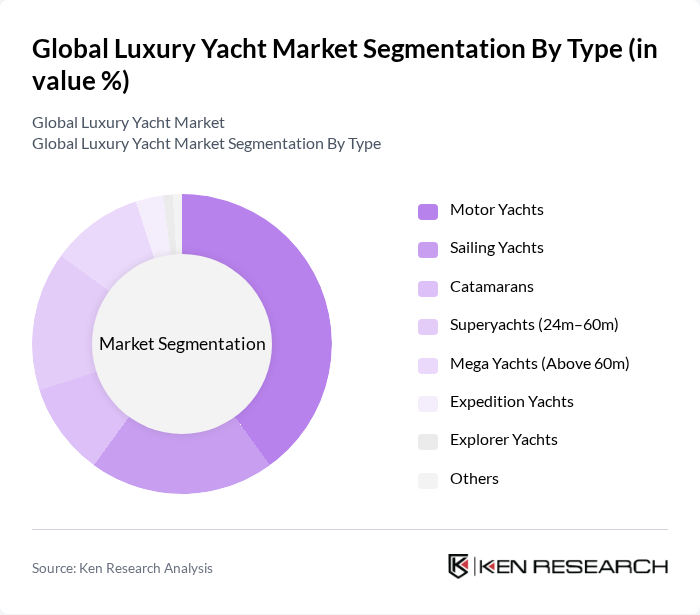
By Type:The luxury yacht market is segmented into various types, including Motor Yachts, Sailing Yachts, Catamarans, Superyachts (24m–60m), Mega Yachts (Above 60m), Expedition Yachts, Explorer Yachts, and Others. Among these,Motor Yachtsare currently the most popular choice among consumers due to their speed, comfort, and advanced technology. The demand forSuperyachtshas also been on the rise, driven by affluent buyers seeking luxury and customization options. Recent trends highlight increased interest in eco-friendly propulsion systems and hybrid technologies, particularly in the superyacht segment.
By End-User:The luxury yacht market is segmented by end-user into Private Owners, Charter Companies, Corporate Clients, and Government Agencies.Private Ownersdominate the market, driven by the desire for personal leisure and luxury experiences. Charter Companies are also significant players, capitalizing on the growing trend of yacht rentals among affluent travelers seeking unique vacation experiences. The charter segment has grown due to increased demand for flexible, experience-driven travel options, especially post-pandemic.

Global Luxury Yacht Market Competitive Landscape
The Global Luxury Yacht Market is characterized by a dynamic mix of regional and international players. Leading participants such as Azimut-Benetti Group, Ferretti Group, Sunseeker International Ltd., Lürssen, Princess Yachts, Feadship, Heesen Yachts, Sanlorenzo, Oceanco, Gulf Craft, Groupe Beneteau, Viking Yacht Company, Hatteras Yachts, Sea Ray (Brunswick Corporation), Lagoon Catamarans (Groupe Beneteau) contribute to innovation, geographic expansion, and service delivery in this space.
Global Luxury Yacht Market Industry Analysis
Growth Drivers
- Increasing Disposable Income:The global luxury yacht market is significantly driven by rising disposable incomes, particularly in regions like Asia-Pacific and the Middle East. In future, the World Bank projects that the global GDP per capita will reach approximately $12,000, with emerging economies like India and China experiencing growth rates of 6% and 5%, respectively. This increase in wealth enables more individuals to invest in luxury experiences, including yacht ownership and chartering, thereby expanding the market.
- Rising Demand for Luxury Experiences:The luxury yacht market is benefiting from a growing consumer preference for unique and personalized experiences. According to a report by Bain & Company, the global luxury goods market is expected to reach $1.5 trillion in future, with a significant portion allocated to luxury travel and experiences. This trend is particularly evident among millennials and Gen Z, who prioritize experiential spending, thus driving demand for luxury yachts as a means of leisure and adventure.
- Expansion of Charter Services:The luxury yacht charter sector is experiencing robust growth, with the global yacht charter market projected to reach $15 billion in future. This expansion is fueled by increased accessibility and the rise of online platforms that facilitate yacht rentals. The Mediterranean and Caribbean regions are particularly popular, with charter bookings increasing by 20% annually, reflecting a shift towards shared luxury experiences rather than outright ownership, thus broadening market participation.
Market Challenges
- High Maintenance Costs:One of the significant challenges facing the luxury yacht market is the high maintenance costs associated with yacht ownership. Annual maintenance expenses can range from $10,000 to over $1 million, depending on the yacht's size and complexity. This financial burden can deter potential buyers, particularly in a fluctuating economic environment where discretionary spending is scrutinized, impacting overall market growth.
- Regulatory Compliance Issues:The luxury yacht industry faces stringent regulatory compliance challenges, particularly concerning safety and environmental standards. In future, the International Maritime Organization (IMO) is expected to enforce stricter emissions regulations, which may require significant investments in retrofitting existing vessels. Compliance with these regulations can be costly and complex, posing a barrier to entry for new market participants and affecting operational costs for existing owners.
Global Luxury Yacht Market Future Outlook
The luxury yacht market is poised for continued evolution, driven by technological advancements and shifting consumer preferences. As sustainability becomes a priority, manufacturers are increasingly focusing on eco-friendly designs and materials. Additionally, the integration of smart technologies is expected to enhance user experience and operational efficiency. The rise of digital platforms for yacht charters will further democratize access to luxury experiences, making the market more dynamic and competitive in future.
Market Opportunities
- Growth in Emerging Markets:Emerging markets, particularly in Asia and Africa, present significant opportunities for the luxury yacht sector. With a growing affluent class and increasing interest in luxury lifestyles, countries like China and India are expected to see a surge in yacht ownership and chartering, potentially increasing market revenues by billions in the next few years.
- Increasing Popularity of Eco-Friendly Yachts:The demand for eco-friendly yachts is on the rise, driven by consumer awareness of environmental issues. In future, the market for sustainable yachts is projected to grow by 30%, as manufacturers innovate with hybrid and fully electric models. This trend not only aligns with global sustainability goals but also attracts environmentally conscious consumers, creating a lucrative niche within the luxury yacht market.
Scope of the Report
| Segment | Sub-Segments |
|---|---|
| By Type | Motor Yachts Sailing Yachts Catamarans Superyachts (24m–60m) Mega Yachts (Above 60m) Expedition Yachts Explorer Yachts Others |
| By End-User | Private Owners Charter Companies Corporate Clients Government Agencies |
| By Sales Channel | Direct Sales Online Sales Brokers and Dealers Auctions |
| By Price Range | Below $1 Million $1 Million - $5 Million $5 Million - $10 Million Above $10 Million |
| By Region | North America Europe Asia-Pacific Middle East & Africa Latin America |
| By Usage Type | Leisure Racing Chartering |
| By Customization Level | Standard Models Semi-Custom Models Fully Custom Models |
Key Target Audience
Investors and Venture Capitalist Firms
Government and Regulatory Bodies (e.g., International Maritime Organization, U.S. Coast Guard)
Luxury Yacht Manufacturers and Producers
Luxury Yacht Brokers and Dealers
Marina Operators and Management Companies
Insurance Providers for Marine Assets
Luxury Travel and Charter Companies
Financial Institutions and Banks specializing in Marine Financing
Players Mentioned in the Report:
Azimut-Benetti Group
Ferretti Group
Sunseeker International Ltd.
Lurssen
Princess Yachts
Feadship
Heesen Yachts
Sanlorenzo
Oceanco
Gulf Craft
Groupe Beneteau
Viking Yacht Company
Hatteras Yachts
Sea Ray (Brunswick Corporation)
Lagoon Catamarans (Groupe Beneteau)
Table of Contents
Market Assessment Phase
1. Executive Summary and Approach
2. Global Luxury Yacht Market Overview
2.1 Key Insights and Strategic Recommendations
2.2 Global Luxury Yacht Market Overview
2.3 Definition and Scope
2.4 Evolution of Market Ecosystem
2.5 Timeline of Key Regulatory Milestones
2.6 Value Chain & Stakeholder Mapping
2.7 Business Cycle Analysis
2.8 Policy & Incentive Landscape
3. Global Luxury Yacht Market Analysis
3.1 Growth Drivers
3.1.1 Increasing Disposable Income
3.1.2 Rising Demand for Luxury Experiences
3.1.3 Expansion of Charter Services
3.1.4 Technological Advancements in Yacht Design
3.2 Market Challenges
3.2.1 High Maintenance Costs
3.2.2 Regulatory Compliance Issues
3.2.3 Environmental Concerns
3.2.4 Limited Availability of Skilled Labor
3.3 Market Opportunities
3.3.1 Growth in Emerging Markets
3.3.2 Increasing Popularity of Eco-Friendly Yachts
3.3.3 Expansion of Yacht Financing Options
3.3.4 Development of Smart Yachts
3.4 Market Trends
3.4.1 Customization and Personalization
3.4.2 Integration of Advanced Technologies
3.4.3 Shift Towards Sustainable Practices
3.4.4 Growth of Yacht Shows and Exhibitions
3.5 Government Regulation
3.5.1 Safety Standards Compliance
3.5.2 Environmental Regulations
3.5.3 Tax Incentives for Yacht Owners
3.5.4 Registration and Licensing Requirements
4. SWOT Analysis
5. Stakeholder Analysis
6. Porter's Five Forces Analysis
7. Global Luxury Yacht Market Market Size, 2019-2024
7.1 By Value
7.2 By Volume
7.3 By Average Selling Price
8. Global Luxury Yacht Market Segmentation
8.1 By Type
8.1.1 Motor Yachts
8.1.2 Sailing Yachts
8.1.3 Catamarans
8.1.4 Superyachts (24m–60m)
8.1.5 Mega Yachts (Above 60m)
8.1.6 Expedition Yachts
8.1.7 Explorer Yachts
8.1.8 Others
8.2 By End-User
8.2.1 Private Owners
8.2.2 Charter Companies
8.2.3 Corporate Clients
8.2.4 Government Agencies
8.3 By Sales Channel
8.3.1 Direct Sales
8.3.2 Online Sales
8.3.3 Brokers and Dealers
8.3.4 Auctions
8.4 By Price Range
8.4.1 Below $1 Million
8.4.2 $1 Million - $5 Million
8.4.3 $5 Million - $10 Million
8.4.4 Above $10 Million
8.5 By Region
8.5.1 North America
8.5.2 Europe
8.5.3 Asia-Pacific
8.5.4 Middle East & Africa
8.5.5 Latin America
8.6 By Usage Type
8.6.1 Leisure
8.6.2 Racing
8.6.3 Chartering
8.7 By Customization Level
8.7.1 Standard Models
8.7.2 Semi-Custom Models
8.7.3 Fully Custom Models
9. Global Luxury Yacht Market Competitive Analysis
9.1 Market Share of Key Players
9.2 Cross Comparison of Key Players
9.2.1 Company Name
9.2.2 Fleet Size (Number of Yachts Delivered)
9.2.3 Annual Revenue (USD Millions)
9.2.4 Revenue Growth Rate (%)
9.2.5 Market Share (%)
9.2.6 Order Book (Number and Value of Yachts on Order)
9.2.7 Average Yacht Length Delivered (Meters)
9.2.8 Geographic Reach (Regions Served)
9.2.9 Product Portfolio Breadth (Type/Size Range)
9.2.10 R&D Investment (% of Revenue)
9.2.11 Sustainability Initiatives (e.g., Hybrid/Electric Models)
9.2.12 Customer Satisfaction Index
9.2.13 Brand Recognition Score
9.3 SWOT Analysis of Top Players
9.4 Pricing Analysis
9.5 Detailed Profile of Major Companies
9.5.1 Azimut-Benetti Group
9.5.2 Ferretti Group
9.5.3 Sunseeker International Ltd.
9.5.4 Lürssen
9.5.5 Princess Yachts
9.5.6 Feadship
9.5.7 Heesen Yachts
9.5.8 Sanlorenzo
9.5.9 Oceanco
9.5.10 Gulf Craft
9.5.11 Groupe Beneteau
9.5.12 Viking Yacht Company
9.5.13 Hatteras Yachts
9.5.14 Sea Ray (Brunswick Corporation)
9.5.15 Lagoon Catamarans (Groupe Beneteau)
10. Global Luxury Yacht Market End-User Analysis
10.1 Procurement Behavior of Key Ministries
10.1.1 Government Procurement Policies
10.1.2 Budget Allocations for Luxury Assets
10.1.3 Decision-Making Processes
10.1.4 Evaluation Criteria for Procurement
10.2 Corporate Spend on Infrastructure & Energy
10.2.1 Investment Trends in Luxury Yachts
10.2.2 Budgeting for Yacht Maintenance
10.2.3 Corporate Gifting and Incentives
10.3 Pain Point Analysis by End-User Category
10.3.1 Cost of Ownership
10.3.2 Availability of Skilled Crew
10.3.3 Regulatory Compliance Challenges
10.4 User Readiness for Adoption
10.4.1 Awareness of Luxury Yacht Options
10.4.2 Financial Readiness
10.4.3 Willingness to Invest in Customization
10.5 Post-Deployment ROI and Use Case Expansion
10.5.1 Measuring ROI on Yacht Investments
10.5.2 Expanding Use Cases for Corporate Clients
10.5.3 Long-term Value of Luxury Yachts
11. Global Luxury Yacht Market Future Size, 2025-2030
11.1 By Value
11.2 By Volume
11.3 By Average Selling Price
Go-To-Market Strategy Phase
1. Whitespace Analysis + Business Model Canvas
1.1 Market Gaps Identification
1.2 Value Proposition Development
1.3 Revenue Streams Analysis
1.4 Cost Structure Evaluation
1.5 Key Partnerships Exploration
1.6 Customer Segmentation
1.7 Channels of Distribution
2. Marketing and Positioning Recommendations
2.1 Branding Strategies
2.2 Product USPs
2.3 Target Audience Identification
2.4 Marketing Channels Selection
2.5 Promotional Strategies
3. Distribution Plan
3.1 Urban Retail Strategies
3.2 Rural NGO Tie-ups
3.3 Online Distribution Channels
3.4 Partnerships with Yacht Brokers
4. Channel & Pricing Gaps
4.1 Underserved Routes
4.2 Pricing Bands Analysis
4.3 Competitor Pricing Strategies
4.4 Customer Willingness to Pay
5. Unmet Demand & Latent Needs
5.1 Category Gaps Identification
5.2 Consumer Segments Analysis
5.3 Emerging Trends in Consumer Preferences
6. Customer Relationship
6.1 Loyalty Programs Development
6.2 After-sales Service Strategies
6.3 Customer Feedback Mechanisms
7. Value Proposition
7.1 Sustainability Initiatives
7.2 Integrated Supply Chains
7.3 Unique Selling Points
8. Key Activities
8.1 Regulatory Compliance
8.2 Branding Initiatives
8.3 Distribution Setup
9. Entry Strategy Evaluation
9.1 Domestic Market Entry Strategy
9.1.1 Product Mix Considerations
9.1.2 Pricing Band Strategy
9.1.3 Packaging Options
9.2 Export Entry Strategy
9.2.1 Target Countries Identification
9.2.2 Compliance Roadmap Development
10. Entry Mode Assessment
10.1 Joint Ventures
10.2 Greenfield Investments
10.3 Mergers & Acquisitions
10.4 Distributor Model Evaluation
11. Capital and Timeline Estimation
11.1 Capital Requirements Analysis
11.2 Timelines for Market Entry
12. Control vs Risk Trade-Off
12.1 Ownership vs Partnerships
12.2 Risk Management Strategies
13. Profitability Outlook
13.1 Breakeven Analysis
13.2 Long-term Sustainability Strategies
14. Potential Partner List
14.1 Distributors Identification
14.2 Joint Ventures Opportunities
14.3 Acquisition Targets
15. Execution Roadmap
15.1 Phased Plan for Market Entry
15.1.1 Market Setup
15.1.2 Market Entry
15.1.3 Growth Acceleration
15.1.4 Scale & Stabilize
15.2 Key Activities and Milestones
15.2.1 Milestone Planning
15.2.2 Activity Tracking
Research Methodology
Phase 1: Approach1
Desk Research
- Market reports from industry associations such as the International Yacht Brokers Association (IYBA)
- Analysis of luxury yacht sales data from leading manufacturers and brokers
- Review of maritime regulations and trends from governmental and maritime organizations
Primary Research
- Interviews with yacht owners and potential buyers to understand purchasing motivations
- Surveys with yacht charter companies to gauge market demand and pricing strategies
- Field interviews with yacht designers and builders to assess innovation trends
Validation & Triangulation
- Cross-validation of findings through multiple data sources including sales, charter, and brokerage data
- Triangulation of insights from primary interviews with secondary data trends
- Sanity checks through expert panel reviews comprising industry veterans and analysts
Phase 2: Market Size Estimation1
Top-down Assessment
- Estimation of the global luxury yacht market size based on historical sales data and growth rates
- Segmentation by yacht type (motor yachts, sailing yachts) and geographical regions
- Incorporation of macroeconomic indicators such as GDP growth and disposable income trends
Bottom-up Modeling
- Analysis of unit sales data from leading yacht manufacturers and brokers
- Operational cost assessments based on average selling prices and maintenance costs
- Volume x price modeling to estimate revenue generation across different yacht segments
Forecasting & Scenario Analysis
- Multi-factor regression analysis incorporating factors like tourism growth and luxury spending
- Scenario planning based on economic fluctuations and changes in consumer preferences
- Baseline, optimistic, and pessimistic forecasts through 2030, considering market dynamics
Phase 3: CATI Sample Composition1
| Scope Item/Segment | Sample Size | Target Respondent Profiles |
|---|---|---|
| Luxury Yacht Owners | 60 | Private Yacht Owners, High-Net-Worth Individuals |
| Yacht Charter Companies | 50 | Charter Managers, Operations Directors |
| Yacht Manufacturers | 40 | Product Development Managers, Sales Executives |
| Maritime Brokers | 40 | Brokerage Agents, Market Analysts |
| Luxury Yacht Designers | 40 | Design Engineers, Creative Directors |
Frequently Asked Questions
What is the current value of the Global Luxury Yacht Market?
The Global Luxury Yacht Market is valued at approximately USD 8.7 billion, reflecting a significant growth trend driven by increasing disposable incomes, luxury travel preferences, and the popularity of yacht charters among high-net-worth individuals.
What factors are driving the growth of the luxury yacht market?
Which regions dominate the luxury yacht market?
What types of yachts are most popular in the luxury yacht market?
Other Regional/Country Reports
Indonesia Luxury Yacht Market
Malaysia Luxury Yacht Market
APAC Luxury Yacht Market
Other Adjacent Reports
Singapore Superyacht Manufacturing Market
Mexico Marine Tourism Market
Vietnam Luxury Travel Market Size, Share & Forecast, By Service Type, Customer Type & Booking Channel, 2025–2032Mexico Boat Building Market
South Korea Maritime Equipment Market
KSA Yacht Maintenance Market
Qatar Eco-Friendly Vessel Market
Japan Marine Insurance Market
South Africa Luxury Hospitality Market
Why Buy From Us?

What makes us stand out is that our consultants follow Robust, Refine and Result (RRR) methodology. Robust for clear definitions, approaches and sanity checking, Refine for differentiating respondents' facts and opinions, and Result for presenting data with story.

We have set a benchmark in the industry by offering our clients with syndicated and customized market research reports featuring coverage of entire market as well as meticulous research and analyst insights.

While we don't replace traditional research, we flip the method upside down. Our dual approach of Top Bottom & Bottom Top ensures quality deliverable by not just verifying company fundamentals but also looking at the sector and macroeconomic factors.

With one step in the future, our research team constantly tries to show you the bigger picture. We help with some of the tough questions you may encounter along the way: How is the industry positioned? Best marketing channel? KPI's of competitors? By aligning every element, we help maximize success.

Our report gives you instant access to the answers and sources that other companies might choose to hide. We elaborate each steps of research methodology we have used and showcase you the sample size to earn your trust.

If you need any support, we are here! We pride ourselves on universe strength, data quality, and quick, friendly, and professional service.