About the Report
Base Year 2024Global Modified Atmosphere Packaging Market Overview
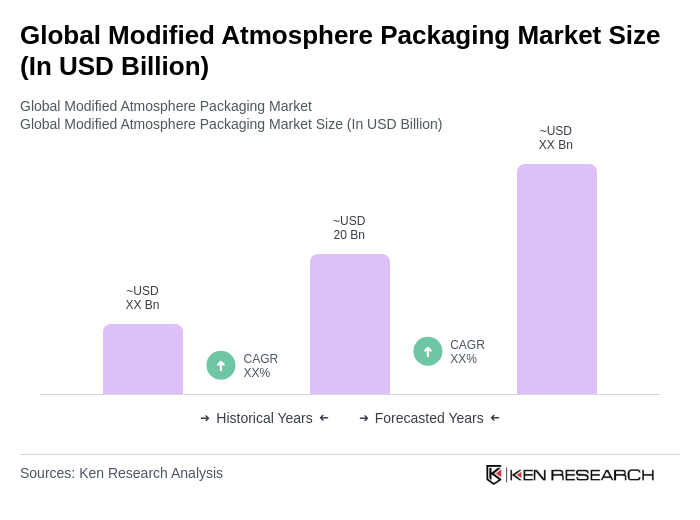
- The Global Modified Atmosphere Packaging Market is valued at USD 20 billion, based on a five-year historical analysis. This value aligns with multiple industry estimates placing the market in the high-teens billions and reflects robust demand tied to MAP’s role in extending shelf life and maintaining freshness of perishable foods.
- Key demand drivers include the increasing consumption of fresh and minimally processed packaged foods, heightened food safety expectations, and advances in barrier films and intelligent/sensor-enabled packaging that optimize gas composition and reduce spoilage and waste.
- Market leadership is concentrated in the United States, Germany, and China, supported by large food processing bases, strong packaged food consumption, and investment in packaging innovation; regional analyses consistently cite North America, Europe (notably Germany), and Asia (notably China) among leading markets for MAP solutions.
- There is no European Union mandate that requires modified atmosphere packaging for specified perishable products. EU policy emphasizes food waste reduction and food safety through broader measures (e.g., waste prevention frameworks and food information/safety regulations), while MAP remains a widely adopted industry practice rather than a mandated requirement.
Global Modified Atmosphere Packaging Market Segmentation
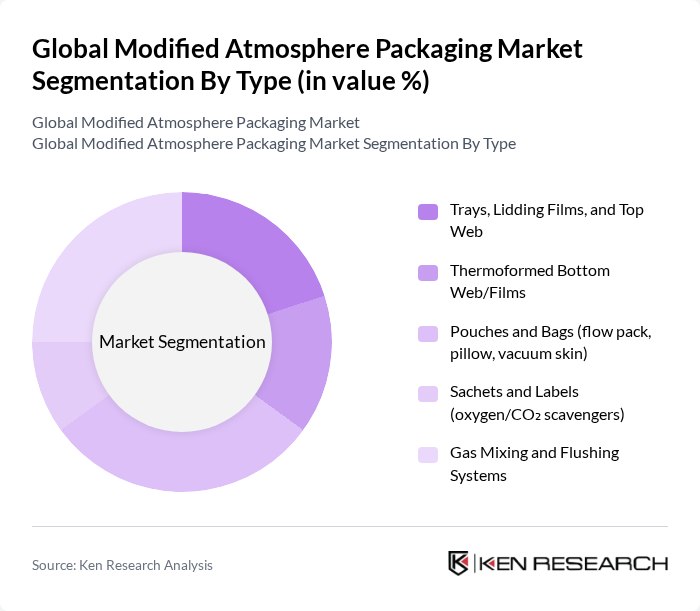
By Type:The market is segmented into trays, lidding films, thermoformed bottom webs, pouches and bags, sachets and labels, and gas mixing and flushing systems. Among these,pouches and bagsare gaining traction due to versatility, lightweight formats, and compatibility with high-speed flow-pack and VFFS systems, supporting ready-to-eat and snack categories while maintaining modified atmospheres for extended freshness.
By End-User:The end-user segmentation includes meat, poultry, seafood, fruits and vegetables, bakery and confectionery, dairy and cheese, and ready meals and convenience foods. Themeat, poultry, and seafoodsegment is particularly dominant because MAP slows aerobic microbial growth and oxidation, helping maintain color, texture, and safety across fresh and processed meats; strong global protein consumption and cold-chain expansion further support MAP penetration in this segment.

Global Modified Atmosphere Packaging Market Competitive Landscape
The Global Modified Atmosphere Packaging Market is characterized by a dynamic mix of regional and international players. Leading participants such as Amcor plc, Sealed Air Corporation, Berry Global, Inc., Mondi Group, Smurfit Kappa Group, LINPAC Packaging (Klöckner Pentaplast), Coveris, Huhtamaki Oyj, Schur Flexibles Group, Winpak Ltd., Constantia Flexibles, ProAmpac LLC, AptarGroup, Inc., Tetra Pak International S.A., Ilpra S.p.A. contribute to innovation, geographic expansion, and service delivery in this space.
Global Modified Atmosphere Packaging Market Industry Analysis
Growth Drivers
- Increasing Demand for Extended Shelf Life:The global demand for extended shelf life in food products is projected to reach 1.5 billion tons in future, driven by consumer preferences for fresher options. This trend is supported by the World Bank's report indicating that food waste accounts for approximately 1.3 billion tons annually. Modified atmosphere packaging (MAP) plays a crucial role in reducing spoilage, thereby enhancing food preservation and minimizing waste, which is vital for both consumers and retailers.
- Rising Consumer Preference for Fresh Food:A significant shift towards fresh food consumption is evident, with the global fresh food market expected to surpass $3 trillion in future. This trend is fueled by health-conscious consumers seeking minimally processed options. According to the International Food Information Council, 70% of consumers prioritize freshness in their food choices. MAP technology effectively meets this demand by maintaining the quality and nutritional value of fresh products, thus driving its adoption in the food industry.
- Growth in the E-commerce Food Sector:The e-commerce food sector is anticipated to grow to $200 billion in future, reflecting a 20% increase from the previous year. This growth is largely attributed to the convenience of online shopping and changing consumer habits. As e-commerce expands, the need for effective packaging solutions that ensure product freshness during transit becomes critical. MAP provides the necessary protection against spoilage, making it an essential component for online food retailers aiming to enhance customer satisfaction.
Market Challenges
- High Initial Investment Costs:The implementation of modified atmosphere packaging systems requires substantial initial investments, often exceeding $500,000 for small to medium-sized enterprises. This financial barrier can deter companies from adopting MAP technologies, particularly in regions with limited access to capital. The high costs associated with advanced machinery and materials can hinder market penetration, especially among smaller food producers who may struggle to justify such expenditures.
- Stringent Regulatory Requirements:The modified atmosphere packaging industry faces rigorous regulatory scrutiny, particularly concerning food safety standards. Compliance with regulations set by organizations such as the FDA and EFSA can be complex and costly, often requiring extensive testing and documentation. In future, it is estimated that compliance costs could reach up to $100,000 for companies seeking to enter new markets. These challenges can impede innovation and slow down the adoption of MAP technologies.
Global Modified Atmosphere Packaging Market Future Outlook
The future of the modified atmosphere packaging market appears promising, driven by increasing consumer awareness of food safety and sustainability. As the demand for fresh and minimally processed foods continues to rise, companies are likely to invest in innovative packaging solutions that enhance product longevity. Additionally, advancements in biodegradable materials and smart packaging technologies are expected to gain traction, aligning with consumer preferences for environmentally friendly options. This evolution will likely reshape the competitive landscape, fostering growth and innovation in the industry.
Market Opportunities
- Expansion in Emerging Markets:Emerging markets, particularly in Asia and Africa, present significant growth opportunities for modified atmosphere packaging. With a combined population exceeding 4 billion, these regions are experiencing rising disposable incomes and urbanization, leading to increased demand for packaged food products. Companies that strategically enter these markets can capitalize on the growing need for effective preservation solutions, potentially increasing their market share significantly.
- Development of Biodegradable Packaging Materials:The shift towards sustainability is creating opportunities for the development of biodegradable packaging materials. With the global biodegradable packaging market projected to reach $500 million in future, companies investing in eco-friendly MAP solutions can differentiate themselves. This trend aligns with consumer preferences for sustainable products, providing a competitive edge while addressing environmental concerns associated with traditional plastic packaging.
Scope of the Report
| Segment | Sub-Segments |
|---|---|
| By Type | Trays, Lidding Films, and Top Web Thermoformed Bottom Web/Films Pouches and Bags (flow pack, pillow, vacuum skin) Sachets and Labels (oxygen/CO? scavengers) Gas Mixing and Flushing Systems |
| By End-User | Meat, Poultry, and Seafood Fruits and Vegetables Bakery and Confectionery Dairy and Cheese Ready Meals and Convenience Foods Pharmaceuticals and Medical Devices |
| By Material | Plastics (PE, PP, PET, PA/EVOH multilayer) Paper & Paperboard (barrier-coated) Metals (aluminum trays/foils) Bioplastics and Compostable Films |
| By Application | Fresh Produce (whole and cut) Fresh and Processed Meat Seafood Bakery and Snacks Dairy and Cheese Ready-to-Eat/Heat Meals |
| By Distribution Channel | B2B Direct (food processors, packers) Distributors/Converters Online Procurement Platforms Retail Private Label Partnerships |
| By Region | North America Europe Asia-Pacific Latin America Middle East & Africa |
| By Price Range | Economy Mid-Range Premium Others |
Key Target Audience
Investors and Venture Capitalist Firms
Government and Regulatory Bodies (e.g., Food and Drug Administration, Environmental Protection Agency)
Manufacturers and Producers of Packaging Materials
Food and Beverage Companies
Logistics and Supply Chain Companies
Retail Chains and Supermarkets
Packaging Equipment Manufacturers
Industry Associations (e.g., Flexible Packaging Association)
Players Mentioned in the Report:
Amcor plc
Sealed Air Corporation
Berry Global, Inc.
Mondi Group
Smurfit Kappa Group
LINPAC Packaging (Klockner Pentaplast)
Coveris
Huhtamaki Oyj
Schur Flexibles Group
Winpak Ltd.
Constantia Flexibles
ProAmpac LLC
AptarGroup, Inc.
Tetra Pak International S.A.
Ilpra S.p.A.
Table of Contents
Market Assessment Phase
1. Executive Summary and Approach
2. Global Modified Atmosphere Packaging Market Overview
2.1 Key Insights and Strategic Recommendations
2.2 Global Modified Atmosphere Packaging Market Overview
2.3 Definition and Scope
2.4 Evolution of Market Ecosystem
2.5 Timeline of Key Regulatory Milestones
2.6 Value Chain & Stakeholder Mapping
2.7 Business Cycle Analysis
2.8 Policy & Incentive Landscape
3. Global Modified Atmosphere Packaging Market Analysis
3.1 Growth Drivers
3.1.1 Increasing demand for extended shelf life
3.1.2 Rising consumer preference for fresh food
3.1.3 Growth in the e-commerce food sector
3.1.4 Technological advancements in packaging solutions
3.2 Market Challenges
3.2.1 High initial investment costs
3.2.2 Stringent regulatory requirements
3.2.3 Competition from alternative packaging methods
3.2.4 Environmental concerns regarding plastic use
3.3 Market Opportunities
3.3.1 Expansion in emerging markets
3.3.2 Development of biodegradable packaging materials
3.3.3 Increasing demand for convenience foods
3.3.4 Innovations in smart packaging technologies
3.4 Market Trends
3.4.1 Growing focus on sustainability
3.4.2 Rise in online grocery shopping
3.4.3 Adoption of automation in packaging processes
3.4.4 Shift towards personalized packaging solutions
3.5 Government Regulation
3.5.1 Regulations on food safety standards
3.5.2 Guidelines for plastic usage and recycling
3.5.3 Compliance with international packaging standards
3.5.4 Incentives for sustainable packaging initiatives
4. SWOT Analysis
5. Stakeholder Analysis
6. Porter's Five Forces Analysis
7. Global Modified Atmosphere Packaging Market Market Size, 2019-2024
7.1 By Value
7.2 By Volume
7.3 By Average Selling Price
8. Global Modified Atmosphere Packaging Market Segmentation
8.1 By Type
8.1.1 Trays, Lidding Films, and Top Web
8.1.2 Thermoformed Bottom Web/Films
8.1.3 Pouches and Bags (flow pack, pillow, vacuum skin)
8.1.4 Sachets and Labels (oxygen/CO? scavengers)
8.1.5 Gas Mixing and Flushing Systems
8.2 By End-User
8.2.1 Meat, Poultry, and Seafood
8.2.2 Fruits and Vegetables
8.2.3 Bakery and Confectionery
8.2.4 Dairy and Cheese
8.2.5 Ready Meals and Convenience Foods
8.2.6 Pharmaceuticals and Medical Devices
8.3 By Material
8.3.1 Plastics (PE, PP, PET, PA/EVOH multilayer)
8.3.2 Paper & Paperboard (barrier-coated)
8.3.3 Metals (aluminum trays/foils)
8.3.4 Bioplastics and Compostable Films
8.4 By Application
8.4.1 Fresh Produce (whole and cut)
8.4.2 Fresh and Processed Meat
8.4.3 Seafood
8.4.4 Bakery and Snacks
8.4.5 Dairy and Cheese
8.4.6 Ready-to-Eat/Heat Meals
8.5 By Distribution Channel
8.5.1 B2B Direct (food processors, packers)
8.5.2 Distributors/Converters
8.5.3 Online Procurement Platforms
8.5.4 Retail Private Label Partnerships
8.6 By Region
8.6.1 North America
8.6.2 Europe
8.6.3 Asia-Pacific
8.6.4 Latin America
8.6.5 Middle East & Africa
8.7 By Price Range
8.7.1 Economy
8.7.2 Mid-Range
8.7.3 Premium
8.7.4 Others
9. Global Modified Atmosphere Packaging Market Competitive Analysis
9.1 Market Share of Key Players
9.2 Cross Comparison of Key Players
9.2.1 Company Name
9.2.2 Product Portfolio Breadth (trays, films, MAP equipment)
9.2.3 Revenue Growth Rate (YoY, MAP-related)
9.2.4 Geographic Footprint (regions served, MAP facilities)
9.2.5 End-Market Mix (meat, produce, dairy, ready meals)
9.2.6 Installed Base/Capacity (MAP lines, converters, tray output)
9.2.7 Innovation Pipeline (barrier tech, recyclable/mono-material)
9.2.8 Sustainability KPIs (recyclability %, PCR content, CO?e/ton)
9.2.9 Strategic Partnerships (retailers, OEMs, gas suppliers)
9.2.10 Pricing Positioning (value, mid, premium by product)
9.2.11 On-time Delivery/Lead Time (days for films/trays)
9.2.12 Quality & Compliance (food safety certs: BRCGS, ISO 22000)
9.3 SWOT Analysis of Top Players
9.4 Pricing Analysis
9.5 Detailed Profile of Major Companies
9.5.1 Amcor plc
9.5.2 Sealed Air Corporation
9.5.3 Berry Global, Inc.
9.5.4 Mondi Group
9.5.5 Smurfit Kappa Group
9.5.6 LINPAC Packaging (Klöckner Pentaplast)
9.5.7 Coveris
9.5.8 Huhtamaki Oyj
9.5.9 Schur Flexibles Group
9.5.10 Winpak Ltd.
9.5.11 Constantia Flexibles
9.5.12 ProAmpac LLC
9.5.13 AptarGroup, Inc.
9.5.14 Tetra Pak International S.A.
9.5.15 Ilpra S.p.A.
10. Global Modified Atmosphere Packaging Market End-User Analysis
10.1 Procurement Behavior of Key Ministries
10.1.1 Government food safety initiatives
10.1.2 Budget allocation for food preservation technologies
10.1.3 Collaboration with private sector for packaging solutions
10.2 Corporate Spend on Infrastructure & Energy
10.2.1 Investment in sustainable packaging technologies
10.2.2 Budget for compliance with environmental regulations
10.2.3 Expenditure on research and development
10.3 Pain Point Analysis by End-User Category
10.3.1 Challenges in maintaining product freshness
10.3.2 Issues with packaging waste management
10.3.3 Need for cost-effective packaging solutions
10.4 User Readiness for Adoption
10.4.1 Awareness of modified atmosphere packaging benefits
10.4.2 Willingness to invest in new technologies
10.4.3 Training needs for staff on new packaging methods
10.5 Post-Deployment ROI and Use Case Expansion
10.5.1 Measurement of shelf life improvements
10.5.2 Analysis of cost savings from reduced waste
10.5.3 Expansion into new product lines
11. Global Modified Atmosphere Packaging Market Future Size, 2025-2030
11.1 By Value
11.2 By Volume
11.3 By Average Selling Price
Go-To-Market Strategy Phase
1. Whitespace Analysis + Business Model Canvas
1.1 Market gaps and opportunities
1.2 Value proposition development
1.3 Revenue model identification
1.4 Key partnerships and resources
1.5 Customer segments and relationships
1.6 Cost structure analysis
1.7 Channels for delivery
2. Marketing and Positioning Recommendations
2.1 Branding strategies
2.2 Product USPs
2.3 Target audience identification
2.4 Communication strategies
2.5 Digital marketing initiatives
2.6 Trade show participation
3. Distribution Plan
3.1 Urban retail strategies
3.2 Rural NGO tie-ups
3.3 E-commerce distribution channels
3.4 Direct-to-consumer models
3.5 Partnerships with logistics providers
4. Channel & Pricing Gaps
4.1 Underserved routes
4.2 Pricing bands analysis
4.3 Competitor pricing strategies
4.4 Customer willingness to pay
4.5 Value-based pricing models
5. Unmet Demand & Latent Needs
5.1 Category gaps in packaging solutions
5.2 Consumer segments with unmet needs
5.3 Innovations in product offerings
5.4 Feedback mechanisms for product improvement
6. Customer Relationship
6.1 Loyalty programs
6.2 After-sales service
6.3 Customer feedback loops
6.4 Community engagement initiatives
7. Value Proposition
7.1 Sustainability initiatives
7.2 Integrated supply chains
7.3 Customization options for clients
7.4 Cost-effectiveness of solutions
8. Key Activities
8.1 Regulatory compliance
8.2 Branding efforts
8.3 Distribution setup
8.4 Training and development
8.5 Market research and analysis
9. Entry Strategy Evaluation
9.1 Domestic Market Entry Strategy
9.1.1 Product mix considerations
9.1.2 Pricing band analysis
9.1.3 Packaging strategies
9.2 Export Entry Strategy
9.2.1 Target countries identification
9.2.2 Compliance roadmap development
10. Entry Mode Assessment
10.1 Joint Ventures
10.2 Greenfield investments
10.3 Mergers & Acquisitions
10.4 Distributor Model
11. Capital and Timeline Estimation
11.1 Capital requirements
11.2 Timelines for market entry
12. Control vs Risk Trade-Off
12.1 Ownership considerations
12.2 Partnerships evaluation
13. Profitability Outlook
13.1 Breakeven analysis
13.2 Long-term sustainability strategies
14. Potential Partner List
14.1 Distributors
14.2 Joint Ventures
14.3 Acquisition targets
15. Execution Roadmap
15.1 Phased Plan for Market Entry
15.1.1 Market Setup
15.1.2 Market Entry
15.1.3 Growth Acceleration
15.1.4 Scale & Stabilize
15.2 Key Activities and Milestones
15.2.1 Milestone identification
15.2.2 Activity scheduling
Research Methodology
Phase 1: Approach1
Desk Research
- Industry reports from packaging associations and market research firms
- Analysis of trade publications and journals focusing on modified atmosphere packaging technologies
- Review of regulatory frameworks and standards from food safety authorities
Primary Research
- Interviews with packaging engineers and product development managers in food and beverage companies
- Surveys with supply chain professionals regarding packaging preferences and trends
- Field interviews with distributors and retailers to understand market dynamics
Validation & Triangulation
- Cross-validation of data from multiple sources including industry reports and expert interviews
- Triangulation of market size estimates using sales data and production statistics
- Sanity checks through expert panel discussions and feedback sessions
Phase 2: Market Size Estimation1
Top-down Assessment
- Analysis of global food packaging market size and growth rates
- Segmentation by application areas such as fruits, vegetables, and processed foods
- Incorporation of trends in consumer preferences towards sustainable packaging solutions
Bottom-up Modeling
- Estimation of market size based on production volumes of modified atmosphere packaging materials
- Cost analysis of packaging solutions across different food categories
- Volume x price calculations to derive revenue estimates for key segments
Forecasting & Scenario Analysis
- Multi-variable forecasting using historical growth rates and market drivers
- Scenario analysis based on potential regulatory changes and technological advancements
- Development of baseline, optimistic, and pessimistic forecasts through 2030
Phase 3: CATI Sample Composition1
| Scope Item/Segment | Sample Size | Target Respondent Profiles |
|---|---|---|
| Food Processing Industry | 120 | Production Managers, Quality Assurance Specialists |
| Retail Grocery Sector | 90 | Store Managers, Category Buyers |
| Logistics and Distribution | 70 | Logistics Coordinators, Supply Chain Analysts |
| Food Safety and Compliance | 60 | Regulatory Affairs Managers, Compliance Officers |
| Research and Development in Packaging | 50 | R&D Managers, Innovation Leads |
Frequently Asked Questions
What is the current value of the Global Modified Atmosphere Packaging Market?
The Global Modified Atmosphere Packaging Market is valued at approximately USD 20 billion, reflecting strong demand driven by its effectiveness in extending the shelf life and maintaining the freshness of perishable foods.
What are the key drivers of demand in the Modified Atmosphere Packaging Market?
Which regions are leading in the Modified Atmosphere Packaging Market?
Is there a regulatory mandate for Modified Atmosphere Packaging in the European Union?
Other Regional/Country Reports
Indonesia Modified Atmosphere Packaging Market
Malaysia Modified Atmosphere Packaging Market
APAC Modified Atmosphere Packaging Market
Why Buy From Us?

What makes us stand out is that our consultants follow Robust, Refine and Result (RRR) methodology. Robust for clear definitions, approaches and sanity checking, Refine for differentiating respondents' facts and opinions, and Result for presenting data with story.

We have set a benchmark in the industry by offering our clients with syndicated and customized market research reports featuring coverage of entire market as well as meticulous research and analyst insights.

While we don't replace traditional research, we flip the method upside down. Our dual approach of Top Bottom & Bottom Top ensures quality deliverable by not just verifying company fundamentals but also looking at the sector and macroeconomic factors.

With one step in the future, our research team constantly tries to show you the bigger picture. We help with some of the tough questions you may encounter along the way: How is the industry positioned? Best marketing channel? KPI's of competitors? By aligning every element, we help maximize success.

Our report gives you instant access to the answers and sources that other companies might choose to hide. We elaborate each steps of research methodology we have used and showcase you the sample size to earn your trust.

If you need any support, we are here! We pride ourselves on universe strength, data quality, and quick, friendly, and professional service.