About the Report
Base Year 2024Global North Sea Oilfield Equipment Market Overview
- The Global North Sea Oilfield Equipment Market is valued at USD 4 billion, based on a five-year historical analysis. This is aligned with multiple industry trackers placing the North Sea oilfield equipment market in the low-to-mid single-digit billions, with ongoing demand supported by mature-field life extension, infill drilling, and subsea tie-backs in the UKCS and NCS.
- Key players in this market include the United Kingdom and Norway, which dominate due to their extensive offshore oil and gas reserves, established infrastructure, and a strong regulatory framework that supports exploration and production activities. Industry segmentation for the region consistently focuses on the United Kingdom and Norway as the core geographies for the North Sea oilfield equipment demand.
- In 2023, the UK government implemented new regulations aimed at enhancing the safety and environmental standards for offshore oil and gas operations. This includes stricter guidelines for emissions and waste management, requiring operators to adopt advanced technologies and practices to minimize their environmental impact. The North Sea Transition Authority and UK Government policy changes have tightened emissions reporting and environmental expectations for offshore licensing and operations in recent rounds.
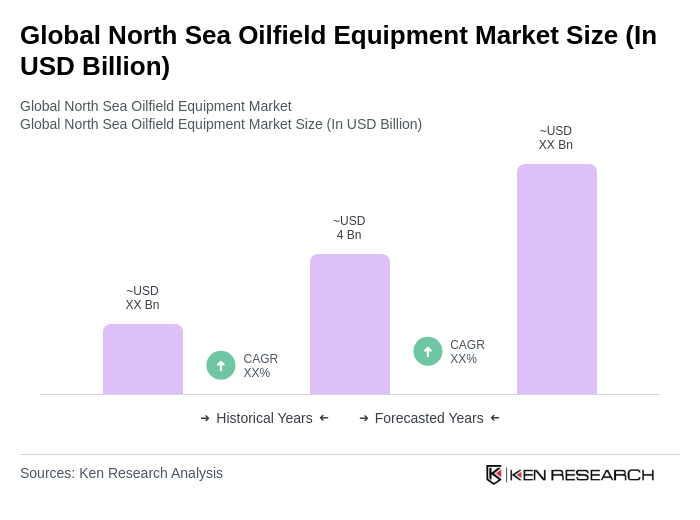
Global North Sea Oilfield Equipment Market Segmentation
By Type:The market is segmented into various types of equipment essential for oilfield operations. The subsegments include:
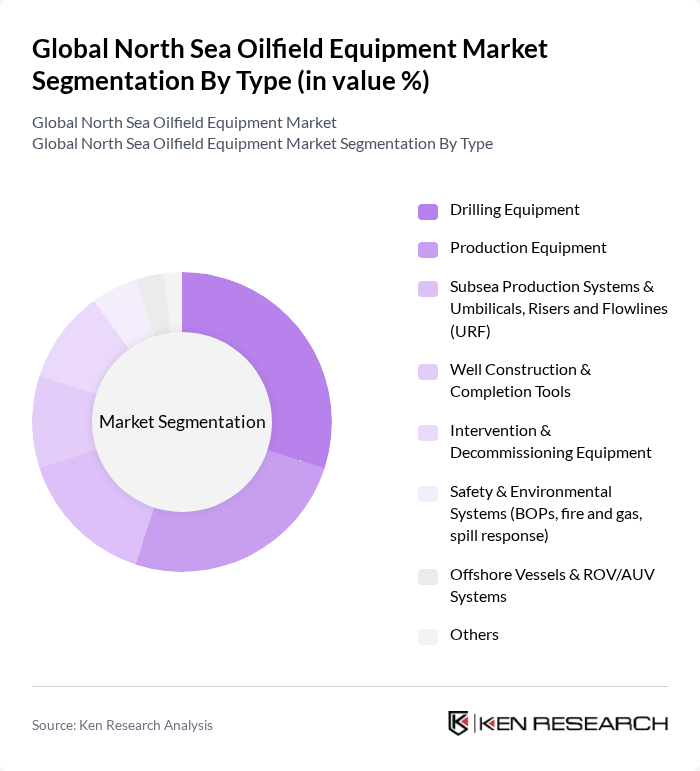
The Drilling Equipment subsegment is currently dominating the market due to the increasing number of offshore drilling projects and the need for advanced drilling technologies to enhance efficiency and safety. The demand for high-performance drilling rigs and tools is driven by the exploration of new oil fields and the need to optimize production from existing fields. Additionally, advancements in drilling techniques, such as horizontal and deep-water drilling, are further propelling this subsegment's growth. Regional market coverage identifies drilling and production equipment as core categories in the North Sea, with increased adoption of automated drilling systems and ROV-enabled operations supporting efficiency gains.
By End-User:The market is segmented based on the end-users of oilfield equipment. The subsegments include:
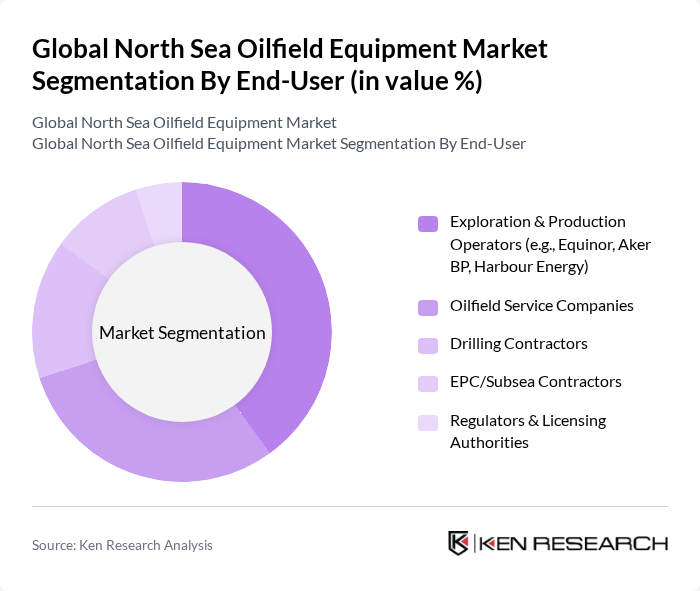
The Exploration & Production Operators subsegment leads the market due to their significant investments in offshore projects and the continuous need for advanced equipment to enhance production efficiency. These operators are increasingly focusing on technological innovations and sustainable practices to optimize their operations, which drives the demand for specialized oilfield equipment. The competitive landscape among these operators further fuels the growth of this subsegment. In the North Sea, operators prioritize subsea tie-backs, brownfield upgrades, and electrification/readiness to meet emissions targets, which sustains capital and opex demand for equipment and services.
Global North Sea Oilfield Equipment Market Competitive Landscape
The Global North Sea Oilfield Equipment Market is characterized by a dynamic mix of regional and international players. Leading participants such as SLB (Schlumberger Limited), Halliburton Company, Baker Hughes Company, NOV Inc. (formerly National Oilwell Varco), Weatherford International plc, TechnipFMC plc, Aker Solutions ASA, Subsea 7 S.A., Oceaneering International, Inc., Saipem S.p.A., KBR, Inc., John Wood Group PLC, Equinor ASA, Aker BP ASA, Harbour Energy plc, Vår Energi ASA, Transocean Ltd., Valaris Limited, Seadrill Limited, Archer Limited, Expro Group Holdings N.V., Tenaris S.A., Vallourec S.A., TGS ASA, PGS ASA contribute to innovation, geographic expansion, and service delivery in this space.
Global North Sea Oilfield Equipment Market Industry Analysis
Growth Drivers
- Increasing Offshore Exploration Activities:The North Sea has seen a resurgence in offshore exploration, with over 30 new exploration licenses issued recently. This increase is driven by the need to discover new reserves, as global oil production from existing fields declines. The UK government reported a 15% rise in exploration investments, amounting to approximately $1.3 billion, highlighting the sector's commitment to expanding its operational footprint in the region.
- Technological Advancements in Equipment:The North Sea oilfield equipment market is benefiting from significant technological innovations, particularly in drilling and extraction technologies. Recently, investments in advanced drilling technologies reached $900 million, enhancing efficiency and reducing operational costs. The integration of AI and IoT in equipment management has led to a 25% increase in operational efficiency, making it a critical driver for market growth as companies seek to optimize resource extraction.
- Rising Global Energy Demand:Global energy demand is projected to increase by 1.6% annually, with the International Energy Agency (IEA) estimating that oil demand will reach 106 million barrels per day in the near future. This surge in demand is prompting North Sea operators to enhance production capabilities, leading to an estimated $2.5 billion increase in capital expenditures for oilfield equipment. This trend underscores the necessity for robust infrastructure to meet future energy needs.
Market Challenges
- Environmental Regulations:The North Sea oilfield sector faces stringent environmental regulations aimed at reducing carbon emissions. Recently, the UK government implemented new regulations that require a 35% reduction in emissions by 2030, impacting operational costs. Compliance with these regulations is expected to increase operational expenses by approximately $600 million annually, posing a significant challenge for companies striving to balance profitability with environmental responsibility.
- Fluctuating Oil Prices:The volatility of oil prices remains a critical challenge for the North Sea oilfield equipment market. Recently, oil prices fluctuated between $75 and $95 per barrel, creating uncertainty in investment decisions. This price instability has led to a 12% reduction in planned capital expenditures for new projects, as companies adopt a more cautious approach to spending, impacting overall market growth and equipment demand.
Global North Sea Oilfield Equipment Market Future Outlook
The future of the North Sea oilfield equipment market is poised for transformation, driven by a shift towards integrating renewable energy sources and enhancing operational efficiencies. Companies are increasingly investing in automation and digital technologies, which are expected to streamline operations and reduce costs. Additionally, the focus on sustainable practices will likely lead to innovations in equipment design and functionality, ensuring compliance with evolving environmental standards while meeting the growing energy demands of the future.
Market Opportunities
- Expansion into Emerging Markets:The North Sea oilfield equipment sector has significant opportunities for expansion into emerging markets, particularly in Asia and Africa. With a projected investment of $1.2 billion in these regions in the near future, companies can leverage their expertise to tap into new oil reserves and infrastructure development, enhancing their global footprint and revenue streams.
- Adoption of Digital Technologies:The increasing adoption of digital technologies presents a lucrative opportunity for the North Sea market. Investments in data analytics and AI are expected to exceed $700 million in the near future, enabling companies to optimize operations and improve decision-making processes. This technological shift will enhance productivity and reduce costs, positioning firms for competitive advantage in a rapidly evolving landscape.
Scope of the Report
| Segment | Sub-Segments |
|---|---|
| By Type | Drilling Equipment Production Equipment Subsea Production Systems & Umbilicals, Risers and Flowlines (URF) Well Construction & Completion Tools Intervention & Decommissioning Equipment Safety & Environmental Systems (BOPs, fire and gas, spill response) Offshore Vessels & ROV/AUV Systems Others |
| By End-User | Exploration & Production Operators (e.g., Equinor, Aker BP, Harbour Energy) Oilfield Service Companies Drilling Contractors EPC/Subsea Contractors Regulators & Licensing Authorities |
| By Application | Offshore Exploration & Appraisal Offshore Development Drilling Offshore Production & Processing Subsea Tie-backs & Brownfield Upgrades Asset Integrity, Intervention & Decommissioning |
| By Component | Pressure Control (BOPs, wellheads, trees) Flow Assurance (pumps, compressors, heaters, insulation) Valves & Actuation Control & Monitoring (DCS/SCADA, subsea control modules) Mooring, Rig & Lifting Systems Power & Electrical (subsea power distribution, cables) |
| By Sales Channel | Direct Sales to Operators OEMs to Service/EPC Contractors Framework Agreements & Long-term Supply Contracts |
| By Distribution Mode | Project-based (EPCI/EPC) Spot/Aftermarket & Maintenance, Repair and Operations (MRO) |
| By Price Range | Standardized/Commodity Equipment Mid-Range/Configured-to-Order High-Spec/Engineered-to-Order (HP/HT, deepwater) |
Key Target Audience
Investors and Venture Capitalist Firms
Government and Regulatory Bodies (e.g., Environmental Protection Agency, Department of Energy)
Oil and Gas Exploration Companies
Equipment Manufacturers and Suppliers
Service Providers and Contractors
Industry Associations and Trade Organizations
Financial Institutions and Investment Banks
Insurance Companies and Risk Management Firms
Players Mentioned in the Report:
SLB (Schlumberger Limited)
Halliburton Company
Baker Hughes Company
NOV Inc. (formerly National Oilwell Varco)
Weatherford International plc
TechnipFMC plc
Aker Solutions ASA
Subsea 7 S.A.
Oceaneering International, Inc.
Saipem S.p.A.
KBR, Inc.
John Wood Group PLC
Equinor ASA
Aker BP ASA
Harbour Energy plc
Var Energi ASA
Transocean Ltd.
Valaris Limited
Seadrill Limited
Archer Limited
Expro Group Holdings N.V.
Tenaris S.A.
Vallourec S.A.
TGS ASA
PGS ASA
Table of Contents
Market Assessment Phase
1. Executive Summary and Approach
2. Global North Sea Oilfield Equipment Market Overview
2.1 Key Insights and Strategic Recommendations
2.2 Global North Sea Oilfield Equipment Market Overview
2.3 Definition and Scope
2.4 Evolution of Market Ecosystem
2.5 Timeline of Key Regulatory Milestones
2.6 Value Chain & Stakeholder Mapping
2.7 Business Cycle Analysis
2.8 Policy & Incentive Landscape
3. Global North Sea Oilfield Equipment Market Analysis
3.1 Growth Drivers
3.1.1 Increasing Offshore Exploration Activities
3.1.2 Technological Advancements in Equipment
3.1.3 Rising Global Energy Demand
3.1.4 Government Investments in Oilfield Infrastructure
3.2 Market Challenges
3.2.1 Environmental Regulations
3.2.2 Fluctuating Oil Prices
3.2.3 Supply Chain Disruptions
3.2.4 Skilled Labor Shortages
3.3 Market Opportunities
3.3.1 Expansion into Emerging Markets
3.3.2 Adoption of Digital Technologies
3.3.3 Strategic Partnerships and Collaborations
3.3.4 Development of Sustainable Practices
3.4 Market Trends
3.4.1 Shift Towards Renewable Energy Integration
3.4.2 Increased Automation in Oilfield Operations
3.4.3 Focus on Safety and Risk Management
3.4.4 Enhanced Data Analytics for Decision Making
3.5 Government Regulation
3.5.1 Emission Control Regulations
3.5.2 Safety Standards Compliance
3.5.3 Licensing and Permitting Requirements
3.5.4 Tax Incentives for Exploration
4. SWOT Analysis
5. Stakeholder Analysis
6. Porter's Five Forces Analysis
7. Global North Sea Oilfield Equipment Market Market Size, 2019-2024
7.1 By Value
7.2 By Volume
7.3 By Average Selling Price
8. Global North Sea Oilfield Equipment Market Segmentation
8.1 By Type
8.1.1 Drilling Equipment
8.1.2 Production Equipment
8.1.3 Subsea Production Systems & Umbilicals, Risers and Flowlines (URF)
8.1.4 Well Construction & Completion Tools
8.1.5 Intervention & Decommissioning Equipment
8.1.6 Safety & Environmental Systems (BOPs, fire and gas, spill response)
8.1.7 Offshore Vessels & ROV/AUV Systems
8.1.8 Others
8.2 By End-User
8.2.1 Exploration & Production Operators (e.g., Equinor, Aker BP, Harbour Energy)
8.2.2 Oilfield Service Companies
8.2.3 Drilling Contractors
8.2.4 EPC/Subsea Contractors
8.2.5 Regulators & Licensing Authorities
8.3 By Application
8.3.1 Offshore Exploration & Appraisal
8.3.2 Offshore Development Drilling
8.3.3 Offshore Production & Processing
8.3.4 Subsea Tie-backs & Brownfield Upgrades
8.3.5 Asset Integrity, Intervention & Decommissioning
8.4 By Component
8.4.1 Pressure Control (BOPs, wellheads, trees)
8.4.2 Flow Assurance (pumps, compressors, heaters, insulation)
8.4.3 Valves & Actuation
8.4.4 Control & Monitoring (DCS/SCADA, subsea control modules)
8.4.5 Mooring, Rig & Lifting Systems
8.4.6 Power & Electrical (subsea power distribution, cables)
8.5 By Sales Channel
8.5.1 Direct Sales to Operators
8.5.2 OEMs to Service/EPC Contractors
8.5.3 Framework Agreements & Long-term Supply Contracts
8.6 By Distribution Mode
8.6.1 Project-based (EPCI/EPC)
8.6.2 Spot/Aftermarket & Maintenance, Repair and Operations (MRO)
8.7 By Price Range
8.7.1 Standardized/Commodity Equipment
8.7.2 Mid-Range/Configured-to-Order
8.7.3 High-Spec/Engineered-to-Order (HP/HT, deepwater)
9. Global North Sea Oilfield Equipment Market Competitive Analysis
9.1 Market Share of Key Players
9.2 Cross Comparison of Key Players
9.2.1 Company Name
9.2.2 North Sea Exposure (revenue share from UKCS/NCS)
9.2.3 Order Backlog and Book-to-Bill Ratio
9.2.4 Installed Base/Active Fleet in North Sea (rigs, trees, ROVs, vessels)
9.2.5 Project Win Rate (tenders/EPCI awards, subsea tie-backs)
9.2.6 EBITDA Margin in Offshore/Subsea Segment
9.2.7 Pricing Discipline (average discount vs. list on frame agreements)
9.2.8 Product/Service Breadth (drilling, subsea, completion, intervention)
9.2.9 Technology Intensity (HP/HT capability, digital/automation deployments)
9.2.10 Supply Chain Resilience (lead times, localization in UK/Norway)
9.2.11 HSE Performance (TRIR/LTIF in North Sea operations)
9.2.12 Decommissioning Capability (P&A packages, heavy-lift, subsea recovery)
9.3 SWOT Analysis of Top Players
9.4 Pricing Analysis
9.5 Detailed Profile of Major Companies
9.5.1 SLB (Schlumberger Limited)
9.5.2 Halliburton Company
9.5.3 Baker Hughes Company
9.5.4 NOV Inc. (formerly National Oilwell Varco)
9.5.5 Weatherford International plc
9.5.6 TechnipFMC plc
9.5.7 Aker Solutions ASA
9.5.8 Subsea 7 S.A.
9.5.9 Oceaneering International, Inc.
9.5.10 Saipem S.p.A.
9.5.11 KBR, Inc.
9.5.12 John Wood Group PLC
9.5.13 Equinor ASA
9.5.14 Aker BP ASA
9.5.15 Harbour Energy plc
9.5.16 Vår Energi ASA
9.5.17 Transocean Ltd.
9.5.18 Valaris Limited
9.5.19 Seadrill Limited
9.5.20 Archer Limited
9.5.21 Expro Group Holdings N.V.
9.5.22 Tenaris S.A.
9.5.23 Vallourec S.A.
9.5.24 TGS ASA
9.5.25 PGS ASA
10. Global North Sea Oilfield Equipment Market End-User Analysis
10.1 Procurement Behavior of Key Ministries
10.1.1 Government Procurement Policies
10.1.2 Budget Allocation Trends
10.1.3 Supplier Selection Criteria
10.2 Corporate Spend on Infrastructure & Energy
10.2.1 Investment Trends in Oilfield Development
10.2.2 Budgeting for Equipment Upgrades
10.2.3 Long-term Contracts and Partnerships
10.3 Pain Point Analysis by End-User Category
10.3.1 Equipment Reliability Issues
10.3.2 High Operational Costs
10.3.3 Regulatory Compliance Challenges
10.4 User Readiness for Adoption
10.4.1 Training and Skill Development Needs
10.4.2 Technology Adoption Barriers
10.5 Post-Deployment ROI and Use Case Expansion
10.5.1 Performance Metrics Evaluation
10.5.2 Case Studies of Successful Implementations
10.5.3 Future Investment Plans
11. Global North Sea Oilfield Equipment Market Future Size, 2025-2030
11.1 By Value
11.2 By Volume
11.3 By Average Selling Price
Go-To-Market Strategy Phase
1. Whitespace Analysis + Business Model Canvas
1.1 Market Gaps Identification
1.2 Value Proposition Development
1.3 Revenue Streams Analysis
1.4 Key Partnerships Exploration
1.5 Cost Structure Assessment
1.6 Customer Segmentation
1.7 Channels of Distribution
2. Marketing and Positioning Recommendations
2.1 Branding Strategies
2.2 Product USPs
2.3 Target Market Identification
2.4 Communication Strategies
2.5 Digital Marketing Approaches
3. Distribution Plan
3.1 Urban Retail Strategies
3.2 Rural NGO Tie-ups
3.3 Direct vs Indirect Distribution
3.4 Logistics and Supply Chain Management
4. Channel & Pricing Gaps
4.1 Underserved Routes
4.2 Pricing Bands Analysis
4.3 Competitor Pricing Strategies
5. Unmet Demand & Latent Needs
5.1 Category Gaps Identification
5.2 Consumer Segments Analysis
5.3 Future Trends Forecasting
6. Customer Relationship
6.1 Loyalty Programs
6.2 After-sales Service Strategies
6.3 Customer Feedback Mechanisms
7. Value Proposition
7.1 Sustainability Initiatives
7.2 Integrated Supply Chains
7.3 Competitive Advantages
8. Key Activities
8.1 Regulatory Compliance
8.2 Branding Initiatives
8.3 Distribution Setup
9. Entry Strategy Evaluation
9.1 Domestic Market Entry Strategy
9.1.1 Product Mix Considerations
9.1.2 Pricing Band Strategy
9.1.3 Packaging Solutions
9.2 Export Entry Strategy
9.2.1 Target Countries Analysis
9.2.2 Compliance Roadmap Development
10. Entry Mode Assessment
10.1 Joint Ventures
10.2 Greenfield Investments
10.3 Mergers & Acquisitions
10.4 Distributor Model Evaluation
11. Capital and Timeline Estimation
11.1 Capital Requirements Analysis
11.2 Timelines for Implementation
12. Control vs Risk Trade-Off
12.1 Ownership vs Partnerships
12.2 Risk Management Strategies
13. Profitability Outlook
13.1 Breakeven Analysis
13.2 Long-term Sustainability Strategies
14. Potential Partner List
14.1 Distributors
14.2 Joint Ventures
14.3 Acquisition Targets
15. Execution Roadmap
15.1 Phased Plan for Market Entry
15.1.1 Market Setup
15.1.2 Market Entry
15.1.3 Growth Acceleration
15.1.4 Scale & Stabilize
15.2 Key Activities and Milestones
15.2.1 Milestone Planning
15.2.2 Activity Tracking
Research Methodology
Phase 1: Approach1
Desk Research
- Industry reports from organizations such as the International Energy Agency (IEA) and the Energy Information Administration (EIA)
- Market analysis from trade associations and oilfield equipment manufacturers' publications
- Regulatory frameworks and policy documents from governmental bodies in the North Sea region
Primary Research
- Interviews with senior executives from oilfield equipment suppliers and service providers
- Surveys targeting project managers and engineers involved in North Sea oilfield operations
- Field interviews with stakeholders in offshore drilling and production activities
Validation & Triangulation
- Cross-validation of findings through multiple data sources including trade publications and expert opinions
- Triangulation of market data with financial performance metrics from key industry players
- Sanity checks conducted through expert panel reviews and feedback sessions
Phase 2: Market Size Estimation1
Top-down Assessment
- Analysis of total oil production volumes in the North Sea and associated equipment demand
- Segmentation of the market by equipment type, including drilling, completion, and production equipment
- Incorporation of macroeconomic factors such as oil prices and investment trends in offshore exploration
Bottom-up Modeling
- Estimation of equipment demand based on historical usage rates and projected growth in oilfield activities
- Cost analysis of equipment procurement and maintenance across various segments
- Volume x cost calculations for each equipment category to derive total market value
Forecasting & Scenario Analysis
- Multi-variable regression analysis incorporating oil price forecasts, technological advancements, and regulatory changes
- Scenario modeling based on varying levels of investment in renewable energy and its impact on oilfield equipment demand
- Development of baseline, optimistic, and pessimistic forecasts through 2030
Phase 3: CATI Sample Composition1
| Scope Item/Segment | Sample Size | Target Respondent Profiles |
|---|---|---|
| Drilling Equipment Suppliers | 120 | Sales Directors, Product Managers |
| Completion Services Providers | 80 | Operations Managers, Technical Engineers |
| Production Equipment Manufacturers | 90 | Procurement Officers, R&D Managers |
| Offshore Installation Contractors | 70 | Project Managers, Safety Officers |
| Regulatory Bodies and Industry Associations | 60 | Policy Analysts, Compliance Officers |
Frequently Asked Questions
What is the current value of the Global North Sea Oilfield Equipment Market?
The Global North Sea Oilfield Equipment Market is valued at approximately USD 4 billion, based on a five-year historical analysis. This valuation reflects ongoing demand driven by mature-field life extension, infill drilling, and subsea tie-backs in the UK Continental Shelf (UKCS) and Norwegian Continental Shelf (NCS).
Which countries dominate the North Sea Oilfield Equipment Market?
What recent regulations have impacted the North Sea oil and gas operations?
What are the key growth drivers for the North Sea Oilfield Equipment Market?
Other Regional/Country Reports
Indonesia Oilfield Equipment Market
Malaysia Oilfield Equipment Market
Why Buy From Us?

What makes us stand out is that our consultants follow Robust, Refine and Result (RRR) methodology. Robust for clear definitions, approaches and sanity checking, Refine for differentiating respondents' facts and opinions, and Result for presenting data with story.

We have set a benchmark in the industry by offering our clients with syndicated and customized market research reports featuring coverage of entire market as well as meticulous research and analyst insights.

While we don't replace traditional research, we flip the method upside down. Our dual approach of Top Bottom & Bottom Top ensures quality deliverable by not just verifying company fundamentals but also looking at the sector and macroeconomic factors.

With one step in the future, our research team constantly tries to show you the bigger picture. We help with some of the tough questions you may encounter along the way: How is the industry positioned? Best marketing channel? KPI's of competitors? By aligning every element, we help maximize success.

Our report gives you instant access to the answers and sources that other companies might choose to hide. We elaborate each steps of research methodology we have used and showcase you the sample size to earn your trust.

If you need any support, we are here! We pride ourselves on universe strength, data quality, and quick, friendly, and professional service.