About the Report
Base Year 2024Global Plant Asset Management Market Overview
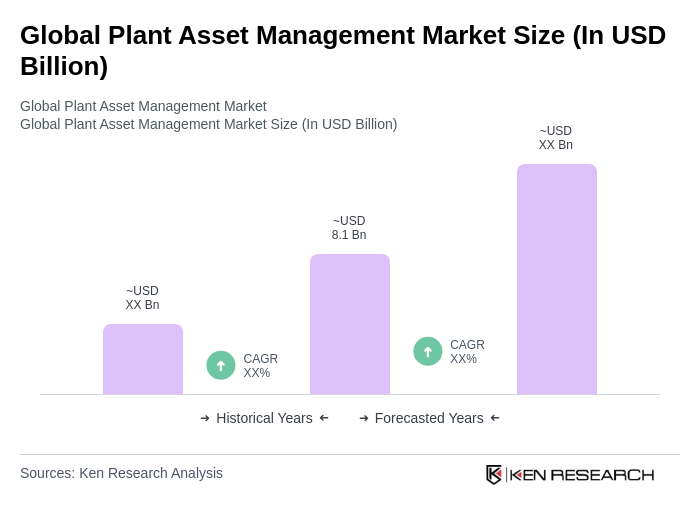
- The Global Plant Asset Management Market is valued at USD 8.1 billion, based on a five-year historical analysis. This growth is primarily driven by the increasing need for operational efficiency, asset optimization, and the integration of advanced technologies such as IoT and AI in asset management practices. Companies are increasingly adopting these solutions to enhance productivity and reduce operational costs, leading to a robust demand for plant asset management systems.
- Key players in this market include the United States, Germany, and China, which dominate due to their strong industrial base, technological advancements, and significant investments in infrastructure development. The presence of major manufacturing and energy companies in these regions further propels the demand for effective asset management solutions, making them critical hubs for market growth.
- In 2023, the European Union adopted the Digital Operational Resilience Act (DORA), a regulation for the financial sector that became applicable in 2025, requiring firms to ensure ICT operational resilience. While DORA is sector-specific to financial services and focused on ICT risk, its emphasis on resilience, asset inventories, and incident response is influencing cross-industry best practices, including asset management and monitoring in industrial operations.
Global Plant Asset Management Market Segmentation
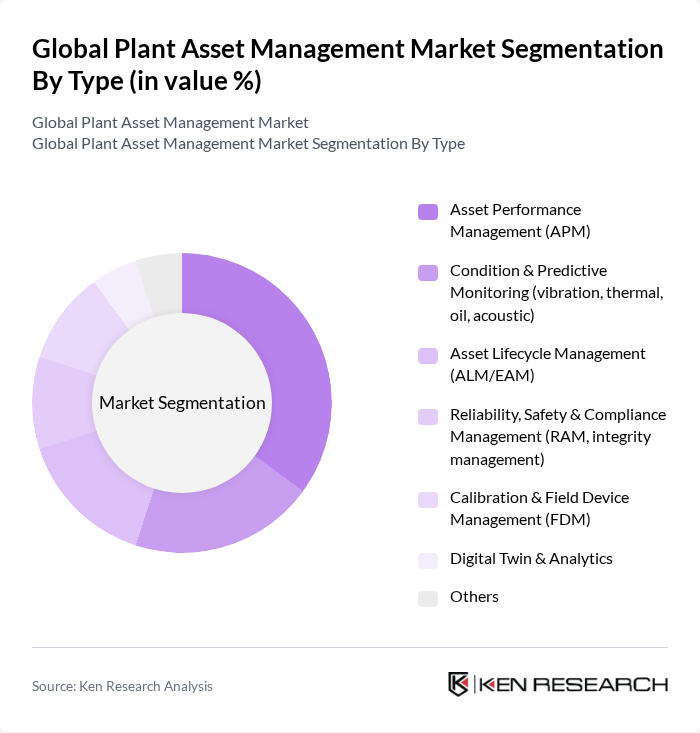
By Type:The market is segmented into various types, including Asset Performance Management (APM), Condition & Predictive Monitoring, Asset Lifecycle Management (ALM/EAM), Reliability, Safety & Compliance Management, Calibration & Field Device Management (FDM), Digital Twin & Analytics, and Others. Among these, Asset Performance Management (APM) is the leading segment due to its critical role in optimizing asset utilization and performance, which is essential for organizations aiming to enhance operational efficiency.
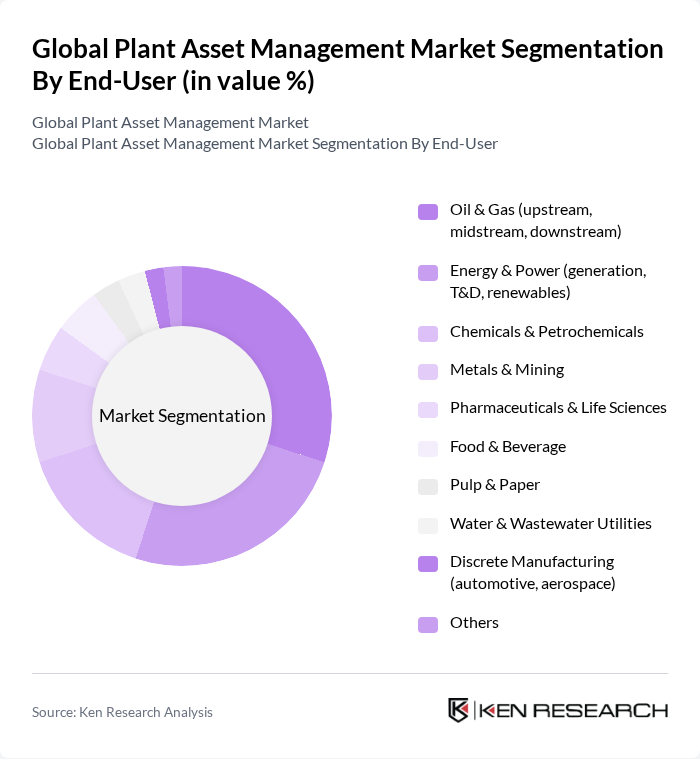
By End-User:The end-user segmentation includes Oil & Gas, Energy & Power, Chemicals & Petrochemicals, Metals & Mining, Pharmaceuticals & Life Sciences, Food & Beverage, Pulp & Paper, Water & Wastewater Utilities, Discrete Manufacturing, and Others. The Oil & Gas sector is the dominant end-user, driven by the need for stringent compliance and safety regulations, as well as the necessity to maximize asset uptime and efficiency in a highly competitive market. Notably, several industry sources indicate Energy & Power has emerged with a sizable share alongside Oil & Gas, reflecting grid reliability initiatives, renewables integration, and aging asset fleets.
Global Plant Asset Management Market Competitive Landscape
The Global Plant Asset Management Market is characterized by a dynamic mix of regional and international players. Leading participants such as Siemens AG, Honeywell International Inc., ABB Ltd., Schneider Electric SE, GE Vernova (including GE Digital), Emerson Electric Co., IBM Corporation, SAP SE, Rockwell Automation, Inc., Yokogawa Electric Corporation, Infor, Inc., AVEVA Group plc, Aspen Technology, Inc. (AspenTech), PTC Inc., Bentley Systems, Incorporated contribute to innovation, geographic expansion, and service delivery in this space.
Global Plant Asset Management Market Industry Analysis
Growth Drivers
- Increasing Demand for Operational Efficiency:The global push for operational efficiency is driving the plant asset management market. In future, companies are projected to invest approximately $1.8 trillion in digital transformation initiatives, with a significant portion allocated to asset management technologies. This investment is expected to enhance productivity by 25%, as organizations seek to streamline operations and reduce downtime, ultimately leading to improved profitability and competitiveness in the market.
- Adoption of IoT and Digital Technologies:The integration of IoT technologies is revolutionizing plant asset management. By future, it is estimated that over 80 billion devices will be connected globally, facilitating real-time data collection and analysis. This connectivity allows for enhanced monitoring and control of assets, leading to a projected 35% reduction in maintenance costs. Companies are increasingly leveraging these technologies to optimize asset performance and drive innovation in their operations.
- Need for Predictive Maintenance Solutions:The demand for predictive maintenance solutions is surging, driven by the need to minimize unplanned downtime. In future, the predictive maintenance market is expected to reach $15 billion, reflecting a growing recognition of its benefits. By utilizing advanced analytics and machine learning, organizations can anticipate equipment failures, reducing maintenance costs by up to 30% and extending asset lifespans, thereby enhancing overall operational efficiency.
Market Challenges
- High Initial Investment Costs:One of the significant challenges facing the plant asset management market is the high initial investment required for advanced technologies. In future, the average cost of implementing a comprehensive asset management system is projected to be around $600,000 for mid-sized companies. This financial barrier can deter organizations from adopting necessary technologies, limiting their ability to enhance operational efficiency and competitiveness in the market.
- Complexity of Integration with Existing Systems:Integrating new asset management solutions with existing systems poses a considerable challenge. In future, approximately 65% of organizations report difficulties in achieving seamless integration, leading to increased project timelines and costs. This complexity can result in operational disruptions and hinder the realization of expected benefits, making it essential for companies to develop robust integration strategies to overcome this challenge.
Global Plant Asset Management Market Future Outlook
The future of the plant asset management market is poised for significant transformation, driven by technological advancements and evolving industry needs. As organizations increasingly prioritize sustainability, the adoption of cloud-based solutions and AI-driven analytics will become more prevalent. In future, the market is expected to witness a surge in investments in these areas, enabling companies to enhance operational efficiency and reduce environmental impact. This shift will create a more agile and responsive asset management landscape, fostering innovation and growth.
Market Opportunities
- Growth in Renewable Energy Sector:The renewable energy sector is rapidly expanding, presenting significant opportunities for plant asset management. In future, investments in renewable energy are projected to exceed $2.5 trillion, necessitating advanced asset management solutions to optimize performance and ensure compliance with regulatory standards. This growth will drive demand for innovative technologies that enhance efficiency and sustainability in energy production.
- Expansion in Emerging Markets:Emerging markets are witnessing rapid industrialization, creating a fertile ground for plant asset management solutions. In future, countries like India and Brazil are expected to increase their manufacturing output by 20%, leading to heightened demand for efficient asset management practices. This expansion presents a lucrative opportunity for companies to introduce tailored solutions that address the unique challenges faced by these markets.
Scope of the Report
| Segment | Sub-Segments |
|---|---|
| By Type | Asset Performance Management (APM) Condition & Predictive Monitoring (vibration, thermal, oil, acoustic) Asset Lifecycle Management (ALM/EAM) Reliability, Safety & Compliance Management (RAM, integrity management) Calibration & Field Device Management (FDM) Digital Twin & Analytics Others |
| By End-User | Oil & Gas (upstream, midstream, downstream) Energy & Power (generation, T&D, renewables) Chemicals & Petrochemicals Metals & Mining Pharmaceuticals & Life Sciences Food & Beverage Pulp & Paper Water & Wastewater Utilities Discrete Manufacturing (automotive, aerospace) Others |
| By Application | Maintenance Strategy Optimization (RCM, CBM) Asset Health & Performance Monitoring Work Order, Spares & Inventory Management Shutdown/Turnaround/Outage (STO) Management Energy & OEE Optimization Regulatory Compliance & Audit Others |
| By Component | Software (APM/EAM, analytics, FDM) Services (implementation, consulting, managed services) Hardware (sensors, gateways, handhelds) |
| By Deployment Mode | On-Premises Cloud-Based |
| By Sales Channel | Direct (vendors, OEMs, system integrators) Distributors/Channel Partners Online/Marketplace |
| By Policy Support | Subsidies Tax Exemptions Grants |
Key Target Audience
Investors and Venture Capitalist Firms
Government and Regulatory Bodies (e.g., Environmental Protection Agency, Department of Energy)
Manufacturers and Producers
Utility Companies
Plant Operators and Maintenance Managers
Technology Providers
Industry Associations (e.g., International Society of Automation)
Financial Institutions
Players Mentioned in the Report:
Siemens AG
Honeywell International Inc.
ABB Ltd.
Schneider Electric SE
GE Vernova (including GE Digital)
Emerson Electric Co.
IBM Corporation
SAP SE
Rockwell Automation, Inc.
Yokogawa Electric Corporation
Infor, Inc.
AVEVA Group plc
Aspen Technology, Inc. (AspenTech)
PTC Inc.
Bentley Systems, Incorporated
Table of Contents
Market Assessment Phase
1. Executive Summary and Approach
2. Global Plant Asset Management Market Overview
2.1 Key Insights and Strategic Recommendations
2.2 Global Plant Asset Management Market Overview
2.3 Definition and Scope
2.4 Evolution of Market Ecosystem
2.5 Timeline of Key Regulatory Milestones
2.6 Value Chain & Stakeholder Mapping
2.7 Business Cycle Analysis
2.8 Policy & Incentive Landscape
3. Global Plant Asset Management Market Analysis
3.1 Growth Drivers
3.1.1 Increasing Demand for Operational Efficiency
3.1.2 Adoption of IoT and Digital Technologies
3.1.3 Regulatory Compliance and Safety Standards
3.1.4 Need for Predictive Maintenance Solutions
3.2 Market Challenges
3.2.1 High Initial Investment Costs
3.2.2 Complexity of Integration with Existing Systems
3.2.3 Data Security and Privacy Concerns
3.2.4 Shortage of Skilled Workforce
3.3 Market Opportunities
3.3.1 Growth in Renewable Energy Sector
3.3.2 Expansion in Emerging Markets
3.3.3 Development of Advanced Analytics Tools
3.3.4 Strategic Partnerships and Collaborations
3.4 Market Trends
3.4.1 Shift Towards Cloud-Based Solutions
3.4.2 Increasing Focus on Sustainability
3.4.3 Rise of Artificial Intelligence in Asset Management
3.4.4 Integration of Augmented Reality for Maintenance
3.5 Government Regulation
3.5.1 Emission Reduction Targets
3.5.2 Safety and Compliance Standards
3.5.3 Incentives for Energy Efficiency
3.5.4 Regulations on Data Protection
4. SWOT Analysis
5. Stakeholder Analysis
6. Porter's Five Forces Analysis
7. Global Plant Asset Management Market Market Size, 2019-2024
7.1 By Value
7.2 By Volume
7.3 By Average Selling Price
8. Global Plant Asset Management Market Segmentation
8.1 By Type
8.1.1 Asset Performance Management (APM)
8.1.2 Condition & Predictive Monitoring (vibration, thermal, oil, acoustic)
8.1.3 Asset Lifecycle Management (ALM/EAM)
8.1.4 Reliability, Safety & Compliance Management (RAM, integrity management)
8.1.5 Calibration & Field Device Management (FDM)
8.1.6 Digital Twin & Analytics
8.1.7 Others
8.2 By End-User
8.2.1 Oil & Gas (upstream, midstream, downstream)
8.2.2 Energy & Power (generation, T&D, renewables)
8.2.3 Chemicals & Petrochemicals
8.2.4 Metals & Mining
8.2.5 Pharmaceuticals & Life Sciences
8.2.6 Food & Beverage
8.2.7 Pulp & Paper
8.2.8 Water & Wastewater Utilities
8.2.9 Discrete Manufacturing (automotive, aerospace)
8.2.10 Others
8.3 By Application
8.3.1 Maintenance Strategy Optimization (RCM, CBM)
8.3.2 Asset Health & Performance Monitoring
8.3.3 Work Order, Spares & Inventory Management
8.3.4 Shutdown/Turnaround/Outage (STO) Management
8.3.5 Energy & OEE Optimization
8.3.6 Regulatory Compliance & Audit
8.3.7 Others
8.4 By Component
8.4.1 Software (APM/EAM, analytics, FDM)
8.4.2 Services (implementation, consulting, managed services)
8.4.3 Hardware (sensors, gateways, handhelds)
8.5 By Deployment Mode
8.5.1 On-Premises
8.5.2 Cloud-Based
8.6 By Sales Channel
8.6.1 Direct (vendors, OEMs, system integrators)
8.6.2 Distributors/Channel Partners
8.6.3 Online/Marketplace
8.7 By Policy Support
8.7.1 Subsidies
8.7.2 Tax Exemptions
8.7.3 Grants
9. Global Plant Asset Management Market Competitive Analysis
9.1 Market Share of Key Players
9.2 Cross Comparison of Key Players
9.2.1 Company Name (e.g., Siemens, ABB, Emerson, Honeywell, Schneider Electric, Yokogawa, Rockwell Automation, AVEVA, IBM, SAP, PTC)
9.2.2 Group Size (Global large-cap; diversified industrial vs. software-first)
9.2.3 Plant Asset Management Revenue and Share of Total Revenue
9.2.4 Revenue Growth Rate in PAM Portfolio (YoY)
9.2.5 Installed Base / Number of Connected Assets Under Management
9.2.6 Customer Retention / Net Revenue Retention (NRR)
9.2.7 Market Coverage (regions, industries served)
9.2.8 Average Contract Value (license/ARR plus services)
9.2.9 Pricing Model (subscription, perpetual, outcome-based)
9.2.10 Time-to-Value / Deployment Lead Time
9.2.11 SLA & Uptime Metrics (cloud/on-prem)
9.2.12 Product Breadth (APM, EAM, FDM, digital twin, analytics)
9.2.13 Integration Depth (DCS/SCADA/PLC, historians like PI System)
9.2.14 Innovation Velocity (R&D spend %, release cadence, AI features)
9.2.15 Cybersecurity & Compliance Certifications
9.2.16 Partner Ecosystem Size (SIs, OEMs, cloud partners)
9.2.17 Reference KPIs (MTBF/MTTR improvement, unplanned downtime reduction)
9.3 SWOT Analysis of Top Players
9.4 Pricing Analysis
9.5 Detailed Profile of Major Companies
9.5.1 Siemens AG
9.5.2 Honeywell International Inc.
9.5.3 ABB Ltd.
9.5.4 Schneider Electric SE
9.5.5 GE Vernova (including GE Digital)
9.5.6 Emerson Electric Co.
9.5.7 IBM Corporation
9.5.8 SAP SE
9.5.9 Rockwell Automation, Inc.
9.5.10 Yokogawa Electric Corporation
9.5.11 Infor, Inc.
9.5.12 AVEVA Group plc
9.5.13 Aspen Technology, Inc. (AspenTech)
9.5.14 PTC Inc.
9.5.15 Bentley Systems, Incorporated
10. Global Plant Asset Management Market End-User Analysis
10.1 Procurement Behavior of Key Ministries
10.1.1 Budget Allocation Trends
10.1.2 Decision-Making Processes
10.1.3 Preferred Procurement Channels
10.2 Corporate Spend on Infrastructure & Energy
10.2.1 Investment Priorities
10.2.2 Spending Patterns
10.2.3 Impact of Economic Conditions
10.3 Pain Point Analysis by End-User Category
10.3.1 Common Challenges Faced
10.3.2 Specific Needs by Sector
10.3.3 Solutions Sought
10.4 User Readiness for Adoption
10.4.1 Awareness Levels
10.4.2 Training and Support Needs
10.4.3 Technology Acceptance
10.5 Post-Deployment ROI and Use Case Expansion
10.5.1 Measurement of Success
10.5.2 Expansion Opportunities
10.5.3 Long-Term Benefits
11. Global Plant Asset Management Market Future Size, 2025-2030
11.1 By Value
11.2 By Volume
11.3 By Average Selling Price
Go-To-Market Strategy Phase
1. Whitespace Analysis + Business Model Canvas
1.1 Market Gaps Identification
1.2 Business Model Development
2. Marketing and Positioning Recommendations
2.1 Branding Strategies
2.2 Product USPs
3. Distribution Plan
3.1 Urban Retail Strategies
3.2 Rural NGO Tie-Ups
4. Channel & Pricing Gaps
4.1 Underserved Routes
4.2 Pricing Bands Analysis
5. Unmet Demand & Latent Needs
5.1 Category Gaps
5.2 Consumer Segments
6. Customer Relationship
6.1 Loyalty Programs
6.2 After-Sales Service
7. Value Proposition
7.1 Sustainability Initiatives
7.2 Integrated Supply Chains
8. Key Activities
8.1 Regulatory Compliance
8.2 Branding Efforts
8.3 Distribution Setup
9. Entry Strategy Evaluation
9.1 Domestic Market Entry Strategy
9.1.1 Product Mix Considerations
9.1.2 Pricing Band Strategy
9.1.3 Packaging Options
9.2 Export Entry Strategy
9.2.1 Target Countries
9.2.2 Compliance Roadmap
10. Entry Mode Assessment
10.1 Joint Ventures
10.2 Greenfield Investments
10.3 Mergers & Acquisitions
10.4 Distributor Model
11. Capital and Timeline Estimation
11.1 Capital Requirements
11.2 Timelines for Implementation
12. Control vs Risk Trade-Off
12.1 Ownership Considerations
12.2 Partnerships Evaluation
13. Profitability Outlook
13.1 Breakeven Analysis
13.2 Long-Term Sustainability
14. Potential Partner List
14.1 Distributors
14.2 Joint Ventures
14.3 Acquisition Targets
15. Execution Roadmap
15.1 Phased Plan for Market Entry
15.1.1 Market Setup
15.1.2 Market Entry
15.1.3 Growth Acceleration
15.1.4 Scale & Stabilize
15.2 Key Activities and Milestones
15.2.1 Milestone Planning
15.2.2 Activity Tracking
Research Methodology
Phase 1: Approach1
Desk Research
- Industry reports from leading market research firms focusing on plant asset management trends
- Government publications and white papers on infrastructure and asset management regulations
- Academic journals and case studies analyzing best practices in asset management across various sectors
Primary Research
- Interviews with asset management professionals in manufacturing and energy sectors
- Surveys targeting plant managers and operational heads to gather insights on asset utilization
- Focus groups with industry experts to discuss emerging technologies in plant asset management
Validation & Triangulation
- Cross-validation of findings through multiple data sources including financial reports and market surveys
- Triangulation of qualitative insights from interviews with quantitative data from surveys
- Sanity checks conducted through expert panels comprising industry veterans and academic researchers
Phase 2: Market Size Estimation1
Top-down Assessment
- Analysis of global capital expenditure trends in plant asset management across key industries
- Segmentation of market size by geographic regions and industry verticals
- Incorporation of macroeconomic indicators influencing investment in asset management technologies
Bottom-up Modeling
- Data collection from leading plant asset management software vendors on sales figures
- Estimation of market size based on the number of operational plants and average asset management spend
- Volume and cost analysis of asset management services provided by third-party vendors
Forecasting & Scenario Analysis
- Multi-variable forecasting models incorporating technological advancements and regulatory changes
- Scenario analysis based on varying levels of investment in digital transformation initiatives
- Development of baseline, optimistic, and pessimistic market growth projections through 2030
Phase 3: CATI Sample Composition1
| Scope Item/Segment | Sample Size | Target Respondent Profiles |
|---|---|---|
| Manufacturing Plant Asset Management | 120 | Plant Managers, Operations Directors |
| Energy Sector Asset Optimization | 100 | Asset Managers, Maintenance Supervisors |
| Infrastructure Asset Management | 80 | Project Managers, Infrastructure Analysts |
| Technology Adoption in Asset Management | 70 | IT Managers, Digital Transformation Leads |
| Regulatory Compliance in Asset Management | 60 | Compliance Officers, Risk Management Executives |
Frequently Asked Questions
What is the current value of the Global Plant Asset Management Market?
The Global Plant Asset Management Market is valued at approximately USD 8.1 billion, driven by the increasing demand for operational efficiency and asset optimization, along with the integration of advanced technologies like IoT and AI in asset management practices.
What are the key drivers of growth in the Plant Asset Management Market?
Which regions dominate the Global Plant Asset Management Market?
What are the main types of plant asset management solutions?
Other Regional/Country Reports
Indonesia Plant Asset Management Market
Malaysia Plant Asset Management Market
APAC Plant Asset Management Market
Why Buy From Us?

What makes us stand out is that our consultants follow Robust, Refine and Result (RRR) methodology. Robust for clear definitions, approaches and sanity checking, Refine for differentiating respondents' facts and opinions, and Result for presenting data with story.

We have set a benchmark in the industry by offering our clients with syndicated and customized market research reports featuring coverage of entire market as well as meticulous research and analyst insights.

While we don't replace traditional research, we flip the method upside down. Our dual approach of Top Bottom & Bottom Top ensures quality deliverable by not just verifying company fundamentals but also looking at the sector and macroeconomic factors.

With one step in the future, our research team constantly tries to show you the bigger picture. We help with some of the tough questions you may encounter along the way: How is the industry positioned? Best marketing channel? KPI's of competitors? By aligning every element, we help maximize success.

Our report gives you instant access to the answers and sources that other companies might choose to hide. We elaborate each steps of research methodology we have used and showcase you the sample size to earn your trust.

If you need any support, we are here! We pride ourselves on universe strength, data quality, and quick, friendly, and professional service.