About the Report
Base Year 2024Global Polysilicon Market Overview
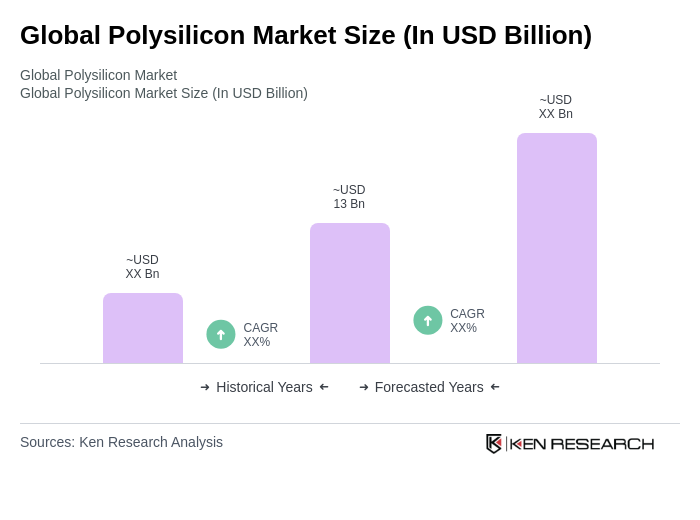
- The Global Polysilicon Market is valued at USD 13 billion, based on a five-year historical analysis. This value aligns with multiple industry trackers placing the market in the low-to-mid teens in recent years, driven by strong solar PV deployments and cyclical pricing in polysilicon spot and contract markets .
- China, the United States, and Germany are dominant players in the Global Polysilicon Market. China leads production and consumption with the vast majority of global capacity and output concentrated in the country; the United States and Germany host key electronic-grade and solar-grade producers (e.g., Hemlock Semiconductor in the U.S. and Wacker Chemie in Germany), underpinned by strong technology capabilities and established supply chains .
- In 2023, the European Union updated its Renewable Energy Directive (RED III), raising the binding EU-level target for renewable energy to at least 42.5% of final energy consumption by 2030, with an ambition to reach 45%. This higher target is intended to accelerate solar deployment in the bloc, indirectly supporting polysilicon demand across PV supply chains .
Global Polysilicon Market Segmentation
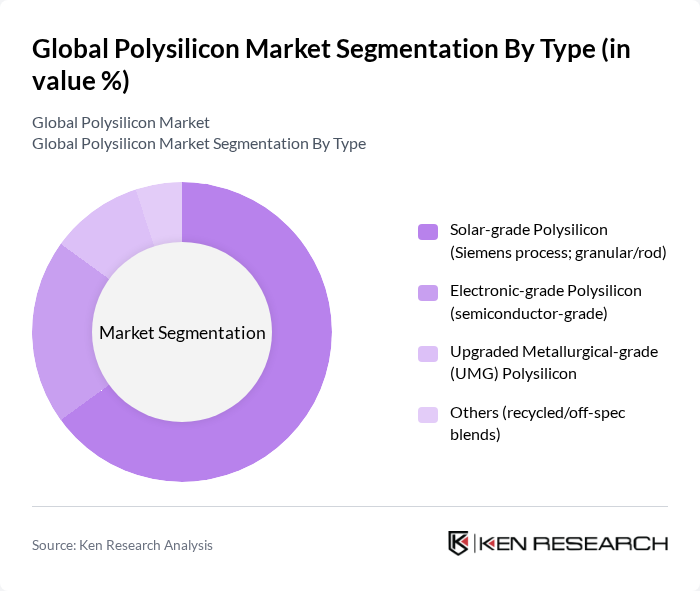
By Type:The polysilicon market is segmented into four main types: Solar-grade Polysilicon (Siemens process; granular/rod), Electronic-grade Polysilicon (semiconductor-grade), Upgraded Metallurgical-grade (UMG) Polysilicon, and Others (recycled/off-spec blends). Solar-grade polysilicon dominates the market due to its extensive use in solar photovoltaic cells, as PV accounts for the overwhelming majority of global polysilicon consumption; electronic-grade serves semiconductor applications and is materially smaller by volume than solar-grade .
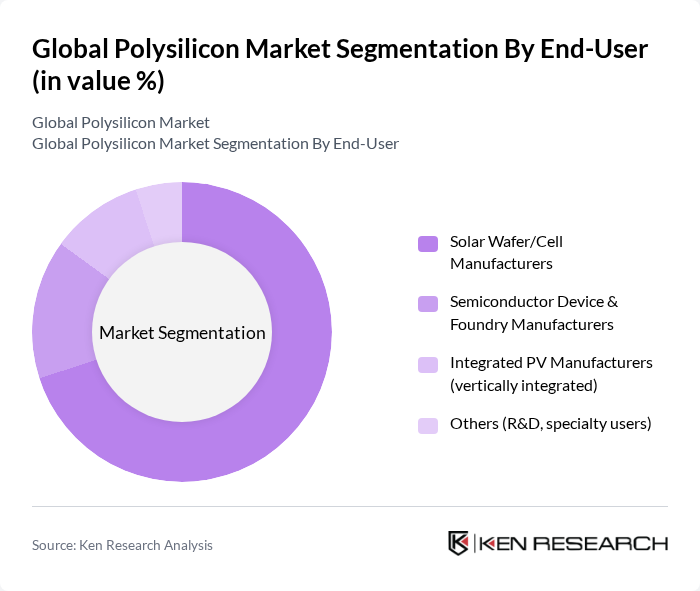
By End-User:The end-user segmentation includes Solar Wafer/Cell Manufacturers, Semiconductor Device & Foundry Manufacturers, Integrated PV Manufacturers (vertically integrated), and Others (R&D, specialty users). Solar wafer/cell manufacturers are the leading end-users, reflecting that PV represents the dominant demand outlet for polysilicon globally, while semiconductor demand is meaningful but smaller in volume share .
Global Polysilicon Market Competitive Landscape
The Global Polysilicon Market is characterized by a dynamic mix of regional and international players. Leading participants such as Wacker Chemie AG, REC Silicon ASA, GCL Technology Holdings Limited (formerly GCL-Poly Energy), LONGi Green Energy Technology Co., Ltd., Tongwei Co., Ltd., Daqo New Energy Corp., Xinte Energy Co., Ltd. (TBEA Group), Asia Silicon (Qinghai) Co., Ltd., East Hope Group, Hemlock Semiconductor Corporation, OCI Holdings Co., Ltd. (OCI Company Ltd.), Mitsubishi Materials Corporation, Tokuyama Corporation, Hanwha Qcells Co., Ltd., Ferroglobe PLC (Silicon-based materials) contribute to innovation, geographic expansion, and service delivery in this space .
- Additional growth drivers and trends:Rapid scale-up of low-cost capacity in China and expansion of granular polysilicon technologies; ongoing volatility in polysilicon prices due to supply additions and downstream wafer/cell module cycles; strong utility-scale solar buildout, particularly in Asia; and steady but smaller demand from semiconductors relative to PV .
Global Polysilicon Market Industry Analysis
Growth Drivers
- Increasing Demand for Solar Energy:The global solar energy market is projected to reach $223 billion in the future, driven by a surge in renewable energy adoption. In the future, solar energy accounted for approximately 12% of the total electricity generation worldwide, reflecting a significant increase from 10% in the previous period. This rising demand is primarily fueled by the need for sustainable energy solutions, as countries aim to reduce carbon emissions and transition to cleaner energy sources, thereby boosting polysilicon consumption.
- Technological Advancements in Production:Innovations in polysilicon production technologies have led to a 20% reduction in manufacturing costs over the past three years. Advanced techniques, such as fluidized bed reactors, have improved efficiency and yield rates, allowing producers to meet the growing demand more effectively. In the future, the average production capacity of polysilicon plants is expected to exceed 30,000 metric tons annually, enhancing supply and supporting market growth in the renewable energy sector.
- Government Incentives for Renewable Energy:In the future, global government spending on renewable energy incentives is projected to reach $150 billion, significantly impacting the polysilicon market. Countries like China and the United States are implementing tax credits and subsidies for solar energy projects, which are expected to increase polysilicon demand by 15% annually. These incentives are crucial for fostering investment in solar technologies and expanding the market for polysilicon producers.
Market Challenges
- Price Volatility of Raw Materials:The polysilicon industry faces significant challenges due to the price volatility of key raw materials, such as silicon and quartz. In the future, silicon prices fluctuated between $15 and $25 per kilogram, creating uncertainty for manufacturers. This volatility can lead to increased production costs and affect profit margins, making it difficult for companies to maintain stable pricing strategies in the polysilicon market.
- Environmental Regulations and Compliance:Stricter environmental regulations are impacting polysilicon production processes. In the future, compliance costs are expected to rise by 10% due to new emissions standards imposed by various governments. These regulations require manufacturers to invest in cleaner technologies and waste management systems, which can strain financial resources and hinder operational efficiency, posing a challenge to market growth.
Global Polysilicon Market Future Outlook
The future of the polysilicon market appears promising, driven by the increasing global emphasis on sustainable energy solutions and technological advancements. As countries strive to meet their renewable energy targets, the demand for polysilicon is expected to rise significantly. Innovations in production methods will likely enhance efficiency and reduce costs, while strategic partnerships among industry players will facilitate market expansion. Overall, the polysilicon market is poised for robust growth, supported by favorable government policies and a shift towards cleaner energy sources.
Market Opportunities
- Expansion into Emerging Markets:Emerging markets, particularly in Asia and Africa, present significant opportunities for polysilicon producers. With a combined population of over 2.5 billion, these regions are increasingly investing in solar energy infrastructure. In the future, investments in solar projects in these markets are expected to exceed $50 billion, creating a substantial demand for polysilicon and driving growth for manufacturers.
- Innovations in Polysilicon Production:Continuous innovations in polysilicon production processes, such as the development of more efficient purification methods, are expected to enhance output quality and reduce costs. In the future, advancements in production technology could lead to a 25% increase in yield rates, allowing manufacturers to meet the rising demand for high-quality polysilicon in solar panel manufacturing, thus creating new market opportunities.
Scope of the Report
| Segment | Sub-Segments |
|---|---|
| By Type | Solar-grade Polysilicon (Siemens process; granular/rod) Electronic-grade Polysilicon (semiconductor-grade) Upgraded Metallurgical-grade (UMG) Polysilicon Others (recycled/off-spec blends) |
| By End-User | Solar Wafer/Cell Manufacturers Semiconductor Device & Foundry Manufacturers Integrated PV Manufacturers (vertically integrated) Others (R&D, specialty users) |
| By Application | Solar PV (Monocrystalline ingots/wafers) Solar PV (Multicrystalline ingots/wafers) Electronics (Semiconductor/wafer deposition) Others (silane-based derivatives) |
| By Investment Source | Domestic Investment Foreign Direct Investment (FDI) Public-Private Partnerships (PPP) Government Schemes |
| By Policy Support | Subsidies Tax Exemptions Renewable Energy Certificates (RECs) Others |
| By Distribution Channel | Direct Sales to Wafer/Cell Producers Contracts with Integrated PV Players Traders/Distributors Spot Market |
| By Region | North America Europe Asia-Pacific Latin America Middle East & Africa |
Key Target Audience
Investors and Venture Capitalist Firms
Government and Regulatory Bodies (e.g., U.S. Department of Energy, European Commission)
Manufacturers and Producers
Distributors and Retailers
Solar Energy Project Developers
Industry Associations (e.g., Solar Energy Industries Association)
Financial Institutions
Polysilicon Technology Innovators
Players Mentioned in the Report:
Wacker Chemie AG
REC Silicon ASA
GCL Technology Holdings Limited (formerly GCL-Poly Energy)
LONGi Green Energy Technology Co., Ltd.
Tongwei Co., Ltd.
Daqo New Energy Corp.
Xinte Energy Co., Ltd. (TBEA Group)
Asia Silicon (Qinghai) Co., Ltd.
East Hope Group
Hemlock Semiconductor Corporation
OCI Holdings Co., Ltd. (OCI Company Ltd.)
Mitsubishi Materials Corporation
Tokuyama Corporation
Hanwha Qcells Co., Ltd.
Ferroglobe PLC (Silicon-based materials)
Table of Contents
Market Assessment Phase
1. Executive Summary and Approach
2. Global Polysilicon Market Overview
2.1 Key Insights and Strategic Recommendations
2.2 Global Polysilicon Market Overview
2.3 Definition and Scope
2.4 Evolution of Market Ecosystem
2.5 Timeline of Key Regulatory Milestones
2.6 Value Chain & Stakeholder Mapping
2.7 Business Cycle Analysis
2.8 Policy & Incentive Landscape
3. Global Polysilicon Market Analysis
3.1 Growth Drivers
3.1.1 Increasing Demand for Solar Energy
3.1.2 Technological Advancements in Production
3.1.3 Government Incentives for Renewable Energy
3.1.4 Rising Global Energy Needs
3.2 Market Challenges
3.2.1 Price Volatility of Raw Materials
3.2.2 Environmental Regulations and Compliance
3.2.3 Competition from Alternative Energy Sources
3.2.4 Supply Chain Disruptions
3.3 Market Opportunities
3.3.1 Expansion into Emerging Markets
3.3.2 Innovations in Polysilicon Production
3.3.3 Strategic Partnerships and Collaborations
3.3.4 Increasing Adoption of Electric Vehicles
3.4 Market Trends
3.4.1 Shift Towards Sustainable Energy Solutions
3.4.2 Growth of Energy Storage Technologies
3.4.3 Increasing Efficiency of Solar Panels
3.4.4 Digitalization in Manufacturing Processes
3.5 Government Regulation
3.5.1 Renewable Energy Standards
3.5.2 Emission Reduction Targets
3.5.3 Subsidies for Solar Energy Projects
3.5.4 Trade Tariffs on Imported Polysilicon
4. SWOT Analysis
5. Stakeholder Analysis
6. Porter's Five Forces Analysis
7. Global Polysilicon Market Market Size, 2019-2024
7.1 By Value
7.2 By Volume
7.3 By Average Selling Price
8. Global Polysilicon Market Segmentation
8.1 By Type
8.1.1 Solar-grade Polysilicon (Siemens process; granular/rod)
8.1.2 Electronic-grade Polysilicon (semiconductor-grade)
8.1.3 Upgraded Metallurgical-grade (UMG) Polysilicon
8.1.4 Others (recycled/off-spec blends)
8.2 By End-User
8.2.1 Solar Wafer/Cell Manufacturers
8.2.2 Semiconductor Device & Foundry Manufacturers
8.2.3 Integrated PV Manufacturers (vertically integrated)
8.2.4 Others (R&D, specialty users)
8.3 By Application
8.3.1 Solar PV (Monocrystalline ingots/wafers)
8.3.2 Solar PV (Multicrystalline ingots/wafers)
8.3.3 Electronics (Semiconductor/wafer deposition)
8.3.4 Others (silane-based derivatives)
8.4 By Investment Source
8.4.1 Domestic Investment
8.4.2 Foreign Direct Investment (FDI)
8.4.3 Public-Private Partnerships (PPP)
8.4.4 Government Schemes
8.5 By Policy Support
8.5.1 Subsidies
8.5.2 Tax Exemptions
8.5.3 Renewable Energy Certificates (RECs)
8.5.4 Others
8.6 By Distribution Channel
8.6.1 Direct Sales to Wafer/Cell Producers
8.6.2 Contracts with Integrated PV Players
8.6.3 Traders/Distributors
8.6.4 Spot Market
8.7 By Region
8.7.1 North America
8.7.2 Europe
8.7.3 Asia-Pacific
8.7.4 Latin America
8.7.5 Middle East & Africa
9. Global Polysilicon Market Competitive Analysis
9.1 Market Share of Key Players
9.2 Cross Comparison of Key Players
9.2.1 Company Name
9.2.2 Installed Polysilicon Capacity (ktpa)
9.2.3 Capacity Utilization (%)
9.2.4 Segment Mix (% solar-grade vs electronic-grade)
9.2.5 Revenue and YoY Growth (polysilicon segment)
9.2.6 Cash Cost of Production (USD/kg)
9.2.7 Average Selling Price Realization (USD/kg)
9.2.8 Power Intensity (kWh/kg) and Energy Sourcing
9.2.9 Siemens vs Fluidized Bed Reactor (FBR) Share
9.2.10 Purity Metrics (9N–11N; defect density for semi-grade)
9.2.11 Wafer/Cell Offtake Contracts (tenor and top customers)
9.2.12 Inventory Days and Order Backlog
9.2.13 Regional Exposure (China/APAC/EU/NA share)
9.2.14 ESG & Compliance (emissions intensity; traceability)
9.3 SWOT Analysis of Top Players
9.4 Pricing Analysis
9.5 Detailed Profile of Major Companies
9.5.1 Wacker Chemie AG
9.5.2 REC Silicon ASA
9.5.3 GCL Technology Holdings Limited (formerly GCL-Poly Energy)
9.5.4 LONGi Green Energy Technology Co., Ltd.
9.5.5 Tongwei Co., Ltd.
9.5.6 Daqo New Energy Corp.
9.5.7 Xinte Energy Co., Ltd. (TBEA Group)
9.5.8 Asia Silicon (Qinghai) Co., Ltd.
9.5.9 East Hope Group
9.5.10 Hemlock Semiconductor Corporation
9.5.11 OCI Holdings Co., Ltd. (OCI Company Ltd.)
9.5.12 Mitsubishi Materials Corporation
9.5.13 Tokuyama Corporation
9.5.14 Hanwha Qcells Co., Ltd.
9.5.15 Ferroglobe PLC (Silicon-based materials)
10. Global Polysilicon Market End-User Analysis
10.1 Procurement Behavior of Key Ministries
10.1.1 Government Procurement Policies
10.1.2 Budget Allocations for Renewable Energy
10.1.3 Collaboration with Private Sector
10.2 Corporate Spend on Infrastructure & Energy
10.2.1 Investment in Renewable Energy Projects
10.2.2 Budget Trends in Energy Sector
10.2.3 Corporate Sustainability Initiatives
10.3 Pain Point Analysis by End-User Category
10.3.1 Cost of Implementation
10.3.2 Technology Integration Challenges
10.3.3 Regulatory Compliance Issues
10.4 User Readiness for Adoption
10.4.1 Awareness of Renewable Energy Benefits
10.4.2 Training and Support Needs
10.4.3 Financial Incentives for Adoption
10.5 Post-Deployment ROI and Use Case Expansion
10.5.1 Performance Metrics Evaluation
10.5.2 Long-term Cost Savings Analysis
10.5.3 Opportunities for Scaling Solutions
11. Global Polysilicon Market Future Size, 2025-2030
11.1 By Value
11.2 By Volume
11.3 By Average Selling Price
Go-To-Market Strategy Phase
1. Whitespace Analysis + Business Model Canvas
1.1 Market Gaps Identification
1.2 Value Proposition Development
1.3 Revenue Streams Analysis
1.4 Cost Structure Evaluation
1.5 Key Partnerships Exploration
1.6 Customer Segmentation
1.7 Channels of Distribution
2. Marketing and Positioning Recommendations
2.1 Branding Strategies
2.2 Product USPs
2.3 Target Market Identification
2.4 Communication Strategies
2.5 Digital Marketing Approaches
3. Distribution Plan
3.1 Urban Retail Strategies
3.2 Rural NGO Tie-ups
3.3 E-commerce Integration
3.4 Logistics and Supply Chain Management
4. Channel & Pricing Gaps
4.1 Underserved Routes
4.2 Pricing Bands Analysis
4.3 Competitor Pricing Strategies
5. Unmet Demand & Latent Needs
5.1 Category Gaps Identification
5.2 Consumer Segments Analysis
5.3 Emerging Trends Exploration
6. Customer Relationship
6.1 Loyalty Programs Development
6.2 After-sales Service Strategies
6.3 Customer Feedback Mechanisms
7. Value Proposition
7.1 Sustainability Initiatives
7.2 Integrated Supply Chains
7.3 Competitive Advantages
8. Key Activities
8.1 Regulatory Compliance
8.2 Branding Initiatives
8.3 Distribution Setup
9. Entry Strategy Evaluation
9.1 Domestic Market Entry Strategy
9.1.1 Product Mix Considerations
9.1.2 Pricing Band Strategy
9.1.3 Packaging Solutions
9.2 Export Entry Strategy
9.2.1 Target Countries Identification
9.2.2 Compliance Roadmap Development
10. Entry Mode Assessment
10.1 Joint Ventures
10.2 Greenfield Investments
10.3 Mergers & Acquisitions
10.4 Distributor Model Evaluation
11. Capital and Timeline Estimation
11.1 Capital Requirements Analysis
11.2 Timelines for Implementation
12. Control vs Risk Trade-Off
12.1 Ownership vs Partnerships
13. Profitability Outlook
13.1 Breakeven Analysis
13.2 Long-term Sustainability Strategies
14. Potential Partner List
14.1 Distributors Identification
14.2 Joint Ventures Opportunities
14.3 Acquisition Targets
15. Execution Roadmap
15.1 Phased Plan for Market Entry
15.1.1 Market Setup
15.1.2 Market Entry
15.1.3 Growth Acceleration
15.1.4 Scale & Stabilize
15.2 Key Activities and Milestones
15.2.1 Milestone Planning
15.2.2 Activity Tracking
Research Methodology
Phase 1: Approach1
Desk Research
- Analysis of global polysilicon production statistics from industry reports and trade associations
- Review of market trends and forecasts published by renewable energy think tanks
- Examination of regulatory frameworks and policies impacting the polysilicon market from government publications
Primary Research
- Interviews with key stakeholders in polysilicon manufacturing, including plant managers and technical directors
- Surveys targeting solar panel manufacturers to understand polysilicon demand dynamics
- Field interviews with industry analysts and consultants specializing in renewable energy markets
Validation & Triangulation
- Cross-validation of data through multiple sources, including trade publications and market analysis reports
- Triangulation of findings from primary interviews with secondary data insights
- Sanity checks conducted through expert panel reviews to ensure data accuracy and relevance
Phase 2: Market Size Estimation1
Top-down Assessment
- Estimation of global polysilicon market size based on solar energy capacity installations
- Segmentation of market data by geographical regions and application sectors
- Incorporation of government incentives and subsidies for solar energy adoption
Bottom-up Modeling
- Collection of production capacity data from leading polysilicon manufacturers
- Estimation of average selling prices based on recent market transactions and pricing trends
- Volume x price calculations to derive revenue estimates for different market segments
Forecasting & Scenario Analysis
- Multi-variable regression analysis incorporating factors such as technological advancements and policy changes
- Scenario modeling based on varying rates of solar adoption and market disruptions
- Development of baseline, optimistic, and pessimistic forecasts through 2030
Phase 3: CATI Sample Composition1
| Scope Item/Segment | Sample Size | Target Respondent Profiles |
|---|---|---|
| Polysilicon Production Insights | 100 | Plant Managers, Production Engineers |
| Solar Panel Manufacturing Demand | 80 | Procurement Managers, Product Development Leads |
| Market Trends and Forecasts | 70 | Market Analysts, Industry Consultants |
| Regulatory Impact Assessment | 60 | Policy Makers, Regulatory Affairs Specialists |
| Technological Advancements in Production | 90 | R&D Managers, Technology Officers |
Frequently Asked Questions
What is the current value of the Global Polysilicon Market?
The Global Polysilicon Market is valued at approximately USD 13 billion, reflecting a strong demand driven by solar photovoltaic deployments and cyclical pricing trends in both spot and contract markets.
Which countries are the leading producers of polysilicon?
What are the main types of polysilicon in the market?
Who are the primary end-users of polysilicon?
Other Regional/Country Reports
Why Buy From Us?

What makes us stand out is that our consultants follow Robust, Refine and Result (RRR) methodology. Robust for clear definitions, approaches and sanity checking, Refine for differentiating respondents' facts and opinions, and Result for presenting data with story.

We have set a benchmark in the industry by offering our clients with syndicated and customized market research reports featuring coverage of entire market as well as meticulous research and analyst insights.

While we don't replace traditional research, we flip the method upside down. Our dual approach of Top Bottom & Bottom Top ensures quality deliverable by not just verifying company fundamentals but also looking at the sector and macroeconomic factors.

With one step in the future, our research team constantly tries to show you the bigger picture. We help with some of the tough questions you may encounter along the way: How is the industry positioned? Best marketing channel? KPI's of competitors? By aligning every element, we help maximize success.

Our report gives you instant access to the answers and sources that other companies might choose to hide. We elaborate each steps of research methodology we have used and showcase you the sample size to earn your trust.

If you need any support, we are here! We pride ourselves on universe strength, data quality, and quick, friendly, and professional service.