Global Rnai Technology Market Report Size, Share, Growth Drivers, Trends, Opportunities & Forecast 2025–2030

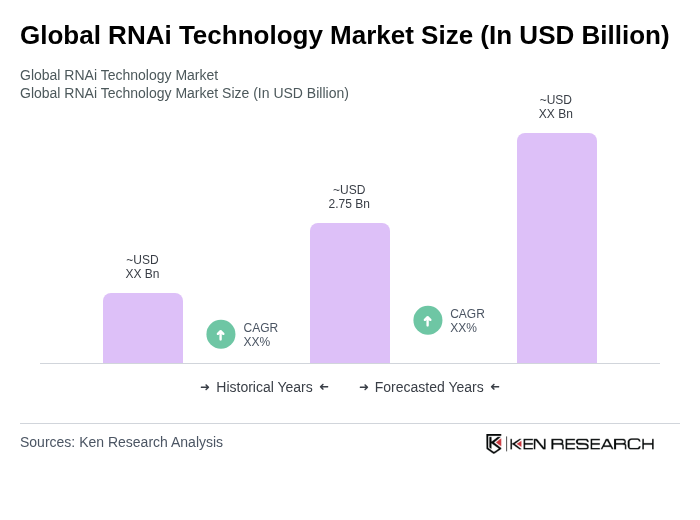
Global RNAi technology market, valued at USD 2.75 Bn, is expanding due to RNAi therapeutics approvals and biotech investments, with siRNA segment at 43.61% share in 2024.

Region:Global

Author(s):Shubham

Product Code:KRAD3523

Pages:84

Published On:November 2025
About the Report

Base Year 2024

Global RNAi Technology Market Overview

  • The Global RNAi Technology Market is valued at USD 2.75 billion, based on a five-year historical analysis. This growth is primarily driven by advancements in gene silencing technologies, increasing investments in research and development, and the rising prevalence of genetic disorders. The market is also bolstered by the growing demand for RNAi-based therapeutics and diagnostics, which are becoming increasingly important in personalized medicine. The proven clinical validation of first-to-market RNAi therapeutics, including approvals such as Onpattro (patisiran) for hereditary transthyretin-mediated amyloidosis, Givlaari (givosiran) for acute hepatic porphyria, Oxlumo (lumasiran) for primary hyperoxaluria, and Leqvio (inclisiran) for hypercholesterolemia, has established RNAi as a credible therapeutic modality and significantly accelerated market expansion.
  • North America dominates the global RNAi technology market with a 42.73% market share, driven by its robust biotechnology sector, significant funding for research, and a strong regulatory framework that supports innovation. The region benefits from supportive regulatory frameworks, with the FDA granting designations like orphan drug and breakthrough therapy that have accelerated development timelines for RNAi assets. Europe, particularly Germany, is a leader driven by its advanced healthcare system and strong pharmaceutical industry, while the Asia Pacific region is expected to see significant growth, fueled by the fastest CAGR of 11.7% over the forecast period, with China rapidly emerging as a key player due to its large population and increasing investment in biotechnology.
  • The FDA's regulatory framework for RNAi therapeutics, supported by breakthrough therapy designations and orphan drug status, has streamlined the approval process for RNAi-based therapies. This regulatory support provides incentives for research funding and accelerates development timelines, fostering innovation and enhancing patient access to these advanced treatments.
Global RNAi Technology Market Size

Global RNAi Technology Market Segmentation

By Type:The RNAi technology market is segmented into various types, including siRNA (small interfering RNA), miRNA (microRNA), shRNA (short hairpin RNA), RNAi reagents & kits, and others. Among these, siRNA is the most widely used due to its effectiveness in gene silencing and therapeutic applications. The increasing focus on precision medicine and the development of novel siRNA-based therapies are driving its dominance in the market. The siRNA segment holds the largest share at 43.61% in 2024, supported by successful clinical validations and advances in delivery technologies such as GalNAc conjugates and lipid nanoparticles.
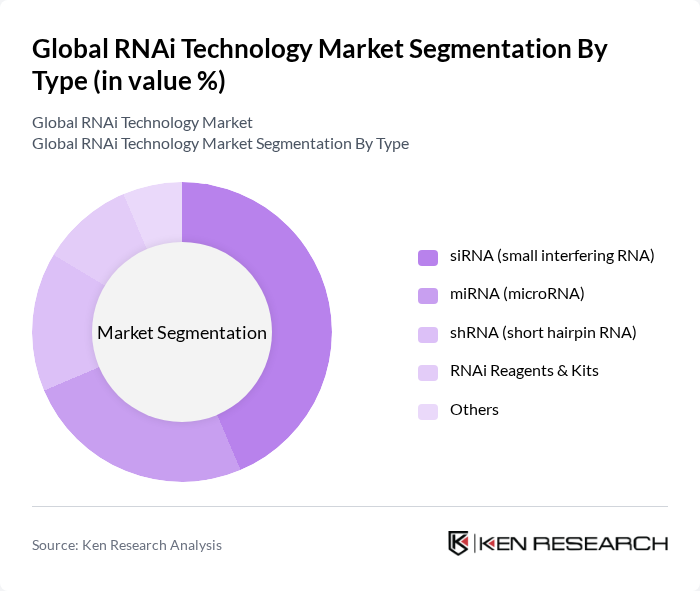
Global RNAi Technology Market segmentation by Type.

By End-User:The market is categorized by end-users, including pharmaceutical companies, biotechnology companies, academic & research institutions, contract development & manufacturing organizations (CDMOs), and others. Pharmaceutical companies are the leading end-users, driven by their extensive research capabilities and the need for innovative therapies to address unmet medical needs.
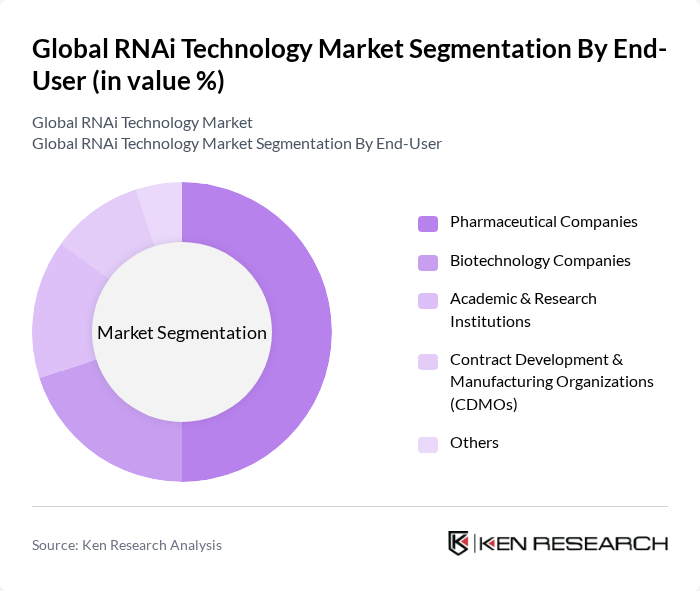
Global RNAi Technology Market segmentation by End-User.

Global RNAi Technology Market Competitive Landscape

The Global RNAi Technology Market is characterized by a dynamic mix of regional and international players. Leading participants such as Alnylam Pharmaceuticals, Moderna, Inc., Silence Therapeutics, Arrowhead Pharmaceuticals, Dicerna Pharmaceuticals, Regulus Therapeutics, Ionis Pharmaceuticals, Pfizer Inc., Novartis AG, Roche Holding AG, Sanofi S.A., Takeda Pharmaceutical Company Limited, Biogen Inc., Vertex Pharmaceuticals Incorporated, Bayer AG contribute to innovation, geographic expansion, and service delivery in this space.

Alnylam Pharmaceuticals

2002

Cambridge, Massachusetts, USA

Moderna, Inc.

2010

Cambridge, Massachusetts, USA

Silence Therapeutics

2000

London, United Kingdom

Arrowhead Pharmaceuticals

2008

Pasadena, California, USA

Dicerna Pharmaceuticals

2007

Cambridge, Massachusetts, USA

Company

Establishment Year

Headquarters

Group Size (Large, Medium, or Small as per industry convention)

Revenue Growth Rate (CAGR %)

Market Penetration Rate (by geography and segment)

Number of Approved RNAi Therapeutics

Pipeline Strength (number of clinical/preclinical candidates)

R&D Investment as % of Revenue

Global RNAi Technology Market Industry Analysis

Growth Drivers

  • Increasing Prevalence of Genetic Disorders:The global incidence of genetic disorders is rising, with approximately 1 in 1,500 to 2,000 individuals affected by rare genetic conditions. In future, the World Health Organization estimates that around over 300 million people worldwide will be living with genetic disorders. This growing patient population drives demand for innovative RNAi therapies, as they offer targeted treatment options that can address the underlying genetic causes of these disorders, thereby enhancing patient outcomes and quality of life.
  • Advancements in Drug Delivery Systems:The RNAi technology market is significantly benefiting from advancements in drug delivery systems, which are crucial for effective RNAi therapeutics. In future, the global drug delivery market is projected to reach $2.5 trillion, with innovations such as lipid nanoparticles and viral vectors enhancing the delivery of RNAi molecules. These advancements improve the stability and bioavailability of RNAi therapeutics, making them more effective in clinical applications and expanding their therapeutic potential across various diseases.
  • Rising Investment in Biotechnology Research:Investment in biotechnology research is surging, with global funding expected to exceed $500 billion in future. This influx of capital is fostering innovation in RNAi technologies, enabling the development of novel therapeutics and enhancing research capabilities. Increased funding from both public and private sectors is facilitating clinical trials and accelerating the commercialization of RNAi-based products, thereby driving market growth and expanding the therapeutic landscape for RNAi applications.

Market Challenges

  • High Development Costs:The development of RNAi therapeutics is associated with substantial costs, often exceeding $1 billion per drug. These high expenses stem from extensive research, clinical trials, and regulatory compliance requirements. In future, the financial burden of developing RNAi-based therapies poses a significant challenge for companies, particularly smaller firms, limiting their ability to invest in innovative solutions and slowing the pace of market entry for new products.
  • Regulatory Hurdles:Navigating the regulatory landscape for RNAi therapeutics is complex and time-consuming. In future, regulatory agencies are expected to enforce stringent guidelines for the approval of RNAi-based products, which can delay market entry. The need for comprehensive safety and efficacy data adds to the challenges faced by developers, potentially hindering innovation and limiting the availability of RNAi therapies to patients who need them.

Global RNAi Technology Market Future Outlook

The future of the RNAi technology market appears promising, driven by ongoing advancements in gene silencing technologies and the integration of artificial intelligence in research. As regulatory frameworks evolve, they may become more accommodating, facilitating faster approvals for RNAi therapeutics. Additionally, the rise of combination therapies, particularly those integrating CRISPR and RNAi, is expected to enhance treatment efficacy, paving the way for innovative solutions in genetic disorders and other diseases, thus expanding the market's potential.

Market Opportunities

  • Expansion in Emerging Markets:Emerging markets present significant growth opportunities for RNAi technologies, with healthcare spending projected to increase by 10% annually. Countries like India and Brazil are investing heavily in biotechnology, creating a favorable environment for RNAi therapeutics. This expansion can lead to increased access to innovative treatments, addressing unmet medical needs in these regions and driving market growth.
  • Collaborations with Pharmaceutical Companies:Strategic collaborations between RNAi technology firms and established pharmaceutical companies are on the rise, with over 50 partnerships expected in future. These collaborations leverage shared resources and expertise, accelerating the development and commercialization of RNAi therapeutics. Such partnerships can enhance market penetration and facilitate the introduction of innovative RNAi solutions to a broader patient population.

Scope of the Report

SegmentSub-Segments
By Type

siRNA (small interfering RNA)

miRNA (microRNA)

shRNA (short hairpin RNA)

RNAi Reagents & Kits

Others

By End-User

Pharmaceutical Companies

Biotechnology Companies

Academic & Research Institutions

Contract Development & Manufacturing Organizations (CDMOs)

Others

By Application

Drug Discovery & Development

Therapeutics

Oncology

Ocular Disorders

Respiratory Disorders

Hepatitis B & C

Autoimmune Diseases

Neurological Disorders

Other Therapeutics

Agriculture

Research & Diagnostics

Others

By Delivery Method

Lipid Nanoparticles

Viral Vectors

Polymer & Conjugate Systems

Others

By Region

North America

United States

Canada

Mexico

Europe

Germany

United Kingdom

France

Italy

Spain

Rest of Europe

Asia-Pacific

China

Japan

India

South Korea

Australia

Rest of Asia-Pacific

Latin America

Middle East & Africa

By Research Phase

Preclinical

Clinical Trials

Commercialization

Others

By Funding Source

Government Grants

Private Investments

Venture Capital

Others

Key Target Audience

Investors and Venture Capitalist Firms

Government and Regulatory Bodies (e.g., U.S. Food and Drug Administration, European Medicines Agency)

Biotechnology and Pharmaceutical Companies

Contract Research Organizations (CROs)

Biomanufacturers

Healthcare Providers and Institutions

Intellectual Property Firms

Pharmaceutical Supply Chain Companies

Players Mentioned in the Report:

Alnylam Pharmaceuticals

Moderna, Inc.

Silence Therapeutics

Arrowhead Pharmaceuticals

Dicerna Pharmaceuticals

Regulus Therapeutics

Ionis Pharmaceuticals

Pfizer Inc.

Novartis AG

Roche Holding AG

Sanofi S.A.

Takeda Pharmaceutical Company Limited

Biogen Inc.

Vertex Pharmaceuticals Incorporated

Bayer AG

Table of Contents

Market Assessment Phase

1. Executive Summary and Approach


2. Global RNAi Technology Market Overview

2.1 Key Insights and Strategic Recommendations

2.2 Global RNAi Technology Market Overview

2.3 Definition and Scope

2.4 Evolution of Market Ecosystem

2.5 Timeline of Key Regulatory Milestones

2.6 Value Chain & Stakeholder Mapping

2.7 Business Cycle Analysis

2.8 Policy & Incentive Landscape


3. Global RNAi Technology Market Analysis

3.1 Growth Drivers

3.1.1 Increasing prevalence of genetic disorders
3.1.2 Advancements in drug delivery systems
3.1.3 Rising investment in biotechnology research
3.1.4 Growing demand for personalized medicine

3.2 Market Challenges

3.2.1 High development costs
3.2.2 Regulatory hurdles
3.2.3 Limited awareness among healthcare professionals
3.2.4 Technical complexities in RNAi delivery

3.3 Market Opportunities

3.3.1 Expansion in emerging markets
3.3.2 Collaborations with pharmaceutical companies
3.3.3 Development of novel RNAi therapeutics
3.3.4 Increasing applications in agriculture

3.4 Market Trends

3.4.1 Growing focus on gene silencing technologies
3.4.2 Integration of AI in RNAi research
3.4.3 Rise of CRISPR and RNAi combination therapies
3.4.4 Increased funding for RNAi-based startups

3.5 Government Regulation

3.5.1 Guidelines for RNAi therapeutic development
3.5.2 Intellectual property regulations
3.5.3 Safety and efficacy standards
3.5.4 Environmental impact assessments

4. SWOT Analysis


5. Stakeholder Analysis


6. Porter's Five Forces Analysis


7. Global RNAi Technology Market Size, 2019-2024

7.1 By Value

7.2 By Volume

7.3 By Average Selling Price


8. Global RNAi Technology Market Segmentation

8.1 By Type

8.1.1 siRNA (small interfering RNA)
8.1.2 miRNA (microRNA)
8.1.3 shRNA (short hairpin RNA)
8.1.4 RNAi Reagents & Kits
8.1.5 Others

8.2 By End-User

8.2.1 Pharmaceutical Companies
8.2.2 Biotechnology Companies
8.2.3 Academic & Research Institutions
8.2.4 Contract Development & Manufacturing Organizations (CDMOs)
8.2.5 Others

8.3 By Application

8.3.1 Drug Discovery & Development
8.3.2 TherapeuticsOncologyOcular DisordersRespiratory DisordersHepatitis B & CAutoimmune DiseasesNeurological DisordersOther Therapeutics
8.3.3 Agriculture
8.3.4 Research & Diagnostics
8.3.5 Others

8.4 By Delivery Method

8.4.1 Lipid Nanoparticles
8.4.2 Viral Vectors
8.4.3 Polymer & Conjugate Systems
8.4.4 Others

8.5 By Region

8.5.1 North AmericaUnited StatesCanadaMexico
8.5.2 EuropeGermanyUnited KingdomFranceItalySpainRest of Europe
8.5.3 Asia-PacificChinaJapanIndiaSouth KoreaAustraliaRest of Asia-Pacific
8.5.4 Latin America
8.5.5 Middle East & Africa

8.6 By Research Phase

8.6.1 Preclinical
8.6.2 Clinical Trials
8.6.3 Commercialization
8.6.4 Others

8.7 By Funding Source

8.7.1 Government Grants
8.7.2 Private Investments
8.7.3 Venture Capital
8.7.4 Others

9. Global RNAi Technology Market Competitive Analysis

9.1 Market Share of Key Players

9.2 Cross Comparison of Key Players

9.2.1 Company Name
9.2.2 Group Size (Large, Medium, or Small as per industry convention)
9.2.3 Revenue Growth Rate (CAGR %)
9.2.4 Market Penetration Rate (by geography and segment)
9.2.5 Number of Approved RNAi Therapeutics
9.2.6 Pipeline Strength (number of clinical/preclinical candidates)
9.2.7 R&D Investment as % of Revenue
9.2.8 Strategic Partnerships & Collaborations
9.2.9 Intellectual Property Portfolio (patents held/granted)
9.2.10 Regulatory Approval Success Rate
9.2.11 Product Development Cycle Time
9.2.12 Sales Conversion Rate
9.2.13 Customer Satisfaction Score

9.3 SWOT Analysis of Top Players

9.4 Pricing Analysis

9.5 Detailed Profile of Major Companies

9.5.1 Alnylam Pharmaceuticals
9.5.2 Moderna, Inc.
9.5.3 Silence Therapeutics
9.5.4 Arrowhead Pharmaceuticals
9.5.5 Dicerna Pharmaceuticals
9.5.6 Regulus Therapeutics
9.5.7 Ionis Pharmaceuticals
9.5.8 Pfizer Inc.
9.5.9 Novartis AG
9.5.10 Roche Holding AG
9.5.11 Sanofi S.A.
9.5.12 Takeda Pharmaceutical Company Limited
9.5.13 Biogen Inc.
9.5.14 Vertex Pharmaceuticals Incorporated
9.5.15 Bayer AG

10. Global RNAi Technology Market End-User Analysis

10.1 Procurement Behavior of Key Ministries

10.1.1 Budget Allocation Trends
10.1.2 Decision-Making Processes
10.1.3 Preferred Suppliers
10.1.4 Compliance Requirements

10.2 Corporate Spend on Infrastructure & Energy

10.2.1 Investment Priorities
10.2.2 Spending Patterns
10.2.3 Cost-Benefit Analysis
10.2.4 Long-term Contracts

10.3 Pain Point Analysis by End-User Category

10.3.1 Challenges in Implementation
10.3.2 Budget Constraints
10.3.3 Technical Support Needs
10.3.4 Regulatory Compliance Issues

10.4 User Readiness for Adoption

10.4.1 Training Requirements
10.4.2 Infrastructure Readiness
10.4.3 Technology Acceptance Levels
10.4.4 Feedback Mechanisms

10.5 Post-Deployment ROI and Use Case Expansion

10.5.1 Performance Metrics
10.5.2 Scalability Potential
10.5.3 User Satisfaction Levels
10.5.4 Future Investment Plans

11. Global RNAi Technology Market Future Size, 2025-2030

11.1 By Value

11.2 By Volume

11.3 By Average Selling Price


Go-To-Market Strategy Phase

1. Whitespace Analysis + Business Model Canvas

1.1 Market Gaps Identification

1.2 Value Proposition Development

1.3 Revenue Streams Analysis

1.4 Cost Structure Evaluation

1.5 Key Partnerships Exploration

1.6 Customer Segmentation

1.7 Competitive Advantage Assessment


2. Marketing and Positioning Recommendations

2.1 Branding Strategies

2.2 Product USPs

2.3 Target Market Identification

2.4 Communication Strategies

2.5 Digital Marketing Approaches


3. Distribution Plan

3.1 Urban Retail Strategies

3.2 Rural NGO Tie-ups

3.3 Online Distribution Channels

3.4 Direct Sales Approaches


4. Channel & Pricing Gaps

4.1 Underserved Routes

4.2 Pricing Bands Analysis

4.3 Competitor Pricing Comparison

4.4 Value-Based Pricing Strategies


5. Unmet Demand & Latent Needs

5.1 Category Gaps Identification

5.2 Consumer Segments Analysis

5.3 Emerging Trends Exploration

5.4 Future Needs Assessment


6. Customer Relationship

6.1 Loyalty Programs

6.2 After-sales Service

6.3 Customer Feedback Mechanisms

6.4 Community Engagement Strategies


7. Value Proposition

7.1 Sustainability Initiatives

7.2 Integrated Supply Chains

7.3 Customer-Centric Innovations

7.4 Competitive Differentiation


8. Key Activities

8.1 Regulatory Compliance

8.2 Branding Efforts

8.3 Distribution Setup

8.4 Market Research Activities


9. Entry Strategy Evaluation

9.1 Domestic Market Entry Strategy

9.1.1 Product Mix Considerations
9.1.2 Pricing Band Strategies
9.1.3 Packaging Innovations

9.2 Export Entry Strategy

9.2.1 Target Countries Identification
9.2.2 Compliance Roadmap Development

10. Entry Mode Assessment

10.1 Joint Ventures

10.2 Greenfield Investments

10.3 Mergers & Acquisitions

10.4 Distributor Model Evaluation


11. Capital and Timeline Estimation

11.1 Capital Requirements Analysis

11.2 Timelines for Implementation


12. Control vs Risk Trade-Off

12.1 Ownership vs Partnerships

12.2 Risk Mitigation Strategies


13. Profitability Outlook

13.1 Breakeven Analysis

13.2 Long-term Sustainability Strategies


14. Potential Partner List

14.1 Distributors

14.2 Joint Ventures

14.3 Acquisition Targets


15. Execution Roadmap

15.1 Phased Plan for Market Entry

15.1.1 Market Setup
15.1.2 Market Entry
15.1.3 Growth Acceleration
15.1.4 Scale & Stabilize

15.2 Key Activities and Milestones

15.2.1 Milestone Identification
15.2.2 Activity Scheduling

Research Methodology

ApproachModellingSample

Phase 1: Approach1

Desk Research

  • Analysis of market reports from biotechnology and pharmaceutical associations
  • Review of scientific publications and patents related to RNAi technology
  • Examination of industry white papers and market forecasts from research institutions

Primary Research

  • Interviews with leading researchers in RNAi technology from academic institutions
  • Surveys with product managers at biotech firms specializing in RNAi therapeutics
  • Field interviews with regulatory affairs specialists in the pharmaceutical sector

Validation & Triangulation

  • Cross-validation of findings through multiple expert interviews and literature reviews
  • Triangulation of data from market reports, academic research, and industry insights
  • Sanity checks through feedback from a panel of RNAi technology experts

Phase 2: Market Size Estimation1

Top-down Assessment

  • Estimation of global RNAi market size based on pharmaceutical spending trends
  • Segmentation by application areas such as therapeutics, agriculture, and research
  • Incorporation of growth rates from emerging markets and technological advancements

Bottom-up Modeling

  • Volume estimates based on sales data from leading RNAi product manufacturers
  • Cost analysis of RNAi development and production processes
  • Market share calculations based on firm-level revenue and product offerings

Forecasting & Scenario Analysis

  • Multi-variable regression analysis incorporating factors like funding trends and regulatory changes
  • Scenario modeling based on potential breakthroughs in RNAi applications
  • Development of baseline, optimistic, and pessimistic market projections through 2030

Phase 3: CATI Sample Composition1

Scope Item/SegmentSample SizeTarget Respondent Profiles
RNAi Therapeutics Development100Biotech Researchers, Clinical Trial Managers
Agricultural RNAi Applications60Agronomists, Product Development Scientists
RNAi Delivery Systems50Formulation Scientists, Regulatory Affairs Specialists
RNAi Research Funding40Venture Capital Analysts, Grant Managers
Market Trends in RNAi Technology70Market Analysts, Business Development Managers

Frequently Asked Questions

What is the current value of the Global RNAi Technology Market?

The Global RNAi Technology Market is valued at approximately USD 2.75 billion, reflecting significant growth driven by advancements in gene silencing technologies and increasing investments in research and development, particularly in personalized medicine and RNAi-based therapeutics.

What factors are driving the growth of the RNAi Technology Market?

Which region dominates the Global RNAi Technology Market?

What are the main types of RNAi technologies available?

Other Regional/Country Reports

Indonesia Rnai Technology Market

Malaysia Rnai Technology Market

KSA Rnai Technology Market

APAC Rnai Technology Market

SEA Rnai Technology Market

Vietnam Rnai Technology Market

Why Buy From Us?

Refine Robust Result (RRR) Framework

What makes us stand out is that our consultants follow Robust, Refine and Result (RRR) methodology. Robust for clear definitions, approaches and sanity checking, Refine for differentiating respondents' facts and opinions, and Result for presenting data with story.

Our Reach Is Unmatched

We have set a benchmark in the industry by offering our clients with syndicated and customized market research reports featuring coverage of entire market as well as meticulous research and analyst insights.

Shifting the Research Paradigm

While we don't replace traditional research, we flip the method upside down. Our dual approach of Top Bottom & Bottom Top ensures quality deliverable by not just verifying company fundamentals but also looking at the sector and macroeconomic factors.

More Insights-Better Decisions

With one step in the future, our research team constantly tries to show you the bigger picture. We help with some of the tough questions you may encounter along the way: How is the industry positioned? Best marketing channel? KPI's of competitors? By aligning every element, we help maximize success.

Transparency and Trust

Our report gives you instant access to the answers and sources that other companies might choose to hide. We elaborate each steps of research methodology we have used and showcase you the sample size to earn your trust.

Round the Clock Support

If you need any support, we are here! We pride ourselves on universe strength, data quality, and quick, friendly, and professional service.

Why Clients Choose Us?

400000+
Reports in repository
150+
Consulting projects a year
100+
Analysts
8000+
Client Queries in 2022








