About the Report
Base Year 2024Global Senolytics Anti Aging Pharmaceuticals Market Overview
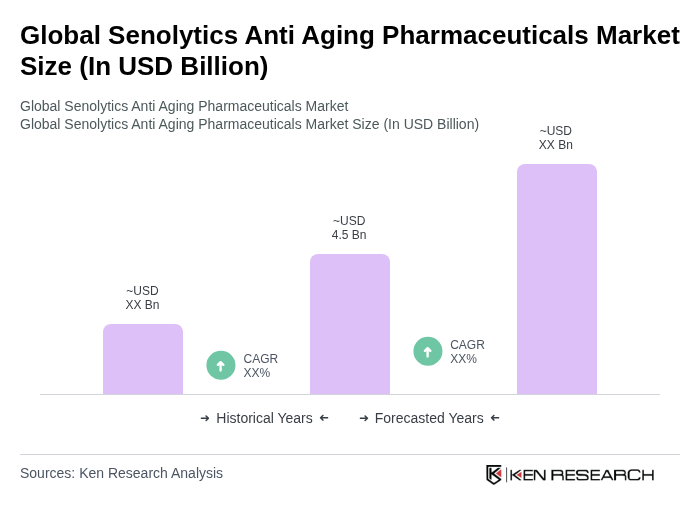
- The Global Senolytics Anti Aging Pharmaceuticals Market is valued at USD 4.5 billion, based on a five-year historical analysis. This growth is primarily driven by the increasing prevalence of age-related diseases, rising healthcare expenditure, and advancements in biotechnology that facilitate the development of innovative therapies targeting cellular senescence. Notably, the market is further propelled by a growing global elderly population, heightened investment in geroscience research, and expanding clinical trial activity for senolytic agents. The diversification of senolytic compound classes and the emergence of novel molecular targets are also key trends shaping the market landscape .
- Key players in this market are predominantly located in North America and Europe, with the United States and Germany leading due to their robust healthcare infrastructure, significant investment in research and development, and a high concentration of biotechnology firms focused on anti-aging solutions. North America holds the largest market share, driven by strong R&D infrastructure, proactive regulatory frameworks, and a surge in clinical trials and patent filings for senolytic therapies. Europe follows closely, emphasizing clinical research and pharmaceutical engagement, while the Asia-Pacific region is emerging rapidly due to increasing investments and a large aging population .
- In 2023, the U.S. Food and Drug Administration (FDA) issued the "Guidance for Industry: Cellular and Gene Therapy Products Targeting Senescent Cells," establishing requirements for comprehensive clinical trial data to demonstrate safety and efficacy. This regulation, issued by the U.S. Food and Drug Administration, aims to streamline the approval process for senolytic therapies while ensuring rigorous safety standards, including mandatory preclinical studies, phased clinical trials, and post-marketing surveillance .
Global Senolytics Anti Aging Pharmaceuticals Market Segmentation
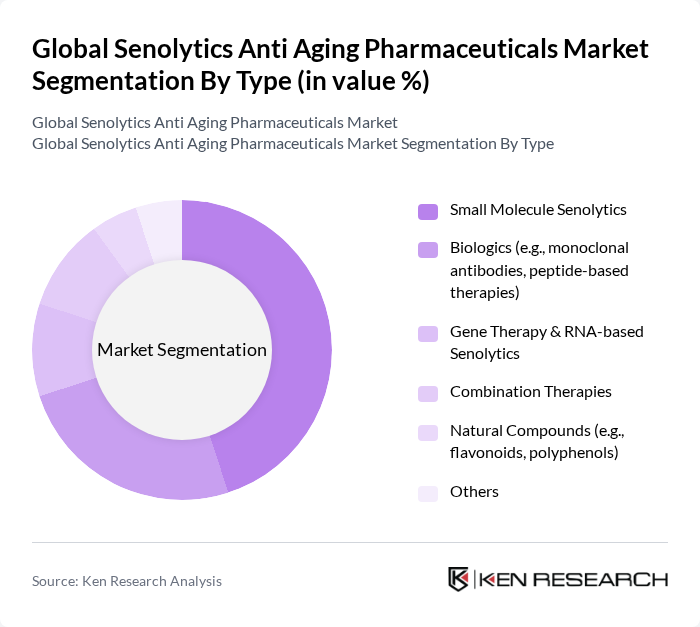
By Type:The market is segmented into various types of senolytics, including small molecule senolytics, biologics, gene therapy, combination therapies, natural compounds, and others. Among these, small molecule senolytics are currently dominating the market due to their ease of administration and effectiveness in targeting senescent cells. The growing interest in personalized medicine and the increasing number of clinical trials focusing on these therapies further bolster their market presence. The diversification of senolytic agents, such as Bcl-2 family inhibitors and peptide-based therapies, reflects the expanding research focus and clinical validation within the segment .
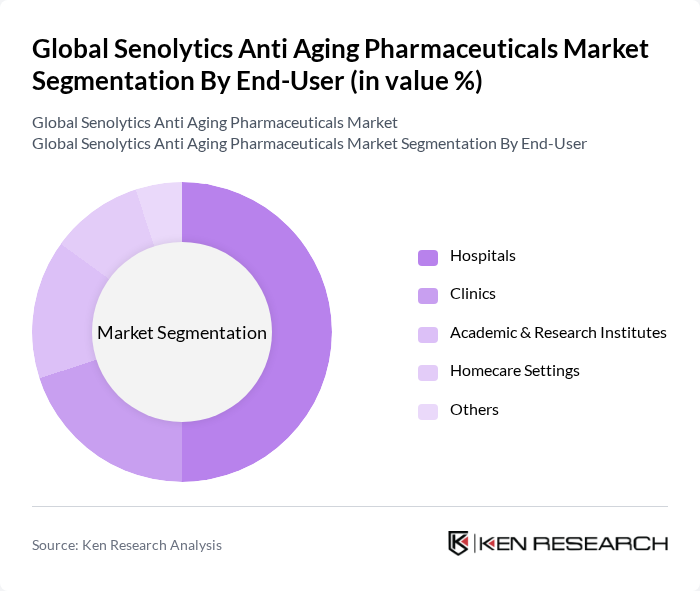
By End-User:The end-user segmentation includes hospitals, clinics, academic and research institutes, homecare settings, and others. Hospitals are the leading end-users, primarily due to their capacity to conduct advanced treatments and clinical trials. The increasing number of specialized anti-aging clinics and the growing trend of outpatient treatments are also contributing to the expansion of this segment. Research institutes are playing a growing role in early-stage development, while homecare settings are gradually expanding as oral and self-administered senolytic therapies advance .
Global Senolytics Anti Aging Pharmaceuticals Market Competitive Landscape
The Global Senolytics Anti Aging Pharmaceuticals Market is characterized by a dynamic mix of regional and international players. Leading participants such as Unity Biotechnology, Senolytic Therapeutics Inc., Cleara Biotech, Oisín Biotechnologies, Life Biosciences, Calico Life Sciences, AgeX Therapeutics, Juvenescence Ltd., Novartis AG, Roche Holding AG, Merck & Co., Inc., Pfizer Inc., Sanofi S.A., AstraZeneca plc, Johnson & Johnson, Abbott Laboratories, Sun Pharmaceutical Industries Ltd., Recursion Pharmaceuticals, Inc., BioAge Labs, T.A. Sciences, Inc. contribute to innovation, geographic expansion, and service delivery in this space.
Global Senolytics Anti Aging Pharmaceuticals Market Industry Analysis
Growth Drivers
- Increasing Aging Population:The global population aged 65 and older is projected to reach approximately 1.5 billion in future, according to the United Nations. The number of individuals over 60 is currently estimated to be over 1 billion globally, supporting substantial demand for pharmaceuticals targeting age-related conditions. This demographic shift is a key driver for the senolytics market, emphasizing the need for innovative treatments.
- Rising Demand for Anti-Aging Solutions:The global anti-aging market is anticipated to reach approximately $421 billion in future, fueled by increasing consumer interest in maintaining youthfulness. This trend is particularly pronounced in developed regions, where spending on health and wellness products is rising. The demand for senolytics is expected to grow as consumers become more aware of the potential benefits of these pharmaceuticals in combating age-related decline, thus driving market expansion significantly.
- Advancements in Senolytic Research:Research funding for senolytics has surged, with investments exceeding $1 billion in future alone. Breakthroughs in understanding cellular senescence are leading to the development of novel senolytic compounds. Institutions like the National Institutes of Health (NIH) are prioritizing this area, which is expected to yield new therapies in future. These advancements are crucial for the market, as they promise to enhance the efficacy and safety of anti-aging treatments.
Market Challenges
- High Research and Development Costs:The average cost of developing a new pharmaceutical is estimated at approximately $2.6 billion, according to the Tufts Center for the Study of Drug Development. This financial burden poses a significant challenge for companies in the senolytics sector, as extensive research and clinical trials are necessary to bring new products to market. The high costs can deter investment and slow the pace of innovation, impacting overall market growth.
- Regulatory Hurdles:Navigating the regulatory landscape for pharmaceuticals can be complex and time-consuming. In the U.S., the FDA requires extensive clinical trial data before approving new drugs, which can take over a decade. This lengthy process can delay the introduction of senolytic therapies, hindering market entry and growth. Additionally, varying regulations across different regions complicate global market strategies for companies in this field.
Global Senolytics Anti Aging Pharmaceuticals Market Future Outlook
The future of the senolytics market appears promising, driven by ongoing research and a growing consumer base seeking effective anti-aging solutions. As the aging population expands, the demand for innovative therapies will likely increase. Furthermore, advancements in personalized medicine and technology integration are expected to enhance treatment efficacy. Companies that adapt to these trends and invest in research will be well-positioned to capitalize on emerging opportunities in the senolytics sector, fostering sustainable growth in the coming years.
Market Opportunities
- Expansion into Emerging Markets:Emerging markets, particularly in Asia and Latin America, are witnessing rapid economic growth and increasing healthcare spending. In future, these regions are expected to account for over 30% of global healthcare expenditures. This presents a significant opportunity for senolytics companies to introduce their products, catering to a burgeoning middle class seeking advanced anti-aging solutions.
- Development of Novel Senolytic Compounds:The ongoing research into new senolytic compounds offers substantial market potential. With over 50 clinical trials currently underway, the introduction of innovative therapies could revolutionize the anti-aging landscape. Companies that successfully develop and commercialize these novel compounds will likely capture significant market share, addressing the unmet needs of aging populations worldwide.
Scope of the Report
| Segment | Sub-Segments |
|---|---|
| By Type | Small Molecule Senolytics Biologics (e.g., monoclonal antibodies, peptide-based therapies) Gene Therapy & RNA-based Senolytics Combination Therapies Natural Compounds (e.g., flavonoids, polyphenols) Others |
| By End-User | Hospitals Clinics Academic & Research Institutes Homecare Settings Others |
| By Distribution Channel | Online Pharmacies Retail Pharmacies Hospital Pharmacies Direct Sales Others |
| By Region | North America Europe Asia-Pacific Latin America Middle East & Africa |
| By Age Group | 40 Years 50 Years 60 Years Years and Above |
| By Product Formulation | Tablets Injections Topicals Others |
| By Research Phase | Preclinical Clinical Trials Marketed Products Others |
Key Target Audience
Investors and Venture Capitalist Firms
Government and Regulatory Bodies (e.g., U.S. Food and Drug Administration, European Medicines Agency)
Pharmaceutical Manufacturers
Biotechnology Companies
Healthcare Providers and Clinics
Pharmaceutical Distributors
Health Insurance Companies
Market Analysts and Industry Experts
Players Mentioned in the Report:
Unity Biotechnology
Senolytic Therapeutics Inc.
Cleara Biotech
Oisin Biotechnologies
Life Biosciences
Calico Life Sciences
AgeX Therapeutics
Juvenescence Ltd.
Novartis AG
Roche Holding AG
Merck & Co., Inc.
Pfizer Inc.
Sanofi S.A.
AstraZeneca plc
Johnson & Johnson
Abbott Laboratories
Sun Pharmaceutical Industries Ltd.
Recursion Pharmaceuticals, Inc.
BioAge Labs
T.A. Sciences, Inc.
Table of Contents
Market Assessment Phase
1. Executive Summary and Approach
2. Global Senolytics Anti Aging Pharmaceuticals Market Overview
2.1 Key Insights and Strategic Recommendations
2.2 Global Senolytics Anti Aging Pharmaceuticals Market Overview
2.3 Definition and Scope
2.4 Evolution of Market Ecosystem
2.5 Timeline of Key Regulatory Milestones
2.6 Value Chain & Stakeholder Mapping
2.7 Business Cycle Analysis
2.8 Policy & Incentive Landscape
3. Global Senolytics Anti Aging Pharmaceuticals Market Analysis
3.1 Growth Drivers
3.1.1 Increasing Aging Population
3.1.2 Rising Demand for Anti-Aging Solutions
3.1.3 Advancements in Senolytic Research
3.1.4 Growing Awareness of Health and Wellness
3.2 Market Challenges
3.2.1 High Research and Development Costs
3.2.2 Regulatory Hurdles
3.2.3 Market Competition
3.2.4 Limited Consumer Awareness
3.3 Market Opportunities
3.3.1 Expansion into Emerging Markets
3.3.2 Development of Novel Senolytic Compounds
3.3.3 Strategic Partnerships and Collaborations
3.3.4 Increasing Investment in Anti-Aging Research
3.4 Market Trends
3.4.1 Personalized Medicine Approaches
3.4.2 Integration of Technology in Anti-Aging Solutions
3.4.3 Focus on Preventive Healthcare
3.4.4 Rise of Natural and Organic Products
3.5 Government Regulation
3.5.1 Approval Processes for New Pharmaceuticals
3.5.2 Guidelines for Clinical Trials
3.5.3 Regulations on Marketing and Advertising
3.5.4 Compliance with Safety Standards
4. SWOT Analysis
5. Stakeholder Analysis
6. Porter's Five Forces Analysis
7. Global Senolytics Anti Aging Pharmaceuticals Market Market Size, 2019-2024
7.1 By Value
7.2 By Volume
7.3 By Average Selling Price
8. Global Senolytics Anti Aging Pharmaceuticals Market Segmentation
8.1 By Type
8.1.1 Small Molecule Senolytics
8.1.2 Biologics (e.g., monoclonal antibodies, peptide-based therapies)
8.1.3 Gene Therapy & RNA-based Senolytics
8.1.4 Combination Therapies
8.1.5 Natural Compounds (e.g., flavonoids, polyphenols)
8.1.6 Others
8.2 By End-User
8.2.1 Hospitals
8.2.2 Clinics
8.2.3 Academic & Research Institutes
8.2.4 Homecare Settings
8.2.5 Others
8.3 By Distribution Channel
8.3.1 Online Pharmacies
8.3.2 Retail Pharmacies
8.3.3 Hospital Pharmacies
8.3.4 Direct Sales
8.3.5 Others
8.4 By Region
8.4.1 North America
8.4.2 Europe
8.4.3 Asia-Pacific
8.4.4 Latin America
8.4.5 Middle East & Africa
8.5 By Age Group
8.5.1 30-40 Years
8.5.2 41-50 Years
8.5.3 51-60 Years
8.5.4 61 Years and Above
8.6 By Product Formulation
8.6.1 Tablets
8.6.2 Injections
8.6.3 Topicals
8.6.4 Others
8.7 By Research Phase
8.7.1 Preclinical
8.7.2 Clinical Trials
8.7.3 Marketed Products
8.7.4 Others
9. Global Senolytics Anti Aging Pharmaceuticals Market Competitive Analysis
9.1 Market Share of Key Players
9.2 Cross Comparison of Key Players
9.2.1 Company Name
9.2.2 Group Size (Large, Medium, or Small as per industry convention)
9.2.3 Revenue Growth Rate (CAGR, 3-5 year)
9.2.4 R&D Investment as % of Revenue
9.2.5 Number of Active Senolytic Programs/Assets
9.2.6 Clinical Pipeline Stage (Preclinical, Phase I/II/III, Marketed)
9.2.7 Market Penetration Rate (by geography or segment)
9.2.8 Strategic Partnerships & Collaborations
9.2.9 Intellectual Property Portfolio (patents filed/granted)
9.2.10 Regulatory Approval Success Rate
9.2.11 Distribution Reach (channels, countries)
9.2.12 Pricing Strategy
9.2.13 Brand Recognition
9.2.14 Customer Retention Rate
9.3 SWOT Analysis of Top Players
9.4 Pricing Analysis
9.5 Detailed Profile of Major Companies
9.5.1 Unity Biotechnology
9.5.2 Senolytic Therapeutics Inc.
9.5.3 Cleara Biotech
9.5.4 Oisín Biotechnologies
9.5.5 Life Biosciences
9.5.6 Calico Life Sciences
9.5.7 AgeX Therapeutics
9.5.8 Juvenescence Ltd.
9.5.9 Novartis AG
9.5.10 Roche Holding AG
9.5.11 Merck & Co., Inc.
9.5.12 Pfizer Inc.
9.5.13 Sanofi S.A.
9.5.14 AstraZeneca plc
9.5.15 Johnson & Johnson
9.5.16 Abbott Laboratories
9.5.17 Sun Pharmaceutical Industries Ltd.
9.5.18 Recursion Pharmaceuticals, Inc.
9.5.19 BioAge Labs
9.5.20 T.A. Sciences, Inc.
10. Global Senolytics Anti Aging Pharmaceuticals Market End-User Analysis
10.1 Procurement Behavior of Key Ministries
10.1.1 Government Health Initiatives
10.1.2 Budget Allocations for Anti-Aging Research
10.1.3 Collaboration with Pharmaceutical Companies
10.1.4 Others
10.2 Corporate Spend on Infrastructure & Energy
10.2.1 Investment in R&D Facilities
10.2.2 Funding for Clinical Trials
10.2.3 Partnerships with Research Institutions
10.2.4 Others
10.3 Pain Point Analysis by End-User Category
10.3.1 Access to Innovative Treatments
10.3.2 Affordability of Senolytics
10.3.3 Awareness of Available Options
10.3.4 Others
10.4 User Readiness for Adoption
10.4.1 Attitudes Towards Anti-Aging Solutions
10.4.2 Willingness to Pay for Senolytics
10.4.3 Knowledge of Senolytic Benefits
10.4.4 Others
10.5 Post-Deployment ROI and Use Case Expansion
10.5.1 Measurement of Treatment Efficacy
10.5.2 Long-term Health Benefits
10.5.3 Expansion into New Markets
10.5.4 Others
11. Global Senolytics Anti Aging Pharmaceuticals Market Future Size, 2025-2030
11.1 By Value
11.2 By Volume
11.3 By Average Selling Price
Go-To-Market Strategy Phase
1. Whitespace Analysis + Business Model Canvas
1.1 Market Gaps Identification
1.2 Business Model Development
1.3 Value Proposition Canvas
1.4 Competitive Landscape Analysis
1.5 Customer Segmentation
1.6 Revenue Streams
1.7 Cost Structure
2. Marketing and Positioning Recommendations
2.1 Branding Strategies
2.2 Product USPs
2.3 Target Audience Identification
2.4 Marketing Channels
2.5 Messaging Framework
2.6 Campaign Planning
2.7 Performance Metrics
3. Distribution Plan
3.1 Urban Retail Strategies
3.2 Rural NGO Tie-ups
3.3 E-commerce Integration
3.4 Direct-to-Consumer Approaches
3.5 Distribution Partnerships
3.6 Logistics and Supply Chain Management
3.7 Performance Evaluation
4. Channel & Pricing Gaps
4.1 Underserved Routes
4.2 Pricing Bands
4.3 Competitive Pricing Analysis
4.4 Value-Based Pricing Strategies
4.5 Discount and Promotion Strategies
4.6 Price Sensitivity Analysis
4.7 Channel Conflict Resolution
5. Unmet Demand & Latent Needs
5.1 Category Gaps
5.2 Consumer Segments
5.3 Product Development Opportunities
5.4 Market Entry Strategies
5.5 Customer Feedback Mechanisms
5.6 Innovation Roadmap
5.7 Future Trends Analysis
6. Customer Relationship
6.1 Loyalty Programs
6.2 After-sales Service
6.3 Customer Engagement Strategies
6.4 Feedback and Improvement Loops
6.5 Community Building Initiatives
6.6 Customer Education Programs
6.7 Performance Tracking
7. Value Proposition
7.1 Sustainability Initiatives
7.2 Integrated Supply Chains
7.3 Unique Selling Points
7.4 Customer-Centric Innovations
7.5 Competitive Advantages
7.6 Market Differentiation Strategies
7.7 Value Communication
8. Key Activities
8.1 Regulatory Compliance
8.2 Branding
8.3 Distribution Setup
8.4 Market Research
8.5 Stakeholder Engagement
8.6 Performance Monitoring
8.7 Continuous Improvement
9. Entry Strategy Evaluation
9.1 Domestic Market Entry Strategy
9.1.1 Product Mix
9.1.2 Pricing Band
9.1.3 Packaging
9.2 Export Entry Strategy
9.2.1 Target Countries
9.2.2 Compliance Roadmap
10. Entry Mode Assessment
10.1 Joint Ventures
10.2 Greenfield Investments
10.3 Mergers & Acquisitions
10.4 Distributor Model
10.5 Risk Assessment
10.6 Strategic Fit Analysis
10.7 Exit Strategies
11. Capital and Timeline Estimation
11.1 Capital Requirements
11.2 Timelines
11.3 Funding Sources
11.4 Financial Projections
11.5 Budget Allocation
11.6 Milestone Tracking
11.7 Risk Mitigation Plans
12. Control vs Risk Trade-Off
12.1 Ownership vs Partnerships
12.2 Risk Assessment Framework
12.3 Control Mechanisms
12.4 Partnership Evaluation
12.5 Long-term Strategy Alignment
12.6 Performance Metrics
12.7 Exit Strategies
13. Profitability Outlook
13.1 Breakeven Analysis
13.2 Long-term Sustainability
13.3 Profit Margin Projections
13.4 Cost Management Strategies
13.5 Revenue Growth Strategies
13.6 Financial Health Indicators
13.7 Market Positioning for Profitability
14. Potential Partner List
14.1 Distributors
14.2 Joint Ventures
14.3 Acquisition Targets
14.4 Strategic Alliances
14.5 Research Collaborations
14.6 Technology Partners
14.7 Market Entry Facilitators
15. Execution Roadmap
15.1 Phased Plan for Market Entry
Research Methodology
Phase 1: Approach1
Desk Research
- Analysis of market reports from pharmaceutical industry associations and journals
- Review of scientific literature on senolytics and anti-aging therapies
- Examination of regulatory frameworks and guidelines from health authorities
Primary Research
- Interviews with leading researchers in gerontology and senolytics
- Surveys with pharmaceutical executives involved in anti-aging product development
- Focus groups with healthcare professionals specializing in age-related therapies
Validation & Triangulation
- Cross-validation of findings through multiple data sources including clinical trials and market surveys
- Triangulation of insights from academic research, industry reports, and expert opinions
- Sanity checks through peer reviews and expert panel discussions
Phase 2: Market Size Estimation1
Top-down Assessment
- Estimation of market size based on global pharmaceutical spending trends
- Segmentation by therapeutic areas and demographic factors influencing anti-aging treatments
- Incorporation of emerging market growth rates and adoption of senolytics
Bottom-up Modeling
- Collection of sales data from key pharmaceutical companies involved in senolytics
- Estimation of market penetration rates for existing anti-aging products
- Volume and pricing analysis based on product types and distribution channels
Forecasting & Scenario Analysis
- Multi-variable forecasting using demographic shifts and healthcare spending patterns
- Scenario analysis based on potential regulatory changes and market entry of new therapies
- Development of baseline, optimistic, and pessimistic market projections through 2035
Phase 3: CATI Sample Composition1
| Scope Item/Segment | Sample Size | Target Respondent Profiles |
|---|---|---|
| Pharmaceutical R&D in Senolytics | 100 | Research Scientists, Clinical Trial Managers |
| Healthcare Providers Specializing in Anti-Aging | 80 | Dermatologists, Geriatricians |
| Regulatory Affairs in Pharmaceuticals | 60 | Regulatory Managers, Compliance Officers |
| Market Analysts in Pharmaceuticals | 50 | Market Research Analysts, Business Development Managers |
| Investors in Biotechnology and Pharmaceuticals | 40 | Venture Capitalists, Investment Analysts |
Frequently Asked Questions
What is the current value of the Global Senolytics Anti Aging Pharmaceuticals Market?
The Global Senolytics Anti Aging Pharmaceuticals Market is valued at approximately USD 4.5 billion, driven by the increasing prevalence of age-related diseases and advancements in biotechnology that support innovative therapies targeting cellular senescence.
What factors are driving the growth of the senolytics market?
Which regions are leading in the senolytics market?
What are the main types of senolytics available in the market?
Other Regional/Country Reports
Indonesia Senolytics Anti Aging Pharmaceuticals Market
Malaysia Senolytics Anti Aging Pharmaceuticals Market
KSA Senolytics Anti Aging Pharmaceuticals Market
APAC Senolytics Anti Aging Pharmaceuticals Market
SEA Senolytics Anti Aging Pharmaceuticals Market
Vietnam Senolytics Anti Aging Pharmaceuticals Market
Other Adjacent Reports
Vietnam Geriatric Pharmaceuticals Market
Saudi Arabia biotechnology market Size, Share, Growth Drivers, Trends, Opportunities & Forecast 2025–2030UAE Clinical Research Market
Mexico Longevity Technology Market
Why Buy From Us?

What makes us stand out is that our consultants follow Robust, Refine and Result (RRR) methodology. Robust for clear definitions, approaches and sanity checking, Refine for differentiating respondents' facts and opinions, and Result for presenting data with story.

We have set a benchmark in the industry by offering our clients with syndicated and customized market research reports featuring coverage of entire market as well as meticulous research and analyst insights.

While we don't replace traditional research, we flip the method upside down. Our dual approach of Top Bottom & Bottom Top ensures quality deliverable by not just verifying company fundamentals but also looking at the sector and macroeconomic factors.

With one step in the future, our research team constantly tries to show you the bigger picture. We help with some of the tough questions you may encounter along the way: How is the industry positioned? Best marketing channel? KPI's of competitors? By aligning every element, we help maximize success.

Our report gives you instant access to the answers and sources that other companies might choose to hide. We elaborate each steps of research methodology we have used and showcase you the sample size to earn your trust.

If you need any support, we are here! We pride ourselves on universe strength, data quality, and quick, friendly, and professional service.