About the Report
Base Year 2024Global Serviced Apartment Market Overview
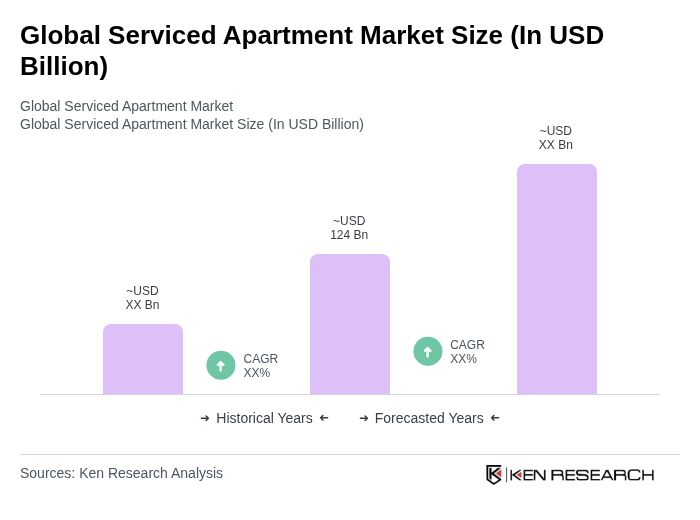
- The Global Serviced Apartment Market is valued at USD 124 billion, based on a five-year historical analysis. This growth is primarily driven by the increasing demand for flexible accommodation options among business and leisure travelers, the rise in remote work, digital nomadism, and the expansion of relocation for education and employment. The market has seen a significant shift towards longer stays, with serviced apartments offering amenities such as fully equipped kitchens, living spaces, and work areas that cater to both short-term and long-term residents. The sector is also benefiting from the trend of corporate relocations and the preference for home-like comfort during extended assignments, contributing to robust occupancy rates and revenue growth .
- Key players in this market include major cities such as London, New York, and Singapore, which dominate due to their status as global business hubs and tourist destinations. These cities offer a high concentration of serviced apartments that cater to diverse traveler needs, from corporate clients to families, thus driving demand and occupancy rates in the sector. The North American region holds the largest market share, while Asia Pacific is experiencing the fastest growth due to rapid urbanization and increasing expatriate populations .
- In 2023, the European Union implemented the Directive (EU) 2019/1937 on Health and Safety Standards for Tourist Accommodation, issued by the European Parliament and Council. This regulation mandates that all serviced apartments must comply with specific health, fire safety, and hygiene standards, including periodic inspections, staff training, and transparent guest information. The directive ensures a consistent level of service and security for guests, thereby enhancing consumer confidence in the market .
Global Serviced Apartment Market Segmentation
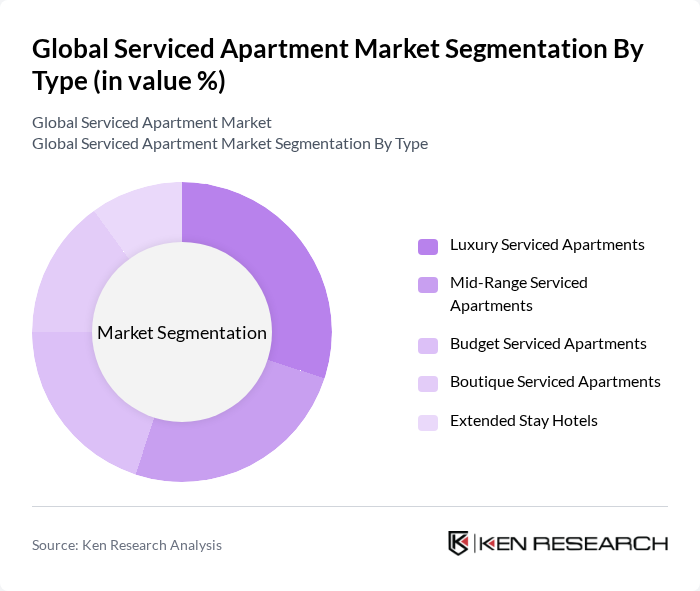
By Type:The serviced apartment market can be segmented into Luxury Serviced Apartments, Mid-Range Serviced Apartments, Budget Serviced Apartments, Boutique Serviced Apartments, and Extended Stay Hotels. Luxury serviced apartments are distinguished by premium amenities, personalized concierge services, and spacious layouts, catering to affluent travelers and corporate executives. Mid-range and budget serviced apartments focus on value, comfort, and essential facilities, appealing to cost-conscious travelers and longer-term residents. Boutique serviced apartments emphasize unique design and personalized experiences, while extended stay hotels offer flexible accommodation with hotel-like services for guests requiring stays of several weeks or months .
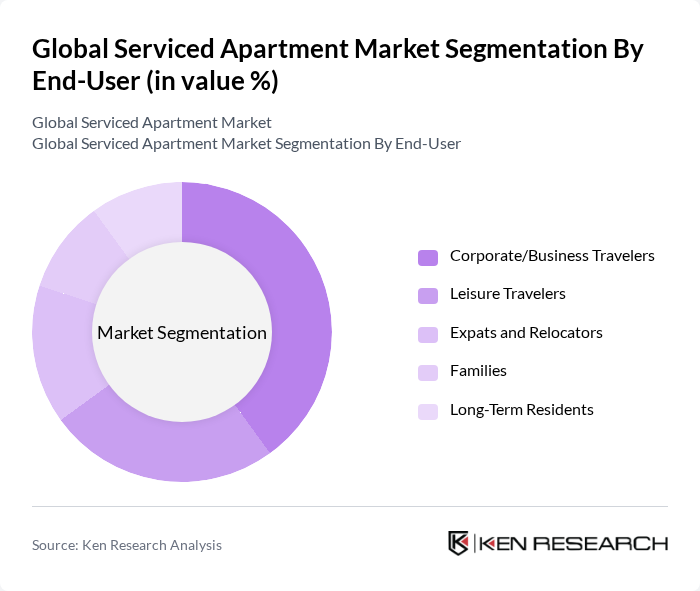
By End-User:The end-user segmentation includes Corporate/Business Travelers, Leisure Travelers, Expats and Relocators, Families, and Long-Term Residents. Corporate/business travelers represent the largest segment, driven by the need for flexible, cost-efficient accommodation during assignments and relocations. Leisure travelers seek serviced apartments for family vacations and group stays, valuing space and amenities. Expats and relocators prefer serviced apartments for extended transitions, while families and long-term residents are attracted by the home-like environment and comprehensive facilities .
Global Serviced Apartment Market Competitive Landscape
The Global Serviced Apartment Market is characterized by a dynamic mix of regional and international players. Leading participants such as Marriott International (Residences & Corporate Housing), The Ascott Limited, Oakwood Worldwide, Frasers Hospitality, Staybridge Suites (IHG), Adina Apartment Hotels, Hilton Worldwide (Temporary Housing), InterContinental Hotels Group (IHG), Residence Inn by Marriott, Quest Apartment Hotels, Saco Apartments, BridgeStreet Global Hospitality, The Student Hotel, Zoku, OYO Rooms contribute to innovation, geographic expansion, and service delivery in this space.
Global Serviced Apartment Market Industry Analysis
Growth Drivers
- Increasing Demand for Flexible Accommodation Options:The serviced apartment sector is experiencing a surge in demand, driven by the need for flexible living arrangements. In future, the global demand for flexible accommodation is projected to reach 1.5 million units, reflecting a 20% increase from the previous year. This trend is particularly evident in urban areas where transient populations seek short-term leases that offer the comforts of home, such as kitchens and living spaces, appealing to both leisure and business travelers.
- Rise in International Travel and Tourism:The World Tourism Organization reported that international tourist arrivals are expected to reach 1.8 billion in future, a significant rebound post-pandemic. This increase in travel is fueling the demand for serviced apartments, which provide a cost-effective alternative to hotels. With an estimated 30% of travelers preferring serviced apartments for their longer stays, the sector is well-positioned to capitalize on this growing market segment, particularly in major tourist destinations.
- Growth of the Corporate Housing Sector:The corporate housing market is projected to grow significantly, with an estimated value of $10 billion in future. This growth is driven by companies increasingly opting for serviced apartments to accommodate employees on business trips. The flexibility and amenities offered by serviced apartments align with corporate needs for cost-effective, comfortable, and convenient housing solutions, making them a preferred choice for extended stays.
Market Challenges
- Intense Competition from Traditional Hotels:The serviced apartment market faces stiff competition from traditional hotels, which are investing heavily in enhancing their offerings. In future, the hotel industry is expected to see a revenue increase of 5% to $200 billion, making it a formidable competitor. Many hotels are adapting by introducing apartment-style accommodations, which could dilute the unique value proposition of serviced apartments, challenging their market share.
- Regulatory Hurdles in Various Regions:Regulatory challenges pose significant barriers to the growth of serviced apartments. In future, cities like New York and San Francisco are tightening regulations on short-term rentals, with fines reaching up to $10,000 for non-compliance. These regulations can limit the availability of serviced apartments, making it difficult for operators to expand and meet the rising demand, ultimately impacting profitability and market growth.
Global Serviced Apartment Market Future Outlook
The future of the serviced apartment market appears promising, driven by evolving consumer preferences and technological advancements. As remote work continues to gain traction, the demand for flexible living arrangements is expected to rise. Additionally, the integration of smart technologies in serviced apartments will enhance guest experiences, making them more appealing. The market is likely to see increased investment in sustainability initiatives, aligning with global trends towards eco-friendly practices, which will further attract environmentally conscious travelers.
Market Opportunities
- Growth in Remote Work and Digital Nomadism:The rise of remote work is creating opportunities for serviced apartments to cater to digital nomads. In future, an estimated 30% of the workforce is expected to work remotely, increasing the demand for flexible living spaces that accommodate work and leisure. This trend presents a lucrative opportunity for serviced apartment operators to target this demographic with tailored offerings.
- Development of Smart Serviced Apartments:The integration of smart technologies in serviced apartments is a growing opportunity. By future, the smart home market is projected to reach $135 billion, indicating a strong consumer interest in tech-enabled living. Serviced apartments that incorporate smart features, such as automated lighting and climate control, can enhance guest experiences and differentiate themselves in a competitive market, attracting tech-savvy travelers.
Scope of the Report
| Segment | Sub-Segments |
|---|---|
| By Type | Luxury Serviced Apartments Mid-Range Serviced Apartments Budget Serviced Apartments Boutique Serviced Apartments Extended Stay Hotels |
| By End-User | Corporate/Business Travelers Leisure Travelers Expats and Relocators Families Long-Term Residents |
| By Length of Stay | Short-Term Stays (<30 nights) Medium-Term Stays (30-90 nights) Long-Term Stays (>90 nights) |
| By Location | Urban Areas Suburban Areas Near Airports Tourist Destinations |
| By Booking Channel | Direct Bookings Online Travel Agencies (OTAs) Corporate Contracts Travel Agents |
| By Management Type | On-Site Managed Serviced Apartments Off-Site Managed Serviced Apartments |
| By Geography | North America Europe Asia Pacific Latin America Middle East & Africa |
Key Target Audience
Investors and Venture Capitalist Firms
Government and Regulatory Bodies (e.g., Department of Housing and Urban Development, Ministry of Tourism)
Real Estate Developers
Property Management Companies
Travel and Hospitality Corporations
Tourism Boards
Insurance Companies
Financial Institutions
Players Mentioned in the Report:
Marriott International (Residences & Corporate Housing)
The Ascott Limited
Oakwood Worldwide
Frasers Hospitality
Staybridge Suites (IHG)
Adina Apartment Hotels
Hilton Worldwide (Temporary Housing)
InterContinental Hotels Group (IHG)
Residence Inn by Marriott
Quest Apartment Hotels
Saco Apartments
BridgeStreet Global Hospitality
The Student Hotel
Zoku
OYO Rooms
Table of Contents
Market Assessment Phase
1. Executive Summary and Approach
2. Global Serviced Apartment Market Overview
2.1 Key Insights and Strategic Recommendations
2.2 Global Serviced Apartment Market Overview
2.3 Definition and Scope
2.4 Evolution of Market Ecosystem
2.5 Timeline of Key Regulatory Milestones
2.6 Value Chain & Stakeholder Mapping
2.7 Business Cycle Analysis
2.8 Policy & Incentive Landscape
3. Global Serviced Apartment Market Analysis
3.1 Growth Drivers
3.1.1 Increasing demand for flexible accommodation options
3.1.2 Rise in international travel and tourism
3.1.3 Growth of the corporate housing sector
3.1.4 Expansion of urbanization and metropolitan areas
3.2 Market Challenges
3.2.1 Intense competition from traditional hotels
3.2.2 Regulatory hurdles in various regions
3.2.3 Fluctuations in global economic conditions
3.2.4 Changing consumer preferences and expectations
3.3 Market Opportunities
3.3.1 Growth in remote work and digital nomadism
3.3.2 Development of smart serviced apartments
3.3.3 Partnerships with travel and relocation services
3.3.4 Expansion into emerging markets
3.4 Market Trends
3.4.1 Increasing focus on sustainability and eco-friendly practices
3.4.2 Integration of technology in guest services
3.4.3 Customization of guest experiences
3.4.4 Rise of hybrid accommodation models
3.5 Government Regulation
3.5.1 Zoning laws affecting serviced apartment developments
3.5.2 Licensing requirements for operators
3.5.3 Health and safety regulations
3.5.4 Taxation policies impacting short-term rentals
4. SWOT Analysis
5. Stakeholder Analysis
6. Porter's Five Forces Analysis
7. Global Serviced Apartment Market Market Size, 2019-2024
7.1 By Value
7.2 By Volume
7.3 By Average Selling Price
8. Global Serviced Apartment Market Segmentation
8.1 By Type
8.1.1 Luxury Serviced Apartments
8.1.2 Mid-Range Serviced Apartments
8.1.3 Budget Serviced Apartments
8.1.4 Boutique Serviced Apartments
8.1.5 Extended Stay Hotels
8.2 By End-User
8.2.1 Corporate/Business Travelers
8.2.2 Leisure Travelers
8.2.3 Expats and Relocators
8.2.4 Families
8.2.5 Long-Term Residents
8.3 By Length of Stay
8.3.1 Short-Term Stays (<30 nights)
8.3.2 Medium-Term Stays (30-90 nights)
8.3.3 Long-Term Stays (>90 nights)
8.4 By Location
8.4.1 Urban Areas
8.4.2 Suburban Areas
8.4.3 Near Airports
8.4.4 Tourist Destinations
8.5 By Booking Channel
8.5.1 Direct Bookings
8.5.2 Online Travel Agencies (OTAs)
8.5.3 Corporate Contracts
8.5.4 Travel Agents
8.6 By Management Type
8.6.1 On-Site Managed Serviced Apartments
8.6.2 Off-Site Managed Serviced Apartments
8.7 By Geography
8.7.1 North America
8.7.2 Europe
8.7.3 Asia Pacific
8.7.4 Latin America
8.7.5 Middle East & Africa
9. Global Serviced Apartment Market Competitive Analysis
9.1 Market Share of Key Players
9.2 Cross Comparison of Key Players
9.2.1 Company Name
9.2.2 Company Size (Large, Medium, or Small)
9.2.3 Geographic Presence (Number of Countries)
9.2.4 Portfolio Size (Number of Units)
9.2.5 Occupancy Rate (%)
9.2.6 Average Daily Rate (ADR)
9.2.7 Revenue Per Available Room (RevPAR)
9.2.8 Customer Satisfaction Score (NPS/Rating)
9.2.9 Market Penetration Rate (%)
9.2.10 Year-on-Year Growth Rate (%)
9.3 SWOT Analysis of Top Players
9.4 Pricing Analysis
9.5 Detailed Profile of Major Companies
9.5.1 Marriott International (Residences & Corporate Housing)
9.5.2 The Ascott Limited
9.5.3 Oakwood Worldwide
9.5.4 Frasers Hospitality
9.5.5 Staybridge Suites (IHG)
9.5.6 Adina Apartment Hotels
9.5.7 Hilton Worldwide (Temporary Housing)
9.5.8 InterContinental Hotels Group (IHG)
9.5.9 Residence Inn by Marriott
9.5.10 Quest Apartment Hotels
9.5.11 Saco Apartments
9.5.12 BridgeStreet Global Hospitality
9.5.13 The Student Hotel
9.5.14 Zoku
9.5.15 OYO Rooms
10. Global Serviced Apartment Market End-User Analysis
10.1 Corporate Procurement Behavior
10.1.1 Corporate Travel Policies
10.1.2 Budget Allocations for Temporary Housing
10.1.3 Preferred Accommodation Providers
10.1.4 Compliance with Local Regulations
10.1.5 Long-Term Assignment Requirements
10.2 Corporate Spend on Relocation & Housing
10.2.1 Corporate Travel Budgets
10.2.2 Investment in Employee Relocation
10.2.3 Spending on Long-Term Accommodations
10.2.4 Expatriate Housing Programs
10.3 Pain Point Analysis by End-User Category
10.3.1 Cost Management and Budget Optimization
10.3.2 Quality of Service and Consistency
10.3.3 Availability of Amenities and Flexibility
10.3.4 Booking Flexibility and Cancellation Policies
10.3.5 Location and Accessibility
10.4 User Readiness for Adoption
10.4.1 Awareness of Serviced Apartments
10.4.2 Perceived Value vs. Cost
10.4.3 Experience with Similar Accommodations
10.4.4 Digital Adoption and Online Booking Comfort
10.5 Post-Deployment ROI and Use Case Expansion
10.5.1 Measurement of Cost Savings
10.5.2 User Satisfaction Surveys and Feedback
10.5.3 Expansion into New Markets and Geographies
10.5.4 Repeat Booking Rates and Customer Retention
11. Global Serviced Apartment Market Future Size, 2025-2034
11.1 By Value
11.2 By Volume
11.3 By Average Selling Price
Go-To-Market Strategy Phase
1. Whitespace Analysis + Business Model Canvas
1.1 Market Gaps Identification
1.2 Value Proposition Development
1.3 Revenue Streams Analysis
1.4 Cost Structure Evaluation
1.5 Key Partnerships Exploration
1.6 Customer Segmentation
1.7 Channels of Distribution
2. Marketing and Positioning Recommendations
2.1 Branding Strategies
2.2 Product USPs
3. Distribution Plan
3.1 Urban Retail vs Rural NGO Tie-ups
4. Channel & Pricing Gaps
4.1 Underserved Routes
4.2 Pricing Bands
5. Unmet Demand & Latent Needs
5.1 Category Gaps
5.2 Consumer Segments
6. Customer Relationship
6.1 Loyalty Programs
6.2 After-Sales Service
7. Value Proposition
7.1 Sustainability
7.2 Integrated Supply Chains
8. Key Activities
8.1 Regulatory Compliance
8.2 Branding
8.3 Distribution Setup
9. Entry Strategy Evaluation
9.1 Domestic Market Entry Strategy
9.1.1 Product Mix
9.1.2 Pricing Band
9.1.3 Packaging
9.2 Export Entry Strategy
9.2.1 Target Countries
9.2.2 Compliance Roadmap
10. Entry Mode Assessment
10.1 JV
10.2 Greenfield
10.3 M&A
10.4 Distributor Model
11. Capital and Timeline Estimation
11.1 Capital Requirements
11.2 Timelines
12. Control vs Risk Trade-Off
12.1 Ownership vs Partnerships
13. Profitability Outlook
13.1 Breakeven Analysis
13.2 Long-Term Sustainability
14. Potential Partner List
14.1 Distributors
14.2 JVs
14.3 Acquisition Targets
15. Execution Roadmap
15.1 Phased Plan for Market Entry
15.1.1 Market Setup
15.1.2 Market Entry
15.1.3 Growth Acceleration
15.1.4 Scale & Stabilize
15.2 Key Activities and Milestones
15.2.1 Milestone
Research Methodology
Phase 1: Approach1
Desk Research
- Industry reports from global real estate and hospitality associations
- Market analysis from government tourism boards and economic development agencies
- Published articles and white papers on serviced apartment trends and consumer preferences
Primary Research
- Interviews with property managers and operators of serviced apartments
- Surveys targeting business travelers and expatriates regarding accommodation preferences
- Focus groups with corporate travel managers to understand booking behaviors
Validation & Triangulation
- Cross-validation of data from multiple sources including industry reports and expert interviews
- Triangulation of market size estimates using occupancy rates and average daily rates
- Sanity checks through feedback from industry experts and stakeholders
Phase 2: Market Size Estimation1
Top-down Assessment
- Analysis of global tourism growth rates and their impact on serviced apartment demand
- Segmentation of the market by geographic regions and customer demographics
- Incorporation of macroeconomic indicators such as GDP growth and urbanization trends
Bottom-up Modeling
- Data collection on the number of serviced apartments and average occupancy rates
- Revenue estimates based on average daily rates and length of stay
- Calculation of total market size by aggregating revenue from various regions
Forecasting & Scenario Analysis
- Multi-variable forecasting models incorporating economic indicators and travel trends
- Scenario analysis based on potential impacts of global events on travel behavior
- Development of baseline, optimistic, and pessimistic market growth projections through 2030
Phase 3: CATI Sample Composition1
| Scope Item/Segment | Sample Size | Target Respondent Profiles |
|---|---|---|
| Business Traveler Preferences | 120 | Frequent Business Travelers, Corporate Travel Managers |
| Expatriate Accommodation Choices | 100 | Expatriates, Relocation Consultants |
| Market Trends in Urban Areas | 80 | Real Estate Analysts, Urban Planners |
| Corporate Housing Demand | 70 | HR Managers, Corporate Housing Providers |
| Consumer Preferences for Amenities | 90 | Travel Enthusiasts, Hospitality Experts |
Frequently Asked Questions
What is the current value of the Global Serviced Apartment Market?
The Global Serviced Apartment Market is valued at approximately USD 124 billion, reflecting a significant growth trend driven by increasing demand for flexible accommodation options among both business and leisure travelers.
What factors are driving the growth of the serviced apartment market?
Which regions are leading in the serviced apartment market?
What types of serviced apartments are available in the market?
Other Regional/Country Reports
Other Adjacent Reports
Oman Corporate Housing Market
Japan Extended Stay Accommodation Market
Egypt Short-Term Rental Market
Bahrain Real Estate Investment Market
Belgium Tourism Accommodation Market
Thailand Relocation Services Market
KSA Property Management Market Outlook to 2030Philippines Hospitality Technology Market
Why Buy From Us?

What makes us stand out is that our consultants follow Robust, Refine and Result (RRR) methodology. Robust for clear definitions, approaches and sanity checking, Refine for differentiating respondents' facts and opinions, and Result for presenting data with story.

We have set a benchmark in the industry by offering our clients with syndicated and customized market research reports featuring coverage of entire market as well as meticulous research and analyst insights.

While we don't replace traditional research, we flip the method upside down. Our dual approach of Top Bottom & Bottom Top ensures quality deliverable by not just verifying company fundamentals but also looking at the sector and macroeconomic factors.

With one step in the future, our research team constantly tries to show you the bigger picture. We help with some of the tough questions you may encounter along the way: How is the industry positioned? Best marketing channel? KPI's of competitors? By aligning every element, we help maximize success.

Our report gives you instant access to the answers and sources that other companies might choose to hide. We elaborate each steps of research methodology we have used and showcase you the sample size to earn your trust.

If you need any support, we are here! We pride ourselves on universe strength, data quality, and quick, friendly, and professional service.