About the Report
Base Year 2024Global Spectator Sports Market Overview
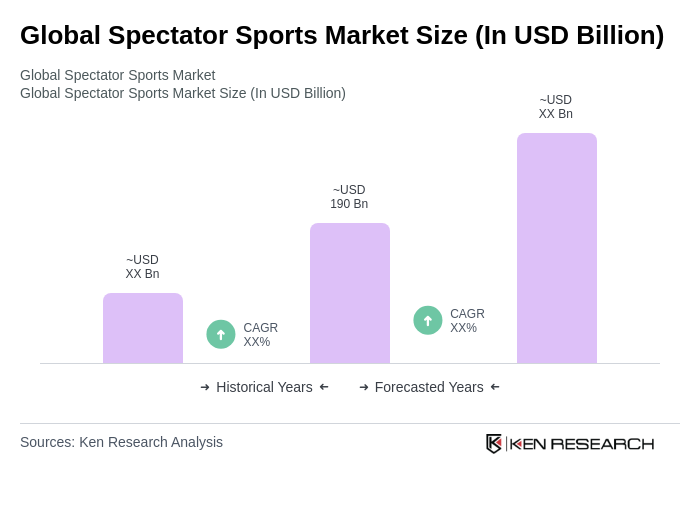
- The Global Spectator Sports Market is valued at USD 190 billion, based on a five-year historical analysis. This valuation aligns with multiple industry trackers that place the market near the high one-hundred billions, reflecting steady growth supported by rising media-rights revenues, sponsorship, and live event recovery .
- Countries such as the United States, China, and the United Kingdom lead the Global Spectator Sports Market due to mature leagues, significant media-rights ecosystems, and large fan bases. The United States accounts for a major share with top-tier leagues (NFL, NBA, MLB), while China’s market continues expanding, and the UK anchors Europe through the Premier League and other marquee events .
- There is no European Union regulation in 2023 mandating public disclosure of all sports sponsorship agreements exceeding EUR 1 million. EU-level sports policy has focused on competition law, integrity, and transparency principles, but no bloc-wide disclosure threshold of this nature has been enacted; sponsorship disclosure obligations vary by member-state and by sectoral rules (e.g., gambling, alcohol) rather than a single EU-wide threshold .
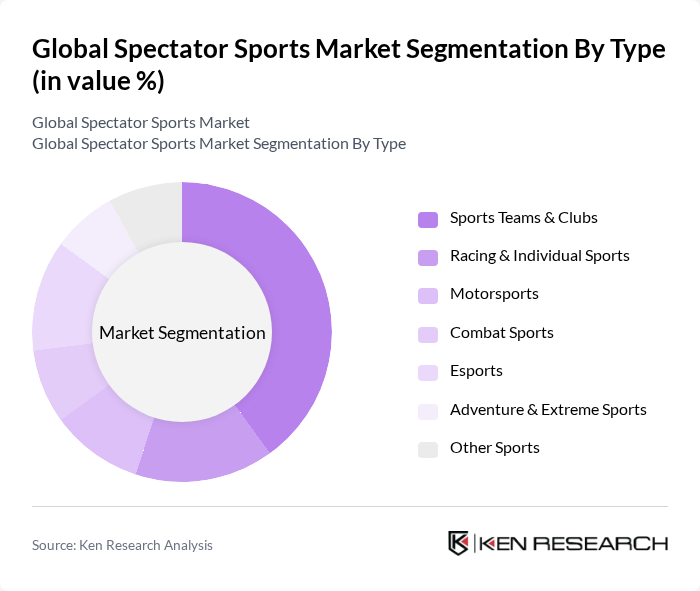
Global Spectator Sports Market Segmentation
By Type:The market is segmented into various types, including Sports Teams & Clubs, Racing & Individual Sports, Motorsports, Combat Sports, Esports, Adventure & Extreme Sports, and Other Sports. Each of these segments caters to different audiences and has unique revenue models. Sports Teams & Clubs dominate the market given their scale in media rights, sponsorships, and ticketing across major leagues. Esports continues to gain traction with younger and digitally native audiences, supported by streaming platforms and brand partnerships .
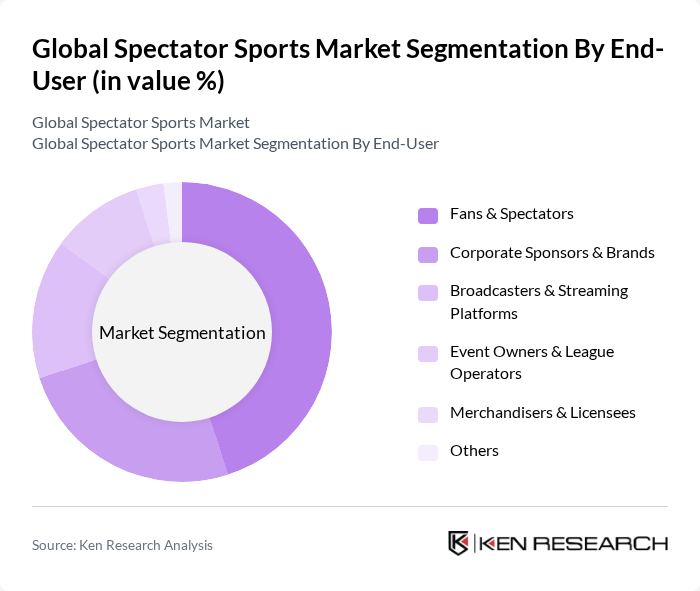
By End-User:The market is segmented by end-users, including Fans & Spectators, Corporate Sponsors & Brands, Broadcasters & Streaming Platforms, Event Owners & League Operators, Merchandisers & Licensees, and Others. Fans & Spectators represent the largest segment, led by spending on tickets, subscriptions, and merchandise. Corporate sponsors continue to increase allocations to sports for global reach and targeted engagement, while broadcasters and streaming platforms drive value via escalating media-rights competition and new digital distribution models .
Global Spectator Sports Market Competitive Landscape
The Global Spectator Sports Market is characterized by a dynamic mix of regional and international players. Leading participants such as Fédération Internationale de Football Association (FIFA), Union of European Football Associations (UEFA), National Football League (NFL), National Basketball Association (NBA), Major League Baseball (MLB), International Cricket Council (ICC), National Hockey League (NHL), Formula One Group (F1), World Wrestling Entertainment (WWE), DFL Deutsche Fußball Liga GmbH (Bundesliga), LaLiga Group International, The Football Association Premier League Limited, Major League Soccer (MLS), Association of Tennis Professionals (ATP), Women’s Tennis Association (WTA) contribute to innovation, geographic expansion, and service delivery in this space .
Global Spectator Sports Market Industry Analysis
Growth Drivers
- Increasing Global Participation in Sports:The global sports participation rate has surged, with over 3.5 billion individuals engaging in various sports activities as of in future. This increase is driven by a growing emphasis on health and fitness, with the World Health Organization reporting that physical inactivity costs economies approximately $54 billion annually. As more people participate, the demand for spectator sports rises, leading to increased attendance and viewership, thus boosting revenues for sports organizations.
- Rise of Digital Streaming Platforms:The digital streaming market for sports has expanded significantly, with revenues projected to reach $30 billion in future. Major platforms like ESPN+ and DAZN have reported subscriber growth rates exceeding 20% annually. This shift towards online consumption allows fans to access live events conveniently, increasing overall viewership and engagement. Consequently, sports leagues are capitalizing on this trend by securing lucrative broadcasting deals, enhancing their financial stability and market reach.
- Enhanced Fan Engagement through Technology:Technological advancements have transformed fan engagement, with 75% of sports organizations investing in digital tools by in future. Innovations such as mobile apps, virtual reality experiences, and interactive social media campaigns have significantly improved fan interaction. For instance, the use of augmented reality in stadiums has increased fan satisfaction scores by 40%. This enhanced engagement not only drives ticket sales but also boosts merchandise sales, contributing to overall market growth.
Market Challenges
- Economic Downturns Affecting Attendance:Economic fluctuations pose a significant challenge to spectator sports, with attendance rates declining by 15% during economic recessions. The International Monetary Fund forecasts a global GDP growth of only 2.5% in future, which may lead to reduced disposable income for consumers. Consequently, families may prioritize essential expenses over entertainment, resulting in lower ticket sales and diminished revenues for sports organizations, impacting their financial health.
- Regulatory Restrictions on Events:Regulatory challenges, including restrictions on event capacities and safety protocols, have become increasingly prevalent. For instance, in future, many countries are enforcing limits on crowd sizes due to ongoing health concerns, which can reduce attendance by up to 30%. These regulations not only affect immediate ticket sales but also hinder long-term planning for events, creating uncertainty for sports organizations and their financial forecasts.
Global Spectator Sports Market Future Outlook
The future of the spectator sports market appears promising, driven by technological innovations and a growing global audience. As digital platforms continue to evolve, they will likely enhance accessibility and engagement, attracting younger demographics. Furthermore, the increasing focus on sustainability in sports events will resonate with environmentally conscious fans, potentially leading to new revenue streams. Overall, the market is poised for growth, adapting to changing consumer preferences and leveraging technology to enhance the spectator experience.
Market Opportunities
- Expansion into Emerging Markets:Emerging markets, particularly in Asia and Africa, present significant growth opportunities, with sports viewership expected to increase by 25% by in future. Investments in local sports infrastructure and grassroots programs can tap into this potential, fostering a new generation of fans and participants, ultimately driving revenue growth for leagues and teams.
- Development of Esports as a Spectator Sport:The esports sector is projected to generate $1.5 billion in revenue by in future, with viewership surpassing traditional sports in some demographics. By integrating esports into traditional sports events and creating hybrid experiences, organizations can attract a diverse audience, enhancing overall market engagement and revenue potential.
Scope of the Report
| Segment | Sub-Segments |
|---|---|
| By Type | Sports Teams & Clubs Racing & Individual Sports Motorsports Combat Sports Esports Adventure & Extreme Sports Other Sports |
| By End-User | Fans & Spectators Corporate Sponsors & Brands Broadcasters & Streaming Platforms Event Owners & League Operators Merchandisers & Licensees Others |
| By Distribution Channel | OTT/Digital Streaming Platforms Linear TV/Pay-TV Networks Online Ticketing Platforms Venue Box Office/Direct Sales Mobile Applications Others |
| By Event Type | Domestic Leagues & Seasons International Events & Tours Championships & Finals Tournaments & Cups Others |
| By Audience Engagement Method | In-Stadium Live Attendance Virtual/Remote Viewing Hybrid (In-Person + Digital) Interactive Social/Second-Screen Platforms Others |
| By Sponsorship Type | Team & League Sponsorship Event & Venue Sponsorship (Naming Rights) Media & Broadcast Sponsorship Athlete/Influencer Endorsements Others |
| By Revenue Model | Ticket Sales & Matchday Merchandising & Licensing Media Rights Sponsorship & Advertising Other Ancillary Revenues |
Key Target Audience
Investors and Venture Capitalist Firms
Government and Regulatory Bodies (e.g., International Olympic Committee, National Football League, Federal Trade Commission)
Sports Teams and Franchises
Event Organizers and Promoters
Broadcasting Networks and Media Companies
Sponsors and Brand Partners
Stadium and Venue Operators
Sports Marketing Agencies
Players Mentioned in the Report:
Federation Internationale de Football Association (FIFA)
Union of European Football Associations (UEFA)
National Football League (NFL)
National Basketball Association (NBA)
Major League Baseball (MLB)
International Cricket Council (ICC)
National Hockey League (NHL)
Formula One Group (F1)
World Wrestling Entertainment (WWE)
DFL Deutsche Fuball Liga GmbH (Bundesliga)
LaLiga Group International
The Football Association Premier League Limited
Major League Soccer (MLS)
Association of Tennis Professionals (ATP)
Womens Tennis Association (WTA)
Table of Contents
Market Assessment Phase
1. Executive Summary and Approach
2. Global Spectator Sports Market Overview
2.1 Key Insights and Strategic Recommendations
2.2 Global Spectator Sports Market Overview
2.3 Definition and Scope
2.4 Evolution of Market Ecosystem
2.5 Timeline of Key Regulatory Milestones
2.6 Value Chain & Stakeholder Mapping
2.7 Business Cycle Analysis
2.8 Policy & Incentive Landscape
3. Global Spectator Sports Market Analysis
3.1 Growth Drivers
3.1.1 Increasing Global Participation in Sports
3.1.2 Rise of Digital Streaming Platforms
3.1.3 Enhanced Fan Engagement through Technology
3.1.4 Growth in Sponsorship and Advertising Revenues
3.2 Market Challenges
3.2.1 Economic Downturns Affecting Attendance
3.2.2 Regulatory Restrictions on Events
3.2.3 Competition from Alternative Entertainment
3.2.4 Safety and Security Concerns at Events
3.3 Market Opportunities
3.3.1 Expansion into Emerging Markets
3.3.2 Development of Esports as a Spectator Sport
3.3.3 Innovative Fan Experience Solutions
3.3.4 Partnerships with Technology Companies
3.4 Market Trends
3.4.1 Increasing Use of Augmented Reality in Events
3.4.2 Growth of Mobile Ticketing Solutions
3.4.3 Focus on Sustainability in Sports Events
3.4.4 Rise of Women’s Sports Viewership
3.5 Government Regulation
3.5.1 Regulations on Sponsorship Deals
3.5.2 Safety Regulations for Spectator Events
3.5.3 Tax Incentives for Sports Development
3.5.4 Broadcasting Rights Regulations
4. SWOT Analysis
5. Stakeholder Analysis
6. Porter's Five Forces Analysis
7. Global Spectator Sports Market Market Size, 2019-2024
7.1 By Value
7.2 By Volume
7.3 By Average Selling Price
8. Global Spectator Sports Market Segmentation
8.1 By Type
8.1.1 Sports Teams & Clubs
8.1.2 Racing & Individual Sports
8.1.3 Motorsports
8.1.4 Combat Sports
8.1.5 Esports
8.1.6 Adventure & Extreme Sports
8.1.7 Other Sports
8.2 By End-User
8.2.1 Fans & Spectators
8.2.2 Corporate Sponsors & Brands
8.2.3 Broadcasters & Streaming Platforms
8.2.4 Event Owners & League Operators
8.2.5 Merchandisers & Licensees
8.2.6 Others
8.3 By Distribution Channel
8.3.1 OTT/Digital Streaming Platforms
8.3.2 Linear TV/Pay-TV Networks
8.3.3 Online Ticketing Platforms
8.3.4 Venue Box Office/Direct Sales
8.3.5 Mobile Applications
8.3.6 Others
8.4 By Event Type
8.4.1 Domestic Leagues & Seasons
8.4.2 International Events & Tours
8.4.3 Championships & Finals
8.4.4 Tournaments & Cups
8.4.5 Others
8.5 By Audience Engagement Method
8.5.1 In-Stadium Live Attendance
8.5.2 Virtual/Remote Viewing
8.5.3 Hybrid (In-Person + Digital)
8.5.4 Interactive Social/Second-Screen Platforms
8.5.5 Others
8.6 By Sponsorship Type
8.6.1 Team & League Sponsorship
8.6.2 Event & Venue Sponsorship (Naming Rights)
8.6.3 Media & Broadcast Sponsorship
8.6.4 Athlete/Influencer Endorsements
8.6.5 Others
8.7 By Revenue Model
8.7.1 Ticket Sales & Matchday
8.7.2 Merchandising & Licensing
8.7.3 Media Rights
8.7.4 Sponsorship & Advertising
8.7.5 Other Ancillary Revenues
9. Global Spectator Sports Market Competitive Analysis
9.1 Market Share of Key Players
9.2 Cross Comparison of Key Players
9.2.1 Organization/League
9.2.2 Scale Tier (Global, Regional, National)
9.2.3 Total Commercial Revenue (USD) and YoY Growth
9.2.4 Media Rights Value and Reach (TV households/OTT subs)
9.2.5 Average Attendance per Event and Stadium Utilization
9.2.6 Global Fan Base Size/Social Followers
9.2.7 Sponsorship Revenue and Top Categories
9.2.8 Average Ticket Yield and Matchday Revenue
9.2.9 Digital Engagement (MAUs, watch time, ARPU)
9.2.10 Internationalization Metrics (markets/events outside home)
9.3 SWOT Analysis of Top Players
9.4 Pricing Analysis
9.5 Detailed Profile of Major Companies
9.5.1 Fédération Internationale de Football Association (FIFA)
9.5.2 Union of European Football Associations (UEFA)
9.5.3 National Football League (NFL)
9.5.4 National Basketball Association (NBA)
9.5.5 Major League Baseball (MLB)
9.5.6 International Cricket Council (ICC)
9.5.7 National Hockey League (NHL)
9.5.8 Formula One Group (F1)
9.5.9 World Wrestling Entertainment (WWE)
9.5.10 DFL Deutsche Fußball Liga GmbH (Bundesliga)
9.5.11 LaLiga Group International
9.5.12 The Football Association Premier League Limited
9.5.13 Major League Soccer (MLS)
9.5.14 Association of Tennis Professionals (ATP)
9.5.15 Women’s Tennis Association (WTA)
10. Global Spectator Sports Market End-User Analysis
10.1 Procurement Behavior of Key Ministries
10.1.1 Government Funding for Sports
10.1.2 Public-Private Partnerships in Sports
10.1.3 Infrastructure Development Initiatives
10.2 Corporate Spend on Infrastructure & Energy
10.2.1 Investment in Stadium Facilities
10.2.2 Sponsorship Deals with Corporates
10.2.3 Energy Efficiency Initiatives
10.3 Pain Point Analysis by End-User Category
10.3.1 Fan Experience Challenges
10.3.2 Sponsorship ROI Concerns
10.3.3 Regulatory Compliance Issues
10.4 User Readiness for Adoption
10.4.1 Technology Adoption in Sports
10.4.2 Fan Engagement Readiness
10.5 Post-Deployment ROI and Use Case Expansion
10.5.1 Measuring Event Success
10.5.2 Expanding Digital Offerings
11. Global Spectator Sports Market Future Size, 2025-2030
11.1 By Value
11.2 By Volume
11.3 By Average Selling Price
Go-To-Market Strategy Phase
1. Whitespace Analysis + Business Model Canvas
1.1 Market Gaps Identification
1.2 Business Model Development
2. Marketing and Positioning Recommendations
2.1 Branding Strategies
2.2 Product USPs
3. Distribution Plan
3.1 Urban Retail Strategies
3.2 Rural NGO Tie-ups
4. Channel & Pricing Gaps
4.1 Underserved Routes
4.2 Pricing Bands Analysis
5. Unmet Demand & Latent Needs
5.1 Category Gaps
5.2 Consumer Segments
6. Customer Relationship
6.1 Loyalty Programs
6.2 After-sales Service
7. Value Proposition
7.1 Sustainability Initiatives
7.2 Integrated Supply Chains
8. Key Activities
8.1 Regulatory Compliance
8.2 Branding Efforts
8.3 Distribution Setup
9. Entry Strategy Evaluation
9.1 Domestic Market Entry Strategy
9.1.1 Product Mix Considerations
9.1.2 Pricing Band Strategy
9.1.3 Packaging Approaches
9.2 Export Entry Strategy
9.2.1 Target Countries
9.2.2 Compliance Roadmap
10. Entry Mode Assessment
10.1 Joint Ventures
10.2 Greenfield Investments
10.3 Mergers & Acquisitions
10.4 Distributor Model
11. Capital and Timeline Estimation
11.1 Capital Requirements
11.2 Timelines for Implementation
12. Control vs Risk Trade-Off
12.1 Ownership vs Partnerships
13. Profitability Outlook
13.1 Breakeven Analysis
13.2 Long-term Sustainability
14. Potential Partner List
14.1 Distributors
14.2 Joint Ventures
14.3 Acquisition Targets
15. Execution Roadmap
15.1 Phased Plan for Market Entry
15.1.1 Market Setup
15.1.2 Market Entry
15.1.3 Growth Acceleration
15.1.4 Scale & Stabilize
15.2 Key Activities and Milestones
15.2.1 Milestone Planning
Research Methodology
Phase 1: Approach1
Desk Research
- Analysis of industry reports from sports governing bodies and market research firms
- Review of financial statements and annual reports from major spectator sports organizations
- Examination of demographic and economic data from government databases and sports analytics platforms
Primary Research
- Interviews with executives from leading sports franchises and event organizers
- Surveys targeting fans and attendees at major sporting events
- Focus groups with sports marketing professionals and sponsorship managers
Validation & Triangulation
- Cross-validation of findings through multiple data sources, including ticket sales and viewership statistics
- Triangulation of insights from primary interviews with secondary data trends
- Sanity checks conducted through expert panels comprising sports economists and analysts
Phase 2: Market Size Estimation1
Top-down Assessment
- Estimation of total market size based on global sports revenue reports and attendance figures
- Segmentation by sport type, geographic region, and revenue streams (e.g., ticket sales, broadcasting rights)
- Incorporation of growth trends influenced by emerging markets and digital engagement
Bottom-up Modeling
- Collection of data on ticket sales and merchandise revenue from major sporting events
- Estimation of sponsorship revenue based on historical data and current market conditions
- Analysis of ancillary revenue streams, including concessions and hospitality services
Forecasting & Scenario Analysis
- Multi-variable forecasting using historical growth rates and market trends
- Scenario analysis based on potential impacts of economic fluctuations and global events (e.g., pandemics)
- Development of baseline, optimistic, and pessimistic forecasts through 2030
Phase 3: CATI Sample Composition1
| Scope Item/Segment | Sample Size | Target Respondent Profiles |
|---|---|---|
| Professional Sports Franchises | 100 | Team Owners, General Managers |
| Event Organizers | 80 | Event Coordinators, Marketing Directors |
| Broadcasting Networks | 60 | Content Acquisition Managers, Sports Analysts |
| Sports Sponsorship Agencies | 70 | Sponsorship Managers, Brand Strategists |
| Fan Engagement Platforms | 90 | Product Managers, User Experience Designers |
Frequently Asked Questions
What is the current valuation of the Global Spectator Sports Market?
The Global Spectator Sports Market is valued at approximately USD 190 billion, reflecting steady growth driven by increasing media-rights revenues, sponsorships, and the recovery of live events following disruptions in recent years.
Which countries lead the Global Spectator Sports Market?
What are the main segments of the Global Spectator Sports Market?
How has digital streaming impacted the spectator sports market?
Other Regional/Country Reports
Indonesia Spectator Sports Market
Malaysia Spectator Sports Market
Why Buy From Us?

What makes us stand out is that our consultants follow Robust, Refine and Result (RRR) methodology. Robust for clear definitions, approaches and sanity checking, Refine for differentiating respondents' facts and opinions, and Result for presenting data with story.

We have set a benchmark in the industry by offering our clients with syndicated and customized market research reports featuring coverage of entire market as well as meticulous research and analyst insights.

While we don't replace traditional research, we flip the method upside down. Our dual approach of Top Bottom & Bottom Top ensures quality deliverable by not just verifying company fundamentals but also looking at the sector and macroeconomic factors.

With one step in the future, our research team constantly tries to show you the bigger picture. We help with some of the tough questions you may encounter along the way: How is the industry positioned? Best marketing channel? KPI's of competitors? By aligning every element, we help maximize success.

Our report gives you instant access to the answers and sources that other companies might choose to hide. We elaborate each steps of research methodology we have used and showcase you the sample size to earn your trust.

If you need any support, we are here! We pride ourselves on universe strength, data quality, and quick, friendly, and professional service.