About the Report
Base Year 2024United States Of America Spectator Sports Market Overview
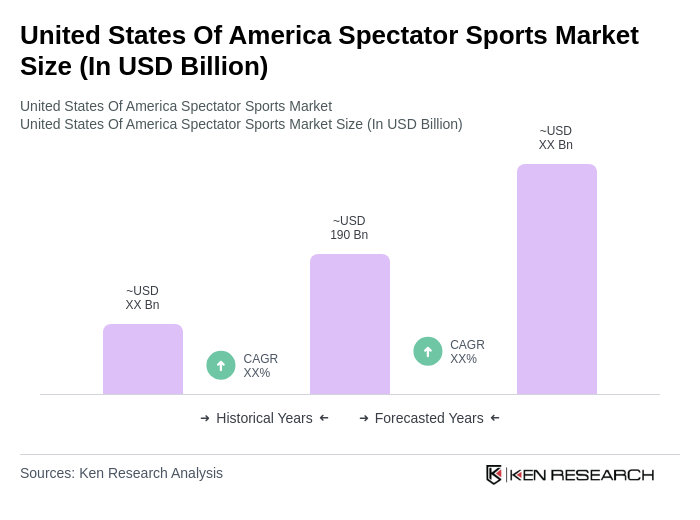
- The United States of America Spectator Sports Market is valued at approximately USD 190 billion, based on a five-year historical analysis, aligning with industry aggregates for spectator sports within the broader U.S. performing arts and spectator sports sector and recent market tallies for spectator sports globally scaled to the U.S. market context. This growth is primarily driven by the increasing popularity of professional sports leagues, significant media rights deals, and a surge in consumer spending on live events and merchandise. The market has seen a robust recovery post-pandemic, with fans returning to stadiums and arenas, contributing to the overall market expansion.
- Key players in this market include major cities such as New York, Los Angeles, and Chicago, which dominate due to their large populations, extensive sports infrastructure, and the presence of multiple professional teams across various sports. These cities not only host significant sporting events but also attract substantial sponsorship and media deals, further solidifying their positions as leaders in the spectator sports market.
- In 2023, the U.S. government implemented regulations to enhance the safety and security of sporting events, mandating stricter crowd control measures and emergency response protocols, with venues and leagues advancing smart?stadium technologies, security screening, and incident response planning to support safe fan experiences. This initiative aims to ensure a safe environment for fans and participants, thereby boosting attendance and overall market confidence in live sporting events.
United States Of America Spectator Sports Market Segmentation
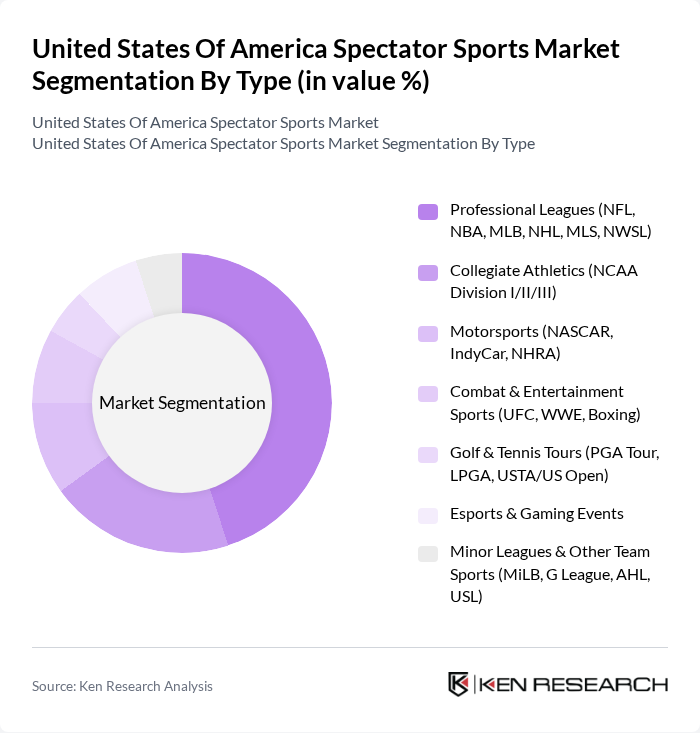
By Type:The market is segmented into various types, including professional leagues, collegiate athletics, motorsports, combat and entertainment sports, golf and tennis tours, esports and gaming events, and minor leagues and other team sports. Among these, professional leagues dominate the market due to their extensive fan base, lucrative broadcasting rights, and significant sponsorship deals. The NFL, NBA, and MLB are particularly influential, driving substantial revenue through ticket sales, merchandise, and media rights.
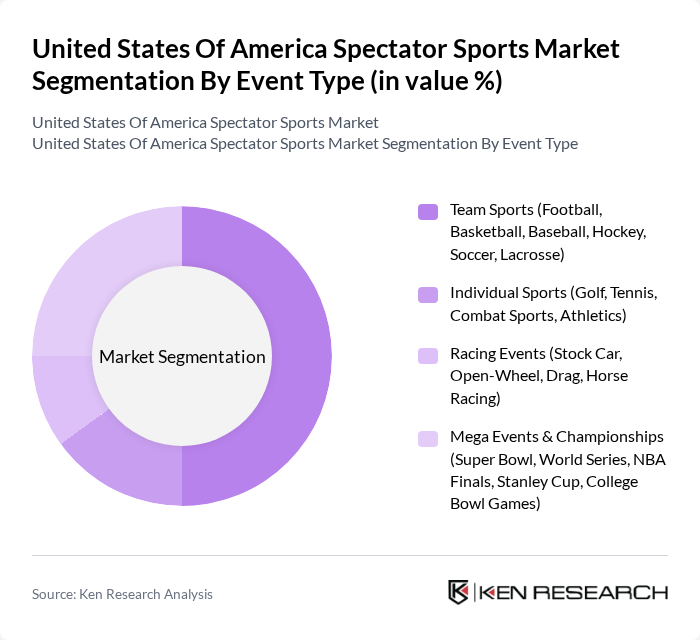
By Event Type:The market is further segmented by event type, including team sports, individual sports, racing events, and mega events and championships. Team sports, particularly football, basketball, and baseball, dominate the market due to their widespread popularity and large-scale events like the Super Bowl and World Series. These events attract massive audiences both in-person and through media, significantly contributing to the overall market revenue.
United States Of America Spectator Sports Market Competitive Landscape
The United States Of America Spectator Sports Market is characterized by a dynamic mix of regional and international players. Leading participants such as National Football League (NFL), National Basketball Association (NBA), Major League Baseball (MLB), National Hockey League (NHL), Major League Soccer (MLS), National Women’s Soccer League (NWSL), PGA Tour, Ultimate Fighting Championship (UFC), World Wrestling Entertainment (WWE), National Association for Stock Car Auto Racing (NASCAR), IndyCar Series (INDYCAR / Penske Entertainment), United States Tennis Association (USTA) – US Open, Live Nation Entertainment, Anschutz Entertainment Group (AEG), Ticketmaster (Live Nation), StubHub, SeatGeek, Fanatics, DraftKings, ESPN (The Walt Disney Company) & ESPN+ contribute to innovation, geographic expansion, and service delivery in this space.
United States Of America Spectator Sports Market Industry Analysis
Growth Drivers
- Increasing Popularity of Live Sports Events:The attendance at live sports events in the U.S. reached approximately 110 million in future, reflecting a growing enthusiasm for in-person experiences. Major leagues like the NFL and NBA reported record attendance figures, with the NFL averaging over 67,000 fans per game. This trend is supported by a cultural shift towards valuing live experiences, which is projected to continue driving ticket sales and overall market growth in future.
- Rise in Disposable Income:The U.S. disposable personal income is expected to reach $17.5 trillion in future, up from $16.8 trillion in future. This increase allows consumers to allocate more funds towards entertainment, including spectator sports. As families and individuals have more disposable income, they are more likely to spend on tickets, merchandise, and related experiences, thereby bolstering the spectator sports market significantly.
- Expansion of Digital Streaming Services:The digital streaming market is projected to grow to $220 billion by future, with sports content being a significant driver. Major platforms like ESPN+ and Amazon Prime Video are investing heavily in exclusive sports rights, increasing accessibility for fans. This trend not only enhances viewership but also creates new revenue streams through subscriptions and advertising, positively impacting the spectator sports market.
Market Challenges
- High Operational Costs:The operational costs for sports franchises in the U.S. have surged, with average team expenses exceeding $350 million annually. This includes player salaries, facility maintenance, and marketing. Such high costs can limit profitability, especially for smaller teams, and may lead to increased ticket prices, potentially deterring attendance and impacting overall market growth.
- Competition from Alternative Entertainment:The entertainment landscape is increasingly competitive, with options like streaming services, video games, and social media drawing audiences away from live sports. In future, over 55% of U.S. adults reported preferring to watch entertainment at home rather than attending live events. This shift poses a significant challenge for spectator sports, necessitating innovative strategies to retain and attract fans.
United States Of America Spectator Sports Market Future Outlook
The future of the spectator sports market in the U.S. appears promising, driven by technological advancements and evolving consumer preferences. As digital platforms continue to enhance fan engagement through interactive experiences, the market is likely to see increased participation. Additionally, the integration of sustainability practices in sports events is expected to resonate with environmentally conscious consumers, further boosting attendance and viewership in the coming years.
Market Opportunities
- Growth of Esports:The esports market is projected to reach $2.0 billion in revenue by future, presenting a significant opportunity for traditional sports franchises to engage younger audiences. Collaborations between traditional sports teams and esports organizations can create new fan bases and revenue streams, enhancing overall market dynamics.
- Development of New Stadiums and Facilities:With over $12 billion allocated for new stadium constructions in future, there is a substantial opportunity for enhancing fan experiences. Modern facilities equipped with advanced technology can attract larger crowds and improve overall attendance, positively impacting the spectator sports market.
Scope of the Report
| Segment | Sub-Segments |
|---|---|
| By Type | Professional Leagues (NFL, NBA, MLB, NHL, MLS, NWSL) Collegiate Athletics (NCAA Division I/II/III) Motorsports (NASCAR, IndyCar, NHRA) Combat & Entertainment Sports (UFC, WWE, Boxing) Golf & Tennis Tours (PGA Tour, LPGA, USTA/US Open) Esports & Gaming Events Minor Leagues & Other Team Sports (MiLB, G League, AHL, USL) |
| By Event Type | Team Sports (Football, Basketball, Baseball, Hockey, Soccer, Lacrosse) Individual Sports (Golf, Tennis, Combat Sports, Athletics) Racing Events (Stock Car, Open-Wheel, Drag, Horse Racing) Mega Events & Championships (Super Bowl, World Series, NBA Finals, Stanley Cup, College Bowl Games) |
| By Audience Demographics | Age Groups (Gen Z, Millennials, Gen X, Boomers) Gender (Male, Female, Non-binary) Income Levels (Low, Middle, High) Household Composition (Families, Singles, Groups/Corporate) |
| By Revenue Source | Media & Broadcasting Rights Ticketing & Matchday (Gate, Premium Seating, Hospitality) Sponsorships & Partnerships (Naming Rights, Brand Activations) Merchandise & Licensing (Onsite, E-commerce, Fan Gear) Betting & Fantasy Sports Partnerships |
| By Distribution Channel | In-Venue (Box Office, Onsite Premium/Hospitality) Digital/OTT (League Apps, DTC Streaming, Social Platforms) Linear TV & Radio (National/Regional Sports Networks) Ticketing Marketplaces (Primary & Secondary) |
| By Geographic Presence | Northeast (e.g., New York, Boston, Philadelphia) Midwest (e.g., Chicago, Detroit, Minneapolis) South (e.g., Dallas, Atlanta, Miami) West (e.g., Los Angeles, San Francisco Bay Area, Seattle) |
| By Fan Engagement Method | Social & Creator Platforms (Short-form, Live) Team/League Mobile Apps & Loyalty In-Stadium Technology (Wi?Fi 6/7, Cashless, AR/VR, Beacons) Fantasy, Sportsbooks & Gamification |
Key Target Audience
Investors and Venture Capitalist Firms
Government and Regulatory Bodies (e.g., Federal Trade Commission, National Labor Relations Board)
Sports Team Owners and Franchise Operators
Broadcasting Networks and Media Companies
Sponsorship and Advertising Agencies
Event Organizers and Promoters
Sports Marketing Firms
Facility Management Companies
Players Mentioned in the Report:
National Football League (NFL)
National Basketball Association (NBA)
Major League Baseball (MLB)
National Hockey League (NHL)
Major League Soccer (MLS)
National Womens Soccer League (NWSL)
PGA Tour
Ultimate Fighting Championship (UFC)
World Wrestling Entertainment (WWE)
National Association for Stock Car Auto Racing (NASCAR)
IndyCar Series (INDYCAR / Penske Entertainment)
United States Tennis Association (USTA) US Open
Live Nation Entertainment
Anschutz Entertainment Group (AEG)
Ticketmaster (Live Nation)
StubHub
SeatGeek
Fanatics
DraftKings
ESPN (The Walt Disney Company) & ESPN+
Table of Contents
Market Assessment Phase
1. Executive Summary and Approach
2. United States Of America Spectator Sports Market Overview
2.1 Key Insights and Strategic Recommendations
2.2 United States Of America Spectator Sports Market Overview
2.3 Definition and Scope
2.4 Evolution of Market Ecosystem
2.5 Timeline of Key Regulatory Milestones
2.6 Value Chain & Stakeholder Mapping
2.7 Business Cycle Analysis
2.8 Policy & Incentive Landscape
3. United States Of America Spectator Sports Market Analysis
3.1 Growth Drivers
3.1.1 Increasing Popularity of Live Sports Events
3.1.2 Rise in Disposable Income
3.1.3 Expansion of Digital Streaming Services
3.1.4 Enhanced Fan Engagement through Technology
3.2 Market Challenges
3.2.1 High Operational Costs
3.2.2 Competition from Alternative Entertainment
3.2.3 Regulatory Compliance Issues
3.2.4 Economic Uncertainty Affecting Attendance
3.3 Market Opportunities
3.3.1 Growth of Esports
3.3.2 Development of New Stadiums and Facilities
3.3.3 Partnerships with Technology Companies
3.3.4 Expansion into Emerging Markets
3.4 Market Trends
3.4.1 Increasing Use of Augmented Reality
3.4.2 Focus on Sustainability in Sports Events
3.4.3 Rise of Women’s Sports
3.4.4 Integration of Social Media in Marketing
3.5 Government Regulation
3.5.1 Safety Regulations for Spectator Events
3.5.2 Tax Incentives for Sports Facilities
3.5.3 Broadcast Rights Regulations
3.5.4 Anti-Discrimination Policies in Sports
4. SWOT Analysis
5. Stakeholder Analysis
6. Porter's Five Forces Analysis
7. United States Of America Spectator Sports Market Market Size, 2019-2024
7.1 By Value
7.2 By Volume
7.3 By Average Selling Price
8. United States Of America Spectator Sports Market Segmentation
8.1 By Type
8.1.1 Professional Leagues (NFL, NBA, MLB, NHL, MLS, NWSL)
8.1.2 Collegiate Athletics (NCAA Division I/II/III)
8.1.3 Motorsports (NASCAR, IndyCar, NHRA)
8.1.4 Combat & Entertainment Sports (UFC, WWE, Boxing)
8.1.5 Golf & Tennis Tours (PGA Tour, LPGA, USTA/US Open)
8.1.6 Esports & Gaming Events
8.1.7 Minor Leagues & Other Team Sports (MiLB, G League, AHL, USL)
8.2 By Event Type
8.2.1 Team Sports (Football, Basketball, Baseball, Hockey, Soccer, Lacrosse)
8.2.2 Individual Sports (Golf, Tennis, Combat Sports, Athletics)
8.2.3 Racing Events (Stock Car, Open-Wheel, Drag, Horse Racing)
8.2.4 Mega Events & Championships (Super Bowl, World Series, NBA Finals, Stanley Cup, College Bowl Games)
8.3 By Audience Demographics
8.3.1 Age Groups (Gen Z, Millennials, Gen X, Boomers)
8.3.2 Gender (Male, Female, Non-binary)
8.3.3 Income Levels (Low, Middle, High)
8.3.4 Household Composition (Families, Singles, Groups/Corporate)
8.4 By Revenue Source
8.4.1 Media & Broadcasting Rights
8.4.2 Ticketing & Matchday (Gate, Premium Seating, Hospitality)
8.4.3 Sponsorships & Partnerships (Naming Rights, Brand Activations)
8.4.4 Merchandise & Licensing (Onsite, E-commerce, Fan Gear)
8.4.5 Betting & Fantasy Sports Partnerships
8.5 By Distribution Channel
8.5.1 In-Venue (Box Office, Onsite Premium/Hospitality)
8.5.2 Digital/OTT (League Apps, DTC Streaming, Social Platforms)
8.5.3 Linear TV & Radio (National/Regional Sports Networks)
8.5.4 Ticketing Marketplaces (Primary & Secondary)
8.6 By Geographic Presence
8.6.1 Northeast (e.g., New York, Boston, Philadelphia)
8.6.2 Midwest (e.g., Chicago, Detroit, Minneapolis)
8.6.3 South (e.g., Dallas, Atlanta, Miami)
8.6.4 West (e.g., Los Angeles, San Francisco Bay Area, Seattle)
8.7 By Fan Engagement Method
8.7.1 Social & Creator Platforms (Short-form, Live)
8.7.2 Team/League Mobile Apps & Loyalty
8.7.3 In-Stadium Technology (Wi?Fi 6/7, Cashless, AR/VR, Beacons)
8.7.4 Fantasy, Sportsbooks & Gamification
9. United States Of America Spectator Sports Market Competitive Analysis
9.1 Market Share of Key Players
9.2 Cross Comparison of Key Players
9.2.1 Entity Name (League/Promoter/Operator)
9.2.2 Scale Tier (League footprint, annual events, average attendance)
9.2.3 Media Rights Value (Total deal value, annualized $; per?game $)
9.2.4 Attendance KPIs (Total attendance, average per game/event)
9.2.5 Ticketing Economics (Average ticket price; yield per occupied seat)
9.2.6 Sponsorship & Naming Rights Revenue
9.2.7 Game-Day Revenue per Capita (F&B, merchandise in-venue)
9.2.8 Digital Reach (Monthly active app users; social followers/views)
9.2.9 Merchandise & Licensing GMV (incl. Fanatics/league stores)
9.2.10 Market Penetration (No. of U.S. markets/venues; RSN/OTT coverage)
9.2.11 Customer Retention & Renewal (Season-ticket renewal rate; churn)
9.2.12 Event Utilization (Sell?through rate; occupancy %; no?show rate)
9.3 SWOT Analysis of Top Players
9.4 Pricing Analysis
9.5 Detailed Profile of Major Companies
9.5.1 National Football League (NFL)
9.5.2 National Basketball Association (NBA)
9.5.3 Major League Baseball (MLB)
9.5.4 National Hockey League (NHL)
9.5.5 Major League Soccer (MLS)
9.5.6 National Women’s Soccer League (NWSL)
9.5.7 PGA Tour
9.5.8 Ultimate Fighting Championship (UFC)
9.5.9 World Wrestling Entertainment (WWE)
9.5.10 National Association for Stock Car Auto Racing (NASCAR)
9.5.11 IndyCar Series (INDYCAR / Penske Entertainment)
9.5.12 United States Tennis Association (USTA) – US Open
9.5.13 Live Nation Entertainment
9.5.14 Anschutz Entertainment Group (AEG)
9.5.15 Ticketmaster (Live Nation)
9.5.16 StubHub
9.5.17 SeatGeek
9.5.18 Fanatics
9.5.19 DraftKings
9.5.20 ESPN (The Walt Disney Company) & ESPN+
10. United States Of America Spectator Sports Market End-User Analysis
10.1 Procurement Behavior of Key Ministries
10.1.1 Government Funding for Sports Initiatives
10.1.2 Partnerships with Local Sports Organizations
10.1.3 Investment in Infrastructure Development
10.2 Corporate Spend on Infrastructure & Energy
10.2.1 Sponsorship Deals with Sports Teams
10.2.2 Investment in Stadium Renovations
10.2.3 Funding for Community Sports Programs
10.3 Pain Point Analysis by End-User Category
10.3.1 Accessibility Issues for Fans
10.3.2 High Ticket Prices
10.3.3 Limited Engagement Opportunities
10.4 User Readiness for Adoption
10.4.1 Interest in New Technologies
10.4.2 Willingness to Attend Live Events
10.4.3 Engagement with Digital Platforms
10.5 Post-Deployment ROI and Use Case Expansion
10.5.1 Increased Attendance Rates
10.5.2 Enhanced Fan Experience
10.5.3 Growth in Merchandise Sales
11. United States Of America Spectator Sports Market Future Size, 2025-2030
11.1 By Value
11.2 By Volume
11.3 By Average Selling Price
Go-To-Market Strategy Phase
1. Whitespace Analysis + Business Model Canvas
1.1 Market Gaps Identification
1.2 Business Model Framework
2. Marketing and Positioning Recommendations
2.1 Branding Strategies
2.2 Product USPs
3. Distribution Plan
3.1 Urban Retail Strategies
3.2 Rural NGO Tie-Ups
4. Channel & Pricing Gaps
4.1 Underserved Routes
4.2 Pricing Bands
5. Unmet Demand & Latent Needs
5.1 Category Gaps
5.2 Consumer Segments
6. Customer Relationship
6.1 Loyalty Programs
6.2 After-Sales Service
7. Value Proposition
7.1 Sustainability Initiatives
7.2 Integrated Supply Chains
8. Key Activities
8.1 Regulatory Compliance
8.2 Branding Efforts
8.3 Distribution Setup
9. Entry Strategy Evaluation
9.1 Domestic Market Entry Strategy
9.1.1 Product Mix Considerations
9.1.2 Pricing Band Analysis
9.1.3 Packaging Strategies
9.2 Export Entry Strategy
9.2.1 Target Countries
9.2.2 Compliance Roadmap
10. Entry Mode Assessment
10.1 Joint Ventures
10.2 Greenfield Investments
10.3 Mergers & Acquisitions
10.4 Distributor Model
11. Capital and Timeline Estimation
11.1 Capital Requirements
11.2 Timelines for Implementation
12. Control vs Risk Trade-Off
12.1 Ownership Considerations
12.2 Partnerships Evaluation
13. Profitability Outlook
13.1 Breakeven Analysis
13.2 Long-Term Sustainability
14. Potential Partner List
14.1 Distributors
14.2 Joint Ventures
14.3 Acquisition Targets
15. Execution Roadmap
15.1 Phased Plan for Market Entry
15.1.1 Market Setup
15.1.2 Market Entry
15.1.3 Growth Acceleration
15.1.4 Scale & Stabilize
15.2 Key Activities and Milestones
15.2.1 Activity Planning
15.2.2 Milestone Tracking
Research Methodology
Phase 1: Approach1
Desk Research
- Analysis of industry reports from sports associations and market research firms
- Review of financial statements and annual reports from major spectator sports franchises
- Examination of government publications and sports regulatory body data
Primary Research
- Interviews with executives from leading sports leagues and franchises
- Surveys targeting sports marketing professionals and event organizers
- Focus groups with fans to understand engagement and spending behaviors
Validation & Triangulation
- Cross-validation of findings through multiple data sources including ticket sales and viewership statistics
- Triangulation of insights from industry experts and market analysts
- Sanity checks through peer reviews and expert panel discussions
Phase 2: Market Size Estimation1
Top-down Assessment
- Estimation of total market size based on national sports revenue reports
- Segmentation by sport type, including football, basketball, baseball, and hockey
- Incorporation of trends in media rights and sponsorship revenues
Bottom-up Modeling
- Collection of ticket sales data from major sporting events and franchises
- Analysis of merchandise sales and ancillary revenue streams
- Estimation of fan engagement metrics and their impact on revenue generation
Forecasting & Scenario Analysis
- Multi-factor regression analysis incorporating economic indicators and demographic trends
- Scenario modeling based on potential changes in consumer behavior and technology adoption
- Baseline, optimistic, and pessimistic forecasts through 2030
Phase 3: CATI Sample Composition1
| Scope Item/Segment | Sample Size | Target Respondent Profiles |
|---|---|---|
| Professional Football League Insights | 140 | Team Executives, Marketing Directors |
| College Sports Revenue Analysis | 100 | Athletic Directors, Event Coordinators |
| Fan Engagement Strategies | 120 | Fan Experience Managers, Social Media Strategists |
| Media Rights and Broadcasting Trends | 80 | Broadcasting Executives, Sports Analysts |
| Sponsorship and Partnership Dynamics | 90 | Sponsorship Managers, Brand Strategists |
Frequently Asked Questions
What is the current value of the United States spectator sports market?
The United States spectator sports market is valued at approximately USD 190 billion, reflecting a robust recovery and growth driven by the popularity of professional sports leagues, media rights deals, and increased consumer spending on live events and merchandise.
Which cities dominate the spectator sports market in the U.S.?
What are the key growth drivers for the U.S. spectator sports market?
What challenges does the U.S. spectator sports market face?
Other Regional/Country Reports
Indonesia Spectator Sports Market
Malaysia Spectator Sports Market
Why Buy From Us?

What makes us stand out is that our consultants follow Robust, Refine and Result (RRR) methodology. Robust for clear definitions, approaches and sanity checking, Refine for differentiating respondents' facts and opinions, and Result for presenting data with story.

We have set a benchmark in the industry by offering our clients with syndicated and customized market research reports featuring coverage of entire market as well as meticulous research and analyst insights.

While we don't replace traditional research, we flip the method upside down. Our dual approach of Top Bottom & Bottom Top ensures quality deliverable by not just verifying company fundamentals but also looking at the sector and macroeconomic factors.

With one step in the future, our research team constantly tries to show you the bigger picture. We help with some of the tough questions you may encounter along the way: How is the industry positioned? Best marketing channel? KPI's of competitors? By aligning every element, we help maximize success.

Our report gives you instant access to the answers and sources that other companies might choose to hide. We elaborate each steps of research methodology we have used and showcase you the sample size to earn your trust.

If you need any support, we are here! We pride ourselves on universe strength, data quality, and quick, friendly, and professional service.