About the Report
Base Year 2024Global Sports Protective Equipment Market Overview
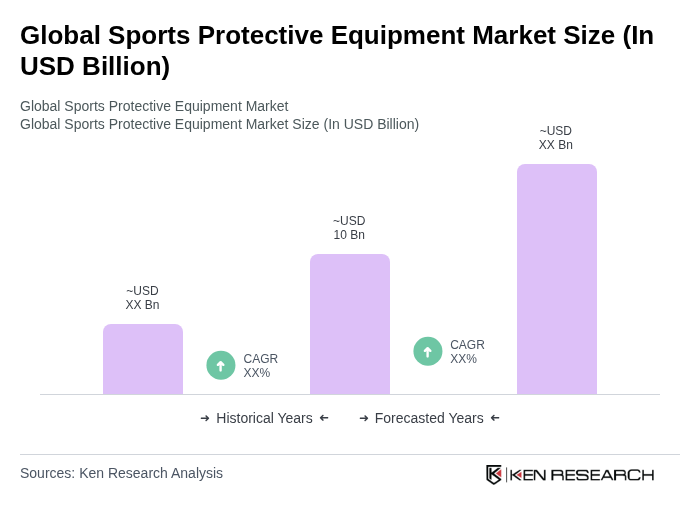
- The Global Sports Protective Equipment Market is valued at USD 10 billion, based on a five-year historical analysis. This growth is primarily driven by increasing participation in sports and fitness activities, heightened awareness of safety standards, and advancements in technology that enhance product performance and comfort. The rising incidence of sports-related injuries, along with the growing popularity of organized sports and recreational activities, has also contributed to the demand for protective gear as athletes and recreational users prioritize safety. Additionally, the market is benefitting from the introduction of smart protective equipment with impact sensors and the use of lightweight, high-performance materials, further enhancing adoption rates .
- Key players in this market include the United States, Germany, and China, which dominate due to their robust sports culture, significant investments in sports infrastructure, and a high number of professional and amateur athletes. The presence of leading manufacturers and a growing trend towards health and fitness further solidify their positions in the market, making them pivotal regions for the growth of sports protective equipment. North America currently holds the largest market share, driven by strong consumer spending, youth sports development, and the expansion of professional and amateur leagues, while Asia-Pacific is experiencing the fastest growth due to rising sports participation and government initiatives .
- In 2023, the European Union implemented Regulation (EU) 2016/425 on personal protective equipment, issued by the European Parliament and the Council. This regulation mandates that all sports protective equipment placed on the EU market must meet strict health and safety requirements, including conformity assessment procedures, CE marking, and comprehensive technical documentation. Manufacturers are required to conduct rigorous testing and certification processes to ensure compliance, thereby enhancing the quality and reliability of protective gear available in the market .
Global Sports Protective Equipment Market Segmentation
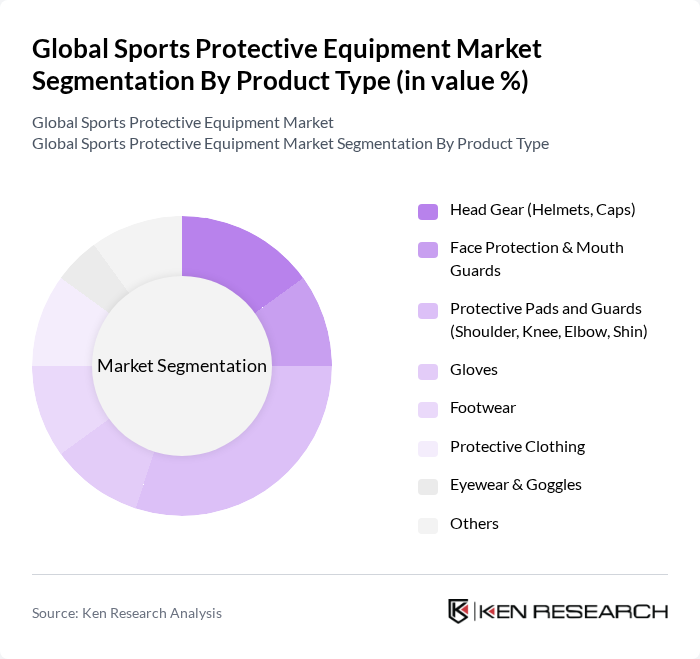
By Product Type:The product type segmentation includes various categories of protective gear designed for different sports and activities. The subsegments are Head Gear (Helmets, Caps), Face Protection & Mouth Guards, Protective Pads and Guards (Shoulder, Knee, Elbow, Shin), Gloves, Footwear, Protective Clothing, Eyewear & Goggles, and Others. Among these, Protective Pads and Guards are currently dominating the market due to their essential role in preventing injuries in contact sports. The increasing awareness of safety and the growing number of athletes participating in high-risk sports have led to a surge in demand for these protective items. Technological advancements, such as the integration of impact sensors and the use of advanced lightweight materials, are further driving the adoption of these products .
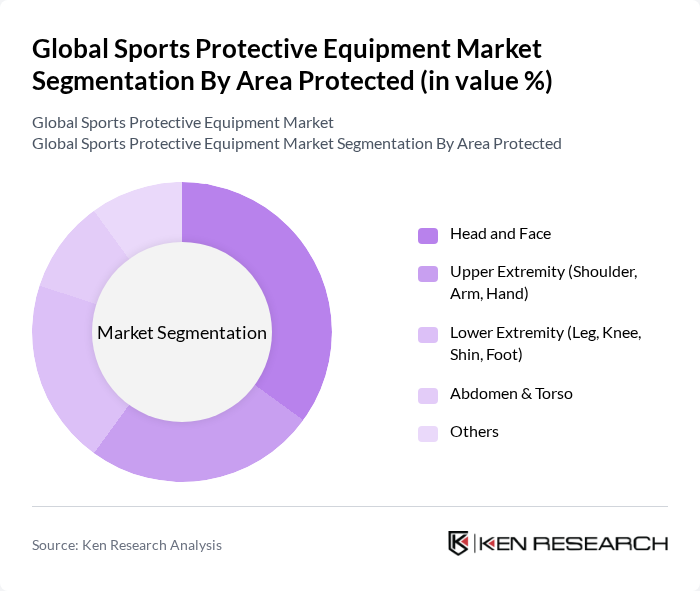
By Area Protected:This segmentation focuses on the specific body areas that the protective equipment is designed to safeguard. The subsegments include Head and Face, Upper Extremity (Shoulder, Arm, Hand), Lower Extremity (Leg, Knee, Shin, Foot), Abdomen & Torso, and Others. The Head and Face protection segment is leading the market, driven by the increasing awareness of head injuries in sports like football and hockey. The growing emphasis on safety regulations and the introduction of advanced materials have further propelled the demand for headgear. Head and face protection accounts for the largest share of the market, reflecting the critical importance of preventing concussions and facial injuries .
Global Sports Protective Equipment Market Competitive Landscape
The Global Sports Protective Equipment Market is characterized by a dynamic mix of regional and international players. Leading participants such as Nike, Inc., Adidas AG, Under Armour, Inc., Puma SE, Reebok International Ltd., Rawlings Sporting Goods Company, Inc., Easton Diamond Sports, LLC, Schutt Sports, LLC, Riddell, Inc., STX, LLC, Warrior Sports, Inc., Bell Sports, Inc., Fox Racing, Inc., Babolat S.A., Mizuno Corporation, ASICS Corporation, Xenith, LLC, Bauer Hockey, LLC, Amer Sports Oyj, CCM Hockey contribute to innovation, geographic expansion, and service delivery in this space.
Global Sports Protective Equipment Market Industry Analysis
Growth Drivers
- Increasing Awareness of Safety in Sports:The global emphasis on safety in sports has surged, with the World Health Organization reporting that sports-related injuries account for approximately 30% of all injuries in children aged 5-14. This heightened awareness has led to a 20% increase in demand for protective gear, as athletes and parents prioritize safety. Furthermore, educational campaigns and initiatives by sports organizations have contributed to a growing culture of safety, driving sales of helmets, pads, and other protective equipment.
- Rising Participation in Sports and Fitness Activities:According to the International Sports Federation, global participation in sports and fitness activities has increased by 25% over the past five years, with over 2.5 billion people engaging in various sports. This surge in participation has directly correlated with a 30% rise in the demand for sports protective equipment, as individuals seek to minimize injury risks. The growing trend of fitness and wellness has further fueled this demand, particularly in emerging markets where sports participation is rapidly expanding.
- Technological Advancements in Protective Gear:The sports protective equipment sector has witnessed significant technological innovations, with companies investing over $1.5 billion in R&D annually. These advancements include the development of lightweight, high-impact resistant materials and smart gear equipped with sensors to monitor performance and safety. As a result, the market for technologically advanced protective gear has grown by 35% in the last three years, appealing to both professional athletes and recreational users who prioritize safety and performance.
Market Challenges
- High Cost of Advanced Protective Equipment:The introduction of advanced protective gear often comes with a high price tag, with some products exceeding $400. This cost can deter potential buyers, particularly in price-sensitive markets. According to industry reports, approximately 50% of consumers cite price as a significant barrier to purchasing high-quality protective equipment. This challenge is particularly pronounced in developing regions, where disposable income levels are lower, limiting access to advanced safety gear.
- Counterfeit Products in the Market:The proliferation of counterfeit sports protective equipment poses a significant challenge, with estimates suggesting that counterfeit goods account for nearly $2 billion in losses annually in the sports industry. These inferior products not only compromise safety but also undermine consumer trust in established brands. Regulatory bodies are struggling to combat this issue, leading to a growing demand for authentic products, which can further complicate market dynamics and consumer purchasing decisions.
Global Sports Protective Equipment Market Future Outlook
The future of the sports protective equipment market appears promising, driven by ongoing innovations and a growing emphasis on safety. As consumer awareness increases, manufacturers are likely to focus on developing more advanced, user-friendly products. Additionally, the rise of e-commerce platforms is expected to enhance accessibility, allowing consumers to purchase protective gear more conveniently. Collaborations with sports organizations will further promote safety initiatives, ensuring that protective equipment remains a priority for athletes and recreational participants alike.
Market Opportunities
- Expansion into Emerging Markets:Emerging markets present a significant opportunity for growth, with a projected increase in sports participation rates by 40% over the next five years. Companies can capitalize on this trend by tailoring products to local preferences and price points, potentially increasing market share and revenue in these regions.
- Development of Eco-Friendly Materials:The demand for sustainable products is rising, with 70% of consumers willing to pay more for eco-friendly sports gear. By investing in the development of biodegradable and recyclable materials, manufacturers can attract environmentally conscious consumers and differentiate themselves in a competitive market, enhancing brand loyalty and market presence.
Scope of the Report
| Segment | Sub-Segments |
|---|---|
| By Product Type | Head Gear (Helmets, Caps) Face Protection & Mouth Guards Protective Pads and Guards (Shoulder, Knee, Elbow, Shin) Gloves Footwear Protective Clothing Eyewear & Goggles Others |
| By Area Protected | Head and Face Upper Extremity (Shoulder, Arm, Hand) Lower Extremity (Leg, Knee, Shin, Foot) Abdomen & Torso Others |
| By End-User | Professional Athletes Amateur Athletes Recreational Users Schools and Colleges Others |
| By Sport Type | Football (Soccer & American Football) Hockey (Ice, Field, Roller) Baseball/Softball Cycling Skiing & Snowboarding Water Sports Extreme Sports Others |
| By Distribution Channel | Online Retail Specialty Sports Stores Supermarkets and Hypermarkets Direct Sales Others |
| By Material | Foam Plastic Composite Materials Metal Others |
| By Price Range | Low-end Mid-range High-end Others |
| By Region | North America Europe Asia-Pacific Latin America Middle East & Africa |
Key Target Audience
Investors and Venture Capitalist Firms
Government and Regulatory Bodies (e.g., Consumer Product Safety Commission, Occupational Safety and Health Administration)
Manufacturers and Producers
Distributors and Retailers
Sports Organizations and Governing Bodies
Health and Safety Organizations
Insurance Companies
Sports Equipment Retail Chains
Players Mentioned in the Report:
Nike, Inc.
Adidas AG
Under Armour, Inc.
Puma SE
Reebok International Ltd.
Rawlings Sporting Goods Company, Inc.
Easton Diamond Sports, LLC
Schutt Sports, LLC
Riddell, Inc.
STX, LLC
Warrior Sports, Inc.
Bell Sports, Inc.
Fox Racing, Inc.
Babolat S.A.
Mizuno Corporation
ASICS Corporation
Xenith, LLC
Bauer Hockey, LLC
Amer Sports Oyj
CCM Hockey
Table of Contents
Market Assessment Phase
1. Executive Summary and Approach
2. Global Sports Protective Equipment Market Overview
2.1 Key Insights and Strategic Recommendations
2.2 Global Sports Protective Equipment Market Overview
2.3 Definition and Scope
2.4 Evolution of Market Ecosystem
2.5 Timeline of Key Regulatory Milestones
2.6 Value Chain & Stakeholder Mapping
2.7 Business Cycle Analysis
2.8 Policy & Incentive Landscape
3. Global Sports Protective Equipment Market Analysis
3.1 Growth Drivers
3.1.1 Increasing awareness of safety in sports
3.1.2 Rising participation in sports and fitness activities
3.1.3 Technological advancements in protective gear
3.1.4 Stringent safety regulations and standards
3.2 Market Challenges
3.2.1 High cost of advanced protective equipment
3.2.2 Lack of awareness in developing regions
3.2.3 Counterfeit products in the market
3.2.4 Rapidly changing consumer preferences
3.3 Market Opportunities
3.3.1 Expansion into emerging markets
3.3.2 Development of eco-friendly materials
3.3.3 Customization and personalization of products
3.3.4 Collaborations with sports organizations
3.4 Market Trends
3.4.1 Growth of e-commerce in sports equipment
3.4.2 Increasing demand for smart protective gear
3.4.3 Focus on athlete endorsements and sponsorships
3.4.4 Rise of fitness and wellness culture
3.5 Government Regulation
3.5.1 Compliance with international safety standards
3.5.2 Regulations on material usage in protective gear
3.5.3 Guidelines for product testing and certification
3.5.4 Policies promoting sports safety initiatives
4. SWOT Analysis
5. Stakeholder Analysis
6. Porter's Five Forces Analysis
7. Global Sports Protective Equipment Market Size, 2019-2024
7.1 By Value
7.2 By Volume
7.3 By Average Selling Price
8. Global Sports Protective Equipment Market Segmentation
8.1 By Product Type
8.1.1 Head Gear (Helmets, Caps)
8.1.2 Face Protection & Mouth Guards
8.1.3 Protective Pads and Guards (Shoulder, Knee, Elbow, Shin)
8.1.4 Gloves
8.1.5 Footwear
8.1.6 Protective Clothing
8.1.7 Eyewear & Goggles
8.1.8 Others
8.2 By Area Protected
8.2.1 Head and Face
8.2.2 Upper Extremity (Shoulder, Arm, Hand)
8.2.3 Lower Extremity (Leg, Knee, Shin, Foot)
8.2.4 Abdomen & Torso
8.2.5 Others
8.3 By End-User
8.3.1 Professional Athletes
8.3.2 Amateur Athletes
8.3.3 Recreational Users
8.3.4 Schools and Colleges
8.3.5 Others
8.4 By Sport Type
8.4.1 Football (Soccer & American Football)
8.4.2 Hockey (Ice, Field, Roller)
8.4.3 Baseball/Softball
8.4.4 Cycling
8.4.5 Skiing & Snowboarding
8.4.6 Water Sports
8.4.7 Extreme Sports
8.4.8 Others
8.5 By Distribution Channel
8.5.1 Online Retail
8.5.2 Specialty Sports Stores
8.5.3 Supermarkets and Hypermarkets
8.5.4 Direct Sales
8.5.5 Others
8.6 By Material
8.6.1 Foam
8.6.2 Plastic
8.6.3 Composite Materials
8.6.4 Metal
8.6.5 Others
8.7 By Price Range
8.7.1 Low-end
8.7.2 Mid-range
8.7.3 High-end
8.7.4 Others
8.8 By Region
8.8.1 North America
8.8.2 Europe
8.8.3 Asia-Pacific
8.8.4 Latin America
8.8.5 Middle East & Africa
9. Global Sports Protective Equipment Market Competitive Analysis
9.1 Market Share of Key Players
9.2 KPIs for Cross Comparison of Key Players
9.2.1 Company Name
9.2.2 Group Size (Large, Medium, Small as per industry convention)
9.2.3 Global Sports Protective Equipment Revenue (USD, latest year)
9.2.4 Revenue Growth Rate (CAGR %)
9.2.5 Market Share (%)
9.2.6 Geographic Presence (No. of countries/regions)
9.2.7 Product Portfolio Breadth (No. of product categories)
9.2.8 R&D Investment as % of Revenue
9.2.9 Product Innovation Rate (No. of new launches per year)
9.2.10 Distribution Channel Diversity (No. of channels)
9.2.11 Pricing Strategy (Premium, Value, Mass Market)
9.2.12 Brand Recognition Index (survey or ranking)
9.2.13 Customer Satisfaction Score (NPS or equivalent)
9.2.14 Sustainability/ESG Initiatives (qualitative/quantitative)
9.3 SWOT Analysis of Top Players
9.4 Pricing Analysis
9.5 List of Major Companies
9.5.1 Nike, Inc.
9.5.2 Adidas AG
9.5.3 Under Armour, Inc.
9.5.4 Puma SE
9.5.5 Reebok International Ltd.
9.5.6 Rawlings Sporting Goods Company, Inc.
9.5.7 Easton Diamond Sports, LLC
9.5.8 Schutt Sports, LLC
9.5.9 Riddell, Inc.
9.5.10 STX, LLC
9.5.11 Warrior Sports, Inc.
9.5.12 Bell Sports, Inc.
9.5.13 Fox Racing, Inc.
9.5.14 Babolat S.A.
9.5.15 Mizuno Corporation
9.5.16 ASICS Corporation
9.5.17 Xenith, LLC
9.5.18 Bauer Hockey, LLC
9.5.19 Amer Sports Oyj
9.5.20 CCM Hockey
10. Global Sports Protective Equipment Market End-User Analysis
10.1 Procurement Behavior of Key Ministries
10.1.1 Government contracts for sports safety
10.1.2 Budget allocation for sports programs
10.1.3 Compliance with safety regulations
10.1.4 Partnerships with sports organizations
10.2 Corporate Spend on Infrastructure & Energy
10.2.1 Investment in sports facilities
10.2.2 Funding for athlete training programs
10.2.3 Sponsorship of sports events
10.2.4 Development of community sports initiatives
10.3 Pain Point Analysis by End-User Category
10.3.1 Safety concerns among amateur athletes
10.3.2 Accessibility of quality equipment
10.3.3 Affordability of protective gear
10.3.4 Awareness of product benefits
10.4 User Readiness for Adoption
10.4.1 Attitudes towards safety equipment
10.4.2 Willingness to invest in quality gear
10.4.3 Influence of endorsements on purchasing
10.4.4 Trends in online shopping for sports gear
10.5 Post-Deployment ROI and Use Case Expansion
10.5.1 Evaluation of equipment effectiveness
10.5.2 Feedback from end-users
10.5.3 Opportunities for product upgrades
10.5.4 Expansion into new sports categories
11. Global Sports Protective Equipment Market Future Size, 2025-2030
11.1 By Value
11.2 By Volume
11.3 By Average Selling Price
Go-To-Market Strategy Phase
1. Whitespace Analysis + Business Model Canvas
1.1 Market gaps and opportunities
1.2 Value proposition development
1.3 Revenue model identification
1.4 Key partnerships and resources
1.5 Customer segments and relationships
1.6 Channels for distribution
1.7 Cost structure analysis
2. Marketing and Positioning Recommendations
2.1 Branding strategies
2.2 Product USPs
2.3 Target audience identification
2.4 Marketing channels selection
2.5 Promotional tactics
2.6 Customer engagement strategies
2.7 Performance metrics
3. Distribution Plan
3.1 Urban retail strategies
3.2 Rural NGO tie-ups
3.3 Online distribution channels
3.4 Partnerships with sports retailers
3.5 Logistics and supply chain management
3.6 Inventory management practices
3.7 Customer service and support
4. Channel & Pricing Gaps
4.1 Underserved routes
4.2 Pricing bands analysis
4.3 Competitor pricing strategies
4.4 Value-based pricing models
4.5 Discounts and promotions
4.6 Customer feedback on pricing
4.7 Price elasticity considerations
5. Unmet Demand & Latent Needs
5.1 Category gaps in product offerings
5.2 Consumer segments with unmet needs
5.3 Innovations in product design
5.4 Customization opportunities
5.5 Emerging trends in consumer preferences
5.6 Feedback from focus groups
5.7 Market research insights
6. Customer Relationship
6.1 Loyalty programs
6.2 After-sales service
6.3 Customer feedback mechanisms
6.4 Community engagement initiatives
6.5 Customer education and training
6.6 Personalization of customer interactions
6.7 Building brand advocates
7. Value Proposition
7.1 Sustainability initiatives
7.2 Integrated supply chains
7.3 Quality assurance processes
7.4 Competitive advantages
7.5 Customer-centric approach
7.6 Innovation in product development
7.7 Brand reputation management
8. Key Activities
8.1 Regulatory compliance
8.2 Branding efforts
8.3 Distribution setup
8.4 Marketing campaigns
8.5 Product development cycles
8.6 Training and development
8.7 Performance monitoring
9. Entry Strategy Evaluation
9.1 Domestic Market Entry Strategy
9.1.1 Product mix considerations
9.1.2 Pricing band analysis
9.1.3 Packaging strategies
9.1.4 Marketing approach
9.1.5 Distribution channels
9.1.6 Customer engagement tactics
9.1.7 Risk assessment
9.2 Export Entry Strategy
9.2.1 Target countries identification
9.2.2 Compliance roadmap
9.2.3 Market entry barriers
9.2.4 Distribution partnerships
9.2.5 Marketing localization
9.2.6 Pricing strategy adaptation
9.2.7 Risk management strategies
10. Entry Mode Assessment
10.1 Joint Ventures
10.2 Greenfield Investments
10.3 Mergers & Acquisitions
10.4 Distributor Model
10.5 Strategic Alliances
10.6 Licensing Agreements
10.7 Franchising Opportunities
11. Capital and Timeline Estimation
11.1 Capital requirements
11.2 Timelines for market entry
11.3 Budget allocation
11.4 Financial projections
11.5 Funding sources
11.6 Risk assessmen
Research Methodology
Phase 1: Approach1
Desk Research
- Industry reports from sports equipment associations and market research firms
- Analysis of sales data from leading sports protective equipment manufacturers
- Review of regulatory guidelines and safety standards from international sports organizations
Primary Research
- Interviews with product managers at major sports equipment brands
- Surveys with retailers specializing in sports gear and protective equipment
- Field interviews with athletes and coaches regarding equipment preferences and safety concerns
Validation & Triangulation
- Cross-validation of findings through multiple data sources, including sales and consumer feedback
- Triangulation of market trends with insights from industry experts and analysts
- Sanity checks through expert panel discussions and feedback loops
Phase 2: Market Size Estimation1
Top-down Assessment
- Market size derived from global sports equipment sales and growth rates
- Segmentation by product type, including helmets, pads, and other protective gear
- Incorporation of trends in sports participation and safety regulations
Bottom-up Modeling
- Volume estimates based on sales data from key distributors and retailers
- Cost analysis of production and pricing strategies from leading manufacturers
- Estimation of market share based on product category and regional demand
Forecasting & Scenario Analysis
- Multi-variable forecasting using trends in sports participation and injury rates
- Scenario analysis based on potential changes in regulations and consumer behavior
- Baseline, optimistic, and pessimistic projections through 2030
Phase 3: CATI Sample Composition1
| Scope Item/Segment | Sample Size | Target Respondent Profiles |
|---|---|---|
| Retail Sales of Protective Gear | 100 | Store Managers, Sales Representatives |
| Manufacturing Insights | 80 | Production Managers, Quality Assurance Officers |
| Consumer Preferences in Sports Equipment | 120 | Athletes, Coaches, Sports Enthusiasts |
| Market Trends in Safety Equipment | 60 | Industry Analysts, Safety Compliance Officers |
| Distribution Channel Feedback | 90 | Logistics Coordinators, Supply Chain Managers |
Frequently Asked Questions
What is the current value of the Global Sports Protective Equipment Market?
The Global Sports Protective Equipment Market is valued at approximately USD 10 billion, driven by increased participation in sports, heightened safety awareness, and technological advancements in protective gear.
What factors are driving the growth of the sports protective equipment market?
Which regions dominate the Global Sports Protective Equipment Market?
What are the main product types in the sports protective equipment market?
Other Regional/Country Reports
Indonesia Sports Protective Equipment Market
Malaysia Sports Protective Equipment Market
KSA Sports Protective Equipment Market
APAC Sports Protective Equipment Market
SEA Sports Protective Equipment Market
Vietnam Sports Protective Equipment Market
Other Adjacent Reports
South Africa Wearable Sports Technology Market
Mexico Outdoor Recreation Equipment Market
Bahrain Sports Insurance Market
South Africa Team Sports Equipment Market
Southeast Asia Personal Protective Equipment Market Outlook to 2030: Size, Share, Growth and TrendsWhy Buy From Us?

What makes us stand out is that our consultants follow Robust, Refine and Result (RRR) methodology. Robust for clear definitions, approaches and sanity checking, Refine for differentiating respondents' facts and opinions, and Result for presenting data with story.

We have set a benchmark in the industry by offering our clients with syndicated and customized market research reports featuring coverage of entire market as well as meticulous research and analyst insights.

While we don't replace traditional research, we flip the method upside down. Our dual approach of Top Bottom & Bottom Top ensures quality deliverable by not just verifying company fundamentals but also looking at the sector and macroeconomic factors.

With one step in the future, our research team constantly tries to show you the bigger picture. We help with some of the tough questions you may encounter along the way: How is the industry positioned? Best marketing channel? KPI's of competitors? By aligning every element, we help maximize success.

Our report gives you instant access to the answers and sources that other companies might choose to hide. We elaborate each steps of research methodology we have used and showcase you the sample size to earn your trust.

If you need any support, we are here! We pride ourselves on universe strength, data quality, and quick, friendly, and professional service.