About the Report
Base Year 2024Global Tobacco Market Overview
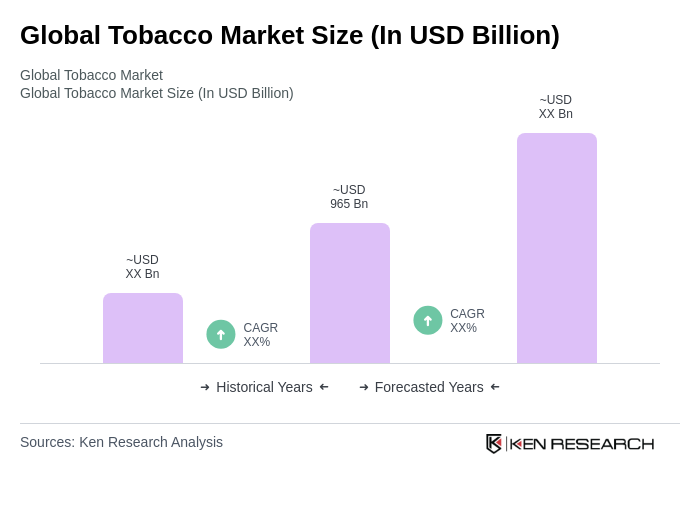
- The Global Tobacco Market is valued at USD 965 billion, based on a five-year historical analysis. This substantial market size is primarily driven by the persistent demand for traditional tobacco products, alongside the rising popularity of alternative products such as e-cigarettes and heated tobacco products. The market’s growth is also influenced by changing consumer preferences, ongoing nicotine dependence among users, and the diversification into reduced-risk products.
- Countries such as China, the United States, and India dominate the Global Tobacco Market due to their large populations and established tobacco consumption habits. China’s market presence is underpinned by extensive domestic production and consumption led by China National Tobacco; the U.S. market shows a strong regulatory framework and a shift toward reduced-risk products like e?vapor and heated tobacco; India features a diverse mix including bidis, smokeless tobacco, and cigarettes.
- In recent years, the U.S. government has implemented stringent regulations on tobacco advertising and marketing, particularly targeting youth. The Family Smoking Prevention and Tobacco Control Act authorizes the Food and Drug Administration to regulate the manufacturing, distribution, and marketing of tobacco products, including restrictions on youth-focused advertising and mandatory health warnings.
Global Tobacco Market Segmentation
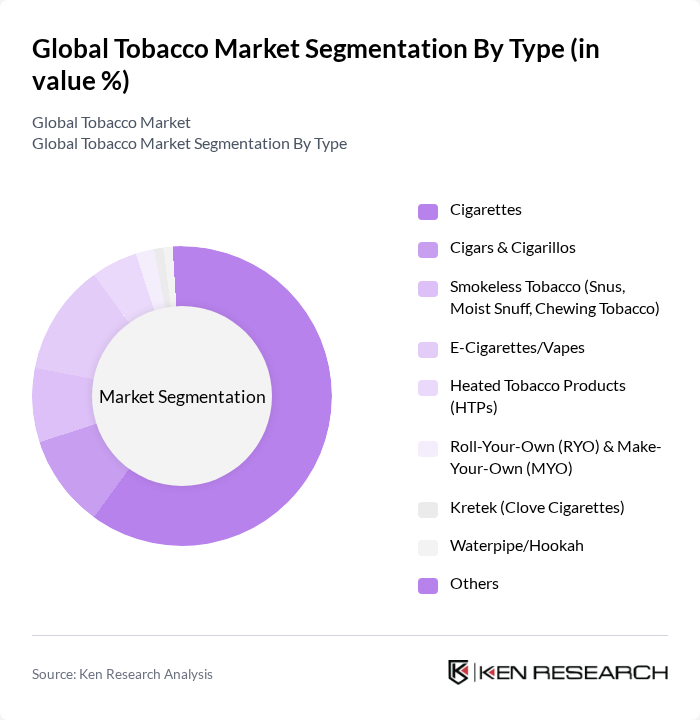
By Type:The tobacco market is segmented into various types, including cigarettes, cigars, smokeless tobacco, e-cigarettes, heated tobacco products, roll-your-own, kretek, waterpipe, and others. Among these, cigarettes remain the dominant segment due to their widespread consumption and established market presence. However, the rise of e-cigarettes and heated tobacco products is reshaping consumer preferences, particularly among younger demographics seeking alternatives to traditional smoking.
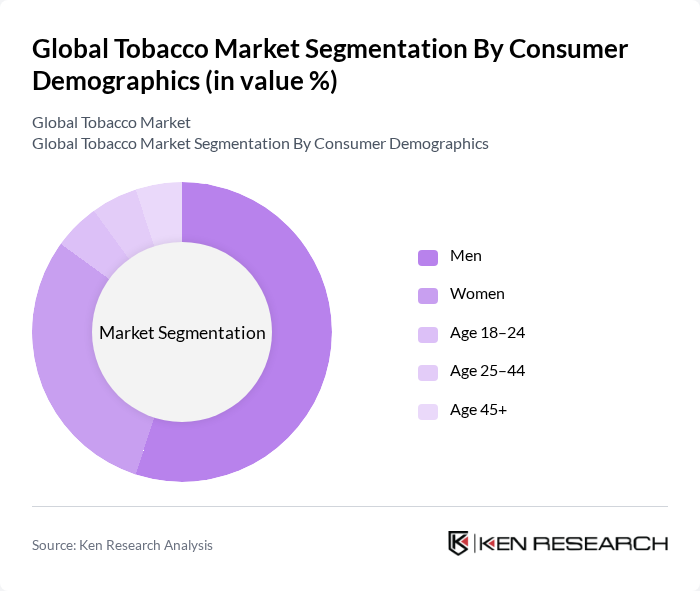
By Consumer Demographics:The tobacco market is segmented by consumer demographics, including men, women, and various age groups. Men represent the largest consumer segment, driven by traditional smoking habits and cultural acceptance; globally, tobacco use prevalence has historically been higher among men than women. There is a growing trend of experimentation and use among younger age groups with e?cigarettes and other alternative products in several markets, indicating a shift in consumer behavior and product mix.
Global Tobacco Market Competitive Landscape
The Global Tobacco Market is characterized by a dynamic mix of regional and international players. Leading participants such as Philip Morris International Inc. (PMI), British American Tobacco p.l.c. (BAT), Japan Tobacco Inc. (JT Group), Imperial Brands PLC, Altria Group, Inc., China National Tobacco Corporation, Reynolds American Inc. (a subsidiary of BAT), Scandinavian Tobacco Group A/S, Swedish Match AB (a subsidiary of Philip Morris International), ITC Limited, KT&G Corporation, Universal Corporation, PT Djarum, Godfrey Phillips India Ltd., Habanos, S.A. contribute to innovation, geographic expansion, and service delivery in this space.
Global Tobacco Market Industry Analysis
Growth Drivers
- Increasing Global Consumption:The global tobacco consumption reached approximately 5.5 trillion cigarettes, with projections indicating a steady demand in future. This consumption is driven by a growing population, particularly in regions like Asia and Africa, where smoking rates remain high. The World Bank reports that countries such as China and India account for over 40% of global tobacco use, highlighting the significant market potential in these regions.
- Rising Demand for Premium Products:The premium tobacco segment has seen a notable increase, with sales of high-end products growing by 12% in future. This trend is fueled by consumers' willingness to pay more for quality and brand prestige. According to industry reports, the premium segment is expected to contribute an additional $10 billion to the market in future, as consumers increasingly seek unique flavors and superior experiences in their tobacco products.
- Expansion of Emerging Markets:Emerging markets are projected to drive significant growth in the tobacco industry, with countries like Vietnam and Indonesia experiencing a 15% increase in tobacco sales in future. The International Monetary Fund (IMF) forecasts that these markets will continue to expand, supported by rising disposable incomes and urbanization. This growth presents opportunities for tobacco companies to penetrate new demographics and increase their market share in these regions.
Market Challenges
- Stringent Regulatory Frameworks:Governments worldwide are implementing stricter regulations on tobacco sales, including advertising bans and age restrictions. For instance, the European Union's Tobacco Products Directive has led to a 20% reduction in tobacco advertising since its implementation. These regulations pose significant challenges for companies, as compliance costs increase and market access becomes more restricted, impacting overall sales and profitability.
- Health Concerns and Anti-Tobacco Campaigns:Growing health awareness has led to a decline in smoking rates in developed countries, with the CDC reporting a 30% decrease in adult smoking prevalence since 2000. Anti-tobacco campaigns and public health initiatives are gaining momentum, further challenging the industry. As a result, tobacco companies face pressure to innovate and adapt their product offerings to align with changing consumer preferences and health regulations.
Global Tobacco Market Future Outlook
The future of the tobacco market is poised for transformation, driven by evolving consumer preferences and regulatory landscapes. As health-conscious trends continue to rise, companies are likely to invest in reduced-risk products and innovative alternatives. Additionally, the expansion into untapped markets will provide new growth avenues, particularly in regions with increasing disposable incomes. The integration of digital marketing strategies will also play a crucial role in reaching younger demographics, ensuring sustained engagement and brand loyalty in a competitive environment.
Market Opportunities
- Growth in E-Cigarette Segment:The e-cigarette market is projected to reach $25 billion in future, driven by a shift towards less harmful alternatives. This segment appeals to younger consumers seeking innovative products, presenting a significant opportunity for traditional tobacco companies to diversify their portfolios and capture new market share.
- Development of Reduced-Risk Products:The demand for reduced-risk tobacco products is increasing, with sales expected to rise by 20% in future. Companies investing in research and development of these products can capitalize on the growing consumer preference for safer alternatives, enhancing their competitive edge in a rapidly changing market landscape.
Scope of the Report
| Segment | Sub-Segments |
|---|---|
| By Type | Cigarettes Cigars & Cigarillos Smokeless Tobacco (Snus, Moist Snuff, Chewing Tobacco) E-Cigarettes/Vapes Heated Tobacco Products (HTPs) Roll-Your-Own (RYO) & Make-Your-Own (MYO) Kretek (Clove Cigarettes) Waterpipe/Hookah Others |
| By Consumer Demographics | Men Women Age 18–24 Age 25–44 Age 45+ |
| By Distribution Channel | Supermarkets/Hypermarkets Convenience/Grocery Stores Tobacco/Smoke Shops Online Retail Others |
| By Product Category | Premium Mass/Mid-Range Value |
| By Packaging Type | Soft Packs Hard Packs Tins/Cans Pods/Cartridges (for E-Cigarettes/HTPs) |
| By Price Range | Low Price Mid Price High Price |
| By Region | North America Europe Asia-Pacific Latin America Middle East & Africa Others |
Key Target Audience
Investors and Venture Capitalist Firms
Government and Regulatory Bodies (e.g., World Health Organization, Food and Drug Administration)
Manufacturers and Producers
Distributors and Retailers
Public Health Organizations
Industry Associations (e.g., Tobacco Manufacturers Association)
Financial Institutions
Market Analysts and Economic Research Agencies
Players Mentioned in the Report:
Philip Morris International Inc. (PMI)
British American Tobacco p.l.c. (BAT)
Japan Tobacco Inc. (JT Group)
Imperial Brands PLC
Altria Group, Inc.
China National Tobacco Corporation
Reynolds American Inc. (a subsidiary of BAT)
Scandinavian Tobacco Group A/S
Swedish Match AB (a subsidiary of Philip Morris International)
ITC Limited
KT&G Corporation
Universal Corporation
PT Djarum
Godfrey Phillips India Ltd.
Habanos, S.A.
Table of Contents
Market Assessment Phase
1. Executive Summary and Approach
2. Global Tobacco Market Overview
2.1 Key Insights and Strategic Recommendations
2.2 Global Tobacco Market Overview
2.3 Definition and Scope
2.4 Evolution of Market Ecosystem
2.5 Timeline of Key Regulatory Milestones
2.6 Value Chain & Stakeholder Mapping
2.7 Business Cycle Analysis
2.8 Policy & Incentive Landscape
3. Global Tobacco Market Analysis
3.1 Growth Drivers
3.1.1 Increasing Global Consumption
3.1.2 Rising Demand for Premium Products
3.1.3 Expansion of Emerging Markets
3.1.4 Innovations in Product Offerings
3.2 Market Challenges
3.2.1 Stringent Regulatory Frameworks
3.2.2 Health Concerns and Anti-Tobacco Campaigns
3.2.3 Competition from Alternative Products
3.2.4 Supply Chain Disruptions
3.3 Market Opportunities
3.3.1 Growth in E-Cigarette Segment
3.3.2 Expansion into Untapped Markets
3.3.3 Development of Reduced-Risk Products
3.3.4 Strategic Partnerships and Collaborations
3.4 Market Trends
3.4.1 Shift Towards Health-Conscious Products
3.4.2 Increasing Use of Digital Marketing
3.4.3 Rise of Sustainable Practices
3.4.4 Growth of Online Sales Channels
3.5 Government Regulation
3.5.1 Tobacco Control Policies
3.5.2 Advertising Restrictions
3.5.3 Taxation on Tobacco Products
3.5.4 Packaging and Labeling Requirements
4. SWOT Analysis
5. Stakeholder Analysis
6. Porter's Five Forces Analysis
7. Global Tobacco Market Market Size, 2019-2024
7.1 By Value
7.2 By Volume
7.3 By Average Selling Price
8. Global Tobacco Market Segmentation
8.1 By Type
8.1.1 Cigarettes
8.1.2 Cigars & Cigarillos
8.1.3 Smokeless Tobacco (Snus, Moist Snuff, Chewing Tobacco)
8.1.4 E-Cigarettes/Vapes
8.1.5 Heated Tobacco Products (HTPs)
8.1.6 Roll-Your-Own (RYO) & Make-Your-Own (MYO)
8.1.7 Kretek (Clove Cigarettes)
8.1.8 Waterpipe/Hookah
8.1.9 Others
8.2 By Consumer Demographics
8.2.1 Men
8.2.2 Women
8.2.3 Age 18–24
8.2.4 Age 25–44
8.2.5 Age 45+
8.3 By Distribution Channel
8.3.1 Supermarkets/Hypermarkets
8.3.2 Convenience/Grocery Stores
8.3.3 Tobacco/Smoke Shops
8.3.4 Online Retail
8.3.5 Others
8.4 By Product Category
8.4.1 Premium
8.4.2 Mass/Mid-Range
8.4.3 Value
8.5 By Packaging Type
8.5.1 Soft Packs
8.5.2 Hard Packs
8.5.3 Tins/Cans
8.5.4 Pods/Cartridges (for E-Cigarettes/HTPs)
8.6 By Price Range
8.6.1 Low Price
8.6.2 Mid Price
8.6.3 High Price
8.7 By Region
8.7.1 North America
8.7.2 Europe
8.7.3 Asia-Pacific
8.7.4 Latin America
8.7.5 Middle East & Africa
8.7.6 Others
9. Global Tobacco Market Competitive Analysis
9.1 Market Share of Key Players
9.2 KPIs for Cross Comparison of Key Players
9.2.1 Company Name
9.2.2 Group Size (Global, Regional, or Local)
9.2.3 Total Tobacco Net Revenue (USD)
9.2.4 Combustibles Volume (Billion Sticks Equivalent)
9.2.5 Reduced-Risk Products Revenue Mix (% of Sales)
9.2.6 HTP/E-Vapor Users (Million, if disclosed)
9.2.7 Geographic Footprint (No. of Countries/Top 5 Markets)
9.2.8 Market Share in Core Markets (% by volume/value)
9.2.9 Price/Mix Contribution to Growth (% pts)
9.2.10 Average Realized Price per 1,000 Sticks (USD)
9.2.11 Innovation Pipeline Intensity (New SKUs/Year; R&D as % Sales)
9.2.12 Brand Portfolio Breadth (No. of Global Brands; Categories Covered)
9.2.13 Distribution Reach (Retail Outlets/Direct Store Delivery Coverage)
9.2.14 Regulatory/ESG Indicators (Excise as % of Price; Illicit Trade Exposure; Scope 1–3 Emissions)
9.2.15 Profitability Metrics (Operating Margin; EBITDA Margin)
9.3 SWOT Analysis of Top Players
9.4 Pricing Analysis
9.5 Detailed Profile of Major Companies
9.5.1 Philip Morris International Inc. (PMI)
9.5.2 British American Tobacco p.l.c. (BAT)
9.5.3 Japan Tobacco Inc. (JT Group)
9.5.4 Imperial Brands PLC
9.5.5 Altria Group, Inc.
9.5.6 China National Tobacco Corporation
9.5.7 Reynolds American Inc. (a subsidiary of BAT)
9.5.8 Scandinavian Tobacco Group A/S
9.5.9 Swedish Match AB (a subsidiary of Philip Morris International)
9.5.10 ITC Limited
9.5.11 KT&G Corporation
9.5.12 Universal Corporation
9.5.13 PT Djarum
9.5.14 Godfrey Phillips India Ltd.
9.5.15 Habanos, S.A.
10. Global Tobacco Market End-User Analysis
10.1 Procurement Behavior of Key Ministries
10.1.1 Government Procurement Policies
10.1.2 Budget Allocations for Tobacco Control
10.1.3 Engagement with Tobacco Producers
10.2 Corporate Spend on Infrastructure & Energy
10.2.1 Investment in Production Facilities
10.2.2 Expenditure on Compliance and Regulation
10.2.3 Funding for Marketing and Distribution
10.3 Pain Point Analysis by End-User Category
10.3.1 Regulatory Compliance Challenges
10.3.2 Supply Chain Disruptions
10.3.3 Market Competition Pressures
10.4 User Readiness for Adoption
10.4.1 Awareness of New Products
10.4.2 Acceptance of Reduced-Risk Products
10.4.3 Readiness for Online Purchases
10.5 Post-Deployment ROI and Use Case Expansion
10.5.1 Evaluation of Product Performance
10.5.2 Customer Feedback Mechanisms
10.5.3 Strategies for Market Expansion
11. Global Tobacco Market Future Size, 2025-2030
11.1 By Value
11.2 By Volume
11.3 By Average Selling Price
Go-To-Market Strategy Phase
1. Whitespace Analysis + Business Model Canvas
1.1 Identification of Market Gaps
1.2 Business Model Framework
1.3 Value Proposition Development
1.4 Revenue Streams Analysis
1.5 Cost Structure Evaluation
1.6 Key Partnerships
1.7 Customer Segmentation
2. Marketing and Positioning Recommendations
2.1 Branding Strategies
2.2 Product USPs
2.3 Target Audience Identification
2.4 Communication Channels
2.5 Promotional Activities
2.6 Market Positioning
3. Distribution Plan
3.1 Urban Retail Strategies
3.2 Rural NGO Tie-Ups
3.3 Online Distribution Channels
3.4 Logistics and Supply Chain Management
3.5 Retail Partnerships
4. Channel & Pricing Gaps
4.1 Underserved Routes
4.2 Pricing Bands Analysis
4.3 Competitor Pricing Strategies
4.4 Consumer Price Sensitivity
4.5 Recommendations for Pricing Adjustments
5. Unmet Demand & Latent Needs
5.1 Category Gaps
5.2 Consumer Segments Analysis
5.3 Emerging Trends and Preferences
5.4 Product Development Opportunities
6. Customer Relationship
6.1 Loyalty Programs
6.2 After-Sales Service
6.3 Customer Engagement Strategies
6.4 Feedback and Improvement Mechanisms
7. Value Proposition
7.1 Sustainability Initiatives
7.2 Integrated Supply Chains
7.3 Customer-Centric Approaches
7.4 Competitive Advantages
8. Key Activities
8.1 Regulatory Compliance
8.2 Branding Efforts
8.3 Distribution Setup
8.4 Marketing Campaigns
9. Entry Strategy Evaluation
9.1 Domestic Market Entry Strategy
9.1.1 Product Mix Considerations
9.1.2 Pricing Band Strategy
9.1.3 Packaging Innovations
9.2 Export Entry Strategy
9.2.1 Target Countries Identification
9.2.2 Compliance Roadmap Development
10. Entry Mode Assessment
10.1 Joint Ventures
10.2 Greenfield Investments
10.3 Mergers & Acquisitions
10.4 Distributor Model Evaluation
11. Capital and Timeline Estimation
11.1 Capital Requirements
11.2 Timelines for Implementation
12. Control vs Risk Trade-Off
12.1 Ownership vs Partnerships
12.2 Risk Management Strategies
13. Profitability Outlook
13.1 Breakeven Analysis
13.2 Long-Term Sustainability Strategies
14. Potential Partner List
14.1 Distributors
14.2 Joint Ventures
14.3 Acquisition Targets
15. Execution Roadmap
15.1 Phased Plan for Market Entry
15.1.1 Market Setup
15.1.2 Market Entry
15.1.3 Growth Acceleration
15.1.4 Scale & Stabilize
15.2 Key Activities and Milestones
15.2.1 Activity Planning
15.2.2 Milestone Tracking
Research Methodology
Phase 1: Approach1
Desk Research
- Analysis of global tobacco consumption trends from WHO and CDC reports
- Review of market reports from industry associations such as the Tobacco Manufacturers Association
- Examination of regulatory frameworks and taxation policies from government publications
Primary Research
- Interviews with industry experts, including tobacco farmers and manufacturers
- Surveys targeting retailers and distributors in the tobacco supply chain
- Focus groups with consumers to understand preferences and usage patterns
Validation & Triangulation
- Cross-validation of data from multiple sources, including trade publications and market surveys
- Triangulation of findings from primary interviews with secondary data insights
- Sanity checks through expert panel reviews to ensure data reliability
Phase 2: Market Size Estimation1
Top-down Assessment
- Estimation of market size based on global tobacco sales data and consumption rates
- Segmentation by product type (cigarettes, cigars, smokeless tobacco) and geography
- Incorporation of trends in illicit trade and its impact on market size
Bottom-up Modeling
- Collection of sales volume data from leading tobacco companies
- Analysis of pricing strategies and their impact on revenue generation
- Estimation of market share based on production capacity and distribution networks
Forecasting & Scenario Analysis
- Multi-factor regression analysis considering health regulations, taxation, and consumer behavior
- Scenario modeling based on potential changes in legislation and public health campaigns
- Development of baseline, optimistic, and pessimistic forecasts through 2030
Phase 3: CATI Sample Composition1
| Scope Item/Segment | Sample Size | Target Respondent Profiles |
|---|---|---|
| Cigarette Consumption Patterns | 150 | Adult Smokers, Retail Store Owners |
| Smokeless Tobacco Usage | 100 | Smokeless Tobacco Users, Health Professionals |
| Tobacco Regulatory Impact | 80 | Policymakers, Public Health Officials |
| Market Trends in E-Cigarettes | 120 | Vape Shop Owners, E-Cigarette Users |
| Consumer Attitudes Towards Tobacco | 90 | General Public, Health Advocates |
Frequently Asked Questions
What is the current value of the Global Tobacco Market?
The Global Tobacco Market is valued at approximately USD 965 billion, reflecting a significant market size driven by the demand for traditional tobacco products and the growing popularity of alternatives like e-cigarettes and heated tobacco products.
Which countries dominate the Global Tobacco Market?
What are the main segments of the Global Tobacco Market?
What are the growth drivers of the Global Tobacco Market?
Other Regional/Country Reports
Why Buy From Us?

What makes us stand out is that our consultants follow Robust, Refine and Result (RRR) methodology. Robust for clear definitions, approaches and sanity checking, Refine for differentiating respondents' facts and opinions, and Result for presenting data with story.

We have set a benchmark in the industry by offering our clients with syndicated and customized market research reports featuring coverage of entire market as well as meticulous research and analyst insights.

While we don't replace traditional research, we flip the method upside down. Our dual approach of Top Bottom & Bottom Top ensures quality deliverable by not just verifying company fundamentals but also looking at the sector and macroeconomic factors.

With one step in the future, our research team constantly tries to show you the bigger picture. We help with some of the tough questions you may encounter along the way: How is the industry positioned? Best marketing channel? KPI's of competitors? By aligning every element, we help maximize success.

Our report gives you instant access to the answers and sources that other companies might choose to hide. We elaborate each steps of research methodology we have used and showcase you the sample size to earn your trust.

If you need any support, we are here! We pride ourselves on universe strength, data quality, and quick, friendly, and professional service.