About the Report
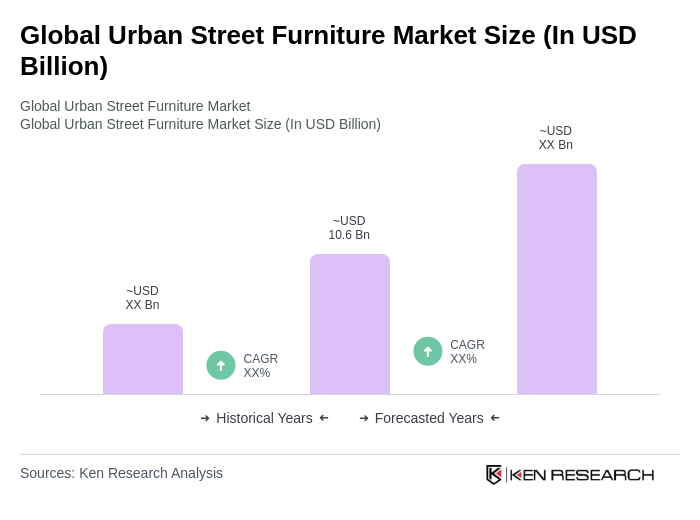
Base Year 2024Global Urban Street Furniture Market Overview
- The Global Urban Street Furniture Market is valued at USD 10.6 billion, based on a five-year historical analysis. This growth is primarily driven by increasing urbanization, government investments in public infrastructure, and a rising focus on enhancing urban aesthetics and functionality. Recent trends include the integration of smart technologies (such as Wi-Fi and environmental sensors), rising demand for sustainable materials, and the expansion of multifunctional outdoor furniture solutions. The demand for street furniture, including benches, trash bins, and lighting, continues to surge as cities strive to create more livable environments for residents and visitors.
- Key players in this market include major cities such as New York, London, and Tokyo, which dominate due to their extensive urban development projects and high population density. These cities prioritize public spaces and invest significantly in street furniture to improve urban mobility and enhance the overall quality of life. Additionally, European countries are also leading in sustainable street furniture solutions, reflecting their commitment to environmental sustainability.
- In 2023, the European Union implemented regulations mandating that all public street furniture must meet specific sustainability criteria, including the use of recycled materials and energy-efficient designs. This requirement is established under theEU Ecodesign Directive 2009/125/EC as amended by Regulation (EU) 2023/826, issued by the European Commission. The regulation sets operational standards for public procurement, requiring municipalities to ensure street furniture incorporates recycled content, meets energy efficiency benchmarks, and complies with lifecycle assessment protocols .
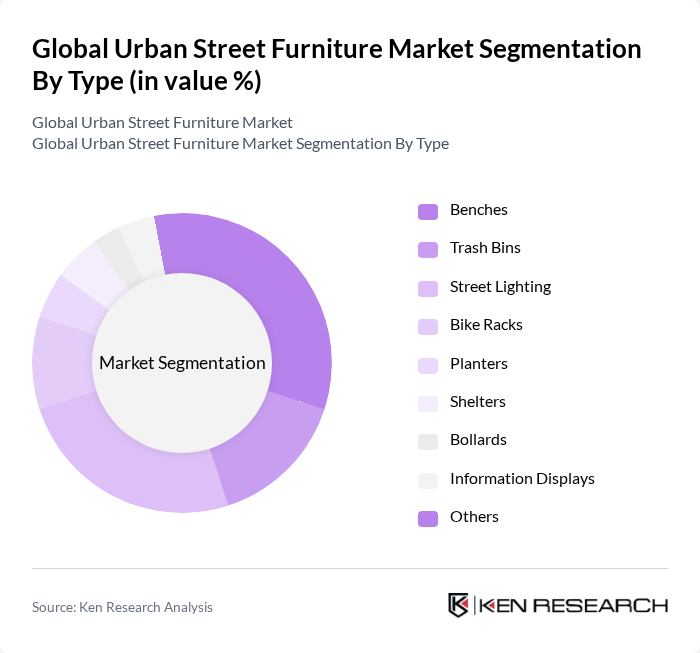
Global Urban Street Furniture Market Segmentation
By Type:The market is segmented into various types of street furniture, including benches, trash bins, street lighting, bike racks, planters, shelters, bollards, information displays, and others. Among these, benches and street lighting remain dominant due to their essential roles in public spaces. Benches provide seating for the public, enhancing comfort in urban areas, while street lighting is crucial for safety and visibility, especially in high-traffic zones. The increasing focus on urban beautification, safety measures, and the adoption of smart lighting technologies drives the demand for these subsegments.
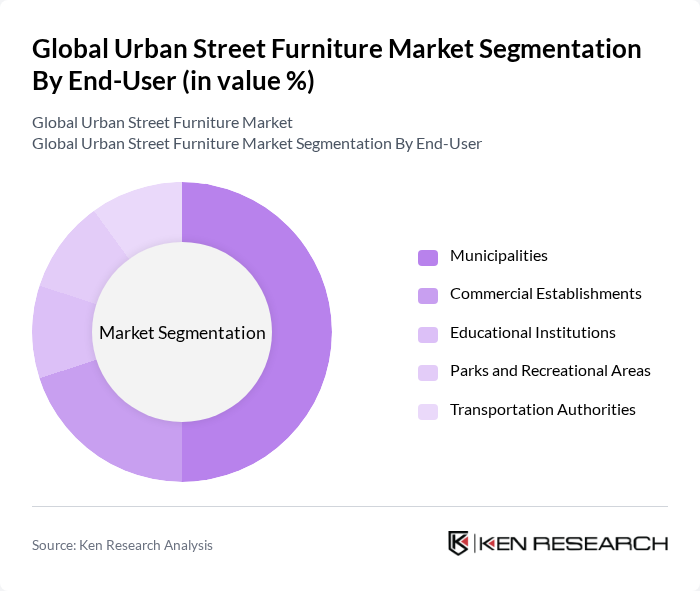
By End-User:The end-user segmentation includes municipalities, commercial establishments, educational institutions, parks and recreational areas, and transportation authorities. Municipalities are the leading end-users, as they are responsible for public space management and urban planning. Increasing investment in public infrastructure and community spaces by local governments drives the demand for street furniture. Additionally, commercial establishments are also significant consumers, seeking to enhance the appeal of their surroundings to attract customers. Parks and recreational areas, as well as transportation authorities, are expanding their adoption of smart and sustainable furniture to support community engagement and mobility.
Global Urban Street Furniture Market Competitive Landscape
The Global Urban Street Furniture Market is characterized by a dynamic mix of regional and international players. Leading participants such as Landscape Forms, Inc., Forms+Surfaces, Inc., Victor Stanley, Inc., Keter Group, DuMor, Inc., Green Furniture Concept AB, JCDecaux SA, BENKERT BÄNKE GmbH, mmcité1 a.s., Metalco Srl, Street Furniture Australia Pty Ltd, SiteScapes Inc., Maglin Site Furniture Inc., Sineu Graff, KOMPAN A/S contribute to innovation, geographic expansion, and service delivery in this space.
Global Urban Street Furniture Market Industry Analysis
Growth Drivers
- Urbanization and Population Growth:The urban population is projected to reach approximately 5 billion in future, increasing the demand for urban street furniture. As cities expand, the need for public spaces equipped with benches, trash bins, and lighting becomes critical. According to the United Nations, urban areas are expected to grow by about 1.5 million people per week, necessitating enhanced urban infrastructure to accommodate this influx, thereby driving the street furniture market significantly.
- Increased Investment in Public Infrastructure:Governments worldwide are allocating substantial budgets for urban development, with global public infrastructure spending expected to exceed $4 trillion in future. This investment includes street furniture, which is essential for enhancing public spaces. For instance, the U.S. government has committed over $1 trillion to infrastructure improvements, directly impacting the demand for urban street furniture as municipalities seek to upgrade public amenities.
- Demand for Sustainable and Eco-Friendly Solutions:The global market for sustainable materials is projected to reach $650 billion in future, reflecting a growing consumer preference for eco-friendly products. Urban street furniture manufacturers are increasingly adopting recycled materials and sustainable practices to meet this demand. For example, cities like Amsterdam are implementing policies that require the use of sustainable materials in public furniture, driving innovation and market growth in this sector.
Market Challenges
- Budget Constraints in Municipalities:Many municipalities face significant budget constraints, with an estimated 30% of local governments reporting funding shortfalls for public projects. This financial limitation often leads to delays or reductions in urban street furniture projects. For instance, a survey by the National League of Cities indicated that a majority of cities are prioritizing essential services over aesthetic improvements, impacting the street furniture market negatively.
- Competition from Low-Cost Alternatives:The rise of low-cost alternatives, particularly from emerging markets, poses a significant challenge to established street furniture manufacturers. For example, products from Asia can be up to 40% cheaper than those produced in developed countries. This price competition forces manufacturers to either lower their prices or enhance their value propositions, impacting profit margins and market dynamics.
Global Urban Street Furniture Market Future Outlook
The future of the urban street furniture market appears promising, driven by the integration of smart technologies and sustainable practices. As cities evolve into smart urban environments, the demand for connected street furniture, such as solar-powered benches with charging stations, is expected to rise. Additionally, the focus on creating aesthetically pleasing and functional public spaces will continue to shape product development, ensuring that urban furniture meets the needs of diverse populations while enhancing city landscapes.
Market Opportunities
- Smart City Initiatives:The global smart city market is projected to reach $2.5 trillion in future, creating opportunities for urban street furniture that incorporates technology. This includes features like Wi-Fi hotspots and interactive displays, enhancing user experience and engagement in public spaces.
- Customization and Personalization Trends:As urban populations become more diverse, the demand for customized street furniture is increasing. Cities are investing in tailored solutions that reflect local culture and community needs, presenting a lucrative opportunity for manufacturers to innovate and differentiate their offerings in the market.
Scope of the Report
| Segment | Sub-Segments |
|---|---|
| By Type | Benches Trash Bins Street Lighting Bike Racks Planters Shelters Bollards Information Displays Others |
| By End-User | Municipalities Commercial Establishments Educational Institutions Parks and Recreational Areas Transportation Authorities |
| By Application | Public Spaces Transportation Hubs Urban Parks Commercial Areas Residential Complexes |
| By Material | Metal Wood Plastic Concrete Composite Materials |
| By Design Style | Contemporary Traditional Minimalist Artistic Eco-Friendly/Smart |
| By Distribution Channel | Direct Sales Online Retail Distributors Trade Shows |
| By Price Range | Budget Mid-Range Premium |
| By Region | North America Europe Asia Pacific Latin America Middle East & Africa |
Key Target Audience
Investors and Venture Capitalist Firms
Government and Regulatory Bodies (e.g., Department of Transportation, Urban Development Authorities)
Manufacturers and Producers
Distributors and Retailers
Urban Planners and Designers
Landscape Architects
Public Works Departments
Real Estate Developers
Players Mentioned in the Report:
Landscape Forms, Inc.
Forms+Surfaces, Inc.
Victor Stanley, Inc.
Keter Group
DuMor, Inc.
Green Furniture Concept AB
JCDecaux SA
BENKERT BANKE GmbH
mmcite1 a.s.
Metalco Srl
Street Furniture Australia Pty Ltd
SiteScapes Inc.
Maglin Site Furniture Inc.
Sineu Graff
KOMPAN A/S
Table of Contents
Market Assessment Phase
1. Executive Summary and Approach
2. Global Urban Street Furniture Market Overview
2.1 Key Insights and Strategic Recommendations
2.2 Global Urban Street Furniture Market Overview
2.3 Definition and Scope
2.4 Evolution of Market Ecosystem
2.5 Timeline of Key Regulatory Milestones
2.6 Value Chain & Stakeholder Mapping
2.7 Business Cycle Analysis
2.8 Policy & Incentive Landscape
3. Global Urban Street Furniture Market Analysis
3.1 Growth Drivers
3.1.1 Urbanization and Population Growth
3.1.2 Increased Investment in Public Infrastructure
3.1.3 Demand for Sustainable and Eco-Friendly Solutions
3.1.4 Technological Advancements in Design and Materials
3.2 Market Challenges
3.2.1 Budget Constraints in Municipalities
3.2.2 Competition from Low-Cost Alternatives
3.2.3 Regulatory Compliance and Standards
3.2.4 Maintenance and Durability Issues
3.3 Market Opportunities
3.3.1 Smart City Initiatives
3.3.2 Customization and Personalization Trends
3.3.3 Integration of Technology in Urban Furniture
3.3.4 Expansion into Emerging Markets
3.4 Market Trends
3.4.1 Growing Popularity of Modular Furniture
3.4.2 Focus on Aesthetic and Functional Design
3.4.3 Rise of Multi-Functional Urban Furniture
3.4.4 Increased Use of Recycled Materials
3.5 Government Regulation
3.5.1 Standards for Safety and Accessibility
3.5.2 Environmental Regulations on Materials
3.5.3 Urban Planning and Zoning Laws
3.5.4 Funding and Grants for Urban Development
4. SWOT Analysis
5. Stakeholder Analysis
6. Porter's Five Forces Analysis
7. Global Urban Street Furniture Market Market Size, 2019-2024
7.1 By Value
7.2 By Volume
7.3 By Average Selling Price
8. Global Urban Street Furniture Market Segmentation
8.1 By Type
8.1.1 Benches
8.1.2 Trash Bins
8.1.3 Street Lighting
8.1.4 Bike Racks
8.1.5 Planters
8.1.6 Shelters
8.1.7 Bollards
8.1.8 Information Displays
8.1.9 Others
8.2 By End-User
8.2.1 Municipalities
8.2.2 Commercial Establishments
8.2.3 Educational Institutions
8.2.4 Parks and Recreational Areas
8.2.5 Transportation Authorities
8.3 By Application
8.3.1 Public Spaces
8.3.2 Transportation Hubs
8.3.3 Urban Parks
8.3.4 Commercial Areas
8.3.5 Residential Complexes
8.4 By Material
8.4.1 Metal
8.4.2 Wood
8.4.3 Plastic
8.4.4 Concrete
8.4.5 Composite Materials
8.5 By Design Style
8.5.1 Contemporary
8.5.2 Traditional
8.5.3 Minimalist
8.5.4 Artistic
8.5.5 Eco-Friendly/Smart
8.6 By Distribution Channel
8.6.1 Direct Sales
8.6.2 Online Retail
8.6.3 Distributors
8.6.4 Trade Shows
8.7 By Price Range
8.7.1 Budget
8.7.2 Mid-Range
8.7.3 Premium
8.8 By Region
8.8.1 North America
8.8.2 Europe
8.8.3 Asia Pacific
8.8.4 Latin America
8.8.5 Middle East & Africa
9. Global Urban Street Furniture Market Competitive Analysis
9.1 Market Share of Key Players
9.2 Cross Comparison of Key Players
9.2.1 Company Name
9.2.2 Group Size (Large, Medium, or Small as per industry convention)
9.2.3 Revenue Growth Rate
9.2.4 Market Penetration Rate
9.2.5 Customer Retention Rate
9.2.6 Product Innovation Rate
9.2.7 Sustainability Initiatives (e.g., % of products made from recycled materials)
9.2.8 Smart/Connected Product Portfolio Share
9.2.9 Distribution Network Coverage (number of countries/regions served)
9.2.10 Brand Recognition Index
9.2.11 Customer Satisfaction Score (NPS or equivalent)
9.2.12 Major Project References (notable city/municipal contracts)
9.3 SWOT Analysis of Top Players
9.4 Pricing Analysis
9.5 Detailed Profile of Major Companies
9.5.1 Landscape Forms, Inc.
9.5.2 Forms+Surfaces, Inc.
9.5.3 Victor Stanley, Inc.
9.5.4 Keter Group
9.5.5 DuMor, Inc.
9.5.6 Green Furniture Concept AB
9.5.7 JCDecaux SA
9.5.8 BENKERT BÄNKE GmbH
9.5.9 mmcité1 a.s.
9.5.10 Metalco Srl
9.5.11 Street Furniture Australia Pty Ltd
9.5.12 SiteScapes Inc.
9.5.13 Maglin Site Furniture Inc.
9.5.14 Sineu Graff
9.5.15 KOMPAN A/S
10. Global Urban Street Furniture Market End-User Analysis
10.1 Procurement Behavior of Key Ministries
10.1.1 Budget Allocation Trends
10.1.2 Decision-Making Processes
10.1.3 Preferred Suppliers
10.2 Corporate Spend on Infrastructure & Energy
10.2.1 Investment Priorities
10.2.2 Funding Sources
10.2.3 Long-Term Contracts
10.3 Pain Point Analysis by End-User Category
10.3.1 Quality and Durability Concerns
10.3.2 Aesthetic Preferences
10.3.3 Maintenance Challenges
10.4 User Readiness for Adoption
10.4.1 Awareness of Urban Furniture Options
10.4.2 Training and Support Needs
10.4.3 Feedback Mechanisms
10.5 Post-Deployment ROI and Use Case Expansion
10.5.1 Performance Metrics
10.5.2 User Satisfaction Surveys
10.5.3 Future Expansion Plans
11. Global Urban Street Furniture Market Future Size, 2025-2030
11.1 By Value
11.2 By Volume
11.3 By Average Selling Price
Go-To-Market Strategy Phase
1. Whitespace Analysis + Business Model Canvas
1.1 Market Gaps Identification
1.2 Value Proposition Development
1.3 Revenue Streams Analysis
1.4 Key Partnerships
1.5 Cost Structure
1.6 Customer Segments
1.7 Channels
2. Marketing and Positioning Recommendations
2.1 Branding Strategies
2.2 Product USPs
3. Distribution Plan
3.1 Urban Retail vs Rural NGO Tie-Ups
4. Channel & Pricing Gaps
4.1 Underserved Routes
4.2 Pricing Bands
5. Unmet Demand & Latent Needs
5.1 Category Gaps
5.2 Consumer Segments
6. Customer Relationship
6.1 Loyalty Programs
6.2 After-Sales Service
7. Value Proposition
7.1 Sustainability
7.2 Integrated Supply Chains
8. Key Activities
8.1 Regulatory Compliance
8.2 Branding
8.3 Distribution Setup
9. Entry Strategy Evaluation
9.1 Domestic Market Entry Strategy
9.1.1 Product Mix
9.1.2 Pricing Band
9.1.3 Packaging
9.2 Export Entry Strategy
9.2.1 Target Countries
9.2.2 Compliance Roadmap
10. Entry Mode Assessment
10.1 JV
10.2 Greenfield
10.3 M&A
10.4 Distributor Model
11. Capital and Timeline Estimation
11.1 Capital Requirements
11.2 Timelines
12. Control vs Risk Trade-Off
12.1 Ownership vs Partnerships
13. Profitability Outlook
13.1 Breakeven Analysis
13.2 Long-Term Sustainability
14. Potential Partner List
14.1 Distributors
14.2 JVs
14.3 Acquisition Targets
15. Execution Roadmap
15.1 Phased Plan for Market Entry
15.1.1 Market Setup
15.1.2 Market Entry
15.1.3 Growth Acceleration
15.1.4 Scale & Stabilize
15.2 Key Activities and Milestones
15.2.1 Milestone Planning
15.2.2 Activity Tracking
Research Methodology
Phase 1: Approach1
Desk Research
- Analysis of industry reports from urban design and public space organizations
- Review of municipal planning documents and urban development policies
- Examination of academic journals focusing on urban studies and street furniture design
Primary Research
- Interviews with city planners and urban designers involved in street furniture projects
- Surveys with manufacturers and suppliers of street furniture products
- Field observations and interviews with users of public spaces to gather qualitative insights
Validation & Triangulation
- Cross-validation of findings through multiple data sources including government and industry reports
- Triangulation of qualitative insights from interviews with quantitative data from surveys
- Sanity checks conducted through expert panel reviews comprising urban design professionals
Phase 2: Market Size Estimation1
Top-down Assessment
- Estimation of market size based on urban population growth and public space development trends
- Analysis of government budgets allocated for urban infrastructure and public amenities
- Incorporation of global trends in sustainable urban development and smart city initiatives
Bottom-up Modeling
- Collection of sales data from leading street furniture manufacturers and suppliers
- Estimation of average unit prices for various categories of street furniture
- Volume estimates based on project tenders and municipal contracts awarded
Forecasting & Scenario Analysis
- Multi-factor regression analysis incorporating urbanization rates and public spending on infrastructure
- Scenario modeling based on potential shifts in urban policy and sustainability mandates
- Baseline, optimistic, and pessimistic forecasts through 2030 based on economic indicators
Phase 3: CATI Sample Composition1
| Scope Item/Segment | Sample Size | Target Respondent Profiles |
|---|---|---|
| Public Park Furniture Installations | 100 | City Planners, Landscape Architects |
| Urban Street Furniture Procurement | 80 | Procurement Officers, Urban Development Managers |
| Smart City Furniture Solutions | 60 | Technology Integration Specialists, Urban Infrastructure Innovators |
| Community Engagement in Urban Design | 50 | Community Leaders, Public Engagement Coordinators |
| Public Space Usage Studies | 70 | Urban Sociologists, Public Space Researchers |
Frequently Asked Questions
What is the current value of the Global Urban Street Furniture Market?
The Global Urban Street Furniture Market is valued at approximately USD 10.6 billion, driven by urbanization, government investments in public infrastructure, and a focus on enhancing urban aesthetics and functionality.
What are the main types of urban street furniture?
Who are the key players in the Global Urban Street Furniture Market?
What factors are driving the growth of the urban street furniture market?
Other Regional/Country Reports
Indonesia Urban Street Furniture Market
Malaysia Urban Street Furniture Market
APAC Urban Street Furniture Market
SEA Urban Street Furniture Market
Other Adjacent Reports
South Africa Smart City Technology Market
India Outdoor Lighting Market Size, Share & Forecast, By Product Type, Application & Technology, 2025-2032Germany Waste Management Equipment Market
Bahrain Urban Planning Services Market
KSA Sustainable Materials Market
Oman Landscape Architecture Market
Egypt Public Transportation Infrastructure Market
Indonesia Eco-Friendly Furniture Market
Kuwait Park and Recreation Equipment Market
Brazil Municipal Infrastructure Market
Why Buy From Us?

What makes us stand out is that our consultants follow Robust, Refine and Result (RRR) methodology. Robust for clear definitions, approaches and sanity checking, Refine for differentiating respondents' facts and opinions, and Result for presenting data with story.

We have set a benchmark in the industry by offering our clients with syndicated and customized market research reports featuring coverage of entire market as well as meticulous research and analyst insights.

While we don't replace traditional research, we flip the method upside down. Our dual approach of Top Bottom & Bottom Top ensures quality deliverable by not just verifying company fundamentals but also looking at the sector and macroeconomic factors.

With one step in the future, our research team constantly tries to show you the bigger picture. We help with some of the tough questions you may encounter along the way: How is the industry positioned? Best marketing channel? KPI's of competitors? By aligning every element, we help maximize success.

Our report gives you instant access to the answers and sources that other companies might choose to hide. We elaborate each steps of research methodology we have used and showcase you the sample size to earn your trust.

If you need any support, we are here! We pride ourselves on universe strength, data quality, and quick, friendly, and professional service.