About the Report
Base Year 2024Global Wi-Fi Router Market Overview
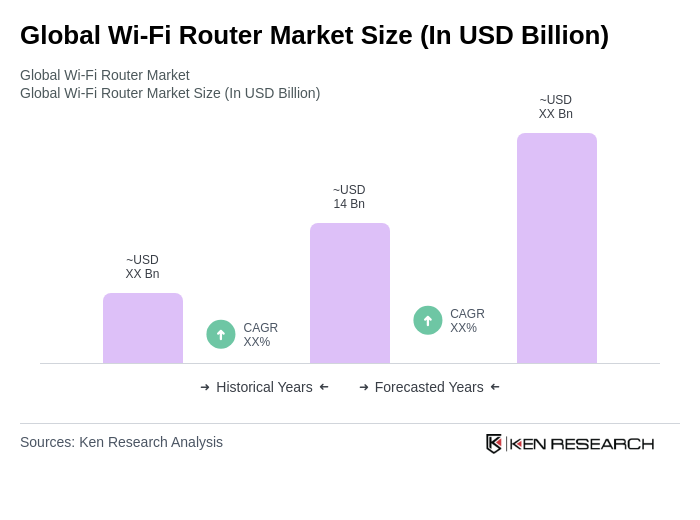
- The Global Wi-Fi Router Market is valued at USD 14 billion, based on a five-year historical analysis. Growth is driven by the rising demand for high-speed internet connectivity, rapid adoption of smart devices, and the ongoing expansion of IoT applications. The acceleration of remote work, e-learning, and the integration of Wi-Fi 6 and mesh networking technologies further support the need for advanced and reliable wireless networking solutions .
- Key players in this market include the United States, China, and Germany. The leadership of these countries is attributed to their advanced digital infrastructure, high internet penetration, and strong investments in R&D. The presence of major manufacturers and a rapidly expanding consumer base in these regions further reinforces their dominant positions .
- The United States, through the Federal Communications Commission (FCC), implemented the “Unlicensed Use of the 6 GHz Band” rules (FCC 20-51, 2020), which allocated additional spectrum for Wi-Fi use. This regulation enhances broadband access, improves network performance, and supports the increasing number of connected devices in residential and commercial environments by enabling Wi-Fi 6E deployment .
Global Wi-Fi Router Market Segmentation
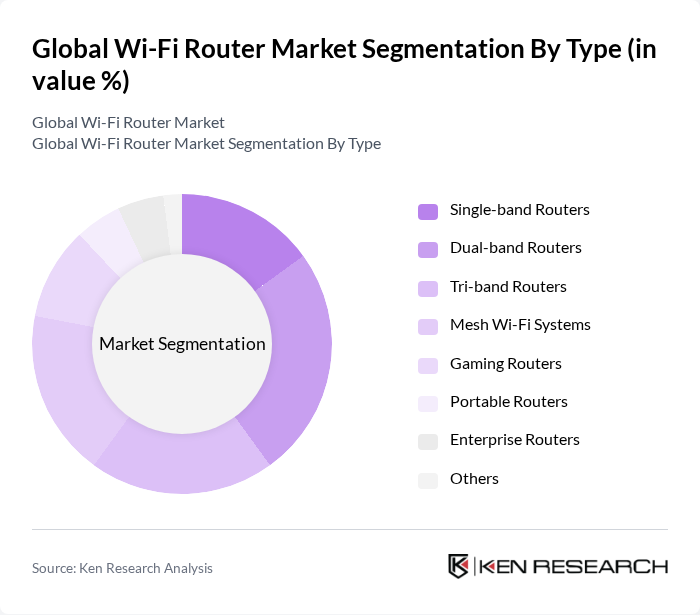
By Type:The market is segmented into Single-band Routers, Dual-band Routers, Tri-band Routers, Mesh Wi-Fi Systems, Gaming Routers, Portable Routers, Enterprise Routers, and Others. Single-band routers are typically used for basic internet needs, while dual-band and tri-band routers cater to households and businesses requiring higher speeds and reduced interference. Mesh Wi-Fi systems are increasingly popular for whole-home coverage, and enterprise routers are designed for large-scale, high-density environments. Gaming routers focus on low latency and high throughput, whereas portable routers serve mobile connectivity needs .
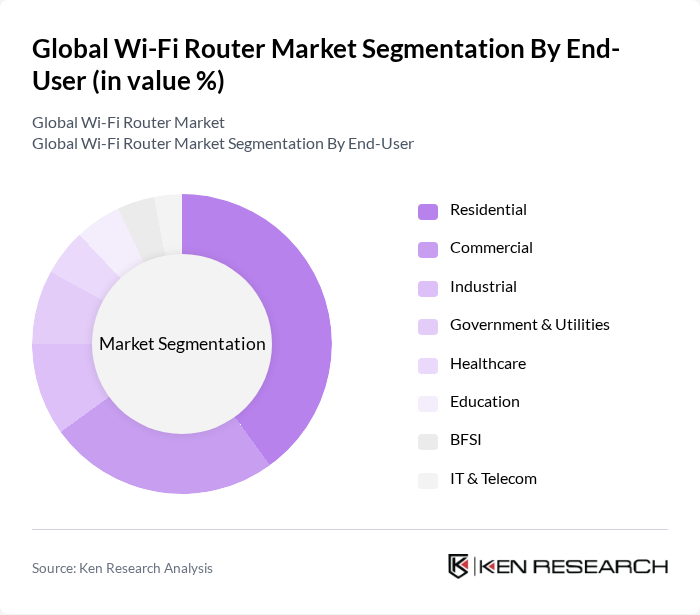
By End-User:The market is segmented based on end-users, including Residential, Commercial, Industrial, Government & Utilities, Healthcare, Education, BFSI, and IT & Telecom. Residential users drive the largest share due to the proliferation of smart home devices and remote work trends. Commercial and industrial users require robust, secure, and scalable solutions to support business operations and IoT integration. The government, healthcare, and education sectors increasingly adopt advanced routers for secure, high-capacity networking, while BFSI and IT & Telecom demand high reliability and compliance with stringent data standards .
Global Wi-Fi Router Market Competitive Landscape
The Global Wi-Fi Router Market is characterized by a dynamic mix of regional and international players. Leading participants such as TP-Link Technologies Co., Ltd., Netgear, Inc., ASUS Computer International (ASUSTeK Computer Inc.), Linksys (Belkin International, Inc.), D-Link Corporation, Huawei Technologies Co., Ltd., Xiaomi Corporation, Cisco Systems, Inc., Ubiquiti Inc., Arris International plc, Motorola Solutions, Inc., Tenda Technology, Inc., Zyxel Communications Corp., Synology Inc., Broadcom Inc., Juniper Networks, Inc., Ericsson Inc., Alcatel-Lucent Enterprise SAS, Nokia Corporation, ZTE Corporation, Edimax Technology Co., Ltd., Legrand SA, Actiontec Electronics, Inc., Amped Wireless, devolo AG, Hon Hai Precision Industry Co., Ltd. (Foxconn), Samsung Electronics Co., Ltd., Verizon Communications Inc., Alphabet Inc. (Google Nest Wi-Fi) contribute to innovation, geographic expansion, and service delivery in this space.
Global Wi-Fi Router Market Industry Analysis
Growth Drivers
- Increasing Demand for High-Speed Internet Connectivity:The global demand for high-speed internet is projected to reach 1.5 billion broadband subscriptions in future, driven by the need for faster data transfer rates. This surge is fueled by the rise in remote work and online education, with the World Bank reporting a 20% increase in internet usage during the pandemic. As consumers seek reliable connectivity, the demand for advanced Wi-Fi routers capable of supporting multiple devices simultaneously is expected to grow significantly.
- Growth in Smart Home Devices:The smart home device market is anticipated to reach 1.3 billion units in future, with a compound annual growth rate (CAGR) of 25%. This growth is driven by consumer interest in automation and energy efficiency. According to Statista, the number of smart home devices per household is expected to increase from 11 in future to 20 in future. Consequently, the demand for Wi-Fi routers that can seamlessly connect and manage these devices is on the rise, enhancing market potential.
- Expansion of E-Commerce and Online Services:E-commerce sales are projected to exceed $6 trillion globally in future, reflecting a 20% increase from the previous period. This growth is supported by the increasing reliance on online shopping and digital services, as reported by the International Monetary Fund (IMF). As consumers engage more with online platforms, the need for robust Wi-Fi infrastructure becomes critical, driving the demand for high-performance routers that can handle increased traffic and connectivity demands.
Market Challenges
- Intense Competition Among Manufacturers:The Wi-Fi router market is characterized by fierce competition, with over 50 major players vying for market share. Companies like TP-Link and Netgear dominate, but new entrants are continually emerging. This saturation leads to price wars, which can erode profit margins. According to industry reports, the average selling price of routers has decreased by 15% over the past two years, challenging manufacturers to innovate while maintaining profitability.
- Security Concerns Related to Wireless Networks:As the number of connected devices increases, so do security vulnerabilities. Cybersecurity incidents involving Wi-Fi networks have surged, with a 30% increase in reported breaches in future. The need for enhanced security features in routers is paramount, as consumers become more aware of potential threats. Regulatory bodies are also tightening security standards, adding pressure on manufacturers to comply with evolving regulations, which can increase operational costs.
Global Wi-Fi Router Market Future Outlook
The future of the Wi-Fi router market appears promising, driven by technological advancements and evolving consumer needs. The integration of Wi-Fi 6 technology is expected to enhance connectivity speeds and efficiency, catering to the growing number of smart devices. Additionally, the increasing focus on energy-efficient solutions aligns with global sustainability goals, encouraging manufacturers to innovate. As the market adapts to these trends, opportunities for growth in emerging markets and partnerships with telecom providers will likely emerge, further shaping the industry landscape.
Market Opportunities
- Expansion into Emerging Markets:Emerging markets, particularly in Asia and Africa, are witnessing a rapid increase in internet penetration, projected to reach 60% in future. This growth presents significant opportunities for Wi-Fi router manufacturers to tap into new customer bases. By offering affordable and reliable solutions tailored to these regions, companies can establish a strong foothold and drive sales growth in previously underserved markets.
- Development of Advanced Wi-Fi Technologies:The rollout of Wi-Fi 6 and upcoming Wi-Fi 7 technologies is set to revolutionize connectivity. With speeds up to 9.6 Gbps, these advancements will cater to the increasing demand for high-speed internet. As consumers and businesses seek enhanced performance, manufacturers that invest in developing and marketing these technologies will likely capture a larger market share, positioning themselves as leaders in innovation.
Scope of the Report
| Segment | Sub-Segments |
|---|---|
| By Type | Single-band Routers Dual-band Routers Tri-band Routers Mesh Wi-Fi Systems Gaming Routers Portable Routers Enterprise Routers Others |
| By End-User | Residential Commercial Industrial Government & Utilities Healthcare Education BFSI IT & Telecom |
| By Distribution Channel | Online Retail Offline Retail Direct Sales Distributors |
| By Price Range | Budget Routers Mid-range Routers Premium Routers |
| By Application | Home Networking Office Networking Public Wi-Fi Hotspots IoT Connectivity Enterprise Networking |
| By Brand | Established Brands Emerging Brands Private Labels |
| By Technology | Wi-Fi 5 (802.11ac) Wi-Fi 6 (802.11ax) Wi-Fi 6E Wi-Fi 7 (802.11be) Others |
Key Target Audience
Investors and Venture Capitalist Firms
Government and Regulatory Bodies (e.g., Federal Communications Commission, International Telecommunication Union)
Manufacturers and Producers
Distributors and Retailers
Telecommunication Service Providers
Network Infrastructure Providers
Industry Associations (e.g., Wi-Fi Alliance)
Financial Institutions
Players Mentioned in the Report:
TP-Link Technologies Co., Ltd.
Netgear, Inc.
ASUS Computer International (ASUSTeK Computer Inc.)
Linksys (Belkin International, Inc.)
D-Link Corporation
Huawei Technologies Co., Ltd.
Xiaomi Corporation
Cisco Systems, Inc.
Ubiquiti Inc.
Arris International plc
Motorola Solutions, Inc.
Tenda Technology, Inc.
Zyxel Communications Corp.
Synology Inc.
Broadcom Inc.
Juniper Networks, Inc.
Ericsson Inc.
Alcatel-Lucent Enterprise SAS
Nokia Corporation
ZTE Corporation
Edimax Technology Co., Ltd.
Legrand SA
Actiontec Electronics, Inc.
Amped Wireless
devolo AG
Hon Hai Precision Industry Co., Ltd. (Foxconn)
Samsung Electronics Co., Ltd.
Verizon Communications Inc.
Alphabet Inc. (Google Nest Wi-Fi)
Table of Contents
Market Assessment Phase
1. Executive Summary and Approach
2. Global Wi-Fi Router Market Overview
2.1 Key Insights and Strategic Recommendations
2.2 Global Wi-Fi Router Market Overview
2.3 Definition and Scope
2.4 Evolution of Market Ecosystem
2.5 Timeline of Key Regulatory Milestones
2.6 Value Chain & Stakeholder Mapping
2.7 Business Cycle Analysis
2.8 Policy & Incentive Landscape
3. Global Wi-Fi Router Market Analysis
3.1 Growth Drivers
3.1.1 Increasing demand for high-speed internet connectivity
3.1.2 Growth in smart home devices
3.1.3 Expansion of e-commerce and online services
3.1.4 Rising adoption of cloud-based applications
3.2 Market Challenges
3.2.1 Intense competition among manufacturers
3.2.2 Rapid technological advancements
3.2.3 Security concerns related to wireless networks
3.2.4 Regulatory compliance issues
3.3 Market Opportunities
3.3.1 Expansion into emerging markets
3.3.2 Development of advanced Wi-Fi technologies (e.g., Wi-Fi 6)
3.3.3 Partnerships with telecom providers
3.3.4 Increasing demand for mesh networking solutions
3.4 Market Trends
3.4.1 Shift towards smart home integration
3.4.2 Growing focus on energy-efficient devices
3.4.3 Rise of subscription-based services
3.4.4 Increased emphasis on cybersecurity features
3.5 Government Regulation
3.5.1 Compliance with international wireless standards
3.5.2 Data protection regulations
3.5.3 Environmental regulations for electronic waste
3.5.4 Import/export regulations affecting technology
4. SWOT Analysis
5. Stakeholder Analysis
6. Porter's Five Forces Analysis
7. Global Wi-Fi Router Market Market Size, 2019-2024
7.1 By Value
7.2 By Volume
7.3 By Average Selling Price
8. Global Wi-Fi Router Market Segmentation
8.1 By Type
8.1.1 Single-band Routers
8.1.2 Dual-band Routers
8.1.3 Tri-band Routers
8.1.4 Mesh Wi-Fi Systems
8.1.5 Gaming Routers
8.1.6 Portable Routers
8.1.7 Enterprise Routers
8.1.8 Others
8.2 By End-User
8.2.1 Residential
8.2.2 Commercial
8.2.3 Industrial
8.2.4 Government & Utilities
8.2.5 Healthcare
8.2.6 Education
8.2.7 BFSI
8.2.8 IT & Telecom
8.3 By Distribution Channel
8.3.1 Online Retail
8.3.2 Offline Retail
8.3.3 Direct Sales
8.3.4 Distributors
8.4 By Price Range
8.4.1 Budget Routers
8.4.2 Mid-range Routers
8.4.3 Premium Routers
8.5 By Application
8.5.1 Home Networking
8.5.2 Office Networking
8.5.3 Public Wi-Fi Hotspots
8.5.4 IoT Connectivity
8.5.5 Enterprise Networking
8.6 By Brand
8.6.1 Established Brands
8.6.2 Emerging Brands
8.6.3 Private Labels
8.7 By Technology
8.7.1 Wi-Fi 5 (802.11ac)
8.7.2 Wi-Fi 6 (802.11ax)
8.7.3 Wi-Fi 6E
8.7.4 Wi-Fi 7 (802.11be)
8.7.5 Others
9. Global Wi-Fi Router Market Competitive Analysis
9.1 Market Share of Key Players
9.2 Cross Comparison of Key Players
9.2.1 Company Name
9.2.2 Group Size (Large, Medium, or Small as per industry convention)
9.2.3 Revenue Growth Rate (YoY)
9.2.4 Market Penetration Rate (Global/Regional)
9.2.5 Customer Satisfaction Score (Net Promoter Score or equivalent)
9.2.6 Product Innovation Rate (New product launches per year)
9.2.7 Distribution Efficiency (Channel coverage, delivery lead time)
9.2.8 Pricing Strategy (Average selling price, pricing tiers)
9.2.9 Brand Recognition (Brand awareness index, global ranking)
9.2.10 Return on Investment (ROI, EBITDA margin)
9.2.11 R&D Expenditure (% of revenue)
9.2.12 After-Sales Service Quality (Support ticket resolution time, satisfaction)
9.3 SWOT Analysis of Top Players
9.4 Pricing Analysis
9.5 Detailed Profile of Major Companies
9.5.1 TP-Link Technologies Co., Ltd.
9.5.2 Netgear, Inc.
9.5.3 ASUS Computer International (ASUSTeK Computer Inc.)
9.5.4 Linksys (Belkin International, Inc.)
9.5.5 D-Link Corporation
9.5.6 Huawei Technologies Co., Ltd.
9.5.7 Xiaomi Corporation
9.5.8 Cisco Systems, Inc.
9.5.9 Ubiquiti Inc.
9.5.10 Arris International plc
9.5.11 Motorola Solutions, Inc.
9.5.12 Tenda Technology, Inc.
9.5.13 Zyxel Communications Corp.
9.5.14 Synology Inc.
9.5.15 Broadcom Inc.
9.5.16 Juniper Networks, Inc.
9.5.17 Ericsson Inc.
9.5.18 Alcatel-Lucent Enterprise SAS
9.5.19 Nokia Corporation
9.5.20 ZTE Corporation
9.5.21 Edimax Technology Co., Ltd.
9.5.22 Legrand SA
9.5.23 Actiontec Electronics, Inc.
9.5.24 Amped Wireless
9.5.25 devolo AG
9.5.26 Hon Hai Precision Industry Co., Ltd. (Foxconn)
9.5.27 Samsung Electronics Co., Ltd.
9.5.28 Verizon Communications Inc.
9.5.29 Alphabet Inc. (Google Nest Wi-Fi)
10. Global Wi-Fi Router Market End-User Analysis
10.1 Procurement Behavior of Key Ministries
10.1.1 Government procurement policies
10.1.2 Budget allocation for technology
10.1.3 Evaluation criteria for suppliers
10.1.4 Trends in public sector purchasing
10.2 Corporate Spend on Infrastructure & Energy
10.2.1 Investment in IT infrastructure
10.2.2 Budgeting for network upgrades
10.2.3 Spending on cybersecurity measures
10.3 Pain Point Analysis by End-User Category
10.3.1 Connectivity issues in rural areas
10.3.2 High costs of premium devices
10.3.3 Complexity of installation and setup
10.4 User Readiness for Adoption
10.4.1 Awareness of new technologies
10.4.2 Training and support needs
10.4.3 Willingness to invest in upgrades
10.5 Post-Deployment ROI and Use Case Expansion
10.5.1 Measurement of performance improvements
10.5.2 Expansion of use cases in businesses
10.5.3 Long-term cost savings analysis
11. Global Wi-Fi Router Market Future Size, 2025-2030
11.1 By Value
11.2 By Volume
11.3 By Average Selling Price
Go-To-Market Strategy Phase
1. Whitespace Analysis + Business Model Canvas
1.1
2. Marketing and Positioning Recommendations
2.1
3. Distribution Plan
3.1
4. Channel & Pricing Gaps
4.1
5. Unmet Demand & Latent Needs
5.1
6. Customer Relationship
6.1
7. Value Proposition
7.1
8. Key Activities
8.1
9. Entry Strategy Evaluation
9.1 Domestic Market Entry Strategy
9.1.1
9.2 Export Entry Strategy
9.2.1
10. Entry Mode Assessment
10.1
11. Capital and Timeline Estimation
11.1
12. Control vs Risk Trade-Off
12.1
13. Profitability Outlook
13.1
14. Potential Partner List
14.1
15. Execution Roadmap
15.1 Phased Plan for Market Entry
15.1.1
15.2 Key Activities and Milestones
15.2.1
Research Methodology
Phase 1: Approach1
Desk Research
- Market reports from industry associations such as the Wi-Fi Alliance and IEEE
- Analysis of consumer electronics sales data from market research firms
- Review of technological advancements and trends in Wi-Fi standards (e.g., Wi-Fi 6, Wi-Fi 7)
Primary Research
- Interviews with product managers at leading Wi-Fi router manufacturers
- Surveys with IT managers in various sectors regarding Wi-Fi infrastructure needs
- Field interviews with retail managers to understand consumer preferences and buying behavior
Validation & Triangulation
- Cross-validation of data from multiple sources including sales figures and consumer feedback
- Triangulation of insights from primary interviews with secondary data trends
- Sanity checks through expert panel reviews comprising industry veterans
Phase 2: Market Size Estimation1
Top-down Assessment
- Estimation of total addressable market based on global internet penetration rates
- Segmentation by residential, commercial, and industrial Wi-Fi router usage
- Incorporation of growth rates from emerging markets and urbanization trends
Bottom-up Modeling
- Volume estimates based on unit sales data from major retailers and e-commerce platforms
- Cost analysis of Wi-Fi routers segmented by price tiers and features
- Estimation of market share for key players based on sales volume and revenue
Forecasting & Scenario Analysis
- Multi-factor regression analysis incorporating factors like broadband adoption and smart home device growth
- Scenario modeling based on potential regulatory changes and technological disruptions
- Baseline, optimistic, and pessimistic forecasts through 2030 based on market dynamics
Phase 3: CATI Sample Composition1
| Scope Item/Segment | Sample Size | Target Respondent Profiles |
|---|---|---|
| Residential Wi-Fi Router Users | 100 | Homeowners, Renters, Tech Enthusiasts |
| Small Business Wi-Fi Solutions | 60 | Small Business Owners, IT Consultants |
| Enterprise Network Managers | 40 | IT Managers, Network Administrators |
| Retail Consumer Insights | 50 | Store Managers, Sales Associates |
| Tech Retailers and Distributors | 40 | Product Buyers, Category Managers |
Frequently Asked Questions
What is the current value of the Global Wi-Fi Router Market?
The Global Wi-Fi Router Market is valued at approximately USD 14 billion, driven by the increasing demand for high-speed internet connectivity, the rapid adoption of smart devices, and the expansion of IoT applications.
What factors are driving the growth of the Wi-Fi Router Market?
Which countries are leading in the Wi-Fi Router Market?
What are the main types of Wi-Fi routers available in the market?
Other Regional/Country Reports
Indonesia Wi-Fi Router Market
Malaysia Wi-Fi Router Market
APAC Wi-Fi Router Market
SEA Wi-Fi Router Market
Other Adjacent Reports
Japan Wireless Access Point Market
Germany Mesh Networking System Market
Bahrain IoT Connectivity Market
Germany Smart Home Device Market
Singapore Broadband Modem Market
Global Network Security Software Market Outlook to 2030Philippines 5G Infrastructure Market
Indonesia Enterprise Networking Equipment Market
Japan Gaming Peripheral Market
Vietnam Telecommunication Service Market
Why Buy From Us?

What makes us stand out is that our consultants follow Robust, Refine and Result (RRR) methodology. Robust for clear definitions, approaches and sanity checking, Refine for differentiating respondents' facts and opinions, and Result for presenting data with story.

We have set a benchmark in the industry by offering our clients with syndicated and customized market research reports featuring coverage of entire market as well as meticulous research and analyst insights.

While we don't replace traditional research, we flip the method upside down. Our dual approach of Top Bottom & Bottom Top ensures quality deliverable by not just verifying company fundamentals but also looking at the sector and macroeconomic factors.

With one step in the future, our research team constantly tries to show you the bigger picture. We help with some of the tough questions you may encounter along the way: How is the industry positioned? Best marketing channel? KPI's of competitors? By aligning every element, we help maximize success.

Our report gives you instant access to the answers and sources that other companies might choose to hide. We elaborate each steps of research methodology we have used and showcase you the sample size to earn your trust.

If you need any support, we are here! We pride ourselves on universe strength, data quality, and quick, friendly, and professional service.